Normal view

There are new articles available, click to refresh the page.
Today — 2 December 2025Electric Vehicles - Latest News | Carscoops

Kia’s EV2 Jumps From Show Car To Sure Thing On January 9

  • We’ll get our first look at the finished Kia EV2 SUV on January 9.
  • The subcompact utility goes into battle with Renault’s 4 E-Tech.
  • It’s expected to cost around €30,000 (£26k) when sales start.

Kia’s effort to cover almost every EV base takes another big step forward in January with the debut of the smallest car in its electric family. We’ve already seen the EV2 in concept form at the beginning of this year, but 11 months on we’ll get to see how much of it has made the leap to the street.

The trending Korean brand didn’t reveal too much about the production version of its baby SUV this week beyond announcing its scheduled appearance at the Brussels Motor Show and confirming it will be built in Europe for its local clients.

Related: Kia’s Smallest EV Could Become One Of Its Most Thrilling Performance Models

But Kia did release three teaser images, and though the car is covered in a sheet in all of them, we can where the production EV2 differs from the concept unveiled at Kia EV Day 2025. The good news is the overall profile and chunky proportions are unchanged.

Small changes, same effect

We can see the squared-off nose, the kink in the waistline, the slightly sporty slope to the rear section of the roof and the spoiler at the top of the rear hatch. Those same details appeared on the EV2 concept, and though the production car’s DRLs, visible through the sheet, aren’t exactly the same, they’re close enough.

But it’s also easy to spot some major, and inevitable, departures. The front overhang looks longer, because concepts don’t need to meet crash regulations but road cars do, and there looks to be a conventional B-pillar too.

\\\\\\

Kia

Kia promises the EV2 will feature “roomy, adjustable space,” but we’ll have to wait until January 9 to find out exactly what that means. By folding the rear seats and sliding the front bench backwards, passengers in the concept could relax, stretch their legs, and sit on the flat floor when parked.

AWD looks, FWD reality

Other details that won’t be uncovered until the debut include the power and range stats. But from what we know about Kia’s other affordable (sub-EV6) electric cars, we can be sure it will have 400- rather than 800-volt charging and despite its all-wheel drive styling, will feature a single motor acting on the front wheels even on sporty GT models.

The closely related Hyundai Inster has a choice of 39 kWh and 46 kWh batteries, is rated at 203-229 miles (327-369 km) of range and the biggest of its two available motors makes just 113 hp (114 PS / 84 kW). Let’s hope Kia’s version punches a little harder.

The EV2 will go on sale during 2026 and Kia is believed to be targeting a €30,000 (£26k / $35k) price to compete with other electric SUVs such as the Renault 4 E-Tech.

The images below are of the EV2 Concept revealed at Kia Day in February 2025.

\\\\\\

Kia

Ford CEO Hints At Affordable RWD Performance Sedan

  • Ford CEO Jim Farley has hinted at a new electric sedan.
  • High-performance model could ride on a new EV platform.
  • The executive believes there’s still a huge market for sedans.

Ford’s future product roadmap has gotten messy as the company has killed or delayed a number of upcoming models. Most of these have been fully electric as the automaker axed their three-row EVs and recently halted F-150 Lightning production – at least temporarily.

Amid this chaos, Ford isn’t throwing in the towel on EVs. Quite the opposite as the company is working on a mid-size truck that will be launched in 2027 and ride on the all-new Universal EV Platform. The latter will eventually underpin a “family of affordable vehicles.”

More: Ford Gives Taurus And Mondeo A Mustang Glow-Up For 2026

That family could include a rear-wheel drive, high-performance sedan that would be affordable. Ford CEO Jim Farley hinted at the car in a recently posted video, which was taken a few months ago at Monterey Car Week.

Return of the Sedan?

The executive didn’t say much about it, but implied the mysterious model has a clean silhouette as well as a “cool closure” system in the back, which enables it to carry a lot of stuff. This suggests the car could be a liftback sedan, which would broaden its appeal in the crossover era.

 Ford CEO Hints At Affordable RWD Performance Sedan
Ford’s own illustration of a four-door Mustang.

Little else is known about the vehicle, but Ford has been hinting at a Mustang sedan since 2022. The company also reportedly showed dealers a rendering in 2024 and this could presumably be what Farley is talking about.

Also: This Is An Official Ford Mustang Sedan Sketch And We Love It

While that remains unclear, the executive said “There’s definitely a market for sedans, a huge market.” However, he said their previous generations of sedans failed in America because they were built on European platforms to European standards. This resulted in expensive cars, which cost the company a lot of money.

Fusion Died So Bronco and Maverick Could Live

Farley went on to point out that the Bronco and Maverick never would have happened if they continued making the Fusion. As he explained, they took the money from cars to invest it elsewhere. This has proven to be a wise move and Ford has focused on the “sweet zone” with Broncos, Mustangs, and Raptors.

Elsewhere in the interview, Farley shared praise for the Xiaomi SU7. He also talked about his dream of doing an off-road supercar. 

We’ve covered the latter before, but in this interview he described it as a WRC [World Rally Championship] car for four people as well as something like a Raptor R without a pickup bed. He went on to say the model would be partially electric and have 1,000 hp (746 kW / 1,014 PS).

Of course, it’s all just a lot of talk at this point and Ford has been having problems executing their vision. Besides botched EV plans in America, the company’s European turnaround has stumbled with rebadged VWs. This is on top of 138 recalls and counting.

 Ford CEO Hints At Affordable RWD Performance Sedan

Maryland Wanted Everyone To Jump On EVs. Now It’s Taxing Chargers

  • Maryland will charge yearly per public EV charger port.
  • Gasoline pumps will remain registered at only $20 each.
  • Non-registered chargers may be disabled until compliant.

Maryland has long pitched itself as a leader in clean energy, aiming to put 1.1 million electric vehicles on its roads by 2030. As of October 2025, registration numbers are under 150,000, so the state is far from meeting its target or even its desired adoption rate.

Now, a new law is only going to make that goal harder to reach. That’s because it’ll likely reduce the number of available electric vehicle chargers across the state.

More: EV Charger Adapter Explodes Moments After Tesla Plugged In

Beginning on January 1, 2026, all public EV chargers in Maryland that accept any form of payment must register with the state’s Weights and Measures program. To do so will cost $150 per charging port annually.

For common four-port Level 2 installations, that’ll be a cool $600 a year in state fees. By comparison, Maryland charges just $20 per gasoline pump nozzle.

The Maryland Department of Agriculture, which oversees Weights and Measures enforcement, tells Planetizen that the fee will help cover inspection, verification, and compliance efforts.

According to officials, inspectors will begin visiting sites in January to confirm registration and ensure chargers clearly display required information, including rates and responsible service contacts.

Charging ports that aren’t registered in time will end up being taken offline with a stop-use notice and a big red tag. Repairs or adjustments on non-compliant equipment will require approval by a registered service agency. In other words, EV owners in Maryland might have to change where they charge.

Maryland’s idiotic $150/yr fee and EV charger inspection program rolls on, despite consumer, industry pushback https://t.co/yCxX1FWlyU

— Mark Lyon (@markhlyon) November 16, 2025

Who Pays the Price?

Independent operators and property owners who host chargers at apartments, condos, workplaces, hotels, or retail spaces have expressed concern over the change. They say the annual fee will impact the economics of maintaining the chargers they have that see lower usage rates.

Others argue that commercial fast-charging networks are better positioned to absorb the cost, while smaller charger hosts might end up having to take chargers offline to handle it.

State inspectors are expected to begin accuracy testing of electricity metering in spring 2026. New charging hardware installed after January will require certified compliance before being activated for public use. How this all shakes out will be something that only time can tell.

@SoundMoneyG more Maryland taxes. This time they're going after EVs. https://t.co/RnTpfnTc7s

— Dan Oh (@Misfit486) December 1, 2025

Alpine Thinks Driving Got Too Serious, So It’s Building EV Convertibles

  • Alpine plans two electric convertibles based on upcoming A310 and A110.
  • The A310 will debut as a fastback GT before spawning a droptop version.
  • The EVs may use the tri-motor setup from the new A390 crossover.

By 2030, Alpine plans to have seven electric models on the road, signaling a shift for the brand while still keeping room for drivers who prefer a more engaging experience. Among them will be a convertible built on the platform of the forthcoming fastback GT, currently referred to as the A310.

As we’re still quite some time away from seeing these new models in the market, details are limited. What we do know is that the A310 will initially hit the market as a four-door fastback, followed by a convertible version.

Given today’s market realities, it’s safe to assume the droptop will come as a two-door, since four-door convertibles have all but vanished.

Read: Alpine’s New A290 Rallye Throws Mud And Sparks At $70K

The fastback is expected to closely follow the design of the new Alpine A390. The sleek crossover has beautifully flowing bodywork, cutting an athletic figure on the road. Its aggressive looks, particularly the sharp front-end, would look excellent in a low-slung fastback package.

 Alpine Thinks Driving Got Too Serious, So It’s Building EV Convertibles
Alpine A390

It’s possible that the same tri-motor system as the A390 could be used, which includes a single motor at the front axle and two at the rear, delivering 396 hp in the GT model and 463 hp in the GT3.

Alpine’s New Electric Sports Car

Then there’s Alpine’s second new electric convertible. It will be based on the second-generation A110, expected to arrive next year. Unlike the outgoing model, this new one will also have a futuristic design similar to the A390. The roadster will be sold alongside the standard coupe model, according to Autocar.

As with the A310, little is known about the A110’s powertrain. Alpine presented an all-electric version of the current model, equipped with a 60 kWh battery and a rear-mounted electric motor with 239 hp and 221 lb-ft (300 Nm) of torque.

While those specs are somewhat promising, we’d expect the new model to hit the market with a larger pack and more power.

 Alpine Thinks Driving Got Too Serious, So It’s Building EV Convertibles

Source: Autocar

The Power Behind McMurtry And Lotus Evija Could Bring Back Concorde

  • Helix’s hypercar electric motors are now headed for supersonic flight.
  • Astro Mechanica wants Mach 3 travel to feel like ordinary air travel.
  • Helix currently supplies motors for McMurtry Spéirling and Lotus Evija.

UK-based Helix has already built a reputation in the industry for giving the world’s wildest EVs their punch. You might not recognize its name, but you’ll have seen its work if you’ve watched a McMurtry Spéirling, Lotus Evija, or Aston Martin Valkyrie swallow up the horizon on a YouTube video.

Also: McMurtry Speirling Smashes Top Gear Lap Record, Beats F1 Car

Now Helix is working with Californian startup Astro Mechanica on an engine concept that claims it can make supersonic passenger air travel viable again.

What’s The Idea?

Astro Mechanica is chasing what the late, great Concorde never could. It wants long-range supersonic aircraft that are efficient enough for everyday use.

To make that possible, the company has built a propulsion system called Duality. It is an adaptive hybrid electric setup that uses both a gas turbine and electric drive to shift personalities depending on speed.

 The Power Behind McMurtry And Lotus Evija Could Bring Back Concorde
The McMurty Speirling

At takeoff, it behaves like a turbofan. At lower supersonic speeds, it behaves like a turbojet. When things get seriously quick, it transforms into something closer to a ramjet.

That flexibility is meant to solve the problem that killed commercial supersonic air travel in the first place. The engines were great at going very fast but not great at everything else, and gobbled up a ton of fuel.

Power Behind The Concept

The current fourth-generation Duality prototype uses four Helix SPX242-94 electric motors. Each produces up to 536 hp (544 PS / 400 kW) of peak power. They drive the two-stage compressor of the propulsor unit and can run continuously at 402 hp (408 PS / 300 kilowatts).

 The Power Behind McMurtry And Lotus Evija Could Bring Back Concorde
Helix/Astro Mechanica

But custom-designed radial flux motors for the fifth generation of Astro Mechanica’s propulsion system are also in development, these ones pumping out up to 1,274 hp (1,292 PS / 950 kW) of peak muscle for extreme-altitude flying.

The company is targeting a first flight in three years and commercial operations within a decade. If it takes until 2035 and Astro Mechanica is the first to offer supersonic air travel, we’ll have waited 32 years since Concorde was retired to see a passenger airplane break the sound barrier.

\\\\\\\\\

Helix/Astro Mechanica, McMurty, Lotus

Malaysia’s First EV Costs $19K. Batteries Sold Separately

  • Malaysia’s first locally developed EV starts from $19,400.
  • Buyers must lease the 52.5-kWh battery for nine years.
  • Electric motor makes 201 hp with 277 miles of range.

Malaysian automaker Perodua has taken its first serious step into electrification with the launch of the QV-E, short for Quest for Visionary Electric Vehicle.

This subcompact crossover marks the brand’s first zero-emission model and comes with a subscription-based battery plan that trims the headline price, though it’s a hollow saving since you can’t drive an electric car without the very component you’re leasing.

More: This Country Can’t Stop Snatching High-End Cars And Exotics Off Its Streets

The QV-E also holds a unique distinction as Malaysia’s first domestically developed electric car. Rival Proton’s e.MAS 7 SUV and e.MAS 5 hatchback are rebadged versions of Geely models, while Perodua has invested heavily in building something original. Development began in 2023, with research and engineering work totaling 800 million ringgit (around $194 million).

Everything started with a scale model of the EMO (Electric Motion Online) concept in May 2023, followed by the EMO-I hatchback mule a year later and the EMO-II crossover concept that surfaced in December 2024. By May 2025, the design had matured into a running prototype, giving the public its first clear look at what would eventually become the production QV-E.

Compact Footprint, Coupe-SUV Looks

\\\\\\\\\\\\\\\\\

Perodua

At 4,170 mm (164.2 inches) long and sitting on a 2,680 mm (105.5-inch) wheelbase, the QV-E blends compact dimensions with a sport-leaning stance. Its front end features sharp split LED headlights, a contoured hood, and muscular fenders.

The silhouette bears some resemblance to the previous-generation Toyota C-HR and the current Nissan Juke, particularly around the windowline. The front door handles are flush with the bodywork, while the rear ones are hidden on the C-pillars.

More: Dodge Won’t Sell You One, So A Tiny Automaker Made This Hemi V8 Coupe

Moving to the rear, the sloping roof meets a full-width light bar and integrated diffuser. The crossover rolls on 18-inch alloy wheels and comes in only two shades for now: Ice Blue and Caviar Gray.

Plain Interior

\\\\\\\\\\

Inside, the dashboard plays it safe, leaning more toward functional than inspiring. A pair of 10.25-inch screens, one for infotainment, the other for instruments, cover the basics without breaking new ground.

The floating center console, ambient lighting, and aluminum-look trim do their best to lift the mood, though the overall impression still feels more cost-conscious than cutting-edge. Safety is well covered with six airbags and a full ADAS suite.

A Single Powertrain Option

The Perodua QV-E sits on a modular platform developed with assistance from Magna Steyr. Power comes from a single electric motor rated at 201 hp (150 kW / 204 PS) and 285 Nm (210 lb-ft) of torque, driving the front wheels for a 0–100 km/h (0–62 mph) time of 7.5 seconds.

The lithium iron phosphate battery, supplied by China’s CATL, has a capacity of 52.5 kWh and claims up to 445 km (276 miles) of range under the optimistic NEDC cycle. The catch, of course, is that this essential piece of hardware isn’t actually included in the car’s price.

Buy The Car, Lease The Battery

The Perodua QV-E starts from 80,000 ringgit (equal to $19,400 at current exchange rates), but owners will have to pay an additional 275 ringgit ($67) per month for the battery as part of a nine-year lease contract.

Perodua CEO Zainal Abidin Ahmad says the Battery-as-a-Service (BaaS) model ensures “a lifetime guarantee on the battery for our customers’ peace of mind,” calling it a way to reduce ownership anxiety often tied to electric vehicles.

Production is set to take place locally in Malaysia, starting with 500 units per month before ramping up to 3,000 by the third quarter of 2026. Bloomberg reports that Perodua aims for 50 percent local parts content by early 2026, rising to 70 percent by 2030.

Electric vehicle adoption in Malaysia continues to gather pace, with the government targeting EVs to make up 15 percent of new car sales by the end of the decade.

Tesla Just Did Something No Automaker Has Ever Pulled Off In Norway

  • Tesla shatters Norway’s all-time yearly sales record, with a month still left.
  • Model Y leads a 34.6% YTD surge as buyers sprint to beat a new tax hike.
  • Tesla’s global sales are expected to drop 7 percent by the end of this year.

Tesla may be battling slumping sales across the US, Europe, and China this year, but there’s one corner of the world where Elon Musk can still hang the “Mission Accomplished” banner without irony.

Also: BYD Sold Nearly Three Times As Many Cars As Tesla In Europe

In Norway, the EV-obsessed Nordic nation, Tesla has secured its most impressive bragging right of 2025 with a near 35 percent sales lift year-to-date.

Tesla Broke a Long-Standing Record

The US electric vehicle brand is pulling in buyers so hard that it has sold more cars in the first 11 months of this year than any automaker has ever managed in an entire 12-month period in Norwegian history.

According to fresh registration data from OFV, the country’s official vehicle registry, Tesla moved 28,606 cars from January through November, blowing past Volkswagen’s long-standing record of 26,575 set back in 2016.

November alone saw a stunning 6,215 new Teslas hit the road, nearly triple last year’s tally, as Norwegians rushed to dealerships ahead of a scheduled EV tax hike landing on January 1.

Norway at one time exempted all EVs from tax in an effort to boost take-up, and even after a circa-$50k cap was introduced, most low- and mid-ranking Model 3s and Ys were below the threshold and still avoided the duty. But that limit is set to be lowered again next year and will scoop up Tesla’s most popular EVs.

The most popular of those in Norway right now is the Model Y, which remains the country’s favorite crossover even after a brief sales dip early in the year. Once the long-awaited refresh arrived in Q2, the Y rebounded strongly.

Norway’s Relentless EV March

 Tesla Just Did Something No Automaker Has Ever Pulled Off In Norway
Tesla

But even drivers who are turned off by CEO Elon Musk and the Tesla brand are still loving electric power. An incredible 98.3 percent of all new cars sold last month were fully electric, Reuters reports, keeping Norway on track for its goal of ending new combustion-engine sales entirely in 2025.

VW grew its sales by almost 50 percent YTD and Kia by an incredible 153 percent, but neither gets close to Tesla’s market share.

And yet, Norway’s Tesla boom stands in stark contrast to the company’s global reputation for 2025. Worldwide deliveries are expected to fall 7 percent, consultancy Visible Alpha says, and US sales dropped 24 percent in October, having enjoyed a brief 18 percent rise in September as buyers tried to get into an EV before the federal tax credit program ended.

Norway EV Sales 2025
BrandNOV-25YTD-25Diff. YTD
1 Tesla6,21528,60634.6%
2 Volkswagen2,19818,69049.8%
3 Volvo1,86711,41118.1%
4 BMW1,1048,60442.7%
5 Toyota3098,171-34.6%
6 Skoda9587,28223.0%
7 Audi6285,63613.6%
8 Ford8465,57573.4%
9 Mercedes-Benz5885,17659.9%
10 Hyundai6625,027-5.6%
11 Nissan3824,412-13.5%
12 MG4874,278-3.8%
13 BYD1724,19676.1%
14 XPeng5293,36795.5%
15 Kia5513,262153.1%
16 Polestar3513,22370.4%
17 Peugeot2622,35528.3%
18 Lexus1271,66221.2%
19 Porsche1721,43333.7%
20 Mazda3181,404-10.3%
SWIPE

OFV

Yesterday — 1 December 2025Electric Vehicles - Latest News | Carscoops

Are EV Drivers At Risk From Radiation? A New Study Has The Answers

  • A new study tested whether EVs expose drivers to hidden radiation.
  • The German researchers tested 11 electric cars while driving and charging.
  • Engineers used dummies packed with sensors to capture real conditions.

A new study has just delivered some reassuring news for anyone who has ever wondered whether sitting on top of a massive battery pack might quietly turn them into a human antenna. Electric cars, it turns out, aren’t the stealth radiation chambers some might imagine.

Germany’s ADAC auto club recently took a deep dive into electromagnetic fields in electric cars and found that drivers and passengers are exposed to very low levels of radiation.

Related: You Might Want To Keep Your Car Windows Closed While Charging

In fact, the results show that EVs are no more dangerous than any other modern vehicle and in some cases they actually give off less electromagnetic – or “electrosmog” – activity than cars with combustion engines.

What Did They Test?

 Are EV Drivers At Risk From Radiation? A New Study Has The Answers

The study was commissioned by Germany’s Federal Office for Radiation Protection. It involved testing eleven electric cars along with a couple of hybrids and one conventional gasoline model.

Engineers from ADAC placed ten probes into a seat dummy and moved it through at least two seating positions while the vehicles were driven and charged. They wanted to know how strong the magnetic fields get under realistic conditions and whether any of them approach the thresholds that scientists consider risky.

During the on-road testing, the team observed a few brief spikes in magnetic field strength during hard acceleration and braking or when electrical components were activated. These peaks, though, are nothing unusual in a car that relies on high voltage circuitry and electric motors.

What the Numbers Show

According to ADAC, the electric fields and current densities that would actually arise in a human body under those conditions remained well below the recommended limits.

And the higher values were measured in the footwell, not near the head. In other words, there is nothing happening inside the cabin that would trouble your cells, your nerves, or your pacemaker.

 Are EV Drivers At Risk From Radiation? A New Study Has The Answers

One surprising finding came from a feature many of us use without a second thought. Heated seats produce some of the strongest electromagnetic readings, and this was true not only in electric cars but also in plug in hybrids and even the lone combustion model in the study.

Even then, however, the numbers were far from dangerous. The most noticeable variations happened in the footwell near the electric drive units and their cabling while the head and torso area barely registered anything at all.

Does Charging Change Anything?

Charging did not make much difference either. AC charging created stronger readings around the plug at the moment the session began yet these levels also fell safely inside all guidelines. And despite its higher power output, DC fast charging produced weaker fields than the slower AC charging.

 Are EV Drivers At Risk From Radiation? A New Study Has The Answers

Sources: ADAC

Before yesterdayElectric Vehicles - Latest News | Carscoops

Ford Accused Of Advertising A Missing Feature On New Trucks

  • Ford is being sued over missing safety tech in 2024 F-150 Lightnings.
  • Plaintiffs claim Ford misrepresented features listed on window stickers.
  • Company offered $100 refunds, but owners say that barely covers losses.

Ford’s electric pickup has long been seen as a bellwether for mainstream EV demand, but the latest news surrounding it has little to do with torque or battery range. Instead, the company now faces scrutiny of an entirely different kind inside a courtroom.

Read: F-150 Lightning Production Halted Indefinitely As Ford Bets On Gas Trucks Again

Ford is being sued in the United States over claims that certain 2024 F-150 Lightning models advertised with a Forward Sensing System were delivered without it. The lawsuit alleges that customers have “incurred damages” due to the missing safety feature and that the company’s efforts to make amends have fallen short.

Missing Sensors or Missing Disclosure?

The class action, filed in the US District Court for the Eastern District of California, argues that the window stickers on 2024MY F-150 Lightning models clearly state the vehicles are equipped with the Forward Sensing System, which includes several parking sensors on the front bumper.

Ford reportedly notified U.S. dealerships on March 31 that every 2024 F-150 Lightning advertised with the system was actually built without it. The company subsequently began contacting customers, offering a $100 refund to address what it described as a window-sticker error.

 Ford Accused Of Advertising A Missing Feature On New Trucks

What the Plaintiff Claims

The plaintiff named in this new lawsuit, Ibrahim Lunawadawala, contends that the refund offer is negligible, pointing out that installing equivalent aftermarket sensors would cost substantially more. The filing states that Ford “has been unwilling to provide adequate compensation to aggrieved consumers.”

“Plaintiff Lunawadawala has suffered an ascertainable loss because of Ford’s misrepresentations, including but not limited to, diminished value of his vehicle and other consequential damages,” the lawsuit continues, as cited by Carcomplaints.

Production Pause and Broader Troubles

This legal development arrives just weeks after Ford confirmed it had indefinitely paused production of the all-electric F-150 Lightning, redirecting resources toward gas and hybrid models instead.

The decision was made not just to address falling sales of the model, but also because of a huge fire at a Novelis aluminum plant in Canada that supplies Ford with the aluminum it needs for all F-150 models.  

\\\\\\\\

Sources: Law, CarComplaints

Rivian’s Latest R1T Just Matched One of the Fastest Corvettes Ever in the Quarter Mile

  • The Rivian R1T Quad Motor Max Pack hits 60 mph in 2.6 seconds.
  • It is faster than a Cybertruck, Raptor R, and Porsche 911 GT3 RS.
  • This is a 7,000-lb truck that embarrasses sports cars on the strip.

It’s been clear for years that electric vehicles aren’t just efficient, they’re mind-blowing fast. Now, Rivian is proving it all over again with a truck that weighs over 7,000 pounds (3,175 kg) once the driver jumps in.

Results from a fresh independent test make it hard to argue otherwise: the R1T Quad Motor Max Pack is astonishingly fast. So fast, in fact, that it can line up against the 655 hp Corvette E-Ray hybrid in a drag race and come away even. Just think about that for a second.

How Fast Is It Really?

The folks over at Car and Driver just managed to sprint from 0-60 mph (97 km/h) in the R1T in just 2.6 seconds. That’s the exact same time that the Tesla Cybertruck managed, but past 60 mph, the Rivian leaves the angular Tesla for dead.

More: Rivian And VW Are Teaming Up To Reinvent The New Electric Golf Mk9

By 70 mph (113 km/h), the R1T is already ahead of the Cybertruck, and by 100 mph (161 km/h), it’s 0.9 seconds out in front. When the Rivian crosses the quarter mile, the Tesla is still 0.6 seconds behind despite weighing less.

 Rivian’s Latest R1T Just Matched One of the Fastest Corvettes Ever in the Quarter Mile

In the end, the Rivian covers the standard quarter mile in just 10.6 seconds, crossing the line at 128 mph (206 km/h). Yes, that’s a ten-second truck, and it’s as wild as it sounds. That figure represents a huge leap forward, at a full 1.1-second and 17-mph improvement over the previous-generation quad-motor version.

The fact that the automotive world now produces something like this shows just how far things have come since the Fast and Furious era first imagined it.

This level of performance comes from a massive 1,025 horsepower (764 kW) and 1,198 lb-ft (1,625 Nm) of torque. By comparison, America’s everyday supercar in hybrid form, the Corvette E-Ray, pairs a 6.2-liter V8 with an electric motor for a combined 655 hp (488 kW) and 594 lb-ft (806 Nm).

Today, the R1T Quad Motor Max Pack is quick compared to just about everything. The Corvette E-Ray, initially touted as the quickest of its kind, can do 0-60 in 2.5 seconds. By the time it gets to the end of the quarter mile, the Rivian has actually caught it and tied it exactly down to the trap speed.

Few Gas Cars Can Follow

 Rivian’s Latest R1T Just Matched One of the Fastest Corvettes Ever in the Quarter Mile

If we get away from electrified sports cars and look at gas-only options, very few cars in the world come even close to keeping up. The Ford F-150 Raptor R needs 3.6 seconds to get to 60 mph. The standard Corvette Stingray needs 2.8. A Porsche 911 GT3 RS needs 2.7.

Put simply, the R1T can do what just about every other car on earth can do, short of tow things a long long way without refueling or, you know, escape a simple fender bender without being a write off.

 Rivian’s Latest R1T Just Matched One of the Fastest Corvettes Ever in the Quarter Mile

A $2 Water Bottle Just Cost This Hyundai Driver Nearly $12,000

  • Hyundai Ioniq 5 owner faces $12K bill after bottle spilled water.
  • Company denied warranty, citing damage from an external factor.
  • State Farm also refused coverage, claiming gradual wiring corrosion.

Most drivers think spilling a bottle of water in their car is annoying at worst. Maybe you get a damp carpet and some condensation on your windows. Maybe your floor mats start to smell like a gym bag.

What you probably do not expect is a repair bill that costs more than a used Honda Civic. But that’s exactly what happened to one Hyundai driver.

Related: Stop Sale Issued For Hyundai Ioniq 5 As Sonata Gas Tanks Risk Melting

Mike McCormick was driving his Ioniq 5 on the freeway in Florida when a traffic snarl-up ahead forced him to hit the brakes. That move sent a water bottle in one of the rear cupholders flying forward and eventually to the floor, where its contents found their way into some wiring harness connectors, though it’s not clear if the bottle’s cap was on, off or somewhere in between at the time.

Within a few minutes of the water bottle performing its base jump, McCormick noticed various warning lights come up on the dash. Then the turn signals stopped working and by the time he got home he couldn’t shut the car off.

How One Bottle Became a Bill

 A $2 Water Bottle Just Cost This Hyundai Driver Nearly $12,000

After inspecting the two-year-old EV, a Hyundai dealer told him the underfloor and under-seat wiring harnesses would both have to be replaced. Annoying, but how much could a few wires cost, right? The answer is a whole lot, as the bill ballooned to a crazy $11,882.08.

And according to the company, the damage was caused by an “external factor,” and not a factory defect, meaning McCormick was on the hook for the whole repair cost.

Okay, you’re thinking, go to plan B: insurance. He tried that too, and State Farm denied his claim, suggesting that its investigation showed the damage to the wiring harness had occurred over time, rather than as a result of the one water bottle spill. Talk about rock and a hard place.

Why So Fragile?

 A $2 Water Bottle Just Cost This Hyundai Driver Nearly $12,000

WFTV Channel 9’s report on the story highlighted the vulnerability of the Ioniq 5’s wiring harness below the Ioniq 5’s seat by referencing another owner who was left with a five figure bill for new harnesses after a dealer found his had frayed.

Also: Sure, You Can Replace Ioniq N Brakes, But Only With Hyundai’s $6K Tool Or A $2K Locked Workaround

And that’s not the only unexpected bill some of the EV drivers have come across. If you want to replace your own brake pads on the sporty Ioniq 5 N, maybe after a track day, you need access to special software and tools that can cost thousands of dollars. Some owners suggest cheaper unofficial workarounds, but those come with inherit risks, including the possibility of voiding your warranty or creating even costlier problems if anything goes wrong.

Do you think Hyundai or the insurance company should pay for the repairs to McCormick’s EV, or is it right that he’s being forced to foot the bill? Leave a comment and let us know.

Thanks to Marco for the tip!

Sources: WFTV 9

Toyota Promises The Electric Hilux Will Be ‘Attainable’, Just Not Affordable

  • Hilux BEV could prove popular with mining companies in Australia.
  • Toyota confirmed the electric Hilux will cost more than diesel models.
  • A 59.2 kWh battery powers twin electric motors producing 193 hp/

Earlier this month, Toyota pulled the covers off its long-awaited battery-electric Hilux, built on the thoroughly reworked ninth-generation platform. While powertrain specifications for the model have been released, Toyota has yet to confirm pricing, saying only that it will be “attainable.”

Read: New Toyota Hilux Brings Sumo-Inspired Looks And EV Option

The complete list of markets where the Hilux BEV will be sold is unclear, but we do know that Australia will be among them. Local buyers will see the Hilux BEV arrive in the first half of 2026, with Toyota initially targeting fleets rather than private owners.

Large mining operations are expected to be the main customers, given the suitability of electric drivetrains for underground work.

Pricing Expectations

While recently speaking with local outlet Drive about the new truck, Toyota Australia vice president for sales and marketing Sean Hanley acknowledged the Hilux BEV will “be dearer than the diesel cars we’ve got right now.”

Prices for the new Hilux equipped with the mild-hybrid diesel engine will start at AU$65,990 ($42,800), and it’s not beyond the realm of possibility that the BEV could add AU$15,000 ($9,700) to that figure, meaning this model could be positioned near the top of the Hilux range.

\\\\\\\\\\\

“We know this is not going to be our biggest seller, but it’s got to be competitive and affordable for those that want it, so it’s got to be attainable,” Hanley added.

“There’s no point putting it out there if it’s going to be a hundred grand (AU$100,000), you know what I mean, like maybe you’re referencing. It’s got to be achievable, it’s got to be attainable.”

Toyota has equipped the Hilux BEV with a small 59.2 kWh battery pack and dual electric motors delivering 193 hp. The pickup has a quoted range of just 149 miles (240 km).

A Niche Future

\\\\\

Despite some interest from private buyers, Hanley is realistic about where this model fits. He describes it as a niche vehicle, built with clear intent rather than broad market ambition.

“Where this will appeal will actually be mining – massively. Again, I don’t wanna sit here and say to you ‘it’s gonna take the world by storm and volume’. [It’s] not going to do that. It’s not meant to do that. That’s not why we’re launching it,” he said.

Still, he admits there could be some crossover appeal. “There is a niche market out there where we can put this car, and in mining it will be, I think, our biggest target market. Now, that’s not to say some tradies may not want it. They may… it’s possible.”

\\\\\\\

Ford’s First Heavy Duty EV Truck Swaps Diesel Grit For Electric Grit

  • Ford F-Line E debuts as an all-electric heavy-duty truck in Europe.
  • Top-spec 6×2 version packs four 98 kWh batteries and 523 hp.
  • Smaller 4×2 variant uses three packs with a 315 hp electric motor.

While Ford has walked back some of its more ambitious electric vehicle goals lately, the company is still pushing forward with notable investment and new product launches.

The Ford Truck division’s first-ever, production battery-powered creation, however, isn’t something customers will find parked at their local dealership. Instead, it’s a dedicated all-electric rig called the F-Line E.

Read: Mercedes Takes On Tesla Semi With New eActros 600 EV Offering 311 Miles Of Range

Ford Trucks operates as the heavy-commercial arm of Ford Otosan, the long-running joint venture between Ford and Turkey’s Koç Holding. The partnership oversees the design, engineering, and production of tractors, construction vehicles, and heavy-duty haulers serving markets across Europe, the Middle East, and Asia.

Production of the F-Line E will take place under Ford Otosan, with the model making its first appearance at the Solutrans fair in France, displayed in both 4×2 and 6×2 configurations.

The largest of the available models has no fewer than four 98 kWh nickel manganese cobalt batteries, making for a combined 392 kWh or a usable 314 kWh. Ford says this is enough to give the F-Line a driving range of up to 186 miles (300 km).

Power is provided by a single electric motor at the rear wheels with 415 hp and 1,010 lb-ft (1,370 Nm) of torque during regular driving, but capable of producing up to 523 hp and 1,821 lb-ft (2,470 Nm). The 6×2 model also supports peak charging speeds of up to 285 kW.

 Ford’s First Heavy Duty EV Truck Swaps Diesel Grit For Electric Grit

By comparison, the smaller 4×2 version has three battery packs and a combined capacity of 294 kWh or 235 kWh usable. It also relies on a less powerful motor with 315 hp and a peak of up to 389 hp.

Ford says this version can travel up to 155 miles (250 km) on a single charge. Peak charging speeds on the 4×2 are capped at 213 kW. Both the 4×2 and 6×2 models are capped at 56 miles (90 km/h).

Built for Work

Ford Trucks positions the F-Line E as a flexible platform suitable for delivery fleets, municipal operations, and various vocational applications, including garbage collection. The truck’s modular design allows operators to tailor it for specific roles without major reconfiguration.

Alongside the F-Line E, Ford also revealed the updated F-Max at the same event. Significantly larger and powered by a revised 12.7-liter engine for 2025, the F-Max promises to trim fuel costs by 11 percent, showing that Ford’s commercial lineup isn’t going all-in on electrification just yet.

\\\\

China’s Getting Ready To Flood The World With Even Cheaper EVs And PHEVs

  • Chinese automakers debut budget EVs under $21,000 to expand abroad.
  • Falling EV prices spark fears of excessive competition and lower profits.
  • BYD and Great Wall Motor report 30 percent profit drops amid price cuts.

Chinese automakers are steering the electric era into a new phase, flooding the market with low-cost EVs and plug-in hybrids at the Guangzhou Motor Show.

With prices starting between 100,001 yuan ($14,100) and 150,000 yuan ($21,100), this new generation of vehicles sends a message that’s hard to miss: China intends to own the mass market for electrification.

Read: The Company That Started The EV Price War Now Says It’s Gone Too Far

According to Nikkei Asia, many of China’s biggest automakers are getting ready to export these budget-friendly newcomers. For Western legacy brands still wrestling with production costs and emissions targets, those prices don’t signal healthy competition so much as the opening act of a global price reckoning.

The Global Push Begins

 China’s Getting Ready To Flood The World With Even Cheaper EVs And PHEVs
Leapmotor A10

Several new EV and PHEV models took the stage at the show, among them the Leapmotor A10, which is expected to start around 100,000 yuan ($14,100) and head for export worldwide. The company’s Lafa 5 electric hatchback is set to launch at roughly the same figure.

Nio made a strong impression with its Firefly, shown for the first time in right-hand drive. Priced around 100,000 yuan ($14,100) in China, the Firefly will enter 17 new markets next year, reaching into Central America and beyond. GAC joined in with its Aion i60, a range-extender SUV starting at 109,800 yuan ($15,500).

Price Wars Continue

The Chinese automotive industry has been in a price war for the past few years, and there are no signs of cooling, as carmakers feverishly battle to gain market share. The lower end of the market is proving to be an especially fierce battleground, Nikkei Asia reports.

During the first nine months of this year alone, 2.35 million EVs and plug-in hybrids priced between 100,001 yuan ($14,100) and 150,000 yuan ($21,100) were sold in China. That makes it the nation’s largest market segment, up from fewer than 1.5 million in the same range last year.

By contrast, models priced between 150,001 yuan and 200,000 yuan ($21,100–$28,200) have held steady at around 2.3 million sales.

 China’s Getting Ready To Flood The World With Even Cheaper EVs And PHEVs
Firefly EV

There has also been significant growth in even more affordable NEVs. The number of vehicles sold in the $11,300 – $14,100 and $11,300-or-less price brackets has doubled to over 1 million units.

While the growing number of affordable models is good for Chinese customers, it’s hurting the automakers themselves. During the July-September quarter, BYD’s net profit fell 30 percent, its first decline in four years. Great Wall saw a similar hit, with profits falling 30 percent despite a 20 percent rise in sales.

Exports, meanwhile, are accelerating. Over the first three quarters of this year, Chinese brands shipped 1.75 million EVs and plug-in hybrids abroad, an astonishing 89 percent increase from the same period last year.

 China’s Getting Ready To Flood The World With Even Cheaper EVs And PHEVs

Source: Nikkei Asia

The Automaker That Swore Off Gas Engines Is Building Its Most Powerful Yet

  • Lotus reverses course with a new powerful plug-in hybrid SUV.
  • The first model launches in China in early 2026 before Europe.
  • The hybrid will recharge from 10 to 80 percent in ten minutes.

Five years ago, Lotus vowed to go fully electric, rolling out a host of battery-powered models like the Eletre, Emeya, and Evija. Yet, like several other automakers now revisiting the middle ground, it seems the British brand can’t entirely turn its back on hybrids.

Read: Lotus Hyper Hybrid Can Run 100% On ICE-Power

The first compromise looks set to arrive in the form of a plug-in hybrid Eletre, blending the company’s electric ambitions with a dose of combustion practicality. About a year ago, Lotus offered a glimpse of its newly developed hybrid system but has since kept the details close to its chest. That quiet stretch appears ready to end.

Hybrid Plans Take Shape

During the company’s most recent earnings call, chief executive Feng Qingfeng confirmed that Lotus’s first plug-in hybrid will pack 912 hp. The model will reach Chinese showrooms in the first quarter of 2026, with European deliveries following later that year.

The company has so far committed to launching three PHEVs. If the first of these is a new version of the Eletre, the second may be a hybrid version of the Emeya sedan.

As for the third model, Lotus has confirmed it will be a smaller SUV, slotting below the Eletre. This model will be launched in 2027 and is currently known as the Vision X.

Inside the Hyper Hybrid

 The Automaker That Swore Off Gas Engines Is Building Its Most Powerful Yet

Lotus has named its new powertrain the ‘Hyper Hybrid,’ built around a 900-volt electrical platform designed for ultra-fast charging. The system allows the battery to charge from 10 to 80 percent in just ten minutes when connected to suitable infrastructure.

The company also notes that the combustion engine will serve as a generator for “on-the-drive” charging, replenishing the battery while the car is in motion.

Lotus has not provided any details about the combustion engine it will use. That said, it’s a safe bet that it will be a turbocharged four-cylinder, as reported by Autocar.

Expanding The Range

 The Automaker That Swore Off Gas Engines Is Building Its Most Powerful Yet
Photo Brad Anderson / Carscoops

Feng explained that adding hybrid models broadens the company’s reach, particularly in regions where full EV adoption has been slower.

“The introduction of hybrid models offers more choice for luxury vehicle buyers and will help us expand into broader markets, including regions with slower EV adoption, such as Italy and Spain and Saudi Arabia,” he said.

Review: We Drove Lotus’ Electric SUV To See If It Can Silence Its Haters

In addition to offering performance comparable to its all-electric models, the PHEVs from Lotus will boast far greater driving ranges. Whereas the electric Eletre has a range of between 254 and 373 miles (409 – 600 km), models equipped with the Hyper Hybrid system will be able to travel up to 684 miles (1,100 km) between stops.

 The Automaker That Swore Off Gas Engines Is Building Its Most Powerful Yet

Sources: Lotus, Autocar

Mahindra’s Confused Formula E SUV Looks More Dakar Than Formula

  • Mahindra BE6 Formula E Edition debuts with extensive styling updates.
  • Redesign adds new bumpers, lights, cladding, and revised skid plates.
  • Formula E-themed cabin adds flair but no performance or chassis gains.

Mahindra has rolled out a fresh take on its BE6 electric SUV, arriving a year after the model’s debut in India. This new BE6 Formula E Edition celebrates the brand’s ongoing presence in the FIA Formula E championship, carrying a range of design tweaks.

More: Land Rover’s Owner Built A Baby Land Rover For Less Than A Bespoke Paint Job

When most carmakers release a special edition, the updates stop at paint colors, wheels, or graphics. Mahindra went a step further, reshaping parts of the body to make the BE6 Formula E Edition stand out for more than its decals.

What Sets It Apart?

The BE6 Formula E Edition features a distinct front bumper framed by round LED headlights and sharply contoured detailing. A new skid plate and a generous spread of dark liquid metal cladding make it look more like a dune-conquering rally car than a formula-inspired build.

The rear bumper has also been redesigned, joined by a double spoiler. Furthermore, the vertical LEDs have been blocked for a cleaner look.

The SUV sits on new 20-inch alloy wheels, though Mahindra also offers the familiar 19-inch set from the standard BE6. Along the profile, the glass roof and pillars wear racing-inspired graphics that contrast neatly with the four body colors on offer: Everest White, Firestorm Orange, Tango Red, and Stealth Black

\\\\\\\\\\

The fully electric SUV has also gained Formula E badges on the front fenders and special branding on the windshield. The cabin combines black upholstery with Firestorm Orange inserts, FIA-branded seat belts and plaque, the Formula E logo on the dashboard, and a custom startup animation.

More: Mahindra Built A Batman SUV And Somehow It’s Completely Serious

Equipment is generous, with a standard digital cockpit, dual wireless charging, a Harman Kardon audio system, and an ADAS suite.

Performance And Range

The Formula E special doesn’t get any performance upgrades over the high-spec BE6. The rear-mounted electric motor produces 282 hp (210 kW / 286 PS) and 380 Nm (280.3 lb-ft) of torque, sending the SUV from 0 to 100 km/h (62 mph) in 6.7 seconds and on to a 202 km/h (126 mph) top speed. A 79 kWh battery provides an estimated 500 km (311 miles) of real-world range.

The top FE3 trim adds adaptive suspension as standard, making it the most sophisticated version yet.

Pricing

Mahindra prices the BE6 Formula E Edition from ₹23.69 lakh ($26,500) for the FE2 and ₹24.49 lakh ($27,400) for the fully equipped FE3. Unlike the limited-run Batman Edition, this one will be widely available, though still exclusive to India. Orders open on January 14, with first deliveries due by February 14, 2026.

For younger fans, Mahindra even plans a BE6 Formula E Ride-On toddler car, arriving in April 2026 for ₹18,000 ($200).

Mahindra has competed in Formula E since the series began in 2014, claiming five victories and 29 podiums to date. While a championship title remains elusive, the team’s consistency has secured its place on the grid for the next era of the sport, continuing into the GEN4 generation for the 2026–2027 season

Audi Fixes One Of Its Most Hated Interior Features For 2026

  • Audi restores physical steering controls across its 2026 lineup.
  • Dynamic Plus mode adds sharper handling to S5 and S6 e-tron.
  • Autonomous lane-change feature joins Audi’s advanced driver aids.

Audi is preparing a host of upgrades for the 2026 model year, covering the A5, A6, Q5, A6 e-tron, and Q6 e-tron. It’s not just a set of software tweaks or safety updates either. The brand says these revisions are designed to make some of its most popular models more enjoyable behind the wheel.

Read: Audi’s AUDI Bets Big On China With A 671 HP Electric SUV That Means Business

However, Audi hasn’t yet said whether these updates will cross the Atlantic for American buyers, leaving the U.S. lineup unchanged for now.

What’s Changing Inside?

The biggest transformations happen inside. Like Volkswagen, Audi has come to appreciate that customers never really warmed to capacitive steering-wheel buttons. So from 2026 onward, all affected models will adopt a redesigned wheel fitted with two physical scroll controls, restoring the tactile precision that many drivers missed.

One of the upgrades that’s bound to be enjoyed by S5 and S6 e-tron customers will be the addition of a Dynamic Plus driving mode. Audi says that this will maximize the dynamics of both models, allowing for controlled oversteer despite their advanced quattro all-wheel drive systems and brake torque vectoring.

For all models built on the Premium Platform Electric (PPE), the regenerative braking system receives further refinement. Drivers will be able to use true one-pedal operation, bringing the car smoothly to a halt without engaging the friction brakes.

Smarter Tech

\\\\\\\\\\

Audi is also introducing a more advanced version of its driver-assistance system across its PPE and PPC models. From next year, these cars will include an autonomous lane-change function where the driver simply needs to toggle the turn signal, and the car will automatically change lane.

Following BMW’s lead, Audi will introduce a trained parking feature capable of autonomously navigating up to 200 meters on private property, retracing a saved route to or from a parking space.

Moreover, starting next year, the new A6 will come equipped with digital matrix LED headlights and digital OLED taillights that include configurable light signatures.

\\\\\\\\

Select models will gain the option of an integrated dashcam mounted at the base of the rear-view mirror. The 4K camera records both driving and parking footage, offering a built-in alternative to aftermarket systems.

Audi has also introduced several mood scenarios, or what it calls ‘experience worlds,’ into the cabin, which adjust the interior lighting, sound, climate control settings, and massage functions. Updates have also been made to the onboard gaming system, meaning controllers can now be paired over Bluetooth.

\\\\\\\\

Cupra’s New EV Troublemaker Looks Like It Has Circular Saw Blades For Wheels

  • Cupra reveals camouflaged Raval EV with sporty chassis and three trims.
  • Shares VW’s new MEB+ platform with ID. Polo, ID. Cross, and Epiq.
  • Top-spec VZ trim gets 233 hp, while lower trims feature 208 hp motors.

Cupra has peeled back just enough camo to give us our first proper look at the little Raval, its feisty new electric compact hatch that promises to inject some welcome attitude into the small-EV segment when it lands in early 2026.

Also: Cupra Builds A Street Hatch That Thinks It’s A Race Car With Removable Rear Seats

The Raval sits on Volkswagen Group’s updated MEB+ platform, the same one that will underpin the VW ID. Polo, ID. Cross and Skoda Epic.

All four will be built in Spain and Cupra didn’t just design its own version – it actually led the chassis-tuning development for the whole family. Each brand still gets its own flavor, but the Raval is, predictably, the spicy one.

What Sets It Apart?

\\\\\

At just over 4,000 mm (157.5 inches) long, the Raval is subcompact-sized, but Cupra insists it’s not just for the school run. That’s why the engineers dropped the chassis 15mm lower than on other MEB+ cars, stiffened the suspension, added progressive steering and fitted disc brakes at both ends.

There are Dynamic Chassis Control adaptive dampers – presumably not standard, details are still TBC – and even base models at launch come with a single, front-mounted electric motor making 208 hp (211 PS / 155 kW). That gives a range of 278 miles (450 km) from a battery of an unspecified capacity.

Stepping up from base Dynamic trim to Dynamic Plus adds more ADAS features, intelligent parking functions, Matrix LED headlights, bucket seats, and a posh Senhheiser 12-speaker audio system.

The Performance Step-Up

\\\\\\

However, the flagship VZ is a different animal altogether thanks to its more powerful 233 hp (226 PS / 166 kW) motor, electronic differential and sporty steering knuckle.

The VZ also gets a 10 mm (0.39 inches) wider track, standard 19-inch wheels with an awesome circular-saw-style design and Dinamica bucket seats, though Cupra’s teaser pics don’t show the interior.

The downside is a range drop to 249 miles (400 km). Other less powerful models could arrive down the line to make the Raval more affordable once the initial buzz has died down, but the launch range is targeting a starting price of €26,000 (£23k / $30k).

\\\\\\

Cupra

Xiaomi’s YU7 Outsold Tesla’s Model Y And Now It’s Getting Personal

  • Xiaomi launched its Customization Service with 100 paint options.
  • Buyers can select special alloy wheels and colored Brembo calipers.
  • 24-karat gold and gold carbon fiber badges add unique touches.

Xiaomi’s YU7 has quickly found its stride in China. Only a few months into its launch, the electric SUV has seen a sharp rise in sales and, in October, even edged past the Tesla Model Y. For now, though, buyers outside China are still waiting for Xiaomi to take its EVs beyond the domestic market.

Last month, Xiaomi sold an impressive 48,654 vehicles across China. Of these, 33,662 were YU7s, meaning it is now comfortably outselling the SU7 sedan. By comparison, Tesla shipped approximately 61,500 Model Ys in October, but 35,400 of these were sent to overseas markets, meaning Chinese buyers snapped up roughly 26,100 units.

Read: A 60-Week Waitlist Just Made Xiaomi’s SUV A Flippers Goldmine

Since customer deliveries of the YU7 began in July, Xiaomi is believed to have shipped around 70,000 units in total. That’s a rapid rise for a newcomer, suggesting the SUV has struck a chord with Chinese buyers.

New Customization Options

 Xiaomi’s YU7 Outsold Tesla’s Model Y And Now It’s Getting Personal

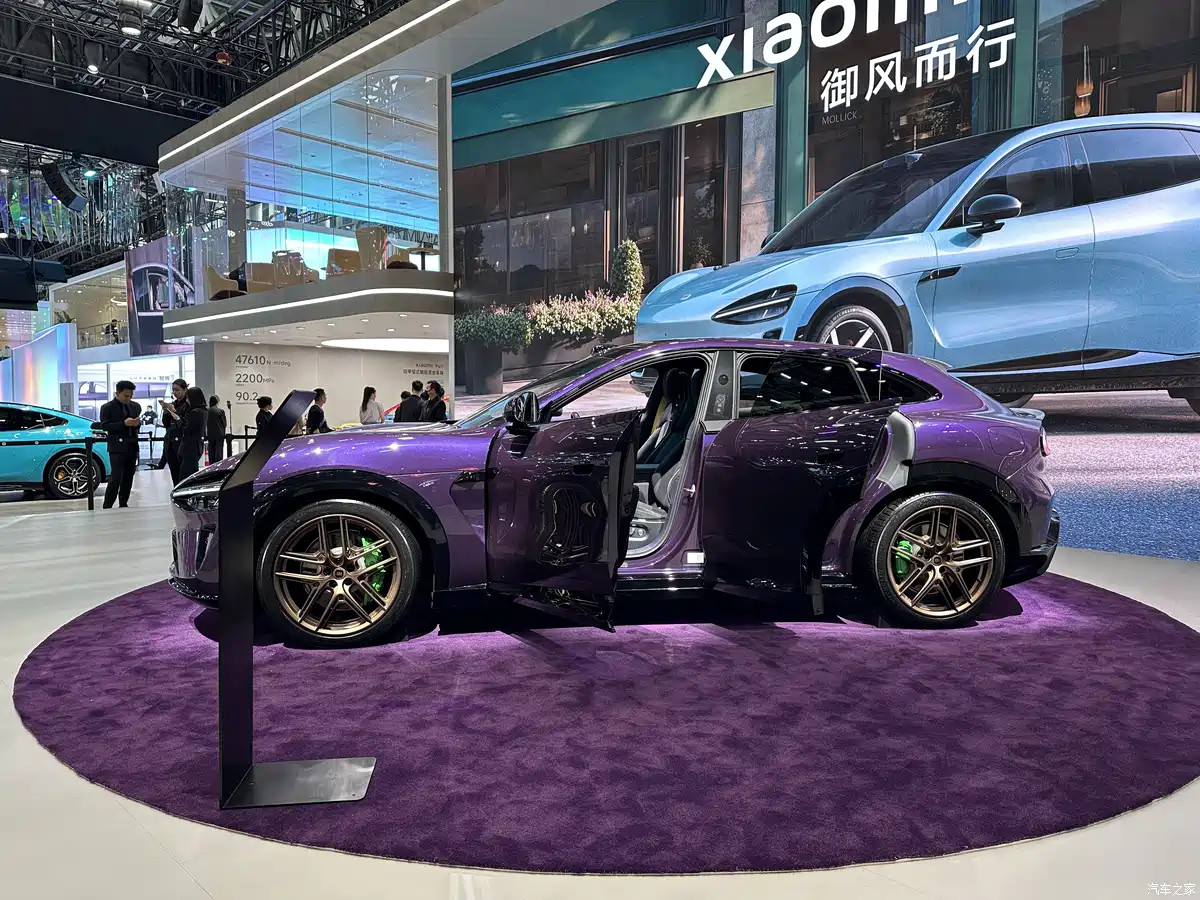
On the back of continued SUV sales success, Xiaomi announced its new Customization Service at the Guangzhou Auto Show, presenting a YU7 Max painted in Crystal Purple to mark the occasion.

The new service is effectively Xiaomi’s take on Porsche’s Paint to Sample program, with plans to roll out more than 100 new paint colors over the next three years. It’s a striking contrast to Tesla’s strategy, which restricts buyers to just a few standard colors and trims in the name of production efficiency and fatter profit margins.

The full list of paint colors has yet to be announced, but Xiaomi did say that the special finishes will be priced from 11,000 yuan ($1,500). Through the Customization Service, shoppers will also be able to choose from a selection of alloy wheels and colored Brembo brake calipers.

 Xiaomi’s YU7 Outsold Tesla’s Model Y And Now It’s Getting Personal

For buyers with a taste for extravagance, Xiaomi will also offer 24-karat gold badges or black-and-white emblems, along with gold carbon fiber versions.

Powering single motor versions of the YU7 is a rear-mounted unit delivering 315 hp (235 kW) and 389 lb-ft (528 Nm) of torque, fed by a 96.3 kWh battery pack. Xiaomi also offers dual-motor versions with 489 hp (365 kW) and 681 hp (508 kW), respectively.

An even more potent version of the YU7 is on the cards, but it’s too early to say if it will reach the same heights as the SU7 Ultra.

\\\\

Skoda’s Vision Sedan Keeps Its Engine Layout But Loses The Engine

  • Skoda unveiled a modern reincarnation of the 1970s 100 sedan.
  • Digital concept was designed by headlight specialist Martin Paclt.
  • It’s envisioned as fully electric with a rear-engined RWD layout.

Skoda has already served up a flurry of digital concepts nodding to its back catalogue, but this latest one marks a first, as it’s the only sedan in the mix. The design channels something like a future Superb, though under the surface it sticks with the rear-engined, rear-wheel-drive layout once common in the brand’s earlier models.

More: This Futuristic RWD Coupe Could Have Been Skoda’s Best Throwback Yet

The concept draws directly from the Skoda 100, a milestone model for the Czech brand that became its first to pass the one-million-unit production mark. Between 1969 and 1977, 1,079,708 examples of the 100 were built.

This digital reinterpretation was developed by Martin Paclt, part of Skoda’s headlight design team. He’s no stranger to shaping the company’s visual identity, having contributed to concept projects like the Vision X, 7S, and O, as well as production vehicles including the Enyaq, Karoq, Kamiq, and Kodiaq.

Paclt said he chose the Skoda 100 because of its strong recognition and what he described as its “clean, timeless lines,” which align naturally with the brand’s current Modern Solid design philosophy.

Throwback Details

\\\\\\

The new sedan’s proportions reflect those of today’s Superb, though Paclt aimed to give it a more premium, limousine-like presence compared to its modestly priced ancestor from the 1970s.

References to the original 100 appear throughout the design: character lines along the flanks, cooling intakes on the rear fenders, vents beneath the taillights, and a front graphic that encloses both grille and headlights.

The latter break from the old circular style, though Paclt experimented with that shape in early sketches before settling on a cleaner interpretation.

More: The Mazda RX-8 Spirit Lives On, But It’s Wearing A Skoda Badge

The reborn 100 sedan rides on large, futuristic alloy wheels that emphasize its balanced proportions and short overhangs. The rear deck draws attention with its roof scoop and the omission of a traditional rear window, a feature now common among experimental concepts that prioritize form over convention.

Electric Heart with a Vintage Layout

 Skoda’s Vision Sedan Keeps Its Engine Layout But Loses The Engine

Curiously, although envisioned as a fully electric vehicle, the study preserves the rear-engined, rear-drive setup that defined the original 100.

The rear intakes now cool electric components rather than a combustion engine, while the main storage area sits at the front with a smaller compartment at the back, staying faithful to the model’s unconventional architecture.

The digital 100 sedan joins Skoda’s growing catalogue of heritage-inspired concepts, following the 110R and 1000 MBX coupes, the Favorit hatchback, and the Felicia Fun pickup.

None are planned for production, yet each gives the company’s designers space to revisit its history through an electric, Modern Solid lens, where past models find new expression in digital form rather than on the assembly line.

\\\\\

Skoda

❌
❌