Normal view

There are new articles available, click to refresh the page.
Before yesterdayMain stream

Fiat’s Best Sellers Could Soon Be Slower Than the Speed Limit

  • Fiat CEO supports limiting city car top speeds to 73 mph.
  • Speed limiters could replace costlier ADAS tech in small cars.
  • Models like the 500 and Panda mostly stay in low-speed zones.

Some city cars just aren’t built for speed, and Fiat seems ready to lean into that idea even more. Its famously compact 500 and Panda models might soon become intentionally slower, not due to technical limitations, but as part of a wider strategy to comply with European safety regulations without driving up costs.

Fiat CEO Olivier Francois recently suggested that capping top speeds could be a practical alternative to loading small, affordable models with costly driver-assistance tech.

Review: New Fiat Grande Panda Hybrid Makes Budget Look Cool Again

“I would happily limit my city cars, my smaller cars, to what is today the maximum legal speed limit,” he told Autocar. “It’s already a limitation. There is something weird that I need to over-spec my cars to go above the legal speed limit.”

According to Francois, the average legal top speed across Europe is around 73 mph (118 km/h), adding that most of the safety equipment “has been developed for cars to go way above the speed limit.”

How Fast Should a City Car Go?

But Fiat’s best-sellers, including the 500, Panda, and the newly introduced Grande Panda, aren’t exactly Autobahn material. They spend most of their lives in slow-moving urban traffic, where speed is hardly the point.

 Fiat’s Best Sellers Could Soon Be Slower Than the Speed Limit
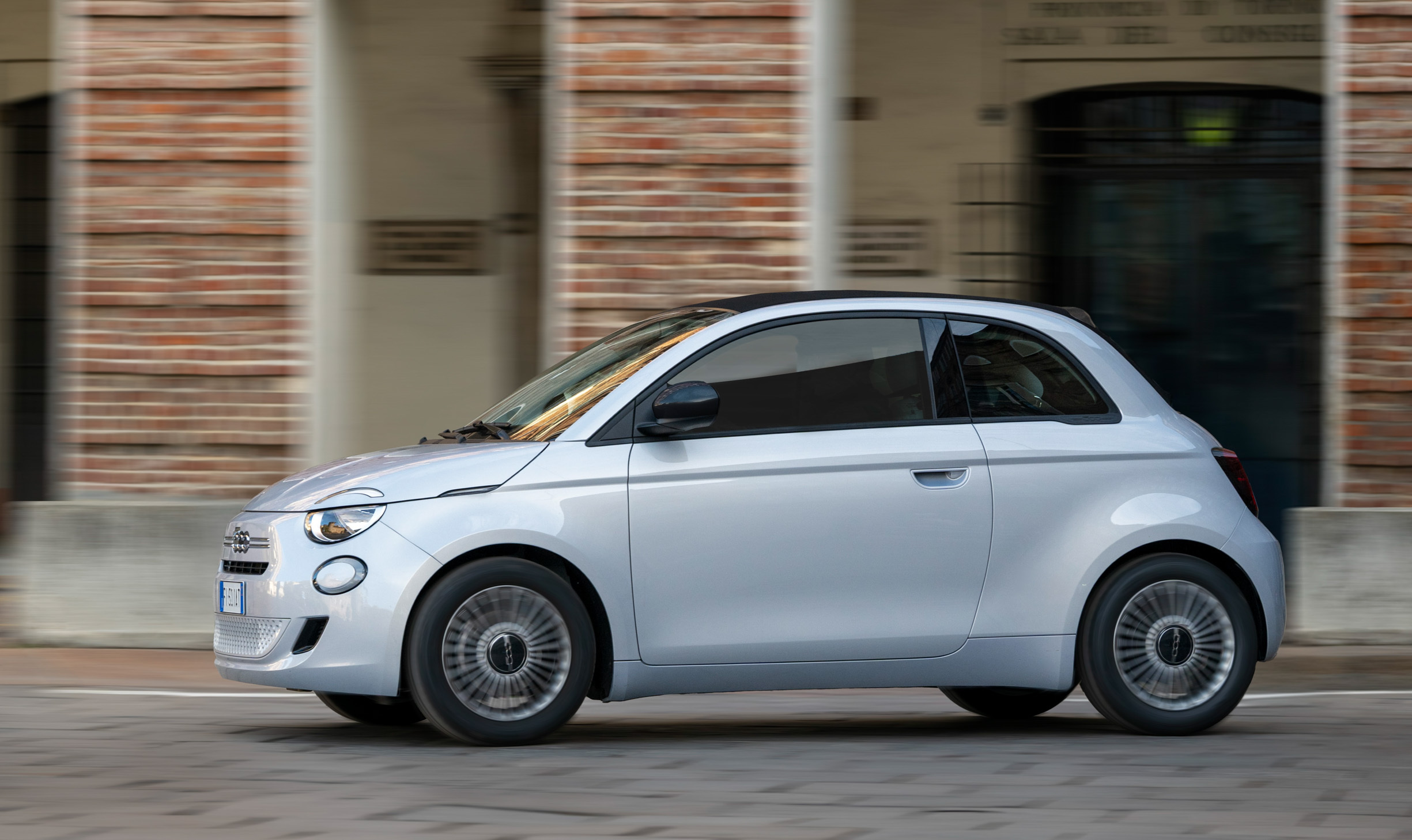
Fiat 500 Hybrid

Francois doesn’t think limiting their top speed to 73 mph (118 km/h) would make much of a difference, since none of the city cars in question is especially fast to begin with.

More specifically, the electric Grande Panda is already limited to 82 mph (132 km/h), a cap intended to help preserve battery range. The internal combustion and hybrid versions of the subcompact hatchback are less restricted, capable of reaching up to 99 mph (160 km/h).

The Fiat 500e, meanwhile, comes with a limiter set at either 84 mph (135 km/h) or 93 mph (150 km/h), depending on battery size. As for the new 500 Hybrid, it can theoretically hit 93 mph (150 km/h) as well, though based on its acceleration figures, that top speed might be more of a long-term goal than a regular achievement.

Slower Means Safer

 Fiat’s Best Sellers Could Soon Be Slower Than the Speed Limit

Francois thinks that a new speed limiter could serve as a cheaper alternative to more sophisticated ADAS that would inevitably increase the price of the models with little or no benefit to the customer. He also welcomed the proposal for a new small car category in Europe that could be free of the strict safety rules applicable in higher segments.

More: EU Quietly Plans New Car Class That Could See Prices Drop To €15,000

“I have a hard time understanding why we need to install all this super-expensive hardware,” he said. “Sensors, cameras, road sign recognition… All this is a little bit inadequate, a bit crazy, and has contributed to raising the average price of a city car by 60% over the last five or six years. I don’t think that city cars in 2018 or 2019 were extremely dangerous.”

Francois’s suggestion is to take a step back, reducing complexity rather than increasing it. “Our proposal was literally to say ‘let’s go a little bit backward from overloading cars with expensive hardware’.”

 Fiat’s Best Sellers Could Soon Be Slower Than the Speed Limit

He argues that applying the same safety rules across all vehicle categories misses the point, especially when it comes to small cars built for dense city environments. “We fundamentally think that with all these rules, the most unsustainable portion lies in the city cars and urban driving,” Francois said.

These vehicles, he notes, are often inexpensive, bought by younger drivers, and used primarily for short-distance commutes. Their speeds, and the risks involved, are much lower.

If Fiat decides to introduce new speed restrictions across its lineup, it wouldn’t be the first to take that route. Volvo, Renault, and Dacia have already capped some of their vehicles at 112 mph (180 km/h), aiming to lower the risk of severe accidents.

 Fiat’s Best Sellers Could Soon Be Slower Than the Speed Limit
Fiat Grande Panda Hybrid

An American EV Was Germany’s Most Defective Vehicle This Year

  • One in five cars in Germany failed annual roadworthiness inspection.
  • VW’s Golf, Touareg, and T-Roc dominated rankings across segments.
  • Mercedes led long-term quality with lowest defects among older cars.

Germany’s car-check watchdog has crunched the reliability numbers and once again, Tesla finds itself parked at the very bottom of the heap. The 2026 TÜV-Report, covering annual roadworthiness inspections of approximately 9.5 million vehicles between July 2024 and June 2025, found that Tesla EVs occupied the two bottom spots in the league table.

The Model 3, which was the worst-ranked car for the two previous years was found to have a defect rate of 13.1 percent, meaning one in every 7.6 cars in the two-to-three-year-old ages group failed the Hauptuntersuchung safety check.

Why Is The Model Y So Troubled?

But the Model Y was even worse. It had a defect rate of 17.3 percent, versus 3.5 percent for a Mini Cooper SE, making it the worst TÜV has seen in this age group in a decade. The biggest defect culprits were the axle assembly, suspension, brakes and lighting.

Related: Tesla Is Now The World’s Most Avoided EV Brand And It’s Probably Musk’s Fault

Pulling back to look at the bigger picture covering cars of all ages reveals that 21.5 percent, or one in five cars failed the inspection due to a “significant” or “dangerous” defect, an increase of 0.9 percent on last year, ADAC reported. And the proportion with minor defects rose 0.8 percent to 12.3 percent.

Other reliability villains include the BMW 5-series and 6-series in both the 4-5-year-old and 8-9-year-old age groups, the Dacia Duster in the 6-7 and 10-11 age groups and the Renault Clio among 12-13-year-old cars.

Electric Cars Defect Rate, 2-3 Years Old
 An American EV Was Germany’s Most Defective Vehicle This Year
ADAC/TÜV

Pop the Champagne for VW

But with every list of losers there has to be a list of winners, and for cars that have passed their fourth birthday, this one is headed by Volkswagen.

The VW Golf wagon and T-Roc scored well in the 4-7-year-old categories and the automaker’s Touareg was top of the oldies. The Mazda CX-3 and Mercedes B-Class were also commended.

Looking at the 2-3-year-old group, Fiat’s 500e toped the small car category, proving to Tesla that EVs can be reliable, the Mazda 2 and BMW 1-series were the top-rated small car and compact, and the C-class took the mid-range award (if you’re reading from the US, those classifications will look kinda messed up).

The T-Roc popped up again to take best SUV, and the B-class bagged most reliable nearly-new minivan.

Rate of Serious Inspection Defects
 An American EV Was Germany’s Most Defective Vehicle This Year
ADAC/TÜV

One big change in this year’s study is the introduction of an award for long-term quality, handed out to brands whose vehicles, aged 10+ exhibit the lowest average defect rate for safety-related faults and stand for quality, durability, and good service.

Mercedes took gold with an 18.5 percent defect rate – almost matching that of a 2-3-year-old Model Y – Audi was second with 19.2 percent and Toyota snuck onto the podium’s last step with a 22 percent defect rate.

Winners By Segment, 2-3 Years Old
ClassWinner
Mini carsFiat 500e
Small carsMazda 2
Compact BMW 1 Series
Mid-rangeMercedes C-Class
SUVVW T-Roc
MinivanMercedes B-Class
SWIPE
Winners In Other Age Groups
AgeWinner
4–5 yearsVW Golf Sportsvan, VW T-Roc
6–7 yearsVW T-Roc
8–9 yearsMazda CX-3
10–11 yearsMercedes B-Class
12–13 yearsVW Touareg
SWIPE

❌
❌