Normal view

There are new articles available, click to refresh the page.
Today — 9 June 2026Main stream

Tesla Can’t Move Cybertrucks at Home, So Kazakhstan’s Government Bought Some

  • A matte black Cybertruck recently joined Kazakhstan state security.
  • The Ministry of Emergency Situations has acquired one as well already.
  • Its arrival follows the start of Cybertruck sales in the Middle East.

Tesla’s trouble moving the Cybertruck in any meaningful quantity on US soil is by now thoroughly documented. Before the electric pickup ever reached a showroom, Elon Musk boasted that Tesla could move as many as 500,000 a year. The reality has been less kind. In 2025, American buyers took home just over 20,000 of them.

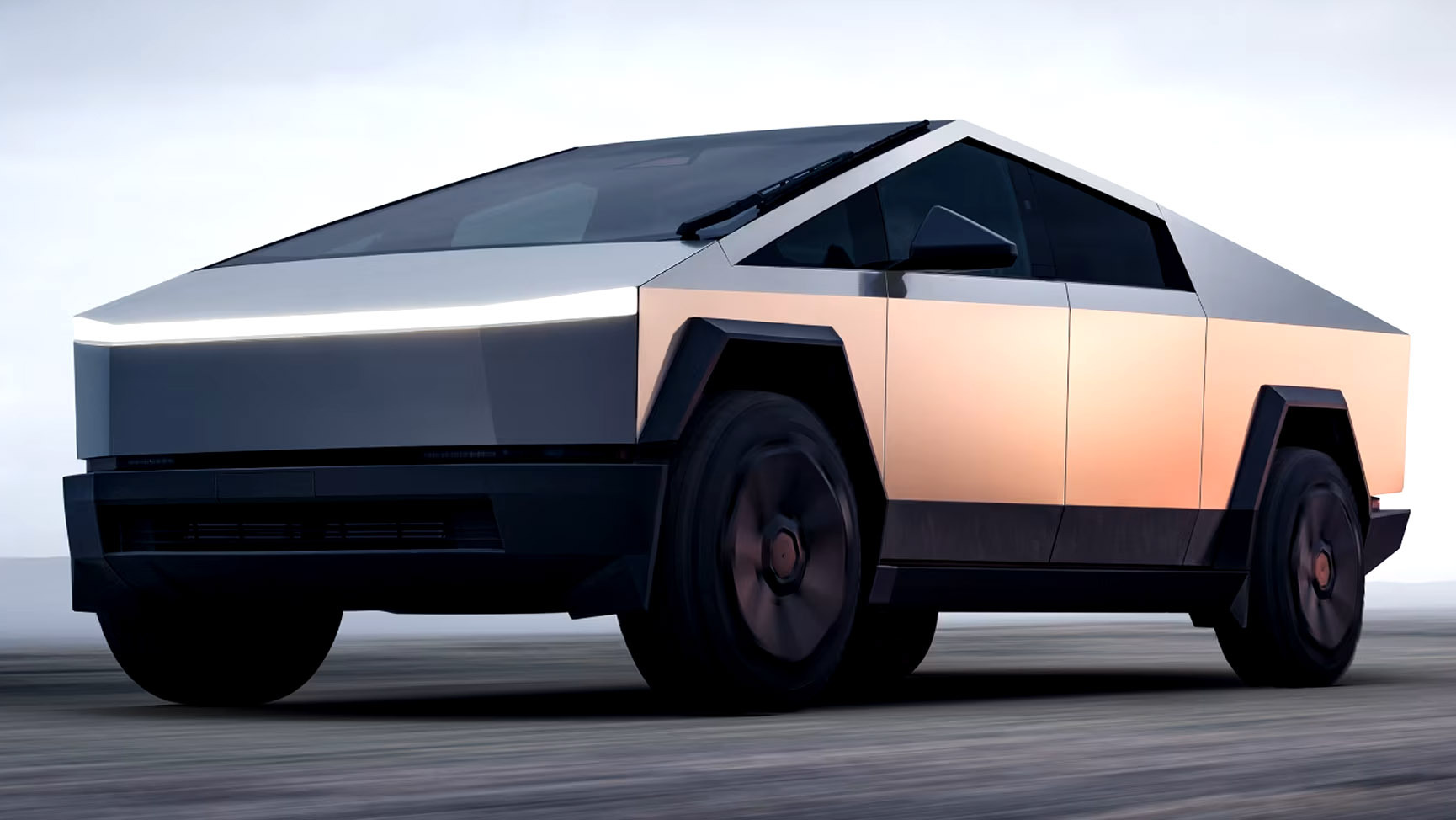
While it seems the Cybertruck has lost a lot of its initial luster in the US, it is slowly being introduced in other markets. One of them is Kazakhstan, where a handful are being used by government departments, proving that the car’s controversial design does have its perks.

Read: Unplugged’s $18K Cybertruck Package Adds What Tesla Left Out

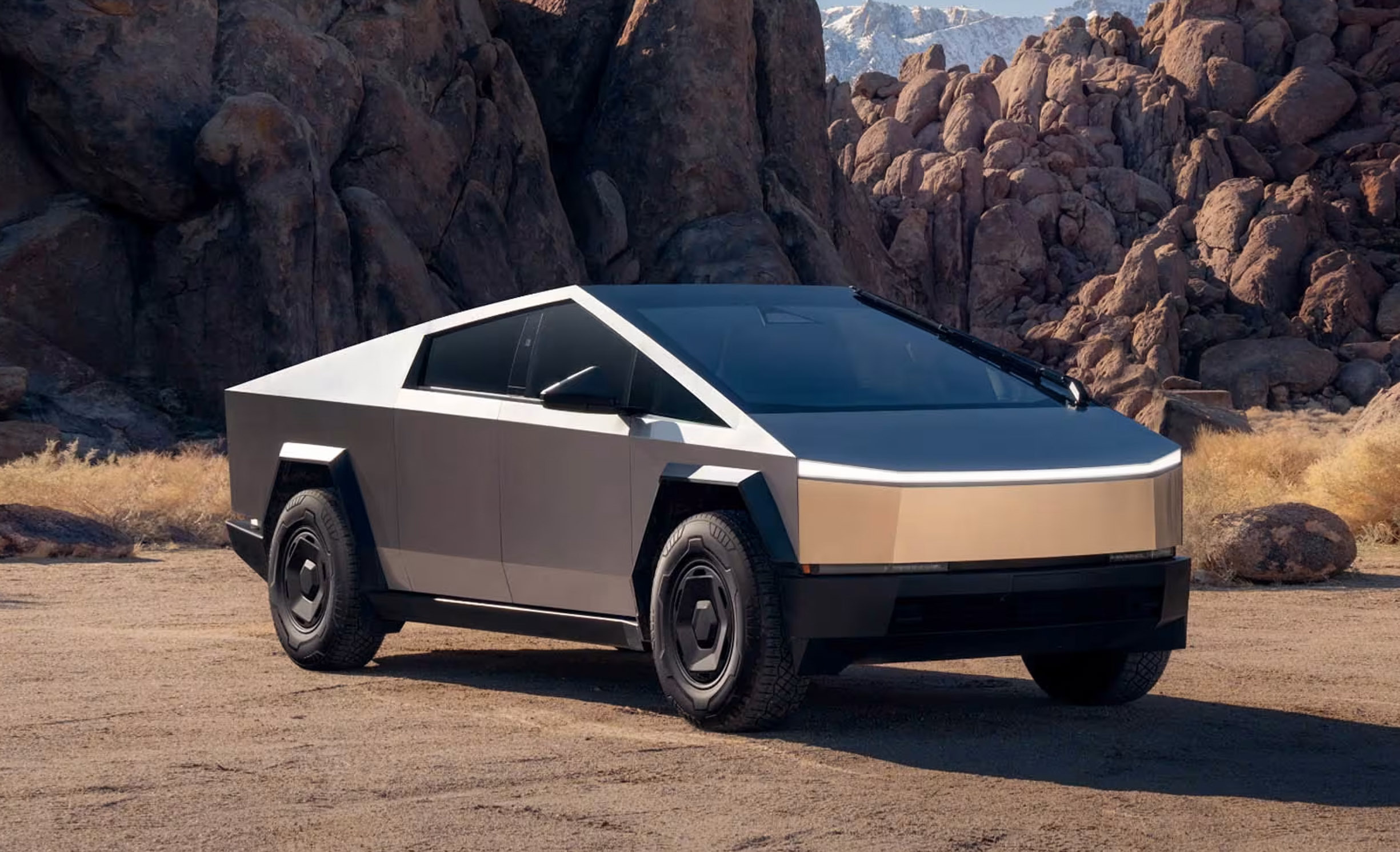
In mid-May, a matte black Cybertruck served the State Security Service during the Summit of the Organization for Turkic States, held in Kazakhstan’s Turkistan region. Fitted with flashing blue and red lights, the Tesla was reportedly donated to the authorities by a local entrepreneur.

It started out as a mobile command center, and from here it will take on a central role at major security events across the country, handling field coordination between units and providing communications support.

A Second Cybertruck

\\\

This isn’t the only Cybertruck roaming the roads of Kazakhstan. The Ministry of Emergency Situations has folded one into its fleet too, this one wrapped in matte white with orange and blue graphics. According to vice minister Yerbolat Sadyrbayev, the truck has proven itself capable of tackling the treacherous terrain of the country’s mountainous Almaty Region.

🇰🇿 The future has arrived in #Kazakhstan’s spiritual capital – #Turkistan#Cyber-police are patrolling the Turkic States Summit @Turkic_States #Cybertruck @Tes @elonmusk pic.twitter.com/ofKCXROnli

— Consulat général du Kazakhstan à Strasbourg (@KazStrasbourg) May 14, 2026

“Our ministry deals with situations where assistance must be provided as quickly as possible and every minute counts,” Sadyrbayev told Kazinform. “The Cybertruck has proven to be highly effective in responding to various emergency situations. We are talking about saving people’s lives.” The minister added that the government plans to add more Cybertrucks to its fleet, although he didn’t specify how many.

At this stage, it seems Tesla will take any Cybertruck order it can get. With US sales sliding from 39,965 in 2024 to just 20,237 in 2025, the company has been eager to sell the truck wherever there’s an appetite for one, even if it’s just for show. Earlier this year, it even started selling the electric pickup in the Middle East.
Before yesterdayMain stream

Canada Let In 2,910 Chinese EVs Last Month, Only 18 Were Confirmed Non-Tesla

  • Up to 49,000 Chinese-made EVs can be imported to Canada at a reduced tariff rate.
  • The first 24,500 of the reduced-tariff quota will be allocated between March and August.
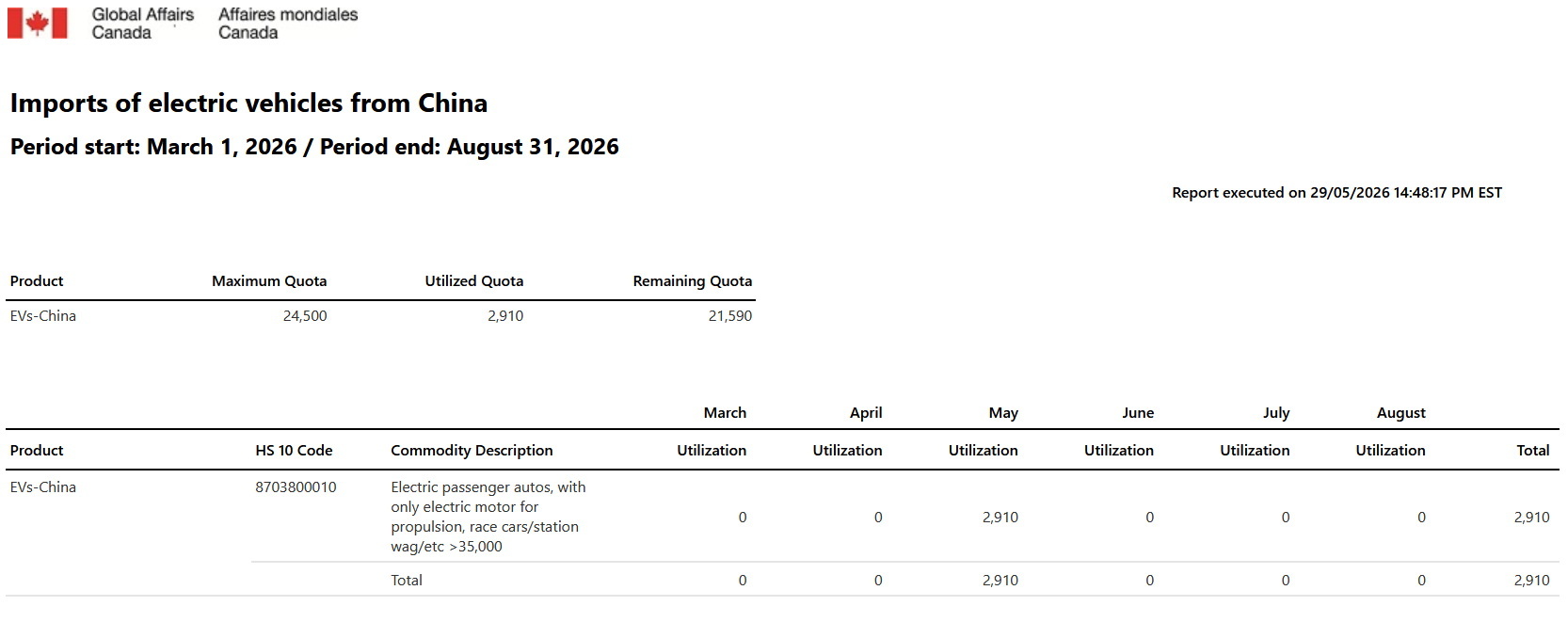
  • In May, 2,910 eligible vehicles were imported into Canada at the lower tariff.

Canada’s new trade agreement with China has cracked open the door for Chinese-built EVs, and the first cars are already landing on Canadian soil. The government has not said which brands are coming through, but the early money is on Tesla.

The math behind the deal is straightforward. EVs imported from China once faced a punishing 100 percent additional tariff. Now they pay just 6.1 percent. The catch is volume. For the program’s first year, imports at the reduced rate are capped at 49,000 units, split into two halves: 24,500 from March through August, and another 24,500 from September through February.

Read: Canada’s New Chinese EV Quota Has A Tesla-Sized Problem Already

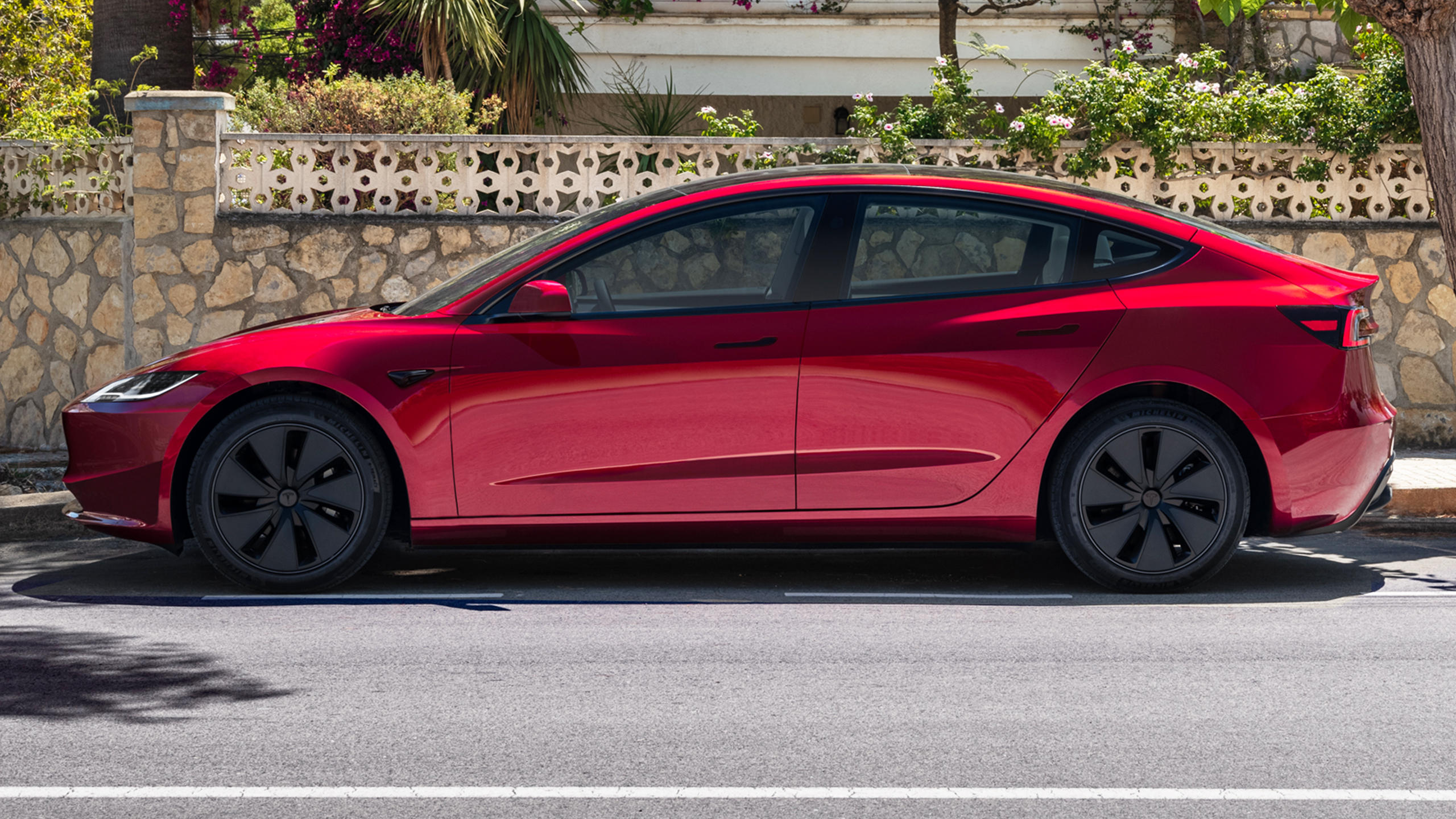
Data from Global Affairs Canada reveals that in May, 2,910 eligible vehicles were imported into Canada, accounting for just under 12 percent of the quota for the current six-month period. The government has made no mention of which brands received the lowered tariffs, but Tesla is thought to have accounted for the vast majority of them, given that it’s now building Model 3s at its Shanghai factory and exporting them to Canada.

 Canada Let In 2,910 Chinese EVs Last Month, Only 18 Were Confirmed Non-Tesla

By comparison, most of Tesla’s Chinese rivals are still early in their Canadian expansions and aren’t ready to export yet. According to Drive Tesla Canada, the only non-Tesla EVs from China to reach Canada in May were 18 examples of the high-end Lotus Eletre.

Others Are Coming From China Too

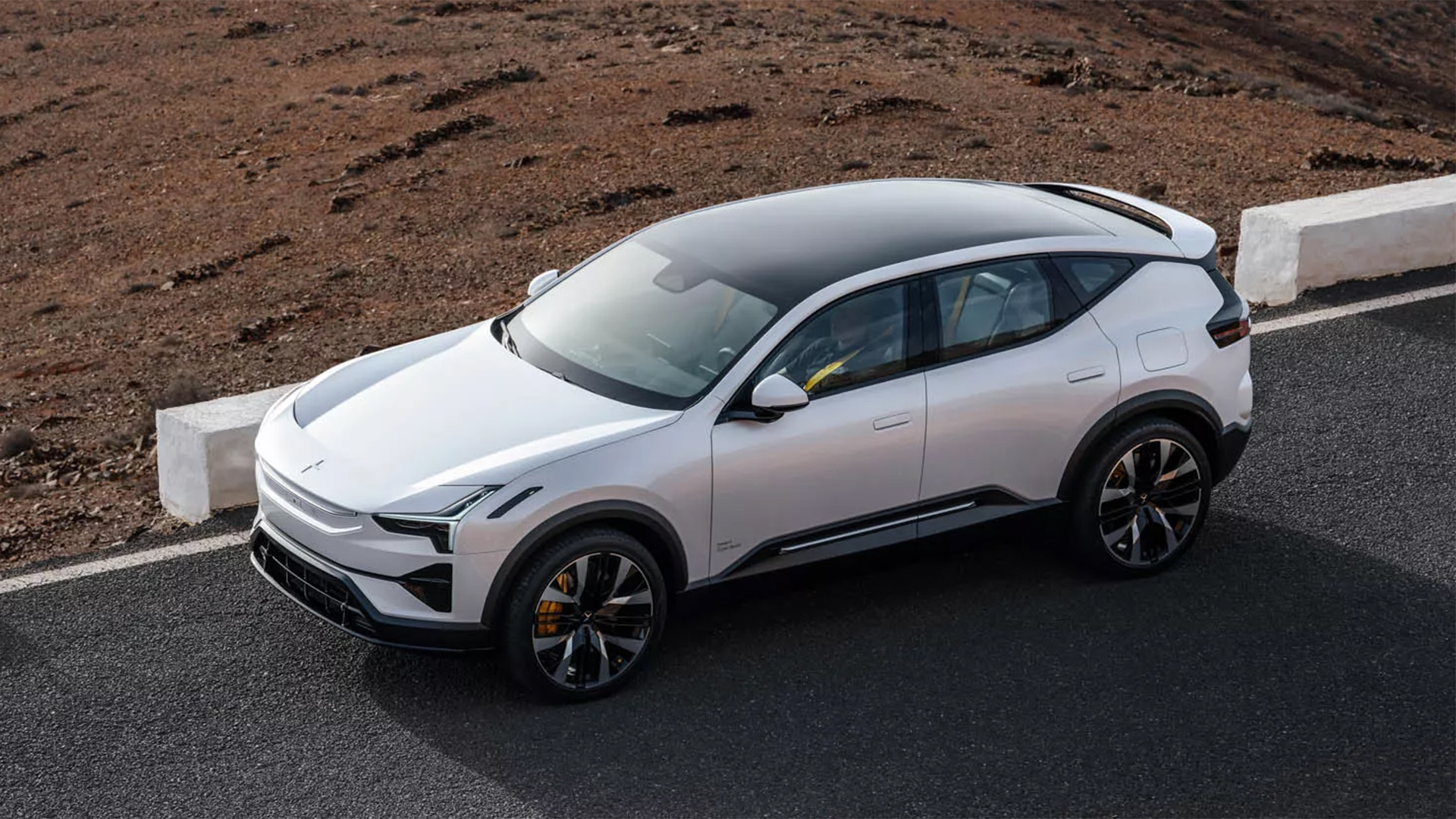
From the moment the new tariff quota system was announced, Tesla was expected to take early advantage of it. In addition to Geely starting to import Lotus Eletres from China, the group also owns the Volvo and Polestar brands, both of which already sell their vehicles in the country. Models from these two brands are also expected to benefit from the lowered tariffs, although it doesn’t yet appear that they’ve done so.

 Canada Let In 2,910 Chinese EVs Last Month, Only 18 Were Confirmed Non-Tesla

As we reported last month, a slew of new brands are gearing up to launch in Canada. Among these is Chery, which is expected to soon roll out vehicles from its Jaecoo brand nationwide. In addition, it’s understood that BYD wants to open as many as 20 locations in Canada this year and may even build its own local factory.

Geely will also grow its footprint beyond the Lotus, Volvo, and Polestar brands. It is readying Zeekr for a local launch and has already started hiring for senior-level positions in Toronto.

\\\\

Canada’s EV Rebates Sent March Sales Up Over 80%, Dealers Are Still Owed Millions

  • Dealers can apply rebates to EVs when they’re sold and are then reimbursed.
  • Many dealerships in Canada are still waiting for the government to pay them back.
  • Canada’s Electric Vehicle Affordability Program will include $2.275 billion in subsidies.

New car buyers in Canada are making the most of newly introduced EV subsidies and, since February, have already claimed more than $122 million. However, a new report reveals that many dealerships are still waiting on the government to reimburse them.

Canada’s Electric Vehicle Affordability Program (EVAP) was reintroduced on February 16 and allows dealers to immediately apply the applicable rebate and then seek reimbursement from the government. As of May 29, 24,389 claims had been recorded in the database, totaling $122 million in subsidies from the $2.275 billion allocated by the government over the next five years.

Read: Americans Pay $37K For The Cheapest Tesla, Canada Got A Chinese One For $29K

Incentives are available for vehicles that cost $50,000 or less. They can reach up to $5,000 for battery-electric and fuel-cell electric vehicles, and at $2,500 for plug-in hybrid vehicles.

The program’s reintroduction is great news for buyers. Canada operated a similar rebate program between 2019 and 2025, encouraging locals to buy more fuel-efficient vehicles. When that program ended in January 2025, EV sales fell from an 18 percent share of total new car sales to just 10 percent.

According to CTV News, sales jumped more than 80 percent in March compared to February, right after the rebates could be claimed again.

However, while vehicles sold from February 16 have been eligible for the subsidies, dealers weren’t able to file reimbursement claims until April 6. The Canadian Auto Dealers Association (CADA) says many dealerships are still waiting to be paid, with some waiting for more than $200,000 in rebates.

Some Delays Caused By Simple Typos

 Canada’s EV Rebates Sent March Sales Up Over 80%, Dealers Are Still Owed Millions

“The commitment to pay dealers in a timely manner has not happened in the early days of the program,” CADA spokesperson Huw Williams said. “There does not seem to be an appreciation that the timelines for repayment are hurting business cash flow. This is money we are advancing on behalf of the federal government.”

Some rebate claims have reportedly been rejected due to simple typos, and there’s no way to appeal or review those denials. According to Transport Canada, it’s working to quickly make the reimbursements.

“There is no hold on repayments; complete and validated claims continue to be processed and reimbursed,” it said. “While Transport Canada aims to process complete and accurate claims as quickly as possible, timelines may vary depending on validation requirements and submission volumes.”

 Canada’s EV Rebates Sent March Sales Up Over 80%, Dealers Are Still Owed Millions

Tesla’s New Camera Design Could Borrow A Trick From Your Windshield

  • Tesla may finally have a fix for problems tied to its vision-only system.
  • A new patent shows camera units fitted with tiny wipers and water sprayers.
  • Cybercab prototypes have been spotted carrying camera-cleaning hardware.

Many automakers chasing autonomy have settled on roughly the same hardware recipe: cameras, radar, and LiDAR, each covering for the others’ weaknesses. Tesla went the other way. Its driver-assist suite leans entirely on cameras, no radar, no LiDAR. While using a vision-only system has some advantages, it also has some drawbacks, including issues caused by dirty camera lenses.

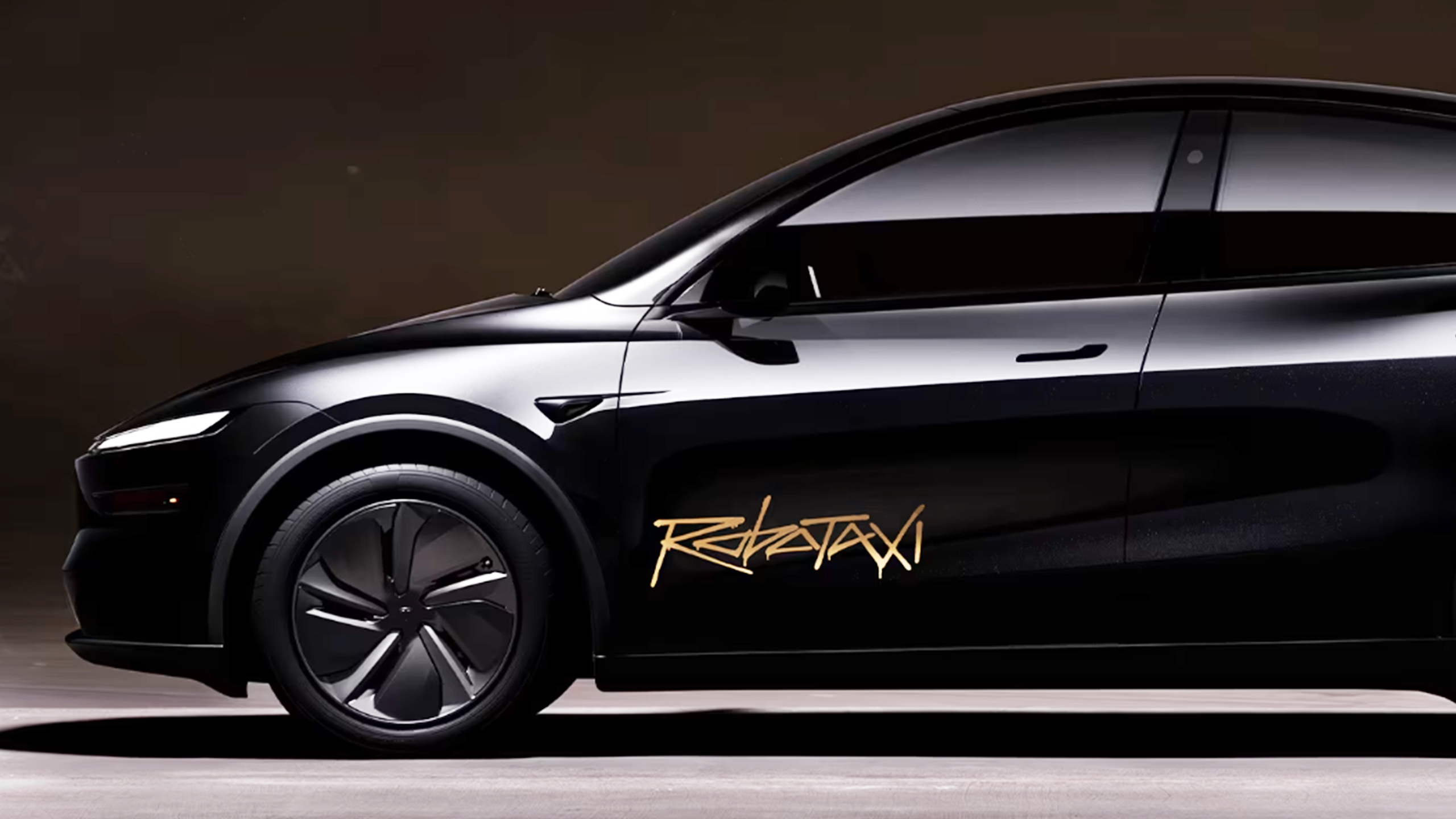
Tesla is aware of the problem. Recent Cybercab prototypes have turned up wearing small washer jets aimed at the exterior cameras, spraying them clean as needed. A patent filing suggests the company wants to go further than a squirt of fluid.

Read: Tesla’s Model Y Robotaxis Can Squirt Now, But Yours Still Can’t

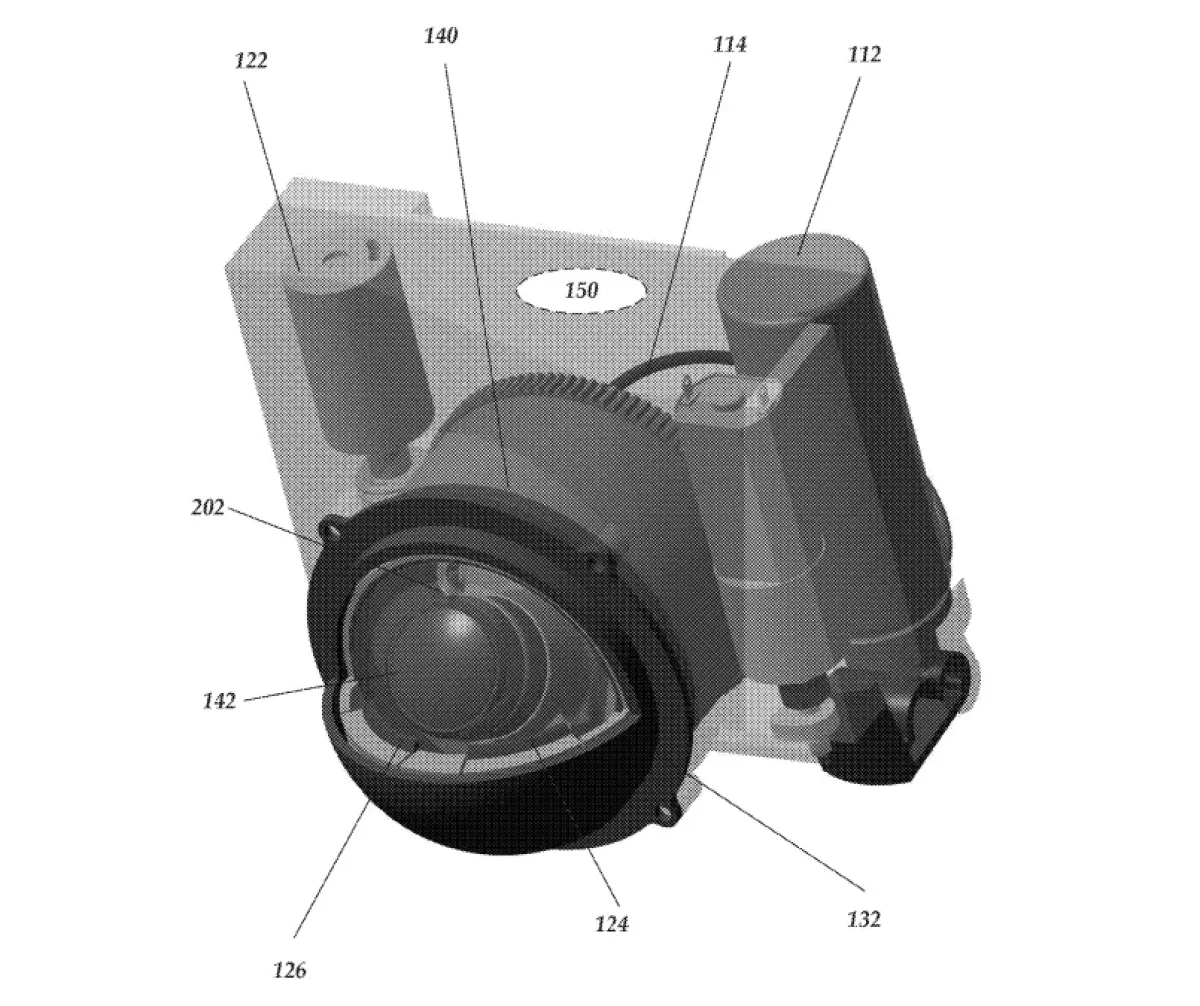
An image from the patent depicts the entire camera unit, including a tiny fluid reservoir that can spray water onto the camera’s lens. Tesla has also designed a tiny wiper blade that can sweep across the lens, ensuring it’s as clean as possible. This blade will be driven by a small wiper motor, also incorporated into the camera’s housing, Not A Tesla App notes.

It’s an innovative solution and could help to overcome some of the issues Tesla’s vision system experiences. Of course, a setup like this won’t help Tesla’s cameras in dealing with sun glare, for example, which can impact how the automated driving systems work.

 Tesla’s New Camera Design Could Borrow A Trick From Your Windshield

It’s also unclear if all of the exterior cameras used by current Tesla models could be fitted with these units, as they are noticeably larger than just having a camera. At the very least, Tesla may be able to squeeze camera units like these into the front of its vehicles, as well as the front quarter panels, and the rear, among the most important cameras it uses to capture 360-degree images.

Of course, these camera units will be more expensive than those currently used and, with more moving parts, will also be more prone to failure. But, as Tesla seeks to achieve full autonomy, they may be necessary.

\\\\\\

In 2020, Tesla Was Supposed To Have 1 Million Robotaxis. It Currently Has 20

  • Tesla’s current unsupervised fleet across the entire US is just 20 cars.
  • California regulators still block Tesla from running any unsupervised cars.
  • In the past 30 days, just 92 vehicles have been used in the robotaxi fleet.

Back in October 2019, Tesla chief executive Elon Musk told investors the company would have more than a million robotaxis on the road within a year. Six years on, Tesla has not only missed that deadline by an embarrassing margin, the US fleet it actually runs is getting smaller.

The long-promised robotaxi service finally launched in Texas last year, starting in a fenced-off corner of Austin with safety drivers riding shotgun. It has since spread to Dallas, Houston, and the Bay Area in California, but the scale remains a rounding error next to Waymo, the company that has quietly built the lead Tesla keeps talking about.

Watch: Tesla Robotaxi Driver Caught Asleep Proves Humans Are Still The Weakest Link

Data from the Robotaxi Tracker service reveals that across the four regions, Tesla has had just 20 unsupervised vehicles in use during the past seven days. Of these, 14 are operating in Austin, 3 are in Dallas, and 3 are in Houston. Crucially, California regulations continue to prevent Tesla from operating a single unsupervised robotaxi in the state. It’s not as if there are loads of human-driven Tesla robotaxis in the Bay Area, either.

The total fleet peaked around December 2025 and January 2026 and has been in steady decline ever since.

A Shrinking Fleet

 In 2020, Tesla Was Supposed To Have 1 Million Robotaxis. It Currently Has 20

Electrek reports that over the past week, the total number of cars operating in Tesla’s total robotaxi fleet, including supervised and unsupervised cars, was just 34 vehicles. In April, there were 107 vehicles operating in the Bay Area fleet, but currently there are just 9. Those Bay Area cars were never true robotaxis to begin with, operating with safety drivers under California’s Transportation Charter-Party permit.

An analysis of activity over the past 30 days shows that just 92 vehicles in total were used by the robotaxi service across the country, of which 33 were operating unsupervised. Most of these, 52 to be precise, are in use across the Bay Area. It’s worth reiterating, however, that these vehicles in California are driven by people, just like a normal ride-hailing service.

Tesla hasn’t explained why its robotaxi fleet is shrinking, but it’s likely related to safety issues that the company is experiencing. As we revealed in January, vehicles operating in Tesla’s robotaxi fleet were involved in an incident every 55,000 miles, roughly four times the average number of miles driven by people.  

 In 2020, Tesla Was Supposed To Have 1 Million Robotaxis. It Currently Has 20

Tesla’s Robot Eyes Missed 14,575 Stickers, Sending Every Owner Back To The Dealer

  • Tesla is worried owners may overload their Model Ys due to a missing label.
  • The safety concern has been blamed on issues with a vision-scanning tool.
  • Impacted Model Y owners will be alerted to the recall from July 17.

Recalls usually come dressed up in regulatory language that hides how mundane the underlying problem is. This one is refreshingly honest about it. More than 14,000 examples of the 2025 and 2026 Tesla Model Y are being recalled in the United States, and unlike most Tesla recalls, an over-the-air update will not fix it.

The recall says Tesla noticed a vehicle with a missing certification label during a routine audit of its Fremont factory last month. It was soon discovered that an automated vision-scanning tool, which verifies the presence of a properly affixed certification label, wasn’t performing as it should have.

Read: Tesla’s First Model Y Price Hike In Two Years Skips The Cheapest Version

The certification label lists the vehicle’s weight specifications, the numbers owners check before loading cargo or hitching a trailer. Without it, drivers can exceed those limits without realizing it, and an overloaded Model Y brakes, handles, and crashes differently than the one Tesla engineered.

What’s The Fix?

 Tesla’s Robot Eyes Missed 14,575 Stickers, Sending Every Owner Back To The Dealer

A total of 14,575 vehicles are caught up in the recall. The list includes 2,697 Model Ys built between November 17, 2024, and February 24, 2025, covering the 2025 model year, plus another 11,878 examples produced from February 25, 2025, through April 21, 2026. It is a large pool of cars, but Tesla says it is not aware of any collisions, injuries, or fatalities tied to the missing sticker, which is about what you would expect from a label-related defect.

Tesla says it repaired the automated scanning tool on April 17 at its Fremont, California, factory and also began performing manual checks to ensure newly produced models have the correct certification label. In addition, the scanning tool at Tesla’s Gigafactory in Texas was also fixed on May 7.

Owners of impacted Model Ys will be alerted to the recall from July 17, and Tesla will inspect affected vehicles and attach the certification label as required.

 Tesla’s Robot Eyes Missed 14,575 Stickers, Sending Every Owner Back To The Dealer

$131 Million Worth Of Cybertrucks Went To One Buyer, And Elon Musk Owns It

  • Tesla has sold millions in battery storage systems to SpaceX as well.
  • SpaceX bought 1,279 Cybertrucks during the fourth quarter of 2025.
  • Cybertruck sales dropped from 38,965 units in 2024 to 20,237 last year.

SpaceX is heading for the public markets, and its prospectus has put a hard number on something Tesla watchers have suspected for a while. Since 2023, Tesla has booked roughly $890 million in revenue from SpaceX and xAI, the artificial intelligence outfit Elon Musk founded and folded into SpaceX in February.

Musk’s space exploration company has proven to be rather fond of the all-electric Cybertruck, despite its popularity falling off a cliff among private buyers. Last year, SpaceX purchased $131 million worth of Cybertrucks from Tesla.

Doing The Math On 131 Million Dollars

At the Cybertruck’s current sticker prices of $69,990, $79,990, and $99,990, that $131 million works out to between 1,310 and 1,872 trucks, depending on trim mix. A realistic blend, weighted toward the base and mid trims that fleet buyers typically favor, lands closer to 1,700 to 1,800 units. The exact figure depends on which trims SpaceX actually bought and when, since pricing has moved over the past 12 months.

These vehicles were purchased at MSRP and, according to the regulatory filing, payments were made on similar terms to normal transactions. While it all seems to be above board, one may wonder if SpaceX bolstering sales of the Cybertruck has helped to boost Tesla’s share price.

Sales Slip

 $131 Million Worth Of Cybertrucks Went To One Buyer, And Elon Musk Owns It

Recent registration data revealed that SpaceX purchased 1,279 Cybertrucks in the fourth quarter of 2025. This represented more than 18 percent of the total number of Cybertrucks registered across this period. An additional 60 trucks were also purchased by xAI, The Boring Company, and Neuralink. Musk’s companies also purchased 158 Cybertrucks in January of this year, and 67 in February.

Read: Tesla’s Running Out Of Cybertruck Buyers, So Musk’s Other Companies Are Buying It

Overall interest in the Cybertruck has slipped significantly in the two-and-a-half years since deliveries began. In 2024, Tesla sold 38,965 Cybertrucks in the US, making it the best-selling electric pickup in the country. However, sales slipped to just 20,237 in 2025 and fell even further through the first quarter of this year, with just 3,519 reportedly sold.

SpaceX and xAI haven’t just tapped Tesla for Cybertrucks. In 2024, they purchased $191 million worth of Megapack energy-storage batteries from the automaker. This figure swelled to a massive $506 million last year, The Wall Street Journal reports.

 $131 Million Worth Of Cybertrucks Went To One Buyer, And Elon Musk Owns It

Tesla’s First Model Y Price Hike In Two Years Skips The Cheapest Version

  • Prices for three versions of the Model Y have increased in the US.
  • Premium RWD, Premium AWD, and Performance trims are now pricier.
  • A stretched six-seat Model Y may soon arrive in American showrooms.

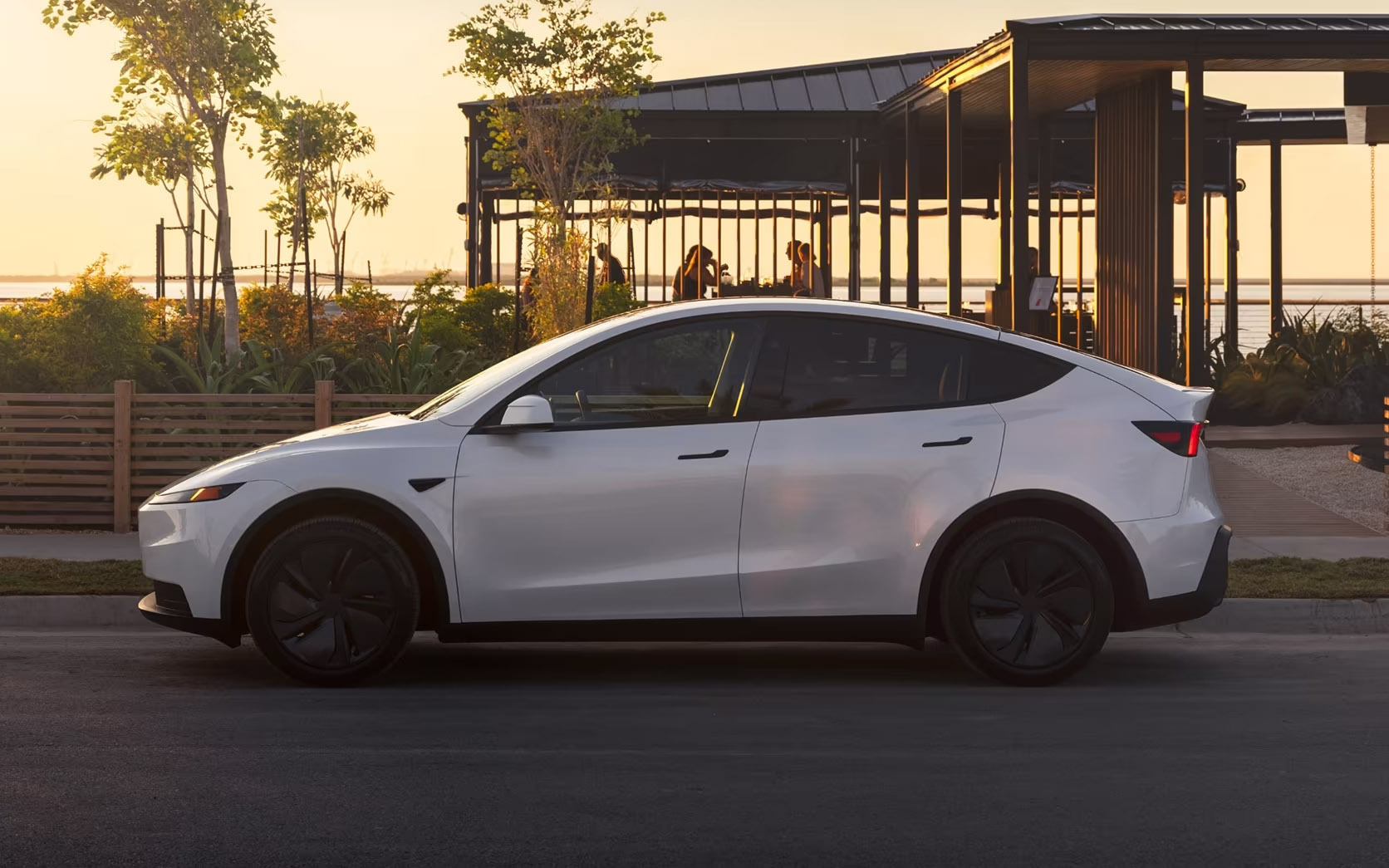
The Model Y still sits at the top of the American EV charts by a margin that borders on embarrassing for the rest of the industry. More than 357,000 found buyers last year, north of five times the volume of the Chevy Equinox EV, which finished 2025 as the best-selling non-Tesla EV. However, there’s some unwelcome news for those shopping for a new Model Y.

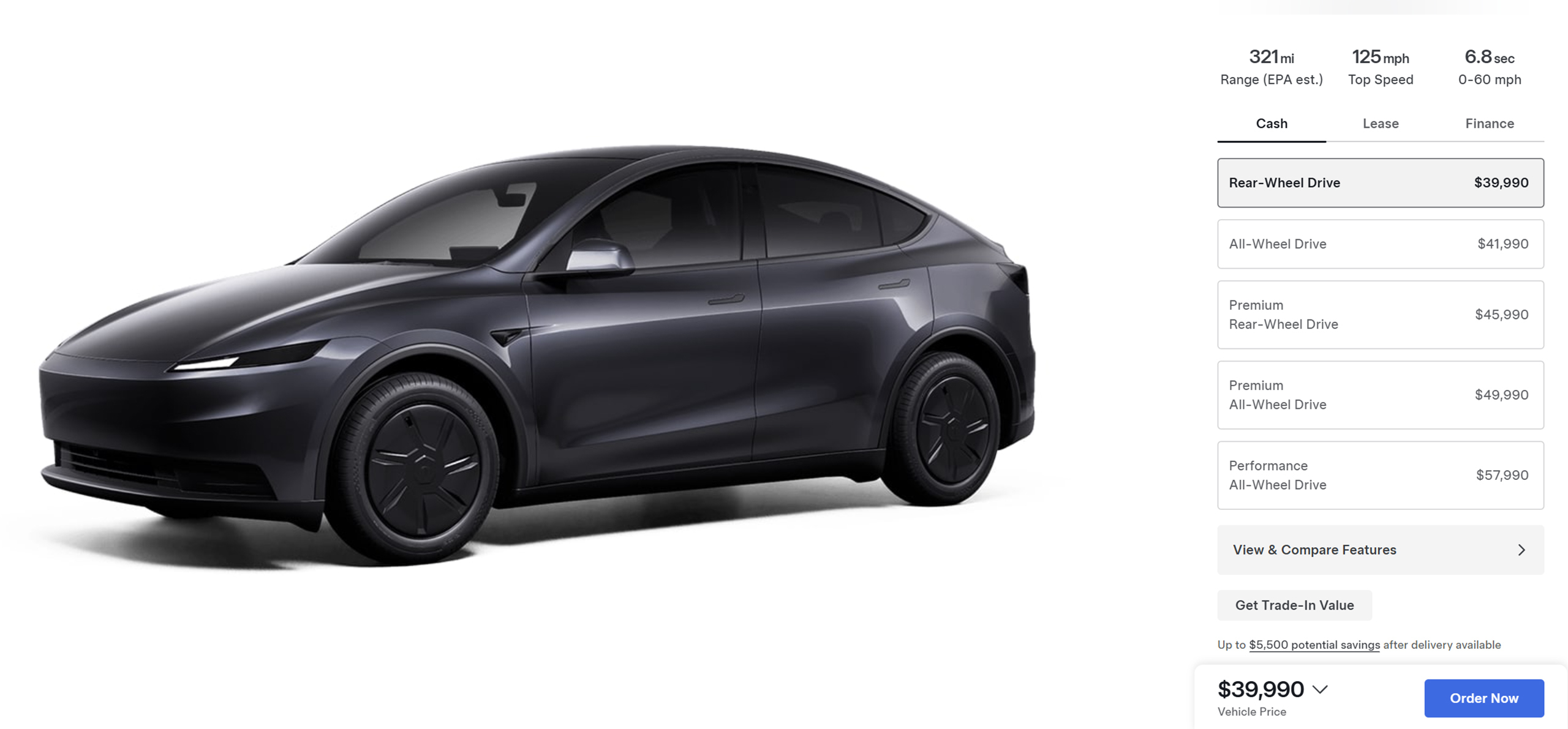
While the price hikes are relatively small, they may be enough to convince some to look elsewhere for their next EV. The entry-level Model Y RWD and AWD trims continue to start at $39,990 and $41,990 respectively, but the mid-range Premium RWD climbs $1,000 to $45,990, an increase of 2.2 percent.

Read: Tesla’s Model Y Just Became The First Vehicle To Pass America’s New Safety Tests

Tesla has applied the same $1,000 walk to the Premium AWD, which now lists at $48,990, while also bumping up the MSRP of the Model Y Performance from $57,490 to $57,990. All prices exclude delivery fees and local state taxes.

Getting Ready To Launch The Six-Seat Model Y L?

 Tesla’s First Model Y Price Hike In Two Years Skips The Cheapest Version

In typical Tesla fashion, the company has offered no explanation for the increases, and they have not been paired with the kind of model-year refresh other automakers usually point to when they tap the price tag. This is the first Model Y hike since 2024, which leaves the increases comfortably below the current 3.8 percent annual inflation rate.

The Model Y line-up may soon grow in the United States with the launch of the three-row Model Y L, first introduced in China and since added to the line-up in several other markets, including the UK and Australia. A prototype of the six-seat Model Y was recently spotted being tested on US roads, perhaps indicating that a local launch is imminent. If it does indeed land locally, prices will likely start just north of $50,000.

\\\\\\\

Tesla’s Best Color Returns From The Model S Grave, Free On One Trim Only

  • Tesla has dropped Deep Blue Metallic and introduced Marine Blue.
  • Frost Blue Metallic from the Model S is now available for the 3 and Y.
  • Sadly, Frost Blue Metallic is only offered for the Performance models.

Tesla has never been known for offering particularly exciting or flamboyant paint schemes, generally opting for subtlety over pizzazz. However, the Model 3 and Model Y have just been updated with two new shades of blue in the United States, and both look superb.

The first new color is dubbed Marine Blue, and it’s available for the Premium Rear-Wheel Drive and Premium All-Wheel Drive versions of the Model 3 and Model Y. Marine Blue is a deep shade that replaces Deep Blue Metallic, which was brighter and a little more eye-catching.

Read: Americans Pay $37K For The Cheapest Tesla, Canada Got A Chinese One For $29K

As before, those shopping on a budget and looking to buy the entry-level Rear-Wheel Drive or All-Wheel Drive versions of the Model 3 or Model Y don’t get this new color and still only have Stealth Grey, Pearl White Multi-Coat, and Diamond Black to choose from.

In the US, Marine Blue adds $1,000 to the price of applicable Model 3s and Model Ys. In Canada, it costs CA$1,300 (US$940).

Exclusive Performance Color

\\\\\\

The second new color introduced by Tesla is Frost Blue Metallic. It’s exclusive to the Model 3 Performance and Model Y Performance. This isn’t the first time this color has been offered by Tesla, as it was previously available on the Model S and Model X before those models were discontinued. Of all the colors that Tesla offers, Frost Blue Metallic might be our favorite, alongside Ultra Red.

What’s more, Frost Blue Metallic is a no-cost option in the US. It’s also been launched for the Model 3 Performance in Canada, though it’s not yet clear whether it will be added to the Model Y Performance locally.

\\\\\\\

A Seven-Year-Old Tesla Model 3 Survived 380,000 Miles, Its Range Did Not

  • A 2019 Tesla Model 3 hit 380,000 miles on its original battery pack.
  • Range took a serious hit, the kind most owners would call alarming.
  • Even so, it still cleared triple-digit highway miles in real-world testing.

Electric vehicles have plenty of advantages over combustion cars but all of them have an uncomfortable truth sitting under the sheet metal. Engines wear out over time, but the size of their gas tank doesn’t shrink. EVs will suffer battery and range degradation no matter what. The only question is how bad it’ll get before the battery fails. One seven-year-old Tesla still running on its original battery is providing some insight.

At over 380,000 miles (610,000 km), one Tesla Model 3 owned by the YouTube channel Drive Protected is going strong long after most vehicles (combustion or EV) are long dead. When new, it offered 240 miles of range. Today, a full charge shows 158 miles. That’s an 82-mile drop, or about 34.2 percent gone. There’s really no sugarcoating it. That’s substantial degradation and puts the battery well below 70 percent of its original capacity.

Read: Tesla’s Longest Range EV Is Here But Not For You

That said, it’s not quite the death sentence you might expect. The car was put through a real-world highway test at a steady 68 mph, returning 138.3 miles before hitting zero. That’s not impressive on paper, but it’s far from unusable. For shorter commutes or city duty, it’s still very much a functioning vehicle.

The numbers back that up. Over the test, it consumed 32.4 kWh. That’s well below the roughly 49 kWh it would have had when new. That aligns with the reduced range estimate and confirms the degradation isn’t just theoretical.

Still, despite losing over a third of its capacity, nothing else about the car appears fundamentally broken. No catastrophic failure, no sudden shutdowns. It’s just a steady erosion of range over time, and about double the miles of most cars when they head to the scrap yard.

In a way, this car is making a case for and against EVs. Yes, battery degradation is real, measurable, and significant. Making batteries cheaper and easier to replace in the near future is key to EV sustainability and longevity. But it also shows that even after mileage that would retire most vehicles, an EV can keep going, albeit with a shorter range.

 A Seven-Year-Old Tesla Model 3 Survived 380,000 Miles, Its Range Did Not

Canada’s New Chinese EV Quota Has A Tesla-Sized Problem Already

  • Up to 49,000 Chinese EVs yearly qualify for lower Canadian tariffs.
  • The first 24,500 reduced-tariff permits stay open through August 31.
  • Chery, Geely, and BYD are lining up new EV launches for Canada.

Worried that automakers like Tesla could vacuum up the bulk of its low-tariff Chinese EV quota in one gulp, the Canadian government is reportedly rethinking how to dole out the import permits before they all end up in one company’s hands.

Under Canada’s new trade arrangement with China, up to 49,000 China-built EVs can be imported each year at a slashed 6.1 percent tariff, a steep drop from the punishing 100 percent duty. The first batch of 24,500 permits has been on the table since late March and is supposed to stay available through August 31, handed out on a first-come, first-served basis.

Read: Chinese EV Brands Are On A Hiring Spree In Canada As They Set Up Shop

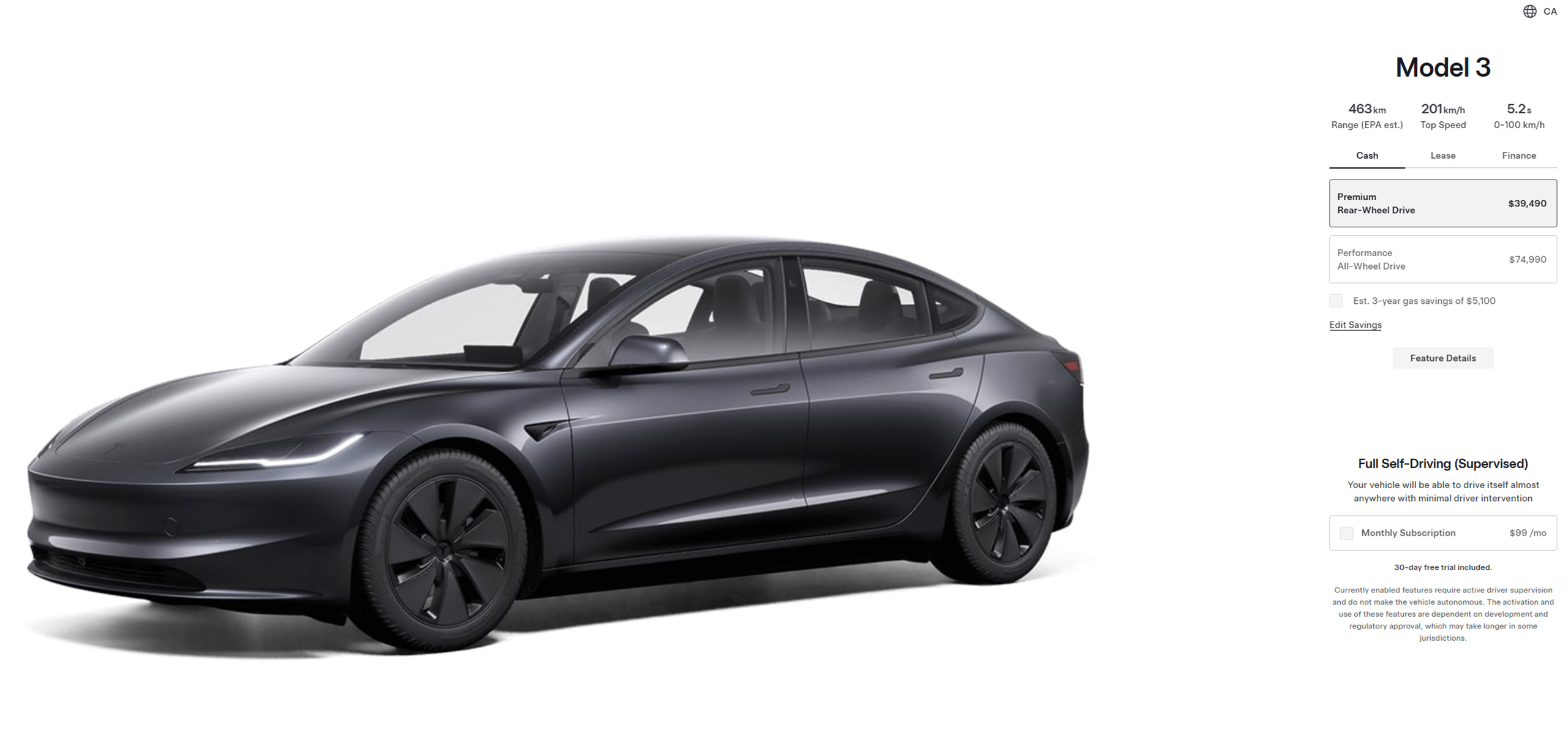
According to Bloomberg, not a single permit has actually been issued yet. That window is about to get crowded, though, because Tesla just confirmed it will start selling a Chinese-built Model 3 in Canada at a sharply lower price. The new entry point is CA$39,490 before destination, roughly US$29,007, which guts the old floor set by the Model 3 Long Range AWD at CA$79,990, or about US$58,700.

Canada Wants Equitable Access For All Chinese Brands

 Canada’s New Chinese EV Quota Has A Tesla-Sized Problem Already

In addition to Tesla, through its Volvo and Polestar brands already operating in Canada, may also be positioned to secure part of the initial allocation. Once the second half of the 49,000 permits becomes available after August 31, officials may revise the system and assign specific reduced-tariff allocations to individual automakers, giving more brands access to the program.

These brands could include newcomers to the Canadian market, such as BYD and Chery. According to unnamed officials, the quota system may eventually expand to favor companies that establish operations in Canada, including local assembly facilities.

News of these potential changes comes just after it was revealed firms including BYD, Cheyr, and the Geely-owned Zeekr brand have launched a hiring spree across Canada, eager to quickly set up shop and start selling their vehicles locally.

 Canada’s New Chinese EV Quota Has A Tesla-Sized Problem Already

One In Six New Cars Sold In Australia Is Now An EV As Gas Sales Fall Off A Cliff

  • Gas-powered vehicle sales fell 30 percent as electrified models rose.
  • In April, Toyota held first place, with BYD second and Kia third overall.
  • Other Chinese automakers gain ground, including Zeekr, Geely, and Chery.

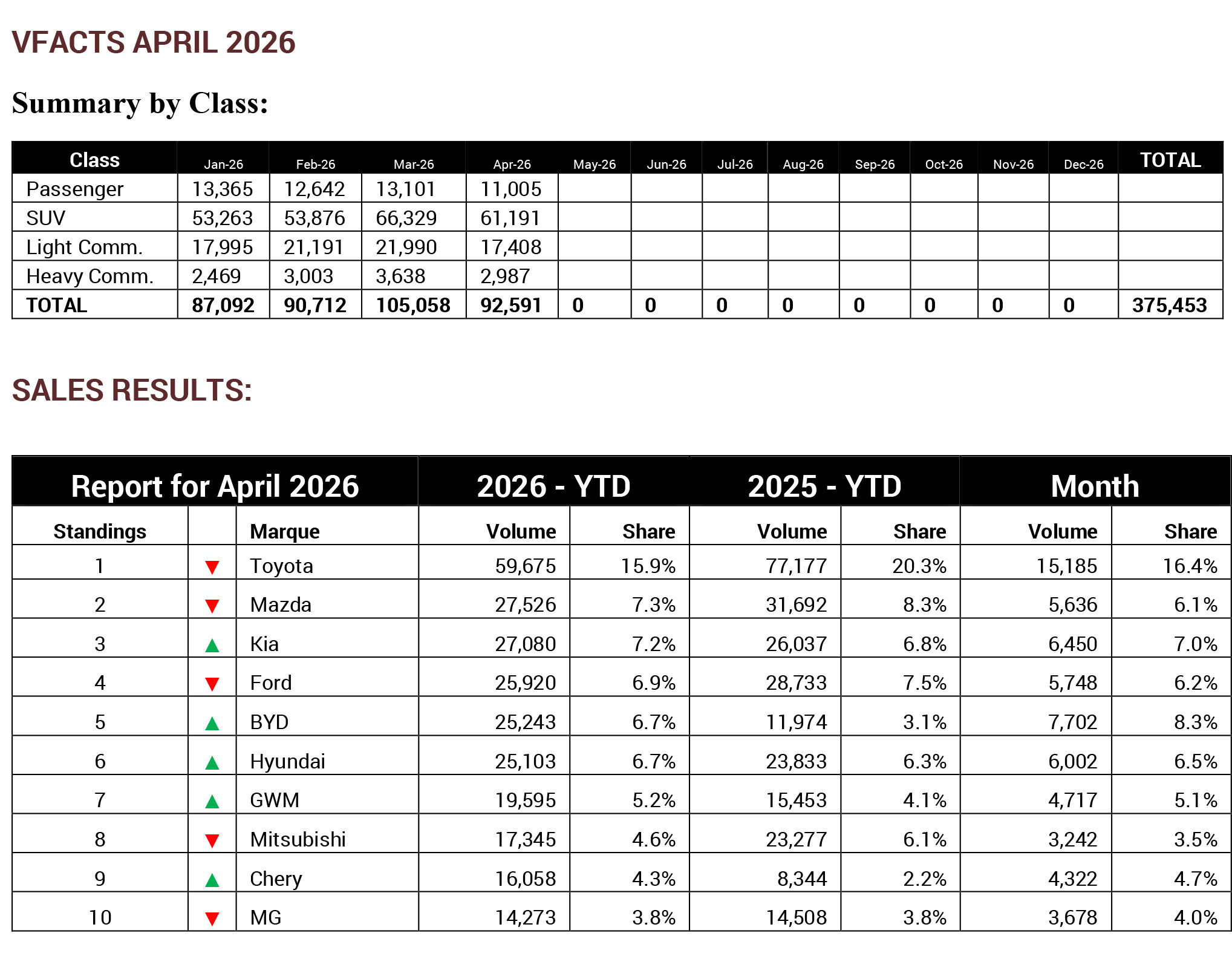
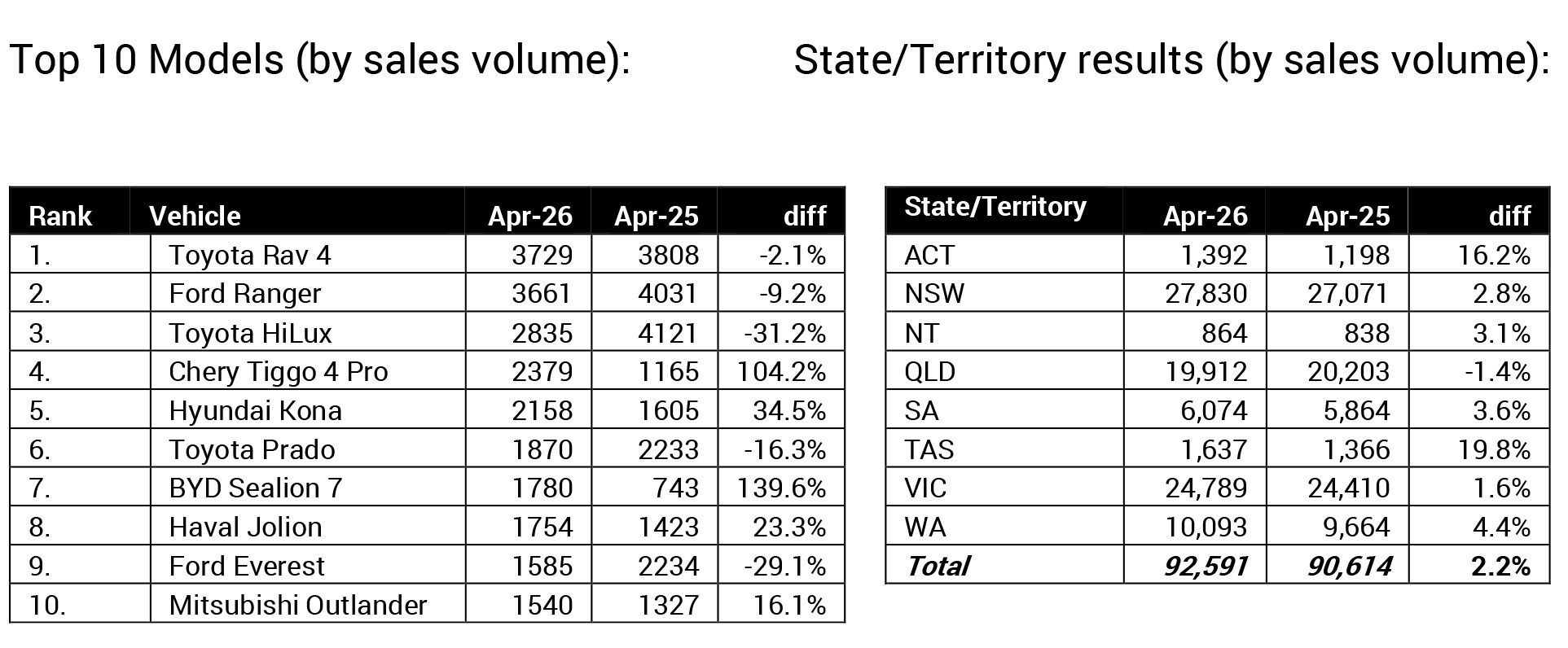
Data from Australia’s Federal Chamber of Automotive Industries and the Electric Vehicle Council reveal that, of the 92,591 new cars, SUVs, pickups, vans, and trucks sold in April 2026 (up 2.2% over the same month in 2025), 16.4% were battery-electric. This works out to 15,185 vehicles. In contrast, April 2025 saw just 6,010 new EV sales.

See Also: For The First Time, Electrified Car Sales Surpassed Gas Vehicles In Australia

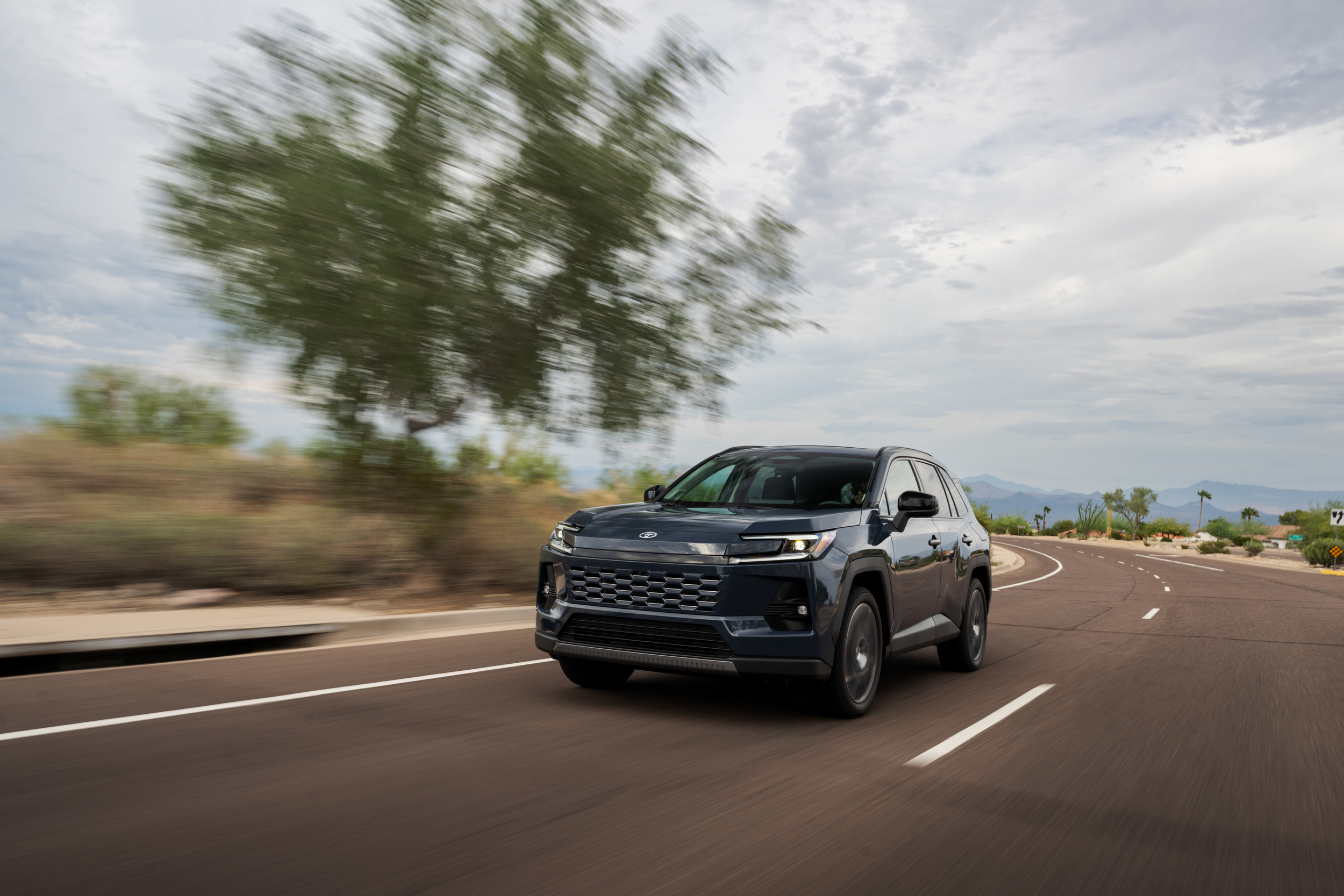
It’s not just EVs that saw strong numbers; hybrids were also in demand. In fact, 18,162 new hybrids found homes in April 2026, bolstered by the first full month of sales of the Toyota RAV4, which bagged best-selling car in Australia. Plug-in hybrids also saw 9,628 new units shifted in April 2026.

Petrol And Diesel Vehicle Sales Dwindle

While EVs, hybrids, and plug-in hybrids were enjoying the limelight, partly driven by tax incentives, traditional gasoline and diesel-powered vehicles took a hit in April 2026. Sales of new gasoline-powered vehicles saw a decline of 30.1% in comparison with April 2025 figures.

Diesel-powered new vehicle sales were down by 21.7%. These declines could also be attributed to the ongoing war in the Middle East, which has significantly affected crude oil deliveries to Australia. This has resulted in rising prices at the pump, as well as some scattered shortages.

For April 2026, BYD’s Sealion 7 SUV dominated the EV rankings, with 1,780 units sold. Meanwhile, the Tesla Model Y sold nearly 1,000 fewer units, although it was up 193.6% year-on-year, as last year’s model was due for replacement.

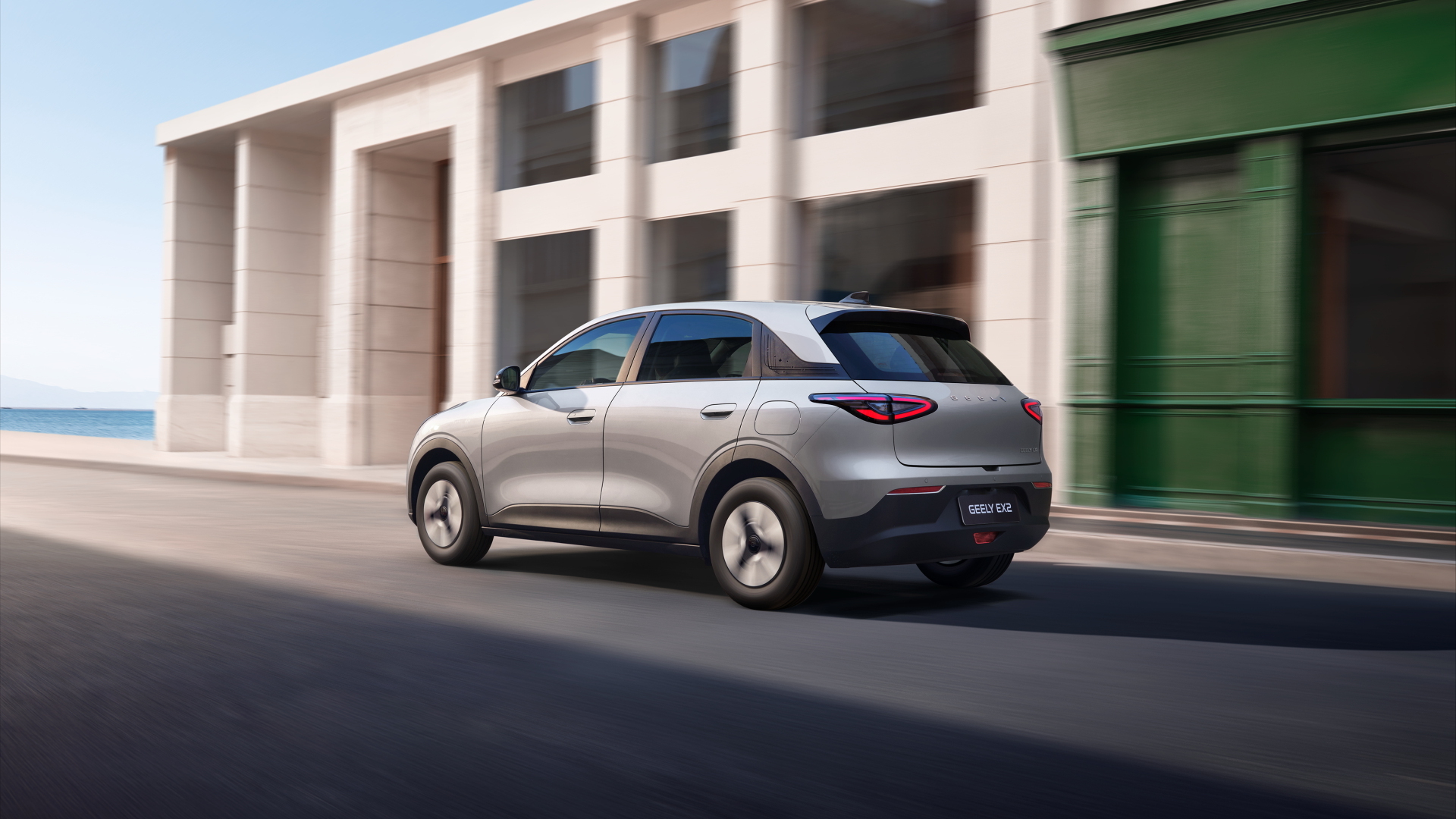
The BYD brand as a whole shifted 7,702 new units. Other strong sellers in the Chinese EV space include the Geely EX5 with 1,202 deliveries, and 1,006 units from Chinese brand Zeekr, of which 973 were its 7X SUV. Shifting our attention to the car segment, Tesla’s Model 3 narrowly beat BYD’s Seal, with 403 versus 370 deliveries.

Toyota Still Leads, Ford And Mazda Drop From Podium

 One In Six New Cars Sold In Australia Is Now An EV As Gas Sales Fall Off A Cliff

Despite a 21.6% reduction in year-on-year sales, Toyota remained top dog in Australian new vehicle sales through April 2026. They shifted 15,185 units, followed by BYD with a 7,702 new unit tally.

 One In Six New Cars Sold In Australia Is Now An EV As Gas Sales Fall Off A Cliff

BYD’s rise to second place means that Ford and Mazda, the historical second and third-place finishers, are now fifth and sixth, with 5,748 and 5,636 units respectively. However, the Ford Ranger held on to the silver medal as the second best-selling vehicle, sandwiched between the RAV4 and Hilux.

When looking at Australian new car sales as a whole, the new third- and fourth-place occupants for April are Kia and Hyundai, with 6,450 and 6,002 units sold respectively. Of course, these two automakers also have EVs and hybrids in their portfolio. The same is true for Chery in eighth place and MG in ninth, while Isuzu rounded off the Top 10 ahead of Mitsubishi.

 One In Six New Cars Sold In Australia Is Now An EV As Gas Sales Fall Off A Cliff

Tesla Is Recalling All 173 Cheap Cybertrucks Because Their Wheels Can Fall Off

  • The issue stems from cracking around brake rotor stud holes under load.
  • Only rear-wheel-drive units with base 18-inch wheels are affected.
  • Some serviced EVs may also carry the same potentially faulty parts.

The owners of 173 Cybertruck RWDs have a new problem to worry about. Tesla has issued a recall on the short-lived budget variant after discovering the wheels can come off while driving, which ranks somewhere near the top of the list of things you definitely do not want your vehicle to do.

Tesla says that on-road disturbances and cornering forces can cause cracking around the stud holes in the brake rotors. If that happens, the entire wheel stud may separate from the hub. The company is not aware of any crashes or injuries tied to the issue, though it has logged three related warranty claims.

Read: His Cybertruck Made It to 100,000 Lyft Miles Before Sending A $7,200 Reminder

A total of 173 models built between March 21, 2024, and November 25, 2025, are included in the recall. Only Cybertruck RWD versions with the base 18-inch wheels are affected, not those fitted with the optional 20-inch setup.

Tesla first identified a potential problem in August of last year, when pre-production testing revealed some cracking in the brake rotors, even though all studs remained intact at the time. Further investigation, along with field reports, showed the issue was more serious than initially thought.

Not only did Cybertruck RWD models leave the factory with the defect, but some Tesla service centers were also using the potentially faulty brake rotors, so vehicles that have had their brakes replaced may also suffer from the same issue.

What’s The Fix?

 Tesla Is Recalling All 173 Cheap Cybertrucks Because Their Wheels Can Fall Off

While the recall notice lists vehicles produced from March 21, 2024, Tesla says it only began building Cybertruck RWD models with 18-inch wheels on August 28, 2025. Production ended less than three months later, on November 5, with the company citing limited demand for the variant.

Owners can expect notification from Tesla after June 20. They will be asked to bring their trucks to a service center, where technicians will replace the front and rear brake rotors, hubs, and lug nuts with updated, more durable components.

\\\\\

Americans Pay $37K For The Cheapest Tesla, Canada Got A Chinese One For $29K

  • Tesla is making the most out of reduced tariffs on Chinese-built EVs.
  • Up to 49,000 EVs built in China can be imported to Canada annually.
  • Base Model 3 RWD hits 62 mph in 5.2 seconds and has a 288-mile range.

As expected, Tesla has become the first EV maker to begin selling Chinese-made models in Canada after the two countries finalized a major trade deal earlier this year. It’s good news for Canadian car buyers, who now get access to Tesla models priced well below their American counterparts. In fact, it’s the cheapest Tesla EV ever sold in North America.

Thanks to the new trade deal, up to 49,000 EVs built in China can be imported into Canada at a reduced tariff rate of 6.1 percent, down from the 100 percent tariff imposed in 2024. Canadian officials began issuing permits for the first 24,500 vehicles in March, and Tesla moved quickly to capitalize.

Read: Canada Could Give China’s Biggest Carmaker A Backdoor Into The US Market

By importing from China, Tesla has reintroduced the entry-level Model 3 Premium RWD to Canada. It is priced from just CA$39,490 before delivery, or around US$29,007 at current exchange rates, undercutting the most affordable Model 3 in the US, the standard RWD model that starts at US$36,990 before taxes and delivery fees. The Shanghai-spec Model 3 has a quoted driving range of 463 km (288 miles) and can go from 0 to 100 km/h (62 mph) in 5.2 seconds.

Before the deal took effect, the most affordable Model 3 available in Canada was the Long Range AWD shipped up from Fremont, California, with a starting price of CA$79,990 (US$58,700). It isn’t a spec-for-spec comparison, but Tesla has effectively cut its Canadian entry point in half overnight.

Performance Gets A Price Cut

 Americans Pay $37K For The Cheapest Tesla, Canada Got A Chinese One For $29K

Canadian buyers can also order the Model 3 in Performance guise, now priced from CA$74,990 (US$55,050). That marks a 17 percent drop from CA$89,990 (US$66,070), bringing the Canadian price roughly in line with the US$54,490 sticker American buyers pay for the same trim. Tesla has not confirmed where it will source Model 3 Performance models for the Canadian market, though reports suggest Fremont remains the likely origin.

The only downside of Tesla now importing some Model 3s from China is that these models do not qualify for Canada’s Electric Vehicle Affordability Program (EVAP) rebate, valued at $5,000, according to Drive Tesla.

It remains unclear how many of the initial 24,500 permits Tesla will lock down, though Canadian officials have confirmed they’re being issued on a first-come, first-served basis. Unless rivals like Volvo and Polestar move quickly to get their own Chinese-built EVs across the Pacific, Tesla looks poised to walk away with the lion’s share.

\\\\\

Tesla’s California Sales Fell 24 Percent, Nearly Everyone Else Got Crushed

  • California EV sales dropped 40% year over year in the first quarter.
  • Tesla shed the most volume yet gained share as rivals fared worse.
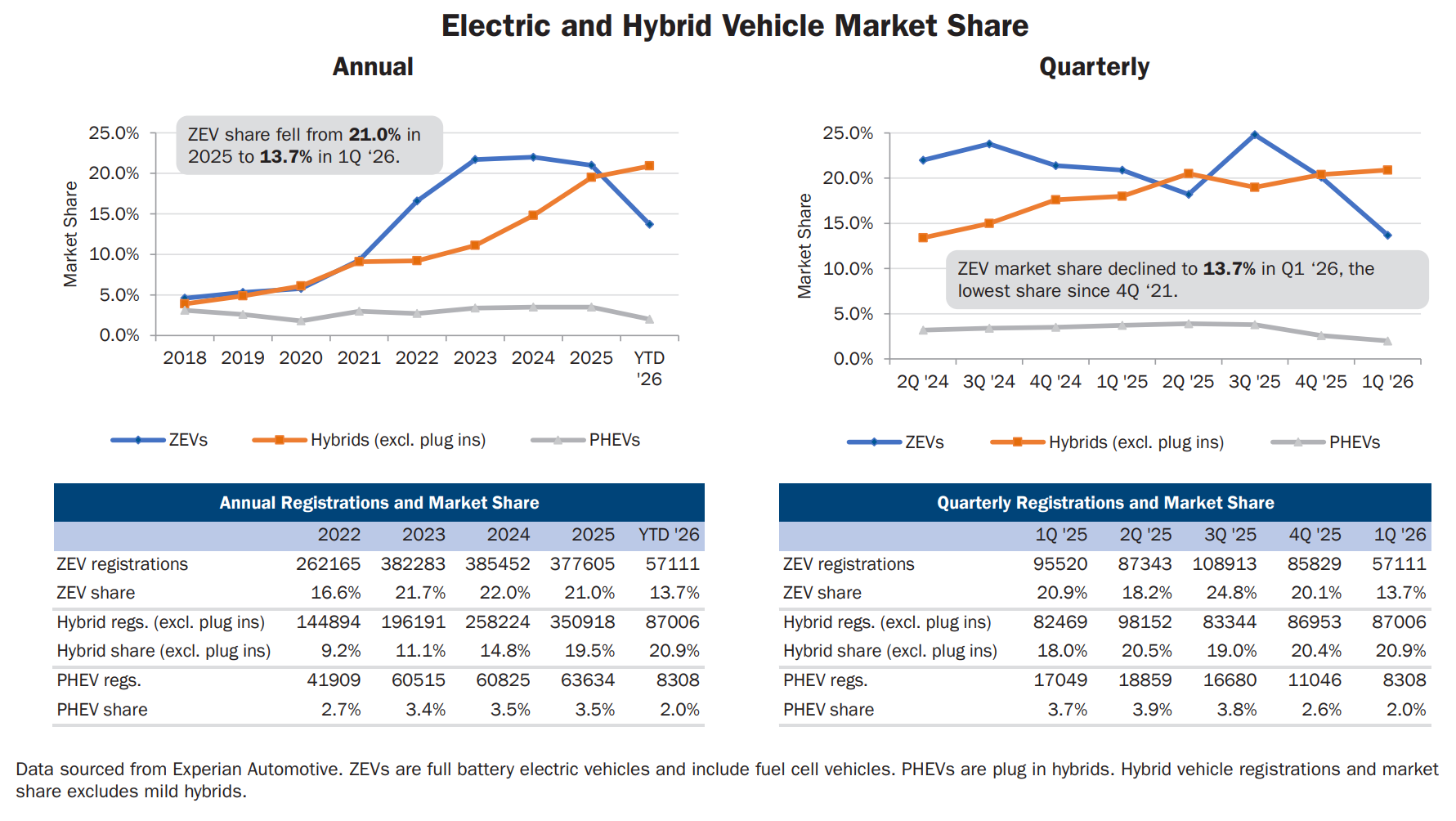
  • ZEV market share across the state has slipped to just 13.7%.

For years, California has set the pace for EV adoption in America, the bellwether other states watched. Now the bellwether is wobbling. Recent sales data reveal a significant decline in the state’s EV registrations through the first quarter of the year, driven by a sharp drop in demand for new Tesla models.

So far this year, a total of 57,111 zero-emission vehicles (ZEV) have been sold across the Golden State. This represents a significant 40.2 percent decline from the 95,520 sold over the same period last year, and comes on the back of an overall drop in new car registrations of 8.9 percent, falling from 457,525 to 416,810.

Read: Rivian Beat Four Major Automakers In EV Sales, And Its Biggest Model Hasn’t Even Launched Yet

The decline in demand for ZEVs means they accounted for just 13.7 percent of the total market in Q1 2026. By comparison, they had a 16.6 percent share in Q1 2022, peaking at 22 percent in Q1 2024 before falling slightly to 21 percent in Q1 2025.

Things look particularly troubling for Tesla. First-quarter registrations fell 24.3 percent to 31,958, down from 42,211 a year earlier. In raw volume, no brand lost more. In percentage terms, Tesla actually weathered the storm better than most of its rivals. Despite its own losses, Tesla’s slice of the EV pie grew from 44.2 percent in Q1 2025 to 56 percent last quarter, less because Tesla improved than because everyone else collapsed around it.

 Tesla’s California Sales Fell 24 Percent, Nearly Everyone Else Got Crushed

Most Brands Suffer

The collapse around Tesla is brutal. Over at Acura, ZEV sales fell from 1,279 to just 11 units in Q1, down 99.1 percent. Audi managed 210 registrations against 2,319 a year earlier, down 90.9 percent. BMW fell 58.9 percent, from 5,301 to 2,180. Chevrolet dropped 59.6 percent to 1,875. Ford was off 58.8 percent at 2,374. Honda plunged 81.6 percent to 832. Dodge mustered 16 units, down 79.7 percent. Hyundai held up comparatively well, off 30.4 percent at 3,586.

Only a handful of brands moved the other way. Lexus posted the standout figure, climbing 192.1 percent to 1,405 units, while Toyota grew 37.8 percent to 2,599 and Lucid added 37.1 percent to reach 1,315. Cadillac edged up 17.1 percent to 1,771.

Several factors have fed into the decline. Affordability concerns remain prevalent across the state, as they are throughout the country, while financing costs remain high due to current interest rates. Additionally, tariffs have driven higher prices, and overall inflation has spiked, while the phase-out of the federal tax credit has done the rest. None of this is mysterious, it all adds up.

Top 25 Selling Hybrid, ZEV, and PHEV Models
RankModelSales
1Tesla Model Y22,907
2Toyota Camry14,903
3Honda CR-V8,315
4Tesla Model 35,688
5Honda Civic5,507
6Toyota RAV44,770
7Honda Accord4,330
8Toyota Corolla3,639
9Toyota Sienna3,252
10Toyota Grand Highlander3,027
11Hyundai Ioniq 52,778
12Lexus RX2,714
13Ford Maverick2,631
14Kia Sportage2,588
15Toyota bZ4X2,527
16Hyundai Santa Fe2,201
17Hyundai Tucson2,194
18Toyota Prius2,139
19Mazda CX-501,963
20Lexus NX1,827
21Kia Niro1,805
22Subaru Forester1,704
23Tesla Model X1,652
24Ford Mustang Mach-E1,578
25Rivian R1S1,520
SWIPE
California ZEV Sales 2026
MakeQ1-25Q1-26% Diff.
Acura1,27911-99.1
Audi2,319210-90.9
BMW5,3012,180-58.9
Cadillac1,5121,77117.1
Chevrolet4,6411,875-59.6
Dodge7916-79.7
Ford5,7582,374-58.8
Genesis54692-83.2
GMC913376-58.8
Honda4,510832-81.6
Hyundai5,1563,586-30.4
Jeep14742-71.4
Kia3,0021,554-48.2
Lexus4811,405192.1
Lucid9591,31537.1
Mazda20-100.0
Mercedes-Benz3,617654-81.9
MINI20761-70.5
Nissan1,447150-89.6
Other1,059133-87.4
Polestar316219-30.7
Porsche1,335409-69.4
Ram1141,300.0
Rivian2,8721,841-35.9
Subaru924465-49.7
Tesla42,21131,958-24.3
Toyota1,8862,59937.8
Volkswagen2,404445-81.5
Volvo636524-17.6
TOTAL95,52057,111-40.2
SWIPE

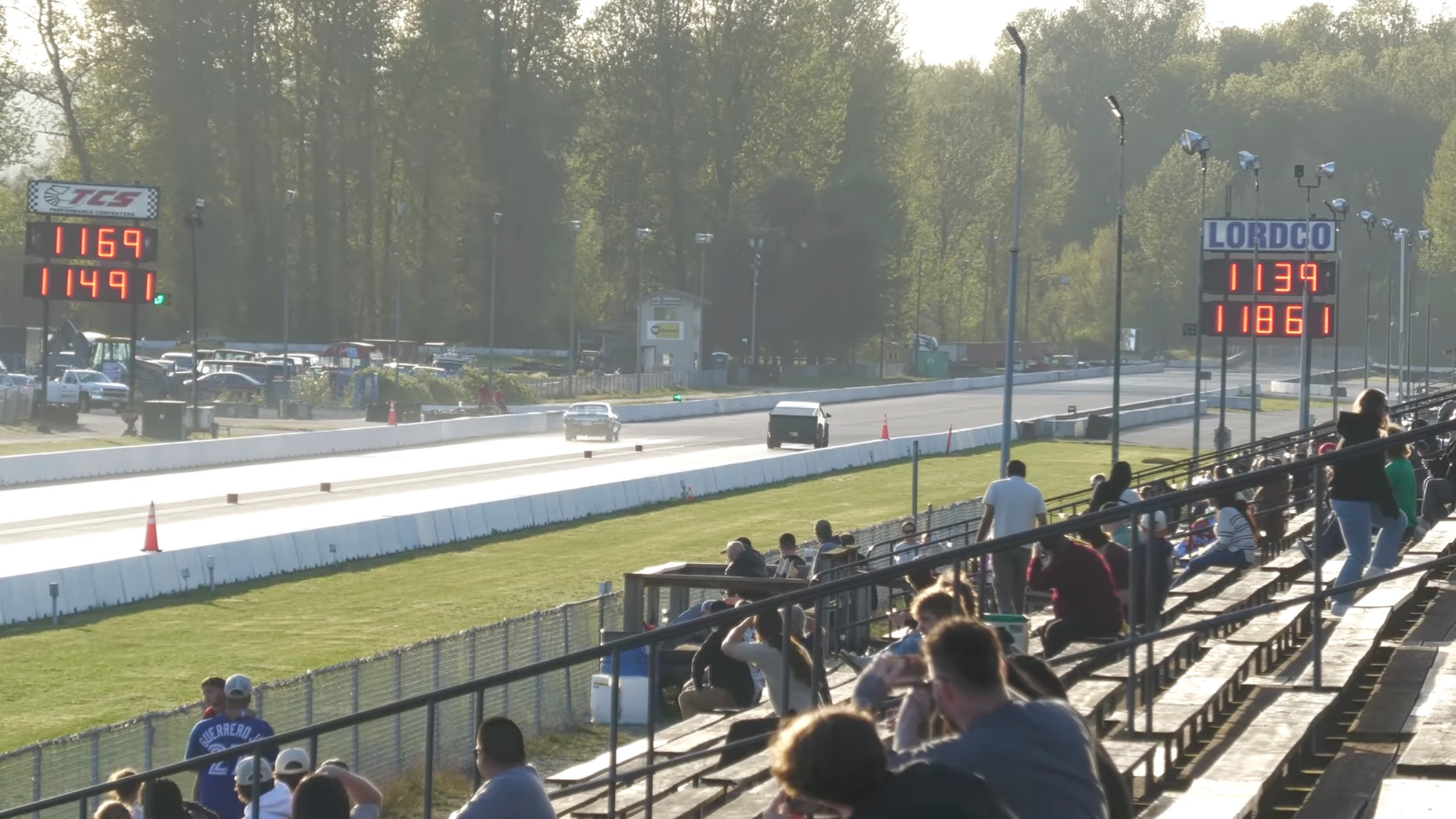
The Cybertruck Hit 118 MPH In The Quarter Mile, A 56-Year-Old Chevy Still Beat It

  • Modified Chevy Chevelle narrowly beats a Cybertruck whose driver had terrible reactions.
  • Tesla recovers late, posts quicker ET and higher trap speed, but still technically loses.
  • A better Tesla reaction in a rematch would have transformed the result in Cybertruck’s favor.

The classic muscle scene is seriously tribal, but the one thing guaranteed to get GM, Mopar, and Ford fans to unite is a race between a V8 and a modern EV. And that’s exactly what’s served up in this surprising video, where a Tesla Cybertruck ventures onto a drag strip.

In the left lane is a 1970 Chevrolet Chevelle Malibu, and while we don’t know the full details of the car in question, it’s obviously not rocking that year’s base inline-six. It rolled to the line wearing fat sticky rear rubber, aftermarket wheels, and the sort of stance that says this thing doesn’t spend much time below full throttle.

Related: In Florida, 148 MPH Gets You Arrested. In California, It Gets You A Ticket

The biggest factory motor available in 1970 Chevelles delivered 454 cubes (7.4 liters) of displacement, and modern builds on that big-block base can easily generate 500-600 hp (507-608 PS) in naturally aspirated form.

Cybersnooze

We’ve all seen enough EV videos to expect the Cybertruck to hook up instantly and erupt from the line, leaving the Chevelle struggling to get its tires hooked up. A few seconds later, the Tesla would be flashing across the finish with the Chevy trailing behind, its pride in tatters.

But that’s not how it worked out here. When the lights change, the Chevy gets the jump immediately and charges ahead, opening enough daylight to make it seem like the race might be over before the Tesla has fully woken up. For the first half of the quarter mile, the old-school muscle car looks comfortably in command.

Then the Cybertruck gets its act together. Once it’s moving and the motors are fully delivering, the giant stainless wedge storms downtrack and begins hauling in the Chevy at an alarming rate. What had looked like an easy Chevelle win suddenly becomes a blink-and-you-miss-it finish line showdown.

Times Come Second

You’ll need slowed playback to separate them by seeing whose numbers come up first, but the Chevelle appears to nose ahead at the line. In drag racing, that’s what counts. First across wins, even if the stopwatch tells a slightly different story.

And the stopwatch did tell a different story. The Cybertruck completed the quarter in 11.39 at 118.6 mph (191 km/h), that ET and trap speed suggesting it’s the top-spec Cyberbeast, which has a tri-motor setup and 845 hp (856 PS / 630 kW). The Chevelle registered 11.69 seconds at 114.9 mph (185 kmh).

So on this occasion, muscle fans got to celebrate taking an EV’s scalp, but you just know that if the Cybertruck sorted his reactions for a rematch, it would be a different story.

 The Cybertruck Hit 118 MPH In The Quarter Mile, A 56-Year-Old Chevy Still Beat It

YouTube/@Wheels

His Cybertruck Made It to 100,000 Lyft Miles Before Sending A $7,200 Reminder

  • One owner used his Cybertruck for Lyft and crossed the 100,000-mile mark.
  • Low charging costs were great, but one repair alone cost him $7,200.
  • Despite several issues, he still says it’s the best vehicle for the job.

Most Cybertruck buyers appear to be the kinda folks that want to make a statement. The focus of this story is an owner who uses it to make a living. After piling up 100,000 miles, mostly for Lyft in Nashville, he says the slab-sided truck is everything from a money-saving workhorse to a warranty-free financial gut punch waiting to happen. Despite everything he’s experienced, he still wants to take this thing to a million miles.

The inventively named user LyftDr1ver on CybertruckOwnersClub shared their story early this week. They say they drive over seven hours at a time for work, which helps explain how they’ve racked up mileage in the six figures.

Driving a conventional truck that much every day would no doubt cost a great deal in gas or diesel. This person is reportedly paying around $12 a day. They say that’s around $350 a month. If you’ve been to a gas pump lately, you know how wildly low those operating costs are. There are other benefits to the Tesla as well.

More: Uber And Lyft Drivers Are Using FSD Teslas As Robotaxis

The driver reports that passengers like the interior space, the panoramic roof, and the smooth ride. The sound system is another highlight, and the truck bed is “ridiculously functional and spacious,” too. One thing that might surprise most is that this person reports a good experience driving in heavy traffic despite its size, thanks to the steer-by-wire setup. Of course, there are downsides to consider as well.

 His Cybertruck Made It to 100,000 Lyft Miles Before Sending A $7,200 Reminder

Being an early Cybertruck build, there are plenty of build-quality annoyances. A tonneau cover that leaks, a suspension clunk that won’t go away, a wireless charger that heats phones up too much, and an initial set of tires that went bald 40,000 miles into the ownership experience. They also note the battery has degraded to about 299 miles of range at full charge.

None of that is as rough as dealing with the $7,200 repair bill for a failed power conversion system that died at around 60,000 miles. As the owner says, “Tesla shows no mercy when you’re outside your warranty.” Those fuel savings dry up real quick after a bill like that, but it’s worth noting that most gas or diesel vehicles would also have some big maintenance bill of this sort with this kind of mileage.

At this point, the owner has two big hopes. First, that the truck doesn’t break down, and second, that they can drive it until the odometer shows seven figures. For some reason, those goals seem ambitious at best, but hey, more power to you, LyftDr1ver.

 His Cybertruck Made It to 100,000 Lyft Miles Before Sending A $7,200 Reminder
Photos Tesla

Side By Side, The Rivian R2 And Model Y Look Like They’re From Different Planets

  • Rivian’s new entry-level electric SUV has a lot going for it.
  • The R2 is taller than a Model Y, but surprisingly, it’s also shorter.
  • Driving the R2 Performance are dual electric motors with 656 hp.

In a market where electric SUVs are starting to blur into one another, standing out is no longer optional. The Rivian R2 is a pivotal model for the brand, bringing its EV technology into a smaller, more affordable package. If Rivian wants to grow into a true volume manufacturer and challenge legacy players, the R2 needs to land with buyers.

Its biggest hurdle is persuading shoppers to choose it over the Model Y, still America’s best-selling EV by a wide margin that even Tesla’s own Model 3 does not approach, let alone anything else. As these side-by-side photos of an R2 and a Model Y show, the pair have similar footprints but look absolutely nothing alike.

Read: Rivian R2 And Jeep Recon Solve The Same Problem, But Which One Solves It For You?

These photos, captured by Reddit user SciencesNotStudies at Rivian’s headquarters, show both vehicles charging next to each other. Whereas Tesla opted for a sleek profile in the Model Y, making it look like a bloated Model 3 rather than a traditional SUV, the Rivian R2 is very different. It’s boxier, stands taller, and is much more upright, looking just like the R1, albeit on a slightly smaller scale.

Interestingly, the Model Y is slightly longer than the R2, measuring 188.6 inches (4,790 mm) compared to the Rivian’s 185.9 inches (4,722 mm). The R2 is also slightly narrower at 75 inches (1,905 mm), versus 75.6 inches (1,920 mm) for the Tesla.

The biggest gap appears in height, with the R2 standing 66.9 inches (1,700 mm) tall compared to the Model Y’s 63.9 inches (1,624 mm). The Rivian’s wheelbase is also 1.8 inches longer, at 115.6 inches (2,935 mm) compared to 113.8 inches (2,890 mm) for the Tesla.

The ground clearance also differs dramatically between the pair. Like the R1, the R2 has been designed to be right at home off-roading, offering 9.6 inches (245 mm) of clearance compared to the Model Y’s 6.0 inches (152 mm).

What About Performance?

 Side By Side, The Rivian R2 And Model Y Look Like They’re From Different Planets

The first version of the R2 to be sold, the Performance Launch Edition, rocks a pair of electric motors delivering 656 hp and an 88.7 kWh battery pack, giving it slightly more power than the Model Y Performance with 618 hp and better range, 328 miles (528 km) compared to 306 miles (492 km). However, as the Tesla weighs less, it hits 60 mph (96 km/h) in 3.3 seconds compared to the R2’s 3.6 seconds.

Where The Numbers Stop Favoring Rivian

And then there’s pricing, which is not doing Rivian many favors on paper. The R2 Performance Launch Edition starts at $57,990, essentially mirroring the $57,490 Model Y Performance. However, step down to the mid-tier R2 Premium with 450 hp and all-wheel drive, and you’re still looking at $53,990, a noticeable jump over Tesla’s Model Y Premium AWD at $48,990.

Also: Rivian R2 Starts At $57,990, But Cheaper Versions Are Still Coming

Rivian has confirmed a base rear-wheel-drive R2 at $45,000, though that version will not arrive until 2027, which is a long wait. Tesla, meanwhile, already covers that ground with two RWD options, starting at $39,990 for the standard version and $44,990 for the Premium.

Although the R2 is Rivian’s answer to the Tesla Model Y, matching its sales volume will be a tall order. Like the R1, it appears to lean toward a more niche appeal and could end up competing more closely with models like the Jeep Recon.

\\\\\\\\\

Lead image Reddit / SciencesNotStudies

Tesla’s Signature Edition Buyers Face A $50,000 Resale Ban Tesla Already Failed To Enforce Once

  • Tesla’s final Signature Edition Models come with a one-year no-resale clause.
  • Flip one earlier than that, and Tesla could demand at least $50,000.
  • Lifetime FSD, free Supercharging, and connectivity die with the first owner.

Production of the Tesla Model S and Model X is ending with 350 Signature Edition cars. Each one gets a ton of perks and a premium price tag. On top of that, buyers have to agree not to sell for at least one year from delivery. Tesla has tried and failed to enforce this type of thing before. This time, it might have figured out the right levers to pull.

Buyers of the last-ever Signature Edition versions of the Model S Plaid and Model X Plaid will reportedly have to sign a strict no-resale agreement before taking delivery. According to the order documents spotted by Not A Tesla App, owners agree not to sell or even attempt to sell the vehicle within the first year after delivery. Breaking the agreement evidently makes owners subject to liquidated damages of $50,000 or however much profit they make, whichever is greater.

More: You’d Have To Be High To Pay $159,420 For Tesla’s Signature Editions

The move is clearly aimed at keeping speculators from immediately flipping the final 350 Signature Editions for huge profits. Tesla is only building 250 examples of the Model S and 100 of the Model X, each finished in exclusive Garnet Red paint with gold badging and unique trim. Tesla tried this with the Cybertruck and the entire scheme fell apart, aside from the brand allegedly blacklisting some customers.

The policy was met with immediate backlash. Owners argued Tesla was trying to control something they had already paid for, while others simply ignored the clause and listed their trucks anyway. Within months, Tesla quietly dropped the restriction as Cybertruck supply increased and the market cooled. This time around, there are some key differences.

Signature Edition Model S/X orders contain a No Resale Agreement.

Here is the document.

Additionally, here is the resale clause which states the Luxe Package does not transfer (this is not new) pic.twitter.com/CGB5QBJIL6

— The Cybertruck Guy (@cybrtrkguy) April 12, 2026

The new agreement is cleaner and potentially easier to enforce. Unlike the Cybertruck contract, which relied on vague “unforeseen reason” language, the Signature Edition version flatly says owners cannot “sell or otherwise attempt to sell” the car within a year.

Tesla also has a stronger case because these are truly limited: just 350 cars total, versus thousands of Cybertrucks. Most importantly, Tesla made the biggest perks like FSD, free Supercharging, and Premium Connectivity non-transferable. That means even after a year, the car is worth less to a second owner, reducing the incentive to flip it in the first place. Will that stop every buyer from selling within 12 months? We doubt it.

NEWS: Tesla has announced a Signature Edition Model S and Model X as a final goodbye for these two vehicles.

• Price: $159,420
• Only 250 Model S & 100 Model X Signature Editions will be built. All Plaid variants.
• Garnet Red exterior paint
• Matching Garnet Red Door… https://t.co/3FYGlbKEa2 pic.twitter.com/VA8NZN8Mht

— Sawyer Merritt (@SawyerMerritt) April 11, 2026
❌
❌