Normal view

There are new articles available, click to refresh the page.
Today — 24 May 2026Regional

When a president settles his own lawsuit to create a fund for allies, fundamental questions arise

A banner showing President Donald Trump hangs from the U.S. Department of Justice on Feb. 20, 2026. (Photo by Shauneen Miranda/States Newsroom)

A banner showing President Donald Trump hangs from the U.S. Department of Justice on Feb. 20, 2026. (Photo by Shauneen Miranda/States Newsroom)

Thomas Hobbes took a very dim view of rebels and insurrectionists. He believed that insurrectionists relinquish their status as citizens the moment they seek to overthrow the government and should never be rewarded for doing so.

Hobbes, one of the finest political theorists of his time, said this in his great political treatise, “Leviathan,” published in 1651 during a civil war in England and Scotland.

Hobbes would likely also take a dim view of a major development announced by the Trump administration on May 20, 2026.

The U.S. Department of Justice has established a US$1.776 billion “Anti-Weaponization Fund,” to be used, the AP reports, to “allow people who believe they were targeted for prosecution for political purposes, including by the Biden administration Justice Department, to apply for payouts.”

The fund, Acting Attorney General Todd Blanche said, offers “a lawful process for victims of lawfare and weaponization to be heard and seek redress.”

Critics immediately charged that it might be used to compensate people involved in – some even convicted for – the Jan. 6, 2021, attack on the Capitol. Blanche has not ruled out that possibility.

The establishment of the fund is part of a settlement agreement, in response to which President Donald Trump dropped his $10 billion lawsuit against the Internal Revenue Service for damages stemming from the leak of his tax returns. Those leaks, the lawsuit alleged, “caused Plaintiffs reputational and financial harm, public embarrassment, unfairly tarnished their business reputations, portrayed them in a false light, and negatively affected President Trump.”

A DOJ press release indicates the fund will provide “formal apologies and monetary relief” to those who file claims and will cease processing claims “no later than” Dec. 1, 2028. It will be run by a five-person board appointed by the attorney general, and the president will also have the power to remove board members.

Whether or not Jan. 6 participants benefit, some believe that this situation creates an unavoidable appearance of self-dealing and favoritism. As a student of American law and political morality, I think there are important moral and constitutional issues implicated by the president’s suit against the IRS and the creation of the Anti-Weaponization Fund.

Some of them are straightforward; others are less so.

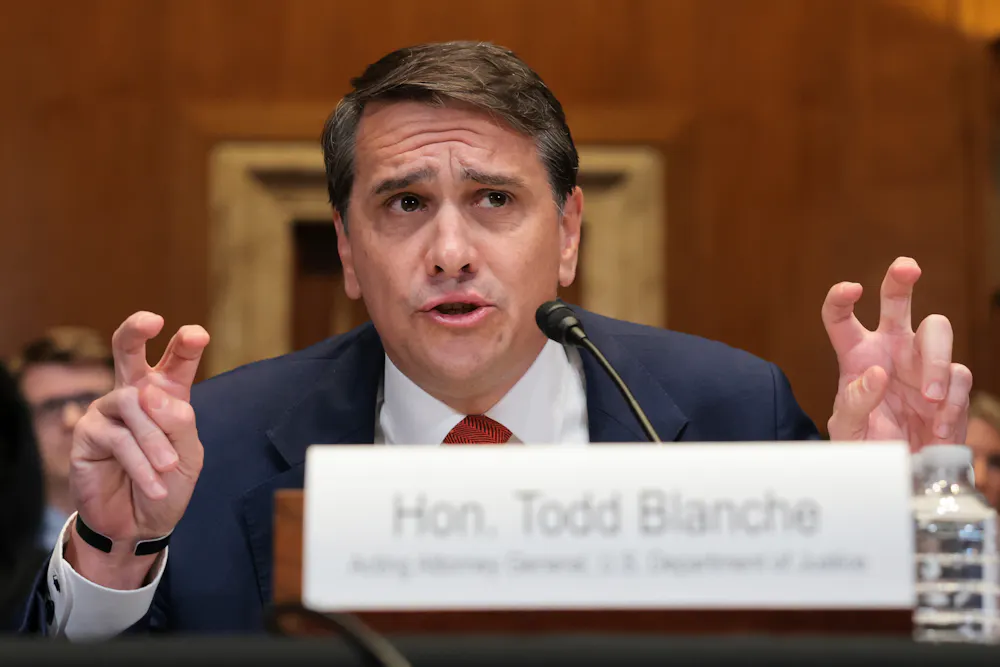
A man talking at a table behind a name plate, gesturing with his fingers.
Acting U.S. Attorney General Todd Blanche testified about the compensation fund during a Senate Committee on May 19, 2026, in Washington, D.C. (Photo by Anna Moneymaker/Getty Images)

A judge in their own cause

An obvious question is: Should taxpayer funds be given to Trump allies, in a settlement reached by the Trump-controlled DOJ as compensation for a Trump family lawsuit?

As far back as ancient Greece, philosophers like Aristotle have worried about what happens when people are called on to make judgments in cases where they are involved. Aristotle thought that the natural instinct for self-preservation meant that they would always favor themselves.

From that concern emerged what was then, and remains, an uncontroversial, bedrock moral principle.

In the Roman world, the Latin phrase “Nemo iudex in causa sua” meant “no one should be a judge in their own cause.” It recognized that anyone having a personal interest should not get to decide matters in which they are involved.

In the Englsh-speaking world, Hobbes himself reiterated that phrase as he explained some of the advantages of living in an organized society, which could supply impartial judges to resolve disputes. And in 1787, James Madison wrote, “No man is allowed to be a judge in his own cause, because his interest would certainly bias his judgment, and, not improbably, corrupt his integrity.”

Commentators reacting to the Justice Department’s decision to establish an Anti-Weaponization Fund to settle the president’s claims against the IRS have drawn on these longstanding principles to criticize it, including how the DOJ, which is part of the executive branch controlled by Trump, negotiated with him to reach this settlement.

The conservative lawyer and activist Ed Whelan said, “There is a glaring conflict of interest with Trump being on both sides of the claim.” Whelan added, “It is outrageous that he and those answering to him would be deciding how the government responds to these extravagant claims.”

In testimony on May 19, 2026, before the Senate Appropriations Committee, Blanche offered a different view. He said the settlement fund was not unprecedented and likened it to a different fund, established by the Obama administration, to settle discrimination claims brought by Native American and Black farmers.

“It’s not limited to Republicans. It’s not limited to Democrats,” Blanche added. “It’s not limited to January 6th defendants. It’s limited only by the term weaponization.” Blanche promised that payments from the fund will be publicly disclosed.

Negotiating with himself

In April, Kathleen Williams, the Florida federal judge who was presiding over Trump’s lawsuit, reframed the moral issue of self-dealing as a legal one. She questioned whether the case could go on, noting “President Trump’s own remarks about this matter acknowledge the unique dynamic of this litigation.”

The remarks she referenced occurred when the president talked about the lawsuit and the prospect of negotiating with himself. “And they do say that, you know, it’s never been a case like this. Donald Trump sues the United States of America. Donald Trump becomes president, and now Donald Trump has to settle the suit.”

Williams, the judge, wrote that “it is unclear to this Court whether the Parties are sufficiently adverse to each other so as to satisfy Article III’s case or controversy requirement.” That requirement means that a court can only rule when there is a real dispute before it.

That rule is designed to prevent so-called collusive lawsuits, in which “the parties are not actually in disagreement but are cooperating” to achieve a result. Judge Williams was scheduled to hear arguments on that question on May 20, 2026. But the settlement announcement was made two days before, and, in light of it, she dismissed the case.

Back to Hobbes

Beyond the case and controversy question, the Justice Department’s actions may implicate constitutional issues.

One is whether, under the constitutional separation of powers, the executive branch has the authority to create a victim compensation fund, or whether that authority rests with Congress.

Another is whether the fund violates the Constitution’s Emoluments Clause, which prohibits the president from receiving any “Emolument from the United States” other than his salary.

While the new fund may not make direct payments to Trump, he may benefit from payments to family members, business associates and others who will claim to have been victimized by the Biden administration, including people prosecuted and convicted of crimes committed on Jan. 6.

Democratic Congressman Jamie Raskin, a former professor of constitutional law, also contends that what the Justice Department has done violates Section 4 of the 14th Amendment, part of which states: “neither the United States nor any State shall assume or pay any debt or obligation incurred in aid of insurrection or rebellion against the United States.”

Referring to the president, Raskin argues hypothetically, “So, to the extent that he wants to give a million dollars to each of 1,600 pardoned rioters and insurrectionists, we think that that’s an unconstitutional use of money.”

That section of the 14th Amendment was designed to ensure that Confederate rebels would not receive compensation for the value of their emancipated slaves. However, in Perry v. United States, a 1935 case, the Supreme Court stated that Section 4’s “language indicates a broader connotation” beyond its Civil War context.

It seems clear that courts will soon be asked to decide whether Raskin and other legal critics are right in their assertions of a host of legal problems with the Anti-Weaponization Fund. How they will do so remains to be seen.

But, in a democracy, deciding whether the creation of the fund violates the moral maxim that no one can be a judge in his or her own cause ultimately will be up to the people.The Conversation

Austin Sarat is theWilliam Nelson Cromwell Professor of Jurisprudence and Political Science at Amherst College

This article is republished from The Conversation under a Creative Commons license. Read the original article.

Before yesterdayRegional

Jan. 6 police officers sue Trump over $1.77B ‘taxpayer-funded slush fund’

22 May 2026 at 07:00
Donald Trump supporters clash with police and security forces in the attack on the US Capitol on Jan. 6, 2021 in Washington, D.C. (Photo by Brent Stirton/Getty Images)

Donald Trump supporters clash with police and security forces in the attack on the US Capitol on Jan. 6, 2021 in Washington, D.C. (Photo by Brent Stirton/Getty Images)

Two police officers who defended the U.S. Capitol on Jan. 6, 2021, sued the Trump administration Wednesday to block the creation of a nearly $1.8 billion fund to pay people said to be victims of judicial weaponization, saying the fund would aid and encourage the pro-Trump rioters who attacked that Capitol that day and still harbor desire to harm the officers.

Retired U.S. Capitol Police Officer Harry Dunn and Metropolitan Police Officer Daniel Hodges said in a complaint in federal court that Jan. 6 rioters, nearly all of whom received a pardon from President Donald Trump on his first day back in office last year, could benefit from the fund and use the money to organize more violent activity.

“In the most brazen act of presidential corruption this century, President Donald J. Trump has created a $1.776 billion taxpayer-funded slush fund to finance the insurrectionists and paramilitary groups that commit violence in his name,” the first paragraph of the complaint reads.

The complaint lists Trump, acting Attorney General Todd Blanche and Treasury Secretary Scott Bessent as defendants.

The Justice Department, which Blanche has led since last month, announced the creation of the fund on Monday in conjunction with Trump dropping a $10 billion lawsuit against the IRS.

Claims by victims of ‘weaponization’

The fund would use money from a pool designated for settling legal claims against the federal government to compensate people who were “victims of lawfare and weaponization,” Blanche said in a press release.

Trump has long complained that the Biden administration targeted him, his allies and supporters for prosecutions that were not supported by facts on the ground. That claim was part of his rationale for pardoning people convicted of crimes on Jan. 6. 

The press release explicitly says there is no partisan test to benefit from the fund, but the structure gives Trump and Blanche, who was Trump’s criminal defense attorney before joining the government, near total control.

Payments from the fund would be decided by a five-member panel, which the attorney general would appoint. Only one appointment would require “consultation” with Congress and the president would be able to fire any member. The fund would dissolve in December 2028, the month before Trump’s term ends.

Dunn and Hodges said in Wednesday’s challenge that Trump’s IRS lawsuit was frivolous from the start because the president was suing a government agency that he controlled. The suit also came after the statute of limitations expired, they said.

The settlement “is a corrupt sham,” they said.

Jan. 6 injuries

Dunn and Hodges both deployed to the Capitol during the 2021 attack. The lawsuit describes the danger they faced and injuries they incurred. Hodges said a rioter tried to gouge out his eyes and that he thought he would die while crushed between metal doors.

Investigations of the attack showed that it was a “planned insurrection” by paramilitary groups like the Proud Boys, the suit says.

Former national Proud Boys leader Enrique Tarrio looked on as far-right activists celebrating the Jan. 6 Capitol attack marched down Constitution Avenue on Tuesday, Jan. 6, 2026. (Photo by Ashley Murray/States Newsroom)

Many of the people Trump pardoned for crimes connected to the attack, including former Proud Boys leader Enrique Tarrio, who was sentenced to 22 years in prison for sedition, have expressed a desire to exact revenge, according to the suit.

On Jan. 6 of this year, Tarrio said on the podcast of right-wing conspiracy theorist Alex Jones that after his pardon, he was “searching for … retribution, retaliation.” 

Fund called ‘stupid on stilts’

The fund is illegal, Dunn and Hodges’ lawsuit says. No law authorized its creation, and the appropriation creating the judgment fund that is used to pay out other settlements does not apply when no settlement has been reached, they said.

Members of Congress, including Republicans, have major reservations about the fund.

Acting Attorney General Todd Blanche at the U.S. Capitol on May 21, 2026. (Photo by Ashley Murray/States Newsroom)

Blanche pitched a group of Senate Republicans during a two-hour meeting Thursday, but didn’t appear to change many minds.

Sen. Rand Paul, a Kentucky Republican, said the meeting was a “spirited discussion.”

Shortly after the meeting, the chamber’s GOP leaders told members they would not vote this month on a $72 billion bill to fund immigration enforcement and security upgrades to Trump’s proposed White House ballroom. Senators sought to insert guardrails on the DOJ fund into the bill.

In a Wednesday interview with Spectrum News, retiring GOP Sen. Thom Tillis of North Carolina called the fund “stupid on stilts.”

“It will invariably put us in a position where your taxpayers dollars and my taxpayer dollars could potentially compensate someone who assaulted a police officer, admitted their guilt, got convicted, got pardoned, and now we are going to pay them for that,” he said. “That’s absurd.”

Senate Appropriations Chairwoman Susan Collins, a Maine Republican, has also voiced her objection. Blanche testified at a Senate Appropriations hearing Tuesday, when Collins questioned him about the fund. She later said his answers did not win her support.

“After my exchange with Acting Attorney General Todd Blanche, I do not support the creation of the proposed Anti-Weaponization Fund,” she said in a written statement that also noted no court had approved it.

Dunn also a candidate

A White House spokesperson deferred a message seeking comment Thursday to the Justice Department. Spokespeople for the department did not return messages.

Dunn, who is running as a Democrat for a Maryland U.S. House seat, told Maryland Matters the fund did not come as a surprise.

“This was a promise to his supporters,” Dunn said. “When it was finally announced, there was no doubt in our minds to stop this.”

Ashley Murray and Will Ford contributed to this report.

US Senate GOP punts immigration bill amid big split with Trump over settlement fund

Acting Attorney General Todd Blanche appears at the U.S. Capitol in Washington, D.C., on May 21, 2026. (Photo by Shauneen Miranda/States Newsroom)

Acting Attorney General Todd Blanche appears at the U.S. Capitol in Washington, D.C., on May 21, 2026. (Photo by Shauneen Miranda/States Newsroom)

WASHINGTON — A multibillion-dollar package to fund immigration enforcement for the rest of President Donald Trump’s term faced new delays Thursday as Senate Republicans showed a rare split with the president over his new “anti-weaponization” fund.

The administration dispatched Acting Attorney General Todd Blanche to Capitol Hill to meet with Senate Republicans as many fought to add restrictions to Trump’s $1.776 billion fund as a condition for passing a proposed $72 billion for the departments of Homeland Security and Justice.

Sen. Rand Paul, R-Ky., said the hourslong closed-door meeting with Blanche included “spirited discussion.”

The Department of Justice announced Monday the fund for “victims of lawfare” in exchange for Trump dropping his $10 billion lawsuit against the IRS. Both agencies are under his purview.

“It’s unprecedented to see a settlement between two parties that seem to be the same person,” Paul said.

Acting Attorney General Todd Blanche walks by reporters at the U.S. Capitol on May 21, 2026. (Photo by Ashley Murray/States Newsroom)

Ultimately, senators left their meeting with Blanche with no immediate path forward for the budget reconciliation bill that requires a simple majority to pass. Senate Majority Leader John Thune can only afford to lose a handful of votes in the GOP-led Senate that is split 53-47, as all Democrats vow to oppose the package.

“We’re going home,” Sen. John Kennedy, R-La., said as he made flight arrangements with his staff while standing outside the meeting room. 

Thune told reporters “we will pick up where we left off.” 

Asked whether he thinks a resolution can be reached, the South Dakota Republican said “that’s what I’m counting on.” 

The Senate has adjourned except for pro forma sessions until the afternoon of June 1, the date Trump set to have the finished bill on his desk.

Among the sticking points in the Blanche meeting: whether Jan. 6, 2021, Capitol riot defendants who assaulted police officers would qualify for the financial relief.

“I did raise that issue,” said Sen. Susan Collins, R-Maine. “But we haven’t seen (bill) language yet.”

The administration maintains the fund will be nonpartisan, and not only open to Trump supporters. A five-seat commission — four to be appointed by Blanche and the fifth in consultation with Congress — will issue decisions on financial claims.

Further details emerged Tuesday from the Department of Justice, revealing that Trump and his family will be forever immune from tax audits as part of the settlement.

Ballroom battle

Before debate erupted over Trump’s “anti-weaponization” fund, Republicans had already fractured over a $1 billion Secret Service security earmark in the bill, $220 million of which was set to be used to “harden” Trump’s White House ballroom project.

The funds for the “East Wing Modernization Project” would have paid for bulletproof glass, drone detection technologies and filtration systems designed to detect chemical or other contaminants. 

Sen. Bill Cassidy, R-La., who lost his primary Saturday after Trump supported another candidate, told reporters he would not vote for ballroom funds.

Democrats claimed credit for getting the $1 billion tossed from the bill after challenging whether the provision fit within the strict parameters of reconciliation. Ultimately, the Senate parliamentarian ruled it out, sparking a social media attack from Trump Tuesday.

Trump told reporters Thursday if Senate Republicans didn’t find a way to pass the extra security money, “Then the White House won’t be a very secure place.”

Senate Dems vow to stop ‘slush fund’

Democrats pounced on the opportunity to spotlight the Republican division.

“This afternoon, Republicans — so divided, so dysfunctional, so disorganized — are fleeing Washington,” Senate Minority Leader Chuck Schumer told reporters at a press conference after movement on the package stalled. 

U.S. House Minority Leader Hakeem Jeffries, D-N.Y., speaks at a press conference with other Democrats about Republicans’ immigration enforcement bill. (Photo by Ashley Murray/States Newsroom)

“Republicans are divided over things that Americans don’t want, but Democrats are united around things that the people do want — for us to lower their costs, rein in the chaos, fight the corruption that is endemic to this administration,” the New York Democrat added. 

Schumer added that “we’ll do everything we can to stop this slush fund, whether it’s in the courts, whether it’s legislative, whether it’s through reconciliation, or any other legislative means.”

Senate Democrats still plan to offer up a handful of painful amendments for GOP senators to vote on during a marathon voting session when and if the bill finally reaches the floor. 

War powers vote postponed

On the other side of the Capitol, House Republicans abruptly delayed an Iran War Powers Resolution vote moments before it was scheduled to open on the floor.

This would have been the fourth time Democrats brought the privileged motion to the floor. The 1970s-era War Powers Resolution sets reporting procedures and limitations on a president’s military campaigns abroad.

An effort to curtail Trump’s campaign in Iran failed in a tied House vote just one week ago.

Rep. Jim McGovern, D-Mass., shouted on the floor as the presiding officer moved procedures forward, skipping the War Powers Resolution.

“Are we not voting on it because the American people are sick and tired of this illegal war that’s costing tens of billions of dollars? Gas prices are through the roof. People can’t afford their groceries,” McGovern said, alleging the Republicans lacked the “guts” to vote on it.

The House now also leaves for the Memorial Day break and will not return until June 1.

House Speaker Mike Johnson’s office did not immediately respond to a request for comment.

Jennifer Shutt contributed to this report.

❌
❌