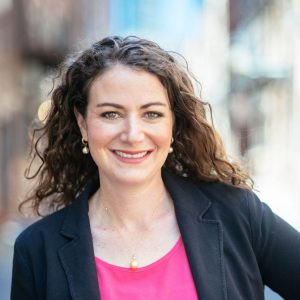
Nurses at St. Mary's Hospital in Madison have petitioned for an election to vote on joining the Service Employees International Union. (Photo by Erik Gunn/Wisconsin Examiner)
Hundreds of nurses at 10 SSM Dean Medical Group outpatient clinics in Dane County voted by 71% to form a union last week.
The union drive of the 340 nurses at the SSM Health clinics comes just months after nurses at SSM St. Mary’s Hospital in Madison voted by 89% to start a union in June. The St. Louis-based Catholic health system has vehemently opposed the union effort from the St. Mary’s nurses, including by trying to get the National Labor Relations Board to invalidate the union election results.
The St. Mary’s nurses have filed official charges with the NLRB over SSM administration’s refusal to begin negotiating a contract and undertaking anti-union efforts.
Nurses at both St. Mary’s and the clinics have said they’re working to unionize to better advocate for their patients as the administration makes cuts that force the nurses to do more. The clinic nurses have also tied their effort directly to the system’s treatment of the St. Mary’s nurses.
“For too long, policies have been handed down from SSM executives in St. Louis that force nurses to do more and more with fewer and fewer resources,” said Kat Doebler, a 30-year nurse who works at the SSM Health Outpatient Surgery Center. “This intense focus of extracting corporate profits out of us has led to burnout and the loss of some of our very best nurses. It’s time for the nurses who actually take care of patients to have a seat at the table in the decisions that affect our jobs and how we provide that care. We are very disappointed that instead of respecting our freedom to form a union, SSM has been waging a campaign to violate our rights. Together with our coworkers at St. Mary’s, we’re calling on SSM to stop breaking federal law and start working with us to make sure our clinics and the hospital are the best places to work and receive care.”
After the SSM administration fought the recognition of the union at St. Mary’s, the system said in a statement that it “respects” the decision of its clinic nurses.
“We thank every nurse who participated in the recent National Labor Relations Board election at ten of our SSM Health Dean Medical Group outpatient centers in the Madison area,” SSM spokesperson Lisa Adams said. “While we would have preferred an outcome that allowed us to continue working directly with our nurses, we respect their decision and are committed to working constructively through the process ahead. We are grateful for the dedication of our nurses and the care they provide each day. Together, we will continue supporting our patients, serving our communities, and advancing our Mission of providing exceptional health care services to all.”
Kristi Noem, at the time secretary of the Department of Homeland Security, receives a tour of the CECOT prison with Minister of Justice and Public Security Gustavo Villatoro in Tecoluca, El Salvador, on March 26, 2025. (Photo by Tia Dufour/Department of Homeland Security)
WASHINGTON — An appeals panel Friday seemed inclined to agree that more than 100 Venezuelan men the Trump administration sent to a brutal prison in El Salvador are entitled to due process hearings to challenge their removal, which was made under an archaic 18th-century wartime law.
Arguing on behalf of the class of men who were removed under the Alien Enemies Act of 1798, Lee Gelernt of the American Civil Liberties Union told the three-judge panel that the men, who were accused of being suspected members of the Venezuelan Tren de Aragua gang, were entitled to hearings to challenge those accusations.
But instead, Gelernt said, the men were denied their due process rights and spent four months in a brutal Salvadoran prison.
The men were eventually returned to Venezuela in a prisoner swap exchange, but many who had pending asylum cases want to challenge their removal under the Alien Enemies Act and continue their immigration proceedings.
He said the Trump administration is asking for the ability to “essentially whisk people away to a foreign prison, give them no opportunity to contest the removal, even whether they’re part of this gang that this proclamation applies to… and then say, ‘Because we got them out of the country into a foreign prison, that’s the end of the matter.’”
DOJ argues against due process
The Trump administration argued before the U.S. Court of Appeals for the District of Columbia Circuit that the Venezuelan men are not entitled to due process hearings.
Department of Justice attorney Tiberius Davis said that the United States had no custody over the 137 Venezuelan men removed to the Salvadoran mega-prison known as CECOT, and therefore the immigrants are not entitled to hearings in the U.S.
He added that it would be impractical for the Trump administration to conduct more than 100 online hearings abroad.
“It’s a real problem with foreign sovereignty to hold hearings, and take evidentiary hearings, in foreign countries, even at our own embassies,” Davis said. “That can be a real problem. So we would have to engage in diplomacy and foreign affairs in order to even do that much.”
March 2025 origins
The case began when President Donald Trump invoked the Alien Enemies Act in March 2025 to rapidly deport Venezuelan immigrants.
U.S. District Judge James Boasberg issued the Trump administration an order to return several deportation planes to the U.S., but instead they landed at CECOT. The U.S. paid El Salvador up to $6 million to detain the men.
On Monday, there is a separate hearing where Boasberg will hear arguments as to whether several Trump officials should be held in contempt for violating his order by not returning the planes carrying men removed under the Alien Enemies Act, including possible criminal contempt charges against Attorney General Todd Blanche and an appellate judge, Emil Bove.
Judge expresses doubt
Circuit Judge Harry T. Edwards seemed skeptical of the Trump administration’s arguments that the U.S. had no custody over the men while at CECOT. Edwards was appointed by former President Jimmy Carter.
“It seems pretty clear … that the U.S. was fully engaged and kept itself in a position of control throughout,” Edwards said.
Davis disagreed and said that diplomacy was involved and pointed to how Secretary of State Marco Rubio had to engage with El Salvador’s president to bring back one of the men sent to CECOT, Salvadoran national Kilmar Abrego Garcia, who was unlawfully removed to his home country.
“I think the district court sort of swept away those foreign affairs concerns,” Davis said.
Gelernt said it was harder to facilitate the return of Abrego Garcia because he was a citizen of El Salvador.
“He’s not part of our class. El Salvador clearly had an interest in their own nationals,” Gelernt said. “They have no interest in these Venezuelans, other than collecting a paycheck.”
In the Perspectives guest blog series, Farm Foundation invites participants from among the varied Farm Foundation programs to share their unique viewpoint on a topic relevant to a Farm Foundation focus area. Michelle Klieger is a 2024 Farm Foundation Young Agri-Food Leader and president of Stratagerm Consulting. In this blog she discusses the European Union’s new deforestation regulations.
The European Union aims to raise the global bar with new Deforestation Regulations. Effective since June of 2023, the regulations ban imported goods that stand to profit off of deforestation practices. By devaluing and even penalizing these practices, the EU hopes to create a commodity trade standard that will reverse the effects of deforestation. They predict 177,920 acres of forests, or one quarter of Rhode Island, will be saved in 2025, and are optimistic that these steps will reduce air pollution.
Soy, palm oil, beef, coffee, and cocoa trades are expected to experience a significant impact due to these new requirements. Brazil, Argentina, Malaysia, Indonesia, Canada and parts of Africa are on edge as they consider trading options. Some argue this is the beginning of a new era, while others see it as a reorganization of supply chains.
Michelle Klieger is the president of Stratagerm Consulting, a food and agricultural consulting firm. An economist and a business strategist, she works with the global seed industry, ag tech companies, conventional and non-conventional agriculture firms, and philanthropic foundations.
Complexities of EU Regulations
For companies working to meet regulations, the process is complex. While individual companies must produce data to receive deforestation- free certification, entire supply chains must be vetted. Each industry faces unique obstacles. Soy, for example, goes from farm production, and is then transported to processing facilities, then moved onto crushers, then to product manufacturers, and finally to retailers. If at any point in the process operations have made use of deforested land, the trading company could be banned from exporting goods to EU countries. Palm oil batches typically mix fruit from many sources at once. Many of these companies can only trace a product after it has been processed and would need to develop brand new traceability methods to meet requirements.
Meeting the new regulations requires an investment in technology and manpower. In order to make products fully traceable many companies are purchasing GPS technology that allows them to accurately map and consistently monitor their farms. Similarly, if products must be tracked and segregated from planting all the way to a grocery store shelf, digital tracking technology will also be needed. Guaranteeing deforestation-free methods must include in person inspections done by real people traveling from farm to farm to see operations up close.
It’s a time consuming process to build out this framework, but one that many companies deem both valuable to the global environment and financially lucrative in the long run. Decisions involve farmers, transportation companies, processing plants and manufacturers, but they also must include government policy, technology and in some cases legal crossroads. There is no overnight shift, but rather a development of practices.
A Supply Chain Split
Already many companies are rerouting supplies to other buyers and avoiding EU regulations altogether. The trend prompts speculation that the new requirements will not raise the bar, but simply split or change the flow of supply chains. Brazil could turn to China as a new soy buyer and Indonesia could potentially trade palm oil to Africa. We’ve seen substitute shifts like these in the past with the U.S.-China trade war and sanctions on Russian energy. It may prove simpler and more cost effective to change buyers rather than invest in meeting new EU regulations. Many of these companies have little ability to enforce downline or upline adherence to regulation and they fear penalties.
Interestingly, in 2020 Brazil produced ⅓ of the world’s soy, but only 13% of crops account for 95% of the deforestation that occurred that year. The other 87% appear to have been produced on grassland and savannah areas. The scenario is true elsewhere and begs the question; will this create a new environmental imbalance that puts stress on other ecosystems? Companies looking to meet regulations could potentially exploit approved farming areas by over farming them.
Demand For a Different Type of Supply
Will it be harder to secure buyers or much used commodities? For the EU, value is placed not just on the product, but how it is sourced. The decision will impact both consumers and European agriculture.
European countries are braced to experience a decreased supply of things like chocolate and coffee. But, exactly how increased operating costs will be absorbed remains uncertain. Typically consumer prices reflect production cost increases, but in this situation one or more points along a supply chain may need to take ownership of costs to ensure tradability. The result, at least in the initial stages, would be lower profit margins for most of these companies and possibly higher purchase prices for consumers.
Several European countries are seeking reduced regulations and maintain that the current requirements are virtually impossible for small and medium sized farms to accommodate. They also argue that these regulations negatively impact many of the current sustainability processes farmers are working to implement for the sake of biodiversity, crop and grazing rotations. Farmers worry that they will not be able to produce the soy meal needed to feed their own livestock and that the EU will become too reliant on exports which would negatively affect the European ag sector.
Good News For U.S. Producers
The EU is not alone. Other countries have similar environmentally focused goals and policy in the works to support these goals. The United States has seen a growing consumer demand for traceability, prompting many businesses to begin the process of leveraging technology and better communication up and down supply chains to help customers make informed decisions.
The Forest Act of 2023 was birthed out of the same desire to stabilize regions of the world that have suffered from illegal deforestation and offer opportunities for many industries and individual businesses to clean up their processes. If it goes into effect, the Forest Act would be very similar to the EU’s Deforestation Regulation; banning products that have been produced on illegally deforested land and penalizing unmet requirements.
Many American operations are positioned to receive deforestation-free certification. Several top soy producers are predicted to meet regulations and be granted access to the EU markets. A welcome relief to farmers who have faced narrowing markets in recent years.
Exactly how competitive this “new” market will be, only time will tell. Traceability efforts take time. Unless trade lines were already working toward deforestation-free goals, it will take years for many of these supply chains to implement methods that meet EU regulations. In the meantime, it’s highly likely that global trade negotiations will be impacted and supply chains will shift in response to the environmental standard.

 Login
Login