Login
LoginTaxpayer dollars flood pregnancy centers. Oversight hasn’t followed.

Crisis pregnancy centers have been the beneficiary of at least a half-billion dollars since the U.S. Supreme Court ended federal abortion protections in June 2022, a States Newsroom investigation found. The centers discourage women from seeking abortion and contraception, which medical experts say compromises public health. (Illustration by David Jack Browning for States Newsroom)
Editor’s note: This is the first report in an ongoing series.
The patient came in with a belly full of blood, Dr. Leilah Zahedi-Spung recalled. Her pregnancy was ectopic, no longer viable, and could have killed her if left untreated. But when she went to a mobile pregnancy help center offering free care in an RV in St. Louis, she was told the pregnancy could be saved.

By the time she saw Zahedi-Spung days later, her fallopian tube had ruptured.
In North Lauderdale, Florida, Ieshia Scott was pregnant and in the throes of postpartum depression. She thought she’d arrived at an abortion clinic. She told the staff she might hurt herself if she had another baby. They told her God would give her strength.
A woman and her partner in Sheboygan, Wisconsin, went to a pregnancy help center by mistake. When they made it to a Planned Parenthood clinic across the street, the pregnant patient handed Dr. Kristin Lyerly a copy of the sonogram. But the scan was not of her uterus. It was her bladder.
All three patients had gone to crisis pregnancy centers, organizations that advertise free pregnancy tests and ultrasounds but dissuade women from pursuing abortions and contraceptive options. Since the U.S. Supreme Court ended national abortion access in June 2022, the centers have seen an infusion of taxpayer dollars in many Republican-led states. But medical experts have urged lawmakers to reconsider the state support, as the centers can endanger public health by “causing delays in accessing legitimate health care,” according to the American College of Obstetricians and Gynecologists.
States Newsroom conducted a 50-state investigation examining state and federal budgets, as well as the tax records of these organizations, finding that while the magnitude of public funding for them is growing, oversight is not.
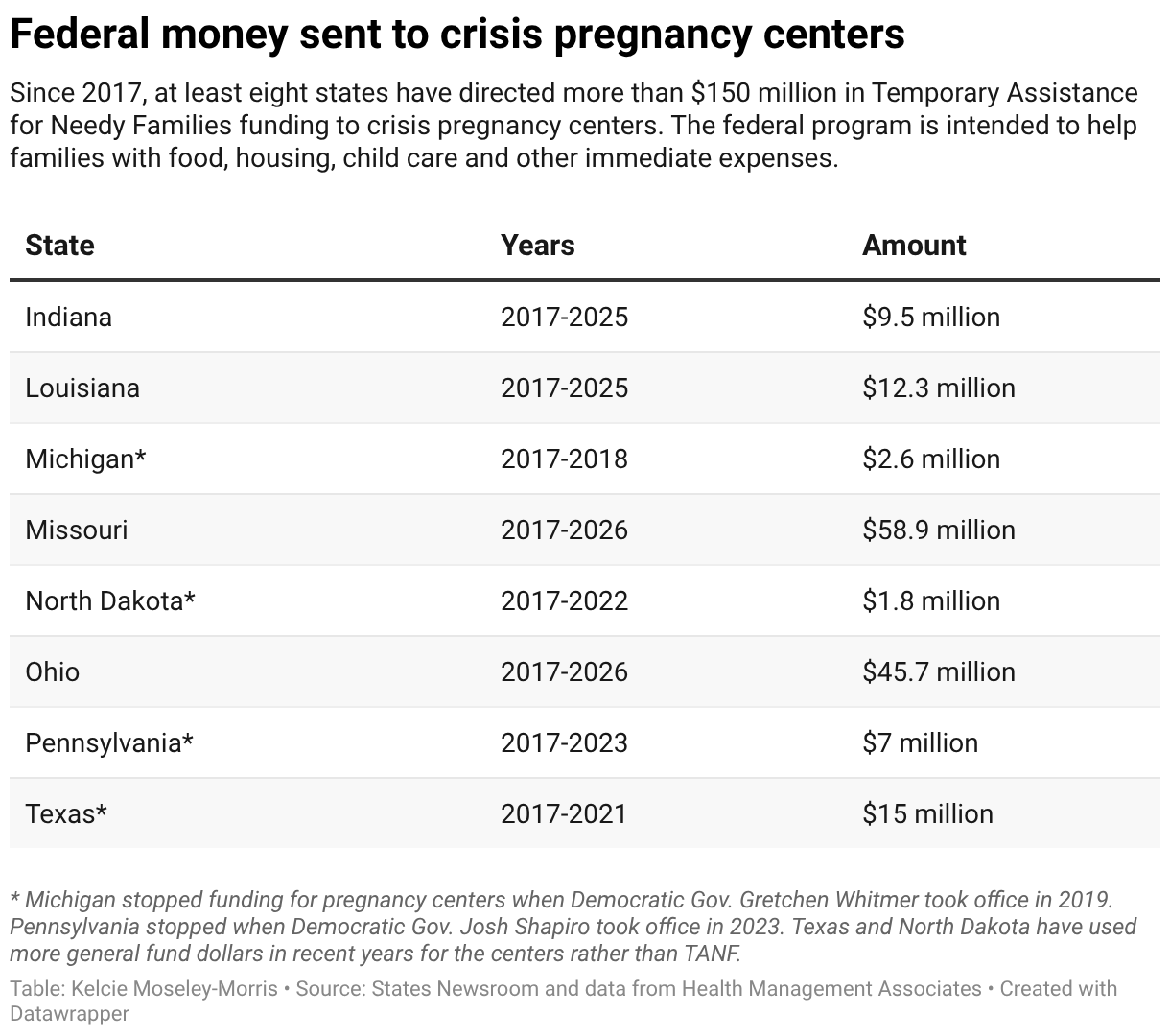
Twenty-one states funneled nearly a half-billion dollars, or $491 million, of taxpayer money to crisis pregnancy center organizations between fiscal years 2022 and 2025. That figure does not include millions some states diverted from federal programs like Temporary Assistance for Needy Families, and it does not include multimillion-dollar tax credit programs launched after federal protections for abortion rights were overturned.
Nearly $1.3 billion in local, state or federal government grants were awarded to 1,259 crisis pregnancy centers in total between 2019 and 2024, according to States Newsroom’s analysis of tax records. The actual figure may be higher, as digital records are not comprehensive or entirely up to date.
Yet that largesse hasn’t been matched by corresponding regulation. Oversight of taxpayer funding remains weak, either blocked by legislators or ignored by state agencies.
The centers are most often faith-based nonprofits that say they provide much-needed support for pregnant clients at no cost. An estimated 2,633 crisis pregnancy centers were operating in the United States as of March 31, 2024, according to research from the University of Georgia.
John Mize, CEO of Americans United for Life, argues that pregnancy centers are important for people who really don’t want an abortion, and for anyone who regrets their abortion to find support.
“I am strongly of the opinion that most women that have abortions do it because they don’t feel like they have any other option,” Mize said.
But critics and researchers say the pregnancy centers mislead potential clients about their services or pose as medical clinics despite lacking proper licensure. They sometimes promote treatments like abortion pill reversal, which is unproven and potentially dangerous.
“Often, patients are lured in by this idea of getting free care,” said Dr. Rachel Jensen, Darney-Landy complex family planning fellow at the American College of Obstetricians and Gynecologists. “It’s free, because it’s often subsidized by taxpayer dollars. Free health care sounds amazing. It should be available to all people. But the problem is, then, that the CPCs are unregulated — and they operate outside of ethical principles and best care practices.”
Firsthand accounts: ‘What’s your plan for this pregnancy?’ Comfort, shame and a missed diagnosis
Indiana state Sen. Shelli Yoder, a Democrat, said access to maternal health care in her state continues to decrease while support for crisis pregnancy centers increases. Indiana boosted its budget for the centers from $250,000 in 2021 to $2 million, then doubled it to $4 million by 2024. The state’s maternal mortality rate is among the worst in the country.
“It’s not that these centers don’t serve a purpose. But they certainly are not a replacement for maternal health care, and they are not health care centers, and yet our state is using taxpayer money to fund them as if they are,” Yoder said. “And we are sending a message to moms, or to women, that they are health care centers, and they are not.”
Zahedi-Spung was working an emergency room shift in 2019 at a St. Louis hospital, not too far from the pregnancy center housed in an RV and frequently parked in front of a Planned Parenthood clinic. She said she was horrified to learn the patient with the ruptured ectopic pregnancy had been told at the mobile crisis pregnancy center a few days before that it could be saved. A tubal ectopic pregnancy is never viable.

Today, Zahedi-Spung works in Colorado as a high-risk OB-GYN. But that experience in the ER still haunts her.
“They’re a private organization providing medical care without a medical license, so they are not liable for anything they tell anyone,” she said.
Andrea Trudden, spokesperson for Heartbeat International, one of the largest pregnancy center networks in the U.S., said that as of 2025, more than 75% of Heartbeat affiliates offer medical services and are different from pregnancy resource centers, which offer parenting classes and material aid but not medical services.
“Medical affiliates that provide limited obstetrical ultrasound or other services follow applicable state laws, professional standards, and clinical protocols,” Trudden said in a written statement.
According to a report from the Charlotte Lozier Institute, 37% of 2,775 crisis pregnancy centers provided testing for sexually transmitted infections, and 29% provided STI treatment in 2024. The institute, which is the research arm of one of the largest anti-abortion policy groups, Susan B. Anthony Pro-Life America, found that 81% of surveyed centers provided ultrasound services in 2024. The report notes that 28% of paid center staff have medical licenses, along with 12% of volunteers.
The only option for miles
In North Florida’s largely rural Wakulla County, there are no full-time practicing OB-GYNs. Wakulla Pregnancy Center is in Crawfordville, the county seat of about 4,800 people. Many women in the area lack transportation, said the center’s director, Pam Pilkinton. They have to travel about 20 miles north to Tallahassee for prenatal care.
Run by a local ministry, the center has a blue-and-white sign that advertises “Free Pregnancy Tests.” Inside, a cozy living room furnished with sofas leads to a counseling room and donation space, where moms peruse a range of free baby clothes and supplies. Most of the center’s clients have low incomes, and are on Medicaid or uninsured.

When Florida passed a six-week abortion ban in 2023, legislators simultaneously increased state funding for crisis pregnancy centers by 455% — from $4.5 million to $25 million. The following legislative session, they added another $4.5 million.
The funds go to the Florida Pregnancy Care Network, which manages contracts with more than 100 crisis pregnancy centers across the state. The organization is required to report the amount and types of services provided and the expenditures to the governor and state legislature once a year. But it is not required to make any noncompliance findings public.
The public money for centers in Florida doesn’t end there. Wakulla Pregnancy Center received a separate allocation in the 2025 budget of $136,000. According to the funding request, $60,000 is allocated for a building asbestos issue, and $58,000 pays for the salary and benefits of the executive director and client coordinator. The rest is for pregnancy tests, educational materials, ultrasound referrals and other supplies.
But Pilkinton is clear about one point: The center does not provide medical care in this maternal health care desert.

“We’re not a medical facility, and that is something that we let everyone know up front,” Pilkinton said. “We provide material support, education, information and peer counseling.”
That doesn’t include practices like referring a patient to an OB-GYN for prenatal care after a positive test, for example, “because we’re not a medical facility,” she said.
Wakulla County’s severe maternal hospitalization rates ranked among the worst in the state in 2023 and 2024.
Like in other states, maternal health care has continued to flounder in Florida — and shortages are likely to worsen. Nearly half of 1,500 OB-GYNs who responded to a state survey say they plan to stop delivering babies within the next two years.
The money Florida allocated for pregnancy centers might have covered more maternity care across the state, said Democratic state Rep. Anna V. Eskamani.
“We do need to strengthen our safety nets when it comes to supporting new moms,” Eskamani said. “Instead of addressing those gaps and investing in those areas, we continue to dole out millions of dollars to these unregulated and often religiously affiliated anti-abortion centers that are not addressing any of these disparities.”

In previous legislative sessions, Eskamani filed bills to repeal state funding and introduce regulation of existing centers. The bills have yet to receive a hearing, but she and her colleagues have filed them again.
“These not-for-profit organizations run with very little federal or state oversight, and sometimes they don’t even have licensed medical staff on site,” she said. “At this point, it’s a blank check.”
Big checks, little oversight
Much of the state funding for pregnancy centers did not exist before the U.S. Supreme Court’s Dobbs v. Jackson Women’s Health Organization decision ended federal protections for abortion rights in June 2022.
Conservative-led states — such as Texas — that already allocated tens of millions to pregnancy centers have doubled or tripled their budgets for pregnancy resource groups since 2022. In Missouri, lawmakers have budgeted nearly $50 million since fiscal year 2022 from the general fund and federal block grant dollars. Texas’ allocation ballooned from $140 million in fiscal years 2024 and 2025 to $180 million in 2026 and 2027.
In southwest Missouri, Republican state Rep. Christopher Warwick’s support of the centers is a focus of his reelection campaign.
“I think it’s important that we fund organizations that are willing to save life,” he said.
Read more: Federal funding for people in poverty heading to anti-abortion centers instead
Louisiana lawmakers directed $4 million from the state’s general fund to pregnancy centers for 2025, as part of its Pregnancy and Baby Care Initiative. But an audit found the state doled out the maximum amount per center allowed by state law — $100,800 — to most of the groups without requiring them to fully document how they spent it.
Auditors were concerned Louisiana paid the centers more than the cost of the actual services provided.
In Oklahoma, state auditors discovered in 2022 that an anti-abortion nonprofit called Oklahoma Pregnancy Care Network disbursed less than 7% of the $1.6 million it promised to nonprofits under the state’s Choosing Childbirth program. A month and a half before its contract was scheduled to end, the group had served 524 women, less than 6% of the 9,300 Oklahoma women it initially projected it would serve. An administrator with the nonprofit told The Oklahoman she was unaware there were problems.
Despite those findings, state lawmakers later directed nearly $18 million — a quarter of the state health department’s entire budget — toward Choosing Childbirth through November 2027. More than $4 million of it went to the Oklahoma Pregnancy Care Network. The network did not respond to States Newsroom’s requests for comment.
Inner workings
Lyerly, the OB-GYN in Sheboygan, Wisconsin, said the couple with the mislabeled sonogram came into her Planned Parenthood clinic in the early months of 2022. It wasn’t uncommon for patients with appointments at Planned Parenthood to accidentally go to the crisis pregnancy center across the street. This couple sought an abortion, she said, but came in with the ultrasound image of the woman’s bladder rather than her uterus. On top of the mislabeled ultrasound, they felt misled, because they were told the pregnancy was just a few weeks along when it was much more advanced.

“This was a challenging situation for them, was emotional and frustrating and upsetting to them, and it was so unnecessary,” said Lyerly. She stopped providing abortions in Wisconsin later that year when a state law banning the procedure went back into effect after the Dobbs decision.
Many centers are affiliated with umbrella organizations, including Care Net, Heartbeat International (formerly Alternatives to Abortion International) and National Institute of Family and Life Advocates, but often do not disclose that connection on their website. The parent companies provide guidance for operations, including yearly conferences, along with training for limited ultrasounds and other services. Training and funding for many of these centers’ ultrasound programs also come from national religious groups like Focus on the Family and the Knights of Columbus.
Heartbeat International is the largest of the three, with more than 4,000 affiliated service providers across the U.S. and in more than 100 countries, according to Trudden.
Trudden said Heartbeat International offers professional training and practical resources for affiliates, who determine their own governance, leadership and location and must agree to a set of standards also shared by Care Net and the National Institute of Family and Life Advocates. Those standards include practicing honesty and confidentiality with clients and complying with all legal and regulatory requirements.
Some pregnancy centers are staffed with licensed professionals trained in sonography. The National Institute of Family and Life Advocates says it has trained more than 6,000 health care professionals “in the medical and legal ‘how to’s’ of limited obstetrical ultrasound.” But at its national conference last year, leaders discouraged centers from performing ultrasounds on women who they suspect have ectopic pregnancies to avoid liability. The guidance came in the wake of a lawsuit against a Massachusetts center, in which the plaintiffs alleged that center staff failed to diagnose an ectopic pregnancy that ruptured, prompting emergency surgery. The clinic reached a settlement with the patient.
Some centers offer more medical services, like prenatal support and testing and treatment for STIs, such as Idaho’s Stanton Healthcare, which is accredited by the Accreditation Association for Ambulatory Health Care and does not receive any public funding.
“We have caught ectopic pregnancies. … I can think of three in the last eight months off the top of my head,” said Angela Dwyer, Stanton’s director of client services.

But advocacy groups such as Campaign for Accountability have raised alarms about how many clinics do not have to follow federal health privacy laws, including the Health Insurance Portability and Accountability Act, known as HIPAA.
Clinics that offer free services and do not bill insurance face no penalty for disclosing a client’s information.
In contrast, Jessica Scharfenberg, CEO of Healthfirst Network in central Wisconsin, said if any of her 10 reproductive health clinics violated HIPAA, they would face steep federal fines and possible jail time for staffers.
“If my entity broke HIPAA, we would have federal consequences, even though we also have an internal policy for it,” Scharfenberg said. “They have their internal policies. They break HIPAA, there’s no consequences for it.”
The websites of some centers give the appearance of being HIPAA compliant even though they aren’t, States Newsroom has reported.
The other two main umbrella organizations did not respond to multiple requests for comment by email and phone.
‘So much help’
In North Lauderdale, Ieshia Scott would stare at her 6-month-old, unable to hold the baby when she cried. Scott, who also had a 10-year-old, felt overwhelmed by a constant cloud of stress and sadness, all while trying to keep up with college classes.
When she found out she was pregnant again, Scott searched for an abortion clinic in the city, and a pregnancy resource center came up in the search results. That 2018 visit would last nearly three hours, during which she fielded dozens of questions about why she wanted an abortion. Scott had suicidal thoughts and was depressed but felt totally unheard.

“I really was disregarded,” said Scott, now 36. “I was actually saying to her, like — ‘I don’t know, I might hurt myself, I might hurt the baby.’”
The center didn’t refer her to a psychiatrist, therapist or OB-GYN. The staff member instead reminded her of the Ten Commandments.
“I’m literally telling her, I can’t — I can’t do it. And she was like, ‘You can, you can. And there’s so much help.’”
Mental health is a contributing factor in about 23% of the nation’s maternal deaths, reports from the federal Centers for Disease Control and Prevention show.
Scott eventually went to a clinic to get the care she needed. But she worries for women who can’t.
More than a dozen states passed abortion bans after Dobbs, and efforts continue nationwide to dismantle what access remains. Several states with abortion bans — including Missouri, South Carolina and Texas — have moved to cut Planned Parenthood out of state Medicaid programs as well, after the U.S. Supreme Court ruled last year that excluding the organization did not violate Medicaid’s provision requiring freedom of choice in providers. Florida legislators are also discussing cutting Planned Parenthood out of the state Medicaid program.
In 2025, at least 51 Planned Parenthood locations closed or limited medical services after losing state and federal support. Those communities lost access not only to abortion services but also to other reproductive and primary medical care. Independent clinics such as Maine Family Planning stopped offering primary care services for about 600 patients because of a funding loss of about $1.9 million, even though none of the Medicaid dollars were used for abortion.
‘Government handouts’
Lawmakers are not only opening public coffers to provide direct financial support to pregnancy centers, but they’re also creating tax breaks, drawing on federal sources and shifting funds meant to help low-income families to aid the anti-abortion organizations — with few regulations.
Some legislators have resisted stronger oversight.
In Missouri, state Rep. Warwick opposed a colleague’s suggestion to require the centers to report how they spend their donations in a tax credit program, saying he wanted to limit bureaucracy. He said in a February 2025 legislative hearing that the tax credit keeps the state from having to “verify what programs work.”

“I don’t think they’re funded enough to be able to mishandle their money,” he told States Newsroom in December. “At least not the ones I’m familiar with.”
Warwick proposed raising the tax credit for pregnancy center donations from 70% to 100% in 2025, meaning someone donating to a pregnancy center could reduce their state tax bill by the exact amount donated.
The credits that Missourians redeemed shot up from about $2 million to an average of more than $7 million per year after lawmakers removed a cap on credits in 2021, according to a fiscal note attached to Warwick’s bill. State officials estimated a 100% tax credit just for pregnancy center donations would cost the state more than $10.7 million in the first year.
Missouri also funnels more than $2 million per year in state and federal dollars to pregnancy resource centers and similar organizations through its Alternatives to Abortion program. That’s in addition to what the centers receive from Missouri’s federal Temporary Assistance for Needy Families fund — $10.3 million in this fiscal year.
Although Warwick’s 100% pregnancy center tax credit failed, he plans to try again in this year’s session. “I don’t think it (a 100% tax credit) would significantly hurt the state, especially when we’re talking about protecting life, protecting the birth of children,” he said.
Nebraska Sen. Joni Albrecht, a Republican who also sponsored a six-week abortion ban, said the centers were a valuable investment when she sought to create a $10 million tax credit program that was revised down to $1 million in 2024.
Of the 13 pregnancy centers approved for tax credits in Nebraska, four provided less than $150,000 in services, according to tax returns, and one had three consecutive state audit reports with findings of deficiencies in controlling and complying with federal grant funding requirements.
In Montana, a state without an abortion ban, Republican Gov. Greg Gianforte found another way to give taxpayer money to pregnancy centers by donating a portion of his annual salary. In 2020, he pledged to give his salary to nonprofit organizations and charities, and has for the past three years included pregnancy centers in that list for a total of more than $60,000.

Idaho state Sen. Ben Adams, a Republican who sponsored a bill to establish a grant fund of $1 million for crisis pregnancy centers in 2025, told States Newsroom he felt it was important to put resources into helping people choose to have a baby.
“We have, for a very long time, primarily through the federal government, essentially funded abortion through funding for Planned Parenthood and all these different organizations,” Adams said. “We say we’re going to restrict a woman’s access to abortion and that we’re pro-life. Well then, we actually have to be investing in those folks who are choosing life and show them that we mean it when we say we want them to choose life.”
For decades, the Hyde Amendment, a provision Congress has renewed annually, has prohibited the use of federal funding for abortions, except in cases of rape, incest and to save the mother’s life.
Idaho is one of a few states with an abortion ban that isn’t providing government support for crisis pregnancy centers. Adams’ bill failed by one vote in committee and faced opposition from many constituents, including a former board chairman of a crisis pregnancy center in Idaho who said subsidizing nonprofit entities with taxpayer dollars is not the proper role of government.
“Providing taxpayer funds on either side of this moral question is inappropriate,” said John Crowder in his testimony to the legislative committee, prefacing his comments by saying he is a Christian who believes life begins at conception. “Such decisions to lend financial support should be left to churches and individuals, not the government.”
Based on his knowledge of the finances of that center, Crowder said, it was clear they could meet the goals of their mission with the donations they received and “without government handouts.”
Stateline reporter Amanda Watford contributed to this report.
This story is part of a reporting fellowship sponsored by the Association of Health Care Journalists and supported by the Commonwealth Fund.
States Newsroom’s investigation is ongoing. If you have had an experience with a crisis pregnancy center, please get in touch at cpcproject@statesnewsroom.com.
METHODOLOGY: To identify government grant funding received by nonprofit crisis pregnancy centers (CPCs), a team of States Newsroom reporters used multiple data sources. Reporters reviewed state and federal budgets and legislation to identify public funding allocated to CPCs between 2019 and 2025, with a particular focus on the period following the U.S. Supreme Court’s Dobbs v. Jackson Women’s Health Organization decision in June 2022, as well as in prior years, as applicable. The team did not include federal funding from sources such as Temporary Assistance for Needy Families in the nationwide analysis, and state tax credit programs were also excluded.
Data reporter Amanda Watford cleaned and analyzed a publicly available dataset of CPCs originally collected by the nonprofit advocacy group Reproductive Health and Freedom Watch. Organizations that appeared to be permanently closed or did not report enough revenue to file a full IRS Form 990 were removed from the States Newsroom analysis. Watford extracted filings from ProPublica’s Nonprofit Explorer for about 2,000 organizations, covering 2019 to 2025. Government grant totals were only available for 217 organizations for 2023 and 2024 due to data infrastructure limitations. A separate analysis using the GivingTuesday 990 database captured basic financial and government grant data for 1,243 organizations between 2019 and 2023. Watford combined the 2019-2023 GivingTuesday data and 2023-2024 ProPublica data. The total amount of government funding provided to CPCs was calculated for each year, yielding a grand total of nearly $1.3 billion across 1,259 CPCs between 2019 and 2024.
This analysis is not comprehensive. Some IRS Form 990 filings were unavailable digitally, and some organizations did not report any government grant funding, so grant funding reported outside the available electronic filings was not fully captured. Financial information available through IRS Form 990 filings is self-reported by organizations to the IRS and is not independently audited. Additionally, there is a lag between when organizations are expected to file returns and when filings are publicly available. Due to these factors, the States Newsroom findings likely undercount the total amount of public, government funding directed to CPCs. An estimated 2,633 CPCs were operating in the United States in 2024, according to research from the University of Georgia.
This story was originally produced by News From The States, which is part of States Newsroom, a nonprofit news network which includes Wisconsin Examiner, and is supported by grants and a coalition of donors as a 501c(3) public charity.