A view of the damaged B1 bridge, a day after it was destroyed by an airstrike, on April 3, 2026 west of Tehran in Karaj, Iran. (Photo by Majid Saeedi/Getty Images)
WASHINGTON — The Trump administration still needs to determine how it will remove nuclear materials from Iran after officials from both countries sign documents to end the war, a senior official said Friday.
“This is very combustible stuff, very volatile stuff. We’re not just going to, like, go down there with a backhoe and a guy with a backpack and start taking it out,” the official, who did not want to be identified by name, said on a call with reporters organized by the White House. “The technical details need to be figured out, but I think there’s a commitment to do that.”
Iranian Foreign Minister Seyed Abbas Araghchi wrote in a social media post a few hours before the call that a memorandum of understanding with the United States “has never been closer.”
“Pending its finalization, the media should refrain from entering speculation about its content,” he added. “In line with our responsible and transparent approach, all details will be shared with the public in due course.”
The officials’ comments came one day after President Donald Trump said negotiators had “just made a great settlement of the war with Iran” that would be “subject to finalization of documents” over the next few days.
Possible meeting in Europe
The U.S. official said the administration is 80% to 85% sure leaders from the two countries would gather sometime this month to sign a memorandum of understanding to end the war, possibly in Europe.
Those documents will create a framework to reopen the Strait of Hormuz, destroy enriched nuclear materials and establish inspections to ensure Iran doesn’t possess a nuclear weapon, the official said.
The MOU will also start a 60-day technical negotiation where leaders from both countries work out more specifics of what the United States wants to see Iran accomplish in order to lift economic sanctions, the official said.
The step-by-step process with verification requirements is designed to build trust and “accomplish something meaningful for both Iran and the United States of America,” the official said.
“I don’t think the Iranians trust us and I don’t think the United States trusts the Iranians,” the official said.
Whether or not Iran could have a civilian nuclear program for energy production will remain to be seen, though the official didn’t entirely rule it out.
“We’re not bothered at all by the idea of civilian power plants in Iran,” the official said. “What we’re bothered by is the type of infrastructure that would allow them to jump from civilian power generation to nuclear weapons development and that’s what they’ve had for a very long time.”
Treasury Secretary Scott Bessent testifies during a U.S. Senate Committee on Finance hearing on June 3, 2026. The department's budget request for fiscal 2027 was the subject of the hearing. (Photo by Chip Somodevilla/Getty Images)
WASHINGTON — The day after acting Attorney General Todd Blanche said the Trump administration’s “anti-weaponization” fund was dead, Treasury Secretary Scott Bessent evaded questions on Capitol Hill Wednesday about whether President Donald Trump, his family and the Trump Organization would be absolved from future tax enforcement, another part of the president’s IRS settlement.
During a budget oversight hearing before the U.S. Senate Committee on Finance, Bessent repeatedly cited “ongoing litigation” to sidestep lawmakers’ inquiries into the settlement details the administration negotiated to voluntarily drop Trump’s multibillion-dollar lawsuit against the IRS for the 2019 leak of his tax returns.
Committee Chair Mike Crapo said he wanted to give Bessent a chance to “set the record straight, understanding there is ongoing litigation.”
“What can you share with us about Treasury and the IRS role in the settlement agreement, specifically since IRS CEO Frank Bisignano signed the settlement agreement?” Crapo of Idaho asked.
Bessent responded that Treasury was represented in the case by the Department of Justice and so “any additional questions about the settlement or the fund should be addressed to the Justice Department and acting Attorney General Todd Blanche.”
Sen. Ron Wyden, the committee’s top Democrat, said during opening remarks that Bessent “owes the committee an explanation of what the Treasury knows about the dirty settlement.”
“That’s because his department was involved from beginning to end,” the Oregon senator added. “Treasury was a defendant and a negotiator in the lawsuit.”
Moments later, Wyden asked, “Does the IRS audit immunity given to Trump, his family, and his businesses still stand? I’d like a yes-or-no answer to that. I got five minutes, I’m gonna use them for these questions, okay, so that we understand what’s at stake here. This immunity deal is the biggest scam against the taxpayer in American history.”
Bessent responded: “As Albert Einstein said, that doing the same thing, expecting a different answer is the definition of insanity.”
“You’ve given no answers on this subject, and that’s why I’m going to ask these questions,” Wyden said.
“Because, as I said, there’s ongoing litigation,” Bessent replied.
Fund fails to launch
Trump, his sons Donald Trump Jr. and Eric Trump, as well as the Trump Organization sued the IRS and the Department of Treasury for $10 billion in damages for leaking his tax returns to news outlets. The contractor responsible for the leak was sentenced in early 2024.
On May 18, the Department of Justice announced the creation of a nearly $1.8 billion “anti-weaponization” fund for “victims of lawfare.”
Under intense worry, even from Republicans, that Jan. 6 defendants who assaulted police could receive reparations, Blanche told lawmakers Tuesday that the DOJ would “not be moving forward with the fund.”
The creation of the fund had mired Senate Republicans’ path to approving a bill that would fund immigration enforcement for multiple years. Trump had wanted the bill on his desk by June 1.
‘FOREVER BARRED’
But lawmakers are still searching for a clear answer on the department’s May 19 settlement addendum declaring “The United States RELEASES, WAIVES, ACQUITS, and FOREVER DISCHARGES each of the Plaintiffs from, and is hereby FOREVER BARRED and PRECLUDED from prosecuting or pursuing, any and all claims, counterclaims, causes of action, appeals or requests for relief … including tax returns filed before the Effective Date.”
Senate Democrats and legal advocates representing multiple plaintiffs in lawsuits challenging the settlement criticized the arrangement Tuesday.
The Department of Justice did respond to a request for comment, and the White House referred States Newsroom to the DOJ and the Trump Organization.
A banner showing President Donald Trump hangs from the U.S. Department of Justice on Feb. 20, 2026. (Photo by Shauneen Miranda/States Newsroom)
Thomas Hobbes took a very dim view of rebels and insurrectionists. He believed that insurrectionists relinquish their status as citizens the moment they seek to overthrow the government and should never be rewarded for doing so.
Hobbes, one of the finest political theorists of his time, said this in his great political treatise, “Leviathan,” published in 1651 during a civil war in England and Scotland.
Hobbes would likely also take a dim view of a major development announced by the Trump administration on May 20, 2026.
The U.S. Department of Justice has established a US$1.776 billion “Anti-Weaponization Fund,” to be used, the AP reports, to “allow people who believe they were targeted for prosecution for political purposes, including by the Biden administration Justice Department, to apply for payouts.”
The fund, Acting Attorney General Todd Blanche said, offers “a lawful process for victims of lawfare and weaponization to be heard and seek redress.”
The establishment of the fund is part of a settlement agreement, in response to which President Donald Trump dropped his $10 billion lawsuit against the Internal Revenue Service for damages stemming from the leak of his tax returns. Those leaks, the lawsuit alleged, “caused Plaintiffs reputational and financial harm, public embarrassment, unfairly tarnished their business reputations, portrayed them in a false light, and negatively affected President Trump.”
A DOJ press release indicates the fund will provide “formal apologies and monetary relief” to those who file claims and will cease processing claims “no later than” Dec. 1, 2028. It will be run by a five-person board appointed by the attorney general, and the president will also have the power to remove board members.
Whether or not Jan. 6 participants benefit, some believe that this situation creates an unavoidable appearance of self-dealing and favoritism. As a student of American law and political morality, I think there are important moral and constitutional issues implicated by the president’s suit against the IRS and the creation of the Anti-Weaponization Fund.
Some of them are straightforward; others are less so.
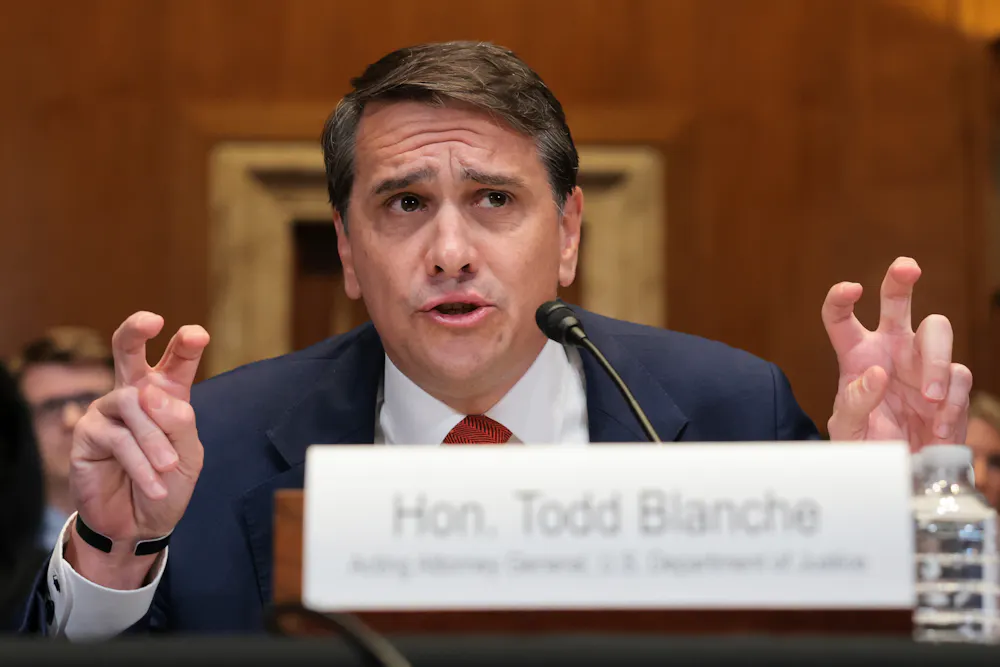
Acting U.S. Attorney General Todd Blanche testified about the compensation fund during a Senate Committee on May 19, 2026, in Washington, D.C. (Photo by Anna Moneymaker/Getty Images)
A judge in their own cause
An obvious question is: Should taxpayer funds be given to Trump allies, in a settlement reached by the Trump-controlled DOJ as compensation for a Trump family lawsuit?
As far back as ancient Greece, philosophers like Aristotle have worried about what happens when people are called on to make judgments in cases where they are involved. Aristotle thought that the natural instinct for self-preservation meant that they would always favor themselves.
From that concern emerged what was then, and remains, an uncontroversial, bedrock moral principle.
In the Roman world, the Latin phrase “Nemo iudex in causa sua” meant “no one should be a judge in their own cause.” It recognized that anyone having a personal interest should not get to decide matters in which they are involved.
In the Englsh-speaking world, Hobbes himself reiterated that phrase as he explained some of the advantages of living in an organized society, which could supply impartial judges to resolve disputes. And in 1787, James Madison wrote, “No man is allowed to be a judge in his own cause, because his interest would certainly bias his judgment, and, not improbably, corrupt his integrity.”
Commentators reacting to the Justice Department’s decision to establish an Anti-Weaponization Fund to settle the president’s claims against the IRS have drawn on these longstanding principles to criticize it, including how the DOJ, which is part of the executive branch controlled by Trump, negotiated with him to reach this settlement.
The conservative lawyer and activist Ed Whelan said, “There is a glaring conflict of interest with Trump being on both sides of the claim.” Whelan added, “It is outrageous that he and those answering to him would be deciding how the government responds to these extravagant claims.”
“It’s not limited to Republicans. It’s not limited to Democrats,” Blanche added. “It’s not limited to January 6th defendants. It’s limited only by the term weaponization.” Blanche promised that payments from the fund will be publicly disclosed.
Negotiating with himself
In April, Kathleen Williams, the Florida federal judge who was presiding over Trump’s lawsuit, reframed the moral issue of self-dealing as a legal one. She questioned whether the case could go on, noting “President Trump’s own remarks about this matter acknowledge the unique dynamic of this litigation.”
The remarks she referenced occurred when the president talked about the lawsuit and the prospect of negotiating with himself. “And they do say that, you know, it’s never been a case like this. Donald Trump sues the United States of America. Donald Trump becomes president, and now Donald Trump has to settle the suit.”
Williams, the judge, wrote that “it is unclear to this Court whether the Parties are sufficiently adverse to each other so as to satisfy Article III’s case or controversy requirement.” That requirement means that a court can only rule when there is a real dispute before it.
That rule is designed to prevent so-called collusive lawsuits, in which “the parties are not actually in disagreement but are cooperating” to achieve a result. Judge Williams was scheduled to hear arguments on that question on May 20, 2026. But the settlement announcement was made two days before, and, in light of it, she dismissed the case.
Back to Hobbes
Beyond the case and controversy question, the Justice Department’s actions may implicate constitutional issues.
Another is whether the fund violates the Constitution’s Emoluments Clause, which prohibits the president from receiving any “Emolument from the United States” other than his salary.
While the new fund may not make direct payments to Trump, he may benefit from payments to family members, business associates and others who will claim to have been victimized by the Biden administration, including people prosecuted and convicted of crimes committed on Jan. 6.
Referring to the president, Raskin argues hypothetically, “So, to the extent that he wants to give a million dollars to each of 1,600 pardoned rioters and insurrectionists, we think that that’s an unconstitutional use of money.”
That section of the 14th Amendment was designed to ensure that Confederate rebels would not receive compensation for the value of their emancipated slaves. However, in Perry v. United States, a 1935 case, the Supreme Court stated that Section 4’s “language indicates a broader connotation” beyond its Civil War context.
It seems clear that courts will soon be asked to decide whether Raskin and other legal critics are right in their assertions of a host of legal problems with the Anti-Weaponization Fund. How they will do so remains to be seen.
But, in a democracy, deciding whether the creation of the fund violates the moral maxim that no one can be a judge in his or her own cause ultimately will be up to the people.
Austin Sarat is theWilliam Nelson Cromwell Professor of Jurisprudence and Political Science at Amherst College
A banner showing President Donald Trump hangs on the Robert F. Kennedy Building of the U.S. Department of Justice on Feb. 20, 2026. (Photo by Shauneen Miranda/States Newsroom)
WASHINGTON — The U.S. Department of Justice announced Monday a new “anti-weaponization” settlement fund as a condition of President Donald Trump voluntarily dropping his multi-billion-dollar lawsuit against the Internal Revenue Service for the leak of his tax returns several years ago.
Trump, his sons Don Jr. and Eric, and the Trump Organization moved to drop the $10 billion suit Monday in the U.S. District Court for the Southern District of Florida, with prejudice — meaning he cannot revive it in the future.
Shortly after Trump’s filing hit the court docket, the DOJ announced the creation of a $1.776 billion settlement, not to be paid to Trump or his family, but to be divvied up among “others who suffered weaponization and lawfare,” according to a department press release.
Democrats swiftly denounced the settlement as a “slush fund.”
The move presumably means those pardoned by Trump for crimes related to the Jan. 6, 2021, attack on the U.S. Capitol could seek money from the government. The DOJ’s announcement did not specifically mention President Joe Biden, former Attorney General Merrick Garland or the Capitol riot, and noted there are “no partisan requirements to file a claim.”
Trump campaigned on pardoning anyone prosecuted by the Biden administration for crimes related to the 2021 attack, describing them as “patriots” and “hostages.” He pardoned roughly 1,600 defendants on the first night of his second term, and the White House published a dedicated web page to those targeted by “a weaponized Biden DOJ.”
In addition to monetary relief, eligible claimants will also receive a formal apology from the government.
Acting Attorney General Todd Blanche, Trump’s former personal defense attorney, said in a statement, “The machinery of government should never be weaponized against any American, and it is this Department’s intention to make right the wrongs that were previously done while ensuring this never happens again.”
“As part of this settlement, we are setting up a lawful process for victims of lawfare and weaponization to be heard and seek redress,” he added.
Trump, his family and the Trump organization will also receive a formal apology but no monetary damages as part of the arrangement, according to the DOJ.
Trump tax info leaked
The president and his family had filed suit in January against the IRS for the leak to news media of their tax information by a contractor in late 2019. The contractor was sentenced for the leak in early 2024.
When questioned by the press Monday afternoon, Trump said he knew “very little about” the creation of the fund.
“These were people that were weaponized and really treated brutally by a system that was so corrupt, with corrupt people running it, and they’re getting reimbursed for their legal fees and the other things that they had to suffer,” Trump said.
A committee of five “very talented people, very highly respected people” will decide how to distribute the money, he said.
Funding an ‘insurrectionist army’
Senate Minority Leader Chuck Schumer denounced the plan Monday afternoon as “one of the most depraved” uses by Trump of the Justice Department.
“This weekend, Trump worked up a plan to shake hands with himself in order to fund his insurrectionist army to the tune of billions,” Schumer, D-N.Y., said in a statement.
“Donald Trump sued his own government. Trump’s DOJ settled with Trump. And now Trump gets a nearly $2 billion slush fund to reward his own allies, loyalists, and insurrectionists. That is not justice. That is corruption happening in broad daylight,” he continued.
In an amicus brief filed Monday afternoon, 93 House Democrats urged U.S. District Judge Kathleen Mary Williams, nominated by President Barack Obama, to immediately dismiss Trump’s “collusive lawsuit” for lack of jurisdiction.
The Democratic lawmakers argued in the filing the fund is “plainly unlawful” for numerous reasons.
“(F)iling a collusive lawsuit only to immediately dismiss it in order to produce a collusive settlement that is illegal multiple times over would not only be legally barred; it would also raise serious questions about whether the parties have manipulated the court system to achieve illicit ends,” according to the brief.
The family of Alvin Cole and their attorneys outside the federal courthouse in Milwaukee. (Photo by Isiah Holmes/Wisconsin Examiner)
Over six years after 17-year-old Alvin Cole was fatally shot by then-Wauwatosa officer Joseph Mensah, the two sides in a contentious civil case have confirmed that they are close to reaching a confidential settlement deal, the Milwaukee Journal Sentinel reports.
A third jury trial in federal court has been set for early May. Each of the first two trials — both held in 2025 — ended in hung juries, with jurors unable to unanimously decide whether Mensah used excessive force when he shot Cole in February 2020.
The shooting occurred at Mayfair Mall, after a group of teenagers got into an argument. One of the teens flashed a handgun and Wauwatosa police officers responded to a call and encountered the group outside the mall. The teens fled when they saw the police, Cole among them. As Mensah and other officers chased Cole, Cole accidentally shot himself in the arm when the handgun he was carrying went off. Cole fell to the ground as police surrounded him, shouting various commands.
Mensah told investigators that he shot Cole, believing that Cole was raising or pointing the handgun at him. Other officers’ accounts contradicted Mensah’s. An officer who was closer to Cole, David Shamsi, said that neither Cole nor the gun moved after Cole was on the ground. Another officer, Evan Olson said that the gun was pointed at him, even though he was in a different position from Mensah. After the shooting, Olson and Mensah — who said that they were friends on and off the job — went off alone together in a squad car, violating policies which state that officers need to be separated after shootings to avoid contaminating statements.
During the trials, Mensah said that he fired to protect himself and others around him, and that he didn’t want to die. Mensah also testified that he did not remember much of what happened that night. Cole was the third person Mensah had killed on the job during his five years as a Wauwatosa officer. Mensah resigned from the department in 2020 following months of protests over the shooting, and was hired by the Waukesha County Sheriff’s Department before he retired from law enforcement. Jurors in the case were not allowed to know about Mensah’s two other shootings in 2015 and 2016, less than a year apart.
The terms of the settlement, including the amount awarded to the family, will remain confidential, lawyers said. During the first trial, attorneys representing Cole’s family asked for $22 million, and then $9 million in the second trial.
This article has been edited to correct the settlement figures sought during the first and second trials.

 Login
Login