
 Login
LoginVW’s ID. Polo Interior Brings Back Something You Thought Was Gone For Good
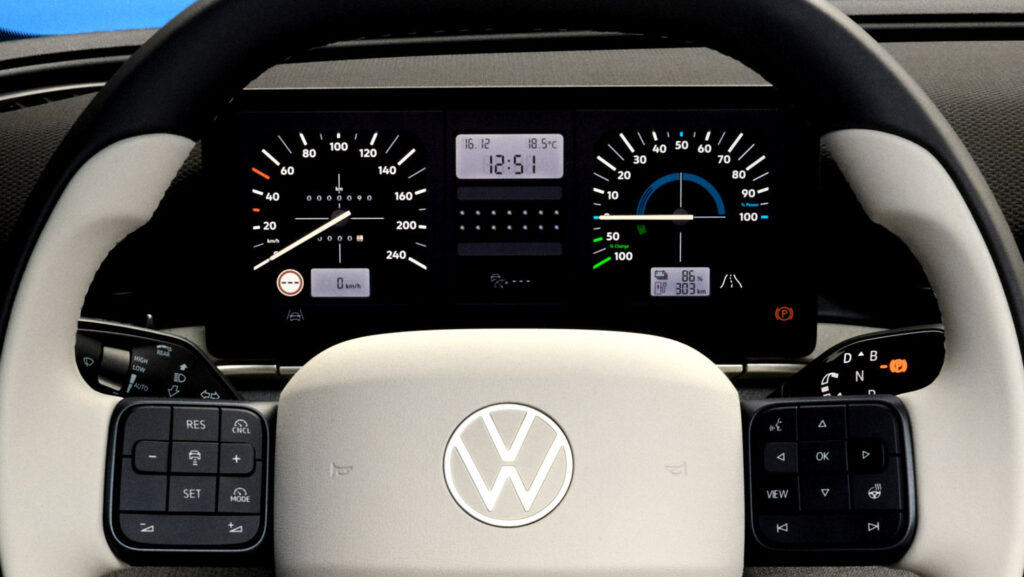
- VW’s ID. Polo brings back physical buttons and classic controls.
- Steering wheel returns to grouped hard keys for major functions.
- Retro-inspired display toggles mimic 1980s Golf-style graphics.
VW is finally letting us peek inside the new ID. Polo, revealing its production interior ahead of the electric subcompact’s official debut later this year. The biggest headline? The long-awaited return of actual buttons and switches.
More: VW Revives Polo Name For EV Era And Teases First Ever Electric GTI
As the first vehicle designed entirely under new VW design chief Andreas Mindt, the ID. Polo marks a shift in direction by blending tactile controls with modern tech in a more user-friendly package. The company has already confirmed that this approach will carry through to other new and updated VW models in the near future.
Buttons Are Back
Gone are the touch sliders and haptic panels that frustrated many owners of the ID.3 and other recent VW models. In their place are proper physical controls, including a knurled volume dial and a traditional four-switch window layout.
The newly designed, squarish steering wheel brings back grouped hard keys for cruise control and infotainment functions, favoring usability over the touch-based gimmickry that has increasingly spread through the industry, especially in the wake of Tesla’s influence.
Mounted directly to the dash, a 10.25-inch digital driver display signals a return to convention, replacing the ID.3’s awkward steering-column-mounted screen. VW says the updated software adds functionality, along with a few nostalgic flourishes. Press a button, and the display shifts to retro-themed graphics that echo the dials and cassette visuals from classic 1980s-era Golfs.
Front and center sits a large 13-inch infotainment touchscreen, and thankfully, it too benefits from the control rethink. Gone are the polarizing touch sliders for volume and temperature. Instead, beneath the screen sits a neat row of physical buttons for HVAC controls and hazard lights. A rotary dial handles volume adjustments and doubles as a track or station selector.
The cabin itself takes on a more inviting feel, with soft recycled fabric replacing the usual expanse of hard, cold plastics across the dashboard, doors, and even the center console. VW has kept its familiar quirk on the pedals, which still feature the play and pause symbols.
Read: VW Brings Back Physical Buttons After Admitting Touchscreens Are A Disaster
Chief Designer Andreas Mindt described the car as “an affordable friend for everyday life”. He added that “clear physical buttons provide stability and trust, warm materials make it appealing, and charming details such as the new retro views of the instruments show the typical Volkswagen wink.”
Platform, Powertrain, and Price
Measuring 159.6 inches (4,053 mm) in length, 71.5 inches (1,816 mm) in width, and 60.2 inches (1,530 mm) in height, with a wheelbase of 102.4 inches (2,600 mm), the new electric Polo shares a similar footprint with its ICE counterpart.
More: Hyundai Going Back To Physical Buttons Because American Buyers Don’t Like Touchscreens
The ID. Polo will launch with a choice of two battery types and three front-mounted motors, delivering outputs of 114 hp (85 kW / 116 PS), 133 hp (99 kW / 135 PS), and 208 hp (155 kW / 211 PS). A more powerful 223 hp GTI version is set to follow the next year.
Battery options include a 37 kWh LFP pack and a more advanced 52 kWh NMC unit with cell-to-pack construction, the latter offering up to 280 miles (450 km) of range. Depending on the specification, charging speeds will range from 90 to 130 kW, with VW’s updated MEB+ platform serving as the base across the lineup.
While Volkswagen has announced a base price of €25,000 (approximately $29,400 at current exchange rates) in Germany, the company recently confirmed that only higher-spec versions will be available at launch across Europe, with initial pricing likely to start closer to €30,000 ($35,300), depending on configuration. There are currently no plans to offer the new subcompact in North America.
