Reading view

There are new articles available, click to refresh the page.

Action Alert: Submit Comments in Support of Dawn Break Solar

By: Alex Beld

Public comments are open now through June 11 for Dawn Break Solar, a 180 Megawatt (MW) solar project paired with a 180 MW battery energy storage system. If approved, the solar project will be located in Waushara County and is planned for completion in 2029. Projects like this have a wide range of local and statewide benefits. Show your support for this project and tell the Public Service Commission of Wisconsin (PSC) why you support the approval of a vital solar project in Wisconsin!

You can use some of the listed benefits below to help you craft your message.

Dawn Break Solar isn’t just about the clean energy it will produce. The 180 MW facility in Waushara County has many benefits:

Economic Growth: Dawn Break Solar is expected to create construction jobs, as well as several long-term local jobs for operations and maintenance. Landowners will also benefit from consistent lease payments during the 35-year lifespan of the project.

Community Benefits: Once in service, Dawn Break Solar will contribute more than $31.5 million in utility-aid payments. Local governments will receive $900,000 annually, with $510,000 for Waushara County and $390,000 for the Towns of Oasis, Plainfield, Deerfield, and Hancock.

Emissions Reductions: Dawn Break Solar will reduce emissions from energy production by about 600 million pounds of CO2 in the first year of operations. In terms of greenhouse gas emissions, this is the equivalent of taking more than 59,100 vehicles off the road for a full year. Additionally, non-GHG emissions reductions will result in health, economic, and environmental benefits. Wisconsin can expect more than $1.3 million in economic benefits associated with public health improvements in Dawn Break Solar’s first year of operations alone.

Submit your comments today and tell the PSC you support the approval of Dawn Break Solar. Feel free to use some of the bullet points above to craft your own unique message.

The post Action Alert: Submit Comments in Support of Dawn Break Solar appeared first on RENEW Wisconsin.

Celebrating the Power of the Sun

By: Alex Beld

All the Good We’re Doing, Together

In the nonprofit world, we spend a lot of our time planning how we will continue to fund our mission—similar to how many people spend much of their time planning how they will make ends meet.

In some cases, for those who can’t make ends meet on their own, there are nonprofits to help. They feed, house, educate, and even protect us. Through RENEW’s Solar for Good program, we have the unique opportunity to help other nonprofits, as well as schools and houses of worship.

The formula is fairly simple—we make it easier for these organizations to access solar power, reducing their energy bills and, in turn, their operating budgets. The hope is that this help allows each and every one of them to spend more of their money and time where it matters: their mission.

Ultimately, every panel that goes up on a food pantry or affordable housing development means one more person who gets to reap the benefits of renewable energy.

Hunger Task Force

In 2025, Hunger Task Force completed a 465-panel array on their new headquarters in Milwaukee. Solar for Good helped the project come to fruition with a $48,237 grant, which covered about 13% of the project cost. Thanks to a wide mix of grants, donations, and government funding, Hunger Task Force covered most of the costs of this project.

Based on projected energy savings of $29,160 per year, Hunger Task Force will pay back its out-of-pocket expenses through avoided energy costs. Each year after that, another nearly $30,000 can go toward providing healthy food to those in need in and around Milwaukee. For every dollar spent on this project, Hunger Task Force will see $1.79 come back to it over the expected life of a typical solar array.

The dollars and cents are a huge motivating factor, but for a nonprofit focused on healthy meals and stewardship, we see additional benefits that are well aligned with the core mission of Hunger Task Force. By reducing emissions, this array helps lower air pollution and mitigate the effects of climate change, both of which lead to better health outcomes for our communities.

Learn more about Hunger Task Force’s Mission to end hunger in Milwaukee and Wisconsin.

West Central Wisconsin Community Action Agency

In 2023, the West Central Wisconsin Community Action Agency (West CAP) completed a 29-kilowatt solar array to reduce the energy burden for low-income families. Solar for Good provided 27 panels through our grant program, about a third of the panels needed for the array. At the time of its completion, it was projected that the array would fully meet the energy needs of the families who would live in the low-income housing project.

Since 1965, West Cap has worked to promote the self-sufficiency of low-income families in the rural communities of west central Wisconsin. Solar panel technology has become a relatively new tool in efforts like this, as it can be used to completely or nearly eliminate energy bills for families that need a hand making life more affordable.

As Peter H. Kilde, former West CAP Executive Director, put it, “Through our poverty-fighting programs, we want to help prepare families for a world less dependent on fossil-fueled energy. This funding will not only allow us to reduce carbon emissions and help our planet, but it will also ease the energy burden for low-income families so they can afford their housing for the long term.”

Learn more about West CAP’s mission to take action against poverty.

Sauk Prairie School District

In 2025, the Sauk Prairie School District completed its second of two solar arrays for a total of 350-kilowatts of power. Their goal was to reduce their energy costs and, therefore, their overall operating budget. The savings will be placed in a fund to replace the roofs of each building across the district, as well as the solar panels. Solar for Schools, now part of Solar for Good, donated 179 panels, just over 20% of the total project.

It’s expected that the array at the elementary school will produce half of the building’s energy needs. As of July 2025, the smaller installation at the high school had already saved the district $15,000 in energy bills, just 10 months into operation.

The project serves as an educational tool for students and the community, with real-time data on energy generation and savings available online.

Learn more about the Sauk Prairie School District’s arrays.

Looking Ahead

As we see electricity bills rise and fossil fuel resources impacted by global conflict, the power of a solar array is becoming greater each day. And though this work has already touched so many, there are even more organizations out there that have yet to realize the benefits of this energy source.

To keep this work moving forward, we need people like you to support this effort. Together, we can help the nonprofits and schools of Wisconsin manage their energy bills so that they can focus their resources and time on what matters most: helping our communities.

The post Celebrating the Power of the Sun appeared first on RENEW Wisconsin.

The MadiSUN 2026 Group Buy Is Here

We are kicking off the MadiSUN 2026 Group Buy, and this year we have three great local installers on board. Arch Solar, Full Spectrum Solar, and Midwest Solar Power all have locations right here in Madison, and all three are reputable, pre-vetted installers.

Here is how it works. Fill out the I’m Interested form linked below, and the installers will reach out to connect with you directly.

The benefit of joining the Group Buy is simple. Because you are signing up through the program, you get a lower rate than what is offered outside of it. You also get the peace of mind of knowing your installer has already been vetted, so you are working with someone reliable from day one.

With energy prices where they are right now, this is a good time to take a look at solar for your home.

Ready to get started? Fill out the I’m Interested form, and we will take it from there.

The post The MadiSUN 2026 Group Buy Is Here appeared first on RENEW Wisconsin.

When the Plug Is Already In the Wall

Why surplus interconnection could be one of Wisconsin’s most practical clean energy tools

In Portage, Wisconsin, there is a set of wires that has been carrying electricity for decades. 

They connect a coal-fired power plant called Columbia Energy Center to the regional grid. Those wires run to a substation, and that substation connects to transmission lines that carry power to homes and businesses across the state.

Columbia is scheduled to retire. But those wires are not going anywhere.

That is the idea behind surplus interconnection, and it is one of the more practical and underappreciated tools in the clean energy transition.

How It Works

When a power plant connects to the electric grid, utility engineers size everything for that plant’s full output. The wires, the transformers, the substation, all of it. That infrastructure does not disappear when a plant retires, isn’t running, or scales back. The available capacity is still there, even if nothing is using it.

Surplus interconnection lets a new clean energy project plug into that existing connection instead of building a new one from scratch.

Think of it like a parking lot at a stadium that only fills up on game days. Most of the time, those spaces sit empty. Surplus interconnection lets new projects use that empty space, instead of paving a brand new lot somewhere else.

There is one important rule. You cannot park more cars in the lot than it was built to hold. The total electricity moving across the connection point cannot exceed what the original plant was approved to put on the system.

This is technology-neutral. Solar, wind, storage, existing fossil fuel plants, or any combination of them can share an existing interconnection, as long as the total output stays within the approved limit. It is about reusing the connection, not about choosing one technology over another.

Where the Opportunities Are

Retiring coal plants are a natural place to start. Columbia is a clear example of this principle. Alliant Energy is building a long-duration battery right next to the existing coal facility, on the same site, using the same grid connection. The Public Service Commission approved the project in 2025, construction begins this year, and once it is online, it will be able to discharge clean power for hours at a stretch.

Peaker plants tell a similar story. These are gas-fired facilities that utilities run only during periods of peak demand, often hot summer afternoons when air conditioners are running across the state. A peaker might only operate a few hundred hours a year, which means its grid connection sits idle most of the time. Co-locating solar, wind, or storage at a peaker means putting that connection to work the rest of the year. The peaker stays in place as backup for the rare hours when it is genuinely needed.

The same logic applies to existing renewables. A solar plant’s grid connection is sized for its peak output, which only happens for a few hours of sunny midday. A wind project often generates most at night, when demand is lower. Either way, the connection has room to spare much of the time. Adding storage, or pairing solar with wind to fill complementary hours, lets the project use that headroom and deliver clean power through the same connection when it is needed most.

This is already happening in Wisconsin. Solar developers across the state are pursuing battery additions at existing utility-scale solar projects.

Why It Matters Now

Wisconsin is about to see a major surge in electricity demand, driven in large part by new data center development. Meeting that demand by building new transmission lines and power plants, both of which take 5 or more years, could take longer than we would like. 

Surplus interconnection provides an additional tool to help us meet the timeline required for projected load growth. Projects that reuse an existing connection point can often be built in two to three years. Though not a silver bullet for meeting energy demand in Wisconsin, it gives us an opportunity to meet this increase in demand without setting us back years on our clean energy goals.

MISO Has Already Given the Green Light

Wisconsin sits inside MISO, the Midcontinent Independent System Operator. MISO is the regional grid operator that manages the bulk power system across fifteen states, and it has explicitly built surplus interconnection into its rulebook. MISO’s own guidance steers developers who want to add batteries at existing plants toward surplus interconnection as the appropriate route. In short, the regional path is already open. What MISO does not do is require any utility to go looking for these opportunities. That is left to the states.

Other states are stepping into this space. Virginia recently passed the first-in-the-nation Facilitating Access to Surplus Transmission Act (FAST Act). Virginia sits in a different Regional Transmission Organization, but the underlying mechanism is the same. The law requires regulated utilities to inventory sites where they have unused interconnection capacity and run competitive solicitations to fill that capacity with new solar and storage. The stated goal is to cut interconnection timelines from years to months and avoid major new transmission build-outs that would otherwise land on customer bills

The tools exist. What is missing here is a consistent practice of looking for these opportunities.

Looking Ahead

Columbia is not the only Wisconsin plant on the way out. Oak Creek, Edgewater, and units at Weston are all scheduled to retire or convert in the next several years. Each one is a high-capacity connection point that could host new solar, wind, storage, or a mix of them. Wisconsin’s growing fleet of utility-scale solar and wind projects offers another set of opportunities for adding complementary generation and storage without new grid infrastructure, and the peakers across the state are solid candidates as well.

Surplus interconnection deserves more deliberate attention. The grid we already have is more valuable than we sometimes give it credit for. Reusing it well is how we get clean energy online faster and protect ratepayers from paying twice.

The post When the Plug Is Already In the Wall appeared first on RENEW Wisconsin.

PSC Approves Fox Solar Project

By: Alex Beld

On Thursday, May 21, the Public Service Commission of Wisconsin (PSC) approved the Fox Solar Project. At 100 Megawatts (MW), this solar project will produce enough clean energy to power about 25,000 homes. The project is paired with a 50 MW battery energy storage system, providing the flexibility to provide power when the sun goes down.

Located in Oconto County, it is planned for completion in 2028. Projects like this have a wide range of local and statewide benefits, including economic growth, new funding for local municipalities, and reduced emissions from energy production.

Witness testimony from David Loomis of Strategic Economic Research stated that this project will create 300 temporary jobs during construction, along with an additional 20 long-term jobs related to the project’s economic activity.

Along with jobs, the project will support the surrounding communities through utility-aid payments. Over the 25-year life of the project, it is expected to contribute more than $13 million in utility aid payments to Oconto County and the Town of Morgan. Recent legislation has changed utility-aid payments to also include battery installations, which has increased the previous estimate on payments for local governments.

Beyond the economic aspects of this project, it also provides an additional source of clean, reliable energy that isn’t subject to volatile fuel prices. With this project we’re removing 304 million pounds of CO2 related to energy production in the first year of operations, and that’s just the CO2 emissions.

The amount of emissions reductions we’ll see from the project is about the same as taking almost 30,000 cars off the road. Avoided emissions, whether from energy production or our cars, means healthier air for everyone. We estimate that in Fox Solar’s first year of energy production, we’ll see $690,000 in economic benefits associated with the public health improvements we expect to see

Thanks to everyone who took the time to share their support of Fox Solar with the PSC!

The post PSC Approves Fox Solar Project appeared first on RENEW Wisconsin.

Planting Solar Where It Matters Most

Meet RENEW Wisconsin’s Spring 2026 Solar for Good Awardees

Casa Ester has been in Omro for nearly twenty years. They welcome migrant farmworker families arriving in Winnebago County, run a youth garden that donates produce to local food pantries, teach social justice education to participants in over a dozen countries, and last year alone helped more than 450 people stay housed. Every dollar they have goes toward the people who walk through their door.

When Casa Ester decided to go solar, the reasoning was clear. Spending less on electricity means more money available for families facing eviction. They, along with five other organizations, have been selected as awardees of this spring’s Solar for Good grant round. Each organization will receive a $5,000 grant to support its efforts to reduce its energy burden and carbon footprint. By going solar, they can do more to serve communities across the state.

The Spring 2026 Awardees

In Chippewa Falls, Hope Village is the only no-cost emergency shelter in Chippewa County. Since 2016, they have helped 339 people navigate housing instability, with 71% finding permanent housing on the other side. This is their second solar project, built on the success of the first. Lower energy costs mean more capacity to serve guests, run programming, and keep the doors open for people who have nowhere else to go.

In Tomah, First Congregational UCC has been working toward solar for three years. Located in Monroe County’s highest-poverty city, they run an early childhood center, support foster families, and provide meals at the free clinic. This summer, they will become the first church in Tomah to go solar and are already planning an open house where they will invite every congregation in town and ask the question they have been sitting with.

TransCenter for Youth has been running small alternative high schools in Milwaukee since 1973, serving students who have not found their footing in larger, more traditional systems. At Shalom High School, students will soon track real-time energy production from a restored solar array through a live dashboard they helped design. The energy savings go back into the school. Beyond the financial benefit, there is something meaningful about a school where students have often been told resources like this are not available to them choosing to lead on clean energy.

At Lake Mills Area School District, solar is going up across the Elementary and Middle Schools. The district also runs a senior center partnership, a multilingual learner program for immigrant families, and a student-run food pantry called The Mills. The energy savings from a project of this size are real and recurring, freeing up resources year after year to keep those programs funded and those buildings open to the full community.

In Strum, the local public library is building a timber-framed solar canopy that also serves as an outdoor learning and programming space. The savings on utilities go directly back into programming for the community. This summer, children in the reading program will learn about solar energy through hands-on activities and watch live energy production on a display inside the library. It is a thoughtful investment from a community that takes its role as a public resource seriously.

The Same Logic, Six Times Over

Six organizations. Six communities. Different missions, different zip codes, different sizes. The same logic runs through all of them: when organizations spend less on keeping the lights on, they have more to give to the people who need them most. We are proud to support each of these groups and look forward to celebrating with them at their ribbon cuttings.

Help Us Do More of This

Every organization in this cohort is doing more for their community because solar has freed up room in their budget. Solar for Good runs on the support of donors who believe clean energy should reach every corner of Wisconsin, not just the places that can easily afford it. A gift goes directly toward grants for nonprofits, schools, libraries, shelters, and faith communities doing work that matters.

Every $5,000 raised is one more organization that gets to do a little more for its community. It’s that simple.

If this work resonates with you, please consider making a gift today. Help us continue to plant solar where it matters most.

The post Planting Solar Where It Matters Most appeared first on RENEW Wisconsin.

PSC Approves Muddy Creek Solar Project

By: Alex Beld

On Thursday, May 14, the Public Service Commission of Wisconsin approved Muddy Creek Solar, a 322 Megawatt (MW) solar project paired with a 300 MW battery energy storage system. Developed by Geronimo Power, the project is expected to provide nearly $2 million in annual utility aid payments to local municipalities.

Geronimo Power has also shown its commitment to supporting the community that will host the project by pledging an annual $75,000 donation to local school districts. Through a Charitable Pledge Agreement, the Menomonie Area School District and the Elk Mound Area School District will receive $12,500 and $62,500, respectively, for 20 years after the project begins operations.

In addition to the direct cash benefit to local municipalities, the project is expected to create more than 800 temporary jobs during construction and more than 50 long-term jobs. Also important to consider is the direct payments to landowners who have leased their land for the life of this project.

This project shows that clean energy projects can bolster our local economies, provide our state with the energy it needs, and reduce our carbon emissions from energy generation.

In total, we expect this project to reduce emissions by 954 million pounds of CO2, the equivalent of removing 94,000 gas-powered vehicles from our roads. And that’s just the CO2.

Thanks to the reduction of CO2 and the several other greenhouse gases that fossil fuels would pump into the air we breathe, Wisconsin can expect more than $2 million in economic benefits associated with public health improvements in Muddy Creek Solar’s first year of operations alone.

This solar and battery project will provide many things Wisconsin needs—jobs, reliable energy, consistent income for landowners, more funding for our schools and local governments, and cleaner air. And when the project reaches the end of its life, the land can be returned to its prior use, whether that be agricultural, recreational, or some other purpose.

Thanks to everyone who took the time to share their support for this much-needed energy project. Together, we can transform how Wisconsin is powered.

The post PSC Approves Muddy Creek Solar Project appeared first on RENEW Wisconsin.

PSC Approves WPPI’s Bring Your Own Device Demand Response Program

On April 23, 2026, the Public Service Commission of Wisconsin (PSC) unanimously approved the Village of Waunakee’s application to establish a Bring Your Own Device (BYOD) demand response program, administered by WPPI Energy on behalf of its member utilities. The decision is a win for Wisconsin customers and a meaningful step forward for demand response across the state’s municipal utility sector.

RENEW Wisconsin submitted public comments in support of the application, and we are excited to see the program move forward.

What the Program Does

The BYOD program allows residential and general service customers to voluntarily enroll their own smart thermostats and receive a one-time enrollment credit of $25 and an annual participation incentive of $25. During summer peak events, WPPI’s platform provider, EnergyHub, will remotely adjust thermostat settings to reduce air conditioning load.

What the PSC Decided

The commission approved the program as a permanent offering rather than a pilot, a distinction that Commissioner Kristy Nieto walked through carefully during the hearing. The logic is straightforward: this program design is not new. MG&E and We Energies have already been running nearly identical programs successfully in Wisconsin, and putting every new adopter of a proven model through a pilot phase does not serve any particular purpose. RENEW made this same point in our comments, and we are glad the commission agreed.

The PSC also added reporting requirements to track program performance and cost-benefit outcomes, and delegated authority to the Division Administrator to approve future identical applications from other WPPI members without requiring full commission review each time.

A Win for Bill Credits

One of the more substantive conversations at the hearing centered on how customers receive their participation incentives. The application proposed offering either a gift card or a bill credit, with the utility choosing at the start of each season.

In our comments, RENEW made the case for bill credits on two levels: the payment format and its recurrence over time.

On format, RENEW offered that a credit on a customer’s utility bill makes the connection between their participation and their energy costs visible in a way a gift card does not. When someone opens their bill and sees a line item tied to a demand response event, it reinforces what the program is doing and what they contributed. A gift card can feel entirely disconnected from the energy of the relationship.

On structure, RENEW recommended that WPPI look beyond the current flat annual payment toward a continuous monthly bill credit as the program matures. A one-time $25 credit is easy to forget by the time the season ends. A credit that shows up month after month keeps the connection alive and creates a natural incentive to stay enrolled on the days the program needs participants most. We are already seeing this approach work: both We Energies’ EV program and Alliant Energy’s demand response program have monthly bill-credit structures that generate strong interest precisely because customers can see and track what they receive.

RENEW also raised a longer-term question about whether a flat $25 annual payment actually reflects what customers are contributing. If a customer reduces their energy use on the hottest, most stressful days of the year when the grid needs it most, that contribution has real value, and the incentive structure should eventually reflect that. Alliant Energy’s residential demand response program offers a useful model. Instead of a flat annual payment, customers earn a credit for every kilowatt-hour they reduce during a peak event, and they receive a follow-up email showing exactly how much they cut and how much they earned. That kind of structure, where your credit reflects what you actually contributed rather than just the fact that you enrolled, is where RENEW would like to see programs like this head over time.

That argument resonated with the commission. Commissioner Hawkins specifically cited RENEW’s comments, noting that the visible connection between a customer’s actions and their bill is what makes a program like this meaningful. The commission required bill credits as the default, with a narrow exception if a utility can demonstrate they are not technically feasible, with a requirement to notify the commission in that event. 

The approved incentive structure maintains the current $25 annual payment for now, which RENEW understands to be a practical starting point for a program that is new to WPPI and its members. The bigger takeaway is that the commission is aligned on the principle that customers should be able to see the value of their participation directly on their bill. 

Step One of Something Larger

RENEW is enthusiastic about this program, however, it is not the ceiling of what is possible. EnergyHub’s platform already supports thermostats, batteries, electric vehicles, and commercial and industrial loads within a single system. WPPI is starting this pilot with a vendor that is already built for where demand response is heading.

In our comments, we encouraged WPPI to treat this program as the foundation for something more ambitious over time: virtual power plant-style programs that aggregate distributed energy resources across a broader customer base, bill credits tied to actual measured demand reduction rather than flat annual payments, and eventually vehicle-to-grid and vehicle-to-load participation as EV adoption grows in Wisconsin.

Wisconsin has significant untapped demand response potential, and this program is a real step toward unlocking it. We look forward to seeing what WPPI and its member utilities build from here.

The post PSC Approves WPPI’s Bring Your Own Device Demand Response Program appeared first on RENEW Wisconsin.

PSC Critizes, Modifies, and Approves Alliant Energy Data Center Contract

By: Alex Beld

On Thursday, May 7, the Public Service Commission of Wisconsin (PSC) approved Alliant Energy’s contract with Meta regarding their data center in Beaver Dam, but not before criticizing their lack of transparency and significantly modifying the contract. Modifications included safeguards requiring the utility to cover transmission costs and to address the potential for underpayments from the data center.

The PSC was clear today in its decision regarding Alliant Energy’s contract with Meta—Wisconsin utilities must be more transparent about their relationships with data centers and ensure that not a single cent of the costs of powering data centers is passed on to Wisconsin families and small businesses.

“I want it to be clear that whether you’re a large load customer coming in to Wisconsin for the first time or a regulated entity familiar with our process, transparency, and by that I mean actual and real transparency, is a foundational expectation and a necessity,” Commissioner Summer Strand said. “Frankly, transparency is quite often mutually beneficial, and I don’t think it needs to be this difficult, so I was a little disappointed, and initially, it was like pulling teeth here to increase the transparency.”

We are encouraged by the PSC signaling that they want utilities not only to place greater emphasis on transparency, but also to have a Very Large Customer tariff that is the same for each data center in their territory. This makes it easier to ensure that each data center pays the same and that all of them pay their own way in Wisconsin.

Though we would have preferred a rejection of this contract today, there was a clear win. As it should be, the PSC is ensuring it is easy for us to verify that data centers are paying for their own energy and infrastructure.

We also encouraged the PSC to be proactive in urging data centers to invest in clean energy technology, especially emerging or cutting-edge technologies. These new neighbors have the resources to spur growth in the world of renewables, and if they intend to be responsible neighbors, they will help us expand our renewable energy footprint rather than stall our progress in combating climate change.

The post PSC Critizes, Modifies, and Approves Alliant Energy Data Center Contract appeared first on RENEW Wisconsin.

No More Kings: Let’s Build the Future While the Administration is Distracted

We’ve seen this history play out before.

Just as momentum for clean energy gains ground—projects rising, costs falling—a new decree arrives from above. The return of top-down, centralized energy policy isn’t just a debate; it’s an attempt to rule by rollback. It’s the old guard trying to reclaim power by stalling investment and clouding the future with uncertainty.

But here’s the thing about progress: it doesn’t belong to any single person. It belongs to the people building it on the ground, right here in Wisconsin.

The Decree vs. The Reality

When leadership tries to reign over the energy transition, we, the people, pay the price:

  • Infrastructure is halted by royal red tape.
  • Investment is chased away to more stable lands.
  • Communities lose their independence to volatile, old-world costs.

We aren’t waiting for a coronation or a change of heart in a distant capital. At RENEW Wisconsin, we believe in a self-governing energy future. We move forward because the climate doesn’t care who sits in the Oval Office.

A Revolutionary Act for Your Individual Retirement Account (IRA)

You don’t have to be a spectator in this power struggle. If you are 70½ or older, you have a unique tool to help fund resistance to progress-killing policies: the Qualified Charitable Distribution (QCD).

Think of it as a way that you can defund an agenda you don’t support and put those funds directly into the hands of those building the future.

With a QCD, you can:

  • Move IRA funds to RENEW Wisconsin to protect local projects.
  • Avoid increasing your taxable income.
  • Satisfy your Required Minimum Distribution (RMD) on your own terms.
  • Ensure your legacy builds local power, not political theater.

Let’s Democratize Energy

You’ve spent a lifetime building your own estate. You know that true stability isn’t granted by a leader—it’s built through hard work and foresight.

The window to act is open, but the gates can be slammed shut by the next administration. Don’t let your hard-earned resources be eroded by shifting political winds. Use a QCD to reinforce the progress we’ve made.

Wisconsin doesn’t answer to kings. We answer to the future we build.


The post No More Kings: Let’s Build the Future While the Administration is Distracted appeared first on RENEW Wisconsin.

Utilities Ramping Up Solar Power Build-Out

By: Alex Beld

But their anticipated output would not be sufficient to serve data center projects in the construction pipeline

*Guest Blog by Michael Vickerman—RENEW Wisconsin Board Member

Construction of large solar power plants in Wisconsin will accelerate throughout the decade, thanks to a series of regulatory approvals handed down over the past 12 months. Indeed, by all appearances, solar power will dominate utility investment in new sources of electric power for the foreseeable future.

In March 2026 alone, the Public Service Commission of Wisconsin (PSC) approved utility requests to acquire three solar projects—two in Columbia County and one in Rock County—totaling 315 megawatts (MW). When energized over the next two years, these three plants will generate more than 600,000 megawatt-hours of zero-emission electricity annually to customers. That amounts to 0.9% of electricity consumption in the Badger State. 

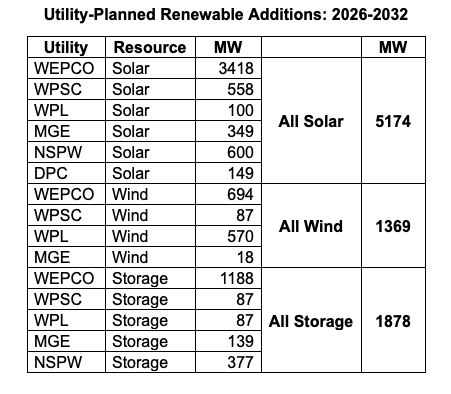
As shown in Table 1 below, WEC Energy and Madison Gas & Electric will add 1.265 gigawatts, or 1,265 MW, of solar power to their generation fleets over the next three years. Construction is well underway at the Koshkonong and High Noon project sites, and ground will be broken this year on the other solar plants listed in the table.

Construction is also proceeding on a 250 MW solar plant in central Wisconsin owned by Minneapolis-based Geronimo Energy. Anticipated to be placed in service later this year, the Portage Solar plant will produce electricity for the wholesale market and sell the renewable energy credits (RECs) from that generation to Microsoft, which will soon complete construction on a hyperscale data center in Racine County. When activated later this year, Microsoft’s facility will become the largest consumer of electricity in the entire state, with a baseline demand of approximately 500 MW. Microsoft will purchase all of the RECs produced by Portage Solar to offset a portion of that facility’s electricity usage. 

Utility-owned solar generating plants often come paired with battery energy storage systems (BESS) placed within the project boundaries. These installations can store up to four hours of electricity at the battery’s rated capacity. 

At the Koshkonong project, for example, the battery system is designed to accept as much as 660 MWh of electricity generated onsite. These BESS units will enable grid operators to discharge stored electricity directly into the transmission system when demand peaks later in the afternoon and evening. 

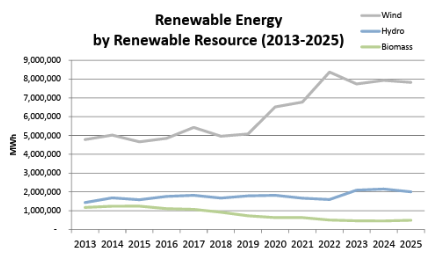
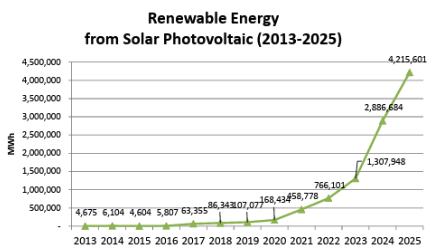
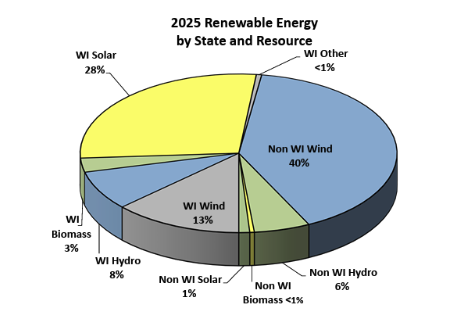
In just a handful of years, solar has emerged as the fastest-growing in-state source of electric power, and its contribution to electricity supplies now surpasses wind and hydro combined (see Table 2). Accounting for 6.6% of Wisconsin-generated electricity in 2025, solar generation could reach the 10% threshold by 2030.

Will solar growth be large enough to offset anticipated load growth driven by hyperscale data centers? 

As impressive as solar’s growth was in 2025, it wasn’t large enough to fully offset the increase in electricity consumption that occurred that year. The other generation resource that saw a significant increase in output from 2024 was coal, whose rise came at the expense of fossil methane. Factoring in other hyperscale data centers now under construction, it will be a challenge to offset rising electricity sales with new solar generation.

As applied to retail electricity customers, the term “capacity factor” is a measure of their actual electrical consumption in a year divided by its peak demand multiplied by 8,760, the number of hours in a year. The consensus estimate of a hyperscale data center’s capacity factor falls in the 75% to 80% range. 

Compared with other customer types, hyperscale data centers impose an unprecedented level of demand on the electric grids that serve them, due to the following reasons.

  • Massive scale of operations serving millions of users; 
  • Expansion of AI use is driving the need for high-density computing power;
  • Energy-intensive cooling systems; and
  • Always-on operations requiring uninterruptible electrical service.

With the above in mind, let’s estimate the power consumption from Microsoft’s Mt. Pleasant campus that will commence operations later this year. If we assume a peak load of 500 MW and a capacity factor of 75 to 80%, electricity consumption from this particular entity would range from 3.3 to 3.5 million MWh per year, or 5% of the electricity sales recorded in the entire state of Wisconsin last year

It would take six solar plants the size of Koshkonong–1,800 MW in total–to offset, on a MWh by MWh basis, the anticipated consumption from just the Mt. Pleasant data center alone. When the two Beaver Dam and the Port Washington data center projects are brought into the picture, the number of Koshkonong-size projects needed to offset all four hyperscalers in the pipeline would exceed 20. 

Given that, it’s fair to conclude that the data center build-out will elevate greenhouse gas emissions from Wisconsin’s electric power industry even with a robust expansion of in-state solar power. Unless something changes on the ground, this worrisome outcome, and all the unpleasant environmental and economic consequences that it will amplify, is quite literally baked into our future.

The post Utilities Ramping Up Solar Power Build-Out appeared first on RENEW Wisconsin.

About That Hail and Your Solar Panels

April has been a rough month for much of Wisconsin. Hail, high winds, tornadoes, and heavy rain have rolled through the state, causing real damage. Here in Madison, the storm on April 14 brought baseball-sized hail, almost three inches across!

Other parts of central and southern Wisconsin got even bigger stones. Cars were dented. Roofs were torn up. Siding was cracked. Power poles came down. And yes, some solar panels broke too.

That’s the reality of weather like this. Extreme storms damage what’s in their path, and almost nothing on the outside of a home gets a free pass when hail comes down at that size. If your panels took a hit, they may need to be repaired or replaced. That’s not great news, but it’s also not the end of the world.

If you were thinking about going solar before the storms rolled through, the storms shouldn’t change the math on that decision. The path forward, whether you’re repairing a system or building one for the first time, looks a lot like dealing with any other part of your home.

How to Get Your System Back Up and Running

When panels get damaged in a storm like this, the fix looks a lot like dealing with hail damage to your roof or siding. The process moves through a few clear steps.

Contact Your Homeowner’s Insurance and Your Installer

Both should know what happened as soon as possible. Your installer works directly with the insurance company on your behalf from there. They document the damage, walk the adjuster through what they’re seeing, and handle the repair, replacement, and reinstall. The homeowner isn’t navigating it alone.

Know Your Coverage Before a Storm Hits

Most standard homeowner’s policies cover rooftop solar under the dwelling section, but it’s worth confirming that hail and wind are listed as covered perils and that your coverage limit reflects what your system is actually worth. Some policies in hail-prone areas carry separate wind and hail deductibles, and ground-mounted systems sometimes need a separate rider, so it helps to know what your specific policy says before you need to use it.

The Rest of the System Is Built To Make This Manageable

Manufacturers test their panels to real standards. Installers know how to work with insurance companies. Each part does its job so that when something does go wrong, the path forward is clear.

Your installer can also help you sort out what’s covered by equipment warranties versus insurance, and show you how to use your monitoring app to confirm the system is performing normally after repairs.

What Hail Does to a Panel

Knowing what kind of damage you’re looking at helps you follow along when your installer comes out for an inspection.

  • Visible damage is less common than people expect, but also the most obvious when it happens. Cracks, chips, or spiderwebbed glass that you can spot from the ground. The tempered glass on top of a panel is built to take a hit, which is why this kind of damage usually only shows up in the more extreme storms. Worth noting too: when a panel does break, the glass stays contained inside the panel. Solar panels are sealed between layers of plastic and held together by an aluminum frame, so cracks don’t send glass flying across your yard or your neighbor’s.
  • Hidden microcracks are the ones experts worry about more. These are microscopic fractures inside the solar cells that might not affect performance right away, but can spread over time the same way a small chip in a windshield can grow into a longer crack. Left unchecked, microcracks can gradually reduce efficiency and create hot spots inside the panel. That’s why post-storm inspections matter even when a system seems to be running fine. 
  • Cell and busbar damage happens beneath the surface when hail’s impact energy transfers through the glass. The busbars are the thin metal strips that carry electricity across the panel. Modern panels use many ultra-thin busbars or wires per cell, often well into double digits, which helps keep current flowing even if part of a cell takes a hit.

A cracked panel will usually still generate electricity at reduced output. If it needs to be replaced, it should be replaced. If it’s still performing within spec, it can keep running. The key is having someone qualified take a look so you know what you’re working with.

A Quick Note on the Testing

Quality solar panels are built to two main standards that work together.

  • IEC 61215 is the performance and durability standard set by the International Electrotechnical Commission. It covers how a panel holds up against weather, including the hail impact testing, where technicians fire ice balls at panels using compressed air cannons. The basic test uses one-inch ice balls at high speeds, and many panels are tested even further against ice balls up to three inches across at speeds up to 88 miles per hour. To pass, the panel has to keep producing power within spec after the impact.
  • UL 61730 is the safety standard set by Underwriters Laboratories, which covers electrical safety, fire resistance, and structural integrity. Together, they tell you a panel can take the weather and stay safe doing it.

The Bigger Picture

Everything on the outside of your home already takes a beating from Wisconsin weather. Your roof, your siding, your windows, and the AC unit out back. None of that has stopped anyone from owning a home. You carry insurance for a reason, and when something breaks, you call somebody who knows how to fix it. Solar panels are no different than anything else on your house in that respect.

April has been hard on Wisconsin, no question about it. But the things people depend on after a storm have shown up. Insurance is paying out. Installers are out doing the work. Hail and wind can damage panels. That’s true. What matters is having the right people in your corner and the right coverage in place when it happens. A solid installer and the right insurance policy take care of that.

The post About That Hail and Your Solar Panels appeared first on RENEW Wisconsin.

PSC’s Preliminary Decision: Data Centers Will Cover Their Costs

By: Alex Beld

Last Friday, April 24, the Public Service Commission of Wisconsin (PSC) unanimously approved an electricity rate plan for data centers and other “Very Large Customers” (VLC) in We Energies’ service territory. This decision will protect Wisconsinites from shouldering the financial burden of the energy and infrastructure costs associated with data centers.

RENEW Wisconsin submitted comments in support of this decision to protect Wisconsin ratepayers. We also asked the PSC to include considerations such as energy efficiency and renewable energy in their decision-making process. Meaning these corporations with massive financial means should, at the very least, be investing in building and operational efficiency, while also signing contracts with utility-scale solar projects.

We also highlighted the importance of these large corporations sticking to their own sustainability goals and how, through their vast access to capital, they could incorporate emerging or cutting-edge renewable energy resources to mitigate their contributions to climate change.

As our Policy Director, Andrew Kell, said in his comments to the PSC, “Data centers have adequate resources to become key innovators and provide the ‘technology push’ and ‘demand pull’ required for these programs, technologies, and infrastructure to scale up and flourish.”

While we don’t have guarantees that data centers will lead the charge on innovation as it relates to renewables, we do at least have a strong indication that the PSC will continue to protect ratepayers in future proceedings related to data centers.

“The decisions we’re making here today will not be limited to this docket,” said PSC Commissioner Kristy Nieto. “They will shape future proceedings, future investments, and the trajectory of the utility system itself.”

The PSC also determined that the energy demand threshold for a VLC to qualify for this rate structure should be reduced from 500 megawatts (MW) to 100 MW, the level at which new energy generation projects typically require PSC approval. The PSC also made it mandatory for eligible VLCs to subscribe.

VLCs will also need to fund and subscribe to portions of multiple new power generation projects, or entire projects, as they will be the driver of much of the state’s new energy demand.

We are still waiting for the final written order for this decision, but we are glad that PSC’s preliminary decisions align with what many public comments submitted stated, which is that data centers must pay the full costs of the energy and infrastructure they require.

As data center development progresses, RENEW aims to collaborate with data centers and strongly encourage them to drive and fully pay for cutting-edge clean energy resources. If data centers do in fact strive to incorporate into communities, they should help to ensure that we can create a sustainable, zero-carbon future.

The post PSC’s Preliminary Decision: Data Centers Will Cover Their Costs appeared first on RENEW Wisconsin.

Earth Day: Celebrating the Place We Call Home

By: Alex Beld

Our shared home and all of its inhabitants deserve protection. It’s been said many times before, but it deserves repeating—we only have the one Earth.

For the last 35 years, supporters like you have helped us lead the charge as we fight to create a future powered by renewable energy. In that time, we’ve made a lot of progress and continue to expand our efforts to end our reliance on fossil fuels and combat climate change.

In 2025 our efforts to support renewables resulted in:

  • 5.6 million megawatt hours of renewable energy generated
  • 9 billion pounds of carbon emissions avoided
  • 560,000 homes powered by renewable energy

We also helped 25 nonprofit organizations go solar through our Solar for Good grant program. This year, we’re looking to do even more to bring the benefits of renewable energy to every corner of Wisconsin.

In 2026 we have already:

  • Supported two utility-scale solar projects
  • Supported one utility-scale wind project
  • Highlighted the value of clean energy jobs
  • Advocated for data center legislation that protects Wisconsinites
  • And Hosted our Annual Summit!

We’ve also seen three new utility-scale renewable projects get approved by the Public Service Commission of Wisconsin! Each of these wins brings us one step closer to our goal of creating a healthy climate and an economy we can afford. And there’s so much more we hope to achieve. It is, after all, still spring. By winter, we hope our list of achievements has gotten much longer. Together, we can make it happen!

The post Earth Day: Celebrating the Place We Call Home appeared first on RENEW Wisconsin.

Bent Tree North Wind Project Approved

By: Alex Beld

On April 21, Alliant Energy announced the unanimous approval of the Bent Tree North Wind project. The 153-megawatt (MW) wind project will include 32 wind turbines and expand on the existing Bent Tree Wind Farm, which has been operating successfully since 2011. Since the project is located in Minnesota but will send power to Wisconsin, it required approval in both states.

Upon completion, the Bent Tree North Wind project is expected to generate enough electricity to power about 50,000 homes each year. This expansion of Alliant’s renewable energy portfolio is a win for Wisconsin residents in terms of both energy affordability and grid reliability.

More renewable energy means less reliance on fossil fuels, which at times experience volatile pricing, and diversifies our energy resources. This helps keep energy prices from rising and gives us more options for keeping the lights on.

And while this project will reduce the carbon footprint of our state’s electricity production, it will also be economically beneficial to the region where it is hosted. It is expected that the local area will see $100 million in local economic benefits over the project’s 30‑year (or so) life. Some of these benefits will come in the form of tax revenue, landowner payments, and wages for the 100-150 construction jobs the project will support.

The turbines used for the project will also support the economies in the Midwest. Alliant Plans to use Nordex N133s, a 4.8 MW turbine, which has several key components constructed at Nordex’s Iowa facility.

The turbines are also designed to produce more energy per tower, resulting in less disturbance to the land hosting the project. Standing at an impressively tall 606 feet, the towers are able to support larger rotors, which in turn increases energy production and efficiency. This means more energy at a lower cost.

We’re glad we were able to show our support for a project that fights climate change, boosts local economies, and helps keep Wisconsin’s utility bills more stable. If you want to learn more about this project and some of the other things Alliant Energy has cooking, check out their efforts here—Alliant’s Wind Generation

The post Bent Tree North Wind Project Approved appeared first on RENEW Wisconsin.

Energy Storage Utility Aid Law Passes

By: Alex Beld

On April 3, 2026, Governor Tony Evers signed a bill that allows counties and municipalities to receive shared revenue payments when a utility-owned battery energy storage system (BESS) is located within their borders. These payments are referred to as utility aid and will amount to $1,000 per megawatt of storage capacity. Local governments also receive utility aid payments for utility-scale renewable energy projects and energy-producing projects.

Utility aid payments are intended to help local governments offset lost property tax revenue and actually provide more funding to municipalities and counties than the property taxes would have. Property owned by a utility company is tax-exempt.

Beginning in 2027, the bill requires the distribution of utility aid payments to local governments for any energy storage facility with a capacity of at least one megawatt. In order for a BESS to qualify for utility aid, it must be used to store a power source that has been converted from another stored energy source. As an example, solar or wind.

It is becoming increasingly common that utility-scale solar is paired with a BESS. Energy storage adds reliability and flexibility to our energy infrastructure, in part by capturing excess power produced by solar installations in the middle of the day and making it available when needed.

Under existing law, when an energy project is located in a city or village, the municipality receives two-thirds of the utility aid, and the county receives one-third. If the project is located in a town, that allocation is reversed. The same will be true for how utility aid payments from a BESS are distributed.

This law was passed with the support of Wisconsin utilities as well as energy developers that are active in the state. This change is a win for communities that host the energy projects that keep our lights on.

The post Energy Storage Utility Aid Law Passes appeared first on RENEW Wisconsin.

Planting the Grid Our Children Will Need: Why the MariBell Transmission Project Matters

There is an old story from the Mediterranean about an elderly man planting an olive tree. A passerby asks why he would plant something that takes decades to bear fruit. The man replies: “Because my children will need the olives.”

Transmission lines are much the same.

Across southwest Wisconsin, communities are hearing about the MariBell Transmission Project, a proposed high-voltage transmission line that would connect Marion, Minnesota, to Bell Center, Wisconsin. The project is part of an effort to strengthen the electric grid across the Upper Midwest.

When people first hear about a transmission project, the natural questions are: Why do we need it? And is it safe?

We can answer both.

Transmission Is Planned Generations Ahead

Transmission lines are not built for today’s electricity needs. They are planned decades ahead for our children’s future.

Much of the infrastructure we rely on today was planned decades ago. Engineers studied population growth and future electricity demand long before many of the businesses and technologies we rely on today even existed.

Regional grid operators like MISO (Midcontinent Independent System Operator) are responsible for conducting these long-range studies. From that work comes the Long Range Transmission Plan, which identifies major grid upgrades needed to maintain reliability across the region. The MariBell project is part of that effort.

Once a project appears on a planning map, it often takes 10 to 15 years before construction begins. Environmental studies, landowner discussions, engineering design, and regulatory approvals are all requirements for this long-term investment.

In other words, transmission is built for the future long before it arrives.

The Backbone of a Reliable Economy

Electricity demand across the Midwest is growing again.

Manufacturing is expanding. We’re electrifying our homes and transportation. At the same time, older power plants are retiring, and new energy sources are coming online across the region.

Transmission connects it all, allowing electricity to travel long distances, balancing supply and demand across states, and ensuring reliability during extreme weather or periods of high demand. It also allows new power generation, from solar to nuclear, to connect to the grid and reach the communities that need it.

Addressing the EMF Question

Another common concern raised during transmission discussions is electromagnetic fields, or EMF.

EMFs are produced whenever electricity flows through a wire, not just transmission lines. Household wiring, appliances, power tools, and TVs also create EMFs.

Because this issue has raised questions for decades, it has been studied extensively. Research conducted by the National Institutes of Health, the World Health Organization, and the National Cancer Institute has examined EMF exposure for more than 40 years.

The consistent scientific finding is that EMF from power lines has not been shown to cause adverse health effects from the levels of exposure typically experienced by the public.

Transmission lines are also designed to naturally reduce exposure. The height of structures and the distance they are placed from homes are both meant to take advantage of the fact that EMF levels drop rapidly the farther you move away from a line. In many cases, household appliances can expose people to stronger EMF levels at a very close range.

That doesn’t mean concerns should be dismissed. But decades of research provide strong reassurance that transmission infrastructure operates safely within established guidelines.

Thinking Like the Man With the Olive Tree

The conversation around the MariBell project is in its early stages. Maps show both proposed and optional corridors, and the final route will be determined through regulatory review and public input.

Those conversations matter. Communities deserve transparency, and landowners deserve to be heard.

The grid we rely on today exists because previous generations believed in planning for the future. They built the infrastructure that powers today’s homes, hospitals, farms, and businesses.

They planted the olive trees.

Now it’s our turn.

Transmission projects like MariBell are not just about meeting today’s electricity needs. They are about ensuring that our children inherit an infrastructure strong enough to support their future.

If we want them to enjoy the harvest, we have to start planting now.

The post Planting the Grid Our Children Will Need: Why the MariBell Transmission Project Matters appeared first on RENEW Wisconsin.

Akron Solar Approved!

By: Alex Beld

Earlier this week, the Public Service Commission of Wisconsin (PSC) approved Akron Solar! This 200 Megawatt (MW) solar project will be located in Adams and Wood Counties and is planned for completion in the latter half of 2029. Projects like this have a wide range of local and statewide benefits. Thanks to everyone who helped make this project happen, especially those who submitted comments to the PSC and told them why Wisconsin needs more solar power!

Even though we’re only three months into 2026, we are excited about the amount of progress we have already made. That said, there’s plenty more for us to accomplish this year. We hope you’re just as excited as we are to keep the momentum up and help us create a future where everyone benefits from the renewable energy revolution!

Akron Solar’s benefits extend well beyond the clean energy it will produce. If you’re not familiar with the project, below are some additional reasons why we support this project:


  • Economic Growth: According to a report by Strategic Economic Research, Akron Solar will create more than 450 jobs during construction, as well as more than 14 good-paying, long-term positions in Adams and Wood Counties.
  • Community Benefits: Once in service, Akron Solar will contribute more than $1,000,000 in utility-aid payments each year. Over $566,000 of this will go to the counties, while the remaining $433,33 will go to the towns of Rome and Saratoga. During its 25-year life, the project will contribute a total of at least $25million in utility-aid payments.
  • Emissions Reductions: Akron Solar will reduce energy production emissions by 650 million pounds of CO2 in the first year of operations. In terms of greenhouse gas emissions, this is the equivalent of taking more than 64,000 vehicles off the road for a full year. These emissions reductions will result in health, economic, and environmental benefits. Wisconsin can expect more than $1.4 million in economic benefits associated with public health improvements in Akron Solar’s first year of operations alone.

The post Akron Solar Approved! appeared first on RENEW Wisconsin.

Action Alert: Submit Comments in Support of Fox Solar

By: Alex Beld

Public comments are open now through March 9 for Fox Solar, a 100 Megawatt (MW) solar project paired with a 50 MW battery energy storage system. If approved, the solar project will be located in Oconto County and is planned for completion in 2028. Projects like this have a wide range of local and statewide benefits. Show your support for this project and tell the Public Service Commission of Wisconsin (PSC) why you support the approval of a vital solar project in Wisconsin!

You can use some of the listed benefits below to help you craft your message.

Fox Solar isn’t just about the clean energy it will produce. The 100 MW facility in Oconto County has many benefits:

Economic Growth: According to witness testimony provided by David Loomis of Strategic Economic Research, Fox Solar will create 300 temporary jobs during construction, as well as more than 20 good-paying, long-term jobs across Wisconsin due to economic stimulus related to the project.

Community Benefits: Once in service, Fox Solar will contribute more than $500,000 in utility-aid payments each year. $283,333 of this will go to Oconto County, while the remaining $216,667 will go to the Town of Morgan. During its 25-year life, the project will contribute more than $12 million in utility-aid payments.

Emissions Reductions: Fox Solar will reduce energy production emissions by 304 million pounds of CO2 in the first year of operations. In terms of greenhouse gas emissions, this is the equivalent of taking more than 29,993 vehicles off the road for a full year. Additionally, non-GHG emissions reductions will result in health, economic, and environmental benefits. Wisconsin can expect more than $690,000 in economic benefits associated with public health improvements in Fox Solar’s first year of operations alone.

Submit your comments today and tell the PSC you support the approval of Fox Solar. Feel free to use some of the bullet points above to craft your own unique message.

The post Action Alert: Submit Comments in Support of Fox Solar appeared first on RENEW Wisconsin.

RENEW Wisconsin Supports Bent Tree North Wind Project

By: Alex Beld

Wisconsin Power and Light (Alliant Energy) plans to expand its Bent Tree Wind Farm with the Bent Tree North Wind Farm project. Though located in Minnesota, the project will provide power for Alliant Energy customers here in Wisconsin. RENEW Wisconsin is advocating for approval of this project both in Minnesota and here in Wisconsin, as Alliant Energy requires approval from both the Minnesota Public Utilities Commission and the Public Service Commission of Wisconsin.

In its first full year of electricity production, Bent Tree North Wind Farm will produce about 550,000 Megawatt-hours (MWh) of electricity. This is enough to power 55,000 Wisconsin households and reduce emissions produced from energy production by more than 865 million pounds of Carbon Dioxide (CO2) each year. This amount of CO2 would be like taking more than 85,500 vehicles off the road.

Along with CO2 emissions, there are a slew of pollutants that this project will keep out of the air we breathe. As a result, Wisconsin can expect over $1.8 million in economic benefits associated with public health improvements in the first year of Bent Tree North Wind’s operations.

Similar to Wisconsin, Minnesota communities that host utility-scale energy projects benefit from these projects. Bent Tree North will add 150 Megawatts (MW) to the already existing Bent Tree Wind Farm, a 201 MW project. In Minnesota, wind projects are subject to a Wind Energy Production Tax. At about $19,000 per turbine, Bent Tree North will add nearly $650,000 in revenue to be split among Steele, Waseca, and Freeborn Counties. Additional financial benefit will go to the landowners who are leasing their land to make this project possible.

The construction of the project is expected to create 100 to 150 full-time jobs until the project is operational. Additionally, construction workers will contribute to local spending for housing, fuel, meals, and supplies, and construction materials such as concrete and gravel are often sourced locally or regionally.

Though we don’t typically extend our advocacy beyond the borders of our state, this is a great opportunity for both Wisconsin and Minnesota, even if we can’t see eye-to-eye on where Paul Bunyan’s Axe really belongs. Rivalries aside, we look forward to seeing this project approved and will provide an update when we know more!

The post RENEW Wisconsin Supports Bent Tree North Wind Project appeared first on RENEW Wisconsin.

❌