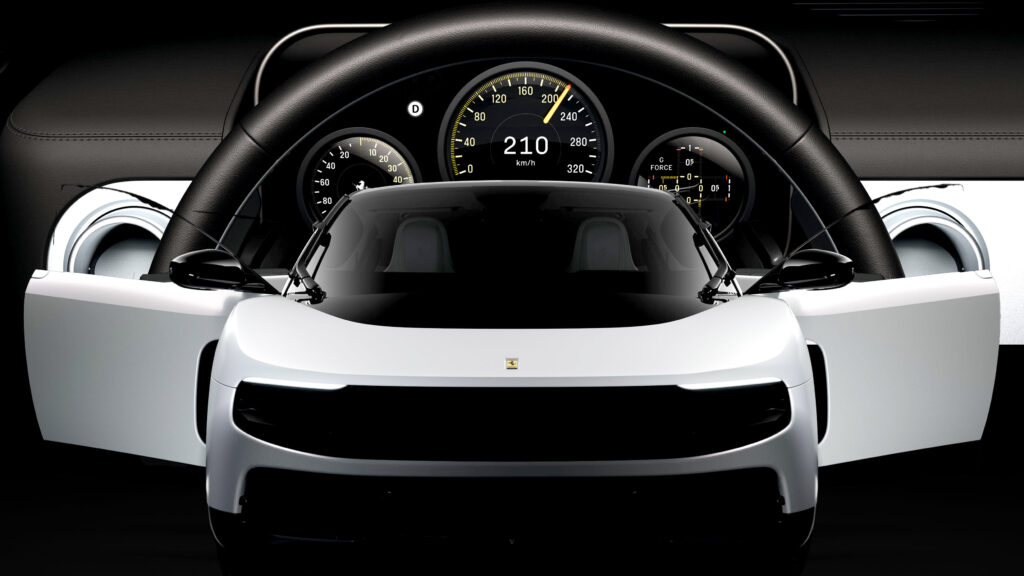
Lamborghini says it doesn’t need an EV until at least 2030.
Ferrari’s controversial Luce debut appears to be influencing rivals.
Lamborghini will keep combustion engines alive with hybrids for now.
Ferrari’s controversial Luce debut got plenty of attention, though perhaps not the kind Maranello was hoping for. Rather than have cross-town rival Lamborghini feeling like it’s behind the times, it appears as though the brand’s CEO is even more content now that the Lanzador didn’t remain on schedule for an earlier debut. He’s openly doubling down on the idea that Lamborghini was right to delay the brand’s first EV.
In a round table with journalists, asked about the reaction to the Luce, Lamborghini CEO Stephan Winkelmann said his company made the “right decision” in postponing its first fully electric car, arguing that customer demand for electric supercars simply hasn’t materialized the way much of the industry assumed it would.
According to Handelsblatt, Winkelmann said Lamborghini has spent years monitoring demand in the luxury segment. To no one’s surprise who’s been paying attention, the company found that acceptance of electric vehicles hasn’t climbed at anything close to the pace many had forecast.
The automaker had planned to launch the all-electric Lanzador before the end of the decade. Initially, production was simply delayed. Now, it won’t happen until at least 2030, if not later, because acceptance for EVs within the brand’s target demographic was “close to zero.” For now, Lamborghini has scrapped it and is looking at a new hybrid model to join the lineup in the near future.
Importantly, European regulations currently call for a ban on the sale of new combustion-powered vehicles beginning in 2035, although exemptions for e-fuels and certain low-volume manufacturers remain under discussion. While many exotic-car makers spent the last several years announcing ambitious EV programs, Lamborghini now appears content to let others test the waters first.
That’s probably a wise move considering its positioning. While nowhere near as successful as Ferrari, Lamborghini has its position underneath Volkswagen Group going for it. It’s currently one of the most profitable divisions. In 2025, it generated €3.2 billion ($3.7 billion) in revenue. Even though operating profit slipped from €835 million ($970 million) to €768 million ($892 million), the company still posted a remarkable 24 percent operating margin.
Many social media users compared the Luce to the Nissan Leaf.
Mazda fired back with a photo of its original 1960s Luce.
Ferrari’s former boss says the design is beyond even copying.
The new, all-electric Ferrari Luce has spent the past week since its launch as the internet’s favorite target. Keyboard critics have torn into the styling, AI renders have circulated to demonstrate how trivially the design could be fixed, and even the share price took a brief tumble.
Not even Toblerone could help itself in poking fun at Ferrari. Heck, even Ferrari’s legendary former boss, Luca di Montezemolo, suggested the Luce is so horrible that not even the Chinese would dare copy it. Both Mazda and Nissan have since jumped on the bandwagon, having their say on the controversial EV.
Mazda came first, simply posting a photo of the original Mazda Luce SS that it introduced back in the 1960s. It appears Ferrari quietly snagged the international trademark for Luce earlier this year after Mazda let it lapse. While the Japanese brand can no longer use the name, there’s no denying the original Luce looks much better than the new Ferrari. The top comment? “Mazda making fun of Ferrari before GTA6,” with more than 4,500 likes.
Soon after, Nissan Ireland jumped onto Instagram. Immediately after the Luce was unveiled, some online pundits began comparing it to the new Nissan Leaf, posting side-by-side photos of the two.
Nissan re-posted one of these images, showing the side profile of the Leaf compared to the Luce, writing “We admit, we’re flattered,” and adding “They say imitation is the sincerest form of flattery, so thank you Ferrari.”
The most obvious similarity between the duo is the two-tone black-and-blue paint schemes they were presented in. You could also argue that the rear hatch of the Luce is similar to the Leaf, as are the black rocker panels, but in general, we don’t think the Luce and Leaf look that much alike. Nevertheless, Nissan Ireland took down the post shortly after it was shared, perhaps because the social media intern received a call from their boss.
Perhaps the funniest meme we’ve seen of the Ferrari Luce is an AI rendering comparing it to an Apple computer mouse. But if the Luce somehow sells well, Ferrari could end up getting the last laugh.
As it turns out, even an aftermarket body kit doesn’t do the Luce any favors.
This kit from Venuum includes a host of exposed carbon fiber accents.
Key features added include a new splitter, a fixed rear wing, and a diffuser.
There is a question worth asking before anyone reaches for the carbon fiber, which is whether the new Ferrari Luce EV can be saved at all. We have our doubts. But the aftermarket, never one to wait for permission, has already started sketching out ways to rework the design of Ferrari’s controversial five-seater.
These renderings come from Venuum, a tuner based in the UAE that sells a wide selection of bodykits for exotic cars, including the likes of the Ferrari Purosangue, Rolls-Royce Wraith, and soon, will unveil a widebody Bugatti Chiron. In transforming the new Luce, they’ve imagined it with a slew of new body panels, and while it looks aggressive, it better resembles a riced-out Japanese sedan than a car fitting of the Ferrari badge.
Modifications start at the front where Venuum has crafted a carbon fiber splitter for the EV as well as a pair of carbon fiber canards. It also sports flared front wheel arches and rock a set of carbon side skirts. The odd air outlets on the front doors have also been finished in carbon for that true aftermarket look.
The rear isn’t that much better looking either. In addition to the flared arches, Venuum has added a fixed rear wing and an aggressive rear diffuser, also made from carbon fiber.
From Bad To Worse
It’s unclear if Venuum plans to release a kit for the Luce which looks exactly like this, although it’s seemingly inevitable that it, as well as numerous other aftermarket specialists, will release kits for the car, aimed at making it look a little more like a Ferrari should. Will any of these kits actually make the five-seat EV look Italian, rather than something even the Chinese wouldn’t dare to copy? We shall see.
For now, the conversation around the Luce’s design runs overwhelmingly negative. Ferrari had better hope the interior and the way the thing drives are persuasive enough to put people in the seats.
As it turns out, even an aftermarket body kit doesn’t do the Luce any favors.
This kit from Venuum includes a host of exposed carbon fiber accents.
Key features added include a new splitter, a fixed rear wing, and a diffuser.
Is there any possible way to make the new Ferrari Luce look good? We’re not sure that there is, but these renderings show that the aftermarket is already thinking about ways to transform the design of the controversial five-seater.
These renderings come from Venuum, a tuner based in the UAE that sells a wide selection of bodykits for exotic cars, including the likes of the Ferrari Purosangue, Rolls-Royce Wraith, and soon, will unveil a widebody Bugatti Chiron. In transforming the new Luce, they’ve imagined it with a slew of new body panels, and while it looks aggressive, it better resembles a riced-out Japanese sedan than a car fitting of the Ferrari badge.
Modifications start at the front where Venuum has crafted a carbon fiber splitter for the EV as well as a pair of carbon fiber canards. It also sports flared front wheel arches and rock a set of carbon side skirts. The odd air outlets on the front doors have also been finished in carbon for that true aftermarket look.
The rear isn’t that much better looking either. In addition to the flared arches, Venuum has added a fixed rear wing and an aggressive rear diffuser, also made from carbon fiber.
From Bad To Worse
It’s unclear if Venuum plans to release a kit for the Luce which looks exactly like this, although it’s seemingly inevitable that it, as well as numerous other aftermarket specialists, will release kits for the car, aimed at making it look a little more like a Ferrari should. Will any of these kits actually make the five-seat EV look Italian, rather than something even the Chinese wouldn’t dare to copy? We shall see.
For the moment, talk about the Luce’s design is overwhelmingly negative. Ferrari had better hope that the car’s interior experience and driving dynamics can convince people to actually buy it.
Ferrari CEO defends the Luce amidst heavy backlash from the public.
Vigna revealed they have already received bank transfers for the EV.
He also said the €550k ($640k) price is “fair to pay for innovation”.
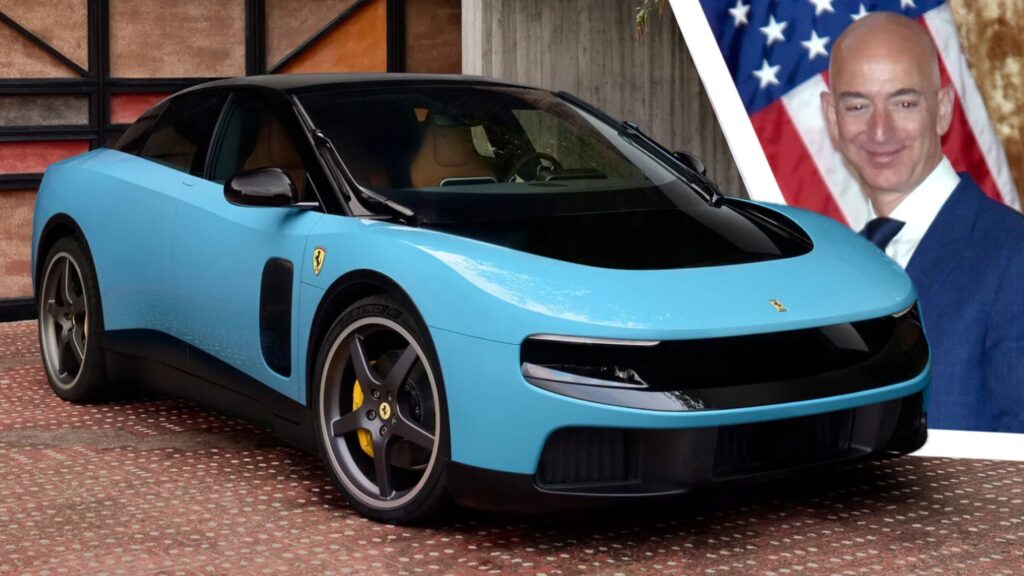
A car can be panned by the public and still find buyers, and Ferrari is betting the gap between the two is wider than the noise suggests. The Luce’s unveiling set off a wave of criticism and dragged on the company’s share price before it rebounded, yet CEO Benedetto Vigna insists there is “strong interest” from clients, and that the €550,000 ($640,000) asked for Ferrari’s first EV is “fair to pay for innovation.”
Vigna made the case at an event in Modena on Thursday, where he said there is “strong interest, including from new clients.” He claimed buyers who attended the debut earlier this week have already put money down. “We’ve already received bank transfers, clients who were there want it,” the CEO said.
According to Reuters, around 1,600 prospective customers saw the EV in person on Monday and Tuesday in Rome, with order books opening on Wednesday. The company will announce precise figures about the number of Luce orders in July, as part of the financial results for Q2 2026.
Photos Ferrari
The loudest complaints concern the way the Luce looks, a design that breaks sharply with Ferraris of the past. The electric sedan was penned by LoveFrom, the studio founded by former Apple design chief Jony Ive and Marc Newson. Most fans came away cold, missing the emotion they expect from Maranello, while others pointed an uncomfortable resemblance to cars from far less exotic brands.
The CEO believes that critics would change their minds if they saw the Luce in person: “If you see it and try it, you immediately understand it was not copied and it has nothing to share with other EVs you have seen and are produced by others, in terms of interiors, exterior and performance.”
Vigna also stressed that the electric Luce is an addition to the range, not a replacement, and that Ferrari will keep building ICE and hybrid cars alongside it.
Ferrari shares are clawing back ground after sliding 8.8 percent in the wake of the Luce’s debut. The current CEO’s optimism isn’t universally shared. Former boss Luca di Montezemolo took a dimmer view, arguing the Luce is “hurting Ferrari” and that the company risks the “destruction of a legend.”
Who do you think is right? Sound off in the comments below.
Ferrari presented Pope Leo XIV with a steering wheel from the new Luce.
The Pontiff asked the Italian brand’s chairman if the Luce was its first sedan.
Shares fell after the reveal, though the stock has since started to recover.
Ferrari is making a big hoopla about the Luce, its first-ever electric car. However, in the days since the vehicle’s unveiling, it’s not the fact that it doesn’t sip a drop of gasoline that’s generated headlines, but rather the controversial design. To say the reception to it has been frosty would be an understatement, and it doesn’t appear as though even Pope Leo XIV can get excited about it.
As part of the global premiere of Luce, Ferrari visited the Pope in Castel Gandolfo, a tiny hillside town he calls home when he’s not in Vatican City. A white-and-black Luce was presented to the Pope by Ferrari chairman John Elkann and chief executive Benedetto Vigna.
In a video shared by Ferrari from the visit, Pope Leo XIV is seen touring the electric Luce. Perhaps he’s not a car guy, but when Ferrari lifts the covers, he doesn’t appear particularly enamored, and we can’t blame him. Shortly before jumping behind the wheel, he asks if this is the “first four-door Ferrari,” which obviously it isn’t. Elkann confirms that it is the company’s first five-seater model. Even the head of the Catholic Church needed a moment to figure out what he was looking at.
The Luce is also the first Ferrari styled by an outside firm, specifically the design company led by Jony Ive, the former head of design at Apple. Whether Ferrari is comfortable with that arrangement now is another question. The car’s unveiling wiped more than $3 billion off the company’s market value, though the share price has begun clawing back ground over the past day.
Ferrari didn’t leave the Pope empty-handed. Rather than gifting him the car, the company presented Leo XIV with the Luce’s leather-and-aluminum three-spoke steering wheel, displayed in a clear case.
If Ferrari set out to get people talking with the Luce, then it’s certainly achieved that. The company has been candid that the Luce isn’t aimed at its traditional customer base, targeting instead young, ultra-high-net-worth buyers who have never owned a Ferrari before. Whether that audience is more enthusiastic about the styling than the Pope was remains to be seen.
Demand for expensive cars with stick shifts has increased in recent years.
Recent trademark filings indicate Ferrari is working on several new 12Cilindri models.
A manual Ferrari 12Cilindri could be shown to owners during June’s Ferrari Cavalcade.
The controversial new electric Luce is a Ferrari unlike anything that has worn the badge before, but don’t mistake it for a sign that Maranello has forgotten how to build a proper driver’s car. If a new report holds up, the company may be about to bring back the manual transmission.
Ferrari hasn’t built a single road car with a manual transmission since 2012, when the 599 GTB and California were offered with traditional six-speed stick shifts. However, in recent years, the upper echelons of the automotive industry have seen a resurgence in demand for supercars with manual gearboxes, including the Pagani Utopia, GMA T.50, and Koenigsegg’s CC850, as well as for slightly more accessible cars with manuals, like the Porsche 911 GT3.
In addition, the values of old Ferraris with manual gearboxes and cars from rival brand Lamborghini have skyrocketed in recent years. Clearly, the number-crunchers at Ferrari have realized there’s strong demand for manuals, and people are willing to pay a premium for them.
According to a new report, Ferrari is working to add a manual transmission to its flagship V12-powered GT car, the 12Cilindri. The Supercar Blog understands that Ferrari will present this new version to owners at the Ferrari Cavalcade road rally next month, before unveiling it to the world in July.
For now, there’s no word on where Ferrari will source the gearbox, or whether it’ll be developed in-house. Either way, the safe bet is a gated manual, the kind that gives 12Cilindri owners the kind of mechanical theater the rest of the lineup quietly stopped offering years ago.
Recent trademark filings from Ferrari revealed it’s working on several exciting new models, including a 12Cilindri MM, 12Cilindri MM Aperta, and 12Cilindri GTO. It’s unlikely the GTO will get a manual, but it’s possible the MM badge could be reserved for the stick shift. If current reports are to be believed, production of this model will be extremely limited, meaning only the most prolific Ferrari collectors will have a chance of owning it.
Toblerone mocked Ferrari EV’s blobby design by posting an image of Luce-style bar.
The candy is in Ferrari’s pale blue and doesn’t feature Toblerone’s trademark triangles.
Text on social media post declared “this is not happening, we’ll always keep the angles.”
Ferrari probably expected strong reactions when it unveiled the new Luce EV. What it likely didn’t expect was getting roasted by a famous Swiss chocolate company.
The internet has spent the last couple of days absolutely demolishing Ferrari’s first fully electric model, comparing it to everything from a rechargeable Apple mouse to a Nissan hatchback. AI-generated videos showing Enzo Ferrari detonating the car have spread everywhere online, and now even Toblerone has decided joining the fun was too tempting to resist.
The Swiss chocolate brand posted a hilariously image on social media showing a redesigned Toblerone bar with all its trademark triangular peaks smoothed away into one shapeless sausage. The candy was even painted in a similar pale blue shade to one of the launch-spec Luce models.
Accompanying text read “This is not happening” before adding that Toblerone would “always keep the angles.”
The joke gets right to the nub of most people’s beef with the Luce. Which isn’t that it’s electric, after all. But that it doesn’t look like a Ferrari (which was certainly intentional), and to most eyes isn’t exciting, desirable or glamorous.
Even Ferrari Alum Can’t Stand It
And criticism hasn’t only come from random commenters armed with Photoshop and too much free time. Former Ferrari chairman Luca di Montezemolo, who led the company for 23 years and famously resisted approving an SUV, delivered what might be the most devastating reaction yet.
“If I had to say what I really think, I would be hurting Ferrari,” the 78-year-old said, looking visibly outraged. He followed up by warning Ferrari risks “the destruction of a legend” and suggested they should perhaps even remove the prancing horse badge entirely. The one thing Ferrari had in its favor, di Montezemolo said, is that the not even the Chinese will try to copy it.
Maybe he’ll change his mind if he gets a chance to drive it. Ferrari claims the Luce produces 1,035 hp (1,050 PS / 772 kW) from four electric motors and hits 62 mph (100 kmh) in 2.5 seconds. That makes it quicker than some of Ferrari’s own combustion cars, yet the Luce has space for five and a huge trunk.
Following backlash to the Luce, Lamborghini believes they made the right call on EVs.
Their first electric vehicle was supposed to arrive in 2028, but they decided to axe it.
Lamborghini also abandoned plans to turn the next-gen Urus into an electric SUV.
Ferrari unveiled the fully electric Luce on Monday and the industry has been abuzz with what a huge disappointment it is. The quad-motor, four-door blob somehow manages to look modern, generic, and outdated all at the same time.
While the company isn’t exactly a stranger to questionable designs, the hate for the Luce has been intense and isn’t entirely due to it being electric. The brand has defended the car, but Lamborghini CEO Stephan Winkelmann couldn’t resist lightly dunking on it.
Speaking to CNBC, Winkelmann implied the backlash to the Luce proved they made the right called in killing the Lanzador. As he explained, axing the EV was “the right way to go,” but “every brand, every company has to decide for themselves.”
As you may recall, Lamborghini introduced the Lanzador concept in 2023 and it was designed to preview an upcoming production model due in 2028. However, the automaker decided to kill the vehicle earlier this year as clients’ interest in electric variants was “close to zero.”
Besides killing the Lanzador, the company decided to abandon plans to turn the Urus into an electric crossover. As a result, the second-generation model will be offered as a plug-in hybrid and it’s expected to arrive around 2029.
While Winkelmann was careful not to talk about Ferrari or the Luce directly, he noted “innovation is paramount” but can’t be forced on customers. He went on to credit Lamborghini for being smart, watching the market, and seeing that acceptance of EVs among its customers was not increasing as time went on.
This caused them to make hard decisions and abandon EVs for plug-in hybrids. Lamborghini is far from the only company to do this as Ford and Honda have killed an assortment of EVs, while others have delayed plans to go electric-only.
Ferrari reportedly threatened media with staggering €600,000 penalties over Luce leaks.
PR handlers closely monitored journalists during tightly controlled Luce previews.
Tech influencers are said to have received longer access and Luce driving sessions.
Ferrari’s launch of the new Luce EV already looked controversial enough thanks to the car’s design itself and powertrain. But according to one YouTuber the real drama started long before anyone switched cameras on. In a lengthy video breakdown following Ferrari’s Rome reveal event, Shmee described an atmosphere that sounded less like a glamorous supercar launch and more like an intelligence operation.
The most eye-popping detail involved embargo agreements carrying a reported €600,000 (about $700,000 at current rates) penalty for anyone responsible for leaks. Penalty clauses are common across the industry when media are given advance access to assets, but they’re rarely a tenth of that size. Now you know why for once we didn’t see a new car splashed all over Instagram 24 hours before the official debut.
When journalists arrived at the event hall, their phones and laptops were sealed with security stickers, says the British YouTuber, whose real name is Tim Burton. Media weren’t allowed to use their own camera operators or equipment. Instead, Ferrari supplied the crews, controlled the footage, and only released clips shortly before the embargo lifted.
That setup created an uncomfortable situation for reporters trying to form genuine opinions about a car they’d never seen before, and looked nothing like they’d imagined. Shmee repeatedly described walking into the reveal thinking “what have they done?” while struggling to process whether the car even resembled a Ferrari.
Start The Clock
He explains how journalists had roughly 30 minutes with the Luce while surrounded by Ferrari staff and PR representatives listening nearby. So it’s no surprise many creators defaulted to repeating official talking points instead of offering meaningful reactions.
Tech Creators Got The Keys First
One detail Shmee revealed that’s perhaps less surprising is the different, and superior access granted to tech creators. Youtubers including Marques Brownlee attendede a separate event, with some reportedly even driving the car. Meanwhile traditional automotive journalists became what Shmee called the “second wave.”
That strategy does make sense. The Luce clearly isn’t aimed at old-school Ferrari obsessives, and it was always going to struggle to win over petrolheads. They already have the Purosangue and a load of sports cars to choose from. The Luce’s real job is to bring new buyers to the brand, drivers who’ve probably never considered a Ferrari before.
It’s a plan that’s worked before with the California and Purosangue, but will it work with the far more radical Luce, or is it too polarizing even for tech-heads?
Luca di Montezemolo says the Luce shouldn’t have the Prancing Horse badge.
Ferrari’s former boss says the Luce risks destroying the fabled Italian brand.
Italy’s deputy Prime Minister has also fiercely criticized the all-electric Ferrari.
Some car launches court controversy by accident. The Luce did it on purpose, and the man who ran Ferrari for two decades is not amused. Back in February, iPhone designer Jony Ive warned us the all-electric Ferrari Luce would be controversial. Even he likely did not anticipate how sharply the market would turn on the exterior design.
Just a few months ago, pundits were praising the interior of the Luce, which ditches the over-reliance on touch-sensitive controls found in other Ferraris in favor of physical buttons, switches, and toggles. But while LoveFrom, the design agency run by Ive that penned the Luce, nailed the cabin, the same cannot be said for the exterior. Even former Ferrari boss Luca di Montezemolo, who served as Chairman and CEO from 1991 to 2014, is not a fan.
Shortly after Ferrari pulled the wraps off the Luce, di Montezemolo gave Italian publication Askanews his unvarnished take. In his view, this is the rare Ferrari even the Chinese will not bother to copy.
“If I had to say what I really think, I would be hurting Ferrari,” he said. “We’re risking the destruction of a legend, and I’m very sorry about that. I hope they at least remove the Prancing Horse from that car. This is surely a car that at least the Chinese won’t copy from us.”
It’s not just di Montezemolo who appears shocked by the new Luce. Even Italy’s deputy prime minister and transport minister, Matteo Salvini, expressed his feelings on X.
“It looks nothing like a (Ferrari),” he wrote. “Is this supposed to be ‘innovation’? Who knows what Enzo Ferrari would say.”
Elettrica, costosissima (550 mila euro!) e, dal punto di vista estetico, si commenta da sola… Sembra tutto fuorché un'auto del Cavallino. E questa sarebbe “innovazione”? Chissà Enzo Ferrari cosa direbbe… pic.twitter.com/zITSlz1a9j
Shortly after Ferrari lifted the covers on the Luce, shares in the brand dropped 8.4 percent in Italy and 5.1 percent in the US. Ferrari has been open about its ambitions for the Luce to attract a new generation of wealthy buyers, particularly those who are environmentally focused, but whether or not it’ll even appeal to them remains to be seen.
Luca di Montezemolo says the Luce shouldn’t have the Prancing Horse badge.
Ferrari’s former boss says the Luce risks destroying the fabled Italian brand.
Italy’s deputy Prime Minister has also fiercely criticized the all-electric Ferrari.
In February, iPhone designer Jony Ive warned us that the all-electric Ferrari Luce would be controversial, but not even he would have predicted the market’s initial response to the car and its exterior design.
Just a few months ago, pundits praised the interior of the Luce, which eschews the over-reliance on touch-sensitive controls of other Ferrari models in favor of physical buttons, switches, and toggles. But while LoveFrom, the design agency run by Ive that designed the Luce, nailed the car’s interior, the same can’t be said about the exterior. Not even former Ferrari boss Luca di Montezemolo likes the car.
Shortly after Ferrari lifted the veil on the Luce, di Montezemolo briefly spoke with Italian publication Askanews about it. According to him, it’s the type of vehicle that not even the Chinese will be willing to copy.
“If I had to say what I really think, I would be hurting Ferrari,” he said. “We’re risking the destruction of a legend, and I’m very sorry about that. I hope they at least remove the Prancing Horse from that car. This is surely a car that at least the Chinese won’t copy from us.”
It’s not just di Montezemolo who appears shocked by the new Luce. Even Italy’s deputy prime minister and transport minister, Matteo Salvini, expressed his feelings on X.
“It looks nothing like a (Ferrari),” he wrote. “Is this supposed to be ‘innovation’? Who knows what Enzo Ferrari would say.”
Elettrica, costosissima (550 mila euro!) e, dal punto di vista estetico, si commenta da sola… Sembra tutto fuorché un'auto del Cavallino. E questa sarebbe “innovazione”? Chissà Enzo Ferrari cosa direbbe… pic.twitter.com/zITSlz1a9j
Shortly after Ferrari lifted the covers on the Luce, shares in the brand dropped 8.4 percent in Italy and 5.1 percent in the US. Ferrari has been open about its ambitions for the Luce to attract a new generation of wealthy buyers, particularly those who are environmentally focused, but whether or not it’ll even appeal to them remains to be seen.
Ferrari’s first EV launch sparked a styling backlash bigger than its powertrain.
Jony Ive’s LoveFrom studio shaped the Luce, breaking from Ferrari design tradition.
Our renders swap the Ferrari badge for Jeep, Dodge, Honda, and Xiaomi logos.
Few electric debuts arrive with this much aesthetic baggage. The debut of the Ferrari Luce turned out to be more controversial than expected, and surprisingly, the noise is louder about its styling than its all-electric powertrain. The car looks nothing like any Ferrari before it, which got us wondering how it would hold up wearing someone else’s emblem.
By now most of the world knows the Luce was shaped with help from LoveFrom, the studio led by former Apple designer Jony Ive. That explains the gulf between this car and anything Flavio Manzoni’s Ferrari Centro Stile team has produced before.
Of course, this sudden break with tradition was completely intentional. After all, Ferrari doesn’t plan on becoming an EV-only brand anytime soon, meaning that the pioneer model had the privilege of carving its own path. With that out of the way, and since the internet is never short on critics, let’s get on with the face swapping.
At first glance, the Luce’s face brought to mind the 2008 Pininfarina Sintesi concept, a shape that would have suited a four-door Ferrari rather well. A second look made the resemblance to the Jeep Avenger headlights impossible to unsee.
The uncanny resemblance inspired our rendering of the Jeep Luce. In reality, all we had to do was to add the illuminated seven-slot grille and paint the bodywork in the vibrant Hawaii color from the new Compass. A lift kit would have sealed the illusion, but we will leave that to the imagination.
The next brand that inevitably comes to mind was Dodge, as the see-through grille of the Ferrari is similar in theory to the nose of the electric Charger Daytona.
The Luce’s short nose is hardly muscle-car territory, but it sits surprisingly well with the Charger’s full-width headlights and illuminated emblem. The deep Redeye paint from Dodge’s palette also plays nicely off the glossy black panels of the electric Ferrari.
Next up, a Japanese brand known for the clean lines of its concept work. Honda has recently axed a long list of high-profile EV projects, but it was hard to resist picturing the Luce with the ‘H’ emblem pinned to its nose.
However, since this is a performance model, we decided to give it the Type R treatment, with a sharper carbon fiber aero kit and red bucket seats. Ironically, the Ferrari Luce doesn’t look as exotic as the cancelled Honda 0 Sedan.
The next and final stop in our face swapping journey is the Far East. Chances are that one of the countless automakers in China will copy the styling features of the electric Ferrari and bring something similar into production before the first examples come out of the Maranello factory.
Given the loose Apple connection and the way the Luce reads more like a tech product than a supercar, Xiaomi was the natural pick. The Lighting Yellow paint and silver stripes from the Porsche-inspired Xiaomi SU7 Ultra came first, followed by a set of Mi emblems.
In order to make a more convincing case for a Chinese EV, we added a roof-mounted Lidar sensor and several carbon fiber aero add-ons. Still, we didn’t need to touch Ferrari’s own aerodynamic wheels inspired by turbines that already come with yellow accents.
We will close out with a bonus, the rebadge a fair number of readers have already asked for. Turn the Luce into the Apple iCar that never made it to market. “Project Titan” was officially canceled in February 2024, having burned through billions in design and research chasing an autonomous, paradigm-shifting EV.
By outsourcing the Luce’s aesthetics to LoveFrom, Ferrari might have given former Apple design chief Jony Ive the platform to express at least a part of the spirit of the ambitious project by the tech giant. . For our imaginary take, the changes were minimal, an Apple logo on the nose and side gills, disc-style alloys, and a Cosmic Orange finish borrowed from the latest iPhone.
Ferrari’s first electric car carries four motors and 1,035 horsepower.
The Luce seats five and adds a rear hatch, breaking with supercar tradition.
Sir Jonathan Ive’s LoveFrom handled the exterior and interior design.
We’ve officially entered a new automotive age that includes an electric Ferrari. We saw disguised test vehicles roaming around Europe. Executives talked around it. Spy photographers chased camouflaged prototypes. But there was always a sense that Maranello was buying itself more time before confronting what might be the biggest challenge in its modern history. Well, time’s up. Meet the Ferrari Luce.
Ferrari didn’t tiptoe into electrification either. Rather than building a low-volume experiment or a softened-up grand tourer, it has created something entirely new: a four-door, five-seat, four-motor EV making 1,035 hp (772 kW / 1,050 PS) and capable of hitting 62 mph (100 km/h) in just 2.5 seconds. That’s only marginally slower than a couple of American sedans that cost under $300,000.
The company says Luce (Italian for “light”) isn’t intended to be viewed as merely Ferrari’s EV. Instead, Maranello calls it a “Ferrari 360°,” a completely new product intended to broaden the brand without replacing combustion or hybrid models. To that end, it’s not a ‘supercar’ in the traditional sense, of course. Thanks to the EV architecture, this is the first Ferrari in history that can shuttle a driver and four passengers at the same time.
A Four-Door Ferrari Designed From Scratch
The Luce was shaped almost entirely by LoveFrom, the studio set up by Jony Ive and Marc Newson together after leaving Apple. Outside design houses are not new to Maranello. Pininfarina and Bertone, for example, have both left fingerprints on the brand over the decades. What is different this time, Ferrari says, is that LoveFrom was given the freedom to argue for something genuinely unconventional rather than refine an existing template.
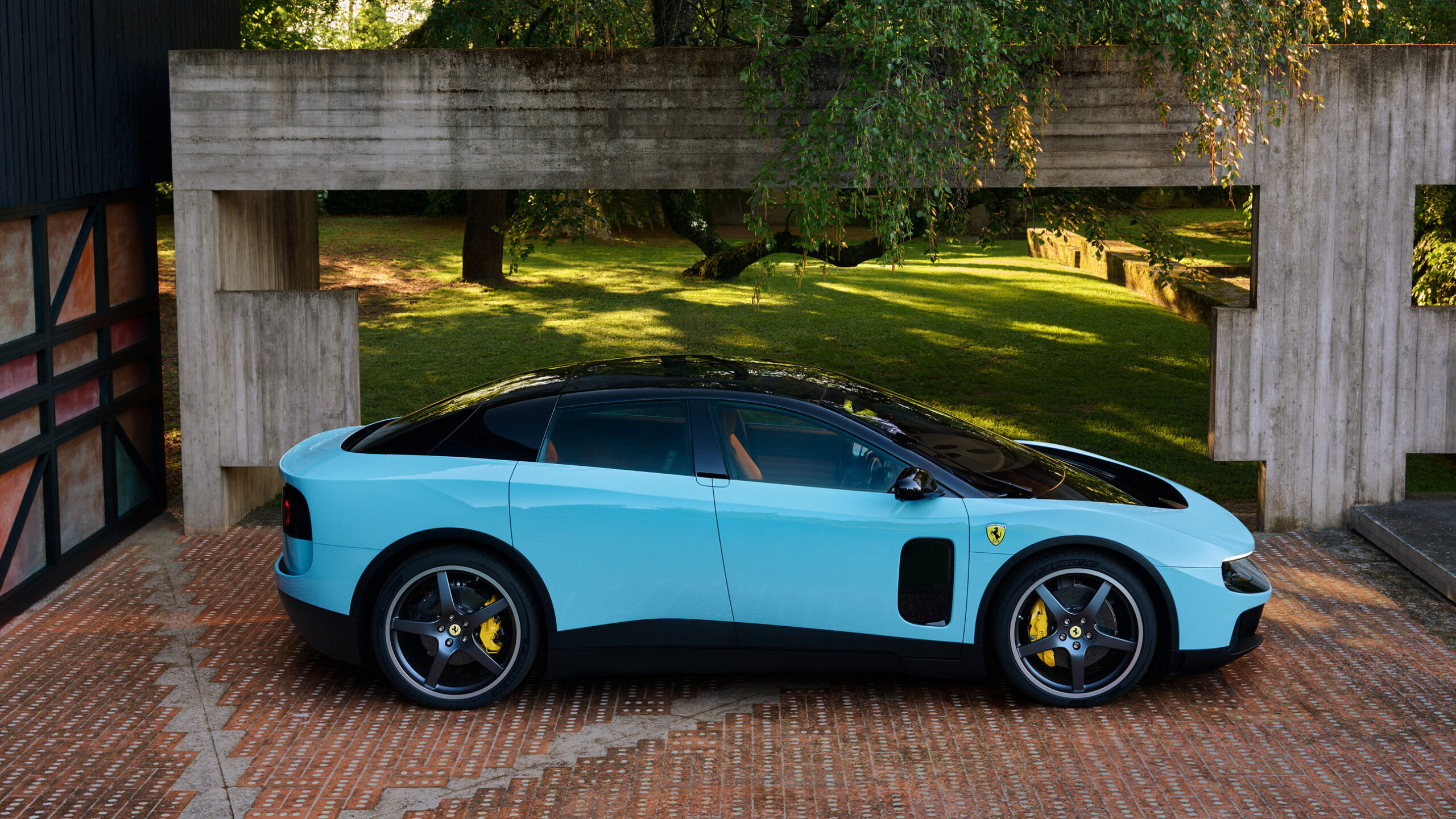
The shape backs that up. Ferrari says the car is centered around an ultra-clean “glass house” design with floating front and rear aerodynamic wings. In reality, without the Ferrari badging, it would probably be tough for most everyday folks to tie this car back to the Prancing Horse brand.
Let’s start up front and work our way around. The Luce’s face features a huge frontal wing that mimics the good ol’ boys at Dodge with the Charger Daytona. There’s a secondary hood area behind it in gloss black and the two tones do tie the car to other modern cars within the Ferrari family. That said, the lighting and front fascia don’t really shout Ferrari in any way.
The Luce rides on gigantic 23-inch front and 24-inch rear wheels, the largest ever fitted to a production Ferrari road car. The overhangs are short, and behind the front wheels, you’ll find a large black panel that appears to be a vent for turbulent air in the wheel well. Beyond that, there’s not much to say of the side beyond the use of Tesla Cybertruck-style door poppers on the B-pillar and, as we suspected, suicide doors for the rear occupants.
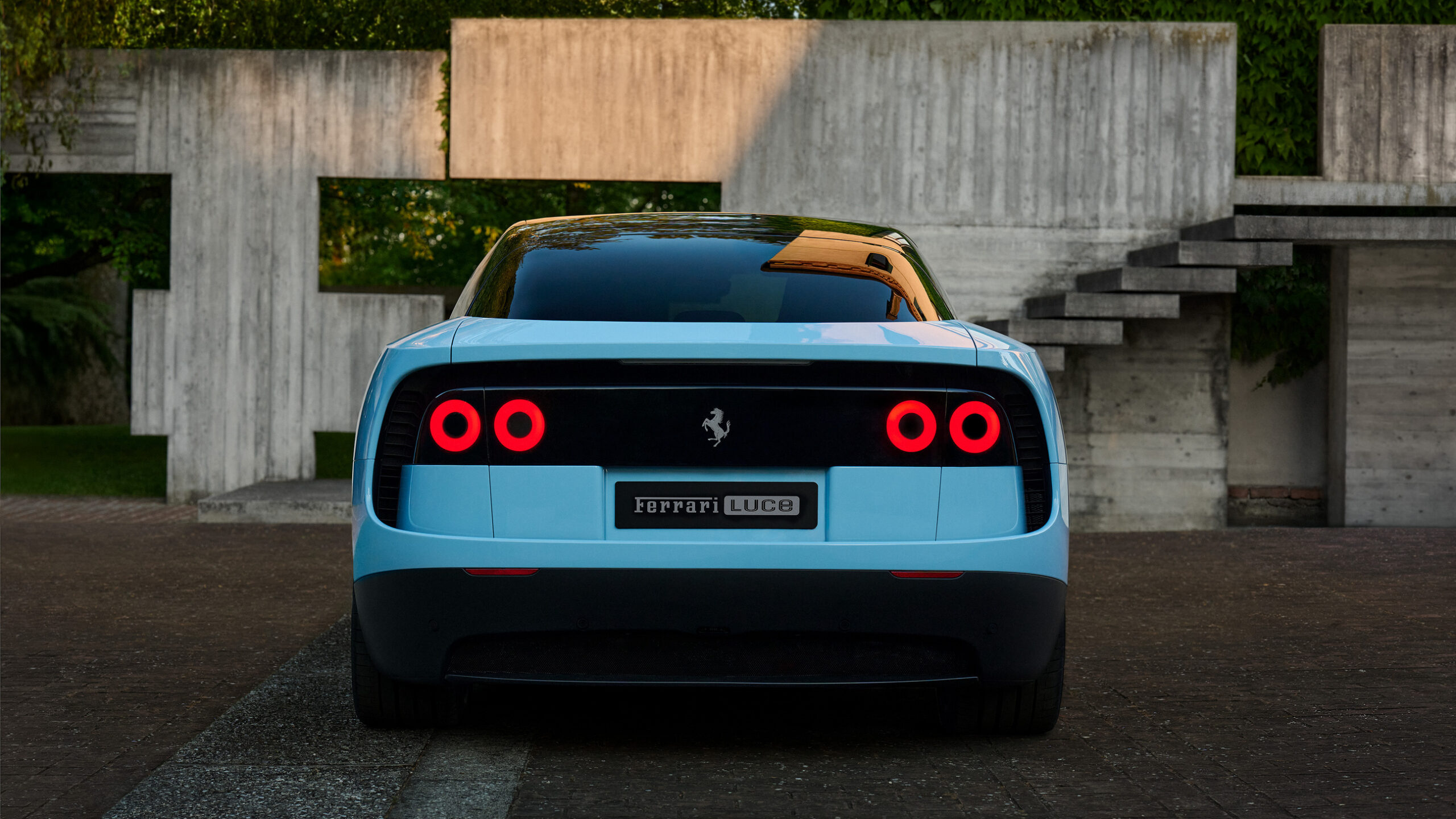
The rear is where things get more interesting. The silhouette reads sedan at a glance, but the entire back panel lifts as a hatch, with the rear glass hinged into the tailgate rather than fixed to the roofline.
Ferrari points to the 360 Modena and 458 Italia as the inspiration, and this might be where the strongest ties to brand DNA actually show up. The lighting structure, on the other hand, could just as easily have someone thinking of a Nissan Skyline or a Chevrolet Impala. That probably is not the flattery Maranello was after, but it is worth remembering who drew the thing.
Ive was central to the design of the original iPhone, and Newson worked on the Apple Watch and various special editions. Today, the original iPhone is a flagship moment in design. The Luce probably won’t go down in the history books with as much gravity, but perhaps over the years it’ll age like fine wine.
The Cabin
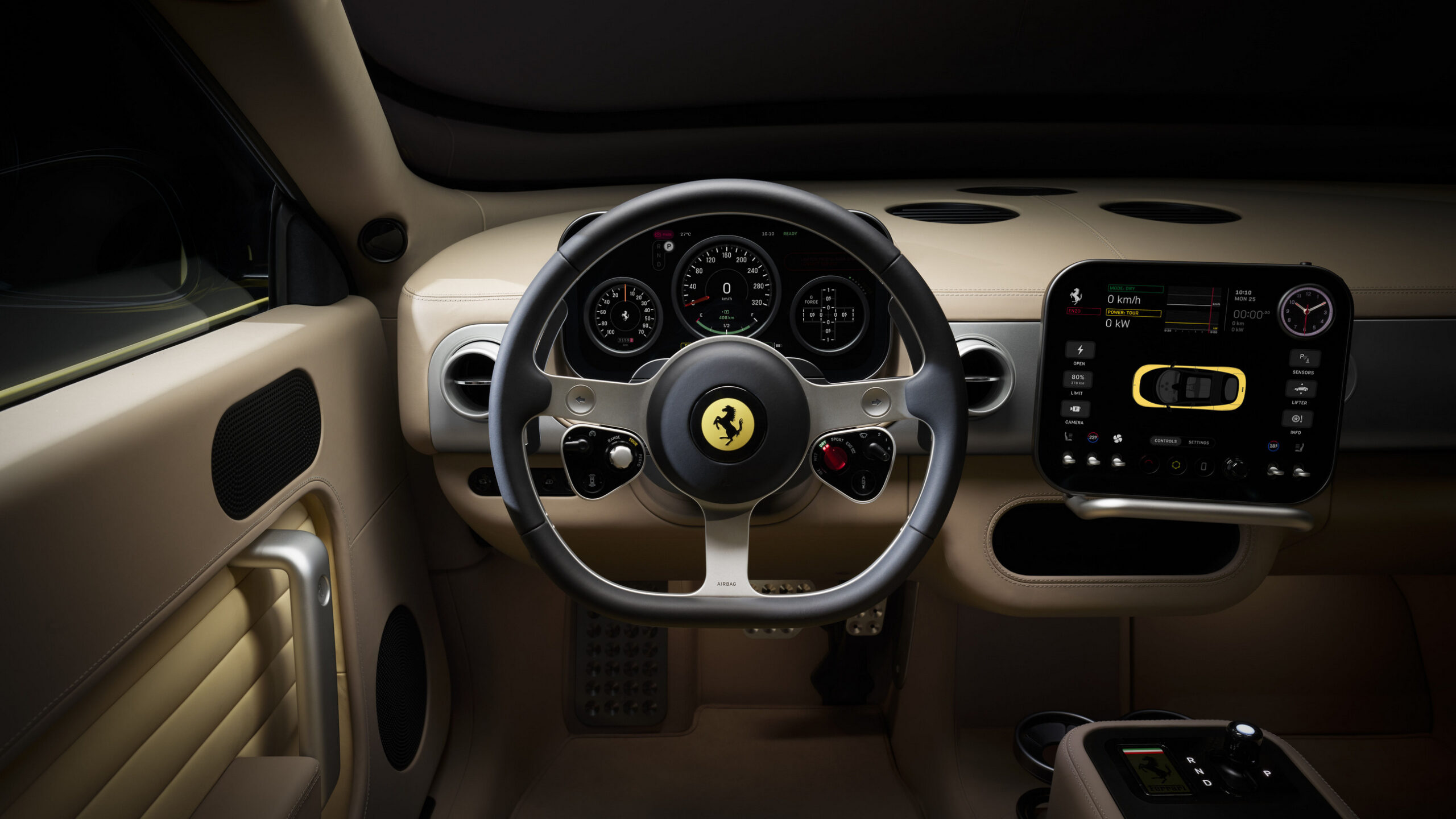
The details are where things start getting nerdy. The steering wheel itself is machined from recycled aluminum and works with a moving binnacle that travels with the wheel to keep key information directly in the driver’s line of sight. Ferrari also mixed physical controls with digital interfaces rather than going all-in on touchscreens. That means actual switches, dials, and toggles still exist alongside OLED displays developed specifically for the Luce.
Then there are the oddball touches that sound peak Ferrari. The key itself uses Corning Gorilla Glass and E Ink technology, and docking it triggers a startup sequence where Ferrari yellow reportedly spreads across the cabin interface.
There’s also a physical overhead pull that activates Launch Mode because, apparently, pressing a button was considered too ordinary. Add in optional massage seats, rear passenger controls, and a 21-speaker, 3,000-watt audio system (more than you get in a seven-passenger Jeep Grand Wagoneer), and the Luce starts sounding less like a stripped-out supercar and more like Ferrari looked at luxury EV buyers and decided to build them something entirely new.
Performance And Power
Power is key, and clearly this thing has it, but let’s talk about weight for a moment first, as it defines how far performance can go in many aspects. The Luce tips the scales at 2,260 kg (4,982 lbs), which means Ferrari’s first EV arrives carrying nearly two-and-a-half tons of mass. That’s not exactly featherweight territory, even by modern EV standards.
Then again, Ferrari engineers seem acutely aware of that reality. The company says the low-mounted battery, four-motor setup, torque vectoring, and packaging give the car responses comparable to something roughly 400 kg lighter. That’s a bold claim, but at this point, Ferrari can’t really make small ones.
The Luce was never going to be judged like a normal EV. Nobody expects Ferrari to simply build a quicker alternative to a luxury electric sedan or crossover. The brand’s entire reputation rests on making machines that feel special, irrational, and emotional.
An Electric Guitar Approach to Ferrari Noise
Sound is one of the levers Ferrari pulls to get there, and crucially the Luce’s is not piped in or synthesized, which is the standard playbook for EVs trying to sound interesting. A precision accelerometer mounted in the rear axle housing captures the real vibrations of the rotating components, and a patented system then “filters, equalises and amplifies the signal in a similar way to an electric guitar, but only when functional to the driving experience.” Ferrari calls the result authentic and functional, and the driver can turn it up or down at will.
There’s also a unique torque shift engagement system designed to deliver a feeling of “engine braking worthy of a sports car.” Speaking of torque, the Luce leverages four electric motors that Ferrari derived from the F80 supercar. The vehicle uses an elastically-mounted subframe to dampen road harshness while the motors produce up to 1,035 hp (772 kW) together.
It has a 122 kWh battery pack, an 800V architecture, and can recover 70 kWh in 20 minutes when using a DC fast charger capable of delivering up to 350 kW. The entire battery pack does more than hold cells. It is a structural member, contributing a 25 percent gain in bending rigidity and 35 percent in torsional rigidity over previous four-door Ferrari applications. At this rate, given all the changes, I’m a little surprised it’s not carrying a Dino badge.
Europe First, U.S. Buyers Wait Until 2027
Ferrari opens European order books later this year with a price tag around €520,000, or over $600,000 at today’s rates. North America will have to wait longer. The Luce does not land at U.S. dealers until Q2 2027, and Maranello has not said what it will charge here.
QUICK FACTS
DIMENSIONS AND WEIGHT
Length
197.9 in (5026 mm)
Width (without mirrors)
78.7 in (1999 mm)
Height
60.8 in (1544 mm)
Wheelbase
116.6 in (2961 mm)
Front track
66.8 in (1696 mm)
Rear track
66.5 in (1690 mm)
Kerb weight*
4982 lbs (2260 kg)
Kerb weight to power ratio
4.76 lbs/hp (2.16 kg/cv)
Weight distribution
47% front / 53% rear
Trunk capacity
21.1 cu ft (597 l)
TIRES
Front
265/35 R23 J9.5
Rear
315/30 R24 J11
BRAKES
Front
CCM, 15.4 x 1.3 in (390 x 34 mm)
Rear
CCM, 14.6 x 1.3 in (372 x 34 mm)
POWERTRAIN
Number of electric engines
4 (one per wheel)
Maximum power**
1,035 hp (772 kW / 1050 PS)
Maximum torque, measured at the engines**
730 lb-ft (990 Nm)
Maximum torque, measured at the wheels
8,482 lb-ft (11500 Nm)
FRONT E-AXLE
Power at the axle
282 hp (210 kW)
Torque at the wheels**
2,508 lb-ft (3400 Nm)
Torque at the engines**
207 lb-ft (280 Nm)
Power density
3.23 kW/kg (93% efficiency)
Engine revs
30,000 rpm
Weight
143 lbs (65 kg)
REAR E-AXLE
Power at the axle
831 hp (620 kW)
Torque at the wheels**
5716 lb-ft (7750 Nm)
Torque at the engines**
524 lb-ft (710 Nm)
Power density
4.80 kW/kg (93% efficiency)
Engine revs
25,500 rpm
Weight
284 lbs (129 kg)
BATTERY
No. of cells
210 (15 modules with 14 cells)
Total power density
195 Wh/kg
Cell power density
305 Wh/kg
Gross capacity
122 kWh
Maximum voltage
800 V
Maximum recharge power
350 kW
PERFORMANCE
0-62 mph (0-100 km/h)
2.5 s
0-124 mph (0-200 km/h)
6.8 s
Maximum speed
193 mph (310 km/h)
Range***
329 miles (530 km)
Consumption (WLTP cycle)
Under homologation
SWIPE
* With optional equipment, ** In Launch Control mode, *** Estimation (under homologation)
The all-electric Luce makes its official debut on May 25.
iPhone designer Jony Ive has penned the EV’s exterior and cabin.
Fresh spy shots suggest the model will use rear suicide doors.
A handful of days now separate the world from the all-electric Ferrari Luce, the car set to drag Maranello into a part of the industry it has spent decades watching from a distance. Ferrari intends to keep the shape under wraps until the last possible moment, which is why prototypes this close to launch still look like the one pictured here.
Carmakers typically run wild-looking test cars in the early stages of development, often piecing them together with random panels borrowed from existing models. Ferrari did exactly that with the Luce back in 2024, hiding it under the skin of a Maserati Levante. The difference here is what should happen next. Most prototypes shed their fake parts and camouflage as they edge toward launch. The Luce hasn’t.
This tester, which looks more like an oversized shoebox than a car, was recently caught by our spy photographers in Maranello. We’ve seen a similar prototype before, but that doesn’t make this one any less bizarre to look at.
Suicide Doors?
Baldauf
With the possible exception of the wing mirrors, every part of the Luce’s exterior has been hidden from view. However, as we recently noted, it appears the EV could use suicide rear doors much like the Purosangue. The horizontal daytime running lights up front are also peeking through.
While Ferrari is shielding the exterior from the world until the very last moment, it’s also showcased much of the EV’s interior. Taking inspiration from Ferraris of yesteryear, it will feature beautiful aluminum toggles and switches for a retro feel, while still offering digital gauges and a central infotainment display.
Adding a dose of theater to the cabin is an aircraft-inspired toggle on the headliner for launch control, sitting near the headlight and demister controls. Jony Ive and his firm LoveFrom designed the interior, and the exterior too, so the same blend of old and new should carry through to the bodywork once it finally appears.
Then there’s the all-important powertrain. The Luce will be driven by a large 122 kWh battery pack that supports charging up to 350 kW, giving the EV a driving range of up to 329 miles (530 km). This pack will provide juice for four electric motors, combining to deliver 986 hp.
The all-electric Luce could be more expensive than the 849 Testarossa.
Ferrari’s first EV may also be a lot more expensive than the Purosangue.
A 122 kWh battery pack and four electric motors will be fitted as standard.
Ferrari is taking a gamble with its all-electric Luce, launching it at a time when EV sales have contracted in the US, and competition from China is offering EV buyers supercar-levels of power at a fraction of the cost. If a new report about the Luce’s potential starting price is accurate, it could prove to be a hard sell for the brand.
Citing unnamed sources, it’s being reported that European prices for the Luce will start at approximately €550,000, or the equivalent of $645,000. To put that in perspective, the Ferrari Purosangue SUV starts at around €400,000 ($470,000) in Europe, although strong demand for that model means some used examples are going for over €600,000 ($704,000).
Bloomberg understands that the final price is yet to be locked in, and could be adjusted 10 percent in either direction from the €550,000 mark. If true, this could make the Luce more expensive than even the 849 Testarossa and 12Cilindri, and would be the firm’s second-most expensive series production model after the F80 hypercar.
Such a sky-high price tag could limit the Luce’s appeal, particularly since Ferrari’s customers are used to buying models from the Italian marque with sizzling internal combustion engines, not heavy battery packs and electric motors. If it’s possible to buy a V12-powered, four-seat Purosangue for less, while boasting all the practicality as the Luce, some may be swayed by the allure of the combustion-powered Fezza.
Admittedly, loyal Ferrari customers aren’t exactly strapped for cash, so they may not really care about how much the Luce costs and could be fixated on buying one anyway. Not only could the Luce be one of Ferrari’s most expensive models, but it’d be one of the priciest EVs on the market, costing way more than anything sold by Porsche and even more than the Rolls-Royce Spectre that starts from under $400,000 in America.
Quad Motors
What will shoppers get for their money? While final specifications for the Luce won’t be announced until its unveiling next month, we know it will have four electric motors delivering over 986 hp. Feeding these motors with juice will be a 122 kWh battery pack supporting charging speeds of up to 350 kW, giving the model a driving range of over 329 miles (530 km).