Reading view

There are new articles available, click to refresh the page.

China’s Biggest Electric SUV Yet Wasn’t Made For Drivers

  • ES9 is China’s longest electric SUV with a 127.9-inch wheelbase.
  • Dual electric motors deliver 697 hp and 516 lb-ft of torque total.
  • It supports three-minute battery swaps across Nio’s network.

For China’s most wealthiest car buyers, the appeal of driving often takes a back seat to being driven. Luxury isn’t measured in horsepower alone, but in legroom, comfort, and the ability to stretch out while someone else handles traffic.

With that in mind, Nio is preparing a new electric SUV designed squarely for this audience, and for larger families as well. Shown here in newly released photos, the Nio ES9 is set to join the brand’s growing lineup, slotting in just above the ES8.

Big Numbers, Bigger Presence

This upcoming flagship will become the largest electric SUV available in China, overtaking the ES8 for that title, according to CarNewsChina. Figures from the Ministry of Industry and Information Technology confirm it stretches 5,365 mm (211.2 inches) in length, spans 2,029 mm (79.8 inches) in width, and stands 1,870 mm (73.6 inches) tall.

Read: This Full-Size Electric SUV Packs 456 HP And Costs Less Than A Honda Civic

That makes it 85 mm (3.3 inches) longer, 29 mm (1.1 inches) wider, and 70 mm (2.7 inches) taller than the ES8. More importantly, the wheelbase stretches to 3,250 mm (127.9 inches), an increase of 120 mm (4.7 inches) over the ES8, which translates to noticeably more room for passengers.

To put that in perspective, its footprint lands somewhere between the standard Cadillac Escalade and the extended-wheelbase Escalade ESV.

 China’s Biggest Electric SUV Yet Wasn’t Made For Drivers

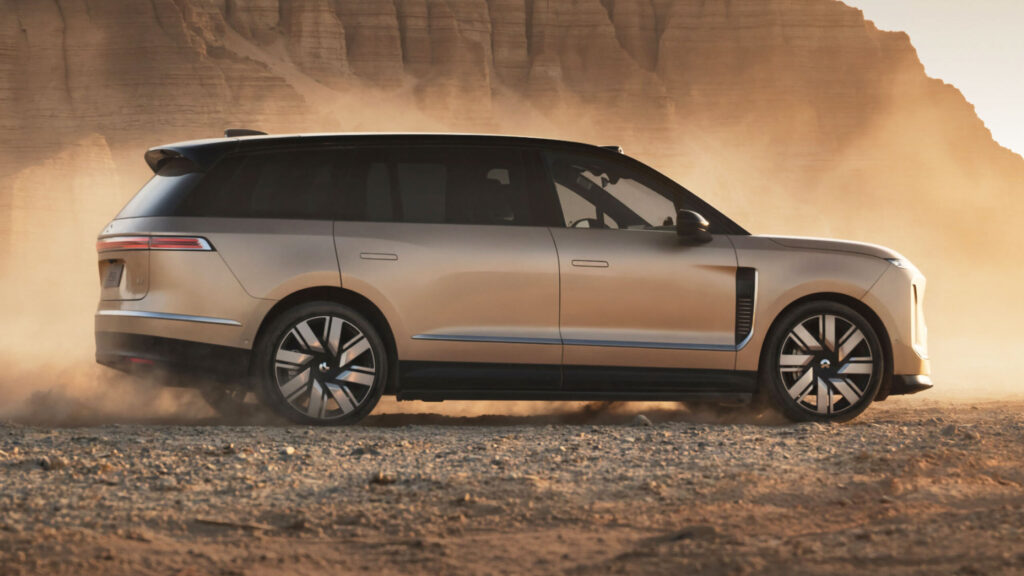
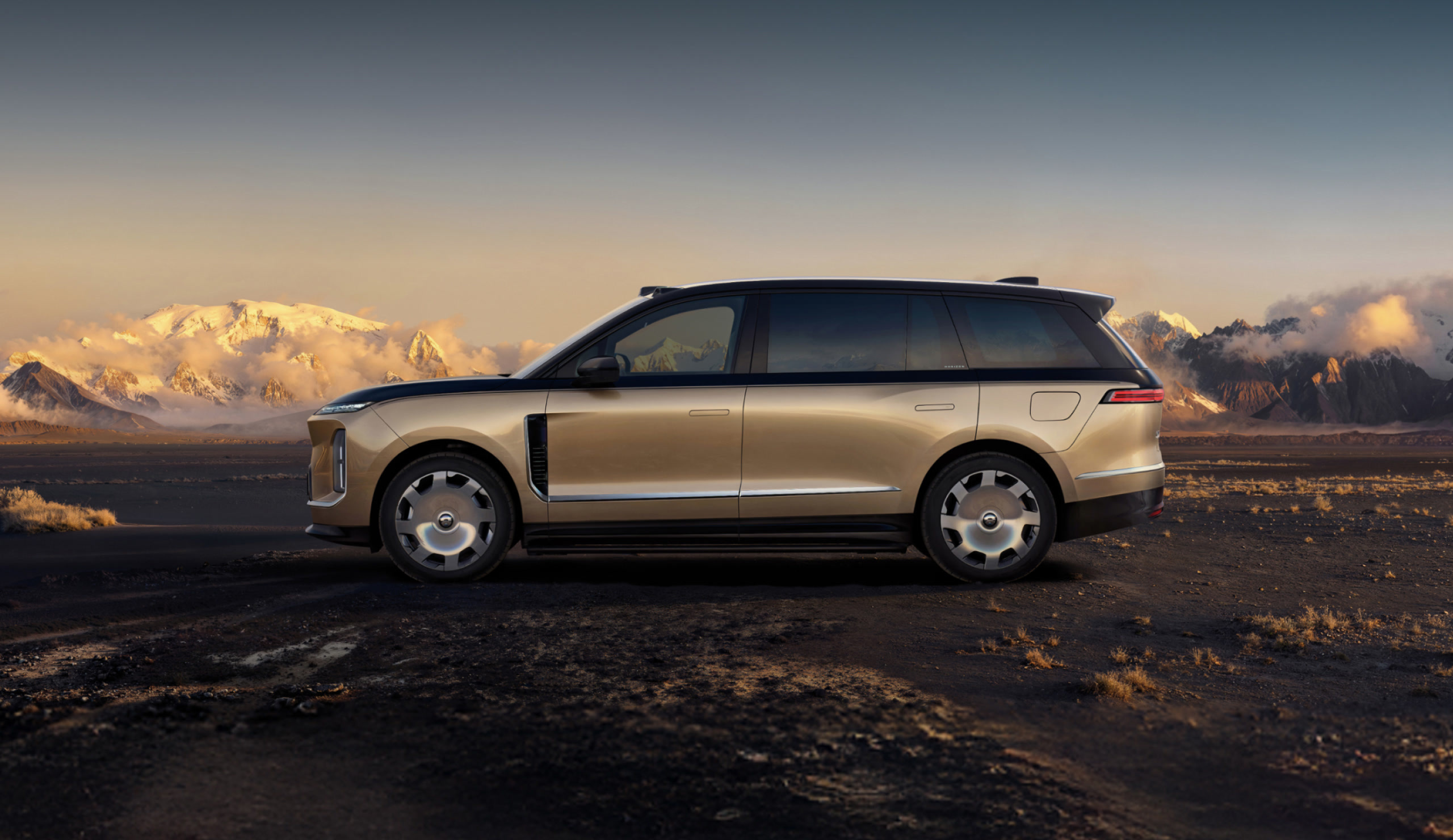
Visually, the design of the ES9 is very similar to its smaller brother, although it does have a more upright and squared front fascia. There are split DRLs and headlights at the front, alongside a large grille and a ribbon of black along the bottom of the bumper. As with the ES8, there’s a LiDAR protruding from the roof.

Around back, the design leans toward simplicity, featuring a single LED light bar and little else of interest. Other photos of the SUV reveal that retractable side steps will be available, as will at least six different wheel designs/finishes. Shoppers will also be able to choose between black or silver accents running along the body.

Dual-Motor Drive

 China’s Biggest Electric SUV Yet Wasn’t Made For Drivers

We don’t yet know what the cabin of the ES9 will look like, but we do have some important powertrain details. Powering the SUV will be a 241 hp (177 kW) electric motor at the front axle and a 456 hp (335 kW) motor at the rear axle, combining to deliver 697 hp (513 kW) and 516 lb-ft (700 Nm) of torque. The battery pack will be sourced from CATL and is expected to have a capacity of 102 kWh.

There’s no word on what charging speeds this battery will support, but in the land of Nio, charging times aren’t particularly important, as Nio operates a huge battery-swapping network where a depleted battery can be replaced with a fully charged one in just 3 minutes.

A full reveal is expected in the coming months, with its domestic launch set to follow soon after. Availability in markets outside China has not yet been confirmed.

 China’s Biggest Electric SUV Yet Wasn’t Made For Drivers

Nio EV Splits Open Like A Can Of Tuna In A Strange Crash

  • Nio EC6 hit a concrete barrier in Shanghai and split through the rear.
  • Driver and passenger escaped without injuries after the violent impact.
  • Battery pack survived the crash and avoided any fire or thermal issues.

All too often, we read about EVs catching fire after relatively minor accidents, and in some cases, occupants were trapped inside. This story is a little different though, as a Nio EC6 was recently destroyed in a crash in China, but remarkably didn’t catch fire despite almost completely splitting in two.

This incident happened in Shanghai on Monday. It’s understood that the light pink-colored EC6 hit a concrete crash barrier side-on after cutting in front of another vehicle, causing it to clip the rear of the Nio.

Local reports suggest that the top edge of the barrow, approximately 120 mm (4.7 inches) wide, applied an extraordinary amount of pressure on the C-pillar and the area of the floor.

Read: Nio’s Mass-Market Onvo Drops Its First 3-Row SUV With More Power Than An EV9 GT

This force caused a split through the rear of the car. Remarkably, the driver and passenger of the Nio were not injured in the crash. Additionally, the battery pack wasn’t severely damaged and did not catch fire.

According to a statement released by Nio, immediately after the crash, the vehicle’s onboard safety systems reported the accident. Nio staff were alerted to the impact and quickly responded to the scene, helping the occupants receive medical treatment.

Perhaps in a thinly-veiled dig at Tesla, Nio says that the EV’s doors immediately unlocked after the collision, allowing the driver and passenger to free themselves.

\\\\

Weibo

The car manufacturer also confirmed that the EC6’s driving assistance system was not enabled at the time.

The Nio EC6 was first unveiled in late 2019 before being thoroughly updated in February 2023. The example involved in this crash was one of the facelifted models.

It’s available with either a 75 kWh or 100 kWh battery pack and sold exclusively in dual-motor guise, producing a combined 483 hp and 516 lb-ft (700 Nm) of torque.

Sources: Weibo, Nio, CarNewsChina

China’s Getting Ready To Flood The World With Even Cheaper EVs And PHEVs

  • Chinese automakers debut budget EVs under $21,000 to expand abroad.
  • Falling EV prices spark fears of excessive competition and lower profits.
  • BYD and Great Wall Motor report 30 percent profit drops amid price cuts.

Chinese automakers are steering the electric era into a new phase, flooding the market with low-cost EVs and plug-in hybrids at the Guangzhou Motor Show.

With prices starting between 100,001 yuan ($14,100) and 150,000 yuan ($21,100), this new generation of vehicles sends a message that’s hard to miss: China intends to own the mass market for electrification.

Read: The Company That Started The EV Price War Now Says It’s Gone Too Far

According to Nikkei Asia, many of China’s biggest automakers are getting ready to export these budget-friendly newcomers. For Western legacy brands still wrestling with production costs and emissions targets, those prices don’t signal healthy competition so much as the opening act of a global price reckoning.

The Global Push Begins

 China’s Getting Ready To Flood The World With Even Cheaper EVs And PHEVs
Leapmotor A10

Several new EV and PHEV models took the stage at the show, among them the Leapmotor A10, which is expected to start around 100,000 yuan ($14,100) and head for export worldwide. The company’s Lafa 5 electric hatchback is set to launch at roughly the same figure.

Nio made a strong impression with its Firefly, shown for the first time in right-hand drive. Priced around 100,000 yuan ($14,100) in China, the Firefly will enter 17 new markets next year, reaching into Central America and beyond. GAC joined in with its Aion i60, a range-extender SUV starting at 109,800 yuan ($15,500).

Price Wars Continue

The Chinese automotive industry has been in a price war for the past few years, and there are no signs of cooling, as carmakers feverishly battle to gain market share. The lower end of the market is proving to be an especially fierce battleground, Nikkei Asia reports.

During the first nine months of this year alone, 2.35 million EVs and plug-in hybrids priced between 100,001 yuan ($14,100) and 150,000 yuan ($21,100) were sold in China. That makes it the nation’s largest market segment, up from fewer than 1.5 million in the same range last year.

By contrast, models priced between 150,001 yuan and 200,000 yuan ($21,100–$28,200) have held steady at around 2.3 million sales.

 China’s Getting Ready To Flood The World With Even Cheaper EVs And PHEVs
Firefly EV

There has also been significant growth in even more affordable NEVs. The number of vehicles sold in the $11,300 – $14,100 and $11,300-or-less price brackets has doubled to over 1 million units.

While the growing number of affordable models is good for Chinese customers, it’s hurting the automakers themselves. During the July-September quarter, BYD’s net profit fell 30 percent, its first decline in four years. Great Wall saw a similar hit, with profits falling 30 percent despite a 20 percent rise in sales.

Exports, meanwhile, are accelerating. Over the first three quarters of this year, Chinese brands shipped 1.75 million EVs and plug-in hybrids abroad, an astonishing 89 percent increase from the same period last year.

 China’s Getting Ready To Flood The World With Even Cheaper EVs And PHEVs

Source: Nikkei Asia

❌