
Normal view

There are new articles available, click to refresh the page.
Before yesterdayMain stream

This Tiny Truck Is Genuinely Happy To See You

  • CAM EV Microvan is Malaysia’s happiest LCV with playful decals.
  • It’s a rebadged Nextem Vaquita from Hong Kong with a smile.
  • Just 1.2 m / 48 in. wide, it offers flexible cargo configurations.

Small cars often wear cute faces to win us over, but some go all-in with the gimmick. That’s exactly the case with the CAM EV Microvan, a tiny electric cargo hauler built for squeezing through tight city streets with a smile on its face. Literally.

Recently unveiled at a show in Malaysia, the CAM EV Microvan is a rebranded version of the Nextem Vaquita from Hong Kong. Aside from a new badge, the most noticeable change is a set of cheerful stickers, transforming it into what might be the happiest delivery van on the planet.

Cartoon Cues and Branding Tricks

The design tweaks are minimal, limited to a grinning mouth on the charging port and cartoon-style eyelashes over the headlights. It’s unclear whether these decals will be offered as factory options or left up to owners with a roll of vinyl, but they’re a clever bit of theater on an otherwise utilitarian platform.

More: Trump Saw These “Really Cute” Cars In Japan And Now Wants Them On US Roads

If you’re curious about the name, Vaquita refers to a type of porpoise, one that’s critically endangered, with fewer than ten left in the wild, according to Wikipedia. Why a commercial van is named after a marine animal on the brink of extinction is anyone’s guess, but sure, let’s go with it.

The LCV itself is pitched as a low-cost, low-maintenance option aimed at small businesses that don’t mind a little existential irony with their deliveries.

The Specifications

\\\\\

CAM EV

In terms of dimensions, the EV measures 3,695 mm (145.5 inches) in length and just 1,220 mm (48 inches) in width. Inside, it’s strictly business: a central driving position, a single seat, a very basic dashboard, and plenty of hard plastics that prioritize practicality over comfort.

More: Renault’s Smallest And Quirkiest EV Is Dead

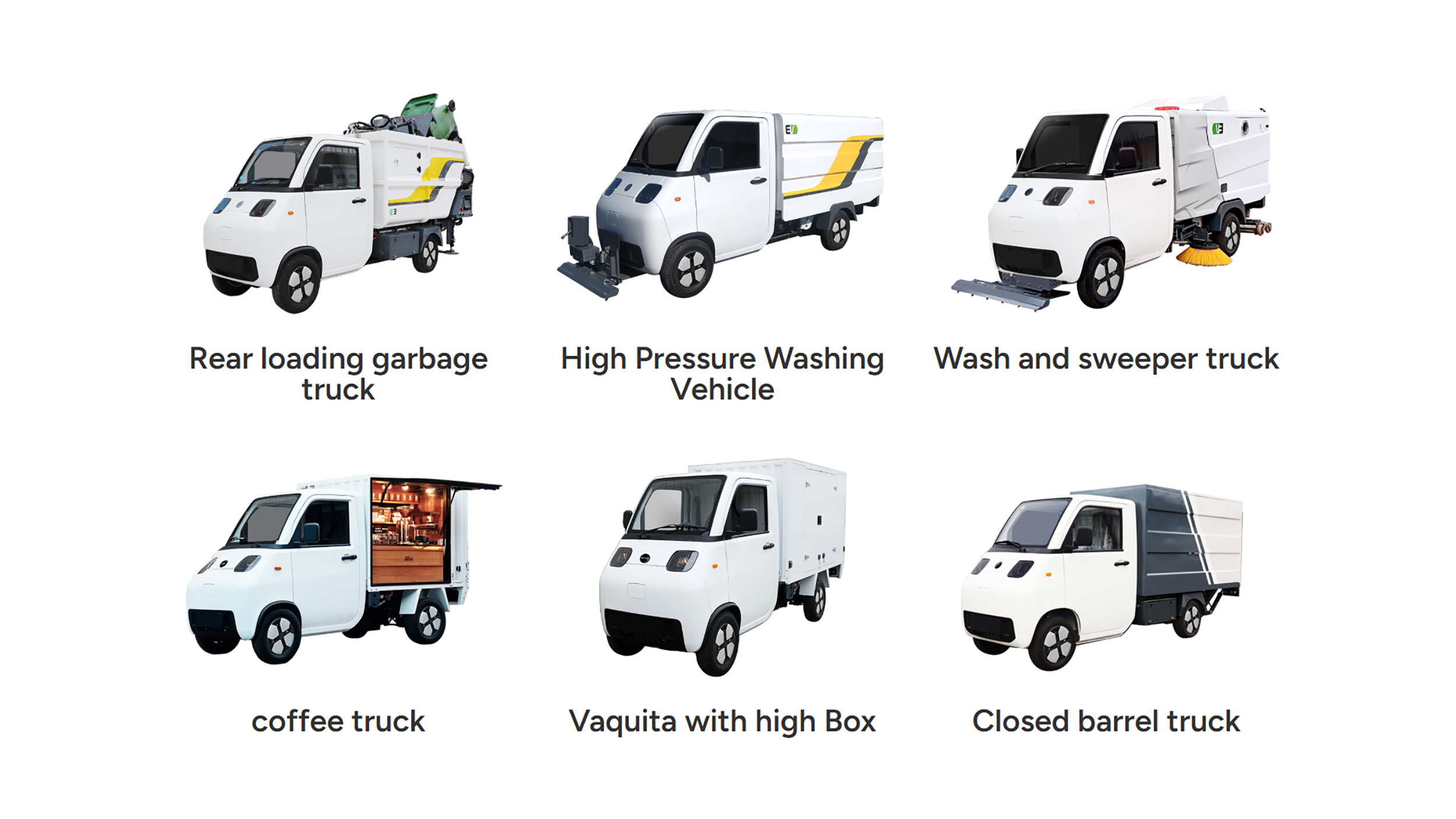
Where it gets interesting is the rear. The Microvan can be configured as a box van, pickup, garbage truck, sweeper, coffee truck, and more. Depending on the configuration, cargo volume reaches up to 2.8 cubic meters (99 cubic feet), with a maximum payload of 630 kg (1,390 pounds).

Power comes from a single electric motor driving the rear wheels. Top speed is capped at 80 km/h (50 mph), while the 15.97 kWh battery delivers an estimated 150 km (93 miles) of range per charge.
 This Tiny Truck Is Genuinely Happy To See You
Different versions of the Nextem Vaquita for professional use.

According to Paultan, the market launch of the CAM EV Microvan in Malaysia is scheduled for the second quarter of 2026.

Pricing is expected to start around 65,000 Malaysian Ringgit, or approximately $15,900 at current exchange rates. That’s not exactly bargain-bin territory for a vehicle of this size, which means the smiling decals may have to work overtime to win over budget-conscious buyers.

Beyond Malaysia, the Nextem Vaquita is expected to enter markets in Hong Kong, Indonesia, the Philippines, Thailand, and Portugal.

\\\\\\\\\\\

Nextem e-Moblity Limited

Malaysia’s First EV Costs $19K. Batteries Sold Separately

  • Malaysia’s first locally developed EV starts from $19,400.
  • Buyers must lease the 52.5-kWh battery for nine years.
  • Electric motor makes 201 hp with 277 miles of range.

Malaysian automaker Perodua has taken its first serious step into electrification with the launch of the QV-E, short for Quest for Visionary Electric Vehicle.

This subcompact crossover marks the brand’s first zero-emission model and comes with a subscription-based battery plan that trims the headline price, though it’s a hollow saving since you can’t drive an electric car without the very component you’re leasing.

More: This Country Can’t Stop Snatching High-End Cars And Exotics Off Its Streets

The QV-E also holds a unique distinction as Malaysia’s first domestically developed electric car. Rival Proton’s e.MAS 7 SUV and e.MAS 5 hatchback are rebadged versions of Geely models, while Perodua has invested heavily in building something original. Development began in 2023, with research and engineering work totaling 800 million ringgit (around $194 million).

Everything started with a scale model of the EMO (Electric Motion Online) concept in May 2023, followed by the EMO-I hatchback mule a year later and the EMO-II crossover concept that surfaced in December 2024. By May 2025, the design had matured into a running prototype, giving the public its first clear look at what would eventually become the production QV-E.

Compact Footprint, Coupe-SUV Looks

\\\\\\\\\\\\\\\\\

Perodua

At 4,170 mm (164.2 inches) long and sitting on a 2,680 mm (105.5-inch) wheelbase, the QV-E blends compact dimensions with a sport-leaning stance. Its front end features sharp split LED headlights, a contoured hood, and muscular fenders.

The silhouette bears some resemblance to the previous-generation Toyota C-HR and the current Nissan Juke, particularly around the windowline. The front door handles are flush with the bodywork, while the rear ones are hidden on the C-pillars.

More: Dodge Won’t Sell You One, So A Tiny Automaker Made This Hemi V8 Coupe

Moving to the rear, the sloping roof meets a full-width light bar and integrated diffuser. The crossover rolls on 18-inch alloy wheels and comes in only two shades for now: Ice Blue and Caviar Gray.

Plain Interior

\\\\\\\\\\

Inside, the dashboard plays it safe, leaning more toward functional than inspiring. A pair of 10.25-inch screens, one for infotainment, the other for instruments, cover the basics without breaking new ground.

The floating center console, ambient lighting, and aluminum-look trim do their best to lift the mood, though the overall impression still feels more cost-conscious than cutting-edge. Safety is well covered with six airbags and a full ADAS suite.

A Single Powertrain Option

The Perodua QV-E sits on a modular platform developed with assistance from Magna Steyr. Power comes from a single electric motor rated at 201 hp (150 kW / 204 PS) and 285 Nm (210 lb-ft) of torque, driving the front wheels for a 0–100 km/h (0–62 mph) time of 7.5 seconds.

The lithium iron phosphate battery, supplied by China’s CATL, has a capacity of 52.5 kWh and claims up to 445 km (276 miles) of range under the optimistic NEDC cycle. The catch, of course, is that this essential piece of hardware isn’t actually included in the car’s price.

Buy The Car, Lease The Battery

The Perodua QV-E starts from 80,000 ringgit (equal to $19,400 at current exchange rates), but owners will have to pay an additional 275 ringgit ($67) per month for the battery as part of a nine-year lease contract.

Perodua CEO Zainal Abidin Ahmad says the Battery-as-a-Service (BaaS) model ensures “a lifetime guarantee on the battery for our customers’ peace of mind,” calling it a way to reduce ownership anxiety often tied to electric vehicles.

Production is set to take place locally in Malaysia, starting with 500 units per month before ramping up to 3,000 by the third quarter of 2026. Bloomberg reports that Perodua aims for 50 percent local parts content by early 2026, rising to 70 percent by 2030.

Electric vehicle adoption in Malaysia continues to gather pace, with the government targeting EVs to make up 15 percent of new car sales by the end of the decade.

❌
❌