Reading view

There are new articles available, click to refresh the page.

Understanding Third-Party Solar in Wisconsin

By: Alex Beld

Third-party solar, also known as Third-party ownership, takes two forms— a solar lease or a power purchase agreement. The lease option is similar to how you would lease a car, paying for the system’s use over time. The power purchase agreement would allow you to purchase the system’s energy from the installer at a rate lower than you would normally pay for energy. Both options for a more affordable pathway to solar exist but are caught in a legal gray area for Wisconsinites, but that doesn’t mean it’s never been allowed in the state.

Around 2020-2021, there were some Wisconsin utilities that allowed TPO. At this time, WE Energies notably blocked installations in Milwaukee that would have utilized TPO arrangements.

Requests for the Public Service Commission of Wisconsin (PSC) to weigh in on legal clarity were unsuccessful until 2022. The PSC took up two “declaratory ruling” requests, ultimately approving a request to allow TPO on a case-by-case basis and rejecting a request to instead appoint criteria for TPO.

Utilities challenged the PSC ruling approving an instance of TPO on a case-by-case basis. The family involved in the ruling moved before there was resolution in a case that would have provided clarity on the matter. Without a customer for the solar system, the PSC ruling was invalid. It is possible that another person or organization could seek approval for a TPO solar system, but it hasn’t happened yet.

These days, utilities seem unified in their approach to block the TPO option in their territories. For the most part, electric utility cooperatives take a similar approach to TPO.

Though it’s our position that TPO could be allowed under current law, there are conflicting interpretations of the law resulting in legal uncertainty. The disagreement comes from the state statute that says only utilities are able to sell power to the public. With TPO, it has long been our view that a customer involved in a TPO contract is not the general public and that this would be a business transaction rather than a utility transaction.

We also recognize that all Wisconsin utilities are actively blocking TPO during the interconnection process, and the PSC is not able to stop them. Wisconsin solar installers should know this history and avoid offering TPO at this time. If an installer is offering TPO in Wisconsin as part of their services, it is either not aware of important regulatory information or is lying to customers.

If you are still considering a TPO offer from an installer, speak to your utility before moving forward with the project.

In the meantime, creating clarity around TPO remains a priority for RENEW. It is our hope that either a case will find its way before the Wisconsin Supreme Court and provide clarity around the use of TPO, or that new legislation can be crafted and passed to create a clear pathway for TPO.

This would allow us to join the 28 other states across the country that have opened a clear pathway to financing options that help more people gain access to the benefits of clean and affordable solar energy.

The post Understanding Third-Party Solar in Wisconsin appeared first on RENEW Wisconsin.

Virtual Power Plants Can Produce Real Results for Wisconsinites

In early July, the U.S. power grid experienced a heat dome that drove Americans’ energy usage to an all-time high

There is little doubt that heat waves fueled by climate change, coupled with the rising power use of data centers, will increasingly strain the electrical grid, likely driving up consumer costs even further. 

So, what can we do? Virtual power plants offer a real solution where customers can work with power providers to reduce demand for energy and use it efficiently — cutting costs for both consumers and utilities.

At the most basic level, virtual power plants (VPPs) are a network of energy users and suppliers that use existing energy resources in the community and within people’s homes to provide power to the grid—and to strategically reduce energy demand during periods of peak use.

VPPs can be managed by private technology or renewable energy companies, regulated utilities, or other program operators. To manage energy use, VPPs use various devices and technologies that create, store, and use power. This can include rooftop solar, electric vehicles (EVs), home and industrial-scale batteries, smart thermostats, water heaters, and other similar energy systems.

By managing these resources throughout the day as power demand rises and falls, VPPs ensure reliable power while producing energy savings and rewards for participating consumers.

Because they reduce peak power demand and enable a more flexible power grid, VPPs have the potential to reduce or eliminate the need to build expensive and polluting fossil fuel infrastructure.

Preventing these new gas-powered plants from being built eliminates the risk that utility customers, who are already burdened by recent energy rate increases, will be asked to pay for stranded fossil fuel infrastructure as Wisconsin transitions to a clean energy economy.

Particularly as large data centers drive a projected 40 percent increase in energy use by 2032, expanded VPP programs will be necessary to supply reliable power, reduce the health impacts of dirty fossil fuel plants, and keep Wisconsin on track for our 2050 carbon-free energy goal.

VPPs in Your Home

In areas where demand response programs are available, customers can voluntarily install smart thermostats, heat pumps, and other devices in their homes that can be managed remotely by the VPP operator. The operator can then reduce demand and draw excess energy to other users, in exchange for compensating the customers, often via bill credit.

VPP systems have begun to catch on throughout the United States, including in Chicago, where a smart thermostat VPP program was recently approved, slated to begin in May 2027. ComEd, the utility serving northern Illinois, will manage the Chicago program and utilize smart thermostats voluntarily installed by consumers. The program is estimated to save $60 per year for the average household.

So, what would the program look like in your home? Let’s say it’s a particularly hot August day, and your thermostat is set to 70 degrees to keep your house comfortable. A VPP operator may increase your house’s temperature to 73 degrees to reduce energy demand during the afternoon or early evening when energy consumption is high, and the energy grid is under stress.

Making this small change across thousands of homes will significantly reduce energy use and relieve stress on the grid. In exchange, you will receive a bill credit for allowing your thermostat to be remotely controlled.

In 2025, a brutal heat wave hit Vermont. But Green Mountain Power, the region’s utility, sourced power from customers’ batteries distributed across the state, reducing the need to buy expensive peak demand energy. Ultimately, the VPP saved consumers an estimated $3 million in energy costs for just one day — roughly $10 per customer.

RENEW’s Role in the VPP Revolution

Here in Wisconsin, RENEW Wisconsin is working to expand consumer access to rooftop solar systems, making it easier and more financially viable to install a miniature solar energy plant on your property.

Additionally, RENEW advocates for expanded consumer EV and Bring Your Own Device (BYOD) programs that reflect the value of consumers reducing their demand, connecting consumers to the energy system, and enabling customers to exert greater control over their energy — reaping the financial reward when they reduce energy consumption.

Wisconsin’s statewide energy efficiency program, Focus on Energy, provides $50 rebates on qualified smart thermostats across nearly all utilities in Wisconsin. Some utilities also offer demand response programs that are compatible with utility-eligible smart thermostats. These utility smart thermostat programs manage cooling during peak times and provide rewards or bill credits for customer participation.

WE Energies just unveiled a summer program that offers new participants $50 for allowing the utility to adjust their thermostat for up to four hours, with the option for customers to override the adjustment. Returning customers can get more than $6 per month for their participation, shaving a few dollars off their monthly bills.

Another example of a demand response program is WE Energies’ pilot EV program, which gives consumers credit for charging their EVs between 12 am and 8 am, when energy demand is low.

RENEW also advocates for consumers to get monthly bill credits for participating in demand response programs, such as Madison Gas and Electric’s smart thermostat and smart water heater programs. Monthly credits, as opposed to annual bill credits or gift cards, enable consumers to readily see how their participation is reducing energy demand and enabling grid flexibility.

In the future, RENEW will continue to advocate for utilities to make these programs permanent, larger, and more comprehensive — linking together thermostats, EVs, batteries, and rooftop solar to create a smart, responsive energy system for Wisconsin, powered by renewable energy and clean technology.

Doing so will reduce the need for outdated fossil fuel infrastructure, lower customers’ energy bills, and help meet all of Wisconsin’s growing power needs.

Brian Wagenaar, a Twin Cities native, is one of RENEW’s 2026 summer law clerks. He is currently a student at the University of Wisconsin Law School and starts his second year in the program this fall. Prior to his time at UW’s Law School, Brian earned his bachelor’s in environmental policy from UW-Green Bay.

The post Virtual Power Plants Can Produce Real Results for Wisconsinites appeared first on RENEW Wisconsin.

Dawn Break Solar Approved by the PSC

By: Alex Beld

On Thursday, July 30, the Public Service Commission of Wisconsin (PSC) approved Dawn Break Solar. This Waushara County project comes in at 180 Megawatts (MW) and is paired with an equally large battery energy storage system (BESS). Many renewable energy advocates joined us in supporting this project, thanks to all of you who helped us support this project as it sought approval from the PSC.

In our comments that advocated for this project, we highlighted both the benefits of the clean energy it will produce, along with the many economic benefits.

When construction is completed, Dawn Break Solar is expected to create many temporary construction jobs, as well as several long-term local jobs for operations and maintenance. Landowners will also benefit from consistent lease payments during the 35-year lifespan of the project.

Over the course of its life, the project will contribute more than $31.5 million in utility-aid payments. Local governments will receive $900,000 annually, with $510,000 for Waushara County and $390,000 for the Towns of Oasis, Plainfield, Deerfield, and Hancock.

Along with the many direct economic benefits, Dawn Break Solar will reduce emissions from energy production by about 600 million pounds of CO2 in the first year of operations. In terms of greenhouse gas emissions, this is the equivalent of taking more than 59,100 vehicles off the road for a full year.

The more we reduce our emissions, the more benefits we will see, specifically better health outcomes. In this case, Wisconsin can expect more than $1.3 million in economic benefits associated with public health improvements in Dawn Break Solar’s first year of operations alone.

Dawn Break Solar is just one piece of the clean energy puzzle. We hope you’ll all continue to join us in supporting invaluable projects like this as we continue to build our clean energy future.

The post Dawn Break Solar Approved by the PSC appeared first on RENEW Wisconsin.

The Past, Present, and Future of Renewable Energy Development

The Public Service Commission of Wisconsin (PSC) recently released two documents that provide useful insights into the past, present, and future of renewable energy development for our state. The PSC’s 2025 Renewable Portfolio Standard (RPS) memo provides statistics regarding utility-scale renewable energy that serves Wisconsin’s electricity needs, including projects located in Wisconsin and in neighboring states. The 2026-2032 Draft Strategic Energy Assessment (SEA) provides many insights, and most pertinent to the renewable industry, the SEA outlines utility plans for additional renewable energy development.

In short, the RPS memo tells a high-level tale of how Wisconsin got to where we are today with renewable energy. It shows that while wind-generating facilities have historically met most of Wisconsin’s renewable energy needs, production from new Wisconsin-based solar projects has increased the total amount of renewable energy that we use. As of 2025, about 20% of all the electricity we use in Wisconsin comes from renewable energy.

Separately, the draft SEA paints a picture of what the future could hold for Wisconsin. According to utility plans, the growth of Wisconsin-based solar will continue through 2030, as will battery energy storage systems (BESS) that support clean energy integration. Starting in 2030, utilities are planning for new Wisconsin-based wind projects to come online and add to Wisconsin’s renewable energy portfolio. This begs the question: Is Wisconsin on track to add enough renewable resources to serve our future needs? Due to policy uncertainty and speculative data center growth, the crystal ball is much too murky to answer that question with much confidence.

The 2025 RPS Memo

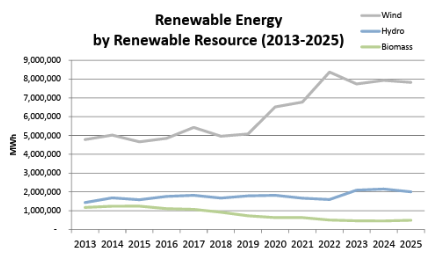
Let’s begin with a look back at Wisconsin’s historical renewable energy development. This figure from the RPS memo shows the growth of wind energy serving Wisconsin’s needs compared to baseline hydroelectric and biogas/biomass resources over the last decade plus:

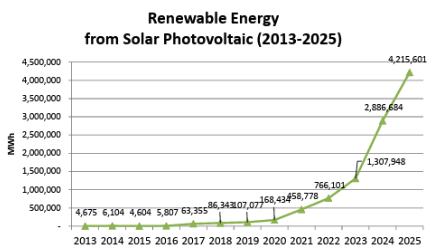
And this PSC figure below presents utility-scale solar production over that same time span separately, as solar production was relatively flat until about 2020:

While the RPS memo does not provide detailed historical stats, based on RENEW’s participation in PSC cases and observation of renewable energy trends, we can provide insight into renewable energy development. This includes development that occurred before 2013 and new trends shown in the RPS memo figures. 

Between 2008 and 2013, renewable energy growth in Wisconsin was mostly driven by wind projects. According to the 2012 RPS memo, at that time, wind projects located in neighboring states contributed about 43% (2.8 million Megawatt-hours, or MWh) to Wisconsin’s renewable energy portfolio. Wisconsin-based wind projects contributed another 20% (1.3 million MWh). Altogether, wind production made up about two-thirds of Wisconsin’s renewable portfolio, with baseline hydroelectric and landfill gas making up most of the rest. The addition of these wind facilities after 2008 helped Wisconsin reach the 10% statewide renewable energy goal for the first time in 2013.

While growth in all renewable energy serving Wisconsin fell flat between 2013 and 2019, in 2020, wind energy production began to increase again, thanks to new projects. A new trend began here as well. For the first time, utility-scale solar projects located in Wisconsin came online and started to significantly contribute to our renewable energy portfolio. 

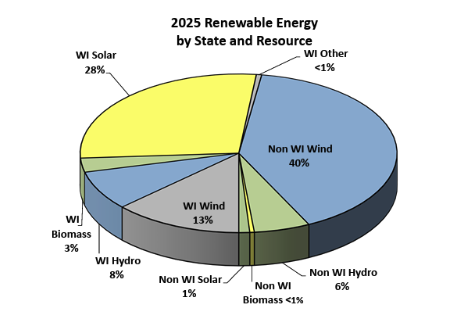
The 2025 RPS memo pie chart below presents a snapshot of what renewable resources serve Wisconsin’s electricity needs today. This is Wisconsin’s current renewable energy portfolio:

While non-Wisconsin-based wind projects used to occupy about two-thirds of this pie in the mid-2010s, that percentage has shrunk – not due to a reduction in wind production, but due to the growth of Wisconsin-based solar. In fact, while non-Wisconsin wind production increased from 2.8 million MWh in 2012 to 5.9 million in 2025, Wisconsin solar production grew astronomically over that same period – from a mere 5,000 MWh in 2012 to 4.2 million MWh in 2025.

The PSC only counts renewable energy production from facilities certified by the PSC as renewable resources, either owned by Wisconsin utilities or contracted by them to serve Wisconsin’s electricity needs. Each year, the PSC calculates the RPS percentage as total renewable energy production from these facilities divided by total retail sales of electricity to Wisconsin customers.

The main takeaway from the 2025 RPS memo is that renewable energy now serves about 20% of Wisconsin’s electricity needs. This includes a doubling in percentage from 10% in 2013, when Wisconsin first met its statewide goal, and a noticeable uptick from 2024, when 18.5% of our electricity came from renewables. To see where Wisconsin is headed, we will now have to look at the draft SEA.

The Strategic Energy Assessment (SEA) 2026-2032

The SEA is a forward-looking document that attempts to project future needs and future supply within Wisconsin’s electricity industry. Wisconsin does not have an Integrated Resource Plan (IRP), as many utility-regulated states do. To somewhat fill that IRP gap, the SEA serves as an information-gathering and reporting process that the PSC is required to do by state law. The PSC released a draft that covers the 2026-2032 period and is now seeking public comments through September 28 to inform updates and edits made to its final revised report.

The first takeaway from the draft SEA is the projected rise of data centers in Wisconsin. Over the 2026-2032 period, collective utility forecasts project a 40% increase in statewide summer peak. The SEA also states that 72% of this projected increase is due to new data centers and their electricity needs. 

While this blog will focus on renewable energy insights provided by the SEA, we must also note that bullish utility projections of new data centers in Wisconsin are highly uncertain, and that the SEA does not provide a rigorous vetting of utility forecasts that would be included within IRP proceedings.

Before we delve further into the SEA outlook for renewable development, let us reference one important SEA statistic that the RPS memo misses. That statistic is the installed capacity of customer-owned solar, which can also help us understand a fuller picture of Wisconsin’s renewable energy production. The SEA states that in 2025, Wisconsin residents and businesses owned 318 Megawatts (MW) of rooftop solar. If we assume a 13% average capacity factor for rooftop solar, this equates to about 362,000 MWh of electricity produced by these customer-owned solar systems in 2025. 

Since utilities do not register these customer-owned solar systems for RPS compliance, the RPS memo does not capture Wisconsinites’ direct contribution to Wisconsin’s renewable portfolio. But if you insert the Wisconsin rooftop solar production estimate into the calculation of that 20% RPS statistic mentioned above, Wisconsin’s 2025 statewide renewable energy percentage increases to about 21.4%. 

As we turn to the SEA’s 2032 renewable projections, it is important to note Wisconsin’s current installed capacity of renewable resources. Wisconsin currently has 2,189 MW of utility-scale solar generating capacity, 827 MW of wind generating capacity, and 510 MW of BESS storage capacity in service. 

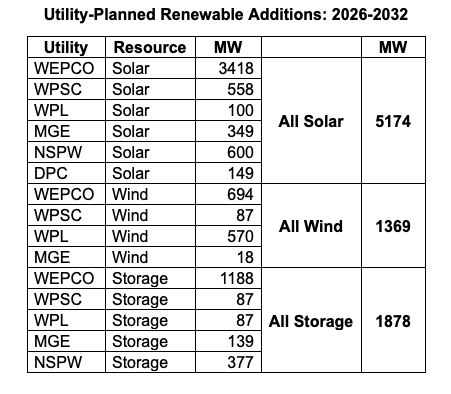
From this understanding of Wisconsin’s current generation portfolio, we can better contextualize the planned build-out coming over the next several years. The table below is informed by SEA-collected statistics and reflects utility-planned additions:

If these plans fully come to fruition, by 2032, Wisconsin will nearly triple its in-state solar and wind generating capacity and more than quadruple its current capacity to store electricity. 

Based on other information within the SEA, a bit more insight can be shared with regard to the start-up timing of these resources. The start of operations for these solar and BESS resources will mostly occur between 2026 and 2030. Many of these solar and battery projects have already been approved by, or have applications pending before, the PSC. Applications for Wisconsin wind additions are just now beginning to be presented to the PSC. Those wind projects would likely start operating between 2030 and 2032.

Later this summer, RENEW plans to follow up on this blog to compare the SEA 2032 clean energy projection to the 2050 modeling results for what Wisconsin will need according to our Wisconsin Zero Carbon Study.

The post The Past, Present, and Future of Renewable Energy Development appeared first on RENEW Wisconsin.

Trump Administration’s Freeze on Wind Projects Threatens America’s Affordable, Sustainable Energy Future

In a political effort to prevent new wind projects from being built, the Trump Administration has gone to increasingly great lengths. Recently, the administration has spent several billion taxpayer dollars to buy out offshore wind leases.

The cancellation of offshore wind leases earlier this year led several Northeast states to sue the administration, and a group of eight states has filed a notice of intent to sue over the settlement the Trump Administration made to buy out wind leases belonging to Invenergy and Bluepoint Wind.

For about a year, the Trump Administration has also utilized formerly routine national security reviews to stall the approval of new wind projects.

For years, the Federal Aviation Administration (FAA) and Department of Defense (DoD) worked with wind energy builders to balance the development of wind energy with concerns about national security and radar interference , mitigating any issues. In the DoD’s own words, this review is supposed to be a “timely, transparent, and repeatable process.” 

But in August 2025, the DoD stopped signing off on any national security mitigation plans to allow proposed wind energy projects over 200 feet tall to move forward.

More than 150 wind projects across the country are impacted by this so-called “wind freeze.” The indefinite pause on DoD approvals creates a cloud of uncertainty that leaves projects without the necessary insurance and financing, threatening the development and deployment of renewable energy and putting immense financial strain on wind project developers.

Some developers missed the construction window to qualify for federal tax credits, which were phased out by the One Big Beautiful Bill Act on July 4.

Faced with endless delay, a coalition of renewable energy trade groups and wind energy development companies sued the DoD back in late May, alleging violations of administrative law and seeking to undo the freeze. That case is known as Renewable Northwest v. Hegseth.

Earlier this year, efforts by the Interior Department to hold up five offshore wind energy projects on the East Coast were stopped by federal courts, with judges allowing the projects to proceed, overriding the agency’s security concerns.

The Benefits of Wind Energy

Unfortunately, the impacts of this purposeful administrative delay will negatively impact all Americans. Stalling or canceling wind energy projects robs communities of tax revenue and jobs, and cuts off a critical source of clean energy as data centers and the AI boom demand more and more power.

In 2025, wind energy produced about 11 percent of America’s utility-generated power. Once installed, wind turbines provide reliable, fixed-cost power at a competitive price, even without subsidies.

Compare that to alternatives like natural gas, where prices can vary substantially with the ebbs and flows of international energy markets and lead to unexpected and unwelcome increases in consumers’ energy bills.

Once turbines have been built, wind energy is not vulnerable to international political crises or other supply shocks. Paired with solar energy, transmission networks, and battery storage, wind power is a key building block of a clean energy future.

States Seek To Intervene in the Lawsuit

This past week, the attorneys general of 18 states and Washington, D.C., filed a motion to intervene in Renewable Northwest v. Hegseth, seeking to represent the interests of their respective states.

The states argue that this agency decision is illegal and causes them serious harm, taking away their authority over energy policy and thwarting their plans to develop clean energy and meet state-level emissions reduction targets.

Those targets are meant to protect human health and the environment, but are jeopardized by a significant delay in wind energy development at a critical moment in the renewable energy transition.

The states that have had wind energy projects stalled by the Trump Administration may face energy insecurity, rising power costs, and dirtier air as a result of DoD actions constraining the development of wind power.

According to the states’ motion, public and private investments in these wind energy projects and the underlying infrastructure, such as job training and research and development, total billions of dollars. Those investments were intended to facilitate the buildout of wind energy, but are now stranded assets until the pending projects can gain the DoD approval needed to move forward.

Finally, the states hoping to intervene in the case argue that they have suffered economic harm, as the halt in wind project approval means that projected jobs and valuable tax revenue go unrealized.

In Colorado alone, more than 7,000 jobs are in jeopardy on proposed projects that involve $2.6 billion in private investment. In 2022, Colorado-based wind projects contributed $10 million in state and local tax receipts and $18 million in lease payments to Colorado residents.

The Bottom Line

The Trump Administration’s anti-wind policies are not just bad for community health and efforts to address the ongoing climate crisis — these policies stand in the way of economic development that investors, companies, and consumers all benefit from.

Trump’s administration has touted an “energy dominance” strategy, but refusing to greenlight wind energy — a clean, proven, and cost-effective form of energy — is deeply shortsighted.

Should the freeze be allowed to continue, Americans will feel the pain in their pocketbooks.

We must continue to push our political leaders to facilitate the clean energy transition that our society needs: creating jobs and investment, lowering energy costs, and ditching fossil fuels for clean power.

Brian Wagenaar, a Twin Cities native, is one of RENEW’s 2026 summer law clerks. He is currently a student at the University of Wisconsin Law School and starts his second year in the program this fall. Prior to his time at UW’s Law School, Brian earned his bachelor’s in environmental policy from UW-Green Bay.

The post Trump Administration’s Freeze on Wind Projects Threatens America’s Affordable, Sustainable Energy Future appeared first on RENEW Wisconsin.

The Great Wisconsin Energy Road Trip

Imagine Wisconsin is about to take the most ambitious road trip in its history.

The destination? A future where the lights stay on, electric bills are affordable, businesses have the power they need to grow, and the air is cleaner than it is today.

Three people walk up to the driver’s seat and say, “I know the best way.” But they all want to take a different route.

Mandela Barnes: “Let’s Build Opportunity.”

Barnes looks out the windshield and says, “This trip should help everyone.”

His path focuses on creating good-paying jobs, expanding clean energy, and making sure the benefits reach working families and communities that have often been left behind.

His message is simple: Wisconsin can grow its economy while building more renewable energy.

Francesca Hong: “Let’s Build the Highway of the Future.”

Hong unfolds what appears to be the largest map anyone has brought. She talks about adding more solar and wind farms, more battery storage, and a stronger electric grid. She also wants Wisconsin to plan ahead rather than wait until there’s a problem.

When giant new electricity users, like AI data centers, move into Wisconsin, she argues they should pay for the new power plants and transmission lines they need, rather than sending the bill to everyone else.

Her route is ambitious and detailed.

Tom Tiffany: “Don’t Fix What Isn’t Broken.”

Tiffany eases off the gas and says, “Slow down.” Tiffany wants to pump the brakes on utility-scale renewable energy projects. His alternative? Wisconsin should lean into fossil fuels and add more nuclear energy generation to the mix to meet our energy needs and keep prices low.

Renewable energy could have a place on his map, but he believes nuclear energy and fossil fuels are what’s needed to meet Wisconsin’s energy needs.

Who Has the Strongest Plan to Expand Renewables?

If the only category being judged is renewable energy strategy, Hong has the best route. She explains not only where Wisconsin should go, but also how to get there. That doesn’t automatically make it the “best” plan for every voter, but it’s certainly our preference at RENEW.

Francesca Hong — A

Hong brings the most complete blueprint to the table. Her plan covers renewable energy from nearly every angle—expanding solar and wind power, adding battery storage, strengthening the electric grid, improving energy efficiency, and planning for Wisconsin’s future energy needs. She also explains who should help pay for new infrastructure.

 Mandela Barnes — B+

Barnes strongly supports renewable energy and clean-energy jobs. His vision is optimistic and focuses on creating opportunities for working families. While his goals are clear, his publicly released energy strategy contains fewer specific details about how those goals would be achieved.

Tom Tiffany — D

Tiffany’s focus is different. He believes that expanding nuclear power and relying on fossil fuels will drive down energy prices. Renewable energy might be part of his approach, but it is certainly not the centerpiece of his energy strategy. Because this report card grades only renewable energy policy, he receives the lowest score.

*These grades are not an endorsement, just a review of a specific policy area

The Destination

Every candidate agrees on one thing:

Wisconsin needs more energy.

Where they disagree is how to build it, who should pay for it, and how quickly the state should move toward renewable energy.

As with every road trip, there are different routes to the same destination, but it’s up to the people of Wisconsin to decide who gets the keys.

*This blog post is not a candidate endorsement.

The post The Great Wisconsin Energy Road Trip appeared first on RENEW Wisconsin.

When the Sky Turns Orange, It Changes the Conversation About Energy

Over the past week, millions of people across the Midwest and East Coast have stepped outside to hazy skies, smelled smoke in the air, and checked their weather apps—not for rain, but for the Air Quality Index (AQI).

For many communities, the AQI has climbed from “Unhealthy for Sensitive Groups” to “Unhealthy” and even “hazardous” categories because of wildfire smoke drifting south from Canada.

The culprit is PM2.5—fine particulate matter measuring 2.5 micrometers or smaller. These particles are so small that they can travel deep into your lungs and even enter your bloodstream. They’re associated with increased asthma attacks, heart disease, strokes, respiratory illness, and other serious health concerns.

We often talk about building an economy and a clean energy future we can afford, focusing on the cost of producing energy and the size of people’s energy bills. In this case, the discussion shifts to what we can’t afford. We can’t afford to keep making the choices that have turned these smoky summer days into a new normal.

Those decisions have not only brought us to this moment, but have been producing the same type of pollution driving today’s air quality alerts. PM2.5 is also one of the primary pollutants produced when coal is burned to generate electricity. Coal-fired power plants also emit sulfur dioxide (SO₂) and nitrogen oxides (NOₓ), which can react in the atmosphere to create even more fine particulate pollution.

To be clear, not every wildfire is directly caused by climate change, but our choice to rely on fuel sources like coal and natural gas makes it more common. What’s worse is that our continued reliance on coal plants continues to regularly expose nearby residents to fine particulate pollution that can harm our health. The same kind of air pollution that much of the country is being exposed to right now. 

Every time smoke fills our skies, we change our behavior. We keep our children indoors, cancel outdoor events, run air purifiers, and hope the wind shifts. Unfortunately, those who live near coal plants don’t have the benefit of waiting for the winds to change.

It reminds us of something we often take for granted: Clean air matters.

That is why RENEW Wisconsin works every day to expand renewable energy across our state.

Every new solar array, every wind project, every battery installation, every clean energy policy we advance is about more than electricity. It’s about protecting the air we breathe, strengthening our economy, creating jobs in Wisconsin, and building an energy system that doesn’t rely on harmful combustion to keep the lights on.

This work doesn’t happen by accident.

It happens because people like you believe Wisconsin deserves a cleaner, healthier, and more resilient energy future.

If you’ve ever wondered whether your support makes a difference, it does.

Your donation helps RENEW Wisconsin:

  • Advocate for clean energy policies at the Capitol and before state agencies.
  • Support the responsible development of wind, solar, and energy storage.
  • Expand access to renewable energy for schools, nonprofits, and communities.
  • Educate the public with trusted, fact-based information.
  • Build a healthier energy future for every Wisconsin family.

The next time you look outside and see a hazy sky, remember that while we can’t stop every wildfire, we can choose how we generate the electricity that powers our lives and build the future we want to see.

If you believe, like us, that we can’t afford to continue to rely on the energy sources that got us into this mess, I invite you to support RENEW Wisconsin today.

Together, we can build a state where clean air isn’t something we hope for—it’s something we protect.

Donate today and help power Wisconsin’s clean energy future.

Ismaeel Chartier
Executive Director, RENEW Wisconsin

The post When the Sky Turns Orange, It Changes the Conversation About Energy appeared first on RENEW Wisconsin.

Expanding Access to Solar Power

What if someone told you that you could save money on your electric bill by getting a small solar array that can fit on your balcony or patio? It is possible — just not in Wisconsin. At least not explicitly.

Millions of such systems have been installed in Europe, giving people the option to use solar energy to offset some of the electricity they use. Because electrical systems differ here, several manufacturers are developing comparable products for use in the U.S. Meeting electrical safety standards is one of the most important steps in making these products ready for balconies, lawns, and the like across the country.

As these products become more widely available, it will be important to make sure you purchase ones specifically designed to meet the strict criteria of UL and the National Electrical Code. Not only to make sure you’re following established rules (once they are created), but also to keep you and your home safe.

Because these approved systems are intentionally small and limited in how much they can produce, they shouldn’t need to be approved by your utility company. These smaller solar systems produce just enough electricity to power a couple of appliances, meaning all the energy they create is used immediately.

So far, existing plug-in solar kits include all the essentials someone might need to simply plug them into an electrical outlet. The attached inverter and plug are designed to shut off when unplugged, during an outage, or when a voltage adjustment is needed.

The solar panels in these kits are the same technology as those on rooftops and solar fields. The economics of purchasing these kits and seeing real savings by buying less electricity is also pretty straightforward. So what would it take to make it explicitly legal here in Wisconsin? Creating a law that sets up rules and regulations to ensure we can safely reduce our energy bills. 

This step requires legislation to allow customers to install these systems under clear guidance. Legislation will also help to create clear rules and guidelines for safe use. Model legislation is available as a starting point, and with over 20 states introducing legislation, many examples of proposals exist, including some that have already been signed into law. A Wisconsin proposal is in the works, too.

It’s exciting to see all the enthusiasm building for balcony solar in the state, but we must keep in mind that changing public policy is not a sprint, not even a marathon, but more like a triathlon. If you want to do something before our next legislative session kicks off in January, consider speaking with some Wisconsin candidates for the upcoming elections this year. Tell them you value clean, affordable energy.

The post Expanding Access to Solar Power appeared first on RENEW Wisconsin.

Solar for Good’s Most Critical Year

Picture a school that stops sending thousands of dollars a year to the utility and instead sends it to its classrooms. Picture a food pantry that keeps the lights on for less and puts the savings back into feeding families. That is what solar does for a nonprofit or a school, and right now we have a short window to make it happen for as many of them as we can.

The next two rounds of Solar for Good, this fall and next spring, are the most important we have ever run. Here’s why.

The Deadline, and Why It’s Here

In 2025, a new federal law called the One Big Beautiful Bill Act changed the rules for solar.

For years, the federal government has helped tax-exempt groups like schools, churches, libraries, and nonprofits pay for solar. Because these groups do not owe federal taxes, they receive this help as a direct cash payment, called direct pay. It is worth up to 30 percent of the cost of the solar project. That payment has made solar possible for many groups that could never have afforded it on their own.

That help still exists. But the new law added a hard deadline, and the key date was July 4, 2026.

Now that the date has passed, any project that starts now has to be built and connected to the utility by the end of 2027 to receive the direct pay payment. Miss that date, and the project loses up to 30 percent of its potential federal funding.

Solar will not become impossible after that. But for many schools and nonprofits, the return on investment will take longer, and a project that pencils out easily today may be much harder to justify without that federal payment. That is why this year is so critical. For any school or nonprofit that has been on the fence, or that has always wanted to go solar someday, this is the year to make a move.

Why Fall 2026 and Spring 2027 Are the Window

Solar projects take time, and for many of these groups, the process is even longer than people expect. Before a nonprofit or school can even start taking bids, it often has to get the project approved by more than one board or governing body. Then it has to raise the money, run the bidding process, select a contractor, secure utility approval, build the project, and connect it to the grid. All of that has to happen before the end of 2027.

Because these projects take so much time to complete, the groups we fund this fall and next spring are the last ones who can realistically start early enough to finish before the deadline. For every school and nonprofit in our communities, this is their last clear shot at that federal payment. Our job at RENEW Wisconsin is to help as many of them through that door as we can before it shuts.

What Solar Actually Means for These Groups

This is not about panels on a roof. It is about what the savings make possible.

For a school, solar means less money going to the power company every month and more money going back into the classroom, back into teachers, back into the students. For a nonprofit, it means more money going back into the mission they care about, whether that is feeding families, sheltering neighbors, or serving their community.

The savings last for decades. A solar array pays a school or nonprofit back year after year, and every one of those dollars stays right here in Wisconsin doing good.

Solar for Good is a RENEW Wisconsin program that gives grants to nonprofits and schools across the state to help them afford solar. Every dollar we raise goes toward helping more of them build their projects.

Here’s the Ask

The more we raise this year, the more schools and nonprofits we can fund. And the more we fund now, the more of them can get built and connected before the end of 2027, while the federal payment is still on the table.

Here is what makes Solar for Good special. Every dollar we raise goes toward building a project, and these funds are not a one-time gift. Every year the solar array is up and running, it saves that school or nonprofit money on their energy bills, money that goes right back into classrooms, staff, and community programs. Those savings add up year after year, far beyond the original grant amount. It is truly a gift that keeps on giving.

If you were ever going to give to Solar for Good, this is the year it matters most.

RENEW accepts all kinds of gifts. Along with cash, checks, and credit card donations, we can also accept gifts of stock and qualified distributions from retirement accounts like Roth IRAs. If you have questions about any of these, reach out to us. We are always happy to work with you to find the right way to give, so we can get as many great solar projects approved and built during these next two critical rounds.

This is a short window, and the clock is ticking. Let’s make the most of it together.

The post Solar for Good’s Most Critical Year appeared first on RENEW Wisconsin.

Wisconsin’s Climate Youth is an Energy Wakeup Call for Wisconsin

Across the country, youth impacted by climate change have sued state governments on the theory that inaction in the face of the climate crisis violates their fundamental constitutional rights.

In one highly publicized case, Held v. State, 16 kids sued the State of Montana over environmental laws that shielded companies developing fossil fuel projects, forbidding the state from reviewing the full impacts of the projects’ greenhouse gas (GHG) emissions.

The youth litigants won a decisive court victory, striking down that provision of the Montana Environmental Policy Act and securing a declaration of their constitutional right to a “stable climate system.”

More recently, the Montana plaintiffs are back in court in 2026 seeking to reinforce their win and ensure Montana’s energy and environmental policy actually complies with the established right to a stable climate.

Wisconsin’s Youth Climate Case

Here in Wisconsin, the nonprofit legal advocacy group Our Children’s Trust teamed up with Midwest Environmental Advocates (MEA) to sue the state’s Public Service Commission (PSC) and the state legislature in 2025 in Dunn v. Wisconsin Public Service Commission.

In their complaint, the young plaintiffs — ranging from age 8 to 17 at the time the case was filed — challenged aspects of Wisconsin energy law that allow utilities to continue building fossil-fuel infrastructure despite the climate crisis.

The youth plaintiffs hail from a wide range of backgrounds, but they all share one tragic bond: climate change is making their lives measurably worse.

The climate crisis has forced some of their families to move, rendered many Wisconsin rivers and lakes degraded and unfit for swimming, fishing, and boating, robbed them of opportunities to engage in cultural activities like tapping maple trees for maple syrup, exposed them to a heightened risk of Lyme disease, exacerbated health issues like asthma, and led to a decline in their mental health.

Driven by these cultural, health, and economic impacts, many of these kids and young adults have dedicated themselves to climate education and activism.

But they can’t do it alone — they will need help from engaged Wisconsinites to push our legislators and courts to consider the true costs of continuing to develop more fossil fuel infrastructure when renewable energy alternatives are readily available.

The Youths’ Argument

In court, plaintiffs argued that the law prohibiting the PSC from considering the impacts of air pollution in issuing Certificates of Public Convenience and Necessity (CPCNs) to large energy projects is unconstitutional, allowing the continued development of fossil fuel projects without considering their full costs to society.

Second, the youth argued that Wisconsin’s Renewable Portfolio Standard (RPS) is unconstitutional, effectively putting a ceiling on the PSC’s ability to push utilities to supply more renewable energy.

In 2005, Wisconsin amended Act 9, setting an initial goal of 10 percent renewable energy by 2015. That goal was first met back in 2013, two years ahead of schedule. Since then, the PSC has been unable to require more renewable energy to support our statewide climate goal, or even accurately track the renewable energy portfolio of Wisconsin’s utilities. This shortcoming has led Wisconsin to fall behind in the adoption of renewable energy.

Without the ability to mandate that utilities develop more renewable energy, Wisconsin will struggle to meet the long-range 2050 goal of 100% carbon-free energy set by Governor Evers.

The plaintiffs argue that these maladies in Wisconsin law are violating their foundational rights to life and liberty, which rest on a stable climate system.

They also argue that the defendant’s inadequate response to climate change was violating Wisconsin’s Public Trust Doctrine and depriving plaintiffs of the ability to use and enjoy Wisconsin’s bountiful water resources: our many public rivers and lakes. Sadly, Wisconsin’s public waterways are increasingly degraded by extreme heat and algal blooms closely linked to climate change.

The Lower Court’s Ruling

Despite a load of evidence, the plaintiffs’ case was dismissed by the court. While the judge sympathized with the youth, acknowledging that the plaintiffs showed clear harm from climate change, they decided that this case is not fit for resolution in a courtroom.

Instead, the court said the plaintiffs’ cause is an energy policy issue that would be better addressed in the state legislature.

However, the plaintiffs are appealing that decision and fighting to bring awareness to the human impacts of the climate crisis, and to push Wisconsin to take meaningful action to mitigate climate change and protect the future of all Wisconsinites.

The High Cost of Fossil Fuels

The natural gas plants that Wisconsin utilities and power producers are currently building and proposing will operate for 30 or more years, producing a wide range of serious, negative environmental health impacts for Wisconsinites.

Natural gas and coal plants struggle to compete with solar and wind power on costs, and that’s not including the often-ignored economic and health costs of fossil fuel projects, which include dirtier air, a slew of health risks, and early death.

In 2025, WE Energies received PSC approval for two massive natural gas plants, Oak Creek and the Paris Generation Project.

While some have touted natural gas as a cleaner “bridge” fuel, analysis conducted by Healthy Climate Wisconsin and the Union of Concerned Scientists predicts that the plants will cost more than $5 billion in health impacts from particulate, sulfur, and other forms of toxic pollution over their three-decade lifespan, with impacts in Wisconsin and neighboring states like Michigan.

These new plants will particularly harm people with existing heart or respiratory issues, as well as communities that have already borne the hefty costs of fossil fuel development.

Overall, Wisconsinites will be less healthy as a result of these natural gas projects, in addition to the broader impact on climate change from burning methane — a greenhouse gas far more potent than carbon dioxide.

The roughly $2 billion WE Energies is spending developing the Oak Creek and Paris projects could have been used to build large-scale solar or wind farms that would have provided clean, reliable energy.

Wisconsin’s Clean Energy Future

With the technology we have available, there is no need for more outdated, dirty fossil fuel infrastructure in Wisconsin.

RENEW Wisconsin is fighting to put solar and wind on level ground with fossil fuels — because solar and wind power prevail when they are given a fair chance to compete in the energy market.

A brighter and attainable Wisconsin energy future powered by renewable energy would produce reliable power, create jobs, and lessen air pollution, leading to a healthier and wealthier Badger State.

A combination of rooftop, community solar, large-scale solar, energy conservation, smart demand reduction programs, and battery storage can meet all of Wisconsin’s energy needs, even with the projected increase in energy demand from data centers.

That is the future RENEW Wisconsin is fighting for.

Brian Wagenaar, a Twin Cities native, is one of RENEW’s 2026 summer law clerks. He is currently a student at the University of Wisconsin Law School and starts his second year in the program this fall. Prior to his time at UW’s Law School, Brian earned his bachelor’s in environmental policy from UW-Green Bay.

The post Wisconsin’s Climate Youth is an Energy Wakeup Call for Wisconsin appeared first on RENEW Wisconsin.

RENEW Wisconsin Summit Panel: A Timely Conversation on Siting

Communities across Wisconsin continue to grapple with how renewable energy projects get sited and permitted. At our 2026 RENEW Wisconsin Summit RENEW Wisconsin hosted a panel that brought together expert voices on state and local siting and permitting authority. The conversation is worth a revisit, as the industry continues to navigate this important topic.

Eric Callisto, a former Chair of the Public Service Commission of Wisconsin (PSC) and private-sector renewable energy attorney, made a clear case for why state-level oversight of large projects matters: projects that serve the regional grid are matters of statewide concern, and an independent expert agency is better positioned to evaluate energy projects than individual town boards. He was candid that without that independent oversight, the “NIMBY element” would prevent many worthy projects from being built.

Orrie Walsvik, an associate attorney at Michael Best, walked through what he called the “inverted pyramid” of clean energy regulation, from baseline zoning to the case-by-case requirements of § 66.0401 to the PSC’s comprehensive authority over 100+ Megawatt projects. His core point: local governments have been delegated administrative authority to help Wisconsin implement its renewable energy policy, not the legislative authority to decide whether that policy is welcome in their jurisdiction.

Isaac Uitenbroek, a zoning administrator with direct experience drafting and implementing solar regulations, provided an honest window into what local government staff navigate: constituent pressure, tight timelines, and the balancing act of building ordinances that meet legal requirements while giving elected officials a process they can use to address community concerns. He advised developers and applicants to communicate early, communicate often, and leave no information vacuum. His perspective reflected real experience with what happens when communities feel blindsided.

David Jakubiak, Senior Vice President of Aileron and expert on renewable energy communications, reinforced that community engagement is not a compliance checkbox but a prerequisite for project success. He pushed back on drone footage, cookie-cutter community meetings, and out-of-state project representatives and witnesses. David made the practical case for finding local champions and showing people what renewable energy actually looks like from the road, not from the sky.

The common thread of the panel discussion and audience question was a recognition that Wisconsin is navigating a genuine policy contest, one requiring developers, lawyers, and local governments to work together to find a workable path that recognizes community concerns and appreciates the local benefits of renewable energy development.

The post RENEW Wisconsin Summit Panel: A Timely Conversation on Siting appeared first on RENEW Wisconsin.

RENEW Wisconsin’s 2026 Clean Energy Honor Roll

By: Alex Beld

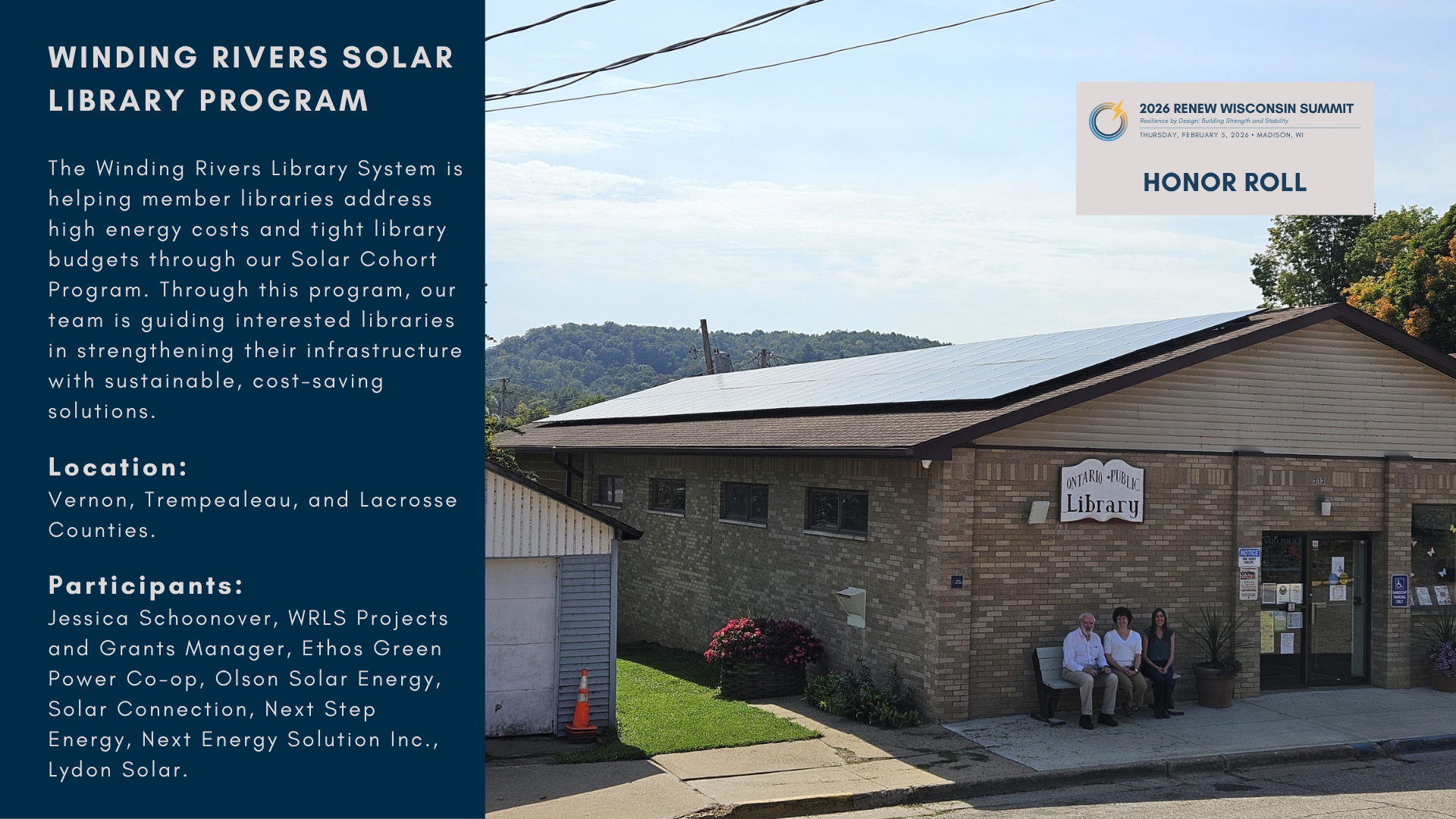
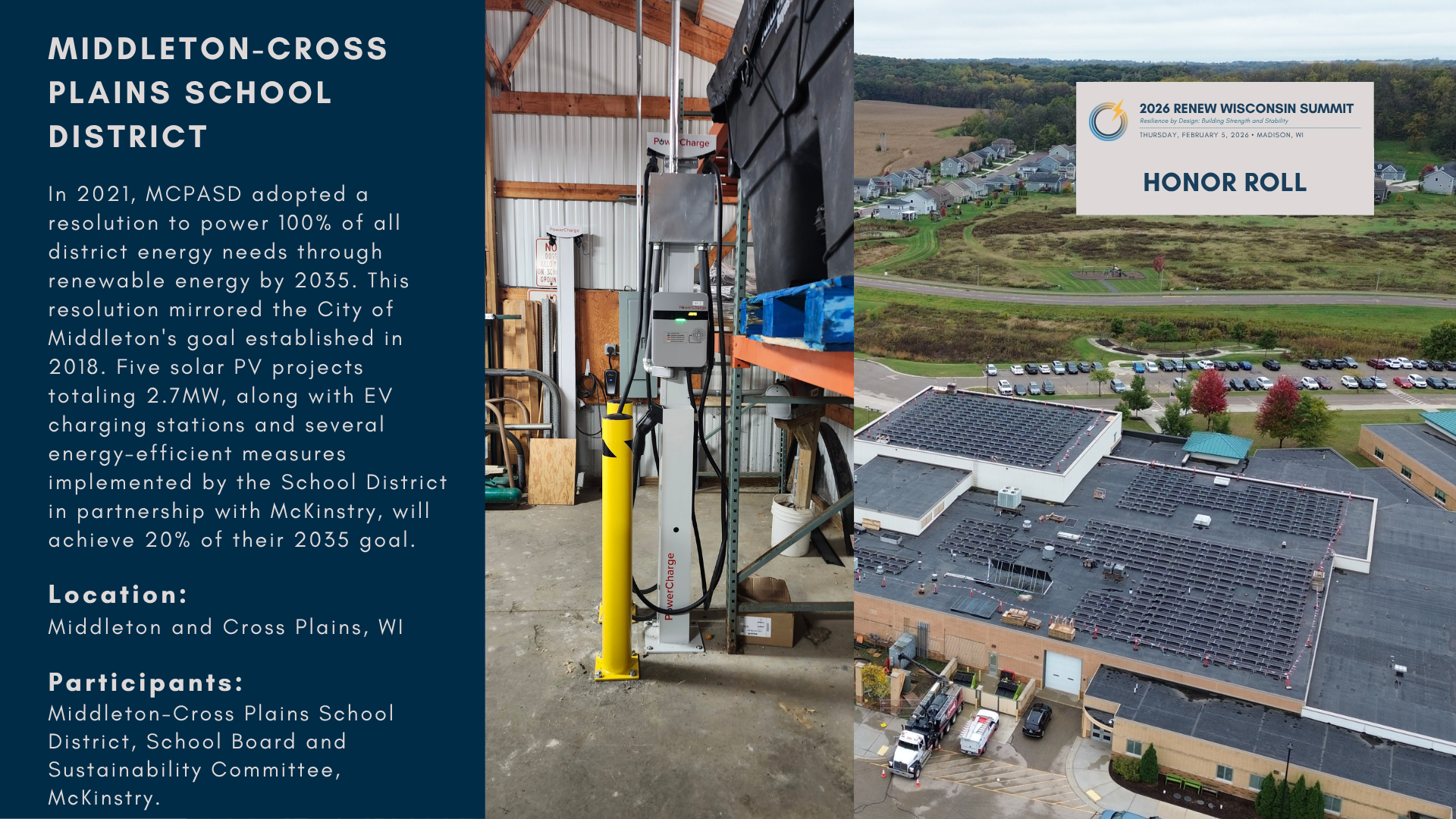
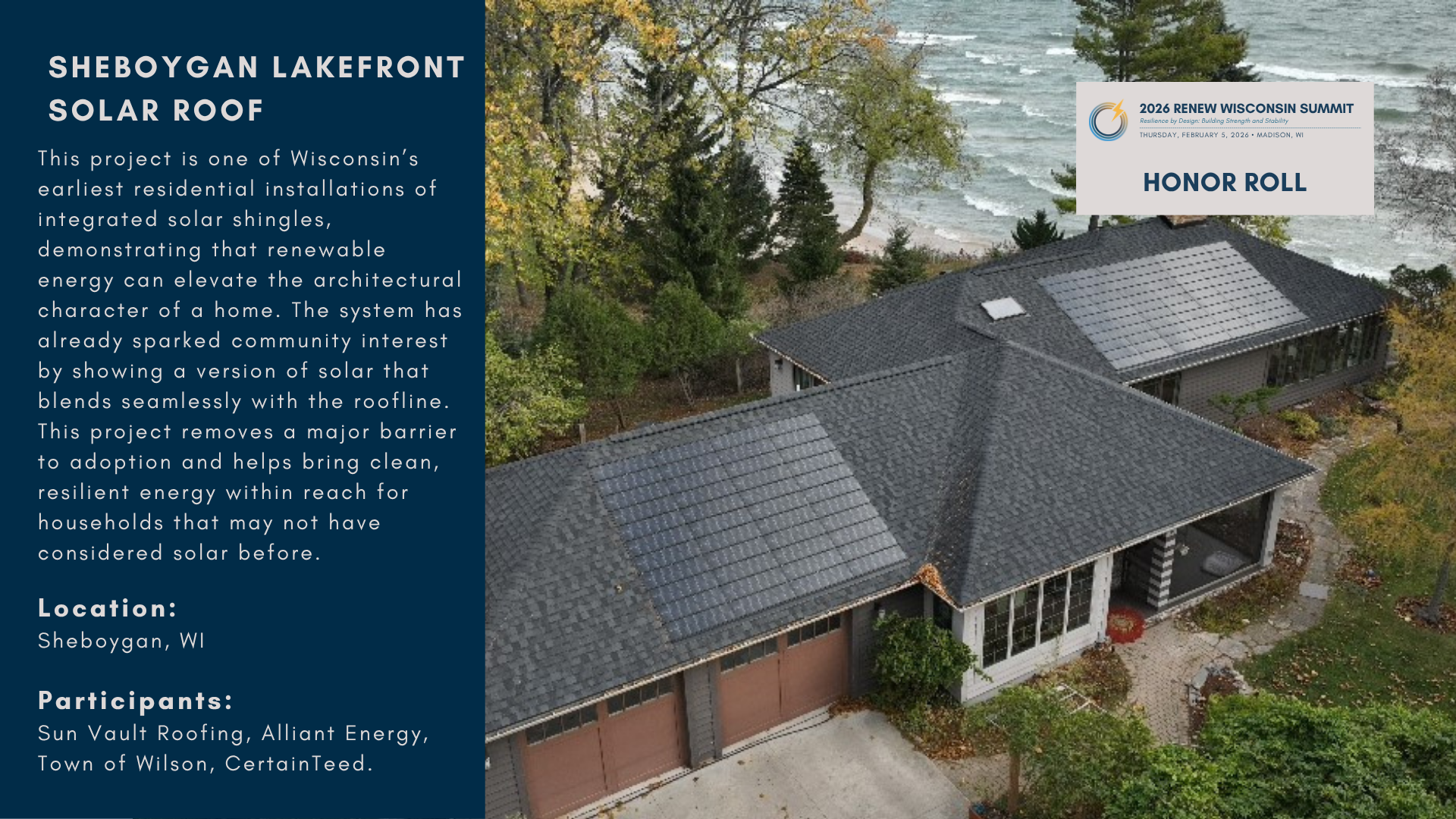
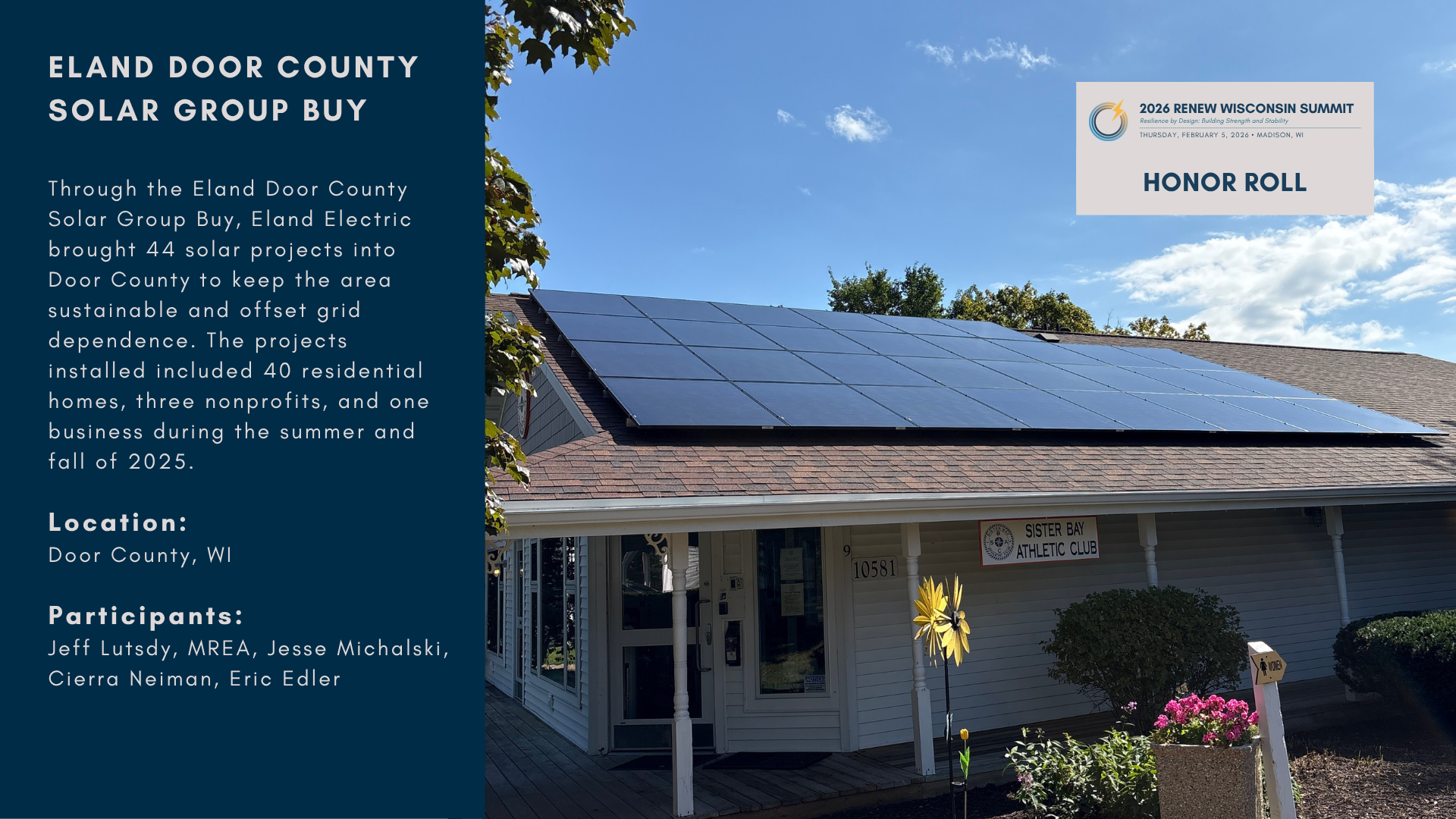
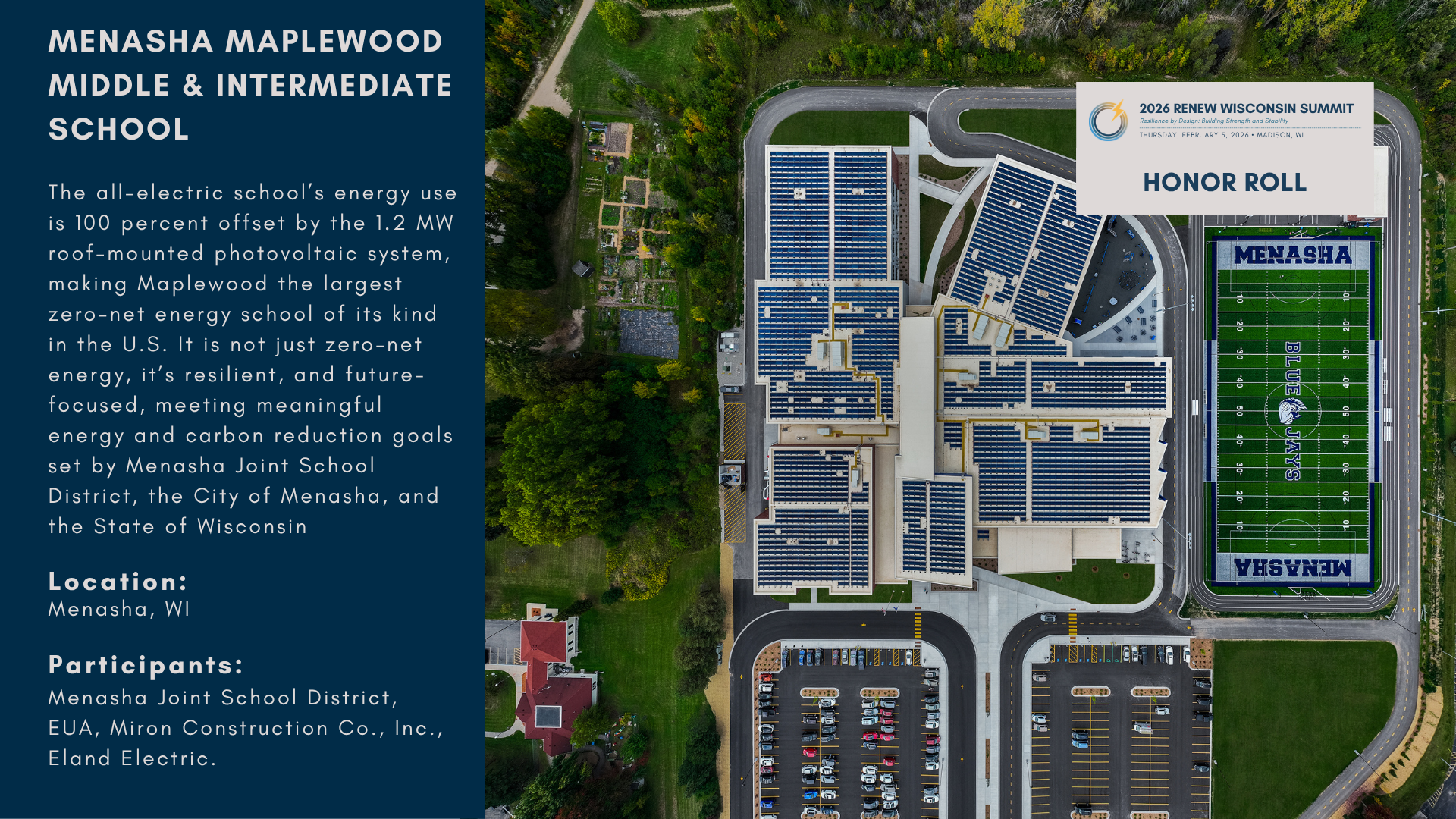
RENEW Wisconsin selected 5 projects for this year’s Honor Roll. These projects and the organizations involved in them demonstrate leadership, ambition, and climate awareness in their design and use of clean energy.

Winding Rivers Solar Library Program

Middleton-Cross Plains School District

Sheboygan Lakefront Solar Roof

Eland Door County Solar Group Buy

Menasha Maplewood Middle & Intermediate School

The post RENEW Wisconsin’s 2026 Clean Energy Honor Roll appeared first on RENEW Wisconsin.

Action Alert: Submit Comments in Support of Dawn Break Solar

By: Alex Beld

Public comments are open now through June 11 for Dawn Break Solar, a 180 Megawatt (MW) solar project paired with a 180 MW battery energy storage system. If approved, the solar project will be located in Waushara County and is planned for completion in 2029. Projects like this have a wide range of local and statewide benefits. Show your support for this project and tell the Public Service Commission of Wisconsin (PSC) why you support the approval of a vital solar project in Wisconsin!

You can use some of the listed benefits below to help you craft your message.

Dawn Break Solar isn’t just about the clean energy it will produce. The 180 MW facility in Waushara County has many benefits:

Economic Growth: Dawn Break Solar is expected to create construction jobs, as well as several long-term local jobs for operations and maintenance. Landowners will also benefit from consistent lease payments during the 35-year lifespan of the project.

Community Benefits: Once in service, Dawn Break Solar will contribute more than $31.5 million in utility-aid payments. Local governments will receive $900,000 annually, with $510,000 for Waushara County and $390,000 for the Towns of Oasis, Plainfield, Deerfield, and Hancock.

Emissions Reductions: Dawn Break Solar will reduce emissions from energy production by about 600 million pounds of CO2 in the first year of operations. In terms of greenhouse gas emissions, this is the equivalent of taking more than 59,100 vehicles off the road for a full year. Additionally, non-GHG emissions reductions will result in health, economic, and environmental benefits. Wisconsin can expect more than $1.3 million in economic benefits associated with public health improvements in Dawn Break Solar’s first year of operations alone.

Submit your comments today and tell the PSC you support the approval of Dawn Break Solar. Feel free to use some of the bullet points above to craft your own unique message.

The post Action Alert: Submit Comments in Support of Dawn Break Solar appeared first on RENEW Wisconsin.

Celebrating the Power of the Sun

By: Alex Beld

All the Good We’re Doing, Together

In the nonprofit world, we spend a lot of our time planning how we will continue to fund our mission—similar to how many people spend much of their time planning how they will make ends meet.

In some cases, for those who can’t make ends meet on their own, there are nonprofits to help. They feed, house, educate, and even protect us. Through RENEW’s Solar for Good program, we have the unique opportunity to help other nonprofits, as well as schools and houses of worship.

The formula is fairly simple—we make it easier for these organizations to access solar power, reducing their energy bills and, in turn, their operating budgets. The hope is that this help allows each and every one of them to spend more of their money and time where it matters: their mission.

Ultimately, every panel that goes up on a food pantry or affordable housing development means one more person who gets to reap the benefits of renewable energy.

Hunger Task Force

In 2025, Hunger Task Force completed a 465-panel array on their new headquarters in Milwaukee. Solar for Good helped the project come to fruition with a $48,237 grant, which covered about 13% of the project cost. Thanks to a wide mix of grants, donations, and government funding, Hunger Task Force covered most of the costs of this project.

Based on projected energy savings of $29,160 per year, Hunger Task Force will pay back its out-of-pocket expenses through avoided energy costs. Each year after that, another nearly $30,000 can go toward providing healthy food to those in need in and around Milwaukee. For every dollar spent on this project, Hunger Task Force will see $1.79 come back to it over the expected life of a typical solar array.

The dollars and cents are a huge motivating factor, but for a nonprofit focused on healthy meals and stewardship, we see additional benefits that are well aligned with the core mission of Hunger Task Force. By reducing emissions, this array helps lower air pollution and mitigate the effects of climate change, both of which lead to better health outcomes for our communities.

Learn more about Hunger Task Force’s Mission to end hunger in Milwaukee and Wisconsin.

West Central Wisconsin Community Action Agency

In 2023, the West Central Wisconsin Community Action Agency (West CAP) completed a 29-kilowatt solar array at one of their low-income housing projects to reduce energy bills for families. Solar for Good provided 27 panels through our grant program, about a third of the panels needed for the array. At the time of its completion, it was projected that the array would fully meet the energy needs of the families who would live in the low-income housing project.

Since 1965, West Cap has worked to promote the self-sufficiency of low-income families in the rural communities of west central Wisconsin. Solar panel technology has become a relatively new tool in efforts like this, as it can be used to completely or nearly eliminate energy bills for families that need a hand making life more affordable.

As Peter H. Kilde, former West CAP Executive Director, put it, “Through our poverty-fighting programs, we want to help prepare families for a world less dependent on fossil-fueled energy. This funding will not only allow us to reduce carbon emissions and help our planet, but it will also ease the energy burden for low-income families so they can afford their housing for the long term.”

Learn more about West CAP’s mission to take action against poverty.

Sauk Prairie School District

In 2025, the Sauk Prairie School District completed its second of two solar arrays for a total of 350-kilowatts of power. Their goal was to reduce their energy costs and, therefore, their overall operating budget. The savings will be placed in a fund to replace the roofs of each building across the district, as well as the solar panels. Solar for Schools, now part of Solar for Good, donated 179 panels, just over 20% of the total project.

It’s expected that the array at the elementary school will produce half of the building’s energy needs. As of July 2025, the smaller installation at the high school had already saved the district $15,000 in energy bills, just 10 months into operation.

The project serves as an educational tool for students and the community, with real-time data on energy generation and savings available online.

Learn more about the Sauk Prairie School District’s arrays.

Looking Ahead

As we see electricity bills rise and fossil fuel resources impacted by global conflict, the power of a solar array is becoming greater each day. And though this work has already touched so many, there are even more organizations out there that have yet to realize the benefits of this energy source.

To keep this work moving forward, we need people like you to support this effort. Together, we can help the nonprofits and schools of Wisconsin manage their energy bills so that they can focus their resources and time on what matters most: helping our communities.

The post Celebrating the Power of the Sun appeared first on RENEW Wisconsin.

The MadiSUN 2026 Group Buy Is Here

We are kicking off the MadiSUN 2026 Group Buy, and this year we have three great local installers on board. Arch Solar, Full Spectrum Solar, and Midwest Solar Power all have locations right here in Madison, and all three are reputable, pre-vetted installers.

Here is how it works. Fill out the I’m Interested form linked below, and the installers will reach out to connect with you directly.

The benefit of joining the Group Buy is simple. Because you are signing up through the program, you get a lower rate than what is offered outside of it. You also get the peace of mind of knowing your installer has already been vetted, so you are working with someone reliable from day one.

With energy prices where they are right now, this is a good time to take a look at solar for your home.

Ready to get started? Fill out the I’m Interested form, and we will take it from there.

The post The MadiSUN 2026 Group Buy Is Here appeared first on RENEW Wisconsin.

When the Plug Is Already In the Wall

Why surplus interconnection could be one of Wisconsin’s most practical clean energy tools

In Portage, Wisconsin, there is a set of wires that has been carrying electricity for decades. 

They connect a coal-fired power plant called Columbia Energy Center to the regional grid. Those wires run to a substation, and that substation connects to transmission lines that carry power to homes and businesses across the state.

Columbia is scheduled to retire. But those wires are not going anywhere.

That is the idea behind surplus interconnection, and it is one of the more practical and underappreciated tools in the clean energy transition.

How It Works

When a power plant connects to the electric grid, utility engineers size everything for that plant’s full output. The wires, the transformers, the substation, all of it. That infrastructure does not disappear when a plant retires, isn’t running, or scales back. The available capacity is still there, even if nothing is using it.

Surplus interconnection lets a new clean energy project plug into that existing connection instead of building a new one from scratch.

Think of it like a parking lot at a stadium that only fills up on game days. Most of the time, those spaces sit empty. Surplus interconnection lets new projects use that empty space, instead of paving a brand new lot somewhere else.

There is one important rule. You cannot park more cars in the lot than it was built to hold. The total electricity moving across the connection point cannot exceed what the original plant was approved to put on the system.

This is technology-neutral. Solar, wind, storage, existing fossil fuel plants, or any combination of them can share an existing interconnection, as long as the total output stays within the approved limit. It is about reusing the connection, not about choosing one technology over another.

Where the Opportunities Are

Retiring coal plants are a natural place to start. Columbia is a clear example of this principle. Alliant Energy is building a long-duration battery right next to the existing coal facility, on the same site, using the same grid connection. The Public Service Commission approved the project in 2025, construction begins this year, and once it is online, it will be able to discharge clean power for hours at a stretch.

Peaker plants tell a similar story. These are gas-fired facilities that utilities run only during periods of peak demand, often hot summer afternoons when air conditioners are running across the state. A peaker might only operate a few hundred hours a year, which means its grid connection sits idle most of the time. Co-locating solar, wind, or storage at a peaker means putting that connection to work the rest of the year. The peaker stays in place as backup for the rare hours when it is genuinely needed.

The same logic applies to existing renewables. A solar plant’s grid connection is sized for its peak output, which only happens for a few hours of sunny midday. A wind project often generates most at night, when demand is lower. Either way, the connection has room to spare much of the time. Adding storage, or pairing solar with wind to fill complementary hours, lets the project use that headroom and deliver clean power through the same connection when it is needed most.

This is already happening in Wisconsin. Solar developers across the state are pursuing battery additions at existing utility-scale solar projects.

Why It Matters Now

Wisconsin is about to see a major surge in electricity demand, driven in large part by new data center development. Meeting that demand by building new transmission lines and power plants, both of which take 5 or more years, could take longer than we would like. 

Surplus interconnection provides an additional tool to help us meet the timeline required for projected load growth. Projects that reuse an existing connection point can often be built in two to three years. Though not a silver bullet for meeting energy demand in Wisconsin, it gives us an opportunity to meet this increase in demand without setting us back years on our clean energy goals.

MISO Has Already Given the Green Light

Wisconsin sits inside MISO, the Midcontinent Independent System Operator. MISO is the regional grid operator that manages the bulk power system across fifteen states, and it has explicitly built surplus interconnection into its rulebook. MISO’s own guidance steers developers who want to add batteries at existing plants toward surplus interconnection as the appropriate route. In short, the regional path is already open. What MISO does not do is require any utility to go looking for these opportunities. That is left to the states.

Other states are stepping into this space. Virginia recently passed the first-in-the-nation Facilitating Access to Surplus Transmission Act (FAST Act). Virginia sits in a different Regional Transmission Organization, but the underlying mechanism is the same. The law requires regulated utilities to inventory sites where they have unused interconnection capacity and run competitive solicitations to fill that capacity with new solar and storage. The stated goal is to cut interconnection timelines from years to months and avoid major new transmission build-outs that would otherwise land on customer bills

The tools exist. What is missing here is a consistent practice of looking for these opportunities.

Looking Ahead

Columbia is not the only Wisconsin plant on the way out. Oak Creek, Edgewater, and units at Weston are all scheduled to retire or convert in the next several years. Each one is a high-capacity connection point that could host new solar, wind, storage, or a mix of them. Wisconsin’s growing fleet of utility-scale solar and wind projects offers another set of opportunities for adding complementary generation and storage without new grid infrastructure, and the peakers across the state are solid candidates as well.

Surplus interconnection deserves more deliberate attention. The grid we already have is more valuable than we sometimes give it credit for. Reusing it well is how we get clean energy online faster and protect ratepayers from paying twice.

The post When the Plug Is Already In the Wall appeared first on RENEW Wisconsin.

PSC Approves Fox Solar Project

By: Alex Beld

On Thursday, May 21, the Public Service Commission of Wisconsin (PSC) approved the Fox Solar Project. At 100 Megawatts (MW), this solar project will produce enough clean energy to power about 25,000 homes. The project is paired with a 50 MW battery energy storage system, providing the flexibility to provide power when the sun goes down.

Located in Oconto County, it is planned for completion in 2028. Projects like this have a wide range of local and statewide benefits, including economic growth, new funding for local municipalities, and reduced emissions from energy production.

Witness testimony from David Loomis of Strategic Economic Research stated that this project will create 300 temporary jobs during construction, along with an additional 20 long-term jobs related to the project’s economic activity.

Along with jobs, the project will support the surrounding communities through utility-aid payments. Over the 25-year life of the project, it is expected to contribute more than $13 million in utility aid payments to Oconto County and the Town of Morgan. Recent legislation has changed utility-aid payments to also include battery installations, which has increased the previous estimate on payments for local governments.

Beyond the economic aspects of this project, it also provides an additional source of clean, reliable energy that isn’t subject to volatile fuel prices. With this project we’re removing 304 million pounds of CO2 related to energy production in the first year of operations, and that’s just the CO2 emissions.

The amount of emissions reductions we’ll see from the project is about the same as taking almost 30,000 cars off the road. Avoided emissions, whether from energy production or our cars, means healthier air for everyone. We estimate that in Fox Solar’s first year of energy production, we’ll see $690,000 in economic benefits associated with the public health improvements we expect to see

Thanks to everyone who took the time to share their support of Fox Solar with the PSC!

The post PSC Approves Fox Solar Project appeared first on RENEW Wisconsin.

Planting Solar Where It Matters Most

Meet RENEW Wisconsin’s Spring 2026 Solar for Good Awardees

Casa Ester has been in Omro for nearly twenty years. They welcome migrant farmworker families arriving in Winnebago County, run a youth garden that donates produce to local food pantries, teach social justice education to participants in over a dozen countries, and last year alone helped more than 450 people stay housed. Every dollar they have goes toward the people who walk through their door.

When Casa Ester decided to go solar, the reasoning was clear. Spending less on electricity means more money available for families facing eviction. They, along with five other organizations, have been selected as awardees of this spring’s Solar for Good grant round. Each organization will receive a $5,000 grant to support its efforts to reduce its energy burden and carbon footprint. By going solar, they can do more to serve communities across the state.

The Spring 2026 Awardees

In Chippewa Falls, Hope Village is the only no-cost emergency shelter in Chippewa County. Since 2016, they have helped 339 people navigate housing instability, with 71% finding permanent housing on the other side. This is their second solar project, built on the success of the first. Lower energy costs mean more capacity to serve guests, run programming, and keep the doors open for people who have nowhere else to go.

In Tomah, First Congregational UCC has been working toward solar for three years. Located in Monroe County’s highest-poverty city, they run an early childhood center, support foster families, and provide meals at the free clinic. This summer, they will become the first church in Tomah to go solar and are already planning an open house where they will invite every congregation in town and ask the question they have been sitting with.

TransCenter for Youth has been running small alternative high schools in Milwaukee since 1973, serving students who have not found their footing in larger, more traditional systems. At Shalom High School, students will soon track real-time energy production from a restored solar array through a live dashboard they helped design. The energy savings go back into the school. Beyond the financial benefit, there is something meaningful about a school where students have often been told resources like this are not available to them choosing to lead on clean energy.

At Lake Mills Area School District, solar is going up across the Elementary and Middle Schools. The district also runs a senior center partnership, a multilingual learner program for immigrant families, and a student-run food pantry called The Mills. The energy savings from a project of this size are real and recurring, freeing up resources year after year to keep those programs funded and those buildings open to the full community.

In Strum, the local public library is building a timber-framed solar canopy that also serves as an outdoor learning and programming space. The savings on utilities go directly back into programming for the community. This summer, children in the reading program will learn about solar energy through hands-on activities and watch live energy production on a display inside the library. It is a thoughtful investment from a community that takes its role as a public resource seriously.

The Same Logic, Six Times Over

Six organizations. Six communities. Different missions, different zip codes, different sizes. The same logic runs through all of them: when organizations spend less on keeping the lights on, they have more to give to the people who need them most. We are proud to support each of these groups and look forward to celebrating with them at their ribbon cuttings.

Help Us Do More of This

Every organization in this cohort is doing more for their community because solar has freed up room in their budget. Solar for Good runs on the support of donors who believe clean energy should reach every corner of Wisconsin, not just the places that can easily afford it. A gift goes directly toward grants for nonprofits, schools, libraries, shelters, and faith communities doing work that matters.

Every $5,000 raised is one more organization that gets to do a little more for its community. It’s that simple.

If this work resonates with you, please consider making a gift today. Help us continue to plant solar where it matters most.

The post Planting Solar Where It Matters Most appeared first on RENEW Wisconsin.

PSC Approves Muddy Creek Solar Project

By: Alex Beld

On Thursday, May 14, the Public Service Commission of Wisconsin approved Muddy Creek Solar, a 322 Megawatt (MW) solar project paired with a 300 MW battery energy storage system. Developed by Geronimo Power, the project is expected to provide nearly $2 million in annual utility aid payments to local municipalities.

Geronimo Power has also shown its commitment to supporting the community that will host the project by pledging an annual $75,000 donation to local school districts. Through a Charitable Pledge Agreement, the Menomonie Area School District and the Elk Mound Area School District will receive $12,500 and $62,500, respectively, for 20 years after the project begins operations.

In addition to the direct cash benefit to local municipalities, the project is expected to create more than 800 temporary jobs during construction and more than 50 long-term jobs. Also important to consider is the direct payments to landowners who have leased their land for the life of this project.

This project shows that clean energy projects can bolster our local economies, provide our state with the energy it needs, and reduce our carbon emissions from energy generation.

In total, we expect this project to reduce emissions by 954 million pounds of CO2, the equivalent of removing 94,000 gas-powered vehicles from our roads. And that’s just the CO2.

Thanks to the reduction of CO2 and the several other greenhouse gases that fossil fuels would pump into the air we breathe, Wisconsin can expect more than $2 million in economic benefits associated with public health improvements in Muddy Creek Solar’s first year of operations alone.

This solar and battery project will provide many things Wisconsin needs—jobs, reliable energy, consistent income for landowners, more funding for our schools and local governments, and cleaner air. And when the project reaches the end of its life, the land can be returned to its prior use, whether that be agricultural, recreational, or some other purpose.

Thanks to everyone who took the time to share their support for this much-needed energy project. Together, we can transform how Wisconsin is powered.

The post PSC Approves Muddy Creek Solar Project appeared first on RENEW Wisconsin.

PSC Approves WPPI’s Bring Your Own Device Demand Response Program

On April 23, 2026, the Public Service Commission of Wisconsin (PSC) unanimously approved the Village of Waunakee’s application to establish a Bring Your Own Device (BYOD) demand response program, administered by WPPI Energy on behalf of its member utilities. The decision is a win for Wisconsin customers and a meaningful step forward for demand response across the state’s municipal utility sector.

RENEW Wisconsin submitted public comments in support of the application, and we are excited to see the program move forward.

What the Program Does

The BYOD program allows residential and general service customers to voluntarily enroll their own smart thermostats and receive a one-time enrollment credit of $25 and an annual participation incentive of $25. During summer peak events, WPPI’s platform provider, EnergyHub, will remotely adjust thermostat settings to reduce air conditioning load.

What the PSC Decided

The commission approved the program as a permanent offering rather than a pilot, a distinction that Commissioner Kristy Nieto walked through carefully during the hearing. The logic is straightforward: this program design is not new. MG&E and We Energies have already been running nearly identical programs successfully in Wisconsin, and putting every new adopter of a proven model through a pilot phase does not serve any particular purpose. RENEW made this same point in our comments, and we are glad the commission agreed.

The PSC also added reporting requirements to track program performance and cost-benefit outcomes, and delegated authority to the Division Administrator to approve future identical applications from other WPPI members without requiring full commission review each time.

A Win for Bill Credits

One of the more substantive conversations at the hearing centered on how customers receive their participation incentives. The application proposed offering either a gift card or a bill credit, with the utility choosing at the start of each season.

In our comments, RENEW made the case for bill credits on two levels: the payment format and its recurrence over time.

On format, RENEW offered that a credit on a customer’s utility bill makes the connection between their participation and their energy costs visible in a way a gift card does not. When someone opens their bill and sees a line item tied to a demand response event, it reinforces what the program is doing and what they contributed. A gift card can feel entirely disconnected from the energy of the relationship.

On structure, RENEW recommended that WPPI look beyond the current flat annual payment toward a continuous monthly bill credit as the program matures. A one-time $25 credit is easy to forget by the time the season ends. A credit that shows up month after month keeps the connection alive and creates a natural incentive to stay enrolled on the days the program needs participants most. We are already seeing this approach work: both We Energies’ EV program and Alliant Energy’s demand response program have monthly bill-credit structures that generate strong interest precisely because customers can see and track what they receive.

RENEW also raised a longer-term question about whether a flat $25 annual payment actually reflects what customers are contributing. If a customer reduces their energy use on the hottest, most stressful days of the year when the grid needs it most, that contribution has real value, and the incentive structure should eventually reflect that. Alliant Energy’s residential demand response program offers a useful model. Instead of a flat annual payment, customers earn a credit for every kilowatt-hour they reduce during a peak event, and they receive a follow-up email showing exactly how much they cut and how much they earned. That kind of structure, where your credit reflects what you actually contributed rather than just the fact that you enrolled, is where RENEW would like to see programs like this head over time.

That argument resonated with the commission. Commissioner Hawkins specifically cited RENEW’s comments, noting that the visible connection between a customer’s actions and their bill is what makes a program like this meaningful. The commission required bill credits as the default, with a narrow exception if a utility can demonstrate they are not technically feasible, with a requirement to notify the commission in that event. 

The approved incentive structure maintains the current $25 annual payment for now, which RENEW understands to be a practical starting point for a program that is new to WPPI and its members. The bigger takeaway is that the commission is aligned on the principle that customers should be able to see the value of their participation directly on their bill. 

Step One of Something Larger

RENEW is enthusiastic about this program, however, it is not the ceiling of what is possible. EnergyHub’s platform already supports thermostats, batteries, electric vehicles, and commercial and industrial loads within a single system. WPPI is starting this pilot with a vendor that is already built for where demand response is heading.

In our comments, we encouraged WPPI to treat this program as the foundation for something more ambitious over time: virtual power plant-style programs that aggregate distributed energy resources across a broader customer base, bill credits tied to actual measured demand reduction rather than flat annual payments, and eventually vehicle-to-grid and vehicle-to-load participation as EV adoption grows in Wisconsin.

Wisconsin has significant untapped demand response potential, and this program is a real step toward unlocking it. We look forward to seeing what WPPI and its member utilities build from here.

The post PSC Approves WPPI’s Bring Your Own Device Demand Response Program appeared first on RENEW Wisconsin.

❌