Login
LoginUtilities Ramping Up Solar Power Build-Out
But their anticipated output would not be sufficient to serve data center projects in the construction pipeline
*Guest Blog by Michael Vickerman—RENEW Wisconsin Board Member
Construction of large solar power plants in Wisconsin will accelerate throughout the decade, thanks to a series of regulatory approvals handed down over the past 12 months. Indeed, by all appearances, solar power will dominate utility investment in new sources of electric power for the foreseeable future.
In March 2026 alone, the Public Service Commission of Wisconsin (PSC) approved utility requests to acquire three solar projects—two in Columbia County and one in Rock County—totaling 315 megawatts (MW). When energized over the next two years, these three plants will generate more than 600,000 megawatt-hours of zero-emission electricity annually to customers. That amounts to 0.9% of electricity consumption in the Badger State.
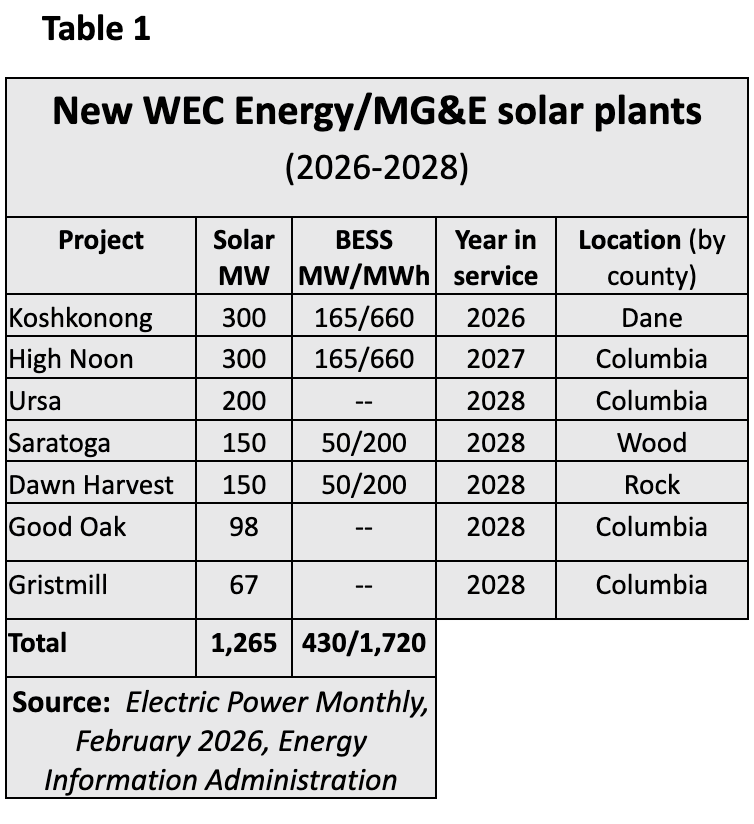
As shown in Table 1 below, WEC Energy and Madison Gas & Electric will add 1.265 gigawatts, or 1,265 MW, of solar power to their generation fleets over the next three years. Construction is well underway at the Koshkonong and High Noon project sites, and ground will be broken this year on the other solar plants listed in the table.
Construction is also proceeding on a 250 MW solar plant in central Wisconsin owned by Minneapolis-based Geronimo Energy. Anticipated to be placed in service later this year, the Portage Solar plant will produce electricity for the wholesale market and sell the renewable energy credits (RECs) from that generation to Microsoft, which will soon complete construction on a hyperscale data center in Racine County. When activated later this year, Microsoft’s facility will become the largest consumer of electricity in the entire state, with a baseline demand of approximately 500 MW. Microsoft will purchase all of the RECs produced by Portage Solar to offset a portion of that facility’s electricity usage.
Utility-owned solar generating plants often come paired with battery energy storage systems (BESS) placed within the project boundaries. These installations can store up to four hours of electricity at the battery’s rated capacity.
At the Koshkonong project, for example, the battery system is designed to accept as much as 660 MWh of electricity generated onsite. These BESS units will enable grid operators to discharge stored electricity directly into the transmission system when demand peaks later in the afternoon and evening.
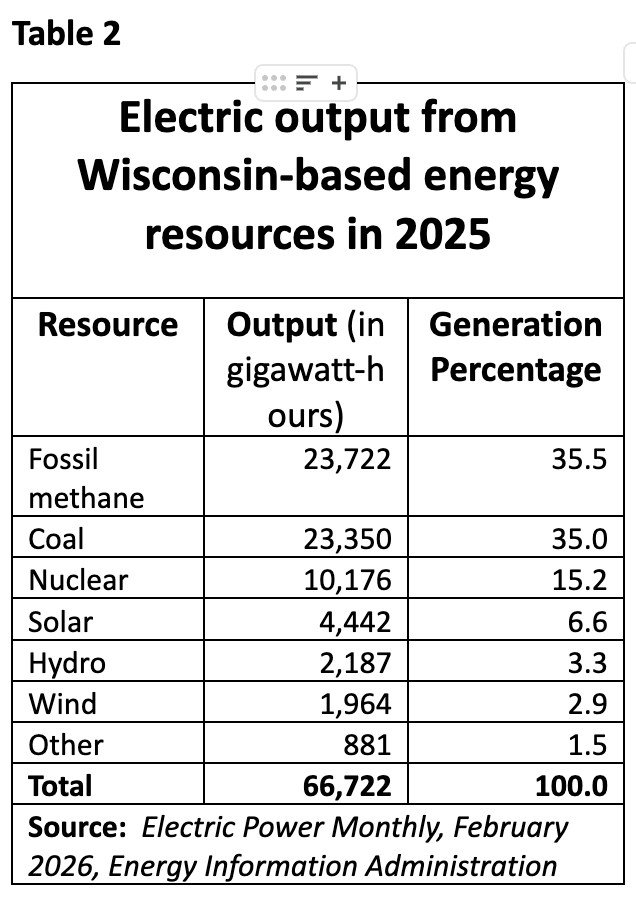
In just a handful of years, solar has emerged as the fastest-growing in-state source of electric power, and its contribution to electricity supplies now surpasses wind and hydro combined (see Table 2). Accounting for 6.6% of Wisconsin-generated electricity in 2025, solar generation could reach the 10% threshold by 2030.
Will solar growth be large enough to offset anticipated load growth driven by hyperscale data centers?
As impressive as solar’s growth was in 2025, it wasn’t large enough to fully offset the increase in electricity consumption that occurred that year. The other generation resource that saw a significant increase in output from 2024 was coal, whose rise came at the expense of fossil methane. Factoring in other hyperscale data centers now under construction, it will be a challenge to offset rising electricity sales with new solar generation.
As applied to retail electricity customers, the term “capacity factor” is a measure of their actual electrical consumption in a year divided by its peak demand multiplied by 8,760, the number of hours in a year. The consensus estimate of a hyperscale data center’s capacity factor falls in the 75% to 80% range.
Compared with other customer types, hyperscale data centers impose an unprecedented level of demand on the electric grids that serve them, due to the following reasons.
- Massive scale of operations serving millions of users;
- Expansion of AI use is driving the need for high-density computing power;
- Energy-intensive cooling systems; and
- Always-on operations requiring uninterruptible electrical service.
With the above in mind, let’s estimate the power consumption from Microsoft’s Mt. Pleasant campus that will commence operations later this year. If we assume a peak load of 500 MW and a capacity factor of 75 to 80%, electricity consumption from this particular entity would range from 3.3 to 3.5 million MWh per year, or 5% of the electricity sales recorded in the entire state of Wisconsin last year.
It would take six solar plants the size of Koshkonong–1,800 MW in total–to offset, on a MWh by MWh basis, the anticipated consumption from just the Mt. Pleasant data center alone. When the two Beaver Dam and the Port Washington data center projects are brought into the picture, the number of Koshkonong-size projects needed to offset all four hyperscalers in the pipeline would exceed 20.
Given that, it’s fair to conclude that the data center build-out will elevate greenhouse gas emissions from Wisconsin’s electric power industry even with a robust expansion of in-state solar power. Unless something changes on the ground, this worrisome outcome, and all the unpleasant environmental and economic consequences that it will amplify, is quite literally baked into our future.
The post Utilities Ramping Up Solar Power Build-Out appeared first on RENEW Wisconsin.