Reading view

There are new articles available, click to refresh the page.

As data centers boom, rural Waldo braces for high-voltage lines over wetlands and homes

A man stands next to a creek and a small foot bridge of logs while surrounded by forest.
Reading Time: 7 minutes

A version of this story was originally published by Circle of Blue.

On a warm fall afternoon, dairy farmer Chris Kestell pushes through prairie brambles taller than himself, tracing a path overgrown with thickets and swarming with bees as he hikes toward a hidden waterway.

Though the route is unidentifiable to the untrained eye, Kestell, 47, has lived here, in the small town of Waldo, Wisconsin, for nearly all his life. His father first walked this path 70 years ago, and his two young boys, 8 and 10 years-old, mark the third generation to follow this practiced journey.

After several minutes, he comes to rest beside a fallen tree. In its petrified tangle of roots, guarded by a tiny plastic gnome, a collection of spoons, bowls, and mugs fit like perfect puzzle pieces. Kestell takes a silver ladle from the snarl and kneels over a wall of dirt, from which a steady trickle emerges.

These are the headwaters of the Milwaukee River, known locally as Nichols Creek. According to Milwaukee Riverkeeper data, it is the “most pristine” monitored waterway in the entire 900 square-mile rivershed, and one of the only regional waters where brook trout reproduce naturally. 

As he has done since he was a young boy, Kestell brings the water to his lips. “By a certain age, everybody drinks here,” he says. “The creek is a landmark for this area. When you’re a kid, you’re like, ‘Wow, this is pretty awesome.’ It’s a special place.”

A creek is surrounded by green trees an a bench and picnic table are on the banks.
The headwaters of the Milwaukee River, known in Waldo, Wis. as Nichols Creek — one of the only regional waters where brook trout reproduce naturally. (Christian Thorsberg / Circle of Blue)

Deep in this quiet wooded alcove, Nichols Creek is a cultural touchstone and habitat of ecological importance. Safe and secure for generations, residents fear it is suddenly at risk of severe damage from a new era of energy transition in Wisconsin. 

The waterway — along with drinking water wells, protected woods and wetlands, and newly restored floodplains — is caught in the spreading network of high-voltage power lines. 

According to Wisconsin Public Service Commission (PSC) documents, more than 400 miles of new high-voltage power lines are either under review or approved in Wisconsin. Similar projects have also been greenlit in MinnesotaMichiganIllinoisOhio, and the other three Great Lakes states in recent months, together totaling well over 1,000 miles. 

As part of its Plymouth Reliability Project, the American Transmission Company (ATC), a local electric utility, plans to install seven miles of high-capacity lines through the Waldo area. Part of the route would pass directly over Nichols Creek, raising concerns over deforestation around the county’s only stream designated as “outstanding” by the Wisconsin Department of Natural Resources.

Meanwhile, a second ATC expansion, the Ozaukee County Distribution Interconnection project, proposes the construction of five new energy substations and corresponding transmission lines just southeast of Waldo. The preferred route would require the clear-cutting of old-growth forest and intersect the Cederberg Bog Wilderness — “the most intact large bogs in southeastern Wisconsin,” according to the Wisconsin DNR, and a registered National Natural Landmark by the U.S. Department of the Interior.

“Our entire business is based on people coming away from the city and spending the weekend here in the trees,” said Katy Rowe, who co-owns Abloom Farms, a resort and wedding venue located on the northern edge of the bog. “Eminent domain should not be used as a weapon against normal American citizens that have decided to live a quiet life in the country.”

According to ATC’s website, these projects are “needed to ensure electric reliability and address current and future energy needs in the community and the surrounding area.” But those needs aren’t due from the smattering of dairy farms, lonely county roads, and modest old homes that comprise rural Waldo, population 467. 

Nearly two dozen data centers in southeastern Wisconsin alone are either proposed, built, or in-development, but the two newest are not like the others. More than 20 miles away, in the city of Port Washington, a 672-acre campus built by Vantage Data Centers broke ground on Dec. 17. Even farther, some 70 miles south, Microsoft is building a 315-acre facility near Racine. 

A creek runs through brown and green vegetation.
Water is shown in an ladle.
A man stands in the background while cups are perches on a tangle of roots in the forest.
A man in a cap and polo shirt ladles water into his mouth from a creek, surrounded by forest.
Chris Kestell drinks from Nichols Creek. (Christian Thorsberg / Circle of Blue)

Though seemingly far enough away to be irrelevant to Waldo, the new sites’ thirst for power knows few bounds. When fully built, the Vantage and Microsoft locations will together require a 24/7 electricity supply totaling 3.2 gigawatts — greater than all of Wisconsin’s homes combined. 

Power generated by natural gas, nuclear, coal, solar, wind, and battery storage stations across the state’s central and eastern regions are all in the mix to bring data center campuses online. Transmission lines, running through Waldo, will transport the electricity they demand.

When reached, ATC declined to comment on the Plymouth Reliability project.

But the company in public testimony has downplayed the project’s potential effects on wetlands and says it will take measures to minimize the impact. 

The project as proposed “will not directly impact stream channels or have direct discharges to streams,” Erika Biemann, senior environmental project manager for ATC, wrote in testimony before Wisconsin’s PSC.

A sign sitting in grass along the side of the road says "No giant towers here. Tell ATC no..."
Existing transmission lines near Abloom Farms in Saukville, Wisconsin. (Christian Thorsberg / Circle of Blue)

Waldo’s story is not a one-off. New state and federal legislation are incentivizing data center development and encouraging power lines’ rapid rise across the region, potentially running roughshod over other communities. 

In February, Illinois — which by one count leads the Great Lakes region with more than 200 data centers — enacted a law allowing tax incentives for the construction of new battery storage facilities and high-voltage transmission lines. A month later, lawmakers in Indiana (75 data centers) enacted a law aiming to make transmission lines more efficient and cost-effective to construct. Similar legislation went into effect in Ohio (192 data centers) in August.

On a national scale, President Trump signed an executive order this January declaring an energy emergency and ordering agencies to “expedite the completion of all authorized and appropriated” energy infrastructure. The order directs the U.S. Army Corps of Engineers to speed up their review of permit applications to develop wetlands for transmission lines and other energy projects. The Corps is reviewing such permits for new lines in Wisconsin and other states. 

In late October, U.S. Secretary of Energy Chris Wright directed the Federal Energy Regulatory Commission to change permitting and rulemaking procedures to “significantly reduce” the amount of time and oversight required to bring data centers onto the grid. 

Literally caught in the middle of a new epoch of surging energy demand and supply in the Great Lakes region, residents say they are contending with powerful economic trends that could be devastating to the environment, and already are weighing on their spirits. 

Back at his family home, Kestell points to a large rock on his front lawn. The new power lines, Kestell said, would run right over his uncle’s final resting place.

“This is not rural electrification anymore, bringing power to poor farms” said Kestell’s father, Tom, also a farmer in Waldo. “This is an elite, wealthy class of people who are invested in these power stations and data centers, who are going to make probably trillions of dollars off this. And the people who they infringe on in the meantime? They’re just collateral damage.”

Homes and ponds face risk

Two dogs walk on the banks of a creek with trees in the background.
JoAnne Friedman’s two-acre retention pond. (Christian Thorsberg / Circle of Blue)

What’s developing in Waldo is a case in point. The wetland area through which Nichols Creek flows is the source of local residents’ well water. 

“Water comes, goes back down into the ground, and then becomes a collection of underground springs,” said JoAnne Friedman, the town chairperson of Lyndon, Wisconsin. “When you try to imagine how much water is underground here, it is a phenomenal amount.”

The water recharge process, and the natural filtration trees and other plants provide, is threatened by the right-of-way easements that the 138-kilovolt power lines require. All vegetation between 60 feet and 110 feet to either side of the lines would need to be cleared during their construction. 

The loss of maple and cedar tree cover, Kestell said, threatens both the warming of Nichols Creek and soil erosion on the side of county roads that already slump and flood when storms roll through. 

“With all of these projects, they don’t realize how much mitigation people who have these properties have done to prevent erosion,” said Friedman, who has needed to enlarge her property’s 20-foot-deep retention pond from half an acre to two acres to manage gushing ephemeral streams during springtime snowmelt and heavy rains. 

Living at the bottom of a small sloped valley, she said she has planted so many trees she “lost count,” all to help redirect flows from damaging her home. If ATC’s transmission line route is built, she said, this cover would all be clear-cut. 

Hundred-year-old trees would also be razed from the backyard of Randy Pietsch, a retired dairy farmer who has lived along the banks of Nichols Creek for more than 50 years. The trout pond he keeps on his property has long been open to friends and family for fishing, though he closed it several years ago and has no plans now of reopening. 

“I’m not hopeful for anything,” he said. “Why they have to come through here is beyond me. I can’t imagine that electric line’s good for fish. They just want to steal the land, that’s all. It’s sad, it’s stressful. You lose a lot of sleep at night.”

A man wearing a Ford cap an blue suspenders leans on a walking stick while surrounded by forest.
Randy Pietsch stands on the banks of Nichols Creek, which flows through his backyard. (Christian Thorsberg / Circle of Blue)

ATC says the project will not significantly affect the creek. 

“The loss of forested riparian habitat along Nicholas Creek would not be significant, especially considering the large riparian forest buffer both upstream and downstream from the proposed route crossing,” Biemann, the ATC environmental project manager, wrote in public testimony. 

Olivia Poelmann, a PSC environmental analysis and review specialist, testified that the project’s cumulative environmental effects are “not expected to be significant and are mostly temporary, with a large majority of impacts occurring primarily during the construction phase of the project.” 

But most startling, residents say, are the effects of ATC’s preferred route on their properties, many of which have been in their families for multiple generations. 

In some cases, the transmission lines’ right-of-way easements extend several feet inside peoples’ homes. One resident, Nolan Harp, said that the lines would run within 40 feet of his front door, placing half of his house within an easement. As a result, five 40-foot tall trees in his yard would be cut down, and his private well would need to be moved.

“That’s my sole source of water. It’s an old well, but it works, it’s clean, and it’s good,” Harp said. “But you can’t have something like that under power lines.”

Harp said that ATC has offered to dig up the open well, its casing, tank, and pump, and replace them elsewhere on his property. But the headache of additional construction, and the obvious hazard of power lines running above his house, has him considering other options.

“I don’t want to move, but if they insist on putting that power line up, I don’t think I can live here,” Harp said.

In late January, the $33.5 million Plymouth project was approved by the PSC, though it added a condition that prevents ATC from using eminent domain to build their power lines. ATC subsequently petitioned to reopen the application on the grounds that PSC cannot revoke that right, which is protected under Wisconsin state law. In April, this petition was granted

Kestell, who founded an organization called Neighbors 4 Neighbors to fight against the project in court, estimates that residents have spent $250,000 of their own money on legal fees.

At the end of the day, their homes and health are the most important concerns. 

“When they put these towers in, some of them are going down 30 or 40 feet, possibly hitting the aquifer when they’re digging foundations,” said Kestell, who estimates his own front door will be within roughly 20 feet of an easement. “We’re just not sure about contamination.”

Wisconsin Watch contributed reporting.

As data centers boom, rural Waldo braces for high-voltage lines over wetlands and homes is a post from Wisconsin Watch, a non-profit investigative news site covering Wisconsin since 2009. Please consider making a contribution to support our journalism.

As energy-hungry data centers loom, Wisconsin ratepayers owe $1B on shuttered power plants

The former site of the We Energies Power Plant on Nov. 13, 2025, in Pleasant Prairie, Wis. (Photo by Joe Timmerman/Wisconsin Watch)

By some measures, the Pleasant Prairie Power Plant, once regarded locally as an “iconic industrial landmark,” had a good run.

Opened in 1980 near Lake Michigan in Kenosha County, it became Wisconsin’s largest generating plant, burning enough Wyoming coal, some 13,000 tons a day, to provide electricity for up to 1 million homes.

But over time, the plant became too expensive to operate. The owner, We Energies, shut it down after 38 years, in 2018.

We Energies customers, however, are still on the hook.

A portion of their monthly bills will continue to pay for Pleasant Prairie until 2039 — 21 years after the plant stopped producing electricity.

In fact, residential and business utility customers throughout Wisconsin owe nearly $1 billion on “stranded assets” — power plants like Pleasant Prairie that have been or will soon be shut down, a Wisconsin Watch investigation found.

That total will likely grow over the next five years with additional coal plants scheduled to cease operations.

Customers must pay not only for the debt taken on to build and upgrade the plants themselves, but also an essentially guaranteed rate of return for their utility company owners, long after the plants stop generating revenue themselves.

“We really have a hard time with utilities profiting off of dead power plants for decades,” said Todd Stuart, executive director of the Wisconsin Industrial Energy Group.

The $1 billion tab looms as Wisconsin utility companies aim to generate unprecedented amounts of electricity for at least seven major high-tech data centers that are proposed, approved or under construction. By one estimate, just two of the data centers, which are being built to support the growth of artificial intelligence, would use more electricity than all Wisconsin homes combined.

All of which raises an important question in Wisconsin, where electricity rates have exceeded the Midwest average for 20 years.

What happens to residents and other ratepayers if AI and data centers don’t pan out as planned, creating a new generation of stranded assets?

How much do Wisconsin ratepayers owe on stranded assets?

Of the five major investor-owned utilities operating in Wisconsin, two — We Energies and Wisconsin Public Service Corp. — have stranded assets on the books. Both companies are subsidiaries of Milwaukee-based WEC Energy Group.

As of December 2024, when the company released its most recent annual report, We Energies estimated a remaining value of more than $700 million across three power plants with recently retired units: Pleasant Prairie, Oak Creek and Presque Isle, a plant on Michigan’s Upper Peninsula.

Wisconsin Public Service Corp.’s December 2024 report listed roughly $30 million in remaining value on recently retired units at two power plants.

In total, utilities owned by WEC Energy Group will likely have over $1 billion in recently retired assets by the end of 2026.

The company also noted a remaining value of just under $250 million for its share of units at Columbia Generating Station slated to retire in 2029, alongside a remaining value of roughly $650 million for units at Oak Creek scheduled to retire next year.

Its customers will pay off that total, plus a rate of return, for years to come.

The company estimates that closing the Pleasant Prairie plant alone saved $2.5 billion, largely by avoiding future operating and maintenance costs and additional capital investments.

Both Wisconsin Power and Light and Madison Gas and Electric also own portions of the Columbia Energy Center, and Wisconsin Power and Light also operates a unit at the Edgewater Generating Station scheduled for retirement before the end of the decade. Neither company provided estimates of the values of those facilities at time of retirement. Andrew Stoddard, a spokesman for Alliant Energy, Wisconsin Power and Light’s parent company, argued against treating plants scheduled for retirement with value on the books as future stranded assets.

How stranded assets occurred: overcommitting to coal

In 1907, Wisconsin became one of the first states to regulate public utilities. The idea was that having competing companies installing separate gas or electric lines was inefficient, but giving companies regional monopolies would require regulation.

Utility companies get permission to build or expand power plants and to raise rates from the three-member state Public Service Commission. The commissioners, appointed by the governor, are charged with protecting ratepayers as well as utility company investors.

A demolition sign is posted at the former site of the We Energies Power Plant on Nov. 13, 2025, in Pleasant Prairie, Wis. (Photo by Joe Timmerman/Wisconsin Watch)

Stranded assets have occurred across the nation, partly because of the cost of complying with pollution control regulations. But another factor is that, while other utilities around the country moved to alternative sources of energy, Wisconsin utilities and, in turn, the PSC overbet on how long coal-fired plants would operate efficiently:

  • In the years before We Energies pulled the plug on Pleasant Prairie, the plant had mostly gone dark in spring and fall. Not only had coal become more expensive than natural gas and renewables, but energy consumption stayed flat. By 2016, two years before Pleasant Prairie’s closure, natural gas eclipsed coal for electricity generation nationally.
  • In 2011, We Energies invested nearly $1 billion into its coal-fired Oak Creek plant south of Milwaukee to keep it running for 30 more years. The plant, which began operating in 1965 and later became one of the largest in the country, is now scheduled to completely retire in 2026 — with $650 million on the books still owed. That will cost individual ratepayers nearly $30 per year for the next 17 years, according to RMI, a think tank specializing in clean energy policy. The majority of the debt tied to those units stems from “environmental controls we were required to install to meet federal and state rules,” WEC Energy Group spokesperson Brendan Conway said.
  • In 2013, to settle pollution violations, Alliant Energy announced an investment of more than $800 million in the Columbia Energy Center plant in Portage, north of Madison. But by 2021, Alliant announced plans to begin closing the plant, though now it is expected to operate until at least 2029.

Various factors encourage construction and upgrades of power plants.

Building a plant can create upwards of 1,000 construction jobs, popular with politicians. Moreover, the Public Service Commission, being a quasi-judicial body, is governed by precedent. For example, if the PSC determined it was prudent to allow construction of a utility plant, that finding would argue in favor of approving a later expansion of that plant.

The PSC allowed utility companies “to overbuild the system,” said Tom Content, executive director of the Wisconsin Citizens Utility Board, a nonprofit advocate for utility customers. “I think the mistake was that we allowed so much investment, and continuing to double down on coal when it was becoming less economic.”

Utilities “profit off of everything they build or acquire,” Stuart said, “and so there is a strong motivation to put steel in the ground and perhaps to even overbuild.”

Conway, the WEC Energy Group spokesperson, argued that the utilities’ plans to retire plants amount to a net positive for customers.

“We began our power generation reshaping plan about a decade ago,” he wrote in an email. “That includes closing older, less-efficient power plants and building new renewable energy facilities and clean, efficient natural gas plants. This plan reduces emissions and is expected to provide customers significant savings — hundreds of millions of dollars — over the life of the plan.”

Guaranteed profits add to ratepayer burden

The built-in profits that utility companies enjoy, typically 9.8%, add to the stranded assets tab.

When the Public Service Commission approves construction of a new power plant, it allows the utility company to levy electricity rates high enough to recover its investment plus the specified rate of return — even after a plant becomes a stranded asset.

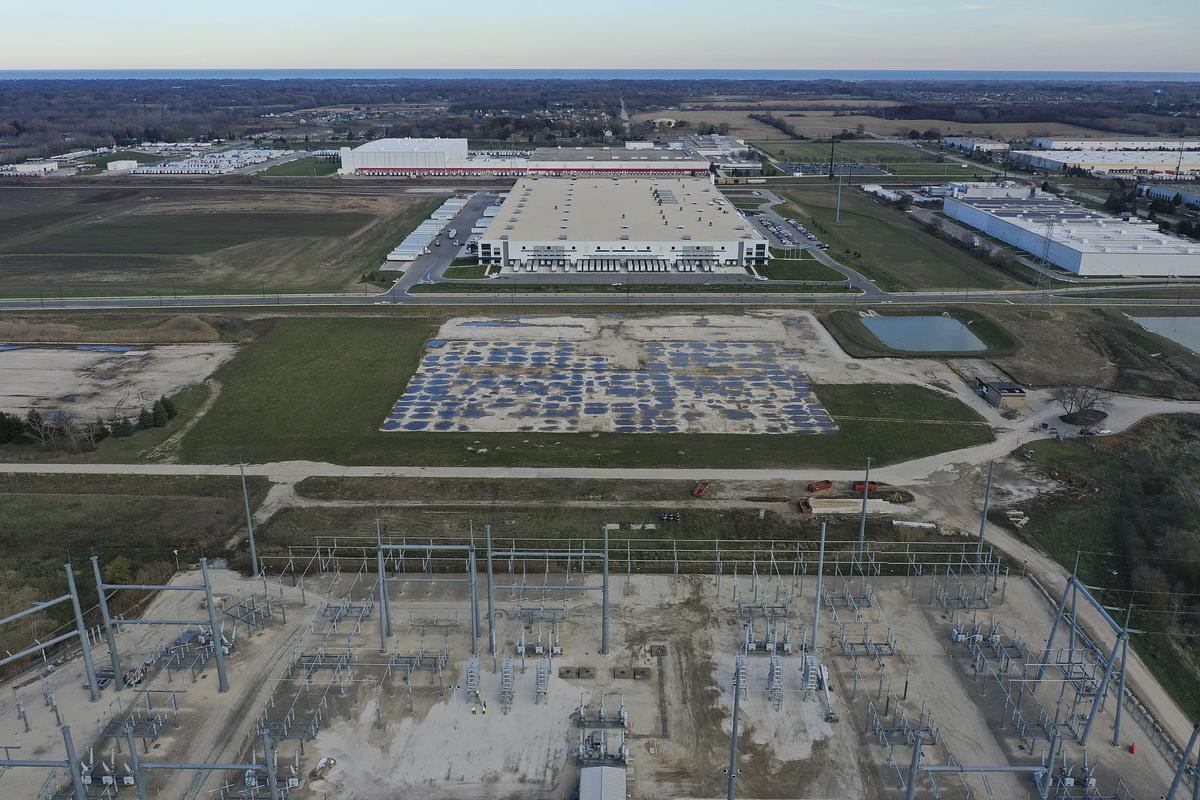
An aerial view of an electrical facility in the foreground. Beyond it are large industrial buildings, open fields and a rectangular patch of ground covered with blue sections.
The former site of the We Energies Power Plant on Nov. 13, 2025, in Pleasant Prairie, Wis. (Photo by Joe Timmerman/Wisconsin Watch)

“We give them this license to have a monopoly, but the challenge is there’s no incentive for them to do the least-cost option,” Content said. “So, in terms of building new plants, there’s an incentive to build more … and there’s incentive to build too much.”

When the Pleasant Prairie plant was shut down in 2018, the PSC ruled that ratepayers would continue to pay We Energies to cover the cost of the plant itself, plus the nearly 10% profit. The plant’s remaining value, initially pegged at nearly $1 billion, remained at roughly $500 million as of December 2024.

Eliminating profits on closed plants would save ratepayers $300 million on debt payments due to be made into the early 2040s, according to Content’s group.

New ‘stranded assets’ threat: data centers

As artificial intelligence pervades society, it’s hard to fathom how much more electricity will have to be generated to power all of the data centers under construction or being proposed in Wisconsin.

We Energies alone wants to add enough energy to power more than 2 million homes. That effort is largely to serve one Microsoft data center under construction in Mount Pleasant, between Milwaukee and Racine, and a data center approved north of Milwaukee in Port Washington to serve OpenAI and Oracle AI programs. Microsoft calls the Mount Pleasant facility “the world’s most powerful data center.”

Data centers are also proposed for Beaver Dam, Dane County, Janesville, Kenosha and Menomonie.

The energy demand raises the risk of more stranded assets, should the data centers turn out to be a bubble rather than boom.

“The great fear is, you build all these power plants and transmission lines and then one of these data centers only is there for a couple years, or isn’t as big as promised, and then everybody’s left holding the bag,” Stuart said.

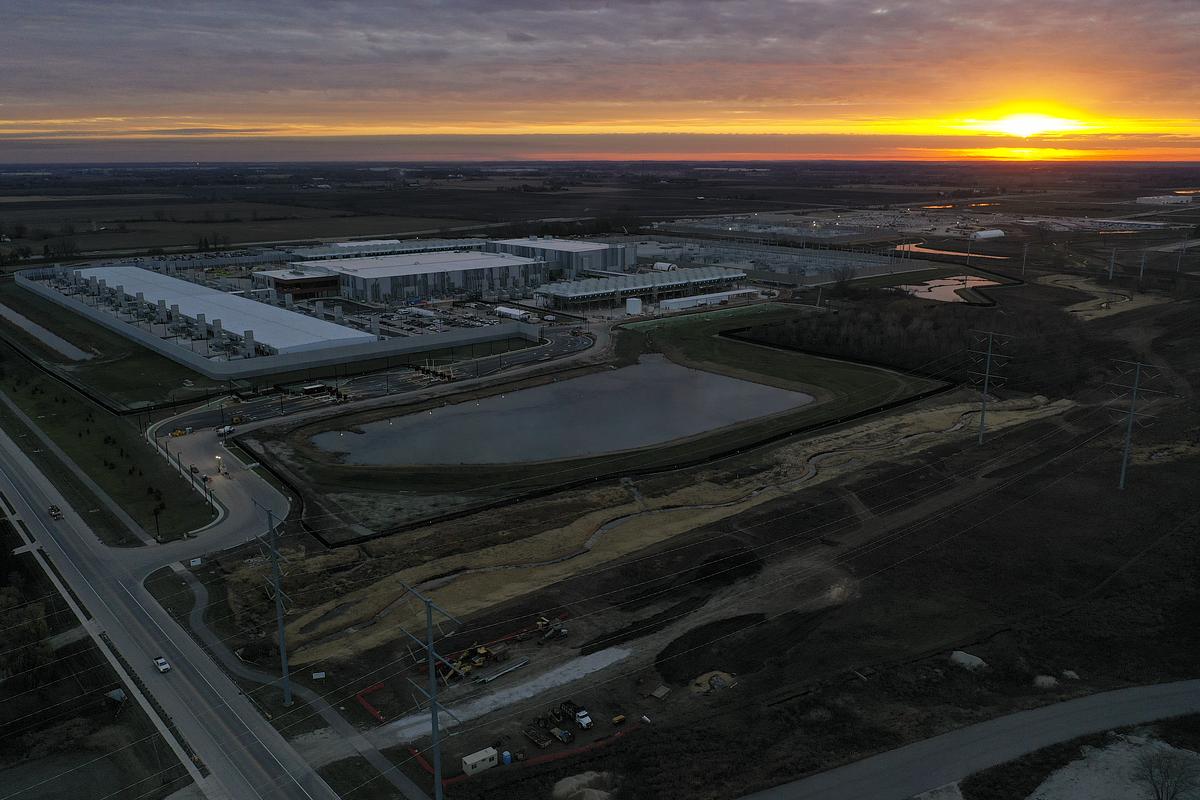
An aerial view of a large industrial complex next to a pond and surrounding construction areas at sunset, with orange light along the horizon under a cloudy sky.
The sun sets as construction continues at Microsoft’s data center project on Nov. 13, 2025, in Mount Pleasant, Wis. (Photo by Joe Timmerman/Wisconsin Watch)

In an October Marquette Law School poll, 55% of those surveyed said the costs of data centers outweigh the benefits. Environmental groups have called for a pause on all data center approvals. Democratic and Republican leaders are calling for data centers to pay their own way and not rely on utility ratepayers or taxpayers to pay for their electricity needs.

Opposition in one community led nearly 10,000 people to become members of the Stop the Menomonie Data Center group on Facebook. In Janesville, voters are trying to require referendums for data centers. In Port Washington, opposition to the data center there led to three arrests during a city council meeting.

Utilities are scheduled in early 2026 to request permission from the Public Service Commission to build new power plants or expand existing plants to accommodate data centers.

Some states, such as Minnesota, have adopted laws prohibiting the costs of stranded assets from data centers being passed onto ratepayers.

Wisconsin has no such laws.

Shifting cost burden to utility companies

Currently, ratepayers are on the hook for paying off the full debt of stranded assets — unless a financial tool called securitization reduces the burden on ratepayers.

Securitization is similar to refinancing a mortgage. With the state’s permission, utilities can convert a stranded asset — which isn’t typically a tradeable financial product — into a specialized bond.

Utility customers must still pay back the bond. But the interest rate on the bond is lower than the utility’s standard profit margin, meaning customers save money.

A 2024 National Association of Regulatory Utility Commissioners report noted that utilities’ shareholders may prefer a “status quo” scenario in which customers pay stranded asset debts and the standard rate of return. Persuading utilities to agree to securitization can require incentives from regulators or lawmakers, the report added.

In some states, utilities can securitize the remaining value of an entire power plant. Michigan utility Consumers Energy, for instance, securitized two coal generating units retired in 2023, saving its customers more than $120 million.

In Wisconsin, however, utilities can securitize only the cost of pollution control equipment on power plants — added to older coal plants during the Obama administration, when utilities opted to retrofit existing plants rather than switching to new power sources.

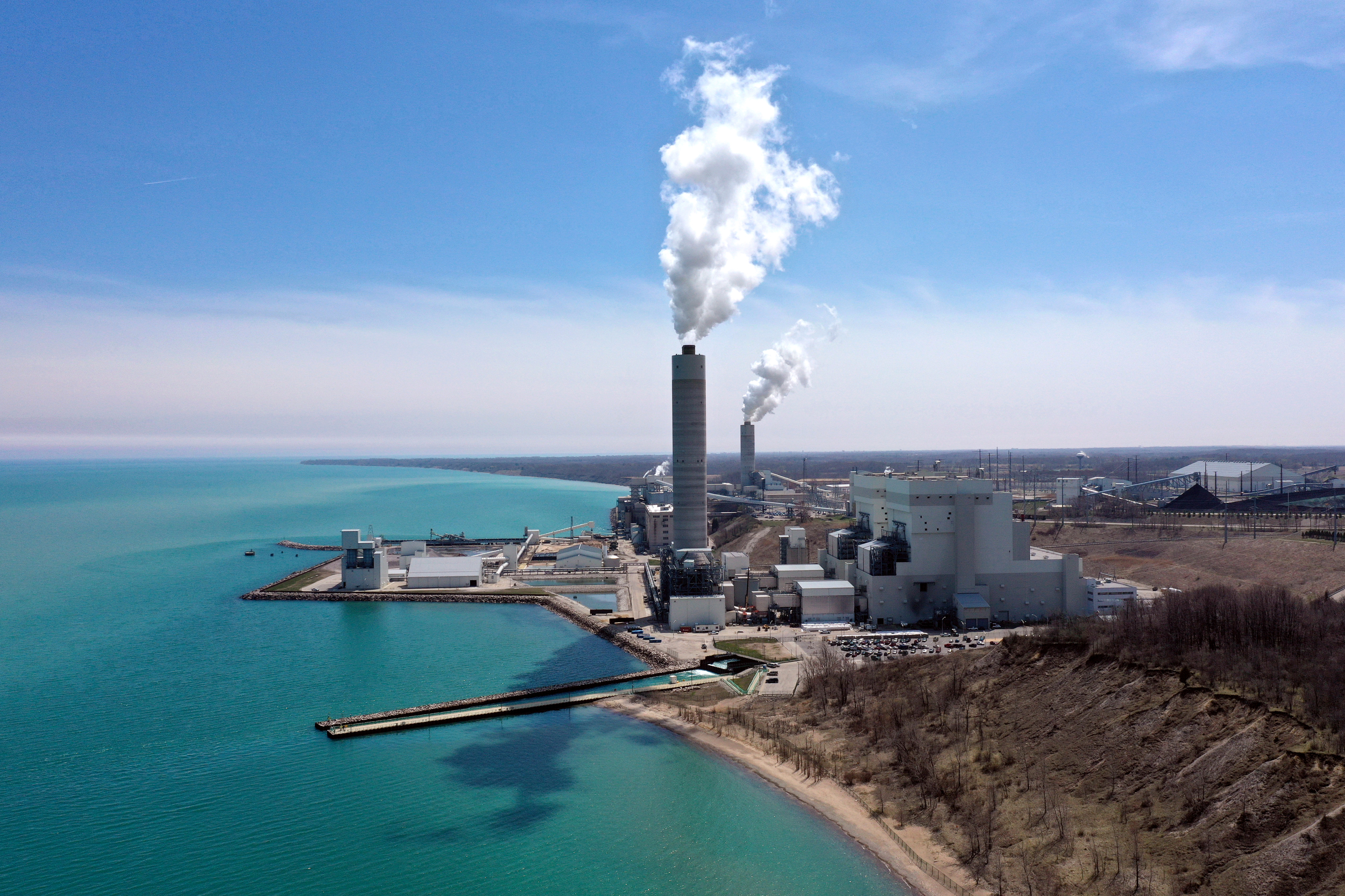
Two smoke plumes billow into a blue sky at a power plant next to a lake.
The Oak Creek Power Plant and Elm Road Generating Station, seen here on April 25, 2019, in Oak Creek, Wis., near Milwaukee, are coal-fired electrical power stations. (Photo by Coburn Dukehart/Wisconsin Watch)

In 2023, two Republican state senators, Robert Cowles of Green Bay and Duey Stroebel of Saukville, introduced legislation to allow the Public Service Commission to order securitization and allow securitization to be used to refinance all debt on stranded assets. The bill attracted some Democratic cosponsors, but was opposed by the Wisconsin Utilities Association and did not get a hearing.

Democratic Gov. Tony Evers proposed additional securitization in his 2025-27 budget, but the Legislature’s Republican-controlled Joint Finance Committee later scrapped the provision.

Even Wisconsin’s narrow approach to securitization is optional, however, and most utilities have chosen not to use it.

We Energies was the first Wisconsin utility to do so, opting in 2020 to securitize the costs of pollution control equipment at the Pleasant Prairie plant. Wisconsin’s Public Service Commission approved the request, saving an estimated $40 million. “We will continue to explore that option in the future,” Conway said.

But the PSC expressed “disappointment” in 2024 when We Energies “was not willing to pursue securitization” to save customers $117.5 million on its soon-to-retire Oak Creek coal plant. The utility noted state law doesn’t require securitization.

Stuart said that if utilities won’t agree to more securitization, they should accept a lower profit rate once an asset becomes stranded.

“It would be nice to ease that burden,” he said. “Just to say, hey, consumers got to suck it up and deal with it, that doesn’t sound right. The issue of stranded assets, like cost overruns, is certainly ripe for investigation.”

Comprehensive planning required elsewhere — but not Wisconsin

Avoiding future stranded assets could require a level of planning impossible under Wisconsin’s current regulatory structure.

When the state’s utilities propose new power plants, PSC rules require the commission to consider each new plant alone, rather than in the context of other proposed new plants and the state’s future energy needs. Operating without what is known as an integrated resource plan, or IRP, opened the PSC to overbuilding and creating more stranded assets. IRPs are touted as an orderly way to plan for future energy needs.

“There’s no real comprehensive look in Wisconsin,” Stuart said. “We’re one of the few regulated states that really doesn’t have a comprehensive plan for our utilities.

”We’ve been doing some of these projects kind of piecemeal, without looking at the bigger picture.”

Protesters speak against a proposed natural gas power plant in Oak Creek, Wis., on March 25, 2025. (Photo by Julius Shieh/Milwaukee Neighborhood News Service)

Structured planning tools like IRPs date back to the 1980s, when concerns about cost overruns, fuel price volatility and overbuilding prompted regulators to step in. Minnesota and Michigan require utilities to file IRPs, as do a majority of states nationwide.

Evers proposed IRPs in his 2025-27 state budget, but Republican lawmakers removed that provision because it was a nonfiscal policy issue.

Northern States Power Company, which operates in Wisconsin and four other Midwestern states, is required by both Michigan and Minnesota to develop IRPs. “Because of these rules, we create a multi-state IRP every few years,” said Chris Ouellette, a spokesperson for Xcel Energy, the utility’s parent company.

Madison Gas and Electric, which only operates in Wisconsin, argued that its current planning process is superior to the IRP requirements in neighboring states. “A formal IRP mandate would add process without improving outcomes,” spokesperson Steve Schultz said. “Wisconsin’s current framework allows us to move quickly, maintain industry-leading reliability and protect customer costs during a period of rapid change.”

How to influence decisions relating to stranded assets

The devil will be in the details on whether the Public Service Commission adopts strong policies to prevent the expected wave of new power plant capacity from becoming stranded assets, consumer advocates say.

The current members, all appointed by Evers, are: chairperson Summer Strand, Kristy Nieto and Marcus Hawkins.

The public can comment on pending cases before the PSC via its website, by mail or at a public hearing. The commission posts notices of its public hearings, which can be streamed via YouTube.

Barbed wire fence surrounds the former site of the We Energies Power Plant on Nov. 13, 2025, in Pleasant Prairie, Wis. (Photo by Joe Timmerman/Wisconsin Watch)

Among the upcoming hearings on requests by utilities to generate more electricity for data centers:

Feb. 12: We Energies’ request to service data centers in Mount Pleasant and Port Washington. We Energies says the fees it proposes, known as tariffs, will prevent costs from being shifted from the data centers to other customers. The “party” hearing is not for public comment, but for interaction between PSC staff and parties in the case, such as We Energies and public interest groups.

Feb. 26: Another party hearing for a case in which Alliant Energy also said its proposed tariffs won’t benefit the data center in Beaver Dam at the expense of other customers.

To keep abreast of case developments, the PSC offers email notifications for document filings and meetings of the commission.

The PSC would not provide an official to be interviewed for this article. It issued a statement noting that utilities can opt to do securitization to ease the financial burden on ratepayers, adding:

“Beyond that, the commission has a limited set of tools provided under state law to protect customers from costs that arise from early power plant retirements. It would be up to the state Legislature to make changes to state law that would provide the commission with additional tools.”

On Nov. 6, state Sen. Jodi Habush Sinykin, D-Whitefish Bay, and Rep. Angela Stroud, D-Ashland, announced wide-ranging data center legislation. One provision of their proposal aims to ensure that data centers don’t push electricity costs onto other ratepayers.

But there is no provision on stranded assets.

This article first appeared on Wisconsin Watch and is republished here under a Creative Commons Attribution-NoDerivatives 4.0 International License. To republish, go to the original and consult the Wisconsin Watch republishing guidelines.

Environmental law firm sues PSC to force release of Meta data center electricity demand

As power-hungry data centers proliferate, states are searching for ways to protect utility customers from the steep costs of upgrading the electrical grid, trying instead to shift the cost to AI-driven tech companies. (Dana DiFilippo/New Jersey Monitor)

As power-hungry data centers proliferate, states are searching for ways to protect utility customers from the steep costs of upgrading the electrical grid, trying instead to shift the cost to AI-driven tech companies. (Dana DiFilippo/New Jersey Monitor)

Midwest Environmental Advocates filed a lawsuit Tuesday against the Wisconsin Public Service Commission seeking to force the release of unredacted documents showing how much electricity will be used at Meta’s planned data center in Beaver Dam. 

In a news release, MEA said it had sought electrical load projections for data center projects in Beaver Dam and Port Washington in an October open records request. The PSC initially provided the firm with versions that redacted the electrical load information. MEA sent a follow-up request seeking unredacted versions of the document. 

The PSC sent the unredacted version of the Port Washington project but denied the request for the Beaver Dam project, claiming it contained trade secrets. 

Wisconsin’s open records law allows government agencies to deny records requests if the information within the document is a trade secret, however MEA disputes that the amount of energy Meta plans to request for its data center counts. 

“It appears the PSC is unlawfully withholding this information because either Meta or a public utility is claiming the electricity demand for the data center is a trade secret,” MEA legal fellow Michael Greif said in a statement. “We call on Alliant Energy, American Transmission Company and Meta to be forthright with the public about their plans. These companies are asking a lot of the public and the public deserves, at least the very least, basic information about the data center’s massive energy needs.” 

Data center projects across the country are often shrouded in secrecy. A study in Virginia found that at least 80% of local governments involved with data center proposals had signed non-disclosure agreements with the data center companies — though it’s unclear how an NDA would be enforceable against Wisconsin’s public records laws. 

Earlier this year, MEA filed a separate lawsuit to force the city of Racine to release records related to the projected water use at Microsoft’s planned data center in Mount Pleasant.

GET THE MORNING HEADLINES.

Massive data centers consuming large amounts of energy have eyes on South Dakota

A winter scene with large wind turbines on a snowy, flat prairie silhouetted against a gray sky.

This article was originally posted by South Dakota Searchlight.

Massive data centers used for cloud computing and artificial intelligence are consuming enormous amounts of energy, and developers are eyeing South Dakota as a potential location, regulators say.

These “hyperscale data centers,” or “hyperscalers,” are designed to handle immense computing demands and are often operated by tech giants. The centers are characterized by their large size — often tens of thousands of square feet — and thousands of computer servers that require significant energy to operate.

Nick Phillips with Applied Digital in Texas, a developer of the centers, highlighted South Dakota’s appeal: a cold climate that cuts down on cooling a room full of hot servers, and abundant wind energy that’s considered one of the most cost-effective renewable energy sources, which can help keep operating costs down.

State regulators are not aware of any hyperscale data centers currently operating in South Dakota. 

“There isn’t a requirement to report hyperscale data centers to the commission, so we don’t have a formal method to track that information,” said Leah Mohr with the Public Utilities Commission. 

Commissioner Kristie Fiegen noted that the state’s largest proposed data center is a 50-megawatt facility in Leola.

“We don’t know what’s coming,” she said. “But the utilities are getting calls every week from people trying to see if they have the megawatts available.”

The commission recently hosted a meeting in Pierre with representatives from regional utilities, regional power grid associations and data centers. The goal was to understand the emerging demands and facilitate an information exchange.

Bob Sahr, a former public utilities commissioner and current CEO of East River Electric Cooperative in Madison, emphasized the scale of energy needed.

“We’re talking loads that eclipse some of the largest cities in South Dakota,” he said.

A single data center campus can require anywhere from 300 to 500 megawatts of electricity to operate. One megawatt can power hundreds of homes. By one estimate, there are over 1,000 hyperscalers worldwide, with the U.S. hosting just over half of them.

Ryan Long, president of Xcel Energy, headquartered in Minneapolis, illustrated the extreme nature of the demand.

“We now have, I would say, north of seven gigawatts of requests across the Xcel Energy footprint for data centers to locate in one of our eight states,” he said. “And I’ll be very frank that there’s no way that we’re going to be able to serve all of that in a reasonable amount of time.”

Protecting existing customers from potential costs or energy shortages is another shared concern. Utility representatives emphasized the need for coal and natural gas to maintain a reliable “base load” when renewable sources like wind and solar are unavailable. Arick Sears of Iowa-based MidAmerican Energy underscored the point, noting that costs for each data center should depend on how much energy it consumes. 

“We need to ensure that large-scale energy users are paying their fair share,” he said.

Utilities also flagged the risk of “stranded costs,” referring to a data center ceasing operations, leaving a utility with added infrastructure to meet a demand that no longer exists. They said financial safeguards will need to be written into power agreements with hyperscalers.

Speed of deployment is another pressing issue. Representatives from Montana-Dakota Utilities, headquartered in North Dakota, and NorthWestern Energy, headquartered in Sioux Falls, noted that some facilities expect to be operational within months of making a deal, straining infrastructure, planning and resources.

Grid managers Brian Tulloh of Indiana-based Midcontinent Independent System Operator and Lanny Nickell of Arkansas-based Southwest Power Pool echoed those concerns. They warned that data center growth is outpacing the grid’s ability to meet demand and cautioned against decommissioning coal power plants too quickly. Setting aside how much it would cost to produce the required energy, Tulloh estimated that MISO needs $30 billion in electric transmission infrastructure to support the demand from hyperscalers.

“The grid wasn’t designed for that,” Public Utilities Commissioner Chris Nelson told South Dakota Searchlight after the meeting.

Nelson was glad to hear the data centers will include backup generators, similar to hospitals, for power outages or when homes need prioritization. He said some even aim to have huge batteries to power the plant until the generators get going. They would consume massive amounts of diesel and natural gas until the outage is over. 

Nelson said all of this makes modern nuclear energy facilities more attractive. He said few alternative “base load” options remain, and the public has little appetite for ramping up coal power. 

NorthWestern Energy is exploring the possibility of constructing a small nuclear power plant in South Dakota, with an estimated cost of $1.2 billion to $1.6 billion for a 320-megawatt facility. The plant would be the first in the state since a test facility near Sioux Falls in the 1960s. 

The company is conducting a study, partially funded by the Department of Energy. Details about the study and potential plant sites remain confidential. 

Additionally, South Dakota’s Legislature has shown interest in nuclear energy, passing a resolution for further study on the topic that led to the publication of an issue memorandum by the Legislative Research Council.

Massive data centers consuming large amounts of energy have eyes on South Dakota is an article from Energy News Network, a nonprofit news service covering the clean energy transition. If you would like to support us please make a donation.

Xcel Energy says data center growth won’t get in the way of 2040 clean energy target in Minnesota

A birds-eye view of dozens of smokestacks release emissions over a snowy landscape.

A top executive with Minnesota’s largest utility says data center growth will not prevent it from meeting the state’s 100% clean electricity law, but it may extend the life of natural gas power plants into the next decade.

“As we take all of that coal off the system — even if you didn’t add data centers into the mix — I think we may have been looking to extend some gas (contracts) on our system to get us through a portion of the 2030s,” said Ryan Long, president of Xcel Energy’s division serving Minnesota and the Dakotas. “Adding data centers could increase the likelihood of that, to be perfectly honest.”

Long made the comments at a Minnesota Public Utilities Commission conference this fall exploring the potential impact of data centers on the state’s 2040 clean electricity mandate.

The expansion of power-hungry data centers, driven by artificial intelligence, has caused anxiety across the country among utility planners and regulators. The trend is moving the goalposts for states’ clean electricity targets and raising questions about whether clean energy capacity can keep up with demand as society also tries to electrify transportation and building heat.

Minnesota PUC commissioner Joe Sullivan organized last month’s conference in response to multiple new data centers projects, including a $700 million facility by Facebook’s parent company Meta that’s under construction in suburban Rosemount. Microsoft and Amazon have each acquired property near a retiring Xcel coal plant in central Minnesota. 

“We need to ensure that our system is able to serve these companies if they come,” Sullivan said, “and that it can serve them with clean resources consistent with state law.” 

Alongside concerns about whether clean energy can keep up with new electricity demand, there’s also an emerging view that data centers — if properly regulated — could become grid assets that help accelerate the transition to carbon-free power. Several stakeholders at the Oct. 31 event shared that view, including Xcel’s regional president.

A 100-megawatt data center could generate as much as $64 million in annual revenue for Xcel, enough to help temper rate increases or cover the cost of other projects on the system, Long said. He said the company wants to attract 1.3 gigawatts worth of data centers to its territory by 2032, and it thinks it can absorb all of that demand without harming progress toward its 2040 clean energy requirement.

Long said data center expansion will not change the company’s plans to close all of its remaining coal-fired power plants by 2040, but it may cause them to try to keep gas plans operating longer. Ultimately, meeting the needs of data centers will require more renewable generation, battery storage, and grid-enhancing technology, but rising costs and supply chain issues have slowed deployment of those solutions.

Other utilities echoed that optimism. Julie Pierce, Minnesota Power’s vice president for strategy and planning said the company has experience serving large customers such as mines in northeastern Minnesota and would be ready to serve data centers. Great River Energy’s resource planning director Zachary Ruzycki said the generation and transmission cooperative “has a lot of arrows in its quiver” to accommodate data centers.

Ruzycki noted, too, that much of the interest it has received from data center developers is because of the state’s commitment to clean energy. Many large data center operators have made corporate commitments to power them on 100% carbon-free electricity, whether from renewables or nuclear power.

Pete Wyckoff, deputy commissioner for energy at the Minnesota Department of Commerce, expressed doubts about the ability to meet unchecked demand from data centers. Even with the state’s recent permitting reforms, utilities are unlikely to be able to deliver “power of any sort — much less clean power — in the size and timeframes that data centers are likely to request.”

He sees hydrogen, long-duration batteries, carbon capture, and advanced nuclear among the solutions that will eventually be needed, but in the short-term the grid could serve more data centers with investments in transmission upgrades, virtual power plants, and other demand response programs.

“These solutions can be deployed faster and cheaper than building all new transmission and large clean energy facilities, though we’ll need those, too,” Wyckoff said.

Aaron Tinjum, director of energy policy and regulatory affairs for the Data Center Coalition, said data centers provide the computing power for things like smart meters, demand response, and other grid technologies. The national trade group represents the country’s largest technology and data center companies.

“We can’t simply view data centers as a significant consumer of energy if they’re all helping us become more efficient, and helping us save on our utility bills,” Tinjum said. 

He also pointed to data centers’ role in driving clean energy development. A recent report from S&P Global Commodity Insights found that data centers account for half of all U.S. corporate clean energy procurement. 

The true impact of data centers on emissions and the grid is complicated, though. Meta, which participated in the recent Minnesota conference, says it matches all of its annual electricity use with renewable energy, but environmental groups say there is evidence that its data centers are increasing fossil fuel use and emissions in the local markets where they are built.

Amelia Vohs, climate program director with the Minnesota Center for Environmental Advocacy, raised concerns at the conference about whether data center growth will make it harder to electrify transportation and heating. She pointed to neighboring Wisconsin, where utilities are proposing to build new gas plants to power data centers.

“This commission and the stakeholders here today have all done a ton of work and made great progress in decarbonizing the electric sector in our state,” Vohs said. “I worry about possibly rolling that back if we all of a sudden have a large load that needs to be served with fossil fuels, or [require] a fossil fuel backup.” 

The Minnesota Attorney General’s Office argued that state regulators need to scrutinize data center deals to make sure developers are paying the total cost of their impact on the system, including additional regulatory, operational and maintenance work that might be required on the grid.

In an interview, Sullivan said he was impressed by tech companies’ interest in having data centers in Minnesota because of the 2040 net zero goal, not despite it. They want to buy electricity from Minnesota utilities rather than build their own power systems or locate in neighboring states, he added, and the October meeting left him confident that “we can deal with this.”

Xcel Energy says data center growth won’t get in the way of 2040 clean energy target in Minnesota is an article from Energy News Network, a nonprofit news service covering the clean energy transition. If you would like to support us please make a donation.

❌