In a governor’s race that has focused more on data center construction than artificial intelligence technology, Democratic gubernatorial candidate David Crowley on Tuesday announced a plan for state regulations on AI aimed at protecting vulnerable Wisconsinites.
In an 11-point plan shared with Wisconsin Watch, Crowley calls for guardrails on AI offerings for minors and holding technology companies responsible for scams and fraud on their platforms. Some key components of the plan include:
Limiting access to AI chatbot apps for children under 13.
Prohibiting addictive design features, such as infinite scrolling and autoplay, on accounts of minors.
Increasing penalties for circulating AI-generated sexual images of minors.
Allowing families to sue AI platforms if their content harms children, such as by promoting suicide or eating disorders.
Penalizing technology companies that profit from scams or fraudulent ads.
More funding for adult protective services and resource centers that can help victims of scams or fraud.
Crowley, the Milwaukee county executive, is running for governor against Republican U.S. Rep. Tom Tiffany in what polling from Marquette University Law School shows could be another close governor’s race in Wisconsin. AI policy debates between the two candidates in the months since the August primary have mostly been focused on the planning and construction of AI data centers, rather than the technology itself.
In a statement, Tiffany also said Wisconsin needs “commonsense guardrails” to protect children and older adults, including holding companies accountable for platforms that allow creation of sexually explicit images or engage minors in inappropriate chatbot conversations. Tiffany said he also wants to prevent personal data from “falling into the hands of foreign adversaries, including Communist China.”
“As governor, I will also support commonsense age-verification requirements for app providers, strengthen parental-consent protections, and give parents greater control over their children’s online activity,” Tiffany said.
Crowley’s proposed state-level AI regulations land as President Donald Trump has dismissed calls for guardrails and warnings from technology company leaders asking for government oversight as their platforms become more advanced.
Trump in May 2025 signed the Take it Down Act, which criminalized the online publication of real and AI-generated intimate images and requires social media platforms to remove them once notified of their existence. Tiffany, and the rest of Wisconsin’s congressional delegation, voted for the bill in 2025.
Other proposed federal legislation has not advanced, including bills requiring public reporting of safety incidents by AI companies and requiring labels on any AI-generated content. Crowley in a statement said he would not “wait around for DC to act” on additional AI regulations if he is elected.
“Like so many parents, Ericka and I are raising our three girls in the age of social media and AI, and we’re navigating things no generation before us has ever had to, worrying about whether a stranger is messaging our kids, or a fake picture of our daughter is going around school, or even scammers trying to drain a grandparent’s life savings,” Crowley said.
The proposals in Crowley’s regulatory plan would require state legislative action. They echo recent bipartisan efforts signed into law by Gov. Tony Evers, including a series of bills that classified sextortion as a crime and provided additional recourse for victims and their families.
Additionally, Attorney General Josh Kaul in August announced Wisconsin could receive up to $313 million in a settlement social media company Meta made with 47 states in a case that alleged addictive components of its platforms threatened teens’ mental health.
Wisconsin Watch is a nonprofit, nonpartisan newsroom. Subscribe to our newsletters for original stories and our Friday news roundup.
Wisconsin has spent decades building one of the country’s strongest apprenticeship cultures.
In 2025, the state reached record Registered Apprenticeship participation, with 18,524 apprentices across more than 3,095 employers. Youth Apprenticeship also reached record scale, enrolling 11,344 high school juniors and seniors and partnering with 7,447 employers.
Now Wisconsin needs to apply that same learn-by-doing discipline to the artificial intelligence transition.
Stanford Digital Economy Lab’s August employment update found that employment among U.S. workers ages 22-25 in highly AI-exposed occupations is about 19% below where it would be if it had kept pace with similarly aged workers in less-exposed occupations. The comparable measure was 15% at the July 2025 data vintage. The adjustment is appearing mainly through reduced hiring, especially where AI automates tasks people previously performed.
That matters because entry-level work is not just cheap labor. It is the training ground where people learn how an organization actually operates.
A junior analyst becomes valuable by seeing why a clean spreadsheet can still produce a bad decision. A new claims employee learns which apparently routine case contains the one fact that changes everything. A beginning marketer learns that a polished message can still be wrong for the audience. Those lessons come from repetitions, exceptions and coaching.
If AI performs the first-pass work and the employer simply eliminates the beginner, Wisconsin gets an efficiency gain today and a capability problem later.
The state should encourage an apprenticeship dividend for AI adoption. Employers that save meaningful labor time through AI should reinvest a defined share of those savings into structured learning for newer workers. That can mean mentor hours, supervised exception cases, verification rotations, paid internships or registered apprenticeship slots in occupations that have not traditionally used apprenticeship language.
Wisconsin already has the machinery to support this. Its 2026-2028 Youth Apprenticeship grant program is designed to sustain and expand work-based learning partnerships among schools, employers, colleges, workforce boards and other local organizations. The state is also directing workforce funding toward advanced manufacturing and AI through WisTRAIN, including training for human-AI collaboration.
What is missing is a measurement standard for the human side of the investment.
Employers should track time to independent competence alongside time saved. How long does it take a new worker to verify an AI-generated answer, catch an exception, explain the trade-offs and make a sound decision without close supervision? If that clock slows down even as the productivity dashboard improves, the organization is consuming its own future talent.
Wisconsin’s apprenticeship tradition offers a better path. Use AI to remove repetitive preparation, then move beginners more quickly into the work that requires judgment. Give experienced workers explicit coaching responsibilities. Make the workplace an extension of the classroom, just as the Youth Apprenticeship program already does.
AI productivity should not mean a thinner career ladder. In Wisconsin, it should fund a faster one.
Gleb Tsipursky, Ph.D., is a behavioral scientist, CEO of Disaster Avoidance Experts and author of “The Psychology of AI Adoption at Work: From Resistance to Results.” He lives in Columbus, Ohio.
Guest commentaries reflect the views of their authors and are independent of the nonpartisan, in-depth reporting produced by Wisconsin Watch’s newsroom staff. Want to join the Wisconversion? See our guidelines for submissions.
The Milwaukee Police Department told NNS it is looking to the future with its policy on generative artificial intelligence, or AI. The department is not currently using the technology, but that could change.
One potential law enforcement use of generative AI is helping officers write police reports.
Some civil rights advocates and defense attorneys say using this type of emerging technology could create problems for Milwaukeeans accused of crimes.
“You have this risk of errors and hallucinations and bias that we see a lot of large language models have, whether it’s a transcription error or if it’s a bias that’s baked into the training data sets,” said Amanda Merkwae, policy and advocacy director for the American Civil Liberties Union of Wisconsin.
Among other requirements are that AI-generated material should be considered a draft and reviewed for accuracy.
Department members should also indicate in the final work product that AI was used.
An MPD spokesperson said its Generative Artificial Intelligence Committee has met to consider a variety of AI products but is still evaluating the utility, cost, accountability and effect that those products may have on the department’s work product.
“Any onboarding of an AI product is only in the consideration phase, so have we given it thought? Yes. Are we anywhere close to implementing that (technology)? No,” the spokesperson said.
What happens at the DA’s office?
Prosecutors in the Milwaukee County District Attorney’s Office have considered what the use of AI technology could mean for criminal cases.
Jeffrey Altenburg, chief deputy district attorney for Milwaukee County, acknowledged risks associated with generative AI but said it could be useful with sufficient human oversight.
“It can be a helpful tool as long as it’s overseen and regulated by actual humans making actual observations and making sure that what is generated is consistent with what was intended to be,” he said.
Deputy District Attorney Matthew Torbenson said prosecutors are not expecting AI-generated reports to capture everything an officer observes.
He gave the example of a child neglect investigation, during which observations — including what a home looks and smells like, whether there is a bug infestation, whether food is available — would have to come from police officers.
“All of that has to come from the impressions of the officers that are on scene,” Torbenson said.
The what ifs
Merkwae said there are concerns about the use of generative AI that should not be ignored.
What happens, for example, if an officer’s testimony later conflicts with an AI-assisted police report?
The error could stem from AI, she said, but it could also raise questions about an officer’s credibility.
“If it was a human-written report and there’s that type of contradiction that can rise to the level of a potential dishonest statement — that could land a prosecutor putting a police officer on the Brady list,” Merkwae said.
The Brady list refers to prosecutors’ records that identify law enforcement officers whose credibility issues may have to be disclosed to defendants.
Connor Romenesko, a forensic science practice coordinator with the Wisconsin State Public Defenders Office, said AI-generated reports could create serious problems without any malice or ill intent on the part of police or prosecutors.
There could be a situation, he said, where an officer is rushed at the end of a shift and fails to adequately review an AI-generated report, and a prosecutor uses that information to charge someone.
A new exhibition in the Madison Museum of Contemporary Art uses generative artificial intelligence to allow viewers to manipulate digital artwork. More than 900 people have signed an open letter calling to shut down the project due to the project’s AI use.
A few months ago, we got an email from a reader seeking advice from journalists covering education and job training.
The reader’s granddaughter will be off to college soon. She and her friends are all wondering how to prepare for a world where artificial intelligence threatens to gobble up so many white-collar jobs.
“Can we predict where the lasting jobs will be?” the reader asked.
The truth: We really didn’t know the answer. But we’re gonna get to the bottom of that and more, by reporting on how AI is changing the job search and the advice colleges give students as they plan their careers.
That’s where you come in. If you’re a student — or know one — help us out by filling out this short form or sharing it. The answers will help us ask better questions and address the real concerns students have.
As AI rapidly changes, well, seemingly everything around us, we’re learning right alongside you. Email me with more questions, as always: mdunlap@wisconsinwatch.org.
Wisconsin Watch is a nonprofit, nonpartisan newsroom. Subscribe to our newsletters for original stories and our Friday news roundup.
A new wave of concerns over the rapid development of artificial intelligence has been sweeping the country after a former tech worker warned that AI could wipe out the human race within a decade.
U.S. Attorney General Todd Blanche speaks about the administration’s crackdown on fraud during a Sept. 14, 2026, news conference at the FBI field office in Kansas City, Missouri. (Photo by Sherman Smith/Kansas Reflector)
The Trump administration will comply with the U.S. Supreme Court’s order this week blocking new restrictions on mail voting for this year’s elections, but President Donald Trump was right to attack the ruling, U.S. Attorney General Todd Blanche said during a wide-ranging White House press conference Tuesday.
Concerns about the dangers of artificial intelligence are overstated, military action in Iran is not a war and the justices wrongly decided the case in which the Justice Department argued in defense of a U.S. Postal Service rule overhauling vote-by-mail requirements before the election, Blanche told reporters during a roughly half-hour briefing in the White House Rose Garden.
Blanche, who was Trump’s personal attorney before joining the government, began the press conference praising federal prosecutions of terrorism and election fraud suspects.
But he quickly transitioned into a broad defense of recent Trump actions and administration policies.
The Trump administration will continue prioritizing “election security” ahead of this year’s midterms, despite its setback at the Supreme Court on the proposed mail voting regulation, he said.
“Of course we’re going to comply with the Supreme Court’s decision, as we always do,” he said.
“That doesn’t mean that we’re not going to do everything in this administration that we can to make sure that there are free and fair elections,” he added. “There’s this constant pressure and this effort by the media and mostly by Democrats that somehow doing that is a bad thing. Everybody should want that.”
Trump’s morning Truth Social post articulating regret over nominating some Supreme Court justices who have ruled against him was “what a democracy is about,” Blanche added.
“As far as President Trump’s Truth about about the justices, he is very frustrated, and … he has every right, and, indeed, he should communicate his concerns with the Supreme Court whenever he has them,” Blanche said.
“I am also upset about the Supreme Court decision. But the idea that President Trump shouldn’t be allowed to communicate to the American people his frustration, I don’t share that.”
While opining on a host of issues, Blanche declined to comment on potential criminal investigations, including when asked about Minnesota Democratic U.S. Rep Ilhan Omar and longtime public health official Anthony Fauci.
AI as campaign issue
Anxiety about artificial intelligence “conveniently became a flashpoint this week,” Blanche said, suggesting Democrats sought to ramp up discontent ahead of Nov. 3 midterm elections to determine control of Congress.
Asked about how AI should be regulated and if development should be slowed, Blanche said the Department of Justice’s mission is to prosecute, not regulate.
But he echoed Trump’s comments this week that U.S. companies should press forward with the technology to remain competitive with China.
Political figures from both parties have commented on AI policy following a call by the chief executives of top companies for a development slowdown amid disclosures the technology could pose an existential threat to humanity.
“When the leaders of the top AI companies are sounding the alarm about the potential for imminent threats, we need to take them seriously,” Hawaii Democratic Sen. Brian Schatz said Tuesday.
“This is an emergency, and we need to treat it like an emergency. If the risk of AI is anywhere near the level that it has been characterized to be, then we have an obligation to act on a bipartisan basis immediately.”
In the Rose Garden, Blanche questioned whether Democrats were raising the issue in good faith or for an electoral advantage.
“Every Democrat senator suddenly races to a microphone to talk about AI after being eerily silent for months and months and months,” he said. “So to talk about the timing of this as being nothing but an effort to to influence the midterms, I shouldn’t have to say that out loud. Of course, that’s what it is. And that shouldn’t be what drives the decisions that we’re making around AI. We can’t lose the AI race to China, right?”
Hegseth ‘phenomenal’
Asked about the articles of impeachment Kentucky Republican Rep. Thomas Massie introduced Tuesday against Defense Secretary Pete Hegseth, objecting to continued military action in Iran even after the House passed a resolution calling for an end to the war, Blanche said Hegseth was doing “a phenomenal job.”
The Justice Department ensures that all Defense Department activity is lawful, Blanche said.
He added that the conflict should not be categorized as a war.
“You called it a war,” he told the reporter who asked about the impeachment. “I disagree with that characterization, as does most of Congress.”
People look out at Manhattan and beyond at One World Observatory at One World Trade Center in New York City. Twenty-five years after 9/11, the surveillance systems built in its aftermath continue to shape how Americans are watched and policed. (Photo by Spencer Platt/Getty Images)
Twenty-five years after 9/11, the surveillance infrastructure built and expanded in its aftermath has become part of a far larger digital ecosystem — producing tools that can collect and analyze information on a scale unimaginable in 2001.
The terrorist attacks of Sept. 11, 2001, did more than reshape the nation’s approach to terrorism. They changed the architecture of American intelligence and policing. They expanded how government agencies collect, share and analyze information, and brought national security tools deeper into ordinary law enforcement.
The infrastructure built in the attacks’ aftermath has proved remarkably durable. Joint terrorism task forces and fusion centers brought federal, state and local agencies into closer intelligence-sharing networks. New laws expanded the government’s ability to obtain information. And police departments acquired technologies that once belonged largely to the realm of national security.
But the expansion of surveillance did not go uncontested. Civil liberties groups warned that the new powers could erode Americans’ privacy and constitutional protections, while many Americans accepted expanded government surveillance as a necessary tradeoff for safety in the aftermath of the attacks.
The country also entered a period of heightened scrutiny for people perceived as foreign or potentially threatening — with American Muslims and immigrant communities bearing a particularly heavy burden.
Then came the digital revolution.
Quotation
In the days after 9/11, we all realized that what the government did in the next few days to respond could have lasting implications for the civil liberties of Americans.
– Gregory Nojeim, director of the security and surveillance project at the Center for Democracy & Technology
Americans began carrying smartphones, broadcasting their lives on social media and generating enormous amounts of commercially collected data. Police gained access to license plate readers, networks of cameras, cellphone location information and other technologies capable of tracking people and mapping their movements.
Now, artificial intelligence is adding another layer: systems that can sift through those vast stores of information, connect previously separate databases and generate analyses in seconds.
Some surveillance and privacy experts say that the amount of information available to the government — and its ability to make sense of it — has fundamentally changed since 9/11.
That has taken on new urgency as surveillance systems have moved further into everyday life. Automated license plate readers can track where people drive. Facial recognition can help identify people in crowds. Commercial data can reveal where and how people live and travel. And increasingly, artificial intelligence can analyze and connect these streams of information at a speed no human investigator could match.
Those capabilities have raised concerns among some experts and advocates about how surveillance could be used to monitor protests, track immigrants and identify people seeking reproductive healthcare.
Gregory Nojeim, senior counsel and director of the security and surveillance project at the Center for Democracy & Technology, described the post-9/11 era as a “perfect storm.”
“That storm is both the expansion of the legal powers that have been conferred on the government to collect and share information, combined with the advance of technology, which has given the government more tools to collect information from more people in more contexts,” Nojeim said.
From intelligence silos to everyday policing
In the months after 9/11, officials sought to fix a critical weakness exposed by the attacks: Intelligence that could have helped uncover the plot was held across government agencies that failed to connect or share it effectively. The response was a sweeping effort to tear down those silos and build a more integrated intelligence network.
Federal, state and local agencies quickly expanded intelligence-sharing, and the government established and expanded networks designed to move information across traditional institutional boundaries. The FBI’s Joint Terrorism Task Forces brought together federal, state and local law enforcement and intelligence personnel.
Fusion centers, generally run by state and local governments with federal support, became another part of the post-9/11 intelligence architecture, with at least one operating in every state. The centers serve as intelligence hubs where law enforcement agencies can share information, analyze data and flag potential threats across jurisdictions.
Katie Kinsey, chief of staff and tech policy counsel at the Policing Project at the NYU School of Law, said the original goal was straightforward — prevent another terrorist attack.
Over time, some fusion centers began supporting investigations and enforcement involving lower-level crimes, Kinsey said. Local police departments also developed their own versions of centralized intelligence hubs, often called real-time crime centers, that can integrate information from cameras, automated license plate readers and other surveillance systems.
David Viola, an adjunct professor at the Center on Terrorism at John Jay College of Criminal Justice and author of “You Have Unleashed a Storm: New York City’s Descent into Chaos During America’s Most Explosive Era of Radical Violence,” said the post-9/11 period also marked a major shift in the kind of information available to investigators.
Before the attacks, he said, intelligence work relied heavily on traditional investigative techniques. Today, digital records can provide information about where people go, with whom they communicate, what they purchase and what they post online.
But technology is only part of the transformation. Viola said the institutional relationships forged among local, state and federal authorities after 9/11 are among the period’s most lasting legacies.
“These are institutions that have cemented the close coordination between state, local, federal, tribal authorities in the past 25 years, and they’re going nowhere, for better or worse,” he said.
Nojeim, of the Center for Democracy & Technology, was directing lobbyists in Washington, D.C., on 9/11. His office was evacuated as officials tried to determine whether the U.S. Capitol was the target of another hijacked plane.
In the aftermath, he said, civil liberties advocates understood that decisions made in response to the attacks could extend far beyond the immediate crisis.
About a month after the attacks, the USA PATRIOT Act was signed into law, dramatically expanding the federal government’s ability to collect information and conduct surveillance in terrorism investigations. Some of its most sweeping surveillance authorities were later curtailed or allowed to expire, but the law helped establish a new framework for national security surveillance that continues to shape how Americans’ data is collected and monitored.
“In the days after 9/11, we all realized that what the government did in the next few days to respond could have lasting implications for the civil liberties of Americans,” Nojeim said.
The data economy
The growth of surveillance after 9/11 also coincided with a separate transformation that would make those systems far more powerful. Americans were beginning to carry smartphones, use social media and spend more of their lives online, generating enormous amounts of digital information that did not exist before.
Kinsey, of the Policing Project, said that created a new dynamic for law enforcement. Agencies had expanded their ability to collect and share intelligence after 9/11, while technology was producing more information about people than ever before. Much of that information was collected by private companies for commercial purposes, but it could also become available to law enforcement, either through data purchases or when companies turned information over to authorities.
At the same time, Kinsey said, Americans have become accustomed to giving up personal information without necessarily understanding how it is collected or what can ultimately be done with it.
Quotation
The things that we would have taken for granted as forms of privacy we can all expect have just completely vanished.
– Jessica Katzenstein, a cultural anthropologist and assistant professor at Arizona State University
“There’s still a lack of awareness because there’s a lack of transparency on the part of law enforcement, but also on the part of these private tech companies about what they are actually collecting on us, and then what they’re doing with that information,” Kinsey said.
That lack of visibility extends beyond the cameras and other surveillance tools people can see. Personal data can be combined and shared behind the scenes, allowing the government to draw conclusions from pieces of information that may seem insignificant on their own.
“Never in human history has the government had more information about what we are doing, who we are doing it with, what we like to buy, and indeed what we are thinking about, than ever before,” said Nojeim, of the Center for Democracy & Technology.
Jessica Katzenstein, a cultural anthropologist and assistant professor at Arizona State University, said technological advances have also changed what Americans consider normal, making forms of live, mass surveillance that once seemed dystopian increasingly commonplace.
“The things that we would have taken for granted as forms of privacy we can all expect have just completely vanished,” she said.
That normalization can make surveillance difficult to roll back once law enforcement agencies have invested in the technology and incorporated it into their work, she said.
“Once you have a sense of both a need and access to tools, it will be very, very difficult to get you to give that up,” said Katzenstein, who also studies police in the U.S. as an ethnographer.
Communities living with the consequences
The expansion of surveillance after 9/11 also had consequences that were not felt equally. American Muslims faced heightened scrutiny in the name of national security, and advocates say the surveillance practices and assumptions that emerged in that period have since affected other communities of color.
Haris Tarin, vice president of policy and programming for the Muslim Public Affairs Council, who also spent more than a decade working in the U.S. Department of Homeland Security, said many American Muslims experienced the aftermath of 9/11 as a “dual attack.”
“We were attacked twice. First by the terrorists, we were attacked for being Americans, and then we were attacked by our own government and people within our own country, where we were cast under suspicion, and that has continued for the last 25 years,” Tarin said.
Tarin said that suspicion soon extended beyond American Muslims to other communities.
“After 9/11, American Muslims were easy to go after because there was not much political consequence,” he said. “But it just didn’t stop with American Muslims. We’ve seen that now extend to immigrants. We’ve seen that now extend to anti-Semitism. We’ve seen that now extend to anti-Black hate.”
Lia Nitake, senior director of technology, telecommunications and media policy at Asian Americans Advancing Justice, said the consequences have been particularly pronounced for communities of color. She said the heightened surveillance of people based on their race, religion or other aspects of their identity has created a climate of fear.
“In a lot of ways, these surveillance measures have also eroded this idea that everyone should have an equal right to privacy,” Nitake said.
Both Tarin and Nitake said the growing use of artificial intelligence raises new concerns about how those disparities could be reproduced or amplified. Police agencies could increasingly rely on technology to monitor communities rather than invest in relationships with them, Tarin said.
“In the AI age, it will be easy for government agencies and law enforcement agencies to use technology to surveil and not do the hard work of community policing and engaging communities,” he said.
Stronger surveillance systems
Police departments nationwide are already using AI-assisted tools to analyze evidence, search databases, draft reports and translate conversations in real time.
North Carolina Central University Police Chief Robert Gaddy, who previously served as a Durham police officer for more than 25 years, sees the technology as a practical response to the growing demands on modern policing.
Information that once had to be gathered and shared manually can now flow through centralized digital systems, while AI-assisted cameras and license plate readers help officers identify suspects, gather evidence and solve crimes.
“If I can take this technology and at least give that (victim’s) security back to them by solving this crime, it’s worth every every bit of it,” Gaddy said.
Gaddy said technology can also help departments facing staffing shortages. But he said its use requires clear limits and oversight, including rules governing how officers access and share information and audits to identify potential misuse.
Still, some experts and advocates worry that newer AI-assisted systems could make existing surveillance infrastructure significantly more powerful by connecting databases that previously operated separately. Some tools allow officers to search multiple databases using natural-language prompts and generate summaries, raising questions about accuracy, missing information and how much officers may rely on the results.
Nojeim, of the Center on Democracy & Technology, said those concerns become especially serious when AI is used in decisions that can affect someone’s liberty.
“We all know from our work or our play with AI that it can make mistakes and that it hallucinates,” he said. “Now we’re in a world where an AI hallucination can be the thing that set off an investigation that landed you in jail inappropriately.”
Modern law enforcement agencies have access to more information than any human could reasonably process, said Viola, the adjunct professor at John Jay College of Criminal Justice. AI could help investigators identify connections that might otherwise be missed. But Viola said those capabilities also come with risks.
“These are very capable tools that can be used to great effect for the betterment of American society and safety,” Viola said. “They can also be used for ill effect if there is an administration who wants to use them for such activity.”
This story was originally produced by Stateline, which is part of States Newsroom, a nonprofit news network which includes Wisconsin Examiner, and is supported by grants and a coalition of donors as a 501c(3) public charity.
Lithium-ion batteries are the leading choice in today’s electric vehicle and battery energy storage system industries, but they contain a number of critical minerals — including lithium, cobalt, nickel, and graphite — that are considered essential for economic and national security reasons, and therefore vulnerable to supply chain disruptions. As renewable energy, electrified infrastructure, and high-power digital technologies continue to grow, there is an increasing need for energy storage systems that are low-cost, resource-abundant, and capable of fast charging and discharging.
That need, among other reasons, has motivated a group of researchers — based at MIT and led by Ju Li, the Carl Richard Soderberg Professor of Power Engineering in the departments of Nuclear Science and Engineering (NSE) and Materials Science and Engineering — to develop complementary energy storage solutions.
The team is looking, in particular, at sodium-metal batteries, which offer several attractive features. Sodium is about 1,000 times more abundant than lithium and, pound for pound, about one-hundredth the cost. A key challenge, however, is that sodium metal is highly reactive, making it difficult for these batteries to achieve both long-term stability and fast cycling.
A new paper in the journal Joule — written by 15 members of the MIT team and published online this week — shows how this dilemma can be addressed by finding the right electrolyte for this battery system.
Electrolytes behaving badly
An electrolyte is one of three main components of a battery, along with the negative electrode (the anode) and the positive electrode (the cathode). The electrolyte acts like the “blood” of the battery, allowing electrically charged ions to move between the two electrodes. “The electrolyte is supposed to just transmit those ions,” explains Li. “It’s supposed to be an ion conductor.” But unfortunately, most electrolytes get involved in unwanted chemical reactions with the electrodes, which can greatly undermine battery stability.
The consequences of these “side reactions” can be severe, says Weiyin Chen, a postdoc in NSE and one of four lead authors of the Joule paper. Insoluble compounds produced during the reactions can build up on the electrodes, creating a barrier that blocks ion transport and can eventually cause the battery to fail.
Until recently, Chen says, no electrolyte used in sodium-metal batteries was fully stable against these unwanted reactions at both the anode and cathode, even though such stability is essential for rechargeable batteries to achieve a long cycle life. An initial breakthrough occurred in 2021, when the Li group and their collaborators identified a “sulfonamide” molecule — consisting of sulfur, oxygen, and nitrogen atoms — that, when used as a solvent, “is magically stable at both electrodes in lithium batteries,” according to Li. This molecule is known as DMTMSA.
Building on that discovery, Li and his colleagues set out to see if related molecules could improve sodium batteries. The goal was not only to maintain stability, but also to enable fast charging and discharging. If charging is too slow, it could take all night to recharge, and if discharging is too slow, the battery cannot deliver much power when needed.
How did the solvent cross the road?
Chen explains the idea with an analogy: Suppose you need to cross a street jam-packed with pedestrians, much like ions traveling from one electrode to another. “You can move more quickly through the crowd with a small backpack that is snug against your body, rather than dragging a bulky suitcase on wheels,” Chen says.
A similar situation occurs in batteries: When sodium ions are surrounded by smaller solvents, they can move faster than when they are surrounded by larger, bulkier solvents. Faster ion transport enables more-rapid charging and discharging. The team’s goal, accordingly, was to identify solvent molecules that are small enough to improve ion transport while still maintaining electrolyte stability.
There is, however, a complicating factor — a trade-off to be addressed: Faster ion transport often comes at the expense of electrolyte stability. Many highly conductive electrolytes react more easily with the electrodes, shortening battery life. Fortunately for their plan, Li says, “reducing the size of solvents provides a new pathway to overcome this trade-off.”
The question then becomes how to find a smaller solvent that has other desirable properties. The idea they adopted is to look for molecules that are “congeneric,” says Li, “meaning that they belong to a similar family and are molecularly similar.” In particular, they searched for molecules related to DMTMSA, hoping to find candidates that were smaller but could retain the stability that made DMTMSA so promising.
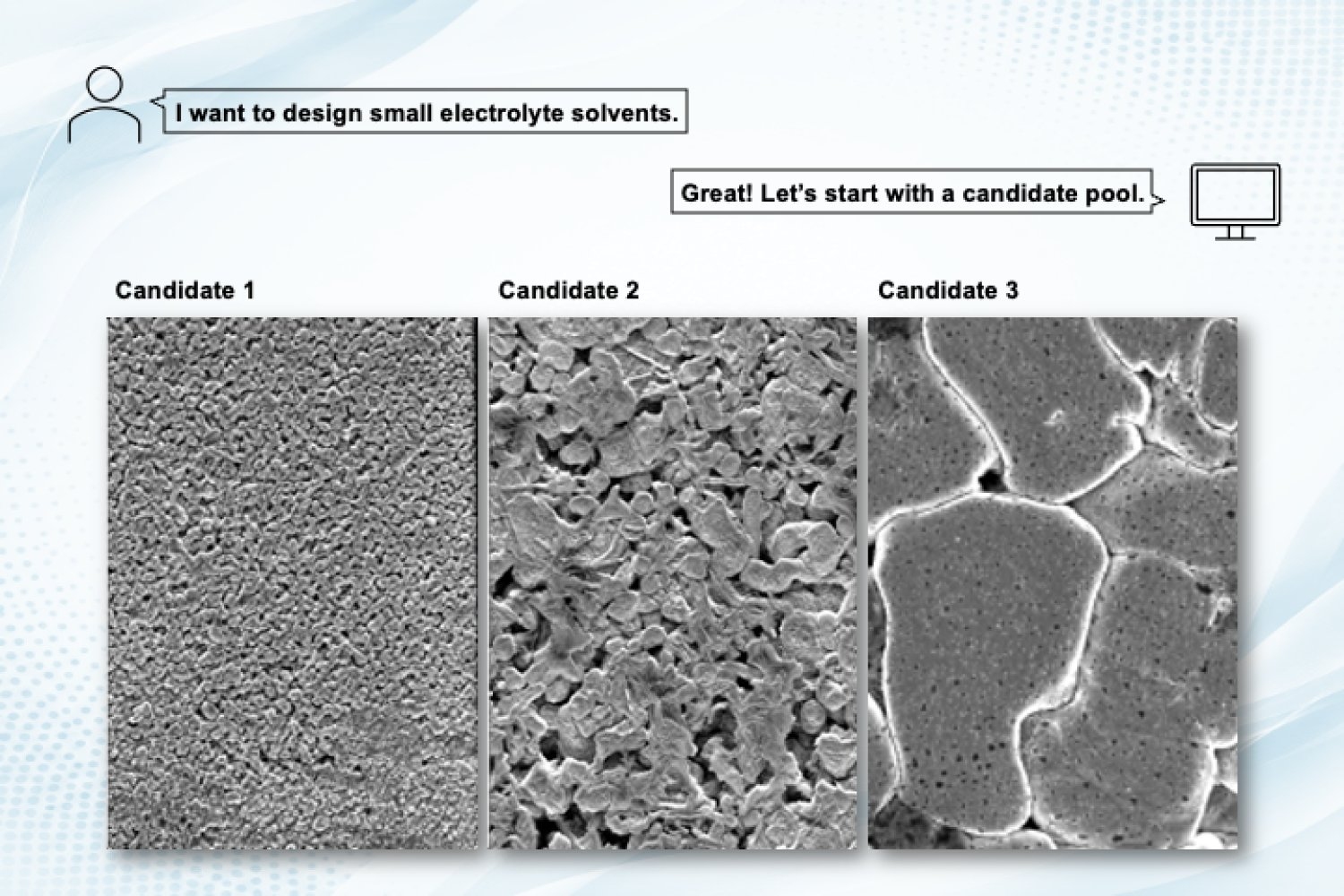
Chia-Wei Hsu, an MIT PhD student in materials science and engineering, created an AI-guided algorithm, which designed 100,000 candidate molecules on his computer within 24 hours. Hsu then narrowed down the pool to 200 candidates by applying a set of technical criteria — including similarity in shape to DMTMSA and comparable electronic properties. Twenty-seven representative candidates covering the full range of possibilities were selected for experimental tests.
“We tested them all under the same conditions to make it a fair, head-to-head competition,” Chen says. A clear winner emerged, a solvent called DMFSA, which was both the smallest and the best.
Small is beautiful
This work, claims Jinhyuk Lee, an associate professor of materials engineering at McGill University who is not part of the study, “addresses one of the most persistent challenges in battery research: improving battery performance at high charging and discharging rates without sacrificing long-term stability. By carefully tailoring the size of solvent molecules, the authors demonstrate a new design strategy that could enable lower-cost, higher performance batteries.”
The group is not done. A new search is underway to find an even better solvent. This time, the approach is similar, but DMFSA (rather than the larger DMTMSA molecule) serves as the starting point. Chen believes the new solvents they are uncovering could eventually lead to rechargeable sodium-metal batteries that combine low-cost, abundant materials with fast charging and high-power performance, opening the door to broader energy storage applications.
The overriding goal of this work, the authors emphasize, is not only to advance sodium batteries. It’s also to introduce a new approach to electrolyte design that uses solvent size and molecular similarity as the key guideposts. Viewing the research in this light, sodium-metal batteries serve as a model system for demonstrating a more general design principle.
“Because the concept is broadly applicable,” Lee comments, “its impact could extend well beyond sodium batteries and influence the design of a wide range of future energy storage technologies.”
This work was supported, in part, by a National Research Foundation of Korea grant funded by the government of Korea government, as well as U.S. National Science Foundation graduate research fellowship. The characterization equipment used in this project is partly from the MIT.nano Characterization Facilities.
A machine-learning-guided pipeline enables researchers to generate solvent candidate pools on demand, narrow the selections down, and experimentally test the most promising electrolyte recipes. These scanning electron microscopy images show the morphology of sodium-metal deposits obtained from three different electrolyte candidates.
A major national credit rating agency downgraded Oracle’s rating last week, citing uncertainty about the tech giant’s investments in artificial intelligence. The drop comes just weeks after the company sued Wisconsin’s utility regulator over new credit requirements for data center operators in We Energies territory — a lawsuit spotlighting the company’s financial condition.
S&P Global Ratings, one of the “big three” ratings agencies responsible for assessing the creditworthiness of government and corporate debt, lowered Oracle’s rating from a BBB to a BBB- on July 9. The rating places Oracle on the bottom edge of S&P’s “investment-grade” tier; any additional downgrades will land the company’s credit rating in the “high yield” or “junk” tier.
“Oracle Corp.’s rapidly expanding AI infrastructure business is increasing its overall credit risk,” S&P analysts wrote in an announcement of the downgrade, pointing to high capital spending, “an uncertain path to profitability” and stiff competition as reasons to be “more cautious” in its approach to AI infrastructure businesses.
Still, S&P isn’t wholly pessimistic about Oracle’s finances.
“Despite the stretched leverage and cash-flow profile over the next two years, we expect Oracle to demonstrate consistent improvements toward profitability as capacity comes online and business scales,” the analysts added.
Oracle is co-developing a vast new data center campus in Ozaukee County, and its BBB- credit rating adds a hurdle to its efforts to connect the campus’ servers to the grid.
The reason: new rules for data centers seeking electrical service in We Energies territory. Wisconsin’s Public Service Commission (PSC) recently approved a rate structure for We Energies’ “very large customers” that requires operators like Oracle to pay for the construction of new power plants needed to meet data center energy needs.
But constructing a new plant can cost hundreds of millions of dollars, and any unpaid debts tied to the plants could fall to We Energies’ other customers if a data center operator becomes insolvent.
To shield ratepayers from a potential cost shift, the PSC set a AAA- credit rating threshold for data center operators seeking electric service from We Energies. Companies below the threshold must post steep collateral, either in cash or lines of credit, as a backstop.
For Oracle, that could mean paying $100 million or more a year as a condition of receiving electric service for Port Washington servers.
“In practical terms, tens of billions of dollars in Oracle’s value would need to be destroyed before creditors or counterparties, such as Wisconsin Electric and its other customers, could experience losses,” the utility’s lawyers wrote.
Oracle sued the commission in Ozaukee County Circuit Court as a backup to the reopener request. The company’s lawsuit asks Judge Sandy Williams to “set aside, reverse, and remand” the credit rating requirements, arguing that they aren’t “needed to prevent harm” to We Energies’ other customers or shareholders.
In a response filed July 9, the commission accused Oracle of trying to dodge regulatory scrutiny. The company seeks “to overturn over one-hundred years of established caselaw and allow it to dictate one-off preferential terms of service with the utility, bypassing Commission oversight altogether,” commission attorneys wrote.
Wisconsin’s Citizens Utility Board (CUB) and renewable energy advocacy group Clean Wisconsin also weighed in this week to support the credit ratings requirements.
“An investment grade credit rating provides little advance warning of financial difficulties that may worsen rapidly,” CUB attorney Daniel Narvey wrote in a position statement filed Monday in Ozaukee County Circuit Court. “If a data center customer suffered financial distress and had not been required to post collateral, (We Energies) and its other customers could be on the hook for billions of dollars of stranded investments.”
Oracle’s stock value has tumbled by more than 25% in the month since it sued the PSC.
Wisconsin isn’t the only state embroiled in a fight over Oracle’s data center operations. In March, Michigan’s Public Service Commission declined to revisit its approval of an electrical service agreement between utility DTE Energy, Oracle and OpenAI. Michigan’s utility regulator approved the contracts in an expedited, uncontested process that drew criticism from ratepayer advocates and Michigan Attorney General Dana Nessel.
Wisconsin Watch is a nonprofit, nonpartisan newsroom. Subscribe to our newsletters for original stories and our Friday news roundup.
In a petition to Congress, 200 state lawmakers from around the country, including Wisconsin, are opposing federal plans that would limit local control over regulating artificial intelligence.
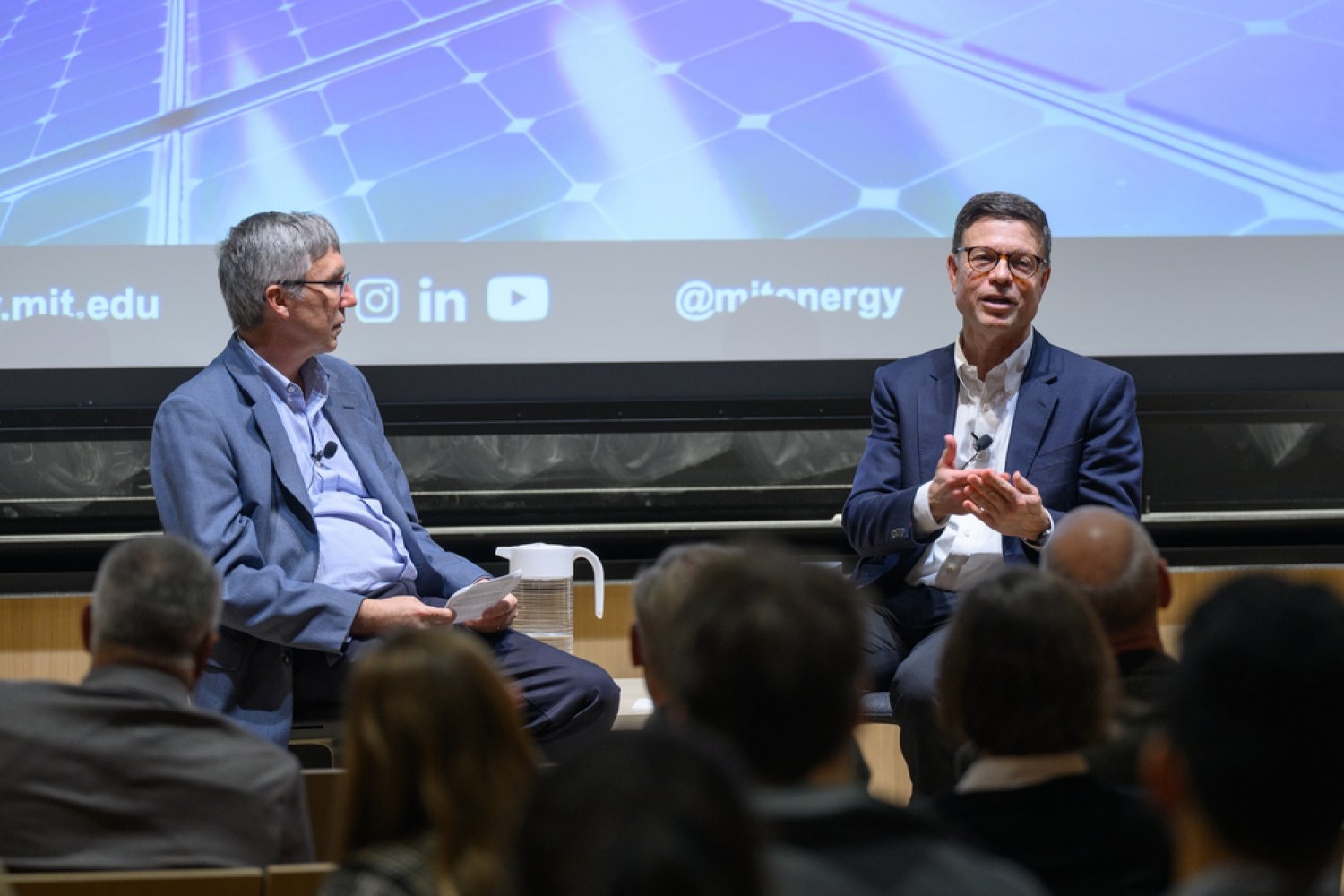
Advancements in battery innovation are transforming both mobility and energy systems alike, according to Kurt Kelty, vice president of battery, propulsion, and sustainability at General Motors (GM). At the MIT Energy Initiative (MITEI) Fall Colloquium, Kelty explored how GM is bringing next-generation battery technologies from lab to commercialization, driving American battery innovation forward. The colloquium is part of the ongoing MITEI Presents: Advancing the Energy Transition speaker series.
At GM, Kelty’s team is primarily focused on three things: first, improving affordability to get more electric vehicles (EVs) on the road. “How do you drive down the cost?” Kelty asked the audience. “It's the batteries. The batteries make up about 30 percent of the cost of the vehicle.” Second, his team strives to improve battery performance, including charging speed and energy density. Third, they are working on localizing the supply chain. “We've got to build up our resilience and our independence here in North America, so we're not relying on materials coming from China,” Kelty explained.
To aid their efforts, resources are being poured into the virtualization space, significantly cutting down on time dedicated to research and development. Now, Kelty’s team can do modeling up front using artificial intelligence, reducing what previously would have taken months to a couple of days.
“If you want to modify … the nickel content ever so slightly, we can very quickly model: ‘OK, how’s that going to affect the energy density? The safety? How’s that going to affect the charge capability?’” said Kelty. “We can look at that at the cell level, then the pack level, then the vehicle level.”
Kelty revealed that they have found a solution that addresses affordability, accessibility, and commercialization: lithium manganese-rich (LMR) batteries. Previously, the industry looked to reduce costs by lowering the amount of cobalt in batteries by adding greater amounts of nickel. These high-nickel batteries are in most cars on the road in the United States due to their high range. LMR batteries, though, take things a step further by reducing the amount of nickel and adding more manganese, which drives the cost of batteries down even further while maintaining range.
Lithium-iron-phosphate (LFP) batteries are the chemistry of choice in China, known for low cost, high cycle life, and high safety. With LMR batteries, the cost is comparable to LFP with a range that is closer to high-nickel. “That’s what’s really a breakthrough,” said Kelty.
LMR batteries are not new, but there have been challenges to adopting them, according to Kelty. “People knew about it, but they didn’t know how to commercialize it. They didn’t know how to make it work in an EV,” he explained. Now that GM has figured out commercialization, they will be the first to market these batteries in their EVs in 2028.
Kelty also expressed excitement over the use of vehicle-to-grid technologies in the future. Using a bidirectional charger with a two-way flow of energy, EVs could charge, but also send power from their batteries back to the electrical grid. This would allow customers to charge “their vehicles at night when the electricity prices are really low, and they can discharge it during the day when electricity rates are really high,” he said.
In addition to working in the transportation sector, GM is exploring ways to extend their battery expertise into applications in grid-scale energy storage. “It’s a big market right now, but it’s growing very quickly because of the data center growth,” said Kelty.
When looking to the future of battery manufacturing and EVs in the United States, Kelty remains optimistic: “we’ve got the technology here to make it happen. We’ve always had the innovation here. Now, we’re getting more and more of the manufacturing. We’re getting that all together. We’ve got just tremendous opportunity here that I’m hopeful we’re going to be able to take advantage of and really build a massive battery industry here.”
This speaker series highlights energy experts and leaders at the forefront of the scientific, technological, and policy solutions needed to transform our energy systems. Visit MITEI’s Events page for more information on this and additional events.
Kurt Kelty (right), vice president of battery, propulsion, and sustainability at General Motors, joined MITEI's William Green at the 2025 MIT Energy Initiative Fall Colloquium. Kelty explained how GM is developing and commercializing next-generation battery technologies.
There is growing attention on the links between artificial intelligence and increased energy demands. But while the power-hungry data centers being built to support AI could potentially stress electricity grids, increase customer prices and service interruptions, and generally slow the transition to clean energy, the use of artificial intelligence can also help the energy transition.
For example, use of AI is reducing energy consumption and associated emissions in buildings, transportation, and industrial processes. In addition, AI is helping to optimize the design and siting of new wind and solar installations and energy storage facilities.
On electric power grids, using AI algorithms to control operations is helping to increase efficiency and reduce costs, integrate the growing share of renewables, and even predict when key equipment needs servicing to prevent failure and possible blackouts. AI can help grid planners schedule investments in generation, energy storage, and other infrastructure that will be needed in the future. AI is also helping researchers discover or design novel materials for nuclear reactors, batteries, and electrolyzers.
Researchers at MIT and elsewhere are actively investigating aspects of those and other opportunities for AI to support the clean energy transition. At its 2025 research conference, MITEI announced the Data Center Power Forum, a targeted research effort for MITEI member companies interested in addressing the challenges of data center power demand.
Controlling real-time operations
Customers generally rely on receiving a continuous supply of electricity, and grid operators get help from AI to make that happen — while optimizing the storage and distribution of energy from renewable sources at the same time.
But with more installation of solar and wind farms — both of which provide power in smaller amounts, and intermittently — and the growing threat of weather events and cyberattacks, ensuring reliability is getting more complicated. “That’s exactly where AI can come into the picture,” explains Anuradha Annaswamy, a senior research scientist in MIT’s Department of Mechanical Engineering and director of MIT’s Active-Adaptive Control Laboratory. “Essentially, you need to introduce a whole information infrastructure to supplement and complement the physical infrastructure.”
The electricity grid is a complex system that requires meticulous control on time scales ranging from decades all the way down to microseconds. The challenge can be traced to the basic laws of power physics: electricity supply must equal electricity demand at every instant, or generation can be interrupted. In past decades, grid operators generally assumed that generation was fixed — they could count on how much electricity each large power plant would produce — while demand varied over time in a fairly predictable way. As a result, operators could commission specific power plants to run as needed to meet demand the next day. If some outages occurred, specially designated units would start up as needed to make up the shortfall.
Today and in the future, that matching of supply and demand must still happen, even as the number of small, intermittent sources of generation grows and weather disturbances and other threats to the grid increase. AI algorithms provide a means of achieving the complex management of information needed to forecast within just a few hours which plants should run while also ensuring that the frequency, voltage, and other characteristics of the incoming power are as required for the grid to operate properly.
Moreover, AI can make possible new ways of increasing supply or decreasing demand at times when supplies on the grid run short. As Annaswamy points out, the battery in your electric vehicle (EV), as well as the one charged up by solar panels or wind turbines, can — when needed — serve as a source of extra power to be fed into the grid. And given real-time price signals, EV owners can choose to shift charging from a time when demand is peaking and prices are high to a time when demand and therefore prices are both lower. In addition, new smart thermostats can be set to allow the indoor temperature to drop or rise — a range defined by the customer — when demand on the grid is peaking. And data centers themselves can be a source of demand flexibility: selected AI calculations could be delayed as needed to smooth out peaks in demand. Thus, AI can provide many opportunities to fine-tune both supply and demand as needed.
In addition, AI makes possible “predictive maintenance.” Any downtime is costly for the company and threatens shortages for the customers served. AI algorithms can collect key performance data during normal operation and, when readings veer off from that normal, the system can alert operators that something might be going wrong, giving them a chance to intervene. That capability prevents equipment failures, reduces the need for routine inspections, increases worker productivity, and extends the lifetime of key equipment.
Annaswamy stresses that“figuring out how to architect this new power grid with these AI components will require many different experts to come together.” She notes that electrical engineers, computer scientists, and energy economists “will have to rub shoulders with enlightened regulators and policymakers to make sure that this is not just an academic exercise, but will actually get implemented. All the different stakeholders have to learn from each other. And you need guarantees that nothing is going to fail. You can’t have blackouts.”
Using AI to help plan investments in infrastructure for the future
Grid companies constantly need to plan for expanding generation, transmission, storage, and more, and getting all the necessary infrastructure built and operating may take many years, in some cases more than a decade. So, they need to predict what infrastructure they’ll need to ensure reliability in the future. “It’s complicated because you have to forecast over a decade ahead of time what to build and where to build it,” says Deepjyoti Deka, a research scientist in MITEI.
One challenge with anticipating what will be needed is predicting how the future system will operate. “That’s becoming increasingly difficult,” says Deka, because more renewables are coming online and displacing traditional generators. In the past, operators could rely on “spinning reserves,” that is, generating capacity that’s not currently in use but could come online in a matter of minutes to meet any shortfall on the system. The presence of so many intermittent generators — wind and solar — means there’s now less stability and inertia built into the grid. Adding to the complication is that those intermittent generators can be built by various vendors, and grid planners may not have access to the physics-based equations that govern the operation of each piece of equipment at sufficiently fine time scales. “So, you probably don’t know exactly how it’s going to run,” says Deka.
And then there’s the weather. Determining the reliability of a proposed future energy system requires knowing what it’ll be up against in terms of weather. The future grid has to be reliable not only in everyday weather, but also during low-probability but high-risk events such as hurricanes, floods, and wildfires, all of which are becoming more and more frequent, notes Deka. AI can help by predicting such events and even tracking changes in weather patterns due to climate change.
Deka points out another, less-obvious benefit of the speed of AI analysis. Any infrastructure development plan must be reviewed and approved, often by several regulatory and other bodies. Traditionally, an applicant would develop a plan, analyze its impacts, and submit the plan to one set of reviewers. After making any requested changes and repeating the analysis, the applicant would resubmit a revised version to the reviewers to see if the new version was acceptable. AI tools can speed up the required analysis so the process moves along more quickly. Planners can even reduce the number of times a proposal is rejected by using large language models to search regulatory publications and summarize what’s important for a proposed infrastructure installation.
Harnessing AI to discover and exploit advanced materials needed for the energy transition
“Use of AI for materials development is booming right now,” says Ju Li, MIT’s Carl Richard Soderberg Professor of Power Engineering. He notes two main directions.
First, AI makes possible faster physics-based simulations at the atomic scale. The result is a better atomic-level understanding of how composition, processing, structure, and chemical reactivity relate to the performance of materials. That understanding provides design rules to help guide the development and discovery of novel materials for energy generation, storage, and conversion needed for a sustainable future energy system.
And second, AI can help guide experiments in real time as they take place in the lab. Li explains: “AI assists us in choosing the best experiment to do based on our previous experiments and — based on literature searches — makes hypotheses and suggests new experiments.”
He describes what happens in his own lab. Human scientists interact with a large language model, which then makes suggestions about what specific experiments to do next. The human researcher accepts or modifies the suggestion, and a robotic arm responds by setting up and performing the next step in the experimental sequence, synthesizing the material, testing the performance, and taking images of samples when appropriate. Based on a mix of literature knowledge, human intuition, and previous experimental results, AI thus coordinates active learning that balances the goals of reducing uncertainty with improving performance. And, as Li points out, “AI has read many more books and papers than any human can, and is thus naturally more interdisciplinary.”
The outcome, says Li, is both better design of experiments and speeding up the “work flow.” Traditionally, the process of developing new materials has required synthesizing the precursors, making the material, testing its performance and characterizing the structure, making adjustments, and repeating the same series of steps. AI guidance speeds up that process, “helping us to design critical, cheap experiments that can give us the maximum amount of information feedback,” says Li.
“Having this capability certainly will accelerate material discovery, and this may be the thing that can really help us in the clean energy transition,” he concludes. “AI [has the potential to] lubricate the material-discovery and optimization process, perhaps shortening it from decades, as in the past, to just a few years.”
MITEI’s contributions
At MIT, researchers are working on various aspects of the opportunities described above. In projects supported by MITEI, teams are using AI to better model and predict disruptions in plasma flows inside fusion reactors — a necessity in achieving practical fusion power generation. Other MITEI-supported teams are using AI-powered tools to interpret regulations, climate data, and infrastructure maps in order to achieve faster, more adaptive electric grid planning. AI-guided development of advanced materials continues, with one MITEI project using AI to optimize solar cells and thermoelectric materials.
Other MITEI researchers are developing robots that can learn maintenance tasks based on human feedback, including physical intervention and verbal instructions. The goal is to reduce costs, improve safety, and accelerate the deployment of the renewable energy infrastructure. And MITEI-funded work continues on ways to reduce the energy demand of data centers, from designing more efficient computer chips and computing algorithms to rethinking the architectural design of the buildings, for example, to increase airflow so as to reduce the need for air conditioning.
In addition to providing leadership and funding for many research projects, MITEI acts as a convenor, bringing together interested parties to consider common problems and potential solutions. In May 2025, MITEI’s annual spring symposium — titled “AI and energy: Peril and promise” — brought together AI and energy experts from across academia, industry, government, and nonprofit organizations to explore AI as both a problem and a potential solution for the clean energy transition. At the close of the symposium, William H. Green, director of MITEI and Hoyt C. Hottel Professor in the MIT Department of Chemical Engineering, noted, “The challenge of meeting data center energy demand and of unlocking the potential benefits of AI to the energy transition is now a research priority for MITEI.”
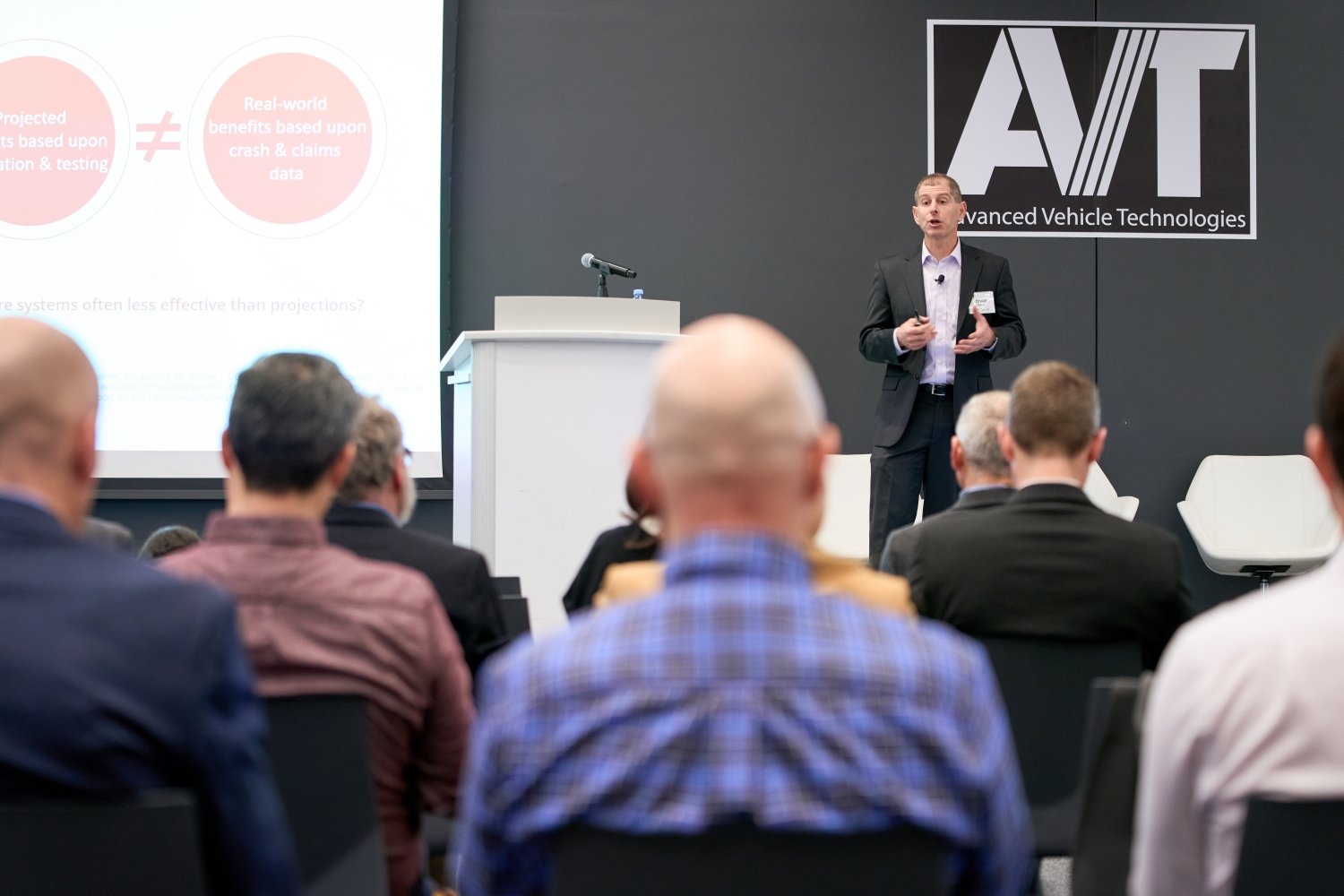
On May 6, MIT AgeLab’s Advanced Vehicle Technology (AVT) Consortium, part of the MIT Center for Transportation and Logistics, celebrated 10 years of its global academic-industry collaboration. AVT was founded with the aim of developing new data that contribute to automotive manufacturers, suppliers, and insurers’ real-world understanding of how drivers use and respond to increasingly sophisticated vehicle technologies, such as assistive and automated driving, while accelerating the applied insight needed to advance design and development. The celebration event brought together stakeholders from across the industry for a set of keynote addresses and panel discussions on critical topics significant to the industry and its future, including artificial intelligence, automotive technology, collision repair, consumer behavior, sustainability, vehicle safety policy, and global competitiveness.
Bryan Reimer, founder and co-director of the AVT Consortium, opened the event by remarking that over the decade AVT has collected hundreds of terabytes of data, presented and discussed research with its over 25 member organizations, supported members’ strategic and policy initiatives, published select outcomes, and built AVT into a global influencer with tremendous impact in the automotive industry. He noted that current opportunities and challenges for the industry include distracted driving, a lack of consumer trust and concerns around transparency in assistive and automated driving features, and high consumer expectations for vehicle technology, safety, and affordability. How will industry respond? Major players in attendance weighed in.
In a powerful exchange on vehicle safety regulation, John Bozzella, president and CEO of the Alliance for Automotive Innovation, and Mark Rosekind, former chief safety innovation officer of Zoox, former administrator of the National Highway Traffic Safety Administration, and former member of the National Transportation Safety Board, challenged industry and government to adopt a more strategic, data-driven, and collaborative approach to safety. They asserted that regulation must evolve alongside innovation, not lag behind it by decades. Appealing to the automakers in attendance, Bozzella cited the success of voluntary commitments on automatic emergency braking as a model for future progress. “That’s a way to do something important and impactful ahead of regulation.” They advocated for shared data platforms, anonymous reporting, and a common regulatory vision that sets safety baselines while allowing room for experimentation. The 40,000 annual road fatalities demand urgency — what’s needed is a move away from tactical fixes and toward a systemic safety strategy. “Safety delayed is safety denied,” Rosekind stated. “Tell me how you’re going to improve safety. Let’s be explicit.”
Drawing inspiration from aviation’s exemplary safety record, Kathy Abbott, chief scientific and technical advisor for the Federal Aviation Administration, pointed to a culture of rigorous regulation, continuous improvement, and cross-sectoral data sharing. Aviation’s model, built on highly trained personnel and strict predictability standards, contrasts sharply with the fragmented approach in the automotive industry. The keynote emphasized that a foundation of safety culture — one that recognizes that technological ability alone isn’t justification for deployment — must guide the auto industry forward. Just as aviation doesn’t equate absence of failure with success, vehicle safety must be measured holistically and proactively.
With assistive and automated driving top of mind in the industry, Pete Bigelow of Automotive News offered a pragmatic diagnosis. With companies like Ford and Volkswagen stepping back from full autonomy projects like Argo AI, the industry is now focused on Level 2 and 3 technologies, which refer to assisted and automated driving, respectively. Tesla, GM, and Mercedes are experimenting with subscription models for driver assistance systems, yet consumer confusion remains high. JD Power reports that many drivers do not grasp the differences between L2 and L2+, or whether these technologies offer safety or convenience features. Safety benefits have yet to manifest in reduced traffic deaths, which have risen by 20 percent since 2020. The recurring challenge: L3 systems demand that human drivers take over during technical difficulties, despite driver disengagement being their primary benefit, potentially worsening outcomes. Bigelow cited a quote from Bryan Reimer as one of the best he’s received in his career: “Level 3 systems are an engineer’s dream and a plaintiff attorney’s next yacht,” highlighting the legal and design complexity of systems that demand handoffs between machine and human.
In terms of the impact of AI on the automotive industry, Mauricio Muñoz, senior research engineer at AI Sweden, underscored that despite AI’s transformative potential, the automotive industry cannot rely on general AI megatrends to solve domain-specific challenges. While landmark achievements like AlphaFold demonstrate AI’s prowess, automotive applications require domain expertise, data sovereignty, and targeted collaboration. Energy constraints, data firewalls, and the high costs of AI infrastructure all pose limitations, making it critical that companies fund purpose-driven research that can reduce costs and improve implementation fidelity. Muñoz warned that while excitement abounds — with some predicting artificial superintelligence by 2028 — real progress demands organizational alignment and a deep understanding of the automotive context, not just computational power.
Turning the focus to consumers, a collision repair panel drawing Richard Billyeald from Thatcham Research, Hami Ebrahimi from Caliber Collision, and Mike Nelson from Nelson Law explored the unintended consequences of vehicle technology advances: spiraling repair costs, labor shortages, and a lack of repairability standards. Panelists warned that even minor repairs for advanced vehicles now require costly and complex sensor recalibrations — compounded by inconsistent manufacturer guidance and no clear consumer alerts when systems are out of calibration. The panel called for greater standardization, consumer education, and repair-friendly design. As insurance premiums climb and more people forgo insurance claims, the lack of coordination between automakers, regulators, and service providers threatens consumer safety and undermines trust. The group warned that until Level 2 systems function reliably and affordably, moving toward Level 3 autonomy is premature and risky.
While the repair panel emphasized today’s urgent challenges, other speakers looked to the future. Honda’s Ryan Harty, for example, highlighted the company’s aggressive push toward sustainability and safety. Honda aims for zero environmental impact and zero traffic fatalities, with plans to be 100 percent electric by 2040 and to lead in energy storage and clean power integration. The company has developed tools to coach young drivers and is investing in charging infrastructure, grid-aware battery usage, and green hydrogen storage. “What consumers buy in the market dictates what the manufacturers make,” Harty noted, underscoring the importance of aligning product strategy with user demand and environmental responsibility. He stressed that manufacturers can only decarbonize as fast as the industry allows, and emphasized the need to shift from cost-based to life-cycle-based product strategies.
Finally, a panel involving Laura Chace of ITS America, Jon Demerly of Qualcomm, Brad Stertz of Audi/VW Group, and Anant Thaker of Aptiv covered the near-, mid-, and long-term future of vehicle technology. Panelists emphasized that consumer expectations, infrastructure investment, and regulatory modernization must evolve together. Despite record bicycle fatality rates and persistent distracted driving, features like school bus detection and stop sign alerts remain underutilized due to skepticism and cost. Panelists stressed that we must design systems for proactive safety rather than reactive response. The slow integration of digital infrastructure — sensors, edge computing, data analytics — stems not only from technical hurdles, but procurement and policy challenges as well.
Reimer concluded the event by urging industry leaders to re-center the consumer in all conversations — from affordability to maintenance and repair. With the rising costs of ownership, growing gaps in trust in technology, and misalignment between innovation and consumer value, the future of mobility depends on rebuilding trust and reshaping industry economics. He called for global collaboration, greater standardization, and transparent innovation that consumers can understand and afford. He highlighted that global competitiveness and public safety both hang in the balance. As Reimer noted, “success will come through partnerships” — between industry, academia, and government — that work toward shared investment, cultural change, and a collective willingness to prioritize the public good.
The cleantech world is experiencing a quiet revolution. Artificial intelligence is no longer knocking at the door, it’s quietly remodeling the entire house....
Car design is an iterative and proprietary process. Carmakers can spend several years on the design phase for a car, tweaking 3D forms in simulations before building out the most promising designs for physical testing. The details and specs of these tests, including the aerodynamics of a given car design, are typically not made public. Significant advances in performance, such as in fuel efficiency or electric vehicle range, can therefore be slow and siloed from company to company.
MIT engineers say that the search for better car designs can speed up exponentially with the use of generative artificial intelligence tools that can plow through huge amounts of data in seconds and find connections to generate a novel design. While such AI tools exist, the data they would need to learn from have not been available, at least in any sort of accessible, centralized form.
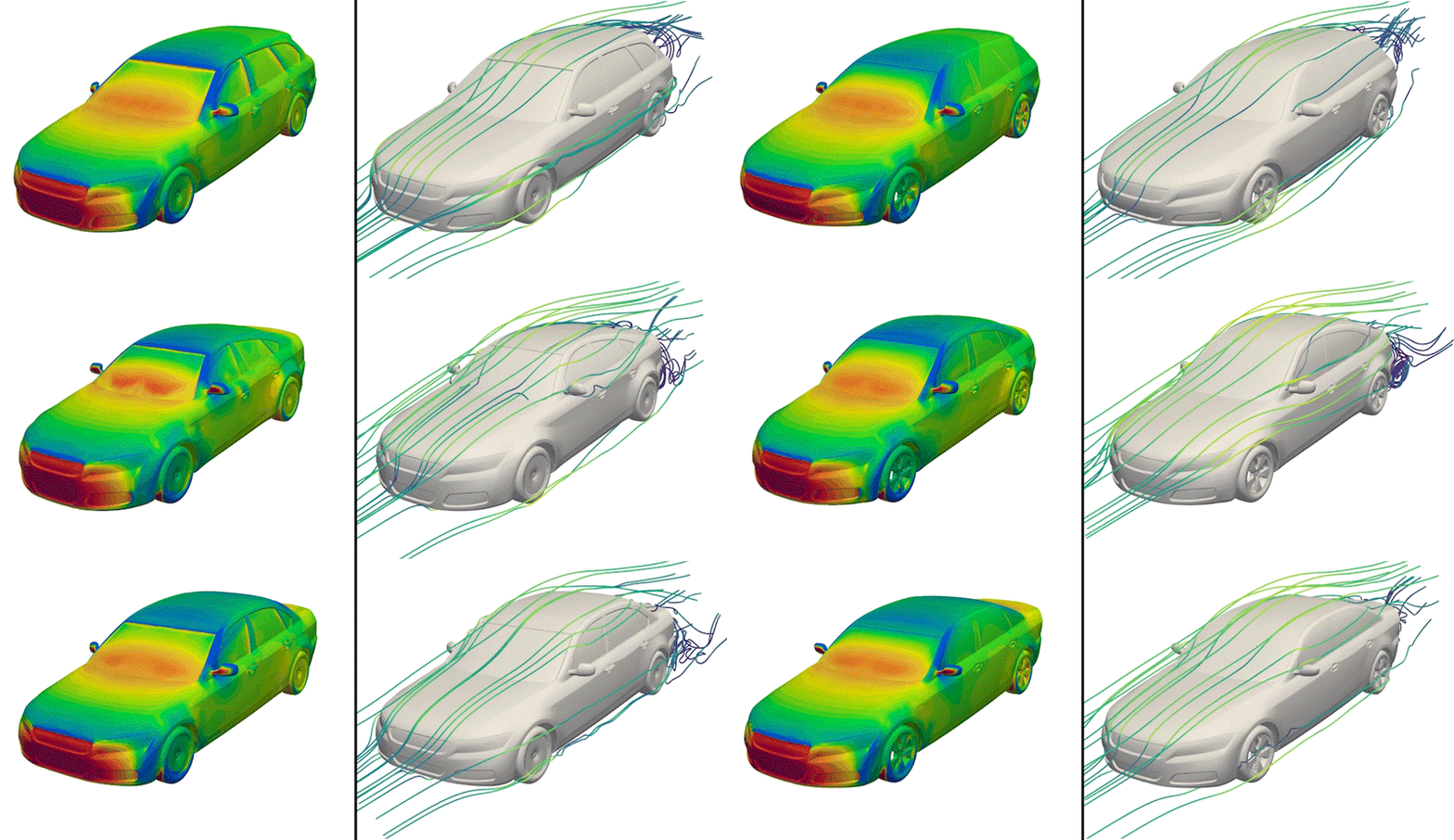
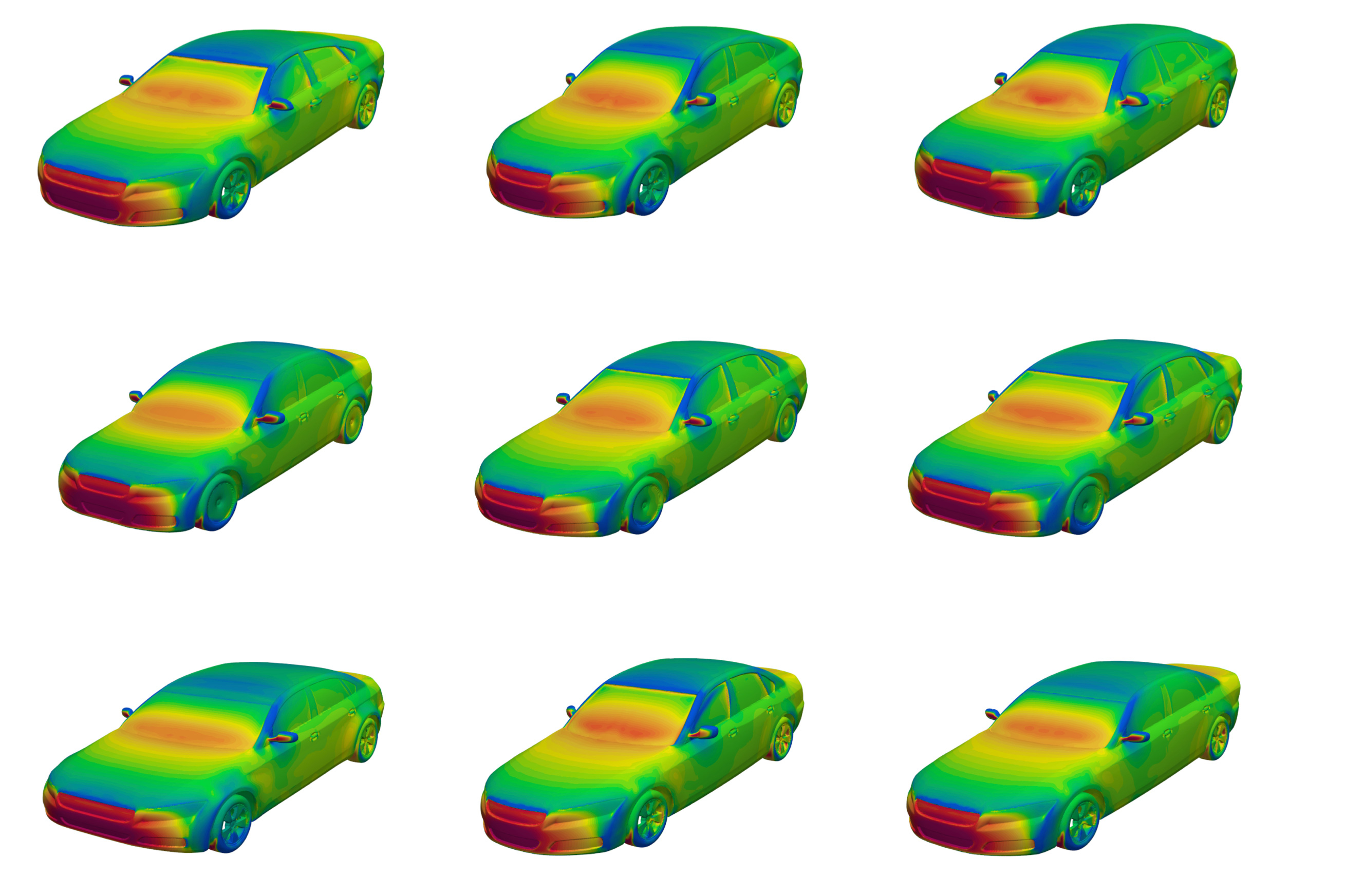
But now, the engineers have made just such a dataset available to the public for the first time. Dubbed DrivAerNet++, the dataset encompasses more than 8,000 car designs, which the engineers generated based on the most common types of cars in the world today. Each design is represented in 3D form and includes information on the car’s aerodynamics — the way air would flow around a given design, based on simulations of fluid dynamics that the group carried out for each design.
Each of the dataset’s 8,000 designs is available in several representations, such as mesh, point cloud, or a simple list of the design’s parameters and dimensions. As such, the dataset can be used by different AI models that are tuned to process data in a particular modality.
DrivAerNet++ is the largest open-source dataset for car aerodynamics that has been developed to date. The engineers envision it being used as an extensive library of realistic car designs, with detailed aerodynamics data that can be used to quickly train any AI model. These models can then just as quickly generate novel designs that could potentially lead to more fuel-efficient cars and electric vehicles with longer range, in a fraction of the time that it takes the automotive industry today.
“This dataset lays the foundation for the next generation of AI applications in engineering, promoting efficient design processes, cutting R&D costs, and driving advancements toward a more sustainable automotive future,” says Mohamed Elrefaie, a mechanical engineering graduate student at MIT.
Elrefaie and his colleagues will present a paper detailing the new dataset, and AI methods that could be applied to it, at the NeurIPS conference in December. His co-authors are Faez Ahmed, assistant professor of mechanical engineering at MIT, along with Angela Dai, associate professor of computer science at the Technical University of Munich, and Florin Marar of BETA CAE Systems.
Filling the data gap
Ahmed leads the Design Computation and Digital Engineering Lab (DeCoDE) at MIT, where his group explores ways in which AI and machine-learning tools can be used to enhance the design of complex engineering systems and products, including car technology.
“Often when designing a car, the forward process is so expensive that manufacturers can only tweak a car a little bit from one version to the next,” Ahmed says. “But if you have larger datasets where you know the performance of each design, now you can train machine-learning models to iterate fast so you are more likely to get a better design.”
And speed, particularly for advancing car technology, is particularly pressing now.
“This is the best time for accelerating car innovations, as automobiles are one of the largest polluters in the world, and the faster we can shave off that contribution, the more we can help the climate,” Elrefaie says.
In looking at the process of new car design, the researchers found that, while there are AI models that could crank through many car designs to generate optimal designs, the car data that is actually available is limited. Some researchers had previously assembled small datasets of simulated car designs, while car manufacturers rarely release the specs of the actual designs they explore, test, and ultimately manufacture.
The team sought to fill the data gap, particularly with respect to a car’s aerodynamics, which plays a key role in setting the range of an electric vehicle, and the fuel efficiency of an internal combustion engine. The challenge, they realized, was in assembling a dataset of thousands of car designs, each of which is physically accurate in their function and form, without the benefit of physically testing and measuring their performance.
To build a dataset of car designs with physically accurate representations of their aerodynamics, the researchers started with several baseline 3D models that were provided by Audi and BMW in 2014. These models represent three major categories of passenger cars: fastback (sedans with a sloped back end), notchback (sedans or coupes with a slight dip in their rear profile) and estateback (such as station wagons with more blunt, flat backs). The baseline models are thought to bridge the gap between simple designs and more complicated proprietary designs, and have been used by other groups as a starting point for exploring new car designs.
Library of cars
In their new study, the team applied a morphing operation to each of the baseline car models. This operation systematically made a slight change to each of 26 parameters in a given car design, such as its length, underbody features, windshield slope, and wheel tread, which it then labeled as a distinct car design, which was then added to the growing dataset. Meanwhile, the team ran an optimization algorithm to ensure that each new design was indeed distinct, and not a copy of an already-generated design. They then translated each 3D design into different modalities, such that a given design can be represented as a mesh, a point cloud, or a list of dimensions and specs.
The researchers also ran complex, computational fluid dynamics simulations to calculate how air would flow around each generated car design. In the end, this effort produced more than 8,000 distinct, physically accurate 3D car forms, encompassing the most common types of passenger cars on the road today.
To produce this comprehensive dataset, the researchers spent over 3 million CPU hours using the MIT SuperCloud, and generated 39 terabytes of data. (For comparison, it’s estimated that the entire printed collection of the Library of Congress would amount to about 10 terabytes of data.)
The engineers say that researchers can now use the dataset to train a particular AI model. For instance, an AI model could be trained on a part of the dataset to learn car configurations that have certain desirable aerodynamics. Within seconds, the model could then generate a new car design with optimized aerodynamics, based on what it has learned from the dataset’s thousands of physically accurate designs.
The researchers say the dataset could also be used for the inverse goal. For instance, after training an AI model on the dataset, designers could feed the model a specific car design and have it quickly estimate the design’s aerodynamics, which can then be used to compute the car’s potential fuel efficiency or electric range — all without carrying out expensive building and testing of a physical car.
“What this dataset allows you to do is train generative AI models to do things in seconds rather than hours,” Ahmed says. “These models can help lower fuel consumption for internal combustion vehicles and increase the range of electric cars — ultimately paving the way for more sustainable, environmentally friendly vehicles.”
“The dataset is very comprehensive and consists of a diverse set of modalities that are valuable to understand both styling and performance,” says Yanxia Zhang, a senior machine learning research scientist at Toyota Research Institute, who was not involved in the study.
This work was supported, in part, by the German Academic Exchange Service and the Department of Mechanical Engineering at MIT.
In a new dataset that includes more than 8,000 car designs, MIT engineers simulated the aerodynamics for a given car shape, which they represent in various modalities, including “surface fields.”

 Login
Login