
Reading view

There are new articles available, click to refresh the page.

Investigation into Waymo Driverless Vehicles Continues Following Latest Collision with Student

Another investigation is underway after a Waymo driverless vehicle hit a young pedestrian, this time in Santa Monica, California.

Last month, School Transportation News reported that Waymo’s driverless vehicles are still illegally passing Austin Independent School District school buses in Texas despite multiple attempts to correct the situation. The National Highway Traffic Safety Administration opened a preliminary evaluation Oct. 17, after a Waymo vehicle failed to stop and passed a school bus in Atlanta, Georgia a month earlier.

NHTSA opened another investigation Jan. 28 following the Santa Monica incident, which is about 15 miles west of downtown Los Angeles. The preliminary evaluation states that on Jan. 23 Waymo “reported to the Office of Defects Investigation (ODI) that a Waymo Automated Vehicle (AV) had struck a child near an elementary school earlier that day.”

The incident occurred within two blocks of the Santa Monica elementary school and during normal school drop off hours. Other children, a crossing guard and several double-parked vehicles were in the vicinity.

The child reportedly ran across the street from behind a double-parked SUV towards the school and was struck by the Waymo AV. Waymo reported that the child sustained minor injuries. The Waymo driverless vehicle was operated by the 5th Generation Automated Driving System.

Waymo announced on its website that it has a commitment to transparency and road safety.

“At Waymo, we are committed to improving road safety, both for our riders and all those with whom we share the road. Part of that commitment is being transparent when incidents occur,” the blog post states.


Related: Waymo Driverless Car Illegally Passes Stopped School Bus in Atlanta
Related: NHTSA Investigates Autonomous Waymo Rides After Illegal School Bus Passing
Related: Texas Autonomous Vehicle Task Force Will Work with School Bus Companies


Waymo Response to Santa Monica Incident

The company details the incident, noting that it contacted NHTSA and will cooperate with the investigation.

“The event occurred when the pedestrian suddenly entered the roadway from behind a tall SUV, moving directly into our vehicle’s path,” the post notes. “Our technology immediately detected the individual as soon as they began to emerge from behind the stopped vehicle. The Waymo Driver braked hard, reducing speed from approximately 17 mph to under 6 mph before contact was made.”

The Waymo post notes that “a fully attentive human driver in this same situation would have made contact with the pedestrian at approximately 14 mph. This significant reduction in impact speed and severity is a demonstration of the material safety benefit of the Waymo Driver.”

Following contact, the student pedestrian reportedly stood up and walked to the sidewalk, and Waymo called 911. The driveless vehicle moved to the side of the road and stayed there until law enforcement cleared the vehicle.

“This event demonstrates the critical value of our safety systems,” Waymo added. “We remain committed to improving road safety where we operate as we continue on our mission to be the world’s most trusted driver.”

The post Investigation into Waymo Driverless Vehicles Continues Following Latest Collision with Student appeared first on School Transportation News.

February 2026

By: STN
school bus, stop light
Photo courtesy of First Light Safety Products
Cover Design by Kimber Horne

This month’s issue highlights safety, covering different aspects of how the student transportation is addressing the most pressing safety challenges facing students, drivers and transportation departments. Learn more about the planning needed for the aftermath of school bus crashes, prevention techniques and equipment including lap/shoulder seatbelts, training policies and garages, as well as furthering safety through awareness, access and accountability.

Also, find dates, agendas and new experiences coming up for our 2026 conferences.

Read the full February 2026 issue.

Features

‘This is Bad’
Planning for what happens in the minutes, days and weeks following a severe school bus crash is as important as training to avoid an incident from occurring in the first place.

An Evolution of Thought
Installing lap/shoulder seatbelts on school buses is only half the battle. Experts say it’s vital to also have usage policies and training procedures in place for successful implementation.

Keys to Success
Developing a safety culture not only begins and ends with school bus passengers but must encompass everything from driver training to garage layout.

Special Reports

Getting the Word Out
As illegal passing incidents continue to plague the industry, many federal and state organizations are working on public safety announcements to increase school bus awareness among motorists.

Feedback
Online
Ad Index

Editor’s Take by Ryan Gray
Strongest Case Yet for 3-point Belts?

Thought Leader by Glenna-Wright Gallo
School Bus Adaptive Technology: Safer Rides, Stronger Teams, Better Access

Publisher’s Corner by Tony Corpin
Autonomous Vehicle Implications

The post February 2026 appeared first on School Transportation News.

Waymo Driverless Vehicles Continue to Illegally Pass School Buses

Despite multiple attempts to correct the situation, Waymo’s autonomous vehicles are still illegally passing Austin Independent School District school buses in Texas.

“Even after the November software update and December software recall Waymo says they conducted,” Austin ISD said in a statement Jan. 14. The school district added the most another violation just occurred two days earlier.

Austin ISD now confirms Waymo vehicles committed a total of 24 violations, as of the middle of January.

“Austin ISD again asks that Waymo cease operations in the mornings and afternoons during school days when our students are using our school buses,” a statement by the district reads. “Austin ISD continues to explore any and all legal recourse available.”

Despite the most recent update last week, Austin ISD officials have been navigating this situation for months.

The National Highway Traffic Safety Administration also opened a preliminary evaluation Oct. 17, after a Waymo vehicle failed to stop and passed a school bus in Atlanta, Georgia in September. School Transportation News reached out to Atlanta Public Schools regarding the violations but had yet to hear back at this writing.

Back in Texas, Austin ISD installed BusPatrol camera systems in 2024 on all 519 of the district’s general and special education buses. Citations for illegal passing incidents began soon after that. Prior to the BusPatrol partnership, the district saw 10,000 to 12,000 violations a year, said Kris Hafezizadeh, the executive director of transportation and vehicle services. Now, the school district sees a little over 7,000 passes. He cited a decrease in repeat offenders.

Among those violators is Waymo. Hafezizadeh said the autonomous vehicles treat the school bus like a stop sign, some not even stopping before approaching the school bus.

Waymo reported to Austin ISD as of Nov. 5 that software updates were in place to resolve the issue. Hafezizadeh said. However, a Nov. 20 memo to Waymo by Austin ISD general counsel states that five violations occurred after Waymo’s Nov. 5 letter.

“Put simply, Waymo’s software updates are clearly not working as intended nor as quickly as required. We cannot allow Waymo to continue endangering our students while it attempts to implement a fix,” the memo states. “Accordingly, Austin ISD demands that Waymo immediately cease operation of its automated vehicles during the hours of 5:20 a.m. – 9:30 a.m. and 3:00 p.m. – 7:00 p.m., until more in-depth software updates are completed and Waymo can guarantee its vehicles will comply with the law.”

Hafezizadeh said Waymo “disagreed.” In early December, Hafezizadeh offered his school buses and parking lot to further test the software in Waymo vehicles. He noted that Waymo brought two of its cars and he provided seven school buses of different OEMs to conduct tests. He added that his staff complied with any request made by Waymo officials during the four-hour test period.

“The unfortunate part is, after that, they had another two or three violations,” he said.

Waymo did not respond to requests for comment at this writing.


Related: NHTSA Investigates Autonomous Waymo Rides After Illegal School Bus Passing
Related: Waymo Driverless Car Illegally Passes Stopped School Bus in Atlanta
Related: Federal Bill Aims to Increase Awareness of Illegal School Bus Passing

The post Waymo Driverless Vehicles Continue to Illegally Pass School Buses appeared first on School Transportation News.

NHTSA Investigates Autonomous Waymo Rides After Illegal School Bus Passing

Following a media report last month of a Waymo vehicle passing a school bus in Atlanta, Georgia, the National Highway Traffic Safety Administration issued a preliminary evaluation into the autonomous Uber option.

The evaluation is set to “investigate the performance of the Waymo (Automated Driving System) around stopped school buses, how the system is designed to comply with school bus traffic safety laws and the system’s ability to follow those traffic safety laws. During this investigation, NHTSA will seek to identify the scope of the issue presented by this incident and identify any other similar incidents,” the report states.

Waymo and Uber announced a partnership in select cities around the U.S., starting in Phoenix and expanding to Atlanta and Austin. Riders in these cities have the option to hail autonomous rides through the Uber app. Rides can also be booked through the Waymo app in San Francisco and Los Angeles.

However, the Waymo vehicle was captured on video Sept. 22 illegally passing a stopped school bus that was unloading children.

NHTSA opened the preliminary evaluation Oct. 17. In INOA-PE2503, the NHTSA’s Office of Defects Investigation states that a Waymo autonomous vehicle, or AV, failed to remain stopped “when approaching a school bus that was stopped with its red lights flashing, stop arm deployed and crossing control arm deployed.”


Related: Waymo Driverless Car Illegally Passes Stopped School Bus in Atlanta
Related: WATCH: West Virginia Releases Illegal Passing Awareness Video
Related: WATCH: Michigan Association Releases Illegal Passing PSA for School Bus Safety Week
Related: Feeling Super About Transportation Technology?


The report states that Waymo AV approached the right side of the school bus from a perpendicular side street. “The AV initially stopped but then drove around the front of the bus by briefly turning right to avoid running into the bus’s right front end, then turning left to pass in front of the bus and then turning further left and driving down the roadway past the entire left side of the bus. During this maneuver, the Waymo AV passed the bus’s extended crossing control arm near disembarking students (on the bus’s right side) and passed the extended stop arm on the bus’s left side,” the report continued.

At the time of the incident, the Waymo AV was operated by Waymo’s 5th Generation Automated Driving System and no safety operator was present in the vehicle. The report noted that Waymo has surpassed 100 million miles of driving as of July, approximately 2 million miles logged per week.

“Based on NHTSA’s engagement with Waymo on this incident and the accumulation of operational miles, the likelihood of other prior similar incidents is high,” the report states.

The post NHTSA Investigates Autonomous Waymo Rides After Illegal School Bus Passing appeared first on School Transportation News.

ACT EXPO Registration Opens, Event Focus on AI and Autonomy

Registration is now open for the 2026 ACT Expo, which returns to Las Vegas, Nevada, in the spring.

The 16th ACT Expo, held May 4-7 at the Las Vegas Convention Center, will feature sessions on AI and autonomy as well as zero-emission vehicles. Originally called the Advanced Clean Transportation, ACT Expo for short, will now be known solely as ACT Expo, which event producers TRC Companies, said reflects the “expanded scope across advanced, autonomous, connected, and clean transportation technologies.”

TRC noted that ACT Expo can no longer “be simply defined as the clean or advanced technology show — it has become so much more.”

ACT now stands for the following:

  • Advanced, Autonomous, Alternative, AI, Analytics, Adaptable, Assets
  • Clean, Commercial, Connected, Cost-Effective, Compliant, Charged, Carbon-free
  • Transportation, Technology, Transition, Trailers, Telematics, TCO, Tires

The event, which annually attracts over 12,000 attendees and 500 exhibitors, “offers end-users the most current insight into the key technology trends driving the market today and in the years ahead, practical lessons from peers, direct access to every major OEM and industry supplier in the market, strategies to boost competitiveness and accelerate the use of high-tech and clean vehicles and fuel, and the relationships that drive long-term success,” a press release on the event states.

The ACT Expo traditionally has hosted one school-bus-specific session each year and features school buses on the trade floor from various manufacturers. This year, however, TRC Companies said ACT Expo will place a greater emphasis on the digital frontier, reflecting industry investment in software-defined vehicles, real-time data collection and analysis via the use of AI and autonomy.


Related: (STN Podcast E257) The Paths Forward: AI, Clean Energy, Manufacturing Discussed at ACT Expo
Related: ACT Expo Heads Back to Anaheim, Agenda Released
Related: School Bus Wi-Fi Solution Now Available for Districts Left in E-Rate Cold
Related: WATCH: Michigan Association Releases Illegal Passing PSA for School Bus Safety Week


“Through end-user case studies, the event will highlight how these cutting-edge technologies are improving performance, safety, and ROI, while giving attendees a clear view of where and how they are scaling,” the release states.

In addition to the technologies, the conference will continue to highlight ultra-clean vehicles and low-carbon fuels, spotlighting infrastructure.

“The pace of change and acceleration of advanced technologies in commercial transportation is phenomenal; it’s unlike anything we have seen before,” stated Erik Neandross, president of Clean Transportation Solutions at TRC. “From the boardroom to the show floor, ACT Expo is the one place where C-suite representatives from fleets, OEMs, and infrastructure partners engage directly to shape real-world progress and the future of their businesses. It’s where fleet leaders learn what’s actually working in the field, what’s just around the corner, and where they can better understand proven strategies that can deliver both economic and environmental results.”

School Transportation News is a media sponsor of the event.

The post ACT EXPO Registration Opens, Event Focus on AI and Autonomy appeared first on School Transportation News.

Waymo Driverless Car Illegally Passes Stopped School Bus in Atlanta

A driverless car operated by Waymo is under scrutiny after it was caught on video illegally passing a stopped school bus that was letting children off in Atlanta, reported WBIR News.

The incident occurred Monday afternoon and was recorded by a woman who witnessed the incident. Georgia state Rep. Clint Crowe said he was shocked after seeing the footage.

“I’m a big fan of new technologies and emerging technologies, and I think driverless cars are going to become more common,” Crowe said. “But we have to think about how they’re going to comply with the law.”

According to the news report, Crowe co-sponsored Addy’s Law in 2024, which was named after 8-year-old Addy Pierce. Pierce was killed in Henry County after being hit while crossing the street to get to her school bus. The law increased penalties for illegally passing a stopped school bus, with fines up to $1,000 and possible jail time.

Crowe emphasized that these laws also apply to autonomous vehicles.

“The majority of our traffic laws come with penalties like fines or driver’s license suspension,” he explained via the article. “These cars don’t have drivers or licenses, so we really have to rethink who is responsible. Who’s in control of the vehicle? Who is the operator?”

Crowe said he believes automobile manufacturers should face stronger consequences when their autonomous vehicles break the law, saying the current $1,000 fine isn’t enough. Other lawmakers agree.

“Driverless cars should be stopped until it can be figured out,” said State Sen. Rick Williams, one of the authors of Addy’s Law. “We should not have this on the road. It’s too dangerous for our children” he said via the article.

Williams said he plans to introduce new legislation that would increase penalties on driverless car companies when their vehicles violate traffic laws. Fortunately, no one was injured during the incident.

Waymo said in a statement via the article that “the trust and safety of the communities we serve is our top priority. We continuously refine our system’s performance to navigate complex scenarios and are looking into this further.”


Related: (STN Podcast E267) I Believe in This: Illegal Passing Drops & Michigan Pupil Transportation Leader Speaks
Related: Georgia Gov Signs Law Following Fatal Illegal Passing Incident
Related: Addy’s Law in Georgia, Targets Illegal Passers of School Buses
Related: Combatting Illegal Passing with Awareness, Technology

The post Waymo Driverless Car Illegally Passes Stopped School Bus in Atlanta appeared first on School Transportation News.

Celebrating an academic-industry collaboration to advance vehicle technology

On May 6, MIT AgeLab’s Advanced Vehicle Technology (AVT) Consortium, part of the MIT Center for Transportation and Logistics, celebrated 10 years of its global academic-industry collaboration. AVT was founded with the aim of developing new data that contribute to automotive manufacturers, suppliers, and insurers’ real-world understanding of how drivers use and respond to increasingly sophisticated vehicle technologies, such as assistive and automated driving, while accelerating the applied insight needed to advance design and development. The celebration event brought together stakeholders from across the industry for a set of keynote addresses and panel discussions on critical topics significant to the industry and its future, including artificial intelligence, automotive technology, collision repair, consumer behavior, sustainability, vehicle safety policy, and global competitiveness.

Bryan Reimer, founder and co-director of the AVT Consortium, opened the event by remarking that over the decade AVT has collected hundreds of terabytes of data, presented and discussed research with its over 25 member organizations, supported members’ strategic and policy initiatives, published select outcomes, and built AVT into a global influencer with tremendous impact in the automotive industry. He noted that current opportunities and challenges for the industry include distracted driving, a lack of consumer trust and concerns around transparency in assistive and automated driving features, and high consumer expectations for vehicle technology, safety, and affordability. How will industry respond? Major players in attendance weighed in.

In a powerful exchange on vehicle safety regulation, John Bozzella, president and CEO of the Alliance for Automotive Innovation, and Mark Rosekind, former chief safety innovation officer of Zoox, former administrator of the National Highway Traffic Safety Administration, and former member of the National Transportation Safety Board, challenged industry and government to adopt a more strategic, data-driven, and collaborative approach to safety. They asserted that regulation must evolve alongside innovation, not lag behind it by decades. Appealing to the automakers in attendance, Bozzella cited the success of voluntary commitments on automatic emergency braking as a model for future progress. “That’s a way to do something important and impactful ahead of regulation.” They advocated for shared data platforms, anonymous reporting, and a common regulatory vision that sets safety baselines while allowing room for experimentation. The 40,000 annual road fatalities demand urgency — what’s needed is a move away from tactical fixes and toward a systemic safety strategy. “Safety delayed is safety denied,” Rosekind stated. “Tell me how you’re going to improve safety. Let’s be explicit.”

Drawing inspiration from aviation’s exemplary safety record, Kathy Abbott, chief scientific and technical advisor for the Federal Aviation Administration, pointed to a culture of rigorous regulation, continuous improvement, and cross-sectoral data sharing. Aviation’s model, built on highly trained personnel and strict predictability standards, contrasts sharply with the fragmented approach in the automotive industry. The keynote emphasized that a foundation of safety culture — one that recognizes that technological ability alone isn’t justification for deployment — must guide the auto industry forward. Just as aviation doesn’t equate absence of failure with success, vehicle safety must be measured holistically and proactively.

With assistive and automated driving top of mind in the industry, Pete Bigelow of Automotive News offered a pragmatic diagnosis. With companies like Ford and Volkswagen stepping back from full autonomy projects like Argo AI, the industry is now focused on Level 2 and 3 technologies, which refer to assisted and automated driving, respectively. Tesla, GM, and Mercedes are experimenting with subscription models for driver assistance systems, yet consumer confusion remains high. JD Power reports that many drivers do not grasp the differences between L2 and L2+, or whether these technologies offer safety or convenience features. Safety benefits have yet to manifest in reduced traffic deaths, which have risen by 20 percent since 2020. The recurring challenge: L3 systems demand that human drivers take over during technical difficulties, despite driver disengagement being their primary benefit, potentially worsening outcomes. Bigelow cited a quote from Bryan Reimer as one of the best he’s received in his career: “Level 3 systems are an engineer’s dream and a plaintiff attorney’s next yacht,” highlighting the legal and design complexity of systems that demand handoffs between machine and human.

In terms of the impact of AI on the automotive industry, Mauricio Muñoz, senior research engineer at AI Sweden, underscored that despite AI’s transformative potential, the automotive industry cannot rely on general AI megatrends to solve domain-specific challenges. While landmark achievements like AlphaFold demonstrate AI’s prowess, automotive applications require domain expertise, data sovereignty, and targeted collaboration. Energy constraints, data firewalls, and the high costs of AI infrastructure all pose limitations, making it critical that companies fund purpose-driven research that can reduce costs and improve implementation fidelity. Muñoz warned that while excitement abounds — with some predicting artificial superintelligence by 2028 — real progress demands organizational alignment and a deep understanding of the automotive context, not just computational power.

Turning the focus to consumers, a collision repair panel drawing Richard Billyeald from Thatcham Research, Hami Ebrahimi from Caliber Collision, and Mike Nelson from Nelson Law explored the unintended consequences of vehicle technology advances: spiraling repair costs, labor shortages, and a lack of repairability standards. Panelists warned that even minor repairs for advanced vehicles now require costly and complex sensor recalibrations — compounded by inconsistent manufacturer guidance and no clear consumer alerts when systems are out of calibration. The panel called for greater standardization, consumer education, and repair-friendly design. As insurance premiums climb and more people forgo insurance claims, the lack of coordination between automakers, regulators, and service providers threatens consumer safety and undermines trust. The group warned that until Level 2 systems function reliably and affordably, moving toward Level 3 autonomy is premature and risky.

While the repair panel emphasized today’s urgent challenges, other speakers looked to the future. Honda’s Ryan Harty, for example, highlighted the company’s aggressive push toward sustainability and safety. Honda aims for zero environmental impact and zero traffic fatalities, with plans to be 100 percent electric by 2040 and to lead in energy storage and clean power integration. The company has developed tools to coach young drivers and is investing in charging infrastructure, grid-aware battery usage, and green hydrogen storage. “What consumers buy in the market dictates what the manufacturers make,” Harty noted, underscoring the importance of aligning product strategy with user demand and environmental responsibility. He stressed that manufacturers can only decarbonize as fast as the industry allows, and emphasized the need to shift from cost-based to life-cycle-based product strategies.

Finally, a panel involving Laura Chace of ITS America, Jon Demerly of Qualcomm, Brad Stertz of Audi/VW Group, and Anant Thaker of Aptiv covered the near-, mid-, and long-term future of vehicle technology. Panelists emphasized that consumer expectations, infrastructure investment, and regulatory modernization must evolve together. Despite record bicycle fatality rates and persistent distracted driving, features like school bus detection and stop sign alerts remain underutilized due to skepticism and cost. Panelists stressed that we must design systems for proactive safety rather than reactive response. The slow integration of digital infrastructure — sensors, edge computing, data analytics — stems not only from technical hurdles, but procurement and policy challenges as well. 

Reimer concluded the event by urging industry leaders to re-center the consumer in all conversations — from affordability to maintenance and repair. With the rising costs of ownership, growing gaps in trust in technology, and misalignment between innovation and consumer value, the future of mobility depends on rebuilding trust and reshaping industry economics. He called for global collaboration, greater standardization, and transparent innovation that consumers can understand and afford. He highlighted that global competitiveness and public safety both hang in the balance. As Reimer noted, “success will come through partnerships” — between industry, academia, and government — that work toward shared investment, cultural change, and a collective willingness to prioritize the public good.
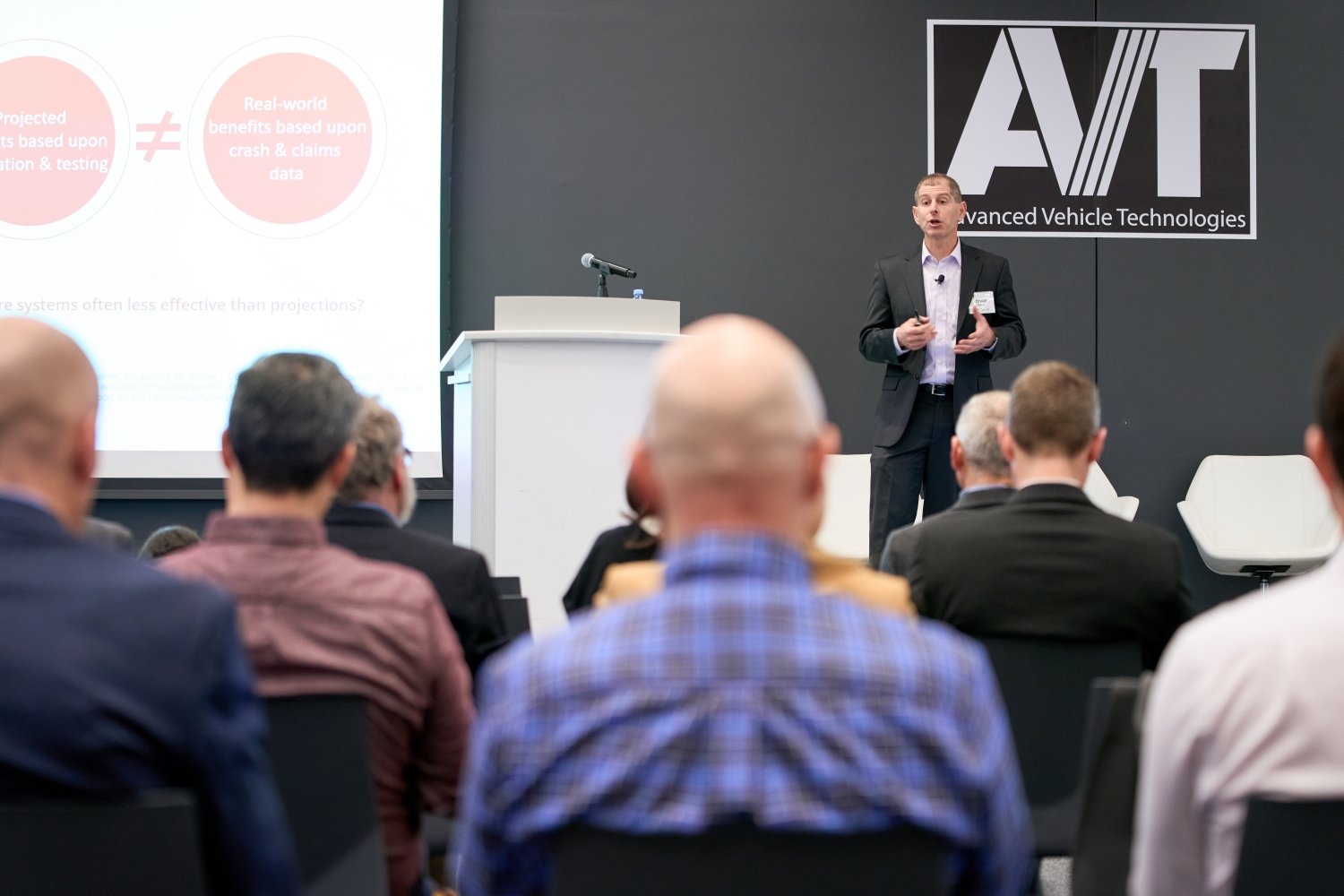
© Photo: Kelly Davidson Studio

Bryan Reimer, founder and co-director of the AVT Consortium, gives the opening remarks.
❌