
Reading view

There are new articles available, click to refresh the page.

Do solar panels work in cold or cloudy climates?

Reading Time: < 1 minute

YES

Solar panels still generate electricity on cloudy days and in cold weather, albeit less.

Clouds cut output as less sunlight reaches the panels, but they continue producing power from indirect light. Snow cover can temporarily block light, though it is typically not obstructed by thin layers of snow. Additionally, most solar panels in the U.S. run more efficiently in cooler weather, as heat lowers performance.

Winter generation can be lower due to shorter days, notably at middle latitudes; cities like Denver receive nearly three times more solar energy in June than December. This mainly affects what share of a home’s electricity solar covers, especially where heating raises demand. Average winter electricity use of U.S. homes is estimated to be six times that of summer use. 

Despite seasonal dips, solar still displaces fossil fuel electricity over the year, delivering large net emissions reductions across a panel’s multi-decade lifespan.

This fact brief is responsive to conversations such as this one.


This fact brief was originally published by Skeptical Science on February 19, 2026, and was authored by Sue Bin Park. Skeptical Science is a member of the Gigafact network.

Do solar panels work in cold or cloudy climates? is a post from Wisconsin Watch, a non-profit investigative news site covering Wisconsin since 2009. Please consider making a contribution to support our journalism.

Corn’s clean energy promise is clashing with its climate footprint

A person in a blue shirt holds a partially husked ear of corn while standing beside another person outdoors with vehicles in the background.
Reading Time: 11 minutes

For decades, corn has reigned over American agriculture. It sprawls across 90 million acres — about the size of Montana — and goes into everything from livestock feed and processed foods to the ethanol blended into most of the nation’s gasoline. 

But a growing body of research reveals that America’s obsession with corn has a steep price: The fertilizer used to grow it is warming the planet and contaminating water.

Corn is essential to the rural economy and to the world’s food supply, and researchers say the problem isn’t the corn itself. It’s how we grow it. 

Corn farmers rely on heavy fertilizer use to sustain today’s high yields. And when that nitrogen breaks down in the soil, it releases nitrous oxide, a greenhouse gas nearly 300 times more potent than carbon dioxide. Producing nitrogen fertilizer also emits large amounts of carbon dioxide, adding to its climate footprint.

Agriculture accounts for more than 10% of U.S. greenhouse gas emissions, and corn uses more than two-thirds of all nitrogen fertilizer nationwide — making it the leading driver of agricultural nitrous oxide emissions, studies show.

The corn and ethanol industries insist that rapid growth in ethanol — which now consumes more than 40% of the U.S. corn crop —  is a net environmental benefit, and they strongly dispute research suggesting otherwise.

Since 2000, U.S. corn production has surged almost 50%, further adding to the crop’s climate impact. 

Yet the environmental costs of corn rarely make headlines or factor into political debates. Much of the dynamic traces back to federal policy — and to the powerful corn and ethanol lobby that helped shape it. 

Iowa corn farmer Levi Lyle uses a roller crimper to flatten cover crops, creating a mulch that suppresses weeds, feeds the soil and reduces or eliminates the need for fertilizer. (Video courtesy of Levi Lyle)

The Renewable Fuel Standard, passed in the mid 2000s, required that gasoline be blended with ethanol, a biofuel that in the United States comes almost entirely from corn. That mandate drove up demand and prices for corn, spurring farmers to plant more of it. 

Many plant corn year after year on the same land. The practice, called “continuous corn,” demands massive amounts of nitrogen fertilizer and drives especially high nitrous oxide emissions. 

At the same time, federal subsidies make it more lucrative to grow corn than to diversify. Taxpayers have covered more than $50 billion in corn insurance premiums over the past 30 years, according to federal data compiled by the Environmental Working Group.

Researchers say proven conservation steps — such as planting rows of trees, shrubs and grasses in corn fields — could sharply reduce these emissions. But the Trump administration has eliminated many of the incentives that helped farmers try such practices

Experts say it all raises a larger question: If America’s most widely planted crop is worsening climate change, shouldn’t we begin growing it a different way?

How corn took over America

Corn has been a staple of U.S. agriculture for centuries, first domesticated by Native Americans and later used by European immigrants as a versatile crop for food and animal feed. Its production really took off in the 2000s after federal mandates and incentives helped turn much of America’s corn crop into ethanol.

Corn’s dominance — and the emissions that come with it — didn’t happen by accident. It was built through a high-dollar lobbying campaign that continues today.

In the late 1990s, America’s corn farmers were in trouble. Prices had cratered amid a global grain glut and the Asian financial crisis. A 1999 report by the Federal Reserve Bank of Minneapolis said crop prices had hit “rock bottom.”

In 2001 and 2002, the federal government gave corn farmers and ethanol producers a boost — first through the U.S. Department of Agriculture’s Bioenergy Program, which paid ethanol producers to increase their use of farm commodities for fuel. Then the 2002 Farm Bill created programs that continue to support ethanol and other renewable energy.

Corn growers soon after mounted an all-out campaign in Washington. Their goal: persuade Congress to require gasoline to be blended with ethanol. State and national grower groups lobbied relentlessly, pitching ethanol as a way to cut greenhouse gasses, reduce oil dependence and revive rural economies.

“We got down to a couple of votes in Congress, and the corn growers were united like never before,” recalled Jon Doggett, then the industry’s chief lobbyist, in an article published by the National Corn Growers Association. “I started receiving calls from Capitol Hill saying, ‘Would you have your growers stop calling us? We are with you.’ I had not seen anything like it before and haven’t seen anything like it since.”

Their persistence paid off. In 2005, Congress created the Renewable Fuel Standard (RFS), which requires that a certain amount of ethanol be blended into U.S. gasoline each year. Two years later, lawmakers expanded it further. The policy transformed the market: The amount of corn used for ethanol domestically has more than tripled in the past 20 years.

When demand for corn spiked as a result of the RFS, it pushed up prices worldwide, said Tim Searchinger, a researcher at Princeton University’s School of Public and International Affairs. The result, Searchinger said, is that more land around the world got cleared to grow corn. That, in turn, resulted in more emissions. 

That lobbying brought clout. “King Corn” became a political force, courted by presidential hopefuls and protected by both parties. Since 2010, national corn and ethanol trade groups have spent more than $55 million on lobbying and millions more on political donations, according to campaign finance records analyzed by Floodlight. 

In 2024 alone, those trade groups spent twice as much on lobbying as the National Rifle Association. Major industry players — Archer Daniels Midland, Cargill and ethanol giant POET among them — have poured even more into Washington, ensuring the sector’s voice remains one of the loudest in U.S. agriculture.

Now those same groups are pushing for the next big prize: expanding higher-ethanol gasoline blends and positioning ethanol-based jet fuel as aviation’s “low-carbon” future.

Research undercuts ethanol’s clean fuel claims

Corn and ethanol trade groups didn’t make their officials available for interviews.

But on their websites and in their literature, they have promoted corn ethanol as a climate-friendly fuel. 

The Renewable Fuels Association cites government and university research that finds burning ethanol reduces greenhouse gas emissions by roughly 40-50% compared with gasoline. The ethanol industry says the climate critics have it wrong — and that most of the corn used for fuel comes from better yields and smarter farming, not from plowing up new land. The amount of fertilizer required to produce a bushel of corn has dropped sharply in recent decades, they say.

“Ethanol reduces carbon emissions, removing the carbon equivalent of 12 million cars from the road each year,” according to the Renewable Fuels Association.

Growth Energy, a major ethanol trade group, said in a written statement that U.S. farmers and biofuel producers are “constantly finding new ways to make their operations more efficient and more environmentally beneficial,” using things like cover crops to reduce their carbon footprint.

But some research tells a different story.

A recent Environmental Working Group report finds that the way corn is grown in much of the Midwest — with the same fields planted in corn year after year — carries a heavy climate cost.

Four U.S. maps labeled 1900s, 1960s, 1990s and 2010s show increasing colored areas representing nitrous oxide emission levels using a scale from black to red.
Emissions of nitrous oxide — an extremely potent greenhouse gas — have soared in America’s Corn Belt in the years since nitrogen fertilizer use became widespread. (Environmental Working Group visualization of nitrous oxide data from Iowa State University researcher Chaoqun Lu and colleagues)

Research in 2022 by agricultural land use expert Tyler Lark and colleagues links the Renewable Fuel Standard to expanded corn cultivation, heavier fertilizer use, worsening water pollution and increased emissions. Scientists typically convert greenhouse gases like nitrous oxide and methane into their carbon dioxide equivalents — or carbon intensity — so their warming impacts can be compared on the same scale.

“The carbon intensity of corn ethanol produced under the RFS is no less than gasoline and likely at least 24% higher,” the authors concluded.

Lark’s research has been disputed by scientists at Argonne National Laboratory, Purdue University and the University of Illinois, who published a formal rebuttal arguing the study relied on “questionable assumptions” and faulty modeling — a charge Lark’s team has rejected.

A 2017 report by the U.S. Government Accountability Office found that the RFS was unlikely to meet its greenhouse gas goals because the U.S. relies predominantly on corn ethanol and produces relatively little of the cleaner, advanced biofuels made from waste. 

The problem isn’t just emissions, researchers say. Corn ethanol requires millions of acres that could instead be used for food crops or more efficient energy sources. One recent study found that solar panels can generate as much energy as corn ethanol on roughly 3% of the land. 

“It’s just a terrible use of land,” Searchinger, the Princeton researcher, said of ethanol. “And you can’t solve climate change if you’re going to make such terrible use of land.”

Most of the country’s top crop isn’t feeding people. More than 40% of U.S. corn goes to ethanol. A similar amount is used to feed livestock, and just 12% ends up as food or in other uses.

Cows stand in a muddy fenced enclosure with more cows grazing nearby on land under an overcast sky.
Cattle and other livestock eat more than 40% of the corn grown in the United States. A similar amount is used to make ethanol. Just 12% ends up as food for people or in other uses. (Dee J. Hall / Floodlight)

As corn production rises, so have emissions 

Globally, corn production doubled from 2000 to 2021. 

That growth has been fueled by fertilizer, which emits nitrous oxide that can linger in the atmosphere for more than a century. That eats away at the ozone layer, which blocks most of the sun’s harmful ultraviolet radiation.

Global emissions have soared alongside corn production. Between 1980 and 2020, nitrous oxide emissions from human activity climbed 40%, the Global Carbon project found. 

In the United States, nitrous oxide emissions from agriculture in 2022 were equal to roughly 262 million metric tons of carbon dioxide, according to the EPA’s inventory of greenhouse gas emissions. That’s equivalent to putting almost 56 million passenger cars on the road.

The biggest increases are coming straight from the Corn Belt.

Corn falls out of a tube labeled AGI next to a tall metal structure.
Corn is loaded into a semi-trailer for transport at this grain terminal in Fitchburg, Wis., in October 2025. (Dee J. Hall / Floodlight)

Ethanol’s climate footprint isn’t the only concern. The nitrogen used to grow corn and other crops is also a key source of drinking water pollution.

According to a new report by the Alliance for the Great Lakes and Clean Wisconsin, more than 90% of nitrate contamination in Wisconsin’s groundwater is linked to agricultural sources — mostly synthetic fertilizer and manure. 

The same analysis estimates that in 2022, farmers applied more than 16 million pounds of nitrogen beyond what crops needed, sending runoff into wells, streams and other water systems.

For families like Tyler Frye’s, that hits close to home. In 2022, Frye and his wife moved into a new home in the rural village of Casco, Wisconsin, about 20 miles east of Green Bay. A free test soon afterward found their well water had nitrate levels more than twice the EPA’s safe limit. “We were pretty shocked,” he said. 

Frye installed a reverse-osmosis system in the basement and still buys bottled water for his wife, who is breastfeeding their daughter, born in July.

One likely culprit, he suspects, are the cornfields less than 200 yards from his home. 

“Crops like corn require a lot of nitrogen,” he said. “A lot of that stuff, I assume, is getting into the well water and surface water.”

When he watches manure or fertilizer being spread on nearby fields, he said, one question nags him: “Where does that go?”

What cleaner corn could look like

Reducing corn’s climate footprint is possible — but the farmers trying to do it are swimming against the policy tide.

The One Big Beautiful Bill Act, backed by President Donald Trump and congressional Republicans, strips out the provisions of President Joe Biden’s Inflation Reduction Act that had rewarded farmers for climate-friendly practices.

And in April, Trump’s USDA canceled the $3 billion Partnerships for Climate-Smart Commodities initiative, a grant program designed to promote farming and forestry practices to improve soil and reduce greenhouse gas emissions. The agency said that the program’s administrative costs meant too little money was reaching farmers, while Agriculture Secretary Brooke Rollins dismissed it as part of the “green new scam.” 

University of Iowa professor Silvia Secchi said the rollback of the Climate-Smart program has already given farmers “cold feet” about adopting conservation practices. “The impact of this has been devastating,” said Secchi, a natural resources economist who teaches at the university’s School of Earth, Environment and Sustainability.

Research shows what’s possible if farmers had support. In its recent report, the Environmental Working Group found that four proven conservation practices — including planting trees, shrubs and hedgerows in corn fields — could make a measurable difference. 

Implementing those practices on just 4% of continuous corn acres across Illinois, Iowa, Minnesota and Wisconsin would cut total greenhouse gas emissions by the equivalent of taking more than 850,000 gasoline cars off the road, EWG found.

Despite setbacks at the federal level, some farmers are already showing what a more climate-friendly Corn Belt could look like.

In northern Iowa, Wendy Johnson farms 1,200 acres of corn and soybeans with her father. On 130 of those acres, she’s trying something different: She’s planting fruit and nut trees, organic grains, shrubs and other plants that need little or no nitrogen fertilizer. 

“The more perennials we can have on the ground, the better it is for the climate,” she said. 

Across the rest of the farm, they enrich the soil by rotating crops and planting cover crops. They’ve also converted less productive parts of the fields into “prairie strips” — bands of prairie grass that store carbon and require no fertilizer. 

A person stands beside farm equipment at the edge of a dry crop field under a clear blue sky.
Wendy Johnson stands beside a “prairie strip” — prairie grasses and perennials that store carbon and need no fertilizer — on the Iowa corn farm she runs with her father. She and her father were set to receive about $20,000 a year in federal support to expand conservation practices, but the U.S. Department of Agriculture canceled the Climate-Smart grant program in April before any funds arrived. (Courtesy of Wendy Johnson)

Under the now-canceled Climate-Smart grant program, they were supposed to receive technical assistance and about $20,000 a year to expand those practices. The grant program was terminated before they got any of the money.

“It’s hard to take risks on your own,” Johnson said. “That’s where federal support really helps. Because agriculture is a high-risk occupation.”

The economics still favor business as usual. Johnson knows that many Midwestern corn growers feel pressure to maximize yields, keeping them hooked on corn — and nitrogen fertilizer. 

“I think a lot of farmers around here are very allergic to trees,” she joked. 

Rows of corn plants in a field with white farm buildings and trees in the background.
Iowa farmer Levi Lyle planted this corn in soil with mulch made from cover crops instead of synthetic fertilizer. This type of mulch suppresses weeds, enriches soil and reduces or eliminates the need for nitrogen fertilizer. It’s a “huge opportunity to sequester more carbon, improve soil health, save money on chemicals and still get a similar yield,” Lyle says. (Courtesy of Levi Lyle)

In southeast Iowa, sixth-generation farmer Levi Lyle, who mixes organic and conventional methods across 290 acres, uses a three-year rotation, extensive cover crops and a technique called roller-crimping — flattening rye each spring to create a mulch that suppresses weeds, feeds the soil and reduces fertilizer needs. 

“The roller crimping of cover crops is a huge, huge opportunity to sequester more carbon, improve soil health, save money on chemicals and still get a similar yield,” he said.

But farmers get few government incentives to take such climate-friendly steps, Lyle said. “There is a lack of seriousness about supporting farmers to implement these new practices,” he said. 

And without federal programs to offset the risk, the innovations that Lyle and Johnson are trying remain exceptions — not the norm.

Many farmers still see prairie strips or patches of trees as a waste, said Luke Gran, whose company helps Iowa farmers establish perennials.

“My eyes do not lie,” Gran said. “I have not seen extensive change to cover cropping or tillage across the broad acreage of this state that I love.”

The next corn boom?

Despite mounting research about corn’s climate costs, industry groups are pushing for policies to boost ethanol demand. 

One big priority: pushing a bill to require that new cars are able to run on gas with more ethanol than what’s commonly sold today.

Corn and biofuel trade groups have also been pressing Democrats and Republicans in Congress for legislation to pave the way for ethanol-based jet fuel. While use of such “sustainable” aviation fuel is still in its early stages domestically, corn and biofuel associations have made developing a market for it a top policy priority. 

Secchi, the Iowa professor, says it’s easy to see why ethanol producers are trying to expand their market: The growth in electric vehicles threatens long-term gasoline sales.

Researchers warn that producing enough ethanol-based jet fuel could trigger major land use shifts. A 2024 World Resources Institute analysis found that meeting the federal goal of 35 billion gallons of ethanol jet fuel would require about 114 million acres of corn — roughly 20% more corn acreage than the U.S. already plants for all purposes. That surge in demand, the authors concluded, would push up food prices and worsen hunger.

Secchi calls that scenario a climate and land use “disaster.” Large-scale use of ethanol-based aviation fuel, she said, would mean clearing even more land and pouring on even more nitrogen fertilizer, driving up greenhouse gas emissions. 

“The result,” she said, “would be essentially to enshrine this dysfunctional system that we created.”

This story is from Floodlight, a nonprofit newsroom that investigates the powers stalling climate action. Sign up for Floodlight’s newsletter here.

Corn’s clean energy promise is clashing with its climate footprint is a post from Wisconsin Watch, a non-profit investigative news site covering Wisconsin since 2009. Please consider making a contribution to support our journalism.

How artificial intelligence can help achieve a clean energy future

There is growing attention on the links between artificial intelligence and increased energy demands. But while the power-hungry data centers being built to support AI could potentially stress electricity grids, increase customer prices and service interruptions, and generally slow the transition to clean energy, the use of artificial intelligence can also help the energy transition.

For example, use of AI is reducing energy consumption and associated emissions in buildings, transportation, and industrial processes. In addition, AI is helping to optimize the design and siting of new wind and solar installations and energy storage facilities.

On electric power grids, using AI algorithms to control operations is helping to increase efficiency and reduce costs, integrate the growing share of renewables, and even predict when key equipment needs servicing to prevent failure and possible blackouts. AI can help grid planners schedule investments in generation, energy storage, and other infrastructure that will be needed in the future. AI is also helping researchers discover or design novel materials for nuclear reactors, batteries, and electrolyzers.

Researchers at MIT and elsewhere are actively investigating aspects of those and other opportunities for AI to support the clean energy transition. At its 2025 research conference, MITEI announced the Data Center Power Forum, a targeted research effort for MITEI member companies interested in addressing the challenges of data center power demand.

Controlling real-time operations

Customers generally rely on receiving a continuous supply of electricity, and grid operators get help from AI to make that happen — while optimizing the storage and distribution of energy from renewable sources at the same time.

But with more installation of solar and wind farms — both of which provide power in smaller amounts, and intermittently — and the growing threat of weather events and cyberattacks, ensuring reliability is getting more complicated. “That’s exactly where AI can come into the picture,” explains Anuradha Annaswamy, a senior research scientist in MIT’s Department of Mechanical Engineering and director of MIT’s Active-Adaptive Control Laboratory. “Essentially, you need to introduce a whole information infrastructure to supplement and complement the physical infrastructure.”

The electricity grid is a complex system that requires meticulous control on time scales ranging from decades all the way down to microseconds. The challenge can be traced to the basic laws of power physics: electricity supply must equal electricity demand at every instant, or generation can be interrupted. In past decades, grid operators generally assumed that generation was fixed — they could count on how much electricity each large power plant would produce — while demand varied over time in a fairly predictable way. As a result, operators could commission specific power plants to run as needed to meet demand the next day. If some outages occurred, specially designated units would start up as needed to make up the shortfall.

Today and in the future, that matching of supply and demand must still happen, even as the number of small, intermittent sources of generation grows and weather disturbances and other threats to the grid increase. AI algorithms provide a means of achieving the complex management of information needed to forecast within just a few hours which plants should run while also ensuring that the frequency, voltage, and other characteristics of the incoming power are as required for the grid to operate properly.

Moreover, AI can make possible new ways of increasing supply or decreasing demand at times when supplies on the grid run short. As Annaswamy points out, the battery in your electric vehicle (EV), as well as the one charged up by solar panels or wind turbines, can — when needed — serve as a source of extra power to be fed into the grid. And given real-time price signals, EV owners can choose to shift charging from a time when demand is peaking and prices are high to a time when demand and therefore prices are both lower. In addition, new smart thermostats can be set to allow the indoor temperature to drop or rise —  a range defined by the customer — when demand on the grid is peaking. And data centers themselves can be a source of demand flexibility: selected AI calculations could be delayed as needed to smooth out peaks in demand. Thus, AI can provide many opportunities to fine-tune both supply and demand as needed.

In addition, AI makes possible “predictive maintenance.” Any downtime is costly for the company and threatens shortages for the customers served. AI algorithms can collect key performance data during normal operation and, when readings veer off from that normal, the system can alert operators that something might be going wrong, giving them a chance to intervene. That capability prevents equipment failures, reduces the need for routine inspections, increases worker productivity, and extends the lifetime of key equipment.

Annaswamy stresses that “figuring out how to architect this new power grid with these AI components will require many different experts to come together.” She notes that electrical engineers, computer scientists, and energy economists “will have to rub shoulders with enlightened regulators and policymakers to make sure that this is not just an academic exercise, but will actually get implemented. All the different stakeholders have to learn from each other. And you need guarantees that nothing is going to fail. You can’t have blackouts.”

Using AI to help plan investments in infrastructure for the future

Grid companies constantly need to plan for expanding generation, transmission, storage, and more, and getting all the necessary infrastructure built and operating may take many years, in some cases more than a decade. So, they need to predict what infrastructure they’ll need to ensure reliability in the future. “It’s complicated because you have to forecast over a decade ahead of time what to build and where to build it,” says Deepjyoti Deka, a research scientist in MITEI.

One challenge with anticipating what will be needed is predicting how the future system will operate. “That’s becoming increasingly difficult,” says Deka, because more renewables are coming online and displacing traditional generators. In the past, operators could rely on “spinning reserves,” that is, generating capacity that’s not currently in use but could come online in a matter of minutes to meet any shortfall on the system. The presence of so many intermittent generators — wind and solar — means there’s now less stability and inertia built into the grid. Adding to the complication is that those intermittent generators can be built by various vendors, and grid planners may not have access to the physics-based equations that govern the operation of each piece of equipment at sufficiently fine time scales. “So, you probably don’t know exactly how it’s going to run,” says Deka.

And then there’s the weather. Determining the reliability of a proposed future energy system requires knowing what it’ll be up against in terms of weather. The future grid has to be reliable not only in everyday weather, but also during low-probability but high-risk events such as hurricanes, floods, and wildfires, all of which are becoming more and more frequent, notes Deka. AI can help by predicting such events and even tracking changes in weather patterns due to climate change.

Deka points out another, less-obvious benefit of the speed of AI analysis. Any infrastructure development plan must be reviewed and approved, often by several regulatory and other bodies. Traditionally, an applicant would develop a plan, analyze its impacts, and submit the plan to one set of reviewers. After making any requested changes and repeating the analysis, the applicant would resubmit a revised version to the reviewers to see if the new version was acceptable. AI tools can speed up the required analysis so the process moves along more quickly. Planners can even reduce the number of times a proposal is rejected by using large language models to search regulatory publications and summarize what’s important for a proposed infrastructure installation.

Harnessing AI to discover and exploit advanced materials needed for the energy transition

“Use of AI for materials development is booming right now,” says Ju Li, MIT’s Carl Richard Soderberg Professor of Power Engineering. He notes two main directions.

First, AI makes possible faster physics-based simulations at the atomic scale. The result is a better atomic-level understanding of how composition, processing, structure, and chemical reactivity relate to the performance of materials. That understanding provides design rules to help guide the development and discovery of novel materials for energy generation, storage, and conversion needed for a sustainable future energy system.

And second, AI can help guide experiments in real time as they take place in the lab. Li explains: “AI assists us in choosing the best experiment to do based on our previous experiments and — based on literature searches — makes hypotheses and suggests new experiments.”

He describes what happens in his own lab. Human scientists interact with a large language model, which then makes suggestions about what specific experiments to do next. The human researcher accepts or modifies the suggestion, and a robotic arm responds by setting up and performing the next step in the experimental sequence, synthesizing the material, testing the performance, and taking images of samples when appropriate. Based on a mix of literature knowledge, human intuition, and previous experimental results, AI thus coordinates active learning that balances the goals of reducing uncertainty with improving performance. And, as Li points out, “AI has read many more books and papers than any human can, and is thus naturally more interdisciplinary.”

The outcome, says Li, is both better design of experiments and speeding up the “work flow.” Traditionally, the process of developing new materials has required synthesizing the precursors, making the material, testing its performance and characterizing the structure, making adjustments, and repeating the same series of steps. AI guidance speeds up that process, “helping us to design critical, cheap experiments that can give us the maximum amount of information feedback,” says Li.

“Having this capability certainly will accelerate material discovery, and this may be the thing that can really help us in the clean energy transition,” he concludes. “AI [has the potential to] lubricate the material-discovery and optimization process, perhaps shortening it from decades, as in the past, to just a few years.” 

MITEI’s contributions

At MIT, researchers are working on various aspects of the opportunities described above. In projects supported by MITEI, teams are using AI to better model and predict disruptions in plasma flows inside fusion reactors — a necessity in achieving practical fusion power generation. Other MITEI-supported teams are using AI-powered tools to interpret regulations, climate data, and infrastructure maps in order to achieve faster, more adaptive electric grid planning. AI-guided development of advanced materials continues, with one MITEI project using AI to optimize solar cells and thermoelectric materials.

Other MITEI researchers are developing robots that can learn maintenance tasks based on human feedback, including physical intervention and verbal instructions. The goal is to reduce costs, improve safety, and accelerate the deployment of the renewable energy infrastructure. And MITEI-funded work continues on ways to reduce the energy demand of data centers, from designing more efficient computer chips and computing algorithms to rethinking the architectural design of the buildings, for example, to increase airflow so as to reduce the need for air conditioning.

In addition to providing leadership and funding for many research projects, MITEI acts as a convenor, bringing together interested parties to consider common problems and potential solutions. In May 2025, MITEI’s annual spring symposium — titled “AI and energy: Peril and promise” — brought together AI and energy experts from across academia, industry, government, and nonprofit organizations to explore AI as both a problem and a potential solution for the clean energy transition. At the close of the symposium, William H. Green, director of MITEI and Hoyt C. Hottel Professor in the MIT Department of Chemical Engineering, noted, “The challenge of meeting data center energy demand and of unlocking the potential benefits of AI to the energy transition is now a research priority for MITEI.”

© Image: Igor Borisenko/iStock
Researchers at MIT and elsewhere are investigating how AI can be harnessed to support the clean energy transition.

Rooftop panels, EV chargers, and smart thermostats could chip in to boost power grid resilience

There’s a lot of untapped potential in our homes and vehicles that could be harnessed to reinforce local power grids and make them more resilient to unforeseen outages, a new study shows.

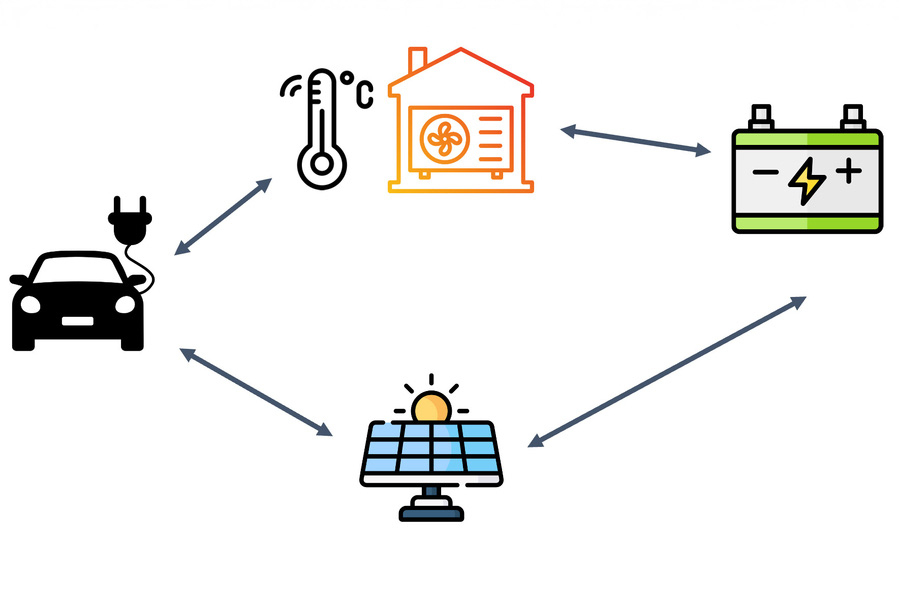
In response to a cyber attack or natural disaster, a backup network of decentralized devices — such as residential solar panels, batteries, electric vehicles, heat pumps, and water heaters — could restore electricity or relieve stress on the grid, MIT engineers say.

Such devices are “grid-edge” resources found close to the consumer rather than near central power plants, substations, or transmission lines. Grid-edge devices can independently generate, store, or tune their consumption of power. In their study, the research team shows how such devices could one day be called upon to either pump power into the grid, or rebalance it by dialing down or delaying their power use.

In a paper appearing this week in the Proceedings of the National Academy of Sciences, the engineers present a blueprint for how grid-edge devices could reinforce the power grid through a “local electricity market.” Owners of grid-edge devices could subscribe to a regional market and essentially loan out their device to be part of a microgrid or a local network of on-call energy resources.

In the event that the main power grid is compromised, an algorithm developed by the researchers would kick in for each local electricity market, to quickly determine which devices in the network are trustworthy. The algorithm would then identify the combination of trustworthy devices that would most effectively mitigate the power failure, by either pumping power into the grid or reducing the power they draw from it, by an amount that the algorithm would calculate and communicate to the relevant subscribers. The subscribers could then be compensated through the market, depending on their participation.

The team illustrated this new framework through a number of grid attack scenarios, in which they considered failures at different levels of a power grid, from various sources such as a cyber attack or a natural disaster. Applying their algorithm, they showed that various networks of grid-edge devices were able to dissolve the various attacks.

The results demonstrate that grid-edge devices such as rooftop solar panels, EV chargers, batteries, and smart thermostats (for HVAC devices or heat pumps) could be tapped to stabilize the power grid in the event of an attack.

“All these small devices can do their little bit in terms of adjusting their consumption,” says study co-author Anu Annaswamy, a research scientist in MIT’s Department of Mechanical Engineering. “If we can harness our smart dishwashers, rooftop panels, and EVs, and put our combined shoulders to the wheel, we can really have a resilient grid.”

The study’s MIT co-authors include lead author Vineet Nair and John Williams, along with collaborators from multiple institutions including the Indian Institute of Technology, the National Renewable Energy Laboratory, and elsewhere.

Power boost

The team’s study is an extension of their broader work in adaptive control theory and designing systems to automatically adapt to changing conditions. Annaswamy, who leads the Active-Adaptive Control Laboratory at MIT, explores ways to boost the reliability of renewable energy sources such as solar power.

“These renewables come with a strong temporal signature, in that we know for sure the sun will set every day, so the solar power will go away,” Annaswamy says. “How do you make up for the shortfall?”

The researchers found the answer could lie in the many grid-edge devices that consumers are increasingly installing in their own homes.

“There are lots of distributed energy resources that are coming up now, closer to the customer rather than near large power plants, and it’s mainly because of individual efforts to decarbonize,” Nair says. “So you have all this capability at the grid edge. Surely we should be able to put them to good use.”

While considering ways to deal with drops in energy from the normal operation of renewable sources, the team also began to look into other causes of power dips, such as from cyber attacks. They wondered, in these malicious instances, whether and how the same grid-edge devices could step in to stabilize the grid following an unforeseen, targeted attack.

Attack mode

In their new work, Annaswamy, Nair, and their colleagues developed a framework for incorporating grid-edge devices, and in particular, internet-of-things (IoT) devices, in a way that would support the larger grid in the event of an attack or disruption. IoT devices are physical objects that contain sensors and software that connect to the internet.

For their new framework, named EUREICA (Efficient, Ultra-REsilient, IoT-Coordinated Assets), the researchers start with the assumption that one day, most grid-edge devices will also be IoT devices, enabling rooftop panels, EV chargers, and smart thermostats to wirelessly connect to a larger network of similarly independent and distributed devices. 

The team envisions that for a given region, such as a community of 1,000 homes, there exists a certain number of IoT devices that could potentially be enlisted in the region’s local network, or microgrid. Such a network would be managed by an operator, who would be able to communicate with operators of other nearby microgrids.

If the main power grid is compromised or attacked, operators would run the researchers’ decision-making algorithm to determine trustworthy devices within the network that can pitch in to help mitigate the attack.

The team tested the algorithm on a number of scenarios, such as a cyber attack in which all smart thermostats made by a certain manufacturer are hacked to raise their setpoints simultaneously to a degree that dramatically alters a region’s energy load and destabilizes the grid. The researchers also considered attacks and weather events that would shut off the transmission of energy at various levels and nodes throughout a power grid.

“In our attacks we consider between 5 and 40 percent of the power being lost. We assume some nodes are attacked, and some are still available and have some IoT resources, whether a battery with energy available or an EV or HVAC device that’s controllable,” Nair explains. “So, our algorithm decides which of those houses can step in to either provide extra power generation to inject into the grid or reduce their demand to meet the shortfall.”

In every scenario that they tested, the team found that the algorithm was able to successfully restabilize the grid and mitigate the attack or power failure. They acknowledge that to put in place such a network of grid-edge devices will require buy-in from customers, policymakers, and local officials, as well as innovations such as advanced power inverters that enable EVs to inject power back into the grid.

“This is just the first of many steps that have to happen in quick succession for this idea of local electricity markets to be implemented and expanded upon,” Annaswamy says. “But we believe it’s a good start.”

This work was supported, in part, by the U.S. Department of Energy and the MIT Energy Initiative.

© Credit: Courtesy of the researchers

An example of the different types of IoT devices, physical objects that contain sensors and software that connect to the internet, that are coordinated to increase power grid resilience.

Plan to expand airport for private jets runs into new Massachusetts climate law

An aerial photo of Hanscom Field showing two runways crossing and a group of hangars and other buildings.

Massachusetts environmental advocates hope a provision in the state’s new climate law could be a final blow to a proposed expansion of private jet facilities at a suburban airport. 

Opponents say adding 500,000 square feet of hangar space at Hanscom Field, a general aviation airport that serves private and corporate aircraft in a town 20 miles outside of Boston, will inevitably mean more flights — mostly private jet travel to luxury locations — which will increase climate pollution with minimal public benefit.

“This is an industry that is highly polluting and yet serves only a very narrow slice of the public,” said Alex Chatfield, a local social worker and an activist fighting the project. 

The expansion plans have been in the works since 2021, but progress slowed in June after state regulators rejected the planners’ first environmental impact report. Since then, state lawmakers passed a new law requiring state agencies and boards, including the state port authority, to consider the impact of greenhouse gas emissions in their decisions. 

The measure does not directly prohibit the Massachusetts Port Authority from proceeding with projects such as the Hanscom plan, but it does leave the agency vulnerable to legal action should it forge ahead without being able to show it weighed the likely greenhouse gas emissions against the benefits of the plan. 

Much-needed hangars

The expansion plan started with Massport, which oversees operations at Hanscom as well as Boston’s Logan International Airport and Worcester Regional Airport. In 2021, the agency released a request for proposals to develop “much-needed hangars” at the airport, said Massport spokesperson Jennifer Mehigan. A plan submitted by North Airfield Ventures and Runway Realty Ventures won the bid. 

The proposed facilities would be built on 47 acres of land, some of which is already owned by the developers and some of which would be leased to them by Massport. The project comprises 17 new hangars, the rehabilitation of a historic Navy hangar on the site, and fuel storage facilities. 

Planners argue the development would be environmentally beneficial, because the structures would be designed for net-zero energy use and built to LEED Gold standards, and buildings and equipment would be electrified whenever possible. They also claim the additional capacity would help cut down on emissions from so-called “ferry flights,” in which a plane hangared elsewhere flies to Hanscom to pick up passengers and then returns to its home airport at the end of the trip. 

Opponents, however, argue that more hangars will inevitably mean more flights. These flights, they say, are likely to be private jet travel to luxury locations, generating emissions for the benefit of just a privileged few. One report, by Washington, D.C.-based Institute for Policy Studies, found that 31,600 private flights departed Hanscom during an 18-month period in 2022 and 2023, and that roughly half of those were bound for high-end vacation destinations like the Bahamas, Palm Beach, and Nantucket.

“It’s very well known that private jets are the most polluting form of transportation per passenger ever devised,” Chatfield said. “It is on a scale that is really hard to imagine.”

State environmental regulators are also skeptical. The state response to the developers’ first environmental impact report, referred to the “fanciful nature of the proponents’ ‘ferry flight theory,’” pointing to a study that found only 132 ferry flights actually occurred at Hanscom rather than the 3,500 developers claimed. Regulators also suggested new hangars at Hanscom were unlikely to attract planes to relocate, and therefore would not reduce what ferry flights do occur.

The developers can resubmit their environmental impact report, addressing the state’s concerns. One of the founders of North Airfield Ventures said the company declines to comment on its plans at this time. 

Factoring in climate impacts

In the months since the state’s order was released, legislators created another obstacle for the project. 

As Massachusetts attempts to reach its goal of net-zero carbon emissions, an ongoing mundane-yet-important challenge has been the fact that some crucial state agencies and boards have lacked the authority to factor climate impacts in their decisions. These bodies were founded well before the climate crisis became such a pressing public policy question, and thus their rules never required or authorized them to consider greenhouse gas emissions or other climate impacts in their decision-making. 

In recent years, attempts have been made to integrate climate change mitigation into more statewide policies and processes. A climate law enacted in 2021 requires the administration to set greenhouse gas reduction goals to be realized by the state’s three-year energy efficiency plans, which were initially intended only to reduce the cost and quantity of electricity, gas, and oil used. The same bill instructed public utilities regulators to consider greenhouse gas impact as part of their decisions. 

“The department up to that point had just focused on reliability and affordability,” said state Sen. Michael Barrett, chair of the legislature’s committee on telecommunications, utilities, and energy, and one of the main authors of both the 2021 and 2024 climate bills. “I have wanted to reorient state agencies that don’t seem to have gotten the memo about climate change being an existential crisis.”

The latest bill included more such provisions, authorizing the Board of Building Regulations and Standards to give preference to building materials that boost emissions reductions, and requiring Massport to consider the greenhouse gas impacts of its decisions.

“I hope that Massport appreciates that what is done today on climate is inadequate, and I hope it also appreciates that the policies have changed,” said Barrett. “I don’t pretend to be able to predict particular outcomes on particular projects, but I do know that Massport needs to take this seriously.”

Plan to expand airport for private jets runs into new Massachusetts climate law is an article from Energy News Network, a nonprofit news service covering the clean energy transition. If you would like to support us please make a donation.

Commentary: Trump may struggle to repeal this IRA provision; Massachusetts should use it

The following commentary was written by Daksh Arora, a project engineer at GameChange Solar, content director for the MIT Energy Conference 2025, and a fellow at the Clean Energy Leadership Institute. See our commentary guidelines for more information.


States like Massachusetts must take the lead in advancing the United States’ climate goals, especially under the incoming Trump administration. While the Biden Administration’s landmark Inflation Reduction Act (IRA) of 2022 made significant strides, the U.S. is still on track to achieve only 66% of its greenhouse gas reduction targets by 2030.

With the potential for further setbacks, such as a possible second withdrawal from the Paris Agreement, states like Massachusetts must step up to drive the deployment of clean energy and climate solutions.

The “Direct Pay” provision in the Inflation Reduction Act (IRA) is a game-changer for municipalities, state and local governments, and other tax-exempt entities to access federal clean energy tax credits. This provision allows entities such as nonprofits, schools, tribal governments, and municipal utilities to receive tax credits directly from the IRS, rather than relying on tax liability to claim them.

Before the IRA, only private entities could benefit from these credits, putting public entities at a disadvantage in developing clean energy projects. The Direct Pay provision has no cap on government spending through 2032, offering new opportunities for public sector investment in clean energy. Furthermore, IRA also increases the maximum available tax credit for certain clean energy projects, from 30% to 50%, with the potential for up to 70% or more for projects in energy or low-income communities, or those using American-made materials, helping overcome financial barriers that previously slowed public clean energy development.

To claim direct pay, eligible entities must complete their energy projects before receiving payment from the federal government, which will occur the following year. While the tax credits will lower overall project costs, upfront capital is still needed to finance projects before the refund arrives.

To help address this, the Greenhouse Gas Reduction Fund (GGRF), a $27 billion program established by another IRA provision, provides increased green bank financing, supporting an equitable green financing ecosystem across the U.S. The IRS just finalized the direct pay rules and it would be really difficult for the next administration to repeal it. 

City governments like in Somerville and Cambridge can use direct pay to supplement the costs of deploying renewable energy infrastructure such as solar panels and storage technologies on public lands and buildings; electrifying vehicle fleets; and building out electric vehicle charging infrastructure.

The cities can also establish their own municipal clean energy utility. In 2024, voters in Ann Arbor approved the creation of a “Sustainable Energy Utility” (SEU) with 79% support. The SEU is designed to supplement the existing energy grid and help residents transition to cleaner, more reliable energy sources. The SEU plans to initially secure 20 megawatts of demand, using that to finance and install solar panels, batteries, and energy-efficiency upgrades for customers. The utility will own and maintain the solar systems, providing power to customers at cost, with no markup, allowing residents to access solar and backup power without upfront costs or debt.

Direct Pay is also a significant shift that allows public power entities, like the New York Power Authority (NYPA), to directly own renewable energy projects instead of relying on complex public-private partnerships. This makes it easier for NYPA to scale up clean energy projects by bypassing the need for third-party ownership structures that were previously required.

While there is an urgent need for funding in renewable energy, infrastructure, and other green initiatives, challenges like high capital costs and slow land acquisition complicate the transition. Some critics argue that financial de-risking may lead to the privatization of public goods and place the private sector in control of the green transition, raising concerns about the fairness of these arrangements. Despite these challenges, the question remains whether private investors can truly finance the world’s vast unmet green infrastructure needs and whether it’s technically possible to overcome the barriers in place. 

Regardless of this question, investing in public capacity is a net win for the environment as direct pay not only levels the playing field between for-profit and tax-exempt entities but also shifts energy generation ownership from private to public and nonprofit sectors, enabling more consumer-focused management of energy assets. States like Massachusetts should ensure that benefits from the IRA reach low-income and marginalized communities.

Massachusetts just streamlined the process for building solar and wind farms, transmission lines, and other energy infrastructure to help meet its climate goals by 2050. The state can do more by working to help communities understand the types of investments eligible for direct pay and how to secure financing for clean energy projects, making access to this funding easier and more efficient. The state can also lead by setting an example by deploying climate solutions at scale and ensuring utilities maximize the federal clean energy tax credits by regulatory oversight.

At the moment, when the state is experiencing a historic drought fueled by climate change, the inaction to expand clean energy infrastructure and advance environmental justice is no longer an option.

Commentary: Trump may struggle to repeal this IRA provision; Massachusetts should use it is an article from Energy News Network, a nonprofit news service covering the clean energy transition. If you would like to support us please make a donation.

North Carolina town sues Duke Energy for climate ‘deception’

A block of older commercial buildings.

This article was originally published by Floodlight.

A small town in North Carolina has taken a bold step, filing the first climate “deception” lawsuit against an electric utility in the United States.

In a civil lawsuit, the Town Council of Carrboro accuses Duke Energy, one of the largest power companies in the United States, of orchestrating a decades-long campaign of denialism and cover up over the dangers of fossil fuel emissions. The lawsuit claims Duke’s actions stalled the transition to clean energy and exacerbated the climate crisis.

Over the past decade, similar suits have been filed by states and communities against large oil companies and — in at least one instance — a gas utility. But Carrboro, N.C., is the first municipality to ever file such a suit against an electric utility.

“We’re a very bold group,” Carrboro Mayor Barbara Foushee told Floodlight. “And we know how urgent this climate crisis is.”

Duke Energy said in a statement, “We are in the process of reviewing the complaint. Duke Energy is committed to its customers and communities and will continue working with policymakers and regulators to deliver reliable and increasingly clean energy while keeping rates as low as possible.”

The suit, filed in Orange County, North Carolina, accuses Duke Energy of intentionally spreading false information about the negative effects of fossil fuels for decades, despite knowing since the late 1960s about planet-warming properties of carbon dioxide emissions. It claims the power company funded trade organizations and climate skeptic scientists who created doubts about the greenhouse effect and obstructed policy and public action on climate change.

“Duke misled the public concerning the causes and consequences of climate change and thereby materially slowed the transition away from fossil fuels and toward renewable energy. Duke’s deception campaign served to protect its fossil fuel-based business model.” the lawsuit reads.

It accuses the power company, which in 2019 was the third largest emitter of C02 in the United States, of falsely marketing itself as a leader in clean energy while continuing to rely heavily on fossil fuels. 

Between 2005 and 2023, the company reported reducing its CO2 emissions from electricity generation by 44%. But in 2023, at least 45% of the electricity Duke produced was still generated by burning coal or methane gas. 

“(Duke) was one of the ringleaders behind deceiving the public and municipalities and governments about the causes and consequences of manmade climate change,” said Raleigh attorney Matthew Quinn, who is representing the town.

Carrboro is a town of about 20,000 with an annual budget of $81 million, Foushee said. Quinn, the attorney, estimates the town will incur some $60 million in costs in adapting to climate change impacts, including repairs to roads, upgrades to stormwater systems and increased heating and cooling costs.

At a press conference Wednesday, Quinn explained that expert analysts had arrived at that number based on the amount and cost of climate adaptation that Carrboro would have undertaken had it not been for Duke’s alleged deception.

“There’s a major gulf between where we should be at and where we are right now,” Quinn said at the press conference.

“Really, what this case is about is that Carrboro has been a victim of the climate deception campaign by Duke Energy, (and) as a result of Duke’s conduct, Carrboro has suffered a lot of damages and injustice,” Quinn said in an interview.

Added Danny Nowell, Carrboro Mayor pro tem: “We have paid for it. We have paid for excess road repairs. We have faced the effects of stormwater, and we will continue to pay for other expenses as we uncover them. It’s time for Carrboro to be repaid.”

Quinn’s fees are being paid by NC Warn, a climate nonprofit, Foushee said.

“People that run local governments and others and people that run corporations, they all better get heavily serious about the climate crisis,” said Jim Warren, executive director of NC Warn. “It’s already harming so many across this state.”

Bob Jarvis, a law professor at Nova Southeastern University, called such lawsuits “cute.” 

“And I use that term very, you know, intentionally. These lawsuits are cute in the sense that they’re trying to shame companies … into doing better,” said Jarvis, adding that they are rarely successful. “Companies have duties to their shareholders to maximize profits. And so what these lawsuits are really saying is that companies should be punished for maximizing profit.”

“It’s interesting with this as a case directly against a utility,” said Korey Silverman-Roati, a senior fellow at the Sabin Center for Climate Change Law. “It’s a shift in perspective from companies just producing fossil fuels to those burning it.”

Although this is the first climate deception lawsuit ever filed against an electric utility, it is not the first time that electric utilities have found themselves in legal trouble for the climate warming pollution their power plants spew as they burn fossil fuels to generate electricity. 

In 2004, electric companies faced federal litigation brought by eight U.S. states, New York City and several land trusts seeking to cap the companies’ CO2 emissions. The U.S. Supreme Court unanimously ruled against the plaintiffs. 

Floodlight is a nonprofit newsroom that investigates the powerful interests stalling climate action.

North Carolina town sues Duke Energy for climate ‘deception’ is an article from Energy News Network, a nonprofit news service covering the clean energy transition. If you would like to support us please make a donation.

Connecticut took on Trump on climate before. It will probably be harder to do it again.

This article was originally published by CT Mirror.

Donald Trump’s return to power comes against a backdrop of the well-known anti-environmental legacy of his first term. His assertion that climate change was a “hoax,” was followed by the rolling back or outright revocation of more than 100 environmental regulations and policies, as tracked by numerous universities and newspapers at the time.

Blue-state attorneys general let none of this go without a fight — filing dozens of lawsuits and taking other actions on all manner of Trump administration moves, not just those connected to the environment, energy and climate. Connecticut was in the thick of it, especially on climate issues related to air quality and the emissions known to contribute to global warming and climate change.

But the second Trump administration could prove even more challenging for the attorneys general. It arrives with previous experience and a team potentially less prone to the mistakes that often caused failures in court in the first go-round. Trump will also have majorities in both chambers of Congress to bolster his agenda.

There are also the very specific policy and action recommendations in Project 2025, the conservative governing plan developed by the Heritage Foundation with assistance from many officials connected to Trump’s first term. After facing serious blowback to the plan during the campaign, Trump claimed he knew nothing about it, though his campaign website contained some of the same ideas.

Trump has since hired several Project 2025 authors for his new administration including a key architect, Russell Vought, to run the Office of Management and Budget. Vought held that same position for part of Trump’s first administration.

There is also a super-majority conservative U.S. Supreme Court that has already flexed its muscles. It has issued a number of rulings that have effectively closed off avenues for challenges. The Chevron decision in June and the court’s use of the so-called major questions doctrine both generally now restrict what agencies like the Environmental Protection Agency and Energy Department can do without specific direction from Congress.

“It’s changed everything,” said Connecticut Attorney General William Tong, who took office halfway through Trump’s first term, picking up the fight from his predecessor George Jepsen, in conjunction with attorneys general around the country.

“It’s hard to overstate how profound this change is,” Tong said. “It essentially overturns the whole apple cart of regulatory infrastructure in this country.”

“I think we’re expecting a fight on everything. And that regulatory process — in changes in rulemaking — is going to grind to a very slow crawl and in some cases, to a halt. And that was the point of the people that initiated this.”

The Supreme Court rulings were destined to cause difficulties for Connecticut and other states regardless of whether Trump or Harris won. Tong said he and his blue-state brethren had been planning for both contingencies, though he wouldn’t say what the strategies will be.

“We’ve been preparing for the prospect of the Trump presidency for a long time now, and we are very closely coordinated and aligned,” he said. “We are ready.”

Roger Reynolds, senior legal director with the advocacy group Save the Sound called the Supreme Court rulings hugely concerning. “We’re in a really critical place right now. They have a clear anti-regulatory agenda,” he said. “It’s about putting their hands on the scales on the side of the regulated industries.”

Connecticut’s Democratic senate leaders, President Martin Looney, D-New Haven, and Majority Leader Bob Duff, D-Norwalk, sent a letter last week to Gov. Ned Lamont urging him to prepare to combat Trump administration actions that could hurt the state and the region. The request follows California Gov. Gavin Newsom’s decision to hold a special legislative session to ensure there is enough money to take legal action against the Trump administration when necessary. Meanwhile, the governors of Colorado and Illinois are forming a blue state governors’ coalition to oppose Trump administration efforts.

The Biden administration has methodically reinstated many of Trump’s first administration rollbacks and fortified them with both regulatory-enhanced programs and funding, such as in the Inflation Reduction Act and the bipartisan infrastructure act.

Trump’s own campaign statements and promises as presented in his platform, Agenda 47, as well as Project 2025, could initiate another round of climate change, energy and environmental whiplash.

According to published reports, two of the first administration’s more effective members, EPA Administrator Andrew Wheeler and Interior Secretary David Bernhardt, both former fossil fuel industry lobbyists, are back at work in the transition and could be in line for positions in the new administration.

Within a week of the election Trump named former Long Island Republican congressman Lee Zeldin to run the EPA. He has limited environmental expertise but is a Trump loyalist. North Dakota Governor Doug Burgum, a fossil fuel proponent, was nominated to head the Interior Department and to lead a new National Energy Council. And a fracking company executive, Chris Wright, was named to lead the Energy Department and sit on that council. Wright has said there is no climate crisis.

A close review of the nearly 900-page Project 2025 shows that it targets climate change, as well as energy and environmental programs and regulations. The project seeks to cripple the EPA, curtail if not eliminate funding and subsidies for clean and renewable energy programs — including for electric vehicles — as well as eliminate the Office of Energy Efficiency and Renewable Energy. And it would eliminate any focus on environmental justice.

It seeks to repeal the Inflation Reduction Act, which is popular enough among Republicans whose states and districts have benefitted that 18 members of the House Republican Caucus sent a letter to Speaker Mike Johnson asking that it not be repealed.

Project 2025 also derides the idea of addressing climate change as a policy goal and seeks to remove even the mention of it broadly throughout government.

It contains pointed political statements such as this: “Mischaracterizing the state of our environment generally and the actual harms reasonably attributable to climate change specifically is a favored tool that the Left uses to scare the American public into accepting their ineffective, liberty-crushing regulations, diminished private property rights, and exorbitant costs.”

And it makes a number of specific recommendations to remove climate change as a consideration, such as with the Office of Energy Efficiency and Renewable Energy: “End the focus on climate change and green subsidies;” and for the Energy Department: “Eliminate political and climate-change interference in DOE approvals of liquefied natural gas (LNG) exports.”

Project 2025 would privatize the National Weather Service and dramatically reduce the percentage of funding provided by the Federal Emergency Management Agency for recovery from disasters like the historic flooding Connecticut, and other states, have experienced due to climate change.

During the campaign Trump disavowed knowledge of the plan, although Agenda 47 says some of the same things in far less detail. It reads: “On Day One, President Trump will rescind every one of Joe Biden’s industry-killing, jobs-killing, pro-China and anti-American electricity regulations,” and “President Trump will DRILL, BABY, DRILL.”

The impacts of any of these would likely be felt down to state and local levels.

Connecticut’s biggest worries

If the Trump administration implements the environmental recommendations of Project 2025, Connecticut as well as other states face the possibility that unspent federal funds for climate and energy projects could be clawed back, costing jobs and the economic development around them.

Among 11 bullet points a conservative administration should pursue in energy policy: “Support repeal of massive spending bills like the Infrastructure Investment and Jobs Act (IIJA) and Inflation Reduction Act (IRA), which established new programs and are providing hundreds of billions of dollars in subsidies to renewable energy developers, their investors, and special interests, and support the rescinding of all funds not already spent by these programs.”

There is also the potential that the funding Connecticut and nearly all states have grown to rely on for large energy and electric grid projects could disappear. Project 2025 calls for eliminating and defunding the Grid Deployment Office.

And there could be the kinds of regulatory shifts seen during the first administration when approvals for offshore wind were slow-walked. Trump, who for years has stated his hatred for offshore wind, has threatened to stop all offshore wind projects on day one, referring to subsidies for them as “insane.”

Connecticut and the entire New England grid has been counting on offshore wind development to bolster its energy capabilities in the face of expanding power needs for economic development around data centers and other large businesses, as well as for electrification needs for motor vehicle charging and heat pump conversions.

Department of Energy and Environmental Protection Commissioner Katie Dykes steered clear of any hand-wringing when asked what she expects from a second Trump administration. She did, however, note that roughly a quarter of DEEP’s budget for both programs and personnel comes from a variety of different federal grants across a number of different federal agencies, EPA being the big one.

“There are a lot of different scenarios that people are contemplating with the new Congress and with the new administration, but it’s early to say what may happen,” she said. “We’re assessing options under different scenarios, but it’s too early to tell what the impacts will be.”

She ticked off a laundry list of programs that recently received federal money and noted the need to get the funds distributed and implemented. “We’re staying in touch with our neighboring states and with project developers to help understand how we can be nimble in the face of any changes that may come.”

And she said DEEP will be collaborating with the state Attorney General’s office and will follow its lead on any steps that need to be taken to protect Connecticut’s mission and interests.

One likely impact for Connecticut is that Trump’s policies will further prolong the now 50-year battle for clean air.

The state continues to face pollution and ozone levels that have long kept it from meeting federal air quality standards. The entire state does not meet 2015 standards and the southern part doesn’t even meet more lenient ones from 2008. That’s even as still tighter standards were issued in February.

The heat of this summer has once again resulted in a large number of bad air days — 23. The result over time has been persistently high asthma rates in the state, especially among vulnerable populations.

A principal cause is pollution and greenhouse gases that blow in from Midwest power plants running on fossil fuels of oil, gas and coal. Connecticut has long contended the situation violates the Good Neighbor provision of the Clean Air Act designed to keep upwind states from polluting downwind ones.

After four years fighting the first Trump administration’s efforts to loosen regulations on both greenhouse gas and standard pollutant emissions, Tong’s office has remained active the last four years, battling red-state attorneys general attempting to thwart the Biden administration’s tighter Good Neighbor regulations. In June, the Supreme Court stayed those regulations and sent them back to the lower courts.

“It’s not great,” Tong said, when asked whether the case is now stuck. “That doesn’t mean I’m gonna fight any less hard than I have. It doesn’t mean that we are any less focused on it. No one’s giving up, and no one’s saying darn it, because we have Lee Zeldin and a six-three conservative court that we should just move on to other things. It’s clean air; it’s foundational and fundamental to public health, so we’re just gonna keep at it. It’s not optional.”

Reynolds at Save the Sound is equally gloomy, saying the current litigation scenario puts everything several years out — again. “It doesn’t mean that it’s not necessarily going to go forward, but it certainly means it’s not going to be implemented anytime in the near future,” he said. “It’s absolutely a fair assessment that we’re not going to see clean air in Connecticut anytime soon.”

And the axis on environmental and climate regulation is likely to flip again as the Trump administration is expected to replace the Biden rules with their own less restrictive ones. The rulemaking process takes time and is likely to set off a whole new wave of court challenges, delaying things even more.

This session, the Supreme Court is taking up a challenge to the 1970 National Environmental Policy Act that requires in-depth environmental reviews for federal projects. A recent federal appeals court ruling curtailed how those reviews can be structured.

There are also hints in Project 2025 that the second Trump administration might try to overturn the so-called Endangerment Finding, which allowed greenhouse gases to be regulated — specifically as part of motor vehicle, power plant and industrial emissions.

All of these could further limit the tools attorneys general and others have for challenging environmental laws and regulations the new administration may want to overturn from the Biden era and before, or may seek to put in place.

Reynolds points out that states still have a lot of power — to approve power plants and review pipelines, among other things. And he notes that the Clean Air and Clean Water Acts specifically allow citizen suits if the federal government isn’t complying with those laws. He said that’s been Save the Sound’s bread and butter in upholding environmental regulations.

“That’s why, since the ‘70s, through all the administrations we’ve had, many of which have put a bull’s eye on environmental regulations, we’ve continued to have progress,” he said. “Our strategy is going to continue to be to enforce these incredibly powerful acts, and fight rollbacks and do what we can to get funding for these initiatives, and to get states and municipalities to take the lead.”

Reynolds isn’t the only one talking about states and municipalities taking the lead.

Brad Campbell, president of the Conservation Law Foundation and a former EPA regional administrator, said simply opposing Trump as state and local officials did during the first administration will not be enough this time, based on what Project 2025 espouses and what Trump has already said, because both clearly cater to the fossil fuel industry.

“What we’ll be pushing for is for states to fill in any gaps that are created by Trump’s attacks on federal agencies and the rollback of some standards,” he said. “A major concern in New England is the climate investments that Biden was able to secure in Congress. Those are enormously important to accelerating New England’s energy transition.”

But if the Trump administration embraces Project 2025’s threat to cut funding to clean energy and other climate-targeted programs, tax incentives and entire programs and offices — across all government, not just environment and energy areas — will states have the money to take the lead?

“States may have to come up with additional funding for the energy transition if the federal government goes into full retreat,” Campbell said.

Focus on the states

“Not going to happen this year,” said Sen. Norm Needleman, D-Essex and co-chair of the Energy and Technology Committee. “The state budgets before Trump won are already out of balance.”

He noted that many state employees — including at DEEP — are paid in whole or part with federal funds. “If you lose 10% of state employees because their funding is cut directly by federal budget changes,” he said. “I don’t know how we make that up, right? I just think it’s going to be a stressful, difficult time.”

Needleman said he still plans to hold a series of meetings before the legislative session begins to formulate policies and initiatives.

“I do not believe that anyone can fight a battle with only a strong defense. I think we need a combination of a sensible offense and a thoughtful defense about the damage that they can do, because we are going to have a target on our back,” he said.  

His co-chair, Rep. Jonathan Steinberg, D-Westport, said he and Needleman are already trying to figure out whether to resurrect some of the major energy, environmental and climate legislation that failed in the last two sessions. The presumption at that time was that the federal government would be at least neutral, if not supportive broadly of climate change initiatives.

“This may further chill our willingness to take on big things,” he said. “I would never throw up my hands and walk away. But coming into the session I was already feeling frustrated, constrained, finding it difficult to do the things that I think we really need to do, which are of bigger consequence, like a lot of this necessary investment in infrastructure.

“Now you layer in on top of it, either federal preemption of any regulatory framework we might choose, or certainly a cessation or diminishment of funding for the things that we’ve counted on the feds for in the past. It’s very hard to figure, what do we do first?”

Sen. Ryan Fazio, R-Greenwich and ranking member on the committee, said his goal is to make the best policy he can in alignment with his goals of low cost, reliable and environmentally responsible energy.

“Whether there’s a Democratic presidential administration or a Republican one, and there is going to be both in the next 20 years, and policy at the federal level — you make the best of it,” he said. “I haven’t seen, really in any substantial way, that federal policy has helped us meet those goals in Connecticut over the last decade or so.

“The goal is to make policy on a state level. You can’t count on federal policies. We need things to be sustainable on their own. Subsidies will not solve our woes.”

Steinberg offers some ideas for getting money if federal funding decreases or disappears. He suggests collaborations with the business community or investors. He said it might be worth considering something like taxing data center developers to cover the energy burden they bring. Such a tax could be reduced or eliminated if the company installs solar, geothermal, or some other energy reduction mechanism. “Anything to mitigate their energy burden by like a third or 50% before they can escape this tax,” he said.

The point, Steinberg said, is to figure out ways to get things done. It could be opting for low cost solutions in the near term or working with the Green Bank on private funding sources.

“I think that there are things that we must explore doing, even if it’s going to be harder,” he said.

Others said the transition to clean energy in New England is well underway which will help survive another round of Donald Trump.

“There is so much momentum behind clean energy technologies in particular,” said Julie McNamara, deputy policy director climate and energy at the Union of Concerned Scientists. “It’s two things at once. There will continue to be progress and there will not be as much progress as there could or must have been.

“Certain things will slow or stop because we’re approaching the parts of the clean energy transition where it gets hard. A lot of the low-hanging fruit has been picked, and so we’re starting to need to take those next further steps, the kind of things where It takes real, intentional work to couple policy with economics and a vision for the future.”

But Steinberg warned against the impulse to just wait Trump out. “It is not only not an answer; it would be irresponsible, in my view.”

He said everyone will need to be creative. “But the one thing we cannot lose is our resolve,” he said. “We just need to keep doing it, because we don’t have a choice.”

Connecticut took on Trump on climate before. It will probably be harder to do it again. is an article from Energy News Network, a nonprofit news service covering the clean energy transition. If you would like to support us please make a donation.

Boise Airport now powered by 100% renewable energy through Idaho Power program

Sweeping canopies hang over drop-off lanes at the Boise airport, with a sunset and mountains in the background.

This article was originally published by the Idaho Capital Sun.

The Boise Airport became powered by 100% renewable energy this fall after Boise opted to be the first city to sign on to an optional new renewable energy program through Idaho Power.

The city of Boise is purchasing enough solar energy to power both the Boise Airport and the Lander Street wastewater treatment facility through 100% renewable energy, Steve Hubble, climate action manager for the city of Boise, said in an interview Thursday.

The Boise Airport is likely the first municipally-owned major airport in Idaho to become 100% solar energy powered. Hubble said he isn’t familiar enough with municipalities in North Idaho or eastern Idaho, which work with different utility companies, to know what their energy mix is.

“We’re the first municipality in Idaho to enter one of these Clean Energy Your Way contracts, so that’s pretty exciting in and of itself,” Hubble said. “And then from a quantitative perspective, I’m always going to link that back to what the city’s goals are.”

The move to powering its facilities by renewable energy represents Boise moving forward on climate policies at a time when the Idaho Legislature is actively pushing back against environmental and climate programs. While the Idaho Legislature has not established formal climate goals, the city of Boise has specific goals it bases climate policies around.

  • Power city government by 100% renewable energy by 2030.
  • City government operations become carbon neutral by 2035.
  • Power the entire community by 100% clean electricity by 2035.
  • The community becomes carbon neutral by 2050.

Making the Boise Airport and Lander Street wastewater treatment plant 100% renewable-powered brings the city to 25% of its 2030 renewable energy goal for city government.

Boise Lander Street Wastewater Treatment plan
 Starting in the fall of 2024, the city of Boise is buying enough solar energy to power the Lander Street Wastewater Treatment plant and the Boise Airport. (Courtesy of City of Boise)

“So in other words, if you look at all the city’s electricity usage right now, about a quarter of it is being powered by renewable electricity, because the airport and Lander Street are two of our three biggest electricity-using facilities,” Hubble said. 

How did Boise make its airport and a water treatment plant renewable energy powered?

Boise had been powering the airport and Lander Street facility with the standard energy it received from Idaho Power, which includes an energy portfolio of renewable energy like hydro as well as nonrenewable energy sources, like coal. To go 100% renewable, the city bought enough renewable solar energy to cover 100% of the energy those two facilities use.

The project is part of Idaho Power’s Clean Energy Your Way program, which is optional and does not change the energy mix that regular Idaho Power customers receive or the rates they pay, Idaho Power Director of Economic Development and Innovation Megan Ronk said in an interview.

Idaho Power’s largest source of energy today is renewable hydro power, Ronk said. For 2022, 24% of Idaho Powers energy generation capacity was coal, Idaho Power reported. Idaho Power has a goal to have 100% clean energy by 2045.

For customers who want to go renewable sooner, Idaho Power created Clean Energy Your Way, Ronk said.

“Clean Energy Your Way is really intended to provide a menu of options to meet customers where they are at in meeting their respective renewable and clean energy goals,” Ronk said in a phone interview.

The Boise City Council approved participating in the Clean Energy Your Way program in October 2023. 

“This is possible because Boiseans have been so clear that they expect our city to lead in protecting our environment for the future,” Boise Mayor Lauren McLean said in a written statement after the Boise City Council vote. “It is important that we are resilient and because we want our kids, and their kids, to be healthy and to have a place where they can live and thrive into the future.”

After the Boise City Council approved participating in the program, Idaho Power and the city applied for approval from the Idaho Public Utilities Commission, which regulates utility companies in Idaho.

Under the application for the project, Boise sought approval to buy up to 10 megawatts of power from Black Mesa Energy solar project in Elmore County. In addition to the normal Schedule 19 rate Boise pays for energy not from the solar project, Boise will pay a fixed cost charge for each kilowatt hour of energy received from the Black Mesa Energy solar project. Excess energy generated but not used will be credited to the city. 

Black Mesa solar energy Boise Idaho
 The city of Boise buys enough energy from the Black Mesa Energy solar project in Elmore County to power the Boise Airport and Lander Street Wastewater Treatment Plant. (Courtesy of Idaho Power)

The Idaho Public Utilities Commission approved the application in August, which allowed the city to begin purchasing the solar energy Sept. 1.

The city’s contract is for 20 years. Hubble told the Sun he expects the city to pay slightly more for energy during the first 18 months of the project. Then, for the duration of the first 10 years, Hubble expects the city to either realize a savings or be paying no more than it would have regularly, without going renewable.

“We’re pretty excited about that savings opportunity, because basically this contract allows us to kind of lock in the rate for a portion of our power cost, and power costs do change, so that’s something we’re really excited about,” Hubble said. “It’s kind of cool, not only the renewable attribute of this, but that economic attribute of this is pretty exciting.”

Boise has a 25% share of the solar energy from the Black Mesa Energy project, while the remaining 75% is being used by Micron for renewable energy projects, Hubble said. 

Other cities, residents and businesses can participate

Idaho Power offers different types of Clean Energy Your Way programs for residential customers, businesses and large municipal customers like the city of Boise. The largest energy-using customers, like the city of Boise, are able to participate in the Clean Energy Your Way Construction agreement that powered the Boise Airport and Lander Street facility. Hubble thinks Boise’s project could set an example for other large Idaho Power municipal or industrial customers who want to go with renewable energy. 

But there are other options for other types of Idaho Power customers too. Residential customers can cover all or part of their energy use with renewable wind and solar energy at a cost of 1 additional cent per kilowatt hour, with the ability to cancel any time. Business customers can purchase renewable energy certificates, with options to buy on a month-to-month basis or for a three-year commitment. 

Boise Airport now powered by 100% renewable energy through Idaho Power program is an article from Energy News Network, a nonprofit news service covering the clean energy transition. If you would like to support us please make a donation.

Commentary: Why businesses stood up for Washington state’s cap-and-invest policy

Several white wind turbines sit on brown hills in southern Washington.

The following commentary was written by Kelley Trombley, senior manager of state policy at Ceres. See our commentary guidelines for more information.


This campaign season, the state of Washington was a battleground for energy and climate policy. The pitched fight over Initiative 2117 became one of the most expensive ballot measures in state history, drawing millions of dollars in political funding to each side of the issue, which would have repealed Washington’s Climate Commitment Act to end its nation-leading cap-and-invest system. In its first year alone, the policy has driven $2.2 billion into projects designed to protect the state from the effects of climate change while fighting pollution, but faced opposition from those who argued it hurt the economy. 

Yet it was some of the top employers in the state – and for that matter on the planet – that urged voters to keep the program in place. Amazon, Microsoft, and REI were among the many companies urging a no vote. And in the end, voters agreed, decisively defeating the ballot measure by a wide margin. It turns out that this kind of climate action is actually an economic boon. 

The strong showing of corporate support for the CCA shouldn’t be surprising. Take it from me and my colleagues at Ceres, a sustainability nonprofit that works with businesses and investors across the country on sustainability issues. Over the last decade, leading businesses have increasingly come to recognize that climate and clean energy policies are key economic drivers. Business leaders have rallied to support them – from the federal Inflation Reduction Act of 2022, marking the nation’s largest-ever investment into confronting climate change, to ambitious legislation in states across the U.S., including here in Washington. 

To understand why, just think about what businesses need to prosper. Reliable and affordable electricity to power their operations. Good transportation networks to ensure people and goods can get where they need to be. Infrastructure investment and job growth to bolster local economies. Market-based systems to efficiently solve pressing economywide problems. And, last but not least, a healthy workforce. 

The CCA is delivering all of that.  

By putting a cap on carbon pollution designed to all but eliminate it by 2050, the policy uses basic economic principles to address the challenge and financial risks of climate change. It promises to reduce impacts such as floods, drought, heatwaves, and severe storms that threaten pillars of the economy that businesses depend on, such as infrastructure, facilities, supply chains, and workforces. Not only that, the CCA is also investing in improving and fortifying many of those very things: its revenue is being used to improve and modernize energy and transportation infrastructure, invest in energy efficiency, and protect communities from climate impacts. Repealing it was projected to cost some 45,000 good-paying jobs and do $9 billion in economic damage. 

Businesses understood the CCA is about protecting and strengthening our economic future, one that we are all in together. And voters did too. By voting no, Washington has signaled to companies across the U.S. that it is acting to address a major economic challenge and is investing in solutions that businesses of the future will rely on.  

There’s a lesson here for state policymakers around the country, especially those committed to strengthening their communities as an attractive and reliable place to conduct business. The private sector will continue to seize business opportunities as clean energy investment grows, and states will find broad support when they address the economic imperative to reduce pollution and advance clean power, transportation, and building policies. In Washington, voters made it abundantly clear that their “no” vote wasn’t about just protecting the climate. It was about protecting the economy as well. 

Commentary: Why businesses stood up for Washington state’s cap-and-invest policy is an article from Energy News Network, a nonprofit news service covering the clean energy transition. If you would like to support us please make a donation.

Months ahead of schedule, North Carolina regulators accept Duke Energy’s controversial plan to reduce carbon

natural gas power plant

North Carolina regulators on Friday accepted Duke Energy’s controversial plan for curbing carbon pollution, a blueprint that ramps up renewable energy and ratchets down coal power but also includes 9 gigawatts of new plants that burn natural gas.

The biennial plan is mandated under a 2021 state law, which requires Duke to zero out its climate-warming emissions by midcentury and cut them 70% by the end of the decade.

The timing of the order from the North Carolina Utilities Commission, two months ahead of schedule, caught many advocates by surprise. But its content did not: it hewed closely to a settlement deal Duke reached this summer with a trade group for the renewable energy industry; Walmart; and Public Staff, the state-sanctioned ratepayer advocate.

But critics were dismayed by regulators’ abdication of the 2030 deadline. The ruling said Duke no longer needed a plan to make the reductions by decade’s end, instead telling it to “pursue ‘all reasonable steps’ to achieve the [70%] target by the earliest possible date.”

“Major step back on climate,” Maggie Shober, research director at the Southern Alliance for Clean Energy,” wrote on X, the website formerly known as Twitter, adding, “for those that say it couldn’t be done, Duke had a 67% reduction by 2030 in its 2020 [long-range plan.] The utility industry generally, and Duke in particular, has had opportunity after opportunity to do better. They chose not to, and here we are.”

EPA rules could complicate plans for gas plants

And while many observers say the three large gas plants approved in the near-term carbon plan are better than the five originally proposed by Duke, detractors note the facilities still could run afoul of rules finalized this spring by the Biden-Harris administration.

“Duke’s plan isn’t even compliant with the latest EPA regulations related to greenhouse gas pollution,” David Rogers, deputy director of the Sierra Club’s Beyond Coal Campaign, said in a statement. 

Concerns about the Biden-Harris rules, along with doubt that the natural gas plants could be converted to burn carbon-free hydrogen, appeared not to persuade regulators. 

“The Commission acknowledges that there are uncertainties and risks associated with new natural gas-fired generation resources, but this is true of all resources,” the panel wrote. 

On the contrary, regulators believe Duke can make use of gas plants after the state’s 2050 zero-carbon deadline, even if clean hydrogen doesn’t pan out.

“Accordingly,” the panel said, “the Commission determines that a 35-year anticipated useful life of new natural gas-fired generation and its assumed capital costs are reasonable for planning purposes.”

The greenlight for the gas infrastructure is not absolute, commissioners emphasized in their order, since Duke still must obtain a separate permit for the facilities. But advocates still bemoaned the anticipated impact on customers.

“This order leaves the door open for Duke Energy to stall on carbon compliance in order to develop additional resources, like natural gas, that largely benefit their shareholders over ratepayers,” Matt Abele, the executive director of the North Carolina Sustainable Energy Association, said via text message.

‘Positive step’ for offshore wind

Still, Abele and other advocates acknowledged the plan’s upsides, including its increase in renewables like solar and batteries. The 2022 plan limited those resources to about 1 gigawatt per year; this year’s version increases the short-term annual addition to about 1.7 gigawatts.

Regulators’ decision to bless 2.4 gigawatts of offshore wind by 2034 and call for Duke to complete an “Acquisition Request for Information” by next summer also drew measured praise. 

“This order is an overall positive step for offshore wind,” Karly Lohan, North Carolina program manager for the Southeastern Wind Coalition, said in an email, adding, “we still need to see Duke move with urgency and administer the [request for information] as soon as possible.”

With regulators required to approve a new carbon-reduction plan for Duke every two years, advocates are already looking ahead to next year, when the process begins anew.

“Proceedings in 2025 present another chance to get North Carolina back on track to achieving the carbon reduction goals as directed by state law,” Will Scott, Environmental Defense Fund’s director of Southeast climate and clean energy, said in a statement.

“By accelerating offshore wind and solar, the Commission could still set a course for meaningful emissions reductions from the power sector that are fueling the effects of climate change, including dangerous and expensive storms like Hurricane Helene.”

And like Scott, David Neal, senior attorney with the Southern Environmental Law Center, isn’t giving up on the state’s 2030 carbon-reduction deadline, the commission’s latest order notwithstanding.

“We’ll continue to push for the clean energy future that North Carolinians deserve and that state law and federal carbon pollution limits mandate,” he said in a statement.

Months ahead of schedule, North Carolina regulators accept Duke Energy’s controversial plan to reduce carbon is an article from Energy News Network, a nonprofit news service covering the clean energy transition. If you would like to support us please make a donation.

❌