Data centers may provide a major economic development opportunity for local communities in Wisconsin, but concerns around water and energy use and potential costs to residents have made them increasingly controversial.
A new report from the Wisconsin Policy Forum aims to put those issues — and Wisconsin’s data center debate — into context. Researchers examined tax incentives supporting those projects as well as their energy and water use.
Communities have ‘significant protections’ under data center incentive deals
State law allows qualified developers to avoid paying sales and use tax on most purchases supporting the construction and operation of a data center.
The Legislative Fiscal Bureau estimates Wisconsin will lose out on $1.5 billion in sales tax revenues related to data center construction between 2024 and 2028, as well as forgo $369 million annually in sales tax revenue related to data center operations.
Wisconsin is one of 38 states that offer tax incentives to data centers. Jason Stein, one of the report’s authors, said without its sales tax exemption, Wisconsin might not have attracted the prominent developments.
“I think it’s reasonable to think that a lot of this investment — maybe most of this investment — would not have occurred without the incentive,” he said.
The report says the state could “recoup a significant portion of the forgone sales tax revenues” if the sales tax exemption helped attract a significant share of data center investment to Wisconsin.
That’s through income and sales taxes paid by construction workers and corporate income taxes paid by construction companies, as well as additional taxes paid by utilities serving data centers.
Data centers are also expected to generate increased property tax revenues in the communities hosting them.
Researchers reviewed local development agreements in Mount Pleasant, Port Washington and Beaver Dam, as well as proposed deals in communities where developments fell through. They found that, in general, local communities were striking “reasonable deals” that included financial safeguards.
Those safeguards often included limits on municipal borrowing, guaranteed property values and incentives tied to project performance, the report said.
“If the developer and the community follow through on their agreement and it moves forward as laid out, then those agreements offer substantial protections for the communities,” Stein said. “There are significant protections in each of these deals.”
Data centers use water, but Wisconsin water use has declined
While much of the public debate around data centers in Wisconsin has centered around water use, policy forum researchers found the bigger challenge is meeting the large electricity demands of those projects while protecting existing ratepayers.
That’s because water use in Wisconsin has declined over the past generation as some heavy industry left the state, industrial and residential users became more efficient and electric utilities shifted some energy generation from “water-intensive” coal plants to natural gas and renewable energy, the report said.
From 2011 to 2024, water withdrawals in the state fell by more than 500 billion gallons, or almost 24%, according to the report.
The three main data center projects in Wisconsin are projected to use less water than the decline in water withdrawals over that period, the report states.
“We were on this track to use less and less water because of changes in our society, and maybe this will slow that down somewhat,” Stein said. “But that is a different thing than saying, ‘Oh my gosh, we’re using more water than ever before.’”
For example, Racine Water Works, the utility providing water for Microsoft’s data center campus in Mount Pleasant, saw its annual water sales decline by 2.3 billion gallons from 2000 to 2025, according to the report.
That’s “more than 250 times” as much water as the 8.4 million gallons annually Microsoft’s data center will use when fully operational, the report states.
Electricity demand expected to rise significantly
While long-term declines in water use are expected to help offset demand from data centers, Wisconsin’s electricity demand is expected to grow, in large part driven by demand from data centers.
Peak demand from all customers on the grid is expected to rise from 14.6 gigawatts in 2024 to 19.9 gigawatts by 2030, the report states.
The report found that the state Public Service Commission modified proposals from We Energies and Alliant Energy establishing rates for data center-scale customers to shield existing residential customers from costs associated with data centers.
But it remains to be seen how data centers will affect transmission rates, which are set at the federal level, said Tyler Byrnes, one of the report’s authors.
“It’s a little bit easier to do the math on one power plant for one data center, whereas you’re starting to divide up electrons moving across power lines (and) across state lines, so it’s more complicated,” he said.
He also said there is not currently an approved data center rate framework for developments of that scale outside the service territories of Alliant Energy and We Energies. He said policymakers may want to consider adopting a statewide framework for electric rates tied to data centers.
The report also notes that there are unresolved questions about whether utilities will be able to bring new energy generation and transmission lines online quickly enough to meet the growing demand.
In Wisconsin, utility Alliant Energy has called off a project meant to reduce power outages in disadvantaged and tribal communities after the Trump administration terminated a federal grant that would have supported it.
In California, the Sacramento Municipal Utility District, which has deployed and upgraded hundreds of thousands of advanced smart meters, has not received any reimbursement from the U.S. Department of Energy for the work since October, when the Trump administration declared it was killing grants that it described as fueling “the Left’s climate agenda.”
And in the upper Midwest, a consortium of regional grid operators, utilities and state agencies is still waiting for $464 million in DOE funds meant to help build high-voltage transmission lines to reduce grid congestion — although the agency in charge of the project says the funding will soon be restored.
Across the country, hundreds of such projects to improve grid reliability and make electricity more affordable face a highly uncertain future — the result of Trump administration actions that have slowed the outflow of billions of dollars of DOE funds to a trickle.
Some of those projects in “blue states” were targeted as political retribution, as recent reporting from The New York Times has made clear. A handful of grant awardees in this category have won favorable court rulings, and more are seeking legal redress.
But many others are suffering from the DOE’s broader failure to carry out work that Congress has tasked it to do, according to groups that have been monitoring the agency since the start of last year. In red and blue states alike, the DOE is forcing thousands of grantees to undergo a laborious review process, so even projects that have not been officially terminated are stuck, unable to determine when or if they’ll start getting the money they’re owed.
According to an April report from the DOE Alumni Network, a group of former agency employees, the DOE has announced the termination of 356 awards totaling $12.5 billion since January 2025 and has threatened to terminate 303 additional awards worth $12.2 billion.
But the DOE has also stalled projects for “a large number of awardees who have never appeared on any list,” the report found. “This means the agency is not moving forward to resolve disputes, finalize conditional awards, or respond to continuation applications, leaving projects in administrative limbo and functionally freezing promised funds.”
“DOE both overtly canceled a set of projects, then had this pattern of behavior where for 15 months they stopped actively managing projects,” said one former DOE official. “Projects can’t proceed to the next stages and get their next tranche of funding.”
The former official, who asked not to be named, described a pattern of stalling, stonewalling and “ghosting” utilities, state governments, energy companies, and nonprofit groups awarded grants under the Biden administration.
Many of those projects have been caught up in a process the DOE announced in May 2025 to review all financial assistance “on a case-by-case basis to identity (sic) waste of taxpayer dollars, protect America’s national security and advance President Trump’s commitment to unleash affordable, reliable and secure energy for the American people.”
Then, in October, the DOE announced the “termination of 321 financial awards supporting 223 projects” — all of them tied to states that voted for Kamala Harris in the 2024 election. The DOE’s termination announcement came right after Russ Vought, director of the White House Office of Management and Budget, declared in a social media post that the administration would cancel “nearly $8 billion in Green New Scam funding.”
Canary Media reached out to a subset of DOE grantees that had won funding from the Grid Resilience and Innovation Partnerships (GRIP) program created by the 2021 bipartisan infrastructure law. The DOE issued a total of more than 100 GRIP grants — in October 2023, August 2024 and October 2024 — for projects to enlarge the grid, harden it against extreme weather, build microgrids to protect vulnerable communities, and deploy technologies to integrate solar, wind, EVs, and batteries.
Some of the GRIP projects involve expanding clean energy and serving disadvantaged communities, two bugbears of the Trump administration. But many more are straightforward grid improvement projects that need federal dollars to reduce the costs borne by utilities and regional or state agencies.
This uncertainty appears to apply to the majority of GRIP projects, according to Emlyn Bottomley, founder of the consultancy High Road Analytics, which focuses on workforce development, and a former Department of Labor deputy policy director in the Biden administration.
According to his tracking of federal spending, of the roughly $11.4 billion in DOE funds obligated to grid infrastructure and resilience — a category that includes GRIP program funds — $9.1 billion remains “at risk,” with funding stalled or timelines for completion shortened. That’s compared with $400 million in grants that have been canceled outright and $1.3 billion not yet disbursed but showing no signs of being stalled.
“It’s a shame these projects are being held up or canceled, especially since the case for them is fairly bipartisan — spanning national security, economic competitiveness, and cost and affordability,” Bottomley said.
All of the GRIP projects required partners to provide matching funds at an amount at least equal to the money DOE is providing, the former DOE official added. “You’re talking about folks putting hundreds of millions of dollars on the line. People have skin in the game for these awards.”
The costs of losing federal funding
Many of the GRIP grantees contacted by Canary Media declined to comment, citing ongoing discussions with DOE. Others reported that they are no longer pursuing the projects as described in their grant applications, at least not with the help of DOE money.
The latter is the case for Alliant Energy’s Smart Power Automation in Rural Communities (SPARC) project, which won a $50 million grant in late 2024 to add grid visibility and control devices to 140 grid circuits in disadvantaged and tribal communities served by subsidiary Wisconsin Power & Light — a utility in a blue state.
Those devices could allow the utility to quickly find and isolate faults on its grid, cutting power outages in targeted communities by up to 50%. They could also support grid-management software to help integrate more renewable and distributed energy and potentially expand wireless communications access to these remote areas.
Alliant “voluntarily withdrew” from the grant award process in April, six months after its grant was terminated by the DOE, Alliant spokesperson Melissa McCarville told Canary Media. The agency has disbursed no funds to the project, according to federal records.
Alliant is “actively pursuing many of the goals that were outlined in the SPARC project,” McCarville wrote in a May email, but as part of a 10-year strategic plan with no set timeline. “While the grant did provide valuable funding, it also required a significant investment, and we want to ensure our contributions are properly prioritized,” she wrote.
Still, at least one grant-funded project in a blue state is proceeding despite the absence of DOE funds.
That’s the case for the Sacramento Municipal Utility District, which serves the state’s capital and environs. In 2023, SMUD won a $50 million grant to support a project to deploy 200,000 smart meters and grid devices and underlying software controls to “improve grid reliability, resilience, visibility and efficiency,” utility spokesperson Gamaliel Ortiz told Canary Media in an email.
SMUD has carried out much of that work, which includes close to $100 million in utility spending, and has received almost $33 million in reimbursements from DOE, according to federal records. However, SMUD “has not received reimbursement for any costs incurred after the grant was cancelled on October 10, 2025,” Ortiz wrote. “We remain committed to this critical work and stay flexible as we evaluate how the loss of grant funding may impact the project timeline.”
In other blue states, some grants have been canceled and others are still under negotiation. In Oregon, utility Portland General Electric has recently learned that the DOE may reinstate a previously terminated $50 million grant to support next-generation “grid edge computing” devices, utility spokesperson John Farmer told Canary Media in an August email. That project had received only $1.2 million in DOE funding, according to federal records.
The purpose of the project was to integrate batteries, EVs, and community solar into its grid to “improve resilience, enable the integration of distributed energy resources, and maximize customer investments in home energy solutions.”
“PGE is evaluating the benefits and risks of reinstating the grant,” Farmer told Canary Media. The utility “recognizes that there are inherent risks of additional and changing demands by the DOE as the administration’s priorities change.”
At the same time, PGE remains in discussion with the DOE on a $250 million grant to build a high-voltage transmission line with the Confederated Tribes of Warm Springs, Farmer wrote. “Without this funding, we would lose the opportunity to offset those costs with external dollars, which could limit how efficiently we can advance needed grid improvements.”
Red state projects are also being held up because the grantee is located in a blue state. Such is the case of the aforementioned $464 million DOE grant for the Joint Targeted Interconnection Queue project to build new transmission lines between the Midcontinent Independent System Operator and Southwest Power Pool, two grid operators spanning nearly a dozen Midwestern states.
The $464 million GRIP grant was meant to bolster $1.3 billion in matching funds from utilities in the region to enable nearly 30 gigawatts of new generation to be built in Iowa, Kansas, Minnesota, Missouri, Nebraska, North Dakota, and South Dakota. All but one of those states voted for Donald Trump in the 2024 election — but the Minnesota Department of Commerce, the entity awarded the grant, is in a blue state.
In May, the Minnesota Department of Commerce announced that the DOE “will honor its $464 million grant,” which will “unlock more than $1 billion in additional private investment and provide communities across the region with economic and infrastructure benefits.”
A DOE spokesperson told Canary Media in a July email that the DOE has conducted its review of GRIP projects based on a “number of criteria,” including whether it has “achieved the milestones set forth in the terms of the award,” whether it “remains technically and economically feasible,” and whether it “continues to effectuate the purpose of the program or the Department’s priorities.”
The spokesperson added that “none of the termination decisions were based on political considerations.” That statement is belied by court testimony reported by The New York Times last month, in which a DOE lawyer stated that none of the October grant terminations were “based on any programmatic, statutory, cost-reduction or performance-based factor,” and that all but one of them “had a recipient location and/or at least one place of performance in a state that awarded its electoral votes to Kamala Harris in the 2024 election and has two Democratic-caucusing senators.”
During a series of congressional hearings in April, Energy Secretary Chris Wright stated that the DOE’s review of more than 20,000 grants was almost complete and that more than 80% of grantees had received notice that their awards could proceed as is or with modifications.
But an Alumni Network analysis of DOE data shared with Congress showed that the DOE’s review both failed to restore the vast majority of projects caught up in the “blue state” termination action in October and failed to address the hundreds of projects that have never been officially terminated but remain unable to secure funds.
The revelation of the DOE’s explicit targeting of blue states for grant termination spurred 39 Senate Democrats to sign a letter to Wright and Vought demanding the immediate restoration of funding for DOE projects terminated in October.
“Once an Administration begins punishing Americans for how they vote,” the senators wrote, “the threat extends far beyond these projects: no state, community, business, or worker can trust that the federal government will apply the law fairly.”
A version of this article was first published by Canary Media.
Wisconsin regulators voted Thursday to send the American Transmission Company (ATC) back to the drawing board as the utility attempts to build the grid infrastructure needed to plug in the Port Washington data center.
Public Service Commission (PSC) Chair Summer Strand called the move a “reasonable reset” after ATC repeatedly adjusted the project’s design, which commission staff and ratepayer advocates argued left both regulators and the public with a muddy picture of a grid expansion expected to cost well over $1 billion.
ATC and its partners, however, warned the decision — likely the first of its kind for the century-old commission — could set a dangerous precedent that drives away investment in Wisconsin’s energy sector.
Data center connection at risk
ATC, which owns and operates transmission lines in the eastern half of Wisconsin, is on the hook to connect the soon-to-open Port Washington data center to the electrical grid.
The company approached the PSC last September for permission to break ground on the project as early as this past May. Its initial application outlined a more than $1.3 billion infrastructure package, including a high-voltage transmission line and five new substations spread across Fond du Lac, Ozaukee, Sheboygan and Washington counties, needed to “reliably serve” the new data center by December 2027. After two months of back-and-forth over the “completeness” of ATC’s application, the commission took up the proposal in December 2025.
Meanwhile, the utility has repeatedly adjusted its plans since December, redesigning proposed routes and adding a set of temporary bypass lines needed to avoid outages during construction. The PSC is responsible for reviewing those changes and giving other parties, namely ratepayer advocates and affected landowners, an opportunity to weigh in.
Some commission staff sounded the alarm as the pile of revisions — and questions — grew.
“I don’t recall any other comparable cases in my experience with as many application material document revisions and ongoing design changes throughout the process,” PSC Environmental Affairs Coordinator Adam Ingwell wrote in testimony filed last month. “The sheer volume of documents and revisions, without adequate explanation, likely makes it more challenging than typical for a member of the public to find specific information about the project.”
Those concerns reached Administrative Law Judge Michael Newmark, who criticized ATC for creating an “unreasonable burden” on commission staff and the public by scattering “a plethora of changes, modifications and updates” across six months of filings.
ATC, on the other hand, cast the revisions as “routine.”
“Every application develops during review,” the company’s attorneys wrote on Wednesday. “Changes far larger and later than ATC’s have never cast doubt” on whether an application should move forward, they added, citing a Barron County solar farm the PSC approved last March despite an “eleventh-hour” overhaul that included “relocating an entire substation.”
“There is simply no principled basis on which to treat ATC’s lesser and earlier changes more harshly,” the attorneys wrote.
Ratepayer advocates weigh in
Ratepayer advocates generally avoid wading into fights over transmission line routes and substation siting, which Wisconsin Citizens Utility Board (CUB) Regulatory Affairs Director Corey Singletary described as a “zero-sum proposition” in which a victory for one group of landowners means shifting construction impacts onto another group of landowners.
But CUB raised concerns that ATC’s revisions make it difficult to forecast the project’s cost.
The route changes and new bypasses make the price tag “a moving target,” said CUB Executive Director Tom Content, as does the possibility that ATC still attempts to complete the project by December 2027. “Would they be paying double overtime or triple overtime to build it that quickly?”
The Wisconsin Utility Association itself weighed in on Wednesday to warn the PSC that any additional delays in the project will “lead to increased costs for customers.”
The PSC can’t require ATC to assign project costs to the companies developing the Port Washington data center. Only FERC, the five-person federal regulator that oversees interstate transmission, could overhaul billing rules to fully shield other customers from the costs of new lines and substations needed to serve data centers.
The commission offered an ad hoc solution this spring. The PSC’s May order creating a new billing structure for We Energies’ data center customers requires data center operators to pay a minimum transmission charge based on their projected electricity use. Wisconsin PSC Commissioner Kristi Nieto called the arrangement a “temporary stopgap measure” to protect other customers from the costs of overbuilt infrastructure if data centers use less electricity than anticipated.
ATC and We Energies have since asked the PSC and FERC to approve a minimum transmission charge agreement with Microsoft, the operator of the vast new data center in Mount Pleasant. “This is a customer protection mechanism that follows the ‘cost causer, cost payer’ methodology,” an ATC spokesperson wrote in an email to Wisconsin Watch.
The utilities have not yet asked the commission to approve similar agreements with the companies developing the Port Washington facility: cloud computing giant Oracle, artificial intelligence firm OpenAI and data center developer Vantage.
In testimony filed last month, Singletary urged the commission to enforce “cost containment” measures for ATC’s project, including requiring the utility to cap its annual revenues from the new transmission lines. He also suggested that the commission push ATC to disclose any bids it receives for “work to be performed and equipment to be procured as part of this project,” which he argued would help keep an eye on the company’s efforts to rein in costs.
‘Least-bad option’
All three commissioners aired matching frustrations during a Thursday afternoon hearing on ATC’s infrastructure plans before concurring on what Commissioner Marcus Hawkins called the “least-bad option” — requiring ATC to resubmit its application and restarting the case’s 180-day clock.
“There needs to be flexibility in the process,” said Nieto, “but there also has to be some point at which the changes become significant enough that we need to evaluate whether we are still reviewing the same project that was originally proposed.”
“This PSC is not opposed or hostile to data centers, construction, generation, (or) transmission,” Strand said, calling the decision “an unfortunate outcome.” Nevertheless, she added, “this application represents a cautionary tale of when unrealistic and unreasonable speed-to-power expectations collide with a deliberative regulatory process.”
ATC has not indicated when it will resubmit its application as of Thursday afternoon, nor whether the December 2027 deadline is still within reach. “ATC is disappointed with today’s Commission’s decision and is considering its options,” a company spokesperson wrote after the hearing.
But the company’s final filing before the hearing signaled the possibility of a legal fight. “To date, the Commission has processed the application consistent with the law,” the company’s attorneys wrote. “At this stage,” restarting the process “would be the one action to depart from that.”
Wisconsin Watch is a nonprofit, nonpartisan newsroom. Subscribe to our newsletters for original stories and our Friday news roundup.
Reading Time: 4minutesClick here to read highlights from the story
Microsoft’s new 15-year electric service contract with We Energies includes outdated language limiting where power plants serving its Mount Pleasant data center could be located.
The Public Service Commission rejected the geographic restriction, which would have limited Microsoft’s access to wind energy from neighboring states.
We Energies says the commission’s order — not the outdated contract language — will govern Microsoft’s power purchases.
Consumer advocates question why We Energies asked Microsoft to sign a contract that didn’t reflect regulators’ decision.
Microsoft’s new 15-year electric service contract for its Mount Pleasant data center includes a provision Wisconsin regulators previously rejected.
Signed last month, the agreement with We Energies specifies that power plants built or purchased to serve data centers must be located in eastern Wisconsin or Michigan’s Upper Peninsula. But Wisconsin’s Public Service Commission (PSC) voted in May to remove those geographic constraints, which critics argued would cut off Microsoft’s access to abundant wind power generated elsewhere in the Midwest and Great Plains.
We Energies says it will follow the commission’s order — as opposed to the contract’s language — while it works with the commission to resolve the discrepancy. In the meantime, some observers question how an outdated version of a high-stakes contract made it this far.
Where should data centers look for power?
The mismatch traces back to one of many disagreements that arose during the PSC’s deliberations on a new rate structure for large data center customers: Should those facilities rely on nearby plants alone or be free to tap energy sources elsewhere?
The PSC-approved rate structure allows large data center operators to “subscribe” to new power plants, picking up the bill for purchasing or constructing them in exchange for the right to use the electricity they generate and revenue from selling surplus electricity on the wholesale market.
We Energies argued that those plants should be located as close as possible to the data centers they would serve.
Longer distances would increase the risk of grid failures disrupting data center operations, WEC Energy Group Director of Planning Jody Arendt told the PSC in January. WEC Energy Group is We Energies’ holding company.
The local power plants would be within the territory of the American Transmission Company (ATC), a transmission utility in which We Energies owns a majority stake — a relationship that could simplify coordinating repairs and upgrades, Arendt said.
Ratepayer advocates and clean energy groups criticized the plan, arguing it would limit data centers’ access to wind energy.
Electricity generated by onshore wind farms is, by some measures, cheaper than electricity generated by new natural gas plants. The Midwest’s regional grid operator has approved billions of dollars in grid upgrades over the past five years, in part to streamline transmitting wind energy from regions with high winds to population centers and industrial hubs.
We Energies fully or partially owns a half-dozen planned and operational wind farms in Wisconsin, including the new Badger Hollow wind farm in Iowa and Grant counties. But neighboring states — especially Iowa and Minnesota — have far higher average wind speeds and generate vastly more wind power.
“Any Wisconsin customers should be able to benefit from lower cost resources like the wind profile in southern Minnesota,” Wisconsin Citizens Utility Board Executive Director Tom Content wrote in an email to Wisconsin Watch.
The PSC ultimately sided with CUB and clean energy groups, striking the location constraints from the data center rate structure it approved in May.
“Over-indexing on a smaller geographic area comes with its own risks,” said Commissioner Marcus Hawkins, adding that planned grid upgrades could resolve some of the challenges of powering data centers from afar.
Outdated contract
With the rate structure approved, We Energies sent Microsoft a contract to implement the new rate structure.
Microsoft asked the PSC in June to reopen the case, in part to address “multiple errors or inconsistencies” in We Energies’ contract — including the provision limiting new power plants to eastern Wisconsin and the Upper Peninsula.
We Energies offered to drop the line, among other “ministerial changes that could streamline or improve” the contract.
After the PSC declined to reopen the case, Microsoft signed the contract as-is on July 16. A Microsoft spokesperson declined to comment on the contract.
Because the commission “did not reopen their decision or take up these changes,” the utility still needs to work with the PSC to fix the contracts, We Energies spokesperson Brendan Conway wrote in an email. “We do not have a timeline for when the language will be updated.”
“From a practical perspective,” he added, Microsoft will be held to the PSC-approved rules, meaning it can subscribe to plants outside of eastern Wisconsin and the Upper Peninsula.
The companies are legally required to abide by the PSC’s terms, commission spokesperson Meghan Sovey-Lashua wrote in an email.
“To the degree there are conflicts” with the PSC’s order, Sovey-Lashua added, “there are procedural options” to bring the issue back to the commission for a resolution.
Ratepayer advocates, meanwhile, wonder why We Energies asked Microsoft to sign an outdated version of the contract in the first place.
“There’s a basic and common-sense expectation that a utility’s filing would be revised to reflect changes the PSC made to a proposal,” Content wrote, “particularly for an issue that generated a fair amount of discussion during the seven-hour deliberation on this issue.”
Microsoft has already signed up to purchase electricity from the planned Red Oak Ridge Energy Center in Kenosha County. We Energies is currently asking the PSC for permission to buy the natural gas plant from developer Invenergy for $1.8 billion while Invenergy awaits PSC approval to build the plant.
Wisconsin Watch is a nonprofit, nonpartisan newsroom. Subscribe to our newsletters for original stories and our Friday news roundup.
A major national credit rating agency downgraded Oracle’s rating last week, citing uncertainty about the tech giant’s investments in artificial intelligence. The drop comes just weeks after the company sued Wisconsin’s utility regulator over new credit requirements for data center operators in We Energies territory — a lawsuit spotlighting the company’s financial condition.
S&P Global Ratings, one of the “big three” ratings agencies responsible for assessing the creditworthiness of government and corporate debt, lowered Oracle’s rating from a BBB to a BBB- on July 9. The rating places Oracle on the bottom edge of S&P’s “investment-grade” tier; any additional downgrades will land the company’s credit rating in the “high yield” or “junk” tier.
“Oracle Corp.’s rapidly expanding AI infrastructure business is increasing its overall credit risk,” S&P analysts wrote in an announcement of the downgrade, pointing to high capital spending, “an uncertain path to profitability” and stiff competition as reasons to be “more cautious” in its approach to AI infrastructure businesses.
Still, S&P isn’t wholly pessimistic about Oracle’s finances.
“Despite the stretched leverage and cash-flow profile over the next two years, we expect Oracle to demonstrate consistent improvements toward profitability as capacity comes online and business scales,” the analysts added.
Oracle is co-developing a vast new data center campus in Ozaukee County, and its BBB- credit rating adds a hurdle to its efforts to connect the campus’ servers to the grid.
The reason: new rules for data centers seeking electrical service in We Energies territory. Wisconsin’s Public Service Commission (PSC) recently approved a rate structure for We Energies’ “very large customers” that requires operators like Oracle to pay for the construction of new power plants needed to meet data center energy needs.
But constructing a new plant can cost hundreds of millions of dollars, and any unpaid debts tied to the plants could fall to We Energies’ other customers if a data center operator becomes insolvent.
To shield ratepayers from a potential cost shift, the PSC set a AAA- credit rating threshold for data center operators seeking electric service from We Energies. Companies below the threshold must post steep collateral, either in cash or lines of credit, as a backstop.
For Oracle, that could mean paying $100 million or more a year as a condition of receiving electric service for Port Washington servers.
“In practical terms, tens of billions of dollars in Oracle’s value would need to be destroyed before creditors or counterparties, such as Wisconsin Electric and its other customers, could experience losses,” the utility’s lawyers wrote.
Oracle sued the commission in Ozaukee County Circuit Court as a backup to the reopener request. The company’s lawsuit asks Judge Sandy Williams to “set aside, reverse, and remand” the credit rating requirements, arguing that they aren’t “needed to prevent harm” to We Energies’ other customers or shareholders.
In a response filed July 9, the commission accused Oracle of trying to dodge regulatory scrutiny. The company seeks “to overturn over one-hundred years of established caselaw and allow it to dictate one-off preferential terms of service with the utility, bypassing Commission oversight altogether,” commission attorneys wrote.
Wisconsin’s Citizens Utility Board (CUB) and renewable energy advocacy group Clean Wisconsin also weighed in this week to support the credit ratings requirements.
“An investment grade credit rating provides little advance warning of financial difficulties that may worsen rapidly,” CUB attorney Daniel Narvey wrote in a position statement filed Monday in Ozaukee County Circuit Court. “If a data center customer suffered financial distress and had not been required to post collateral, (We Energies) and its other customers could be on the hook for billions of dollars of stranded investments.”
Oracle’s stock value has tumbled by more than 25% in the month since it sued the PSC.
Wisconsin isn’t the only state embroiled in a fight over Oracle’s data center operations. In March, Michigan’s Public Service Commission declined to revisit its approval of an electrical service agreement between utility DTE Energy, Oracle and OpenAI. Michigan’s utility regulator approved the contracts in an expedited, uncontested process that drew criticism from ratepayer advocates and Michigan Attorney General Dana Nessel.
Wisconsin Watch is a nonprofit, nonpartisan newsroom. Subscribe to our newsletters for original stories and our Friday news roundup.
Wisconsin’s largest transmission utility is seeking federal intervention months after the Midwest’s regional grid operator awarded a major project to a startup competitor.
The American Transmission Company (ATC), which owns and operates transmission lines across eastern and central Wisconsin, asked the Federal Energy Regulatory Commission (FERC) last month to force the grid operator to either redo its bidding process or reconsider earlier bids.
The request escalates a protracted fight over who profits from billions of dollars in new transmission investments — costs that electricity customers pay through their utility bills — and whether competitive bidding limits those costs. The race to serve energy-hungry data centers has raised the stakes, and ATC’s request is intertwined with plans to connect a massive data center campus in Port Washington to the grid by the end of next year.
The fight to build transmission lines
Wisconsin’s latest high-capacity transmission buildout began in 2022, when the nonprofit Midcontinent Independent Systems Operator (MISO) approved $10 billion in upgrades across the Upper Midwest. Another round of approvals in 2024 brought the total projected price tag to roughly $32 billion. The upgrades are a core part of MISO’s effort to improve grid reliability and connect population centers to abundant electricity from renewable sources, especially from wind farms on the Great Plains.
Included in the buildout are a set of transmission lines and substations circling Milwaukee, stretching south to the Illinois border and north to Fond du Lac and Sheboygan. MISO originally expected the projects to enter service by 2033.
Decade-old federal rules require competitive bidding for multistate transmission projects, and utilities and developers from around the country lined up to compete for a share of the Midwest’s buildout. The winners gain a reliable source of revenue via a fixed “return on equity” — profit per dollar invested — approved by regulators and paid for by electricity customers.
Supporters of the bidding requirement, including Wisconsin’s Citizens Utility Board, say it forces developers to compete on cost, thereby shielding ratepayers from cost overruns and excessive profits.
But investor-owned monopoly utilities have spent years seeking exemptions from competition, contending that the requirement hinders efficient grid development.
Those lobbying efforts have paid dividends elsewhere in the Midwest: Minnesota and Michigan, for instance, enacted right-of-first-refusal (ROFR) laws giving local utilities first dibs on any transmission projects within their territory, including those planned by grid operators like MISO.
Utilities argue ROFR laws ensure projects go to the companies best-equipped to complete them: local monopolies with well-established relationships with local labor and regulators. The companies also argue that claims of cost savings from competitive bidding are overblown.
With no Wisconsin law shielding it from competition, ATC has sought other means to control projects in its territory.
Two months after bidding on the eastern Wisconsin project last July, ATC asked the state Public Service Commission (PSC) for permission to build infrastructure for a planned data center campus in Ozaukee County. Port Washington’s city council approved the campus shortly after MISO signed off on the nearby transmission upgrades.
ATC, which manages the existing local transmission infrastructure, is responsible for ensuring the campus connects to the grid by December 2027. Three of the substations ATC proposed to state regulators would occupy roughly the same locations as MISO’s planned substations, though the data center would require higher-capacity infrastructure on a shorter timeline.
Winning the larger project would allow ATC to meet both needs with one set of substations, but if MISO chose another bidder, the utility said it would still seek state permission to build substations for the data center.
Instead, MISO initially awarded the project to Chicago-based Viridon, a startup owned by private equity firm Blackstone. Viridon’s roughly $350 million bid was the lowest — just over half of MISO’s estimate and more than $100 million below the next-cheapest bid. In its January announcement, MISO acknowledged the budget “may not be achievable” but cited Viridon’s promises to limit cost overruns and profits as reasons to pick the company over its competitors.
ATC pressed the issue. MISO agreed in February to move up the eastern Wisconsin project deadline to 2027. A month later, the operator reassigned the three substations to ATC outright, citing uncertainty over whether Viridon could clear the administrative hurdles in time to meet the new deadline.
Viridon kept only a fraction of the original eastern Wisconsin project, including a set of transmission lines and one substation, all still scheduled for completion by 2033.
ATC appeals to Washington
As ATC awaits PSC’s final approval of the eastern Wisconsin buildout, the utility has opened a new front in its fight against competition by asking FERC to step in.
In April, a group of utilities calling themselves the “Grid Acceleration Coalition” asked FERC to exempt at least some major grid upgrade projects from the competitive bidding requirement. The coalition argued that “bureaucratic red tape” can tack months onto project timelines and strain the country’s ability to “achieve dominance” in artificial intelligence. ATC is a member of the coalition, as is Xcel Energy, owner of Northern States Power Company-Wisconsin.
“This complaint is about whether our country will seize, or squander, a generational chance to own the next century,” the utilities wrote, pointing to the tug-of-war over MISO’s eastern Wisconsin project as an example of delays that could stymie AI development.
FERC has been flooded with similar requests as the nationwide data center boom strains grid capacity and spurs utilities to spend billions of dollars on new infrastructure. The fragmented U.S. energy system is poorly equipped to manage the scale of the buildout, and the five-person commission has begun weighing in on questions about speeding grid connections and shielding residential ratepayers from data-center-related costs.
The Grid Acceleration Coalition’s April request specified that it did not seek to “claw back” projects already awarded via competitive bidding.
ATC’s June complaint goes further. The utility asked FERC last month to either “re-bid” or “reevaluate the existing bids” for MISO’s eastern Wisconsin project, arguing the grid operator botched its earlier review. If FERC agrees, Viridon could lose its remaining portions of the project.
Tom Content of the Citizens Utility Board told Wisconsin Watch that CUB will “support a full evaluation of the process and any concerns,” but said the timing of ATC’s request — months after MISO first awarded the project — was a surprise.
ATC said it brought the issue to FERC rather than appealing to MISO because the commission offers a more neutral venue. The company said it does not know when FERC will decide whether to take up the request. It remains unclear whether ATC’s effort to reopen bidding would delay construction of the substations needed to plug in the Port Washington data center to the grid.
Correction: A previous version of the story incorrectly described the remedy American Transmission Company is seeking in its petition to the Federal Energy Regulatory Commission.
Wisconsin Watch is a nonprofit, nonpartisan newsroom. Subscribe to our newsletters for original stories and our Friday news roundup.
Tribal utility, localities, and consumer and environmental groups argue tax guidance illegally hurts renewable energy. WASHINGTON, D.C. (Dec. 18, 2025) – A broad array of groups with strong interests in clean and affordable energy sued the IRS and Treasury Department over new rules for tax credits that unfairly and illegally discriminate against wind and solar …
Hydroelectric energy is the “backbone of clean power,” but an urgent need to improve efficiencies is driving engineers to explore a whirlwind of options Among alternative energy solutions, wind, solar, and hydrogen capture the majority of attention. Yet the combined output from these sources pales in comparison to that of hydroelectric power. Producing more than …
After the reelection of former President Donald Trump, clean energy advocates across the country are preparing for a White House that will no doubt pursue aggressive rollbacks of climate policies and further expand fossil-fuel production.
Now more than ever, states will need to step up and pursue climate efforts on their own to “ensure continued progress toward clean energy,” said Caroline Spears, executive director of the advocacy group Climate Cabinet.
Few states are as important as New York, which is large, Democrat-controlled — and already committed to ambitious clean energy goals. In 2019, the state passed the Climate Leadership and Community Protection Act (CLCPA), which pledged to reach 70 percent renewable energy by 2030 and net-zero emissions by 2050.
“New York State can continue to lead without federal support or federal oversight,” said Mandy DeRoche, deputy managing attorney at the advocacy group Earthjustice. “We’ll continue our progress regardless, and that will happen in every state no matter what.”
But so far, the Empire State is falling behind on its climate goals. Across a slew of initiatives under New York’s 2019 climate law, regulators are missing key rulemaking deadlines. According to a July report from the state, New York will likely miss its landmark clean energy target for 2030. Right now, it’s on track to get just 53 percent of its electricity from renewable sources by that date, far short of 70 percent.
The report mostly blamed external economic factors, including supply-chain disruptions and high interest rates that led to a spate of major renewable project cancellations. Another issue is skyrocketing energy demand, largely driven by new data centers for crypto mining and AI, as well as microchip manufacturing facilities and the rise in electric vehicles and appliances.
Environmental advocates argue that faltering political will contributes just as much, if not more, to the state’s lackluster progress. Governor Kathy Hochul, a Democrat, has expressed ambivalence over meeting looming clean energy targets.
“The costs have gone up so much I now have to say, ‘What is the cost on the typical New York family?’” Hochul said in a recent TV interview. “The goals are still worthy. But we have to think about the collateral damage of these decisions.”
Missing the 2030 deadline would jeopardize many of the state’s other climate goals, including achieving 100 percent zero-emissions energy by 2040 and shuttering “peaker” fossil-gas plants that disproportionately spew toxic pollutants into low-income communities and communities of color, in addition to emitting large amounts of planet-warming carbon dioxide.
But missing these goals is far from inevitable. From raising energy procurement targets to leaning on public power agencies, climate and legal experts say that there’s still plenty of ways New York can make good on its clean energy pledge.
“We’re not ready to say we can’t meet the 2030 goal,” said DeRoche. “Of course, there are obstacles, but the messaging and the approach from the state should be, ‘This is a statutory obligation, and we will do everything in our power to meet it.’”
How New York could get back on track
On some level, New York’s struggles come down to a straightforward problem: The state doesn’t have enough existing or upcoming renewable energy projects to meet its goals.
About 30 percent of the state’s electricity currently comes from renewable sources, mostly from upstate hydropower plants built many decades ago.
One bright spot is that New York has already outpaced its 6-gigawatt goal for rooftop and community solar — but its targets for utility-scale solar, wind, and battery storage projects, which make up the bulk of its clean energy plan, remain well off-track.
To help solve this, DeRoche and her team at Earthjustice argue in public comments to state energy regulators that New York should vastly increase its renewable energy procurement targets, which set guidelines for how much clean power the state should purchase from private developers. State agencies have determined that they would need to purchase about 14,000 gigawatt hours each year for the next three years to meet the 2030 deadline, yet have recommended procuring only 5,600 gigawatt hours per year.
“The Draft Review provides no basis for setting the target so low,” her team wrote, arguing that state agencies should reevaluate how feasible it would be to procure a higher volume.
New clean energy construction should be prioritized in downstate New York, DeRoche adds, a region that houses most of the state’s population yet relies heavily on fossil fuels compared with the largely hydro- and nuclear-powered upstate areas. The state will also need to address transmission and interconnection backlogs that make it harder to connect new power generation to the grid. Earlier this year, lawmakers passed the RAPID Act to expedite that process for clean energy projects and transmission lines.
Some activists argue that the state itself should take a leading role to develop more clean energy.
Last year, an amendment to the state budget granted the New York Power Authority the ability to build, own, and operate renewable energy projects for the first time. Organizers at the grassroots coalition Public Power New York say that government leaders have yet to capitalize on the change, commonly referred to as the Build Public Renewables Act. In October, NYPA released its first strategic plan for developing renewable energy projects, proposing the installation of 3.5 gigawatts of new clean energy in the next several years.
“This is only the first tranche of NYPA renewables projects,” the report said, with potentially “further projects for consideration.”
Andrea Johnson, an organizer with the New York City chapter of Democratic Socialists of America, a member group of Public Power New York, called that number “measly.” Public Power New York is rallying for the authority to commit to 15 gigawatts of new clean power by 2030, an amount based on research commissioned by the group.
Expanding clean power at a faster rate would fulfill NYPA’s responsibilities under last year’s expanded authority, which calls on it to build projects when the state falls short on its climate mandates, Johnson said. “When the private sector fails — and the private sector is failing — the state needs to step in and actually fill the gap.”
Leveraging NYPA can also allow New York to meet its climate goals at a lower cost, Johnson said. As a nonprofit, public institution, NYPA can access more favorable financing. It also owns and builds transmission lines, allowing it to plan for both energy generation and distribution at the same time, she said. NYPA is also required to provide utility bill credits to low- and moderate-income households for any clean energy produced from its projects.
Beyond building more clean energy, the state should also take steps to ease growing power demand, including strengthening building efficiency standards and accelerating the installation of heat pumps, said Michael Gerrard, faculty director of the Sabin Center for Climate Change Law at Columbia Law School.
That includes addressing the rapid growth of crypto mining and AI electricity use and its effects on residents, said DeRoche. State officials noted that those rising energy demands have made it far more difficult to reach clean energy targets. But agencies have policy tools available to understand and reduce unabated growth — and they should start with making sure that discounted electricity rates for cryptocurrency and AI companies aren’t being subsidized by residents, DeRoche said.
Offshore wind’s uncertain future
Any effort to accelerate New York’s adoption of clean energy will need to grapple with challenges in the offshore wind sector, a cornerstone of the state’s strategy that is likely to face even more setbacks under the incoming Trump administration.
New York aims to install 9 gigawatts of offshore wind power by 2035, but in the past four years, inflation, high interest rates, and supply-chain issues led developers to pull out of contracts in the state.
That challenging economic environment is now improving, however, according to Atin Jain, an offshore wind analyst at the energy consulting firm BloombergNEF. As inflation has started to ease and interest rates have begun to come down, “We have probably passed the worst of it,” Jain said. State officials have been quick to respond to the industry’s economic pressures, he added, expediting auctions to renegotiate previous agreements and adding language in contracts to allow for inflation adjustments.
Two new projects, Sunrise Wind and Empire Wind 1, with 924 and 810 megawatts of capacity, respectively, are currently moving forward in New York. The 132-megawatt South Fork Wind farm went live in March off the coast of Long Island.
But Trump’s reelection casts a new uncertainty over the industry. Trump has vowed to stop offshore wind development “on day one” and to “terminate” the Inflation Reduction Act. If those declarations end up translating to real policy, then offshore wind, which relies heavily on federal tax credits and requires federal approval and permits to build and operate, could suffer — in New York and beyond.
Still, New York has enshrined a legal mandate to decarbonize its economy — meaning no matter the headwinds, the state has an obligation to follow through, DeRoche said.
“We hear from the governor that the CLCPA is the nation’s leading climate law,” said DeRoche. “Well, it’s only the nation’s leading climate law if we’re implementing it.”
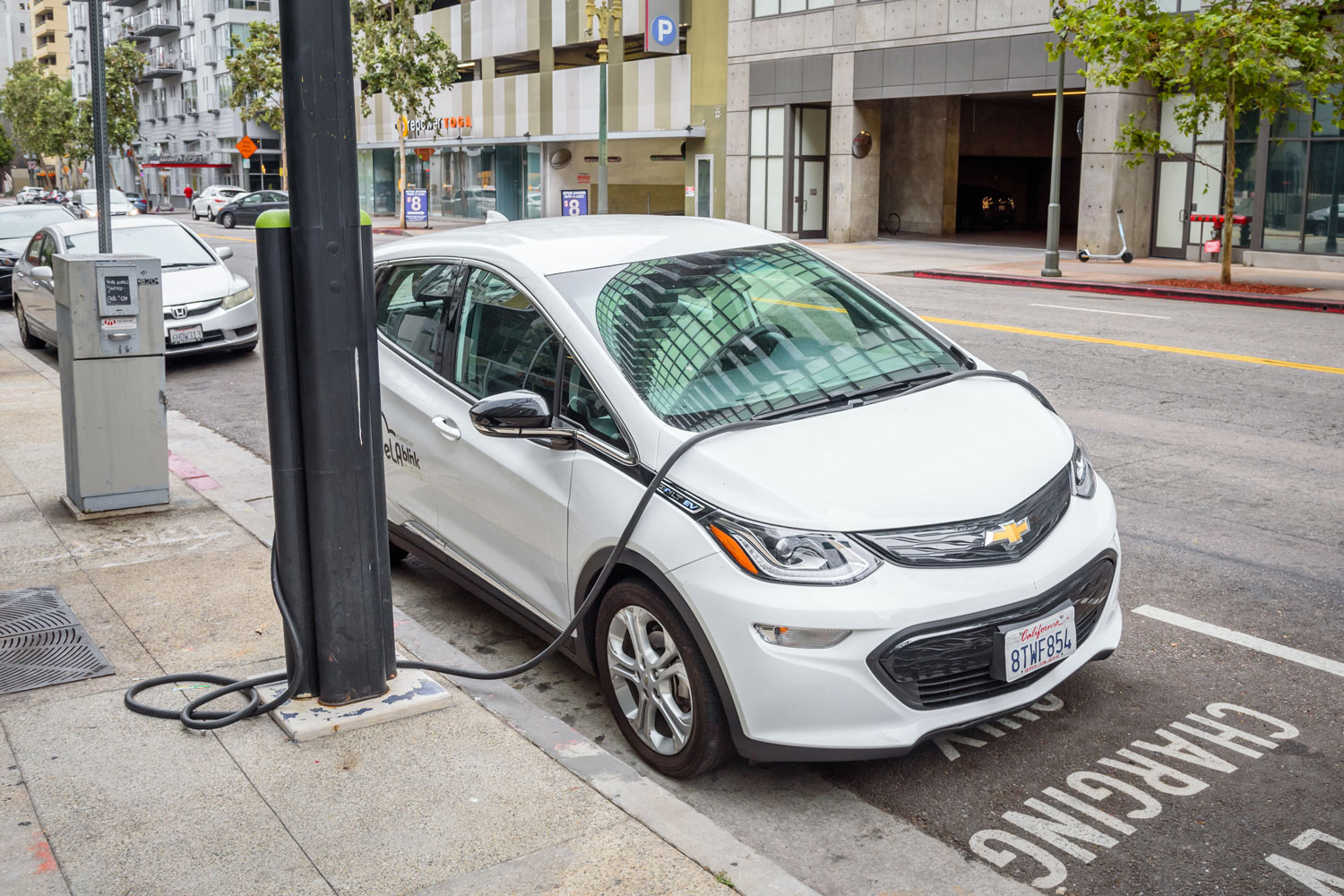
Charging stations for electric vehicles are essential for cleaning up the transportation sector. A new study by MIT researchers suggests they’re good for business, too.
The study found that, in California, opening a charging station boosted annual spending at each nearby business by an average of about $1,500 in 2019 and about $400 between January 2021 and June 2023. The spending bump amounts to thousands of extra dollars annually for nearby businesses, with the increase particularly pronounced for businesses in underresourced areas.
The study’s authors hope the research paints a more holistic picture of the benefits of EV charging stations, beyond environmental factors.
“These increases are equal to a significant chunk of the cost of installing an EV charger, and I hope this study sheds light on these economic benefits,” says lead author Yunhan Zheng MCP ’21, SM ’21, PhD ’24, a postdoc at the Singapore-MIT Alliance for Research and Technology (SMART). “The findings could also diversify the income stream for charger providers and site hosts, and lead to more informed business models for EV charging stations.”
Zheng’s co-authors on the paper, which was published today in Nature Communications, are David Keith, a senior lecturer at the MIT Sloan School of Management; Jinhua Zhao, an MIT professor of cities and transportation; and alumni Shenhao Wang MCP ’17, SM ’17, PhD ’20 and Mi Diao MCP ’06, PhD ’10.
Understanding the EV effect
Increasing the number of electric vehicle charging stations is seen as a key prerequisite for the transition to a cleaner, electrified transportation sector. As such, the 2021 U.S. Infrastructure Investment and Jobs Act committed $7.5 billion to build a national network of public electric vehicle chargers across the U.S.
But a large amount of private investment will also be needed to make charging stations ubiquitous.
“The U.S. is investing a lot in EV chargers and really encouraging EV adoption, but many EV charging providers can’t make enough money at this stage, and getting to profitability is a major challenge,” Zheng says.
EV advocates have long argued that the presence of charging stations brings economic benefits to surrounding communities, but Zheng says previous studies on their impact relied on surveys or were small-scale. Her team of collaborators wanted to make advocates’ claims more empirical.
For their study, the researchers collected data from over 4,000 charging stations in California and 140,000 businesses, relying on anonymized credit and debit card transactions to measure changes in consumer spending. The researchers used data from 2019 through June of 2023, skipping the year 2020 to minimize the impact of the pandemic.
To judge whether charging stations caused customer spending increases, the researchers compared data from businesses within 500 meters of new charging stations before and after their installation. They also analyzed transactions from similar businesses in the same time frame that weren’t near charging stations.
Supercharging nearby businesses
The researchers found that installing a charging station boosted annual spending at nearby establishments by an average of 1.4 percent in 2019 and 0.8 percent from January 2021 to June 2023.
While that might sound like a small amount per business, it amounts to thousands of dollars in overall consumer spending increases. Specifically, those percentages translate to almost $23,000 in cumulative spending increases in 2019 and about $3,400 per year from 2021 through June 2023.
Zheng says the decline in spending increases over the two time periods might be due to a saturation of EV chargers, leading to lower utilization, as well as an overall decrease in spending per business after the Covid-19 pandemic and a reduced number of businesses served by each EV charging station in the second period. Despite this decline, the annual impact of a charging station on all its surrounding businesses would still cover approximately 11.2 percent of the average infrastructure and installation cost of a standard charging station.
Through both time frames, the spending increases were highest for businesses within about a football field’s distance from the new stations. They were also significant for businesses in disadvantaged and low-income areas, as designated by California and the Justice40 Initiative.
“The positive impacts of EV charging stations on businesses are not constrained solely to some high-income neighborhoods,” Wang says. “It highlights the importance for policymakers to develop EV charging stations in marginalized areas, because they not only foster a cleaner environment, but also serve as a catalyst for enhancing economic vitality.”
Zheng believes the findings hold a lesson for charging station developers seeking to improve the profitability of their projects.
“The joint gas station and convenience store business model could also be adopted to EV charging stations,” Zheng says. “Traditionally, many gas stations are affiliated with retail store chains, which enables owners to both sell fuel and attract customers to diversify their revenue stream. EV charging providers could consider a similar approach to internalize the positive impact of EV charging stations.”
Zheng also says the findings could support the creation of new funding models for charging stations, such as multiple businesses sharing the costs of construction so they can all benefit from the added spending.
Those changes could accelerate the creation of charging networks, but Zheng cautions that further research is needed to understand how much the study’s findings can be extrapolated to other areas. She encourages other researchers to study the economic effects of charging stations and hopes future research includes states beyond California and even other countries.
“A huge number of studies have focused on retail sales effects from traditional transportation infrastructure, such as rail and subway stations, bus stops, and street configurations,” Zhao says. “This research provides evidence for an important, emerging piece of transportation infrastructure and shows a consistently positive effect on local businesses, paving the way for future research in this area.”
The research was supported, in part, by the Singapore-MIT Alliance for Research and Technology (SMART) and the Singapore National Research Foundation. Diao was partially supported by the Natural Science Foundation of Shanghai and the Fundamental Research Funds for the Central Universities of China.

 Login
Login