
Reading view

There are new articles available, click to refresh the page.

Toyota Debuts Electric Pickup For Europe, And It’s Just The Beginning
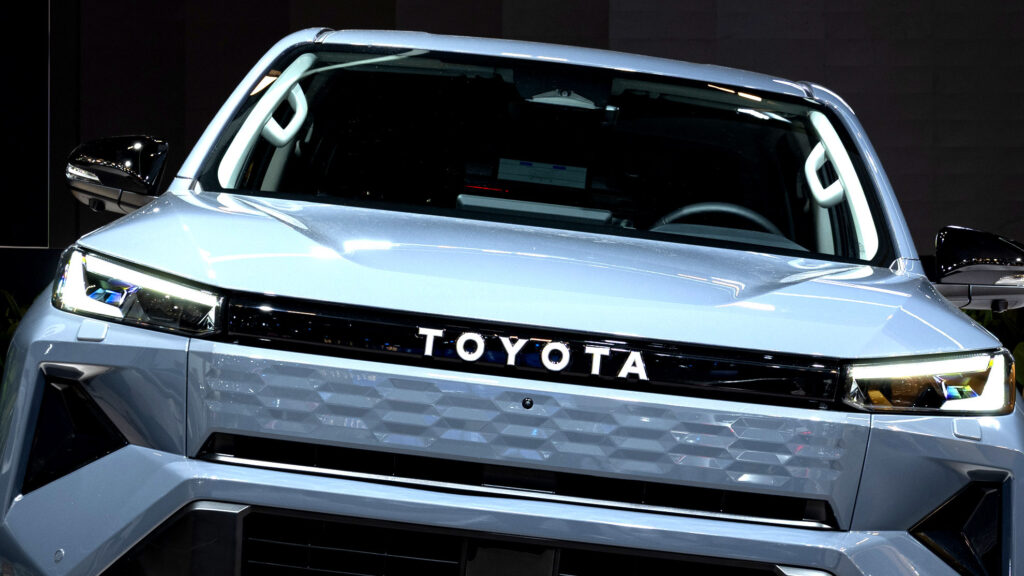
  • Toyota revealed the Euro-spec Hilux at Brussels Motor Show.
  • New EV version joins the mild-hybrid diesel in the lineup.
  • Hilux BEV offers 160-mile range with dual-motor AWD setup.

The Hilux has spent decades surviving anything the world throws at it, from mud and floods to plummeting from a Top Gear crane – though not being dropped from a helicopter. Now Toyota is testing its most famous small pickup with a more complicated challenge: staying relevant in an electric future.

Related: New Toyota Hilux Brings Sumo-Inspired Looks And EV Option

Toyota unveiled the Euro-spec ninth-generation Hilux in mild-hybrid and fully electric Hilux BEV form at this week’s Brussels Motor Show, months after both trucks debuted in Asia. The first ever EV Hilux is big news, but soon it won’t be the only version of the unstoppable truck that doesn’t emit any tailpipe nasties.

As we reported last year, Toyota Toyota hasn’t just confirmed that it’s working on a hydrogen-powered Hilux that will arrive later, it’s already testing them out in the open. Yes, the same pickup that built its legend hauling bricks and sheep is about get a fuel-cell stack.

Multipath Meets Multipurpose

\\\\\\\\\\

Toyota calls this its multipath strategy, though for many buyers little will change. Because they’ll still be able to get a truck with the same 201 hp (204 PS) 2.8 litre diesel mild hybrid (shown above) that made its debut in the previous generation Hilux’s twilight years. Some less-developed European countries will even get a non-hybrid diesel.

In the UK and Europe the 48-volt oil burner is expected to be the volume seller even after the EV’s arrival. It keeps up the old model’s 1,000 kg (2,205 lbs) payload and 3,500 kg (7,720 lbs) tow ratings, while being smoother and slightly cleaner than before.

Electric But Still Unbreakable

\\\\\\\\\\\\

But business-owning truck buyers with an eye on cutting running costs and tax bills will want to give the Hilux BEV a look. It uses a 59.2 kWh battery with motors on both axles for permanent all-wheel drive.

The front motor makes 151 lb-ft (205 Nm) and the rear 198 lb-ft (268 Nm), and Toyota quotes a WLTP range of 160 miles (258 km), which sounds unimpressive in a passenger-car context, but that climbs to 236 miles (380 km) in urban use.

Payload drops to 715 kg (1,580 lbs) and towing to 1,600 kg (3,530 lbs) in the EV, but the fundamentals remain. You’re getting the same body-on-frame construction, 212 mm (8.4 inches) of ground clearance and 700 mm (27.6 inches) of wading depth, whichever power source you choose. And the BEV gets a special off road drive mode tuned for electric torque and braking.

All In the Grilles
 Toyota Debuts Electric Pickup For Europe, And It’s Just The Beginning

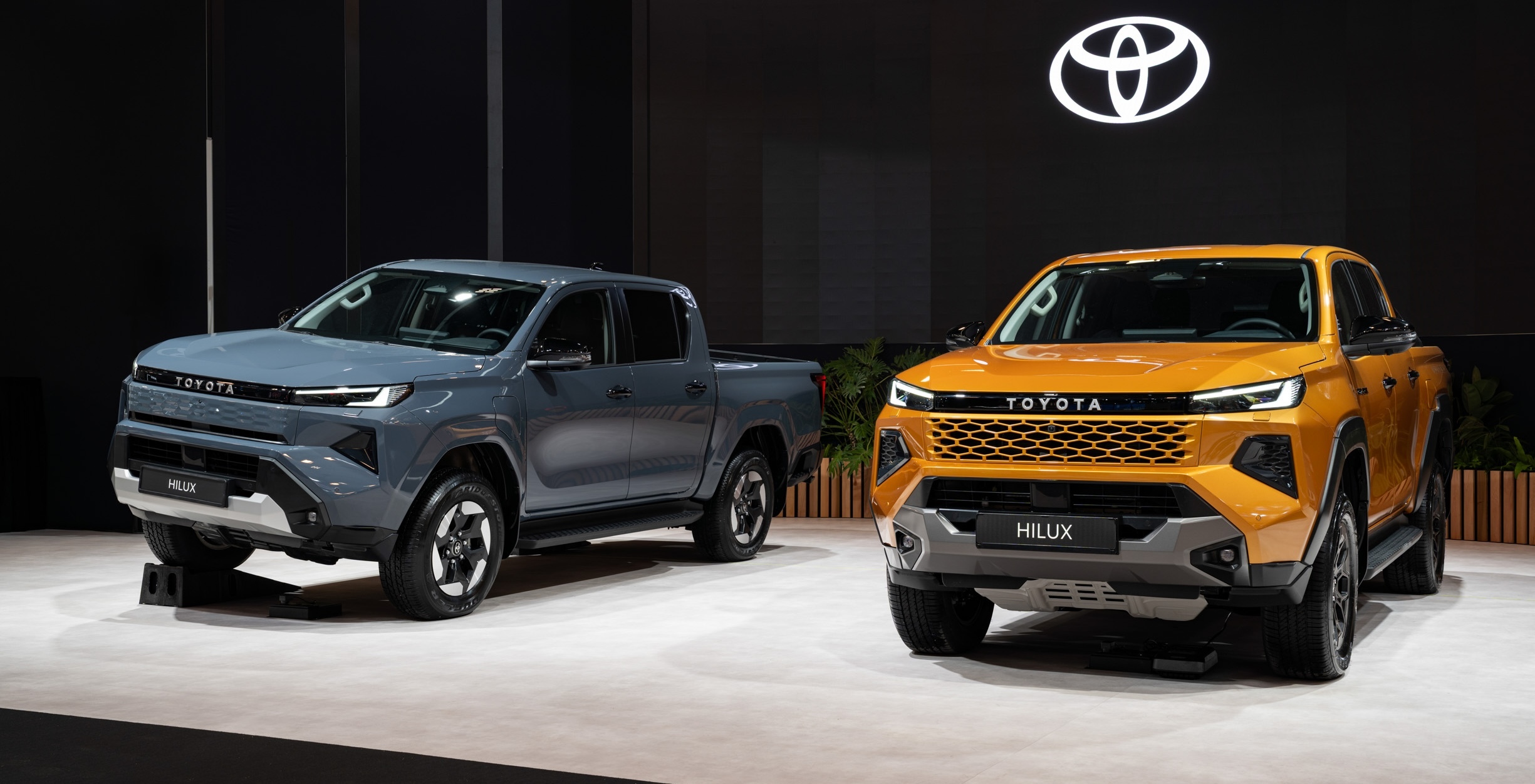
Both hybrid and BEV models adopt the same new Cyber Sumo design that was reportedly developed by Toyota’s Australian team. Characterized by stronger angles and flatter surfaces, it gives the Hilux and more modern, big-truck look, though it seems not everyone loves it. The EV is easily identified by its hole-free grille panel and (less obvious) re-shaped silver bumper insert.

Also: Toyota’s Most Expensive Supercar Has Something In Common With Lexus’ Cheapest Sedan

The modern makeover continues inside the crew cab-only interior where drivers and passengers are treated to a 12.3-inch digital gauge pack and same-sized tablet touchscreen, plus a steering wheel from the new Land Cruiser.

\\\\\\\\\\\\\\\

There are dual storage compartments on the passenger side, dashboard-mounted cupholders, and a full suite of electronic safety gadgets, but Toyota remembered to cram in plenty of physical switches for regularly-used functions.

UK sales start in June, Toyota says, and prices – guaranteed to be higher than for the outgoing truck – will be revealed within the next few months.

\\\\\\\\

Toyota

Toyota Promises The Electric Hilux Will Be ‘Attainable’, Just Not Affordable

  • Hilux BEV could prove popular with mining companies in Australia.
  • Toyota confirmed the electric Hilux will cost more than diesel models.
  • A 59.2 kWh battery powers twin electric motors producing 193 hp/

Earlier this month, Toyota pulled the covers off its long-awaited battery-electric Hilux, built on the thoroughly reworked ninth-generation platform. While powertrain specifications for the model have been released, Toyota has yet to confirm pricing, saying only that it will be “attainable.”

Read: New Toyota Hilux Brings Sumo-Inspired Looks And EV Option

The complete list of markets where the Hilux BEV will be sold is unclear, but we do know that Australia will be among them. Local buyers will see the Hilux BEV arrive in the first half of 2026, with Toyota initially targeting fleets rather than private owners.

Large mining operations are expected to be the main customers, given the suitability of electric drivetrains for underground work.

Pricing Expectations

While recently speaking with local outlet Drive about the new truck, Toyota Australia vice president for sales and marketing Sean Hanley acknowledged the Hilux BEV will “be dearer than the diesel cars we’ve got right now.”

Prices for the new Hilux equipped with the mild-hybrid diesel engine will start at AU$65,990 ($42,800), and it’s not beyond the realm of possibility that the BEV could add AU$15,000 ($9,700) to that figure, meaning this model could be positioned near the top of the Hilux range.

\\\\\\\\\\\

“We know this is not going to be our biggest seller, but it’s got to be competitive and affordable for those that want it, so it’s got to be attainable,” Hanley added.

“There’s no point putting it out there if it’s going to be a hundred grand (AU$100,000), you know what I mean, like maybe you’re referencing. It’s got to be achievable, it’s got to be attainable.”

Toyota has equipped the Hilux BEV with a small 59.2 kWh battery pack and dual electric motors delivering 193 hp. The pickup has a quoted range of just 149 miles (240 km).

A Niche Future

\\\\\

Despite some interest from private buyers, Hanley is realistic about where this model fits. He describes it as a niche vehicle, built with clear intent rather than broad market ambition.

“Where this will appeal will actually be mining – massively. Again, I don’t wanna sit here and say to you ‘it’s gonna take the world by storm and volume’. [It’s] not going to do that. It’s not meant to do that. That’s not why we’re launching it,” he said.

Still, he admits there could be some crossover appeal. “There is a niche market out there where we can put this car, and in mining it will be, I think, our biggest target market. Now, that’s not to say some tradies may not want it. They may… it’s possible.”

\\\\\\\

New Toyota Hilux Brings Sumo-Inspired Looks And EV Option

  • Toyota Hilux debuts with major design and powertrain upgrades.
  • Offers diesel, gasoline, mild-hybrid, BEV, and future FCEV options.
  • Launches first in Europe and Australia, then Asia and Japan soon.

While the Ford F-150 dominates North America, the Toyota Hilux continues to reign just about everywhere else. Now entering its ninth generation, Toyota’s workhorse returns with sharper styling, a thoroughly redesigned cabin, reinforced ladder-frame underpinnings, and, for the first time, a fully electric powertrain.

More: Toyota’s Baby Land Cruiser FJ Looks Retro Enough To Break Your Heart

The new design theme, dubbed “Cyber Sumo,” takes a different path from the hammerhead styling found in other recent Toyota models. Up front, slimmer LED headlights flank a body-colored honeycomb grille, while angular bumper intakes and a solid skid plate add a functional, squared-off presence.

The fully electric version wears a unique front bumper with a closed grille and redesigned intakes, a subtle cue to its zero-emission identity.

\\\\\\\\\\\\\\\\\\\\\\\\\\\\\\\

The profile remains familiar because the greenhouse, pillars, and doors carry over from the outgoing model that’s been around since 2015. Even so, re-sculpted front and rear fenders with boxy wheel arches, paired with fresh wheel designs, give it a tougher stance.

At the rear, the Hilux shows more definition than before, with sharper LED taillights and a modernized bumper that now incorporates practical side steps similar to those on the Ford Ranger.

Its footprint stays consistent with its predecessor at 5,320 mm in length and a 3,085 mm wheelbase. Toyota has chosen to offer only the dual-cab version in Europe and Australia, while markets such as Thailand retain the Single Cab and Smart Cab configurations.

How Has The Interior Changed?

\\\\\\\\\\

The cabin has been thoroughly overhauled, blending modern tech with the Hilux’s traditionally utilitarian nature. A boxy dashboard frames a free-standing 12.3-inch infotainment screen (8-inch in the base Thai-spec model) and a 12.3-inch digital instrument cluster (7-inch in lower trims). Importantly, physical controls remain for core functions such as climate and audio, preserving tactile ease of use.

The chunky steering wheel with buttons is borrowed from the Land Cruiser, while the compact gear knob and drive mode selector sit on the center console. Dual storage compartments line the passenger side, and dashboard-mounted cupholders complete the layout.

Toyota has also expanded the Hilux’s safety credentials with a “significantly extended” suite of advanced driver-assistance systems, bringing it in line with the brand’s passenger car range.

Multiple Powertrain Options

Toyota’s “Multipathway” approach to propulsion continues here, and the new Hilux exemplifies it. Depending on the market, buyers can choose from the familiar 2.8-liter turbodiesel engine in regular or mild-hybrid form, as well as a 2.7-liter gasoline option.

The biggest leap, however, is the all-electric version. It uses dual electric motors producing a combined 193 hp (144 kW / 196 PS), powered by a 59.2 kWh battery pack.

\\\\\\\\\\\\\\\

Toyota quotes a range of 240 km (149 miles) under the WLTP cycle, or just over 300 km (186 miles) using NEDC standards. It may not rival long-range EVs, but Toyota plans to add a hydrogen fuel-cell variant by 2028.

Payload and towing capacities remain robust: up to 1,000 kg (2,205 lbs) and 3,500 kg (7,716 lbs) respectively for internal combustion models. The Hilux BEV, with its heavier battery setup, carries 715 kg (1,576 lbs) and tows 1,600 kg (3,527 lbs).

Upgraded Underpinnings

Under the skin, the Hilux rides on an upgraded version of the IMV ladder-frame architecture of its predecessor rather than moving to the more modern TNGA-F used by the Tacoma and Land Cruiser. 

Still, it benefits from a new electric power steering, new engine and cabin mounts for reduced vibrations, new front rail extensions for improved crash perfromance, and a revised suspension setup.

\\\\\\

The suspension setup combines independent coil springs at the front with a rigid rear axle supported by leaf springs. Toyota Australia says there are two distinct calibrations: one tuned for heavy-load and towing performance, and another focused on everyday ride comfort.

More: Toyota Shrinks Its Hilux Champ Into The Super Short Wheelbase

In terms of off-road credentials, the 4×4 versions use a part-time 4WD system with high and low range ratios, now improved with the standard fitment of a rear locking differential and the available Multi-Terrain Select system.

\\\\\\\\\\\\\\\\\\\\\\\\\\\\\\\\\\

Pricing and Availability

Production remains centered in Thailand, where the diesel-powered Hilux Travo is already on sale, priced between ฿767,000 ($23,700) and ฿1,366,000 ($42,200). The fully electric model starts at ฿1,491,000 ($46,100), placing it at the top of the lineup.

The new Hilux will reach Europe and Australia in December 2025, followed by broader Asian rollouts in 2026 and a home-market debut in Japan by mid-2026. Detailed specifications and pricing for each region will be announced closer to launch.

\\\\\\\\\\
\\\\\\\\\\\\\\\\\\\\\\\

Toyota

❌