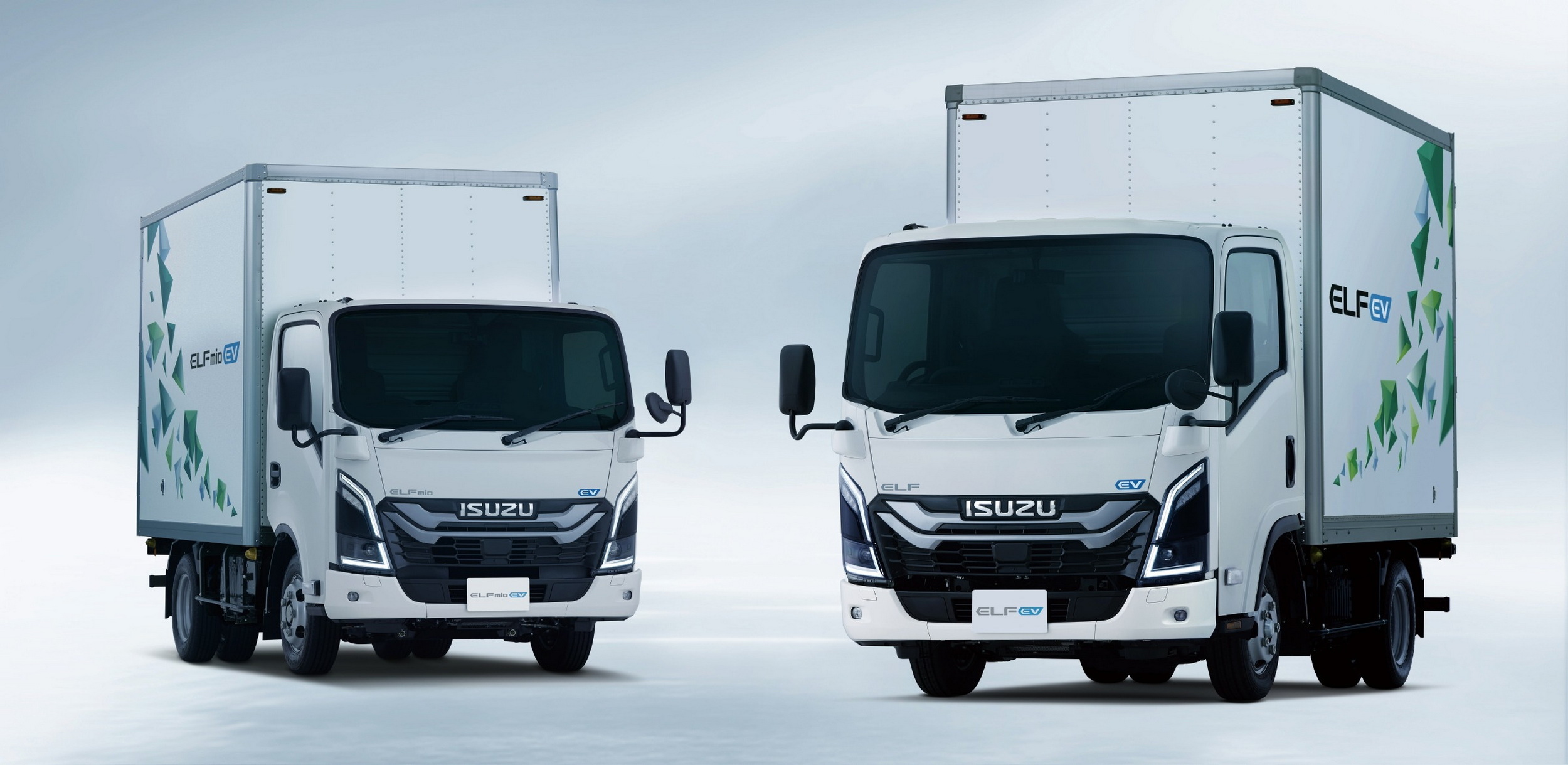
Isuzu and Toyota are building Japan’s first hydrogen light-duty truck.
The fuel cell hardware is Toyota’s, the chassis is Isuzu’s Elf EV.
Toyota’s next fuel cell system delivers 20% better efficiency than before.
Hydrogen mobility might not be moving forward as quickly as expected in passenger cars, but it still has clear promise in the commercial space. The latest move comes from Isuzu and Toyota, which have teamed up to develop Japan’s first mass-produced light-duty fuel-cell electric truck, expected to reach the road within the next two years.
This won’t be a ground-up rethink. Instead, it rides on the familiar ladder-frame chassis of the Isuzu Elf EV. The electric Elf, known globally as the N-Series, arrived in 2023 with modular 20 kWh battery packs, scaling from 40 to 180 kWh depending on spec.
The real story sits under the skin. Toyota’s upcoming third-generation fuel-cell system takes center stage here, bringing a claimed 20% improvement in efficiency over the current setup. It is also expected to last longer and cope better with hard use, which matters when your daily routine involves stop-start urban logistics or hauling refrigerated goods across a city.
Why Hydrogen?
One of the primary drivers behind this FCEV project is the inherent limitation of battery-electric trucks in certain commercial roles. Light-duty trucks used for supermarket and convenience store deliveries often require heavy refrigeration equipment that drains battery power quickly. Furthermore, the long charging times associated with large battery packs can disrupt tight delivery schedules.
Hydrogen refueling, which takes roughly the same amount of time as diesel, offers a more seamless transition for fleet operators, while offering an extended driving range. At the same time, an FCEV truck produces much fewer vibrations and noise compared to a diesel-powered equivalent, while having zero CO2 emissions.
Reducing Costs Is The Key
The sticking point remains cost. Fuel-cell vehicles are still expensive, and hydrogen infrastructure is far from widespread. Isuzu and Toyota say the answer lies in smarter engineering, from optimizing the vehicle structure to rethinking manufacturing processes, alongside continued development of the fuel-cell system itself.
Production of the light-duty fuel cell truck is scheduled to start in the Japanese fiscal year 2027, which ends on March 30, 2028.
This isn’t the first time the two companies have worked together on hydrogen. Isuzu and Toyota are already collaborating on the ERGA FCV, an urban flat-floor bus with hydrogen tanks integrated on its roof structure.
The U.S. Environmental Protection Agency is issuing a request for information from school bus industry stakeholders as it seeks to add biodiesel, renewable diesel (RD) and liquefied natural gas (LNG) as funding options to a revised Clean School Bus Program.
EPA also said it will not be awarding funds for the 2024 CSB Rebate Program. “EPA thanks applicants for their interest and encourages them to apply for the new grant program,” EPA said in a press release Thursday. “The agency will provide more details on the 2026 grants and eligibility requirements in the near future through a Notice of Funding Opportunity.”
In a follow-up email sent by School Transportation News asking for clarification on foregoing the 2024 rebate awards and if those same applications would be recycled, EPA referred to its original statement.
Meanwhile, Thursday’s RFI also mentions hydrogen as an eligible fuel listed by the Investing in Infrastructure and Jobs Act, which created the five-year, $5 billion fund. But there are currently no hydrogen school buses in production. The same goes for liquefied natural gas, which differs from propane. The IIJA also mentions CNG, which won a handful of awards, but manufacturers don’t currently produce that fuel option, either.
Diesel-powered school buses do exist in large numbers nationwide, estimated at about 80 percent of the national fleet of approximately 450,000 vehicles. Many operate with biodiesel blended with regular diesel. The RFI specifically states EPA seeks information on B20, or 20 percent biofuel blend with diesel.
Renewable diesel, or RD, is different from biodiesel as the former is produced by a hydrotreating process, making it a hydrocarbon fuel. Because it is otherwise nearly identical to petroleum diesel, RD is a drop-in fuel alternative that diesel engine manufacturers certify for use in their engines without voiding warranties. But RD is more expensive than petroleum diesel except in California, Oregon, New Mexico and Washington, where Low Carbon Fuel Standard credits are at play.
Electric school buses are not a focus of the RFI because EPA said it has sufficient information on its infrastructure, availability and performance.
EPA added electric school buses have accounted for 90 percent of Clean School Bus Program awards to date, and the next funding round should target other allowed alternative fuels “to allow for the maximum number of affordable bus choices to fit school districts’ specific needs.”
What’s in the RFI?
EPA is asking the current availability and anticipated purchasing within the next year to five years of biodiesel, RD, E85 flex fuel, CNG, LNG, propane or any other biofuel and if those school buses are fueled at the school district facility, an offsite private fueling station, or an offsite public station. EPA also wants to know about fuel supplier arrangements.
Specifically for biodiesel and RD, EPA is asking for details on how the blends or drop-in fuels are used.
It requests information on fueling system components, pricing, construction and installation requirements, performance, domestic content, and other practical considerations.
The RFI also states EPA wants information on how it can further safeguard taxpayer dollars. The agency completed an internal review to assess financial management practices and said it uncovered inconsistent documentation, incomplete adherence to reporting an award conditions, improper or premature drawdowns of funds, and insufficient internal controls by certain awardees, including for profit recipients.
EPA said it is “evaluating additional safeguards and conditions for for-profit entities,” which includes audits of financial statements and conflict of interest policies. It is also considering verification tools or documentation to ensure appropriate bus usage and routes before funds are disbursed; milestone-based payment structures, reimbursement-only models, or phased disbursement mechanisms tied to verified delivery to reduce risk and improve accountability; and enforcement mechanisms such as repayment obligations or clawback provisions in cases of nonperformance, noncompliance, or misuse of funds.
The Clean School Bus Program is set to expire at the end of the current fiscal year, which would require the remaining $2 billion that has yet to be awarded needing to rollout over the next six months.
Public comments are due within 45 days of EPA publishing the RFI in the Federal Register. A webinar is scheduled for March 3.
Community and environmental justice advocates say the Biden administration is failing to deliver promised transparency and public engagement around its $7 billion clean hydrogen hub initiative.
“Engagement isn’t merely leading people into a process that’s going to happen with or without them,” said Tom Torres, hydrogen program director for the Ohio River Valley Institute, a nonprofit serving one of the regions where federally funded partnerships are trying to lay the groundwork for new local hydrogen economies. “It means meaningfully involving people in the decisions about the project.”
The U.S. Department of Energy announced funding in October 2023 for seven regional clean hydrogen hubs — clusters of interconnected projects meant to kickstart production of the fuel with little or no greenhouse gas emissions. Since then, the department has held online briefings and virtual listening sessions for each hub, but advocates say they are not getting the kind of information necessary to assess who will be impacted by the projects and how.
Torres and others say they want more than just dots on a map. They want to know how hydrogen will be produced, how it will be used, and how it will get to end users. For projects that depend on carbon capture, they want to know how and where the carbon will be captured, transported and stored. And once the specifics are known, they want a chance to have meaningful input on the final projects.
Spokespeople for the Department of Energy and regional hubs said the answers to those questions are still being worked out and that more engagement is on the horizon. Advocates are increasingly frustrated and fear that community input will come too late to affect how the hubs are developed.
“It doesn’t make sense … on one hand to say there’s not enough on paper to tell the public about, but on the other hand there is enough to allocate almost $1 billion for these companies,” Torres said.
Are events just ‘checking a box’?
When burned as a fuel source, hydrogen does not emit carbon dioxide, but its production today almost always comes from fossil fuels. Some see a potential for hydrogen to replace natural gas in certain hard-to-electrify sectors such as industry or heavy duty transportation, but the benefits for addressing climate change hinge on whether it can be produced cleanly and at scale.
The Biden administration’s hydrogen hub program, part of the 2021 Bipartisan Infrastructure Law, aims to ramp up production of hydrogen made with low-carbon energy, including renewables, nuclear power, and fossil fuels paired with carbon capture.
“It is literally like building the natural gas infrastructure that we have all over the place again for hydrogen,” said Shawn Bennett, energy and resilience manager for Battelle, the project manager for the Appalachian Regional Hydrogen Hub, ARCH2, which includes projects for Ohio, West Virginia and Pennsylvania. A majority of its projects will use steam methane reforming to make hydrogen from natural gas, along with carbon capture and storage. Other projects in the hub plan to make hydrogen from waste gases or from electrolysis, which uses energy to split water molecules.
In May, dozens of groups urged the Department of Energy to suspend funding discussions for the ARCH2 project until the public receives detailed information beyond general maps and short project descriptions. On July 31 the Department of Energy formally committed the first $30 million of federal funding to ARCH2, with a total of up to $925 million to be spent over the next decade or so.
Last month, the Department of Energy committed up to $1 billion for the Midwest Alliance for Clean Hydrogen, MachH2, which spans Illinois, Indiana, Michigan and Iowa and plans to produce hydrogen from a mix of nuclear power, wind energy and natural gas. The department will hold a December 9 briefing on MachH2.
In response to the Energy News Network’s questions about community groups’ complaints about a lack of outreach, a Department of Energy spokesperson provided a statement saying it “has been actively engaged with these communities in support of the economic playbook” of the Biden-Harris administration.
The ARCH2 project held a community outreach session in West Virginia in November, and additional meetings will be held in Ohio and Pennsylvania early next year, Bennett said. Some community group members protested outside at the West Virginia session but then came inside for a good discussion, he added.
Torres said there was no general presentation at the West Virginia meeting, and company representatives were present for only a handful of the hub’s projects. Even then, project information was still sparse.
“It wasn’t an opportunity for people’s voices to be heard,” he said. “What is the value of these events other than checking a box for these companies?”
Advocacy groups focusing on the MachH2 project said months went by without getting updates or details. Then last month, they got less than 24 hours’ notice for a briefing with general descriptions about the MachH2 hub projects.
During that session, representatives for the Department of Energy said a decision on the hub’s funding commitment would come soon, “probably next week sometime,” said Susan Thomas, the legislative and policy director and communications manager for Just Transition Northwest Indiana. Minutes after the November 20 session ended, the Department of Energy announced the MachH2 funding commitment.
“Our jaws were on the table,” Thomas said.
Details remain to be worked out
Groups have been trying to get answers from the Department of Energy for more than a year, said Chris Chyung, executive director of Indiana Conservation Voters. In his view, the agency’s approach “is just flouting the law.” According to the Department of Energy’s website, engagement with communities and labor is a key principle required in hubs’ community benefits plans, which are part of hubs’ contractual obligations for funding.
Community groups learned in the November 20 briefing that the MachH2 community engagement would not address concerns related to any pipelines associated with the hub. Instead, those would be handled by a separate office within the Department of Energy.
But a pipeline for northwestern Indiana “is absolutely part and parcel of [a] dirty hydrogen project that is part of MachH2,” and the community should get a say on it, said Lauren Piette, an attorney with Earthjustice, which does not consider hydrogen made with natural gas to be climate-friendly, even with carbon capture.
The Department of Energy spokesperson did not respond to the Energy News Network’s question about how community benefits for hub projects can fully be assessed if they don’t include consideration of issues and input related to necessary pipelines.
Representatives of the MachH2 and ARCH2 hubs who spoke at an Ohio Fuel Cell & Hydrogen Consortium program last month said they couldn’t practically engage in community outreach until funding commitments had been negotiated with the Department of Energy. Until then, it wasn’t certain whether each hub would move forward.
Also, as a practical matter, “there was no budget for these things,” Bennett said. Details for each hub’s projects are still being worked out, and ARCH2 is still trying to add additional project partners.
Even then, details for projects won’t be finalized until review under the National Environmental Policy Act, according to Neil Banwart, who is the chief integration officer for the MachH2 hub and also the managing director for hydrogen at Energy Systems Network.
“It’s not a certainty that all of the projects will get built in the locations that we shared on a map,” he said.
Chyung said he felt the comments about funding were “a complete dodge on behalf of these extremely wealthy national corporations that have said since 2023 they were eager to get started on community outreach.”
Hydroelectric energy is the “backbone of clean power,” but an urgent need to improve efficiencies is driving engineers to explore a whirlwind of options Among alternative energy solutions, wind, solar, and hydrogen capture the majority of attention. Yet the combined output from these sources pales in comparison to that of hydroelectric power. Producing more than …
A prospective buyer’s recent commitment to reinvest in a Gary, Indiana, steel plant sought to address union and government leaders’ worries about the sale’s potential impact on jobs and U.S. steelmaking capacity.
The plan to extend the life of the country’s largest and most carbon-emitting coal-fired blast furnace, however, has also heightened concerns from Northwest Indiana residents most affected by the facility’s air pollution.
“This is not acceptable,” said Susan Thomas, director of legislation and policy for Just Transition Northwest Indiana. “We now have technology for doing this much more sustainably.”
A study released Monday quantifies the public health threat highlighted by local clean air advocates, linking the Indiana plant to dozens of annual emergency room visits and premature deaths, as well as thousands of asthma attacks.
Japan-based Nippon Steel is seeking approval from U.S. regulators for a $15 billion acquisition of U.S. Steel, the storied domestic steelmaker whose facilities include the Gary Works plant in Northwest Indiana, along with others in Ohio, Michigan and Pennsylvania, key battleground states where the proposed sale has been a subject of presidential campaigning. Vice President Kamala Harris and former President Donald Trump oppose the sale, as does President Joe Biden.
Much of the public discussion around the proposed sale has centered on its economic and national security implications, but those living near the plant have different concerns and demands. They say they’ve suffered for too long from steel industry pollution, and they only want Nippon as a neighbor if the company installs a new type of furnace that burns with lower or even zero emissions.
“I would love to see Gary Works transform to green sustainable steel, bringing more jobs, cleaning up the area, that would be an amazing win-win,” said Libré Booker, a librarian who grew up near the mill. “The people have lived under these conditions for far too long. It’s definitely time for a change.”
Gary Works is the largest integrated steel mill in North America, employing about 2,200 people. Northwest Indiana is also home to two other steel mills — Burns Harbor and Indiana Harbor — and two coke plants that turn coal into the high-density raw material for steel.
The populations in a three-mile radius of the Gary Works and Indiana Harbor steel mills are 96%-97% people of color, and almost two-thirds low-income people. The new study by Industrious Labs, a nonprofit focused on emissions reduction, used the EPA’s COBRA model to find emissions from the Gary Works plant likely are linked to 57-114 premature deaths, 48 emergency room visits and almost 32,000 asthma attacks each year.
The report cited the mills’ and coke plants’ emissions of sulfur dioxide, nitrogen oxides, carbon monoxide, particulate matter, and lead, all pollutants with direct impacts on public health. Gary Works is the number one emitter of PM2.5 particulate matter in the state, according to the company’s self-reported data analyzed by Industrious Labs.
Industrious Labs steel director Hilary Lewis said the results bolster the demands of clean steel advocates, who want to see coal-fired blast furnaces replaced by direct-reduction iron, or DRI, furnaces powered by hydrogen made with renewable energy, known as green hydrogen.
Booker was among 15 locals who participated in a recent “Sustainable Steel Community Cohort” run by Industrious Labs, attending five workshops learning about the science and policy of cleaner steel.
Green hydrogen, green steel
Green hydrogen is still not produced in large quantities anywhere in the U.S., and all the hydrogen currently produced in the country would not even be enough to power one steel mill, noted Seth Snyder, a partner in the Clean Energy Venture Group, at a recent conference in Chicago focused on clean hydrogen.
But DRI furnaces can be powered by natural gas, which results in much lower emissions than coal. Cleveland Cliffs — which owns the Indiana Harbor and Burns Harbor mills — is transforming its Middletown, Ohio steel mill to gas-burning DRI with the help of a $500 million incentive under the Inflation Reduction Act. The company says the conversion will make it the steel mill with the lowest emissions in the world.
With some modifications, DRI furnaces can burn a blend of natural gas and hydrogen or almost entirely hydrogen, experts say, meaning investment in a gas-burning DRI furnace could be a step on the way to “clean steel.” Lewis and other advocates, however, say gas-burning furnaces are not their goal, and they want the industry to transition off fossil fuels entirely.
Hydrogen can be blended into fuel for traditional blast furnaces too, but the maximum emissions reductions that can be achieved that way are 21%, according to a paper on hydrogen-powered steel production in Europe by the Norwegian non-profit science organization Bellona.
Nippon has announced it would invest $300 million in restoring the aging blast furnace at Gary Works, keeping it running for another 20 years. Installing a DRI furnace, meanwhile, typically costs over $1 billion.
“There is a gap,” said Lewis. “But these companies have the funding available. They have the money to make these decisions, they’re just choosing not to.”
Incentives for change
The IRA incentives tapped by Cleveland Cliffs are no longer available, but this summer California U.S. Rep. Ro Khanna introduced the Modern Steel Act, which would provide $10 billion in low-cost loans and grants, plus tax breaks and other incentives for new and revamped low-emissions steel mills, including hydrogen-fueled DRI.
Separately, lucrative tax credits soon to be available for “clean hydrogen” under the IRA could also make hydrogen-powered steel more financially viable. The specific rules for the tax credit — known as 45V — are still being finalized, amid controversy over what should qualify a project’s hydrogen as “clean.”
“There are a number of different incentives in the IRA that can help steel companies build out their own green hydrogen infrastructure,” Lewis said. “Everything should be on the table. Steel companies would be such huge off-takers for green hydrogen, they can build their own economy here.”
At the BP Whiting oil refinery, 10 miles from Gary Works, there are plans underway for production of blue hydrogen, or hydrogen made with natural gas followed by capture and sequestration of the emissions. The plan is a marquee part of the Midwest (MachH2) hydrogen hub, one of seven planned hubs nationwide slated to receive $7 billion total in federal funding. Such blue hydrogen could be used to power a steel mill, with theoretically no resulting greenhouse gas or public health-harming emissions.
However, local environmental and public accountability leaders are strongly opposed to blue hydrogen production in the region, since carbon sequestration has not yet been done successfully on a large scale in the U.S., and it would entail pipelines carrying carbon dioxide from the refinery to a sequestration site.
“The carbon capture component makes us very nervous, it seems to me they’re rushing into this without really taking the time to study it more seriously,” said Northwest Indiana resident Connie Wachala, another graduate of the sustainable steel program. “That might be because of all the money DOE is making available to industry. I wish our elected and industry officials would start thinking more creatively about how to make [green hydrogen] happen, how to make things better for the people in the neighborhoods and around the steel mills as well as for the shareholders.”
A different future
All four of Wachala’s grandparents came from Poland to work in the steel mills.
“Growing up in the 1950s, I remember my mom hanging the laundry up in the yard on a clothes line. If the wind was blowing a certain way, you’d get black particles on the clothes,” remembered Wachala, who worked as a creative writing teacher before retiring. “My dad’s car was always covered with that soot.”
Booker’s mother worked as a crane operator at the now-closed Bethlehem Steel mill in Burns Harbor, Indiana — among the first wave of women of color to be hired.
“I was proud she worked in the mill and took care of us, but I did not want [that job] whatsoever, seeing her come home every night after the swing shift, with the big old boots and jacket,” said Booker. “I wanted to go to college. It was a source of contention with my mom and I for some years.”
That was in the days when locals largely believed, “if you want a good partner, you’ve got to get one that works in the mill,” she continued. “It was like a prestigious job and position. People looked up to people who worked in the mill.”
Now, Booker laments, “Gary is like a joke,” scorned for its economic decline since the steel industry automated and shrunk — hemorrhaging jobs, and for the pollution that is still emitted. If the merger with Nippon does not go through, it’s widely believed U.S. Steel would eventually close the mill, as it closed its South Works plant in Southeast Chicago decades ago. At their height, the South Works and Gary Works plants together employed about 40,000 people in the Chicago area.
Thomas wrote a frustrated rebuttal to the Chicago Tribune editorial board opining that the Nippon merger was crucial to Gary’s future. She and other local leaders say they don’t want the mill to close, but they can demand better than the extension of heavily polluting industry.
“It’s just perpetuation of this as a sacrifice zone,” said Thomas. “‘This is what you’ve always been, this is how we’re going to keep you.’ But that’s not going to fly anymore.”
Current methods used to process hydrogen into a usable fuel are cost-prohibitive, but several new innovations are promising to open the door to cost-competitive green hydrogen. Hydrogen is well positioned to be the fuel of the future. However, a commercially viable transition to green hydrogen – the environmentally friendly version of the fuel – seems …

 Login
Login