Login
LoginThis Micro EV Has Nearly Twice The Torque Of A Lamborghini V12 Supercar
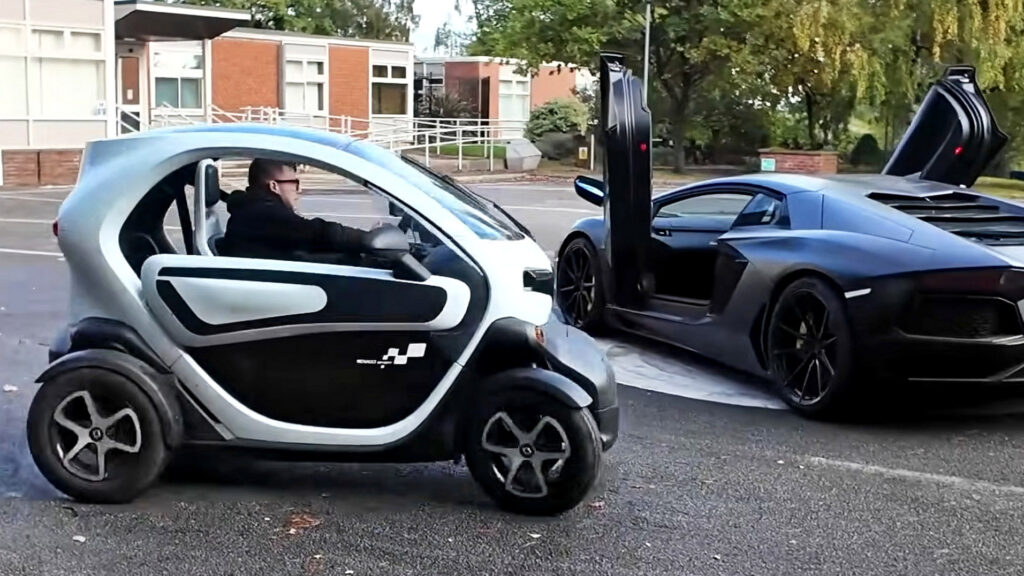
- DM Performance fitted a Stark Varg motor to the Twizy.
- It delivers 692 lb-ft through a custom chain-drive diff.
- Micro EV beat an Audi S1 to 100 mph and spun donuts.
The now-discontinued Renault Twizy was known for its futuristic styling, scissor doors and unconventional seating layout, but never for outright performance. No one has ever accused it of being fast. That, naturally, made it the perfect candidate for something irresponsible.
Enter the UK-based mad scientists at DM Performance, who looked at this humble heavy quadricycle and decided it needed more chaos. Their solution was simple in theory and mildly unhinged in practice: rip out the weedy motor and transplant the heart of the world’s most powerful electric motocross bike.
More: Renault’s Smallest And Quirkiest EV Is Dead
The project started with a full teardown. Out went the factory-fit 17 hp (13 kW) motor. In came the powertrain from a Stark Varg, effectively the electric equivalent of a 450cc gasoline engine. The result is 80 hp (60 kW), a staggering 396 percent jump in output that completely rewrites the Twizy’s modest résumé.
DM Performance / YouTube
But torque is the real headline here. The Stark Varg motor is rated at a frankly absurd 692 lb-ft (938 Nm). For context, the Lamborghini Aventador in the opening photo delivers 690 hp and 509 lb-ft (690 Nm), which means this pint-sized French creation is packing nearly double the torque of a V12 supercar!
More: World’s Least Powerful Gullwing Door Sports Car Finally Gets The Rotary Power It Deserved
It actually gets wilder. The supercharged 6.2-liter V8 in a 2027 Ram TRX produces 680 lb-ft (921 Nm). Now picture that sort of twist in a vehicle that weighs roughly ten times less than the Ram, and you begin to understand just how outrageous this thing really is.
Engineering The Swap
Making it all fit required serious surgery. DM Performance cut away the original rear cradle to accommodate the new motor and engineered a custom chain-drive system to replace the Twizy’s direct-drive transaxle.
DM Performance / YouTube
To cope with the tidal wave of torque, they modified the original differential with a custom stainless steel casing and high-pressure grease to mimic the behavior of a limited-slip diff. A set of Maxpeedingrods coilovers was also installed to reduce the risk of an impromptu rollover.
Finally, the French EV received another transplant. The Stark Varg battery pack weighs 32 kg (70 lbs), significantly lighter than the Twizy’s 100 kg (220 lbs) battery, while offering slightly higher capacity and the ability to discharge massive amounts of energy for high-performance motors.
Smoke, Speed, And Proof
The unique “Stark Twizy” proved its performance credentials by winning a 100 mph (161 km/h) drag race against a more powerful Audi S1 Quattro hot hatch. The builders also took it for a drift session and even performed donuts around a Lamborghini Aventador.
A History Of Madness
This isn’t the first time DM Performance has turned a tiny EV from the heavy quadricycle segment into a monster. They previously completed a wild Citroen Ami using similar Stark Varg internals, though they noted the rear-wheel-drive layout of the Twizy made it a much better platform for hooning.
Electric swaps not your thing? They have also created a turbocharged Hayabusa-swapped Tuk Tuk tricycle. That machine weighs 460 kg (1,014 lbs) and produces a frankly terrifying 305 hp (227 kW / 309 PS) on the dyno.