Damage from a powerful tornado that hit Menasha July 27, 2026. Gov. Tony Evers has written to officials at the Federal Emergency Management Agency urging them to reverse a decision denying federal disaster aid requested in the aftermath of the July storms in northeastern Wisconsin. (Photo by Appleton Police Department)
Gov. Tony Evers has filed an appeal with the federal government to reverse its denial of emergency hazard mitigation funds following disastrous storms that hit northeastern Wisconsin in late July.
The July 27 storms that affected Forest, Outagamie, Vilas and Winnebago counties also produced a strong tornado and damaged more than 2,000 homes as well as businesses, utilities and public infrastructure, Everswrote officials this week at the Federal Emergency Management Agency in Chicago and Washington. Many homes still need repair more than three months later, Evers wrote.
The federal government denied the state’s request in August for a federal disaster declaration after a joint state-federal assessment found more than $8 million in damage to private homes and more than $13 million in damage to public facilities and infrastructure, according to the governor’s office.
The requested funds are necessary to ensure that properties needing repair are also brought into compliance with local floodplain ordinances, possibly requiring buildings to be elevated or demolished, Evers wrote.
The funds are also needed so homeowners can make dwellings safe from flooding, such as by eliminating living spaces and basements that are below ground, and to build tornado-safe shelters.
“In less than one year’s time, the residents of the State of Wisconsin have recently been impacted by three significant events that have received Presidential major disaster declarations: severe storms and flooding in August 2025, severe storms, tornadoes and flooding in April 2026, and severe storms and tornadoes in July 2026,” Evers wrote.
Hazard mitigation grant funding “has been denied for all three of these disasters,” he wrote, even as a number of communities have been hit twice this year alone, by the April flooding and the July storms.
Ensuring that the communities receive the requested hazard mitigation funds “is imperative,” he added, “so the communities in our state are able to recover and prevent similar impacts from future disaster events while saving local, state, and federal taxpayer dollars.”
There’s a lot of untapped potential in our homes and vehicles that could be harnessed to reinforce local power grids and make them more resilient to unforeseen outages, a new study shows.
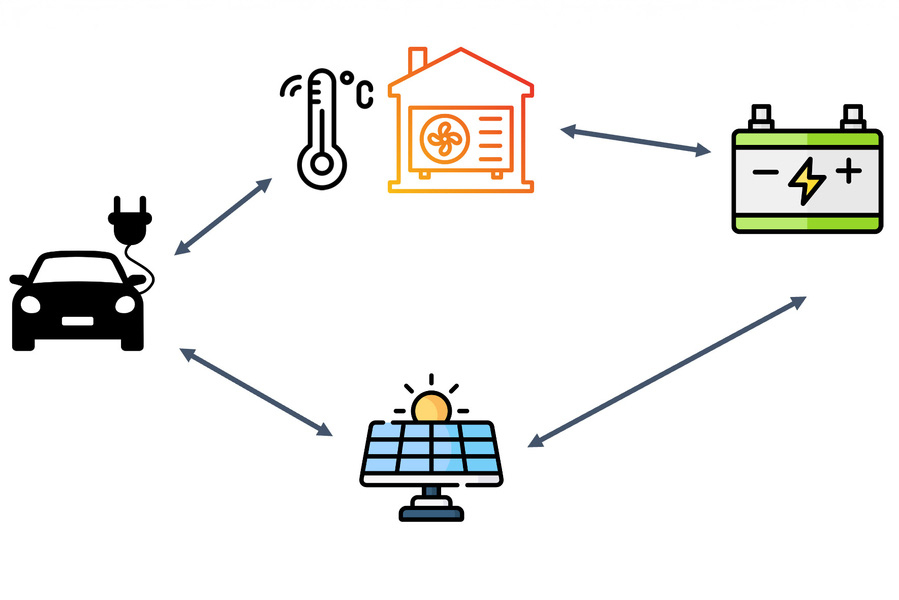
In response to a cyber attack or natural disaster, a backup network of decentralized devices — such as residential solar panels, batteries, electric vehicles, heat pumps, and water heaters — could restore electricity or relieve stress on the grid, MIT engineers say.
Such devices are “grid-edge” resources found close to the consumer rather than near central power plants, substations, or transmission lines. Grid-edge devices can independently generate, store, or tune their consumption of power. In their study, the research team shows how such devices could one day be called upon to either pump power into the grid, or rebalance it by dialing down or delaying their power use.
In a paper appearing this week in the Proceedings of the National Academy of Sciences, the engineers present a blueprint for how grid-edge devices could reinforce the power grid through a “local electricity market.” Owners of grid-edge devices could subscribe to a regional market and essentially loan out their device to be part of a microgrid or a local network of on-call energy resources.
In the event that the main power grid is compromised, an algorithm developed by the researchers would kick in for each local electricity market, to quickly determine which devices in the network are trustworthy. The algorithm would then identify the combination of trustworthy devices that would most effectively mitigate the power failure, by either pumping power into the grid or reducing the power they draw from it, by an amount that the algorithm would calculate and communicate to the relevant subscribers. The subscribers could then be compensated through the market, depending on their participation.
The team illustrated this new framework through a number of grid attack scenarios, in which they considered failures at different levels of a power grid, from various sources such as a cyber attack or a natural disaster. Applying their algorithm, they showed that various networks of grid-edge devices were able to dissolve the various attacks.
The results demonstrate that grid-edge devices such as rooftop solar panels, EV chargers, batteries, and smart thermostats (for HVAC devices or heat pumps) could be tapped to stabilize the power grid in the event of an attack.
“All these small devices can do their little bit in terms of adjusting their consumption,” says study co-author Anu Annaswamy, a research scientist in MIT’s Department of Mechanical Engineering. “If we can harness our smart dishwashers, rooftop panels, and EVs, and put our combined shoulders to the wheel, we can really have a resilient grid.”
The study’s MIT co-authors include lead author Vineet Nair and John Williams, along with collaborators from multiple institutions including the Indian Institute of Technology, the National Renewable Energy Laboratory, and elsewhere.
Power boost
The team’s study is an extension of their broader work in adaptive control theory and designing systems to automatically adapt to changing conditions. Annaswamy, who leads the Active-Adaptive Control Laboratory at MIT, explores ways to boost the reliability of renewable energy sources such as solar power.
“These renewables come with a strong temporal signature, in that we know for sure the sun will set every day, so the solar power will go away,” Annaswamy says. “How do you make up for the shortfall?”
The researchers found the answer could lie in the many grid-edge devices that consumers are increasingly installing in their own homes.
“There are lots of distributed energy resources that are coming up now, closer to the customer rather than near large power plants, and it’s mainly because of individual efforts to decarbonize,” Nair says. “So you have all this capability at the grid edge. Surely we should be able to put them to good use.”
While considering ways to deal with drops in energy from the normal operation of renewable sources, the team also began to look into other causes of power dips, such as from cyber attacks. They wondered, in these malicious instances, whether and how the same grid-edge devices could step in to stabilize the grid following an unforeseen, targeted attack.
Attack mode
In their new work, Annaswamy, Nair, and their colleagues developed a framework for incorporating grid-edge devices, and in particular, internet-of-things (IoT) devices, in a way that would support the larger grid in the event of an attack or disruption. IoT devices are physical objects that contain sensors and software that connect to the internet.
For their new framework, named EUREICA (Efficient, Ultra-REsilient, IoT-Coordinated Assets), the researchers start with the assumption that one day, most grid-edge devices will also be IoT devices, enabling rooftop panels, EV chargers, and smart thermostats to wirelessly connect to a larger network of similarly independent and distributed devices.
The team envisions that for a given region, such as a community of 1,000 homes, there exists a certain number of IoT devices that could potentially be enlisted in the region’s local network, or microgrid. Such a network would be managed by an operator, who would be able to communicate with operators of other nearby microgrids.
If the main power grid is compromised or attacked, operators would run the researchers’ decision-making algorithm to determine trustworthy devices within the network that can pitch in to help mitigate the attack.
The team tested the algorithm on a number of scenarios, such as a cyber attack in which all smart thermostats made by a certain manufacturer are hacked to raise their setpoints simultaneously to a degree that dramatically alters a region’s energy load and destabilizes the grid. The researchers also considered attacks and weather events that would shut off the transmission of energy at various levels and nodes throughout a power grid.
“In our attacks we consider between 5 and 40 percent of the power being lost. We assume some nodes are attacked, and some are still available and have some IoT resources, whether a battery with energy available or an EV or HVAC device that’s controllable,” Nair explains. “So, our algorithm decides which of those houses can step in to either provide extra power generation to inject into the grid or reduce their demand to meet the shortfall.”
In every scenario that they tested, the team found that the algorithm was able to successfully restabilize the grid and mitigate the attack or power failure. They acknowledge that to put in place such a network of grid-edge devices will require buy-in from customers, policymakers, and local officials, as well as innovations such as advanced power inverters that enable EVs to inject power back into the grid.
“This is just the first of many steps that have to happen in quick succession for this idea of local electricity markets to be implemented and expanded upon,” Annaswamy says. “But we believe it’s a good start.”
This work was supported, in part, by the U.S. Department of Energy and the MIT Energy Initiative.
An example of the different types of IoT devices, physical objects that contain sensors and software that connect to the internet, that are coordinated to increase power grid resilience.

 Login