
❌

Reading view

There are new articles available, click to refresh the page.

Nissan’s New Entry-Level EV Pixelates The Renault Twingo
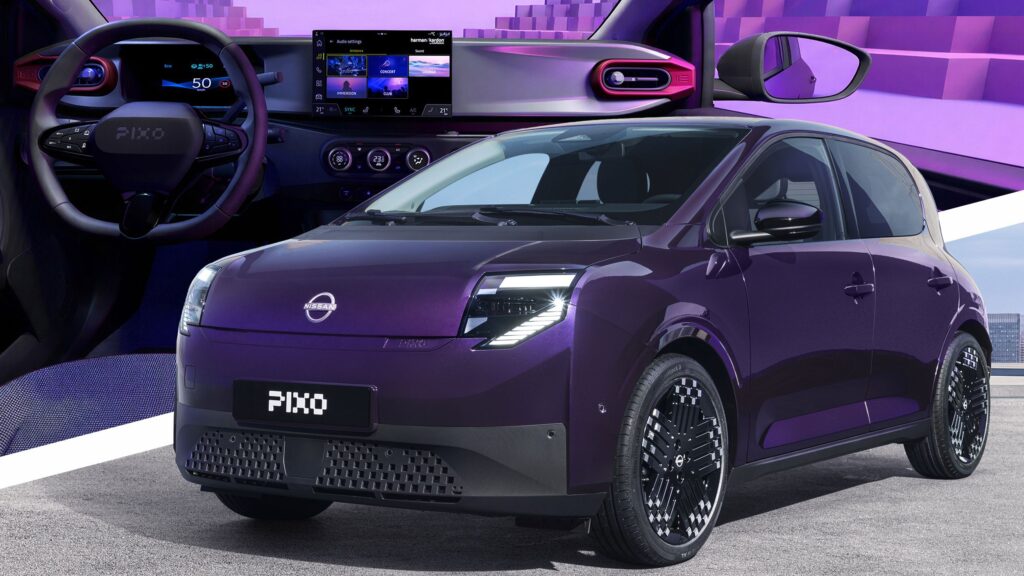
  • Nissan revives the Pixo badge for an affordable urban EV.
  • It is a twin to the Renault Twingo with Nissan styling cues.
  • It makes 81 hp and offers a 161-mile (259 km) WLTP range.

Nissan is dusting off an old nameplate for a new urban EV. The Nissan Pixo is a twin to the Renault Twingo E-Tech and a sibling to the Dacia Spring EV, featuring pixelated styling and modern technology. The model will be sold in Europe and the UK, serving as an entry point in the lineup positioned under the R5-based Nissan Micra.

Measuring 3,796 mm (149.4 in) long, the Nissan Pixo is only 7 mm (0.3 in) longer than the Renault Twingo, while sharing the 2,492 mm (98.1 in) wheelbase. The greenhouse, roof structure, and most of the profile are identical to the Renault, with Nissan designers focusing their efforts on the front and rear ends.

More: Renault Shipped 100 Frog-Eyed Twingos To The UK Purely So You Can Stare At Them

The Pixo swaps the curves and frog-style headlights of the Twingo for a boxier grille-less nose. The squared-off headlights with diagonal LED graphics are inspired by pixels, while the front bumper adopts clean surfacing with plastic cladding around the central intake.

\\\\\\\\\\\\\\\\\\\\\\\\\\\\\\\\\\\\\\\\\

Setting aside the front fenders and the futuristic alloy wheels, the profile doesn’t hide its Renault roots. However the rear end gains redesigned taillights and a simpler tailgate, which are slightly reminiscent of the Nissan Micra K12 from the ’00s. These are joined by Nissan-specific cladding on the rear bumper and Pixo lettering on the plastic trim around the rear windshield. Finally, the color palette gains the fresh Wonder Purple and Gear Blue shades.

More: New Dacia Spring EV Flees From China And Pays The Price

Inside, the dashboard, the steering wheel, and the digital cockpit with Gemini integration are derived from the Renault twin. The same applies to the reclining and foldable rear seats adding practicality points to the urban EV. Nissan brags about the 356 lt (12.6 cubic feet) cargo capacity including the 50 lt (1.8 cubic feet) compartment for charging cables, and the extra 18 lt (0.6 cubic feet) of in-cabin storage. Furthermore there are 23 Easter eggs for owners to discover.

\\\\\\\\\\\\\\\\\\\\\\\\\\\\\\\\\\\\\\\\\\\\\\\

Under the skin, the Pixo is identical to the Renault Twingo and the Dacia Spring. A front-mounted electric motor is good for 81 hp (60 kW / 82 PS), while a 27.5 kWh Lithium Iron Phosphate (LFP) battery delivers a WLTP range of 161 miles (259 km). The EV is compatible with 50 kW DC charging, replenishing the battery from 15-80% in 28 minutes.

More: The Nissan Micra is Back And It’s Unrecognizable

The Nissan Pixo will go on sale in Europe and the UK, with production taking place at the Novo Mesto factory in Slovenia alongside the closely-related Renault Twingo and Dacia Spring. Pricing and pre-order information will be announced from December 2026 onwards. However, judging from the Renault, the entry-level EV from Nissan will most likely start from under €20,000 ($22,800).

Hardcore Nissan fans might remember that the original Pixo which was sold in Europe between 2009 and 2013, was also a rebadged urban hatchback. However, this one was based on the Suzuki Alto and came fitted with a 1.0-liter gasoline engine.
\\\\\\\\\\\

Nissan

New Dacia Spring EV Flees From China And Pays The Price

  • New Dacia Spring is a Euro-made budget-friendly urban EV.
  • It has a Renault platform, 80 hp and a 155-mile WLTP range.
  • The entire lineup will be priced under €20k before subsidies.

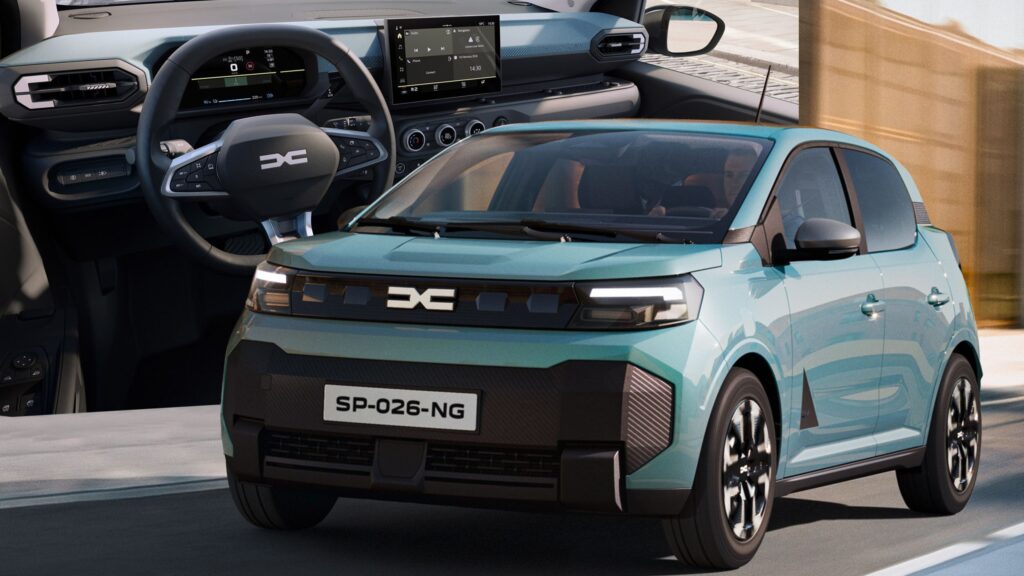
Dacia has unveiled a new generation of the Spring, marking a complete overhaul for one of Europe’s most affordable urban EVs. The small hatchback is built on Renault bones, promising a 155-mile range, clever design features and a sub-€20k ($23k) price tag. Unlike its Chinese-built predecessor, the new Spring will be manufactured in Slovenia, avoiding import tariffs in Europe.

The new model swaps the aging CMFA-EV platform of its predecessor for the new RG-EV architecture. This is another name for the AmpR Small platform, already underpinning the Renault Twingo E-Tech, Renault 5 E-Tech and Nissan Micra hatchbacks.

More: Dacia’s Sub-$28K Striker Claims To Be Three Cars At Once

\\\\\\\\\\\\\\

Power comes from a Twingo-sourced electric motor producing 80 hp (60 kW / 82 PS) and 175 Nm (129 lb-ft) of torque, sending power to the front wheels. The 0-100 km/h (0-62 mph) sprint is completed in 12.1 seconds and top speed is limited at 130 km/h (81 mph). Energy is stored in a small 27.5 kWh Lithium Iron Phosphate (LFP) battery pack, offering up to 250 km (155 miles) of WLTP range.

The battery needs 28 minutes to charge from 15-80% when connected to a 50 kW DC fast charger, or 2 hours and 55 minutes from a 7 kW wallbox using the standard AC charger.

\\\\\\\\\\\\\\\\\

The shift to the new platform gives the urban EV different proportions and a larger footprint while keeping weight low at 1,212 kg (2,672 lbs). The new Spring is 150 mm (5.9 in) longer and 180 mm (7.1 in) wider compared to its predecessor, stretching to 3,850 mm (151.6 in) long. It is also 61 mm (2.4 in) longer than the Renault Twingo E-Tech twin, while adopting a different styling language.

More: Renault Shipped 100 Frog-Eyed Twingos To The UK Purely So You Can Stare At Them

Unlike the Renault which is known for its frog-style headlights and soft curves, the Dacia looks less playful and more utilitarian. Designers gave it boxy LEDs, a generous amount of plastic cladding on the bumpers, conventional door handles and steel wheels measuring 15 or 16 inches in diameter.

\\\\\\\\\\\\\\\\\\\\\\\\\\\\\\\\\\\

Inside, the larger body translates to a more spacious cabin although the model retains the four-seater layout. The cargo space has a capacity of 337 liters (11.9 cubic feet) and grows to 1,283 liters (45.3 cu ft) when folding the 50/50 split rear bench. Dacia has also added a optional 18-liter (0.6 cubic feet) frunk, plenty of storage solutions around the cabin, and the modular YouClip accessory mounting system.

More: Renault’s New Duster Looks Like An Expensive Dacia, Until You See The Price

\\\\\\\\\\\\\\\\\\\\\\\\\\\\\\\\\\\\\\\\

The dashboard appears to be covered in hard plastics with a large piece of colorful trim above the practical tray breaking the monotony of black. The standard 7-inch digital instrument cluster is joined by a 10.1-inch infotainment display on the flagship Journey trim, although the entry level Expression will be limited to a smartphone mount.

Occupants are treated with fabric seats and scratchy plastics on the door cards, designed to keep the costs low. Finally, the model has a familiar β€œMy Safety” button allowing the driver to quickly disable or enable ADAS.

\\\\\\\\\\\\\\\\\\\\\\\\\\\\\\\\\\\\\\\\\

Production of the new Dacia Spring takes place at the Novo Mesto plant in Slovenia alongside the Renault Twingo E-Tech. The market launch is expected in late 2026, with the first deliveries scheduled for early 2027. Dacia has yet to announce detailed pricing but confirmed that all variants will cost under €20,000 ($23,000) before local EV subsidies.

More: Opel’s Cheapest New Car Is Now A Family SUV With Three Pedals And Steelies

This suggests that the new model will be more expensive compared to the outgoing Chinese-built Spring, which started from a heavily discounted €11,900 ($13,800) in Germany earlier this year. The latter will remain on sale alongside the new generation for a transitional period, serving as a cheaper alternative.

The new Spring is one of four new Dacia EVs set to debut by 2030 according to the official roadmap, including the upcoming Sandero EV with a slightly larger footprint.

\\\\\\

Dacia

Renault Shipped 100 Frog-Eyed Twingos To The UK Purely So You Can Stare At Them

  • Renault sent 100 Twingo E-Tech models to UK dealers for static display.
  • The showroom units are painted in Absolute Green with black steelies.
  • Budget-friendly EV packs 80 hp and offers 163 miles of WLTP range.

While America still waits on electric cars that manage to be stylish and affordable at the same time, Renault is busy treating Europe to a cute frog-eyed hatchback. The resurrected Renault Twingo E-Tech has just made the trip across the English Channel, though British buyers won’t be taking one for a spin quite yet.

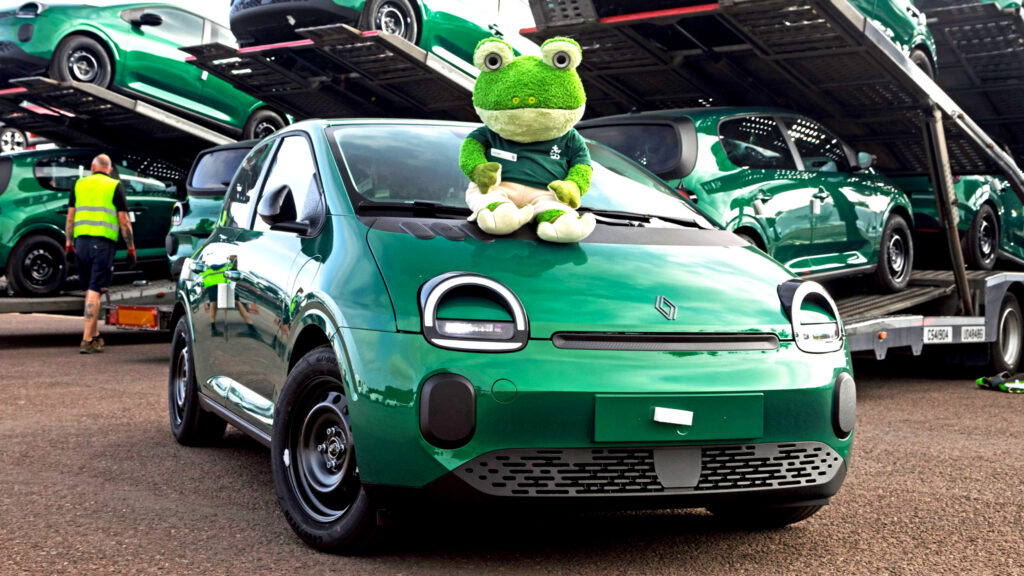
Renault has shipped a convoy of more than 100 Twingos from France to the UK for one specific reason. The EVs will act as display models in showrooms nationwide ahead of the official market launch in late 2026. So why are they staying put?

More: Renault’s R4 Concept Just Became A Beach Buggy That Moonlights As A Pickup

The answer comes down to their configuration. This batch is left-hand drive and hasn’t been approved for UK roads, so the cars will stay locked to the showroom floor rather than heading out for test drives.

\\\\\

Renault

The 100 Renaults arrived on dedicated single-make car haulers, all wearing the Absolute Green presentation color. They also sit on 16-inch steelies in black, though those will probably be hidden under hubcaps once they reach their destinations. For reference, the flagship Twingo trim gets diamond-cut Reverso alloys measuring 18 inches.

Standard equipment includes full-LED lights, independent sliding rear seats, a 10-inch infotainment display, a 7-inch digital instrument cluster, manual A/C and rear parking sensors.

Review: The Fun 2026 Renault 5 EV America Will Never Get To Buy

\\\\\\\

Renault

Beneath its stylish body, the Twingo E-Tech rides on the AmpR Small platform, shared with the R5 E-Tech and the Nissan Micra. A single electric motor produces 80 hp (60 kW / 82 PS) and 175 Nm (129 lb-ft) of torque, fed by a 27.5 kWh lithium iron phosphate (LFP) battery good for a WLTP range of 163 miles (262 km). The little city car handles 50 kW DC fast charging, enough to go from 10 to 80 percent in 30 minutes.

\\\\

Renault

Renault has yet to confirm UK pricing but promises a starting figure under Β£20,000 ($26,900). In France, the Twingo opens at €19,490 ($22,400) in base Evolution trim. Local incentives can knock that down to €15,870 ($18,200), making it one of the cheapest new cars on the French market.

Rivals of the Renault Twingo E-Tech include the Dacia Spring, the Leapmotor T03, and the upcoming production version of the VW ID.Every1 concept. Production of the entry-level Renault is handled in Slovenia.

\\\\\\\\

Renault

❌