
Normal view

There are new articles available, click to refresh the page.
Before yesterdayMain stream

BMW’s New Electric M3 Misses Gas So Much, It’s Borrowing A V10’s Sound

  • BMW’s electric M3 uses soundtracks from past M performance icons.
  • It blends V8, inline-six, and V10 engine notes into its EV profile.
  • The M3 EV will feature simulated shifts with optional sound modes.

Breaking into the electric performance space is a delicate task for a brand like BMW M, which has spent decades building its reputation on combustion-powered icons. But that’s exactly what it’s attempting with the Neue Klasse-based electric M3, or, as it may end up being called, the i3M.

The upcoming high-performance EV won’t replace the traditional ICE-powered model, though. Instead, it’s designed to sit alongside it, borrowing cues from BMW M’s most celebrated models to bridge the old and the new. Or at least that’s the promise.

Read: BMW’s Electric M3 Tries To Simulate Everything It Just Replaced

BMW M released the latest chapter in its video series detailing the development of the new super sedan, previewing the distinctive soundscape it plans to offer. Taking a page from Hyundai N’s playbook, BMW aims to replicate the sounds of some of its most iconic models, blending them with the unique tone of a high-performance EV.

Chasing the Sound of the Past
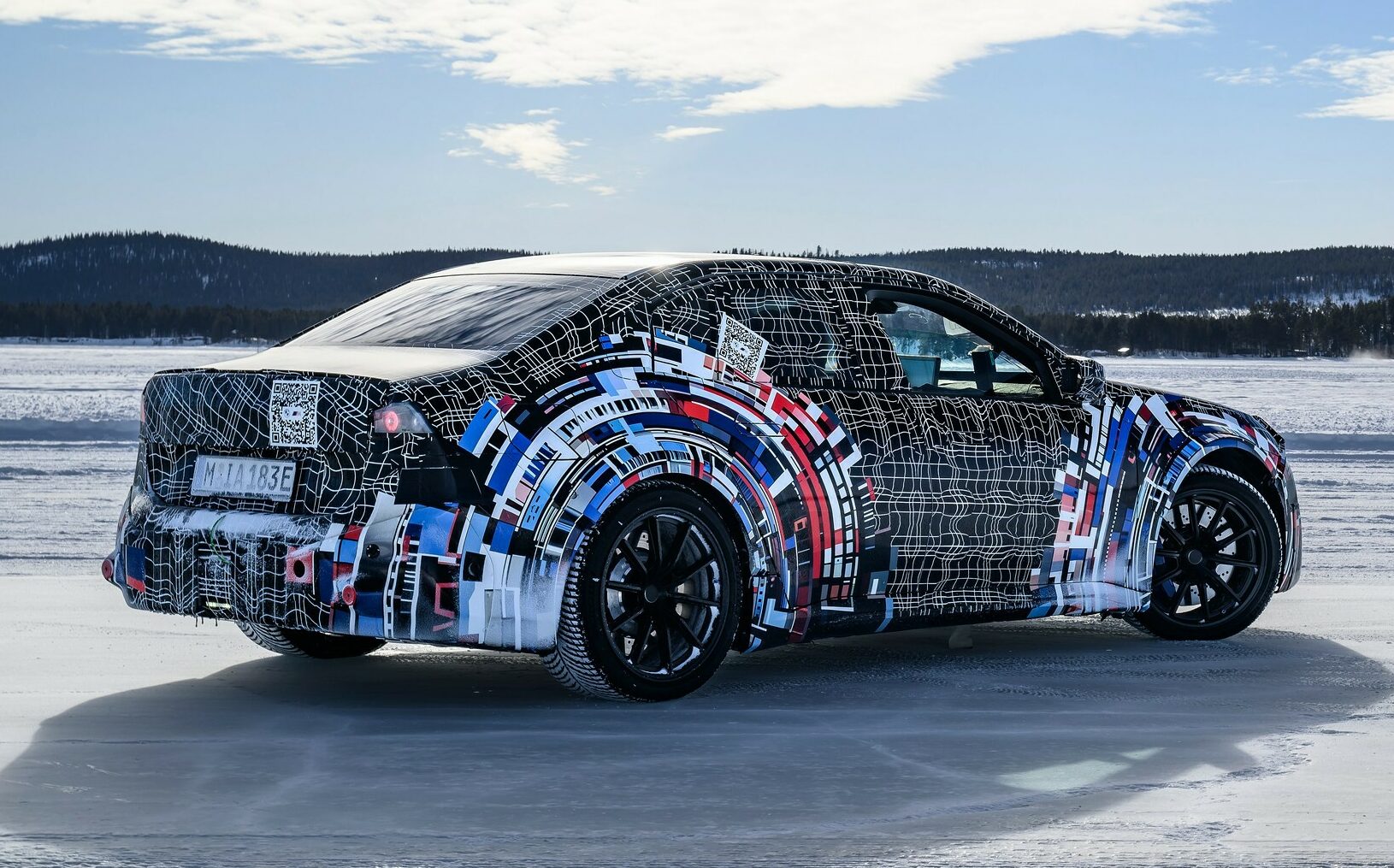
 BMW’s New Electric M3 Misses Gas So Much, It’s Borrowing A V10’s Sound

Rather than relying solely on software to mimic engine sounds, BMW assembled an M3 GTS with a 4.4-liter V8, an M4 GTS with its 3.0-liter twin-turbo inline-six, and a classic BMW M6 featuring the brand’s iconic 5.0-liter naturally aspirated V10. Their engine notes were recorded on a dyno, then layered into the soundtrack of the electric prototype.

The clip only demonstrates the soundtrack of the electric M3 for a brief moment while being put through its paces on BMW’s test track. As the driver hits the throttle, it begins to sound like a turbocharged engine building boost as the revs climb. There are also some notable turbo whistles, mixed in together with some of the high-pitched whine expected of an EV.

Performance to Match the Drama

Like the Hyundai Ioniq 5 N and Ioniq 6 N, BMW’s electric M3 will also include simulated gear shifts to match the synthetic engine notes. For drivers who prefer their EV experience unfiltered, these features are expected to be optional and easily switched off.

Of course, the electric M3 will need to be more than just good-looking to convince shoppers. BMW has confirmed it’ll be fitted with four electric motors and a 100 kWh battery pack that’s up to the task of track use.

While BMW hasn’t revealed any final power figures, we know that each wheel will be controlled individually, allowing for advanced torque vectoring for better performance and handling. There will also be an optional rear-wheel drive-only mode.

\\\\\\\\\\\\\\

BMW iX3 Beats Its Official Range By Over 120 Miles In Real-World Test

  • BMW’s iX3 50 xDrive completed a 626-mile drive from Hungary to Munich.
  • The team finished with 2 percent battery left, enough for another 12 miles.
  • The SUV used smaller 20-inch wheels and skipped HVAC to save energy.

BMW’s latest step into its electric future comes with more stamina than we expected. The second-generation iX3 , unveiled a few months ago with a projected range of 497 miles (800 km) under the WLTP cycle, has quietly outperformed even BMW’s own estimates, though, as always, there are a few caveats tucked in the fine print.

In a real-world run, the electric SUV managed to stretch its legs to more than 621 miles (1,000 km) on a single charge.

Read: The iX3 Is BMW’s Neue Klasse Future Now With A Surprising Price Tag

Eager to see how far their new creation could really go, a small team from BMW decided to take the iX3 on a proper road trip. They set off from the Debrecen plant in Hungary, where the model is built, and pointed it toward Munich, the automaker’s home base in Germany.

Not only did they complete the 626.1-mile (1,007.7 km) journey, but they did so with 2 percent charge remaining, which could have been enough to travel an extra 12 miles (20 km).

What Are The Caveats?

As you could have probably guessed, the team did everything they could to extend the iX3’s driving range. For example, they avoided highways during the journey, sticking to smaller and lower-speed roads where the SUV’s regenerative braking system would be most effective.

Additionally, the iX3 was equipped with smaller 20-inch wheels, rather than the 21- and 22-inch wheels it’s also available with. They also didn’t use the heating, cooling, or radio during the test, to save as much energy as possible.

BMW picked the iX3 50 xDrive, the only version announced to date, which has a pair of electric motors delivering 463 hp and 476 lb-ft of torque, meaning it can hit 60 mph (96 km/h) in just 4.7 seconds, and a sizeable 108.7 kWh battery pack.

\\\\\\\\\

Two Killed After Wrong-Way BMW Driver Crashes Into Cybertruck

  • The BMW sedan hit the Cybertruck, pushing it into an 18-wheeler.
  • Police are investigating if the BMW driver was impaired that night.
  • More than 230 people were injured in wrong-way crashes last year.

Crashes on Houston’s busy freeways are an unfortunate reality of city life, and one earlier this week proved especially tragic. The driver of a BMW was killed, and the driver of a Tesla Cybertruck died in hospital after the two vehicles collided in Houston, Texas.

Shockingly, police say the BMW’s driver had mistakenly entered the freeway, traveling the wrong way after driving down an exit ramp and heading westbound in the eastbound lanes.

Watch: Cybertruck Ripped In Half By A Mercedes Built Like A Tank

The crash occurred around midnight on October 28 along the I-10 Katy Freeway. According to police, the BMW, whose specific model hasn’t been identified, slammed into the Cybertruck and burst into flames almost instantly. The force of the impact also pushed the Tesla into an 18-wheeler.

Initially, it was only the driver of the BMW who was declared dead on the scene, and the driver of the Cybertruck was taken to a nearby hospital in critical condition. Sadly, the Tesla driver succumbed to their injuries.

Houston Police Department Sgt. Rebecca Dallas told KHOU that the BMW driver had entered the freeway in the opposite direction, ignoring multiple Do Not Enter and Wrong Way signs along the ramp.

Investigators are expected to conduct an autopsy of the BMW driver to see if they were impaired at the time of the collision. The name of the driver who caused the crash hasn’t been released. However, the driver of the Cybertruck has been confirmed as a 38-year-old father of two young children.

Accidents Like This Are Far Too Common

Accidents like this are far from rare. More than 1100 wrong-way fatalities have been recorded across Harris County in the past decade, and last year alone, 233 people were injured in similar incidents throughout the area. Clearly, something needs to be done to reduce these numbers.

Local authorities may need to explore a combination of measures, from adding more signage to exit ramps to enhancing driver education. Small changes could go a long way toward preventing future tragedies on Houston’s highways.

❌
❌