The Wauwatosa Police Department (Photo by Isiah Holmes/Wisconsin Examiner)
A Dane County Circuit Court judge ordered the Wisconsin Department of Justice to release its list of about 16,000 law enforcement officers certified in the state.
The lawsuit was brought by media outlets the Badger Project and Invisible Institute. Police officers in Wisconsin are required to be certified by the state’s Law Enforcement Standards Board. The DOJ has previously released partial versions of the list, arguing that the full database could compromise the identity of officers working undercover.
Both outlets have frequently written about “wandering cops” who leave departments due to misconduct or abuse only to be hired by another agency. The DOJ list includes a record of cops being fired or resigning in lieu of termination.
Judge Rhonda Lanford ruled on Tuesday that the DOJ’s argument against releasing the list went against the state’s open records law.
“When responding to records requests, there is a strong presumption of openness and liberal access to public records,” she wrote. “[T]he DOJ has not met its burden to show that this is an ‘exceptional case’ warranting nondisclosure.” The judge concluded that DOJ’s denial “was not the product of a genuine, case-by-case balancing analysis, but rather a habitual denial based on [its] past inability to garner compliance from local agencies.”
Lanford noted that law enforcement officers hold a public position and therefore “necessarily relinquish certain privacy and reputational rights by virtue of the amount of trust society places in them and must be subject to public scrutiny.”
Tom Kamenick, the lead attorney in the lawsuit and founder of the Wisconsin Transparency Institute, said the decision was a win for transparency in Wisconsin government and the requirement that officials must prove real risk of harm when denying an open records request.
“Courts have ruled time and time again that speculative fears of harm do not justify withholding government records from the public,” Kamenick said in a statement. “Government officials must do more than merely claim that, hypothetically, something bad might happen if the records are released. Rather, they must show that harm is likely to occur and is sufficiently serious to overcome the presumption of access to government records. DOJ could not do that here.”
Rev. Bernard LaFayette (center, in wheelchair and cloth cap) holds his wife Kate’s hand as they are wheeled over the Edmund Pettus Bridge in Selma, Alabama on March 9, 2025 as part of 60th anniversary commemorations of Bloody Sunday, the 1965 attack on peaceful civil rights protestors that led to the Selma-to-Montgomery March and the Voting Rights Act. LaFayette ran the Selma voting rights campaign in 1965 and survived an assassination attempt. (Photo by John Partipilo/Tennessee Lookout)
The U.S. Supreme Court’s decision gutting the federal Voting Rights Act sent Black Democrats in the U.S. House reeling on Wednesday, as they confronted a new reality where Republicans could gerrymander some of them out of office and limit the ability of Black voters to elect candidates in the future.
Members of the Congressional Black Caucus vowed to fight the court’s decision. They demanded fresh votes on federal voting rights legislation that has languished for several years and urged voters to turn out in the November election.
But facing a Republican-controlled Congress for at least the rest of the year and a Republican White House for at least the next two-and-a-half years, the prospect of major new voting rights legislation becoming law appears slim in the near term.
“It will pave the way for the greatest reduction in representation for Black and minority voters since the years following Reconstruction,” Rep. Terri Sewell, an Alabama Democrat, said of the court’s decision, referring to the post-Civil War period in the South.
Republicans could ultimately secure up to 19 U.S. House seats nationally directly because of the Supreme Court’s decision, according to a projection by Fair Fight Action, a Georgia-based progressive voting rights group, and the Black Voters Matter Fund, which advocates on behalf of Black voters.
As of Aug. 4, 2025, Congress included 61 Black members of the House, including two delegates, and five senators, according to the Congressional Research Service.
Racial gerrymander
In a 6-3 decision written by Justice Samuel Alito, the Supreme Court ruled that Louisiana’s congressional map was an unconstitutional racial gerrymander because it unnecessarily created a second district where a majority of residents are Black.
Section 2 of the Voting Rights Act had previously limited states from using maps that dilute the voting power of minority citizens. Justice Elena Kagan, one of the court’s three liberal justices, wrote in a dissent that the decision would now allow states to dilute the voting power of minority voters without legal consequences.
Republicans welcomed the decision, with many saying race should play no role in redistricting. President Donald Trump, informed about the ruling by reporters and told that it would help Republicans, exclaimed, “I love it.”
Florida lawmakers approved a new map within hours of the opinion. The proposal, offered by Gov. Ron DeSantis earlier this week, seeks to secure four additional House seats for Republicans. DeSantis had invoked the court’s decision, even before it was released, to push lawmakers to pass the new map.
GOP candidates and officials in other states urged state lawmakers to move quickly to redraw maps, even with primary elections approaching. Even if only a small number of states enact fresh gerrymanders this year, the Supreme Court decision will likely trigger another, bigger wave of redistricting over the next two years ahead of the 2028 election.
“The Court rightly acknowledged that the South has made extraordinary progress, and that laws designed for a different era do not reflect the present reality,” Alabama Republican Attorney General Steve Marshall said in a statement.
Rep. Richard Hudson, a North Carolina Republican who chairs the National Republican Congressional Committee, in a statement said the decision “restores fairness, strengthens confidence in our elections, and ensures every voter is treated equally under the law.”
The Supreme Court in 2019 allowed states to redraw maps for political advantage, ruling that federal courts would no longer adjudicate partisan gerrymandering cases. That previous decision, combined with Wednesday’s opinion, offers states a wide berth to draw maps that limit the voting power of minorities if they’re sold as politically necessary.
Bloody Sunday
Sewell represents a district that includes Selma, where the civil rights activist and future U.S. Rep. John Lewis, D-Ga., along with other marchers, was beaten by state troopers in 1965 while walking across the Edmund Pettus Bridge in an episode called Bloody Sunday.
The beatings helped spur Congress to pass the Voting Rights Act later that year — the same law the Supreme Court weakened on Wednesday.
“The court just gave states permission to use partisan gerrymandering as a wholesale excuse to deny Black and minority voters a voice in our democracy,” Sewell said.
In Missouri, the Republican-controlled legislature earlier this year passed a map intended to oust Rep. Emanuel Cleaver, a Democrat who was Kansas City’s first Black mayor. The state Supreme Court is weighing a legal challenge that could keep the map from taking effect before the November election.
On Wednesday, Cleaver in a statement called the opinion “deeply disrespectful of the generations of African Americans and civil rights advocates who gave their freedom, their blood, and even their lives to make it possible.”
Obama criticizes ruling
Former President Barack Obama condemned the decision as another example of how a majority of the current Supreme Court seems intent on “abandoning its vital role” in ensuring equal participation in American democracy and protecting the rights of minority groups against majority overreach.
“The good news is that such setbacks can be overcome,” Obama said in a statement. “But that will only happen if citizens across the country who cherish our democratic ideals continue to mobilize and vote in record numbers – not just in the upcoming midterms or in high profile races, but in every election and every level.
Several Democrats said Congress should pass the John Lewis Voting Rights Advancement Act, a Democratic-sponsored measure that seeks to restore preclearance — a requirement that states with a history of discrimination obtain federal approval before making voting changes. The Supreme Court effectively halted preclearance in 2013.
The House, under Democratic control, passed the legislation in 2021 but it stalled in the Senate. Democrats could likely pass the bill again if they retake the House in November but would face a likely filibuster again in the Senate. Even if they managed to pass the bill, Trump would be virtually certain to veto it.
Rep. Cleo Fields, a Louisiana Democrat whose district was ruled an unconstitutional racial gerrymander, sought to place the court’s decision in a broader, historical context.
Looking ahead to midterms
Recalling Louisiana’s Jim Crow past, he said the state used to require individuals to recite the Constitution’s preamble before registering to vote.
“If you tell me I’ve got to jump a certain height, I could probably do that. Tell me I’ve got to run a certain distance, I could probably do that, too. But if you tell me I have to be white to serve in Congress from Louisiana, I can’t do nothing about that — I need some help from my government,” Fields said, adding that’s why Congress needs to pass the John Lewis Voting Rights Advancement Act.
House Minority Leader Hakeem Jeffries called the Supreme Court’s conservative majority “illegitimate” and said the opinion was unacceptable but not unexpected.
While acknowledging the decision represents a setback, America has an opportunity to mount a comeback in the upcoming election, he said.
Jeffries, who is set to become speaker if Democrats retake the House in November, said one of the chamber’s first actions would be to pass the John Lewis Voting Rights Advancement Act.
“So we can end the era of voter suppression in America once and for all,” Jeffries said.
Demonstrators chant and hold signs outside the U.S. Supreme Court on April 29, 2026 in Washington, DC. The court heard arguments challenging the Department of Homeland Secuirty's termination of Temporary Protected Status for immigrants from Haiti and Syria. (Photo by Tom Brenner/Getty Images)
WASHINGTON — The U.S. Supreme Court appeared poised Wednesday to uphold the Trump administration’s efforts to end temporary legal protections for 350,000 Haitians and 6,000 Syrians.
The decision could also affect several other lawsuits related to what is known as Temporary Protected Status that are pending in lower courts. The suits challenge the Trump administration’s procedures to terminate country protections, which have sharply raised deportation risks for more than 1 million immigrants.
So far, the Trump administration has ended TPS destinations for 13 countries, out of 17 that were active at the start of President Donald Trump’s administration.
Arguing on behalf of the Trump administration, U.S. Solicitor General D. John Sauer said that federal courts, under the law, cannot review the executive branch’s decision to end or extend a TPS designation.
“They challenge the very kind of foreign policy-laden judgments that are traditionally entrusted to the political branches,” Sauer said of TPS recipients who are suing to remain in the United States.
But two lawyers, Ahilan Arulanantham, representing Syrians, and Geoffrey Pipoly, representing Haitians, argued that their clients could challenge a lack of proper procedure that then-Homeland Security Secretary Kristi Noem took in ending those TPS designations.
That would include not undertaking a review of country conditions before making a determination, the lawyers said.
Most of the questioning came from the three liberal justices, who grilled Sauer and pressed him on Trump’s racist remarks disparaging Haitians.
The conservative justices, who hold a 6-3 majority, asked Sauer only a handful of questions, and seemed skeptical of Arulanantham and Pipoly’s argument, signaling that they may already agree with the Trump administration’s position that the courts cannot review TPS terminations.
A decision is not expected until June or early July. Both cases would go back to the lower courts to continue on the merits argument.
But if the Supreme Court agrees with the Trump administration, then TPS holders from Haiti and Syria could be subject to deportation.
TPS is a humanitarian program that Congress created in 1990 to allow for temporary protections for nationals who hail from countries deemed too dangerous to return to due to violence, disasters or other extreme circumstances.
TPS holders must go through vetting to be approved for work permits and legal protections. Each renewal lasts from six to 12 to 18 months.
Those determinations are up to the Department of Homeland Security secretary, who typically consults with the State Department to evaluate country conditions and determine if the status needs to be extended. Decisions would depend upon whether conditions are still unsafe for a migrant’s return.
Sauer argued that the courts cannot review that final decision, including procedural ones that lead up to it.
Arulanantham contended that position is a “double edged sword.” Another administration could easily come in and a new DHS secretary could theoretically use TPS to give legal status to immigrants in the country unlawfully, and that decision would not be subject to review by the courts, Arulanantham said.
The TPS holders before the Supreme Court argue that Noem did not consult with the appropriate agencies, such as the State Department, before deciding to end TPS designation. They say she did not follow proper procedure — but they are not challenging that a decision to terminate a country can be reviewed.
Arulanantham said with Syria, if Noem had reviewed the State Department’s report, which advises people not to travel to the country because of armed conflict, and still decided against renewing protections, that decision is not reviewable.
“What is reviewable is whether she actually asks anything and gets any information about country conditions,” he said.
Sauer said that legal argument was “meritless,” because the TPS “statute does not micromanage the degree of consultation with other agencies.”
Justice Amy Coney Barrett pressed Arulanantham why a challenge to the review of how a TPS termination is ended would even matter.
“If it’s just kind of a box-checking exercise, I mean, why would Congress permit review of the procedural aspect, when really what everybody cares about much more is the substance?” she asked.
Arulanantham said it’s “because Congress … and the millions of people who live with TPS, have some faith in government, and they believe that if there is consultation, the decisions will be better.”
He said, “Our view is that even if it comes back like a box-checking exercise, people will at least know that somebody talked to somebody else.”
Trump ‘racial animus’ cited
Pipoly argued that the ending of TPS for Haiti was based on racial animosity toward Haitians, pointing to the president’s own words where he referred to the Caribbean island as a “shithole.”
“The true reason for the termination is the president’s racial animus towards non-white immigrants and bare dislike of Haitians in particular,” he said.
Justice Sonia Sotomayor asked Sauer about those comments from Trump.
“We have a president saying at one point that Haiti is a ‘filthy, dirty and disgusting s-hole country,’ I’m quoting him, and where he complained that the United States takes people from such countries, instead of people from Norway, Sweden or Denmark,” she said. “I don’t see how that one statement is not a prime example of … showing that a discriminatory purpose may have played a part in this decision.”
Sauer argued that none of those statements “mentions race or relates to race,” and instead the president was referring to “problems like crime, poverty, welfare dependence.”
In the lower court that blocked the Trump administration from ending TPS for Haiti, federal Judge Ana Reyes found that there was racial animosity in the government’s decision to end the humanitarian protections.
This is not the first time Trump has tried to end TPS for Haiti — he did so in his first administration in 2018, but was blocked by the courts.
Haitian workers in the US
The day before Wednesday’s oral arguments, a handful of Democratic lawmakers gathered with domestic care advocates outside the U.S. Capitol to stress the importance of TPS workers. More than 20,000 Haitians work in healthcare, according to the immigration advocacy group FWD.us.
“At this moment, over 1 million people are at risk of being removed from their homes, separated from their families, having their lives uprooted because of Trump’s cruel and unlawful attempt to terminate their temporary protected status,” Massachusetts Democratic Rep. Ayanna Pressley said during the Tuesday press conference.
Pressley said that thousands of TPS holders serve as essential workers, including one recipient from Haiti who took care of the congresswoman’s mother, who died from cancer.
“It was Haitian nurses who prayed over my mother, who sang songs to my mother, who oiled her scalp lovingly and braided her hair,” Pressley said. “Everyone who calls this country home benefits from TPS, and stands to be harmed by this termination.”
Pressley has led the bipartisan push in the House to approve a measure that would extend TPS for Haiti up to three years.
While it passed in the House, the legislation would need 60 votes in the Senate, which is controlled by Republicans. Additionally, if Congress managed to pass the bill, it would likely be rejected by Trump.
“We are demanding the Supreme Court uphold the law, save lives and protect our communities,” Pressley said. “To send vulnerable families to countries like Haiti, Venezuela and Syria that are enduring horrific humanitarian crises is unconscionable, shameful, unlawful and preventable.”
White House Deputy Chief of Staff Dan Scavino jumps over a chair after gunfire was heard and officials evacuated at the White House Correspondents' Association Dinner April 25, 2026 in Washington, DC. (Photo by Chip Somodevilla/Getty Images)
The suspect in the attack at the White House Correspondents’ Dinner on Saturday night was prepared for a mass casualty event, prosecutors said in a document filed in federal court early Wednesday.
Jeanine Pirro, the U.S. attorney for the District of Columbia, and three assistants in her office signed a memorandum asking a judge to keep 31-year-old Cole Tomas Allen detained as he awaits trial. They said his “actions were premeditated, violent, and calculated to cause death,” and he sought to “express his political opinions through violence.”
“Had the defendant achieved his intended outcome, he would have brought about one of the darkest days in American history,” they wrote. “The defendant traveled across the country with the explicit aim to kill the President of the United States.”
A detention hearing is set for Thursday. Allen is charged with attempting to assassinate President Donald Trump, as well as interstate transportation of a firearm with intent to commit a felony and discharge of a firearm during a crime of violence.
He faces up to life in prison if convicted of attempting to kill the president. Trump, first lady Melania Trump and Cabinet members all safely evacuated the Washington Hilton ballroom.
The document lists a host of weapons, ammunition and other supplies Allen had in his possession at the time of his arrest.
He had a “12-gauge pumpaction shotgun with one spent cartridge in the barrel and eight unfired cartridges in the magazine tube,” the document reads. He carried additional ammunition in a Velcro strapped to his body and in a separate pouch, the prosecutors said.
He also carried a fully loaded .38 caliber pistol with two additional magazines.
Cole Tomas Allen, the suspect in the shooting at the White House Correspondents’ Association dinner, took this selfie in a Washington Hilton hotel room mirror prior to the attack, prosecutors allege. (Photo from court filing)
The document also shows a mirror selfie Allen appears to have taken in his hotel room just before the planned attack. He is fully armed and outfitted in the photo.
The White House Correspondents’ Dinner, dating back more than 100 years, is an annual black-tie event, often attended by the president, that hosts more than 2,000 journalists, administration officials and other guests at the Washington Hilton.
President Donald Trump, Vice President JD Vance, House Speaker Mike Johnson, R-La., and members of the Cabinet attended Saturday’s dinner, along with many members of Congress.
Allen, who traveled by train from Los Angeles to Washington, D.C., prior to the attack, sent a note just prior to attempting to rush the Capital Hilton ballroom, brandishing a gun.
He did not name Trump but said, “Administration officials (not including Mr. Patel): they are targets, prioritized from highest-ranking to lowest.”
Prosecutors argued his intent was to inflict mass harm and disrupt the government.
“Had the defendant successfully made it into the ballroom, he not only could have killed or injured dozens of people, but he could have destabilized the entire federal government, given the number of high-ranking government officials present,” the Department of Justice said. “The defendant sought to express his political opinions through violence. The Court should consider the identities of the defendant’s intended victims and the significant roles they play in governing this country to assess the nature of the charged offenses.”
Kevin Warsh, U.S. President Donald Trump's nominee for chair of the Federal Reserve, testifies during his Senate Committee on Banking, Housing, and Urban Affairs confirmation hearing in the Dirksen Senate Office Building on April 21, 2026 in Washington, D.C. (Photo by Andrew Harnik/Getty Images)
WASHINGTON — President Donald Trump’s pick to lead the Federal Reserve was one step closer to the job Wednesday after North Carolina Republican U.S. Sen. Thom Tillis cast the deciding vote to advance Kevin Warsh’s nomination to the full Senate.
Lawmakers on the Senate Committee on Banking, Housing and Urban Affairs voted 13-11 along party lines to move Warsh to the next step.
The potential turnover at the top of the Fed, which sets monetary policy, comes as Americans see higher costs hit their pocketbooks, particularly soaring prices at the gas pump, as the U.S.-Iran conflict disrupts worldwide energy supplies.
Tillis had withheld his support until the Trump administration announced Friday it would drop what the senator described as a “bogus” investigation of current Fed Chair Jerome Powell.
“It’s no secret that the reason that Mr. Warsh’s nomination could have been held up is because of my concern with the investigation. I want to thank the Department of Justice for the assurances that they gave me,” Tillis, R-N.C., said following the panel’s brief morning session that lasted just under 15 minutes.
“The fact of the matter is, this was based on two minutes of testimony. It was not criminal,” Tillis said of the DOJ’s probe into Powell’s June 2025 testimony to Congress on a major $2.5 billion renovation of the Fed’s Washington, D.C., headquarters.
The committee vote comes after Trump’s sustained verbal attacks on Powell over several months, including numerous public threats to fire the Fed leader if he did not agree to lower interest rates. `
A federal judge last month blocked the administration’s subpoenas to probe the Fed and Powell, citing “a mountain of evidence” that Trump was using the investigation to force Powell’s hand.
The Fed was scheduled to meet Wednesday afternoon to deliver its latest decision on interest rates, possibly the last under Powell, whose term expires May 15.
Inflation, affordability
The committee’s top Democrat, Sen. Elizabeth Warren of Massachusetts, said the vote brings Trump “one step closer to completing his illegal attempt to seize control of the Fed and to artificially juice the economy.”
Inflation and affordability are emerging as major issues ahead of the 2026 midterm elections that will determine control of Congress.
Sen. Raphael Warnock, D-Ga., said his constituents in Georgia and beyond “deserve to know that the Fed is on their side, maximizing their chances to keep a good paying job and keeping their lives affordable, not on the side of the president’s poll numbers or his political concerns as we approach the midterm.”
“Fed independence is not theoretical. It matters to the everyday lives of working families,” Warnock said.
According to a Reuters/Ipsos poll taken between April 24-27, 61% of Americans think the U.S. economy is on the wrong track.
When asked about the costs and benefits of the war in Iran, only a quarter of respondents said they agreed the U.S. military operation was worth it, according to the Ipsos poll.
Americans have watched fuel prices climb in March and April after Iran retaliated against the U.S.-Israeli attacks by choking off the Strait of Hormuz, a narrow maritime passageway where, prior to the war, one-fifth of the world’s petroleum passed.
Gas prices climb
The average price across the U.S. for a gallon of regular gas reached $4.23 Wednesday, not only the highest price point since the U.S. launched operations in Iran on Feb. 28, but also the highest since July 2022, according to GasBuddy.
Prior to the war, a gallon of regular hadn’t topped $3 all year.
An Indianapolis gas pump shows prices over $4 a gallon on Tuesday, April 7, 2026. (Photo by Niki Kelly/Indiana Capital Chronicle)
A return to normal, free flow in the strait — which was about 140 vessels per day pre-war — appears out of reach at the moment, as Trump announced last weekend his negotiators pulled back again on attending talks in Islamabad.
Secretary of Defense Pete Hegseth sidestepped a question Wednesday regarding how much longer the war might last, asked by Rep. Chrissy Houlahan, D-Pa., before the House Armed Services Committee.
During the same hearing however, the Pentagon’s Jules Hurst III, acting undersecretary of war who oversees finances, did reveal the war had so far cost the U.S. $25 billion.
While the Fed’s inflation target is 2%, data released at the beginning of April showed prices for all items rose 3.3% over a year ago. The jump was largely driven by a 21% spike in fuel prices from February to March.
The Fed’s so-called “dual mandate” is to maximize employment and stabilize prices. The Fed primarily loosens or tightens the economy by adjusting interest rates — lowering them if the economy lags and inflation is too low, and raising them when inflation becomes too high.
Lisa Cook firing
Warren and Warnock also noted Trump’s ousting in August of Fed Governor Lisa Cook, appointed to the board by former President Joe Biden. The U.S. Supreme Court is reviewing whether Trump exceeded his authority in firing Cook.
Warnock said he was dissatisfied with Warsh’s written responses to additional questions sent after his April 21 nomination hearing before the committee.
“I asked, quote: ‘If President Trump, or any future president, attempts to unlawfully fire you without cause, would you leave the Federal Reserve?’ His response, quote: ‘I will not answer hypothetical questions of this nature,’” Warnock recounted.
“Well, this isn’t a hypothetical question. In fact, the president attempted to fire Governor Cook this in the past year, and the president has repeatedly mused about firing Chair Powell because he won’t bend to his interest rate demands — doing so as recently as two weeks ago,” Warnock said, referring to Trump’s comments during an April 15 Fox Business interview.
Asked Wednesday afternoon if he thinks Warsh will persuade the Fed’s board of governors to lower interest rates, Trump told reporters, “They should because it’s a good time to lower them. We’re the most prime country anywhere in the world.”
Powell also faced questions Wednesday afternoon.
When asked whether he expects Warsh will remain independent of Trump, Powell said, “He testified very strongly to that effect in his hearing, and I’ll take him at his word.”
The U.S. Supreme Court on Oct. 29, 2024. (Photo by Jane Norman/States Newsroom)
Florida Gov. Ron DeSantis’ office on Monday invoked an upcoming landmark U.S. Supreme Court decision on the role of race in drawing congressional districts to justify the Republican’s proposed gerrymander.
“The use of race in redistricting should never happen,” the governor’s general counsel, David Axelman, wrote in a memo unveiling a map that aims to hand Republicans four additional U.S. House seats in Florida.
On Wednesday, the Supreme Court delivered an opinion sharply weakening a major portion of the federal Voting Rights Act.
Even before the decision, Republicans and Democrats across the country were scrambling to get ahead of the court’s anticipated ruling.
The rush comes even as state legislative sessions wind down and the window to redraw maps rapidly closes ahead of the midterm elections in November — likely pushing most redistricting battles into the 2028 election cycle.
The opinion in the case, Louisiana v. Callais, could reverberate for decades. The court’s conservative majority significantly curtailed the consideration of race when drawing legislative maps.
Until now, Section 2 of the Voting Rights Act has limited states from using maps that dilute the voting power of minority citizens.
“If the Supreme Court does decide to gut or significantly weaken Section 2 of the VRA, we’re very concerned that it would give, basically, the green light to states to racially gerrymander,” Michael McNulty, policy director at Issue One, a group focused on protecting American democracy, said in an interview ahead of the decision.
Republicans could ultimately secure up to 19 U.S. House seats nationally directly because of the Supreme Court’s decision, according to a projection by Fair Fight Action, a Georgia-based progressive voting rights group, and the Black Voters Matter Fund, which advocates on behalf of Black voters. At the state level, the groups have projected that Republicans could gain up to 200 state legislative seats across the South.
“It is hard to overstate what an earthquake this will be for American politics,” Rick Hasen, a professor at UCLA School of Law and director of the Safeguarding Democracy Project, wrote in a blog post following the opinion’s release on Wednesday.
Louisiana case
A group of white voters challenged Louisiana’s congressional map as an unconstitutional racial gerrymander after the state in 2024 created a second district where a majority of voters are Black.
The U.S. Supreme Court’s conservative justices agreed, ruling 6-3 that the map is an unconstitutional racial gerrymander because the state didn’t need to create a second majority-minority district.
In the majority opinion, Justice Samuel Alito wrote that “none of the historical evidence presented by plaintiffs came close to showing an objective likelihood that the State’s challenged map was the result of intentional racial discrimination.”
A protest sign outside the U.S. Supreme Court when Louisiana v. Callais was argued on Oct. 15, 2025. (Photo by Ashley Murray/States Newsroom)
Justice Elena Kagan, one of the court’s three liberal justices, wrote in a dissent that the Supreme Court has “had its sights set” on the Voting Rights Act for more than a decade.
“Under the Court’s new view of Section 2, a State can, without legal consequence, systematically dilute minority citizens’ voting power,” Kagan wrote.
Following the opinion, Republican-led legislatures across the South are expected to move to break apart Democratic districts where a majority of residents are Black or from other minority groups.
U.S. Sen. Marsha Blackburn, a Tennessee Republican, called on the state legislature to reconvene and redraw the state’s congressional districts to create another Republican-held seat in Memphis. Blackburn, who is running for governor, said an additional seat is essential to cement President Donald Trump’s agenda.
Mississippi Republican Gov. Tate Reeves last week announced a special session to redraw the state’s Supreme Court districts, to begin 21 days after the court releases its decision.
“It is a decision that could (and in my view should) forever change the way we draw electoral maps,” Reeves said in a statement announcing the session.
Although the Supreme Court case centered on Louisiana, state officials are likely out of time to adopt a new map for this year’s election. The primary election is set for May 16.
Still, Louisiana will be free to pursue redistricting next year.
U.S. Rep. Troy Carter, Sr., a Democrat who represents one of the state’s two majority-minority districts, said the court’s decision was a “devastating blow” to the promise of equal representation.
“This ruling is about far more than lines on a map — it’s about whether Black Louisianians will have a meaningful opportunity to make their voices heard,” Carter said in a statement.
The redistricting wars of 2026
As of 2024, roughly a third of U.S. House seats represented majority-minority districts — 122 held by Democrats and 26 held by Republicans, according to estimates by Ballotpedia. Texas and California account for nearly half of all the districts.
Seven states have already taken the extraordinary step of redrawing their maps this year after President Donald Trump urged Republicans to draw lines that maximize partisan advantage ahead of the midterms. Maps are typically redrawn every 10 years after the census.
Texas and California struck first, followed by Missouri, North Carolina, Ohio and Utah. Virginia voters last week approved a redraw, and Florida lawmakers approved a new map Wednesday.
Protesters outside the U.S. Supreme Court when Louisiana v. Callais was argued on Oct. 15, 2025. (Photo by Ashley Murray/States Newsroom)
All told, Republicans may emerge from the redistricting war with a small net advantage of a handful of seats if the Florida plan is enacted and the other maps are upheld.
The calendar will prove a major obstacle to additional gerrymanders this year. Primary elections have already been held in some southern states and ballots have been distributed in others.
Mississippi, North Carolina and Texas have already held primaries, while ballots have been distributed in Alabama, Georgia and South Carolina.
But after November the clock resets, giving states more than a year to pursue further changes to their maps before the 2028 election.
“We are much more concerned about the impact on 2028 and beyond that that would have, letting these politicians basically just pick their voters instead of the voters picking them,” McNulty said.
John R. Lewis bill
As Democrats look ahead to Callais’ likely fallout in the coming years, they have begun urgently calling for action in Congress and at the state level. They also say the decision emphasizes the stakes of this year’s elections.
“Today is a devastating day for democracy and a wake-up call for all those who seek to protect it,” Heather Williams, president of the Democratic Legislative Campaign Committee, said in a statement.
Democrats in Congress have repeatedly offered the John R. Lewis Voting Rights Advancement Act. Named after the civil rights activist and Georgia congressman who died in 2020, the legislation aims to strengthen Section 2 and other elements of the current Voting Rights Act, though it’s unclear whether the bill would be constitutional under the Callais decision.
The U.S. House, under Democratic control, passed the legislation in 2021 but it was filibustered in the Senate. Some lawmakers are speaking about the measure again, and Democrats may take control of Congress in November’s elections—though they would still face President Donald Trump in the White House.
“We can and must revive the Voting Rights Act,” Rep. Terri Sewell, an Alabama Democrat and the ranking member of the House Administration Subcommittee on Elections, said at a shadow hearing on voting rights on Monday.
For their part, Republicans hailed the Supreme Court decision as long overdue.
U.S. Rep. Richard Hudson, a North Carolina Republican who chairs the National Republican Congressional Committee, in a statement said “activists” for too long had manipulated the redistricting process to achieve political outcomes, dividing Americans in the process.
“The Supreme Court made clear that our elections should be decided by voters, not engineered through unconstitutional mandates,” Hudson said.
Voting Rights Act over the years
Over more than a decade, the Supreme Court has narrowed the potency of the Voting Rights Act, a 1965 law banning racial discrimination in voting that came as Congress battled Jim Crow laws in southern states.
The measure was intended to help enforce the U.S. Constitution’s 14th and 15th amendments, which guarantee equal protection under the law and prohibit denying the right to vote on the basis of race.
In 2013, the court effectively halted preclearance — the requirement that some states and local governments with a history of discrimination obtain federal permission before changing their voting practices. At the time of the decision, most southern states and a handful of others were subject to preclearance.
The Supreme Court in 2019 ruled that federal courts cannot review allegations of partisan gerrymandering. The decision cleared the way for state lawmakers to gerrymander their maps for political advantage without fear they would be second-guessed by federal judges.
The opinion helped empower a wave of gerrymanders after the 2020 census and set the stage for this year’s mid-decade redistricting.
Turning to the legislatures
Facing a bleak federal landscape, some voting rights advocates are increasingly turning to state legislatures. The Supreme Court decision undercutting Section 2 of the Voting Rights Act will likely intensify efforts to advance state-level legislation.
“Because political participation is inherently local, it is imperative to press for protections at the ground level,” Todd Cox, associate director counsel at the Legal Defense Fund, a racial justice legal organization, said at the shadow hearing.
Some Democratic state lawmakers already introduced measures in anticipation of an unfavorable Supreme Court decision.
The Illinois House last week approved a state constitutional amendment that would require districts to be drawn “to ensure that no citizen is denied an equal opportunity to participate in the political process and to elect representatives of his or her choice on account of race.”
The Illinois amendment would also require, where practical, the creation of racial coalition or influence districts — terms that refer to districts where racial minorities together constitute a majority of residents. The measure, which must also pass the state Senate before going to voters, was a pre-response to the Callais opinion.
“This will ensure that Illinois will always recognize the fundamental principle that a democracy of the people, by the people and for the people must include all the people,” Illinois Democratic House Speaker Emanuel Welch told reporters after the amendment advanced.
Illinois Republicans have cast the amendment as a Democratic power grab. The state has some of the most gerrymandered maps in the nation, Illinois House Minority Leader Tony McCombie, a Republican, said in a statement. The Princeton Gerrymandering Project has given Illinois’ maps an overall “F” grade.
“Let’s be clear: this has nothing to do with strengthening democracy,” McCombie said. “It’s about locking in one-party control at any cost.”
Four of the seven major candidates for the Democratic nomination for governor participated in a forum Tuesday evening at the Goodman Center on Madison’s East Side. (Photo by Baylor Spears/Wisconsin Examiner)
Amid a climate of uncertainty surrounding the future of federal funding for after-school programs, Wisconsin advocates, representatives from nonprofit organizations and local youth asked Democratic candidates for governor what they will do to support after-school programs.
Four of the seven major candidates for the Democratic nomination for governor participated in a forum Tuesday evening at the Goodman Center on Madison’s East Side, hosted by the Wisconsin Partnership for Kids. They included former Lt. Gov. Mandela Barnes, state Rep. Francesca Hong (D-Madison), Lt. Gov. Sara Rodriguez and state Sen. Kelda Roys (D-Madison).
The hosts were from a coalition of organizations that work to improve early childhood education, literacy and economic mobility for children across the state. Some of the coalition’s goals include stabilizing access to child care and supporting out-of-school time programs.
Former Wisconsin Economic Development Corporation CEO Missy Hughes and U.S. Rep. Tom Tiffany, the frontrunner for the Republican nomination, did not respond to the invitation to participate, according to the hosts. Milwaukee County Executive David Crowley and former Wisconsin Department of Administration Secretary Joel Brennan had previous commitments.
Jackie Scott with the Wisconsin Partnership for Kids told the Examiner that the organization wanted to ensure there was a forum where youth issues were at the center of the conversation.
“There’s a huge gap and we wanted to make sure that kids are front and center in the conversations for the next leader because, it’s corny, but kids are our future,” Scott said. “Unfortunately, I feel like kids’ issues often take the back burner. There’s not a whole lot of conversation that actually involves kids and gives youth a voice.”
Catie Tollofson, the vice president of mission and programs at the Goodman Community Center, echoed that sentiment.
“Anytime we’re going to elect an official, we want to make sure that those folks, if they’re representing us at a state level or any level, have youth issues as a part of what they are speaking about and thinking about and running on,” Tollofson said.
During the forum, candidates took questions from kids as well as adult advocates. One of the first questions, from a 10-year-old girl, was about candidates’ favorite activity from when they were her age. Barnes said biking; Roys said attending camps through the Madison School & Community Recreation; Hong said sledding and Rodriguez said camping.
Candidates were asked how they would help to strengthen or expand Wisconsin’s after-school programs.
The conversation came as President Donald Trump has proposed a budget eliminating dedicated federal funding for the 21st Century Community Learning Centers (21st CCLC), which supports local school and community-based after school and summer learning programs.
According to a 2023 report by the National Conference of State Legislatures, federal funding for the program has decreased by about $10 million in inflation-adjusted terms since 2014. This is despite rising demand.
About 27 states in the U.S. have a dedicated funding stream for after-school and outside-of-schooltime programs. Wisconsin is not one of those and its programs rely mostly on federal, local and philanthropic dollars. Last year many programs in the state were left in limbo when the Trump administration abruptly withheld funding. It eventually released the funds.
Candidates expressed support for the programs and said they would provide state funding to keep them going.
Rodriguez said her child care plan, which would cap costs for families at 7% of their income and ensure a minimum wage for employees, would also cover after-school programs.
“You should treat it like the infrastructure that it is… My plan also indicates that child care providers should be paying at a minimum of $18 an hour, and this would include many different types of child care,” she said, including after-school programming.
Hong said she would support investing state dollars into afterschool programs. She said that access to grants or funding would need to be equitable, meaning it should be easy to find and apply for and available to those working in the programs.
“After-school time is mental health care. After-school time is healthcare. It is a way for kids and our communities to be able to take care of each other, and it should have its own dedicated funding stream from the state,” Hong said.
Roys said she breathed a sigh of relief when she got a notification this week that her 8-year-old and 4-year-old got into their after-school programs.
“I think about how much scrambling it would mean if they hadn’t gotten in,” Roys said. “Families with means can pay for all types of enrichment, things that should be basic rights for children… to do sports, to be able to socialize with friends, to have help with homework and tutoring, to do theater and art — that should be available to every single child. Instead we ration it based on where you live and based on whether or not your parents pay for it.”
Roys said that publicly funded after-school programs would help close the gap. “This has become so critical, given what the federal government has put on the chopping block,” she said. “We cannot leave Wisconsin children vulnerable to those kinds of cuts.”
An America After 3PM survey of Wisconsin families conducted by the AfterSchool Alliance found that for every child in an after-school program, there are four who cannot access a program.
Barnes said the state is in a care crisis due to the cuts to education implemented under former Republican Gov. Scott Walker and the Republican-led Legislature. He noted that he participates in Milwaukee recreational programs.
“We already know what works. We have well functioning systems in place in the state. What we don’t have are well funded systems in this state that contribute to the growth and development of our children,” Barnes said. “That’s what we have to prioritize immediately.”
Scott noted that Wisconsin is surrounded by states that are investing in child care, including in Michigan where $75 million in state grants are going towards before-school, after-school and summer programming in the 2025-26 fiscal year.
“I was really excited that pretty much every single candidate acknowledged the fact that this is a broken system in Wisconsin, and that we don’t choose to invest in our kids,” Scott said. “We put that burden on philanthropy or we put that burden on local governments and it’s just not something that could be carried alone by philanthropy and local governments.”
But their anticipated output would not be sufficient to serve data center projects in the construction pipeline
*Guest Blog by Michael Vickerman—RENEW Wisconsin Board Member
Construction of large solar power plants in Wisconsin will accelerate throughout the decade, thanks to a series of regulatory approvals handed down over the past 12 months. Indeed, by all appearances, solar power will dominate utility investment in new sources of electric power for the foreseeable future.
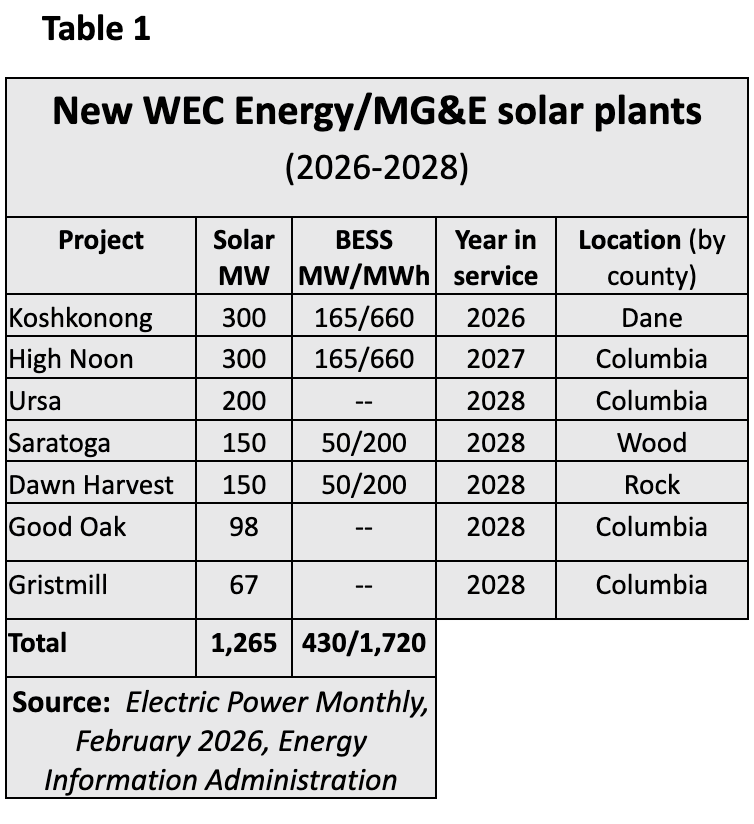
In March 2026 alone, the Public Service Commission of Wisconsin (PSC) approved utility requests to acquire three solar projects—two in Columbia County and one in Rock County—totaling 315 megawatts (MW). When energized over the next two years, these three plants will generate more than 600,000 megawatt-hours of zero-emission electricity annually to customers. That amounts to 0.9% of electricity consumption in the Badger State.
As shown in Table 1 below, WEC Energy and Madison Gas & Electric will add 1.265 gigawatts, or 1,265 MW, of solar power to their generation fleets over the next three years. Construction is well underway at the Koshkonong and High Noon project sites, and ground will be broken this year on the other solar plants listed in the table.
Construction is also proceeding on a 250 MW solar plant in central Wisconsin owned by Minneapolis-based Geronimo Energy. Anticipated to be placed in service later this year, the Portage Solar plant will produce electricity for the wholesale market and sell the renewable energy credits (RECs) from that generation to Microsoft, which will soon complete construction on a hyperscale data center in Racine County. When activated later this year, Microsoft’s facility will become the largest consumer of electricity in the entire state, with a baseline demand of approximately 500 MW. Microsoft will purchase all of the RECs produced by Portage Solar to offset a portion of that facility’s electricity usage.
Utility-owned solar generating plants often come paired with battery energy storage systems (BESS) placed within the project boundaries. These installations can store up to four hours of electricity at the battery’s rated capacity.
At the Koshkonong project, for example, the battery system is designed to accept as much as 660 MWh of electricity generated onsite. These BESS units will enable grid operators to discharge stored electricity directly into the transmission system when demand peaks later in the afternoon and evening.
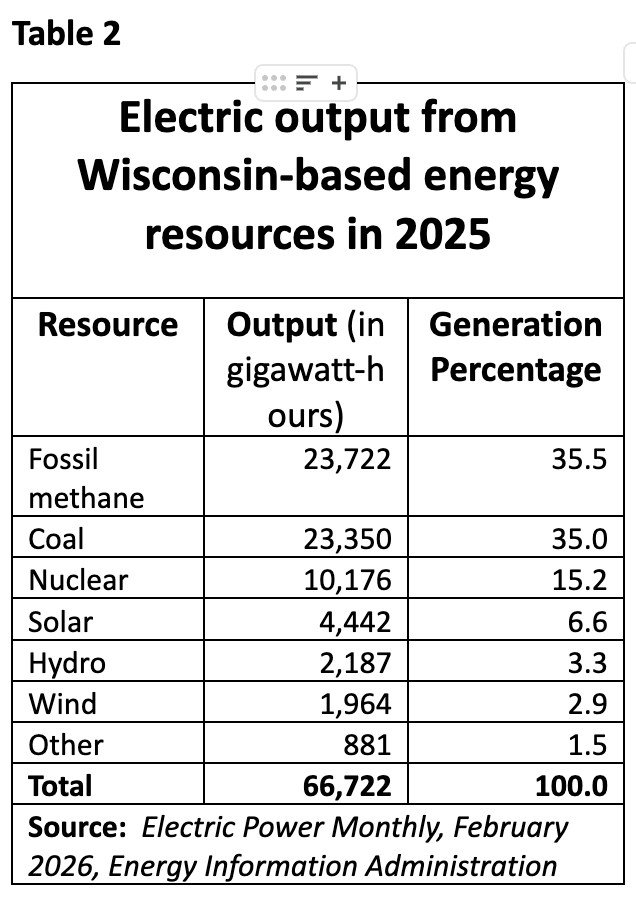
In just a handful of years, solar has emerged as the fastest-growing in-state source of electric power, and its contribution to electricity supplies now surpasses wind and hydro combined (see Table 2). Accounting for 6.6% of Wisconsin-generated electricity in 2025, solar generation could reach the 10% threshold by 2030.
Will solar growth be large enough to offset anticipated load growth driven by hyperscale data centers?
As impressive as solar’s growth was in 2025, it wasn’t large enough to fully offset the increase in electricity consumption that occurred that year. The other generation resource that saw a significant increase in output from 2024 was coal, whose rise came at the expense of fossil methane. Factoring in other hyperscale data centers now under construction, it will be a challenge to offset rising electricity sales with new solar generation.
As applied to retail electricity customers, the term “capacity factor” is a measure of their actual electrical consumption in a year divided by its peak demand multiplied by 8,760, the number of hours in a year. The consensus estimate of a hyperscale data center’s capacity factor falls in the 75% to 80% range.
Compared with other customer types, hyperscale data centers impose an unprecedented level of demand on the electric grids that serve them, due to the following reasons.
Massive scale of operations serving millions of users;
Expansion of AI use is driving the need for high-density computing power;
With the above in mind, let’s estimate the power consumption from Microsoft’s Mt. Pleasant campus that will commence operations later this year. If we assume a peak load of 500 MW and a capacity factor of 75 to 80%, electricity consumption from this particular entity would range from 3.3 to 3.5 million MWh per year, or 5% of the electricity sales recorded in the entire state of Wisconsin last year.
It would take six solar plants the size of Koshkonong–1,800 MW in total–to offset, on a MWh by MWh basis, the anticipated consumption from just the Mt. Pleasant data center alone. When the two Beaver Dam and the Port Washington data center projects are brought into the picture, the number of Koshkonong-size projects needed to offset all four hyperscalers in the pipeline would exceed 20.
Given that, it’s fair to conclude that the data center build-out will elevate greenhouse gas emissions from Wisconsin’s electric power industry even with a robust expansion of in-state solar power. Unless something changes on the ground, this worrisome outcome, and all the unpleasant environmental and economic consequences that it will amplify, is quite literally baked into our future.
April has been a rough month for much of Wisconsin. Hail, high winds, tornadoes, and heavy rain have rolled through the state, causing real damage. Here in Madison, the storm on April 14 brought baseball-sized hail, almost three inches across!
Other parts of central and southern Wisconsin got even bigger stones. Cars were dented. Roofs were torn up. Siding was cracked. Power poles came down. And yes, some solar panels broke too.
That’s the reality of weather like this. Extreme storms damage what’s in their path, and almost nothing on the outside of a home gets a free pass when hail comes down at that size. If your panels took a hit, they may need to be repaired or replaced. That’s not great news, but it’s also not the end of the world.
If you were thinking about going solar before the storms rolled through, the storms shouldn’t change the math on that decision. The path forward, whether you’re repairing a system or building one for the first time, looks a lot like dealing with any other part of your home.
How to Get Your System Back Up and Running
When panels get damaged in a storm like this, the fix looks a lot like dealing with hail damage to your roof or siding. The process moves through a few clear steps.
Contact Your Homeowner’s Insurance and Your Installer
Both should know what happened as soon as possible. Your installer works directly with the insurance company on your behalf from there. They document the damage, walk the adjuster through what they’re seeing, and handle the repair, replacement, and reinstall. The homeowner isn’t navigating it alone.
Know Your Coverage Before a Storm Hits
Most standard homeowner’s policies cover rooftop solar under the dwelling section, but it’s worth confirming that hail and wind are listed as covered perils and that your coverage limit reflects what your system is actually worth. Some policies in hail-prone areas carry separate wind and hail deductibles, and ground-mounted systems sometimes need a separate rider, so it helps to know what your specific policy says before you need to use it.
The Rest of the System Is Built To Make This Manageable
Manufacturers test their panels to real standards. Installers know how to work with insurance companies. Each part does its job so that when something does go wrong, the path forward is clear.
Your installer can also help you sort out what’s covered by equipment warranties versus insurance, and show you how to use your monitoring app to confirm the system is performing normally after repairs.
What Hail Does to a Panel
Knowing what kind of damage you’re looking at helps you follow along when your installer comes out for an inspection.
Visible damageis less common than people expect, but also the most obvious when it happens. Cracks, chips, or spiderwebbed glass that you can spot from the ground. The tempered glass on top of a panel is built to take a hit, which is why this kind of damage usually only shows up in the more extreme storms. Worth noting too: when a panel does break, the glass stays contained inside the panel. Solar panels are sealed between layers of plastic and held together by an aluminum frame, so cracks don’t send glass flying across your yard or your neighbor’s.
Hidden microcracksare the ones experts worry about more. These are microscopic fractures inside the solar cells that might not affect performance right away, but can spread over time the same way a small chip in a windshield can grow into a longer crack. Left unchecked, microcracks can gradually reduce efficiency and create hot spots inside the panel. That’s why post-storm inspections matter even when a system seems to be running fine.
Cell and busbar damage happens beneath the surface when hail’s impact energy transfers through the glass. The busbars are the thin metal strips that carry electricity across the panel. Modern panels use many ultra-thin busbars or wires per cell, often well into double digits, which helps keep current flowing even if part of a cell takes a hit.
A cracked panel will usually still generate electricity at reduced output. If it needs to be replaced, it should be replaced. If it’s still performing within spec, it can keep running. The key is having someone qualified take a look so you know what you’re working with.
A Quick Note on the Testing
Quality solar panels are built to two main standards that work together.
IEC 61215 is the performance and durability standard set by the International Electrotechnical Commission. It covers how a panel holds up against weather, including the hail impact testing, where technicians fire ice balls at panels using compressed air cannons. The basic test uses one-inch ice balls at high speeds, and many panels are tested even further against ice balls up to three inches across at speeds up to 88 miles per hour. To pass, the panel has to keep producing power within spec after the impact.
UL 61730 is the safety standard set by Underwriters Laboratories, which covers electrical safety, fire resistance, and structural integrity. Together, they tell you a panel can take the weather and stay safe doing it.
The Bigger Picture
Everything on the outside of your home already takes a beating from Wisconsin weather. Your roof, your siding, your windows, and the AC unit out back. None of that has stopped anyone from owning a home. You carry insurance for a reason, and when something breaks, you call somebody who knows how to fix it. Solar panels are no different than anything else on your house in that respect.
April has been hard on Wisconsin, no question about it. But the things people depend on after a storm have shown up. Insurance is paying out. Installers are out doing the work. Hail and wind can damage panels. That’s true. What matters is having the right people in your corner and the right coverage in place when it happens. A solid installer and the right insurance policy take care of that.
(The Center Square) – The Commodity Futures Trading Commission filed a lawsuit Tuesday against Wisconsin’s attempt to block prediction markets from operating in the state.
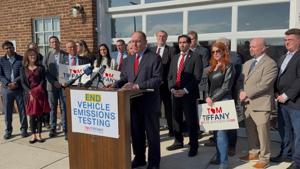
(The Center Square) – A group of Wisconsin congressmen have introduced a bill that would allow Wisconsin to petition to have its air quality designation change and remove the requirement for vehicle emissions testing in Kenosha, Milwaukee, Ozaukee, Racine, Sheboygan,…
(The Center Square) - Former Democratic state representative Pedro Colón announced Tuesday he will be running for a Wisconsin Supreme Court seat to replace retiring conservative judge Annette Ziegler.
State Appeals Judge Pedro Colón has entered the 2027 race for Wisconsin Supreme Court, becoming the second liberal candidate to launch a campaign for the court this month.
The Trump administration wants the Wisconsin Department of Public Instruction to return more than $20 million in federal COVID-19 relief funds provided to private schools during the pandemic.
The number of people aging in Wisconsin prisons is growing rapidly, according to a new report. A Wisconsin physician who studies aging and care in prison systems talks about what this means for the system and the people in state care.
The swift pace of the changes highlights how school district leaders rely on referendums to keep their budgets balanced — and how, for many, the ask to voters was a final effort before resorting to significant changes
You might eat out to relax, but if you're not an active participant in your dining out experience, you could find yourself a glum gourmet. Adam Reiner, author of "The New Rules of Dining Out," stopped by WPR's "The Larry Meiller Show" to explain.
Hundreds of area Muslims participate in Eid al-Fitr in Brooklyn's Prospect Park in April 2024 in New York City. Republican lawmakers and candidates across the country have escalated their anti-Islam rhetoric in recent months as the midterm elections approach. (Photo by Spencer Platt/Getty Images)
Republican lawmakers and candidates across the country have escalated their anti-Islam rhetoric in recent months, a strategy aimed at energizing voters by claiming without evidence that Muslim culture and religious tenets threaten American political values.
Political observers say Republicans are seizing on anti-Islamic sentiment to gin up enthusiasm among their voters as they head into the 2026 midterm elections. It’s been a successful campaign strategy in the past.
Aggressive enforcement tactics have soured many Americans on hard-line immigration policies, once a winning issue for conservatives, and GOP victories on abortion and transgender rights have blunted the electoral power of those issues.
Instead, GOP candidates in some of the highest-profile political races in the country are putting Islam and the nebulous threat of Shariah at the center of their campaigns.
Shariah is a religious code derived from the Quran and the teachings of Prophet Muhammad that addresses moral, spiritual and daily life for Muslims. But the term has become shorthand, in some conservative circles, for anything having to do with Islam or with Islamic extremism.
Critics say conservative politicians have made Muslims a political bogeyman in their fight to hang onto power. Muslims say the rhetoric misrepresents their values and endangers their communities.
“I worry this will harm freedom, which is the very value some of these politicians are claiming to protect,” said Mustafa Akyol, a senior fellow at the Center for Global Liberty and Prosperity at the Cato Institute, a libertarian think tank. Akyol is Muslim, and his research focuses on public policy and Islam.
“To think that American Muslims, which make 1% of the whole population, can enforce Shariah or force it on other people, that’s a very exaggerated claim.”
Up and down the ballot, Republicans have spent about $12 million since last year on ads that negatively mention Islam, Muslims or Shariah, according to AdImpact, an ad tracking firm.
I worry this will harm freedom, which is the very value some of these politicians are claiming to protect.
– Mustafa Akyol, senior fellow at the Cato Institute
Former Alabama Supreme Court Justice Jay Mitchell, now running for Alabama attorney general, recently released a campaign ad inviting supporters of “radical Islam” to “Allah Akbar your butt all the way back to the Middle East.”
In Georgia, Republican state Sen. Greg Dolezal, a candidate for lieutenant governor, released an AI-generated campaign ad last month depicting Muslim people invading a suburban neighborhood. In a post on X sharing the video, he described Muslims as “invaders who would rather pillage our generosity than assimilate.”
Officials in Alabama and Oklahoma have quashed efforts by Muslim groups to expand into larger facilities after those proposed developments attracted the attention and ire of conservative politicians. And Florida’s Republican-dominated legislature this year enacted laws allowing a handful of state officials to designate certain groups as domestic terrorist organizations.
At the federal level, incumbent Republican U.S. Sen. John Cornyn released a $1.6 million political ad earlier this year that claims “radical Islam is a bloodthirsty ideology” and says “Shariah law has no place in American courts or communities.”
There’s even a Sharia-Free America Caucus in Congress, launched last December by Republican Texas Reps. Keith Self and Chip Roy. It currently has more than 60 members spanning 25 states, according to Self. He called it “a noble cause to save Western Civilization and fight back against the threat of Sharia” in a January press release.
Akyol, of the Cato Institute, likens the furor to the American panic over communism in the 1950s that culminated in Wisconsin Republican Sen. Joseph McCarthy’s efforts to root out communist infiltration in the U.S. government and other spheres of power.
Those efforts “led to the crackdown on public freedoms in America like civil liberties, freedom of speech,” Akyol said. “Luckily that ended, but this seems like a McCarthyism 2.0 era where the issue now is not communism, but Islam.”
Years of legislation
Republicans say they’re responding to voter concerns and trying to preempt the possibility that religious or foreign political codes might creep into the U.S. legal system, jeopardizing free speech or due process.
Oklahoma state Sen. David Bullard is working with fellow Republican state legislators on a constitutional amendment that would bar courts and municipalities in Oklahoma from using any foreign law or religious code that would undermine the U.S. or Oklahoma constitutions. Similar efforts have been made this year in Arkansas, Missouri and other states.
Bullard said he’s heard from constituents who are concerned about a growing threat of other cultures “trying to forcefully usurp” American culture.
“Those are definitely Eastern ideas that don’t mix with Western culture, and the Constitution is created wholeheartedly on that Western culture concept,” he told Stateline.
He notes that his amendment doesn’t mention Shariah and does not single out Muslims.
Conservatives have been pushing similar state legislation for more than a decade. Since 2010, at least nine states have enacted laws aimed at preventing courts from enforcing foreign legal codes, including a 2014 constitutional amendment in Alabama.
When asked about examples of the kinds of instances he’s trying to prevent, Bullard cited a 2009 case in New Jersey in which a judge refused to give a woman a protective order after her husband repeatedly assaulted her, saying the husband was acting on his religious interpretation of Shariah. The ruling was overturned the following year.
“I think more and more people in Oklahoma are calling on us to protect them from that,” he said.
But even the most vocal proponents of anti-Shariah measures have struggled to explain how it could replace the American legal system or why more laws are needed to curb it. The establishment clause of the U.S. Constitution already prohibits the government from favoring one religion over another, or forcing adherence to a religious code.
Standing at a podium with a sign emblazoned with a line through the words “Sharia Law,” Florida Republican Gov. Ron DeSantis conceded during a news conference earlier this month that there isn’t an immediate threat of Shariah becoming the basis for Florida law.
“Of course that won’t happen any time soon,” DeSantis said. “But the more that we’re able to do to protect against that, I think, is going to benefit Floridians for many, many years.”
Real-world worry
The Islamic Academy of Alabama has operated as a K-12 private school near Birmingham for nearly three decades. But in December, local leaders of a nearby suburb denied the school’s request to relocate to a larger facility there. Alabama U.S. Sen. Tommy Tuberville, a Republican who’s running for governor and who has railed against Islam on the Senate floor and social media, called for the school to move out of Alabama.
School officials declined Stateline’s interview request but said they remain focused on supporting the education, well-being and safety of their students and community. They’ve dropped their current relocation plans.
In Oklahoma, Republican Attorney General Gentner Drummond — who is running for governor — elevated a proposed expansion by the Islamic Society of Tulsa into a political issue when he announced an investigation into its funding. City leaders later denied the society’s application; Muslim leaders responded by hosting a community open house at their Tulsa mosque to connect with the community and promote a better understanding of their faith.
And in Texas, Attorney General Ken Paxton, who is challenging Cornyn for the GOP nomination in the state’s Senate race, sued over the proposed development of a large Muslim-centric community north of Dallas. He called it a “radical plot to destroy hundreds of acres of beautiful Texas land and line their own pockets” and claimed it was unlawfully reserved only for Muslims.
While some lawmakers have made a distinction in their rhetoric between extremism and the Islamic faith, others have made sweeping, derogatory claims that denigrate and stereotype all Muslims.
Tuberville of Alabama has said: “Islam is not a religion. It’s a cult.” U.S. Republican Rep. Andy Ogles of Tennessee has said, “Muslims don’t belong in American society.” U.S. Rep. Randy Fine, a Florida Republican who’s cosponsoring an anti-Shariah bill in Congress, posted on X in February: “If they force us to choose, the choice between dogs and Muslims is not a difficult one.”
While politicians have invoked fears of extremism in their public comments, Akyol said American Muslims are the ones who are most worried.
“If the people who govern your state define you like that, what may come next?” he said. “Maybe a legal step against you, or some fanatic who really believes in that can take his machine gun and attack you.”
Much of the Islamophobic messaging has gone unchecked by other conservatives, a marked departure from previous leadership. In 2001, a few days after the Sept. 11 terrorist attacks, then-President George W. Bush visited a mosque in Washington, D.C., and met with Muslim community leaders, declaring “Islam is peace” and condemning retaliation against Muslim Americans.
Earlier this month, DeSantis signed a Republican-sponsored bill into law that allows a few state officials to label certain groups “domestic terrorist organizations.” The new law also bans Florida courts from enforcing religious laws and bars state funds from going to schools affiliated with groups designated as terrorist organizations. It does not specifically mention a religion, but cites Shariah as an example of the kind of religious laws it covers.
“You can have these groups that may not be waging physical war-type jihad,” DeSantis said earlier this month. He warned groups could wage “stealth” or “financial” attacks.
“To me, that’s still jihad and we’ve got to stop it, and this bill provides the structure to be able to do it.”
Critics say such laws also have the potential to harm any organization that finds itself at odds with a current administration.
“That is the danger of these laws, because they are specifically designed to silence political dissent,” said Wilfredo Ruiz, communications director at the Florida chapter of the Council on American-Islamic Relations, a national Muslim civil rights group. CAIR was one of two groups labeled as terrorist organizations by an executive order DeSantis issued in December.
The Biden administration criticized CAIR for statements made by its leadership after the Oct. 7, 2023, attacks in Israel, but the group denies that it supports terrorism.
CAIR Florida sued over DeSantis’ order, arguing it violated the group’s First Amendment right to free speech. In March, a federal judge blocked the order.
Ruiz said his organization has the resources to continue challenging such laws in court. But he said he worries about smaller groups, including those that aren’t Muslim but might be at risk of being declared a “terrorist group” by whoever is currently in power in Florida.
“Having that executive power with the capacity to name you a terrorist organization before you have been even accused criminally, much less convicted, this is an openly unconstitutional proposal.”
This story was originally produced by Stateline, which is part of States Newsroom, a nonprofit news network which includes Wisconsin Examiner, and is supported by grants and a coalition of donors as a 501c(3) public charity.

 Login
Login