
Reading view

There are new articles available, click to refresh the page.

Xiaomi’s SU7 Ultra Held The EV Nurburgring Crown, Until Porsche Wanted It Back
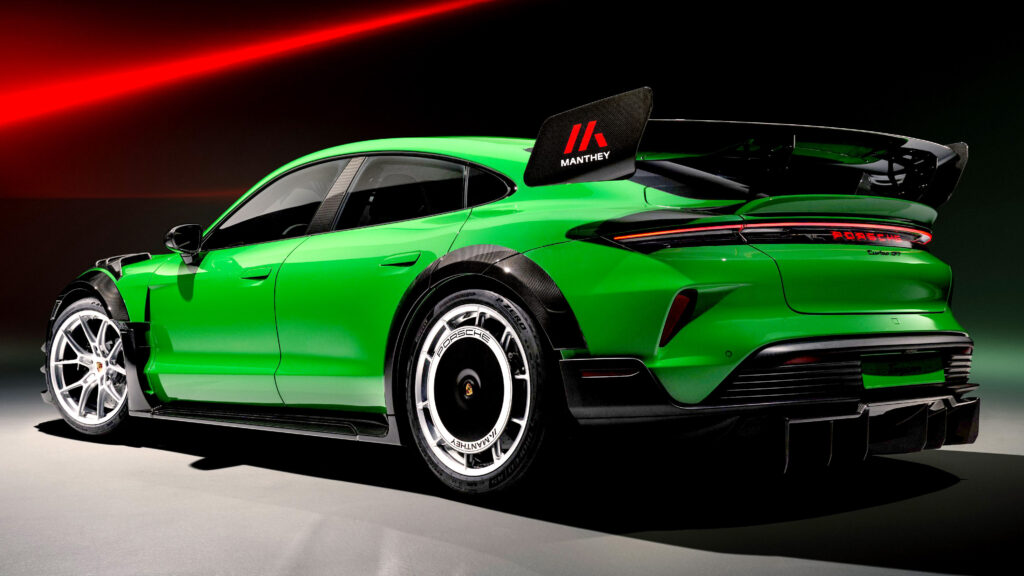
  • Porsche’s Taycan Turbo GT reclaimed the Nürburgring EV record.
  • The Manthey Kit triples downforce and sharpens the chassis setup.
  • Extra power helped the EV edge past Xiaomi’s rapid SU7 Ultra.

The Porsche Taycan Turbo GT was already the apex predator of Zuffenhausen’s electric lineup, but Porsche apparently decided that wasn’t enough. The flagship sedan has just been treated to a new Manthey Kit, layered on top of the existing Weissach Package, and the result is a 6:55.553 lap of the Nürburgring with development driver Lars Kern at the wheel.

That impressive time is 12 seconds quicker than a standard Taycan Turbo GT and more than nine seconds clear of the production-spec Xiaomi SU7 Ultra’s 7:04.957, which means Porsche has clawed back the title of fastest production EV in the executive segment after watching the Chinese newcomer take it last year. It is worth noting that a Xiaomi prototype clocked an even more impressive 6:22:091 in June 2025, although that doesn’t count as a production EV.

More: The Manthey Porsche Just Ran A Near-Perfect Nürburgring Lap. A Mustang Still Beat It

The Manthey Kit is the product of a joint effort between Porsche’s Weissach development center and Manthey’s engineers in Meuspath, with the brief drawn straight from motorsport. The package includes a reworked aero kit, a more potent powertrain, lighter wheels, track-focused tires, and a retuned suspension.

It Looks Like A Race Car

\\\\

Visually, the Manthey-prepped Taycan Turbo GT goes full track weapon, with an aggressive carbon fiber aero kit doing most of the talking. The nose gets an adjustable splitter flanked by canards and GT3-style gills cut into the fenders.

More: Honda’s Civic Type R Held This Record For 3 Years, VW’s 321 HP Golf Just Took It Back

The profile gains wider fender extensions, deeper side skirts, and lighter 21-inch forged aluminum wheels fitted with carbon aero discs on the rear axle. The new wheels use titanium bolts, cut 6 pounds (2.7 kg) of unsprung mass, and wear wider performance tires. Around back, Porsche added a boxier diffuser and a larger manually adjustable rear wing.

According to Porsche, the Manthey upgrades generate more than three times the downforce of the standard model. At 200 km/h (124 mph), the car produces 310 kg (683 lbs) of downforce, up from 95 kg (209 lbs). That figure climbs to 740 kg (1,631 lbs) at the top speed of 309 km/h (192 mph), which is 5 km/h (3 miles) faster than before.

More Power, More Speed

As for the power boost, the combined output of the electric powertrain rises to 804 hp (600 kW / 815 PS) in standard form and 978 hp (730 kW / 993 PS) in Attack mode. Those figures mark increases of 27 hp and 40 hp respectively over the Taycan Turbo GT.

More: Porsche’s Next Sedan Could Replace Both The Panamera And Taycan

When launch control is activated, total output remains at 1,019 hp (760 kW / 1,033 PS), but maximum torque climbs by 22 lb-ft (30 Nm) to 936 lb-ft (1,269 Nm). Even so, those figures still fall short of the rival Xiaomi SU7 Ultra, which produces 1,526 hp (1,138 kW / 1,548 PS) and 1,770 Nm (1,305 lb-ft) of torque.

The added downforce and extra power are paired with a revised setup for the Porsche Active Ride suspension, four-wheel steering, and AWD systems. Braking performance has also been upgraded with 440 mm (17.3 inches) front discs and performance brake pads.

Porsche development driver Lars Kern said the Manthey Kit turns the Taycan Turbo GT with Weissach Package into “the ultimate track tool.” The upgrades allowed him to carry 14 km/h (8.7 mph) more speed through the “Lauda-Lefthander” section of the Nurburgring compared to his previous run.
\\\\\

Porsche’s New Wireless Charger Is Fast, But It’ll Cost You

  • Real-world efficiency ranges from 89 to 92 percent in daily use.
  • The wireless charger is said to cost about $6,500 before taxes.
  • Upfront cost remains the main barrier despite a minimal long-term gap.

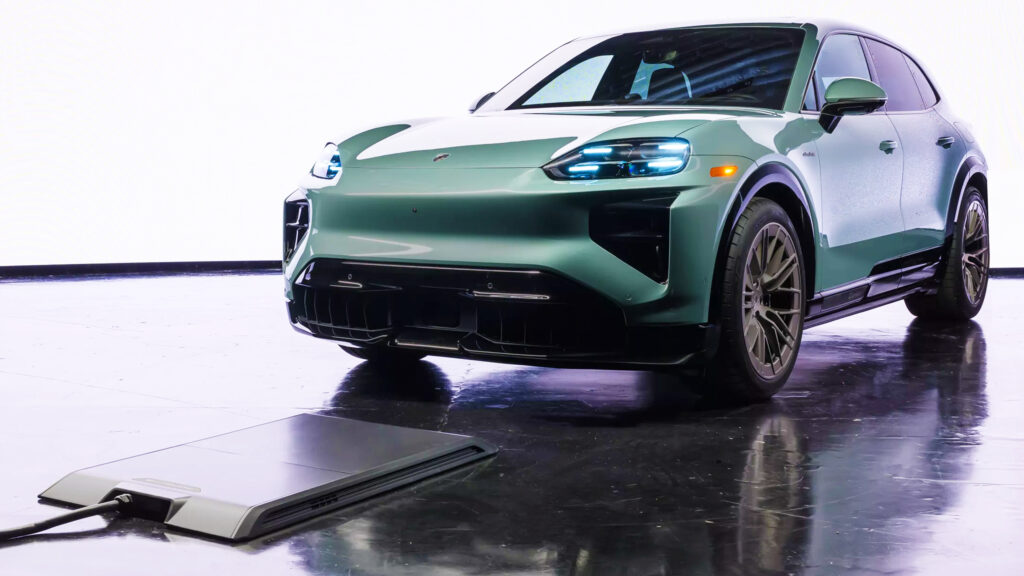
In the push to make home charging feel as seamless as refueling, automakers are starting to rethink the ritual itself. Before lifting the veil on the all-electric Cayenne, Porsche confirmed it had developed complex inductive charging technology. Now that the Cayenne Electric has reached the road, the brand is preparing to launch an optional wireless charging system for those who would rather skip plugging in at home.

At the heart of the charging system is the hefty base plate. Weighing in at 110 lbs (50 kg), it’s been designed to plug into a wall socket and houses a large transmitter coil. The base plate converts AC voltage from the electrical grid into DC voltage, and as the Cayenne Electric is positioned above it, a secondary coil beneath the SUV begins to receive power.

Read: Forget Cables, The Electric Cayenne Can Charge Hands-Free

Impressively, Porsche says its inductive charging technology supports up to 11 kW. Jason Fenske of Engineering Explained notes that Porsche’s own US mobile connector caps at 9.6 kW, making wireless the faster home-charging option for American owners.

The wireless charger comes with special software in the Cayenne Electric’s Surround View parking function, which displays the receiver’s position near the front axle, while a green circle indicates the base plate’s position. Simply pull the Porsche so the green dot is inside the circle, and it’s in the correct position to start charging.

Before the energy flow starts, the system automatically exchanges data, including a password, to prevent potential electricity theft. Wireless charging systems are generally regarded as inefficient, but Porsche’s engineers told Engineering Explained the system delivers between 89 and 92 percent efficiency in real-world use, comfortably clearing the 85 percent minimum the applicable charging standard requires.

Porsche also confirmed that Level 1 wired charging on the Cayenne Electric runs at just 60 percent efficiency, meaning the wireless pad is a significant step up over a standard household outlet.

Not Having A Cable Is Costly

\\\\

Tempted buyers shouldn’t worry about the system’s safety, with Porsche noting that the base plate is fully waterproof and includes sensors to detect foreign bodies, immediately stopping charging if something is detected.

“Ease of use, suitability for everyday use, and charging infrastructure are still the decisive factors when it comes to the acceptance of electric mobility,” Porsche R&D boss Michael Steiner said. “We are proud that inductive charging will soon be available in series production at Porsche. Charging an electric car at home has never been so easy and convenient.”

While the system is certainly convenient, it is expensive. In the UK, the entire setup is expected to cost around £6,750 ($9,125), with £4,750 ($6,421) of that being for the base plate itself.

In the US, the ground pad is said to be priced at about $6,500 before taxes, while the Cayenne EV’s onboard hardware adds another $1,650. A lifetime cost analysis by Fenske suggests the real expense is not in the electricity at all. He says that over 200,000 miles, the difference between wireless charging and a conventional wired Level 2 setup comes to roughly $1,000. Based on average U.S. driving of about 13,000 miles per year, reaching that gap would take roughly 15 years, leaving the upfront hardware premium as the main financial hurdle.

❌