Reading view

There are new articles available, click to refresh the page.

Trump administration completes rollback of Obama-era greenhouse gas regulations

Marathon Petroleum Company’s Salt Lake City Refinery in Salt Lake City on Wednesday, Jan. 3, 2024. (Photo by Spenser Heaps for Utah News Dispatch)

Marathon Petroleum Company’s Salt Lake City Refinery in Salt Lake City on Wednesday, Jan. 3, 2024. (Photo by Spenser Heaps for Utah News Dispatch)

WASHINGTON — President Donald Trump and his top environmental policy officer finalized a move Thursday to undo an Environmental Protection Agency regulation that laid the foundation for federal rules governing emissions of the greenhouse gases that cause climate change.

At a White House event, Trump and EPA Administrator Lee Zeldin said they were officially rolling back the “endangerment finding” that labeled greenhouse gases a threat to public health and provided a framework for the EPA to regulate emissions. 

The 2009 finding, established under President Barack Obama, called climate change a danger to human health and therefore gave the EPA power to regulate greenhouse gases, such as carbon dioxide from cars and trucks. 

Such regulations created a challenge for automakers and other industries, which dragged down the entire economy, according to Trump, administration officials and allies in Congress. 

Democrats and their allies in environmental and climate activism, though, consider the measure a crucial tool to address climate change and protect human health.

Undoing the finding will remove the economy-wide uncertainty, Trump argued. 

“That is why, effective immediately, we are repealing the ridiculous endangerment finding and terminating all additional green emission standards imposed unnecessarily on vehicle models and engines between 2012 and 2027 and beyond,” he said Thursday. 

Affordability argument

In its initial notice last year that it would repeal the endangerment finding, the EPA said it did not have the authority to regulate vehicle emissions.

With household costs, including transportation, expected to be a major theme in the fall’s midterm campaigns to determine control of Congress, members of both parties have framed it as an economic issue.

“This will be the largest deregulatory action in American history, and it will save the American people $1.3 trillion in crushing regulations,” White House press secretary Karoline Leavitt said at Tuesday’s press briefing.

Some Democrats and climate activists argue the rollback will hurt the country’s nascent renewable energy sector, driving up the cost of home heating, electricity and other common expenses.

Senate Minority Leader Chuck Schumer, D-N.Y., and Sen. Sheldon Whitehouse, D-R.I., issued a lengthy joint statement slamming the announcement.

“The Trump EPA has fully abandoned its duty to protect the American people from greenhouse gas pollution and climate change.  This shameful abdication — an economic, moral, and political failure — will harm Americans’ health, homes, and economic well-being. It ignores scientific fact and common-sense observations to serve big political donors,” the senators said.

“This sham decision initially relied on a now thoroughly disgraced and abandoned ‘report’ by known climate deniers. Zeldin stuck to this charade anyway, undaunted by half a century of actual evidence, showing the fix was in from the beginning,” they continued.

Money and fossil fuels

The move outraged Democrats and climate activists when Zeldin first proposed it last summer. Climate activists say undoing the finding undercuts the federal government’s ability to address an issue critical to the United States and the entire world.

In a Tuesday floor speech, Schumer blasted the rollback as a giveaway to fossil fuel companies, leaders of which contributed to Trump’s 2024 campaign.

“Remember: In the spring of 2024, Donald Trump invited top oil executives to Mar-a-Lago and told them, if you raise me a billion dollars to get me elected, I will cut regulations so you can make more money,” Schumer said. “That devil’s bargain is now coming true. I never thought it would be this way in America, in this bald disgusting way that so hurts people’s health, but there it is.”

Democratic attorneys general and environmental groups are likely to sue over the rollback.

At least one lawsuit, from the Environmental Defense Fund, was promised Thursday afternoon.

“EDF will challenge this decision in court, where evidence matters, and keep working with everyone who wants to build a better, safer and more prosperous future,” Fred Krupp, EDF president, said in a statement Thursday. 

Washington state Attorney General Nick Brown, a Democrat, said last year he would “consider all options if EPA continues down this cynical path.”

Ashley Murray contributed to this report.

Have projected 2040 carbon dioxide emissions been revised downward by 40% in the past decade?

Reading Time: < 1 minute

NO

Emissions projections for 2040 have dropped, but not by 40%.

The 2024 International Energy Agency forecast for yearly global CO2 emissions in 2040 was 31 gigatonnes, 18% lower than the 38 Gt predicted in 2014. This reflected scenarios that considered current and announced short-term policies (at the respective times). Global carbon emissions were 37.8 Gt in 2024.

In 2024, a scenario assuming that all long-term climate pledges were carried out forecasted 19 Gt of emissions in 2040.

In the 2024 report, the IEA calculates a 2.4-degree Celsius temperature rise by 2100 given current policies and short-term proposals, versus a 1.7-degree Celsius increase if long-term pledges are implemented.

The IEA also calculates a “Net Zero Emissions by 2050 Scenario,” which limits global warming to 1.5-degree Celsius by 2100. However, the UN ruled in November 2025 that this is no longer possible to prevent an overshoot of this in the short-term.

This fact brief is responsive to conversations such as this one.


This fact brief was originally published by Econofact on November 17, 2025, and was authored by Gabriel Vinocur. Econofact is a member of the Gigafact network.

Have projected 2040 carbon dioxide emissions been revised downward by 40% in the past decade? is a post from Wisconsin Watch, a non-profit investigative news site covering Wisconsin since 2009. Please consider making a contribution to support our journalism.

Study shows making hydrogen with soda cans and seawater is scalable and sustainable

Hydrogen has the potential to be a climate-friendly fuel since it doesn’t release carbon dioxide when used as an energy source. Currently, however, most methods for producing hydrogen involve fossil fuels, making hydrogen less of a “green” fuel over its entire life cycle.

A new process developed by MIT engineers could significantly shrink the carbon footprint associated with making hydrogen.

Last year, the team reported that they could produce hydrogen gas by combining seawater, recycled soda cans, and caffeine. The question then was whether the benchtop process could be applied at an industrial scale, and at what environmental cost.

Now, the researchers have carried out a “cradle-to-grave” life cycle assessment, taking into account every step in the process at an industrial scale. For instance, the team calculated the carbon emissions associated with acquiring and processing aluminum, reacting it with seawater to produce hydrogen, and transporting the fuel to gas stations, where drivers could tap into hydrogen tanks to power engines or fuel cell cars. They found that, from end to end, the new process could generate a fraction of the carbon emissions that is associated with conventional hydrogen production.

In a study appearing today in Cell Reports Sustainability, the team reports that for every kilogram of hydrogen produced, the process would generate 1.45 kilograms of carbon dioxide over its entire life cycle. In comparison, fossil-fuel-based processes emit 11 kilograms of carbon dioxide per kilogram of hydrogen generated.

The low-carbon footprint is on par with other proposed “green hydrogen” technologies, such as those powered by solar and wind energy.

“We’re in the ballpark of green hydrogen,” says lead author Aly Kombargi PhD ’25, who graduated this spring from MIT with a doctorate in mechanical engineering. “This work highlights aluminum’s potential as a clean energy source and offers a scalable pathway for low-emission hydrogen deployment in transportation and remote energy systems.”

The study’s MIT co-authors are Brooke Bao, Enoch Ellis, and professor of mechanical engineering Douglas Hart.

Gas bubble

Dropping an aluminum can in water won’t normally cause much of a chemical reaction. That’s because when aluminum is exposed to oxygen, it instantly forms a shield-like layer. Without this layer, aluminum exists in its pure form and can readily react when mixed with water. The reaction that occurs involves aluminum atoms that efficiently break up molecules of water, producing aluminum oxide and pure hydrogen. And it doesn’t take much of the metal to bubble up a significant amount of the gas.

“One of the main benefits of using aluminum is the energy density per unit volume,” Kombargi says. “With a very small amount of aluminum fuel, you can conceivably supply much of the power for a hydrogen-fueled vehicle.”

Last year, he and Hart developed a recipe for aluminum-based hydrogen production. They found they could puncture aluminum’s natural shield by treating it with a small amount of gallium-indium, which is a rare-metal alloy that effectively scrubs aluminum into its pure form. The researchers then mixed pellets of pure aluminum with seawater and observed that the reaction produced pure hydrogen. What’s more, the salt in the water helped to precipitate gallium-indium, which the team could subsequently recover and reuse to generate more hydrogen, in a cost-saving, sustainable cycle.

“We were explaining the science of this process in conferences, and the questions we would get were, ‘How much does this cost?’ and, ‘What’s its carbon footprint?’” Kombargi says. “So we wanted to look at the process in a comprehensive way.”

A sustainable cycle

For their new study, Kombargi and his colleagues carried out a life cycle assessment to estimate the environmental impact of aluminum-based hydrogen production, at every step of the process, from sourcing the aluminum to transporting the hydrogen after production. They set out to calculate the amount of carbon associated with generating 1 kilogram of hydrogen — an amount that they chose as a practical, consumer-level illustration.

“With a hydrogen fuel cell car using 1 kilogram of hydrogen, you can go between 60 to 100 kilometers, depending on the efficiency of the fuel cell,” Kombargi notes.

They performed the analysis using Earthster — an online life cycle assessment tool that draws data from a large repository of products and processes and their associated carbon emissions. The team considered a number of scenarios to produce hydrogen using aluminum, from starting with “primary” aluminum mined from the Earth, versus “secondary” aluminum that is recycled from soda cans and other products, and using various methods to transport the aluminum and hydrogen.

After running life cycle assessments for about a dozen scenarios, the team identified one scenario with the lowest carbon footprint. This scenario centers on recycled aluminum — a source that saves a significant amount of emissions compared with mining aluminum — and seawater — a natural resource that also saves money by recovering gallium-indium. They found that this scenario, from start to finish, would generate about 1.45 kilograms of carbon dioxide for every kilogram of hydrogen produced. The cost of the fuel produced, they calculated, would be about $9 per kilogram, which is comparable to the price of hydrogen that would be generated with other green technologies such as wind and solar energy.

The researchers envision that if the low-carbon process were ramped up to a commercial scale, it would look something like this: The production chain would start with scrap aluminum sourced from a recycling center. The aluminum would be shredded into pellets and treated with gallium-indium. Then, drivers could transport the pretreated pellets as aluminum “fuel,” rather than directly transporting hydrogen, which is potentially volatile. The pellets would be transported to a fuel station that ideally would be situated near a source of seawater, which could then be mixed with the aluminum, on demand, to produce hydrogen. A consumer could then directly pump the gas into a car with either an internal combustion engine or a fuel cell.

The entire process does produce an aluminum-based byproduct, boehmite, which is a mineral that is commonly used in fabricating semiconductors, electronic elements, and a number of industrial products. Kombargi says that if this byproduct were recovered after hydrogen production, it could be sold to manufacturers, further bringing down the cost of the process as a whole.

“There are a lot of things to consider,” Kombargi says. “But the process works, which is the most exciting part. And we show that it can be environmentally sustainable.”

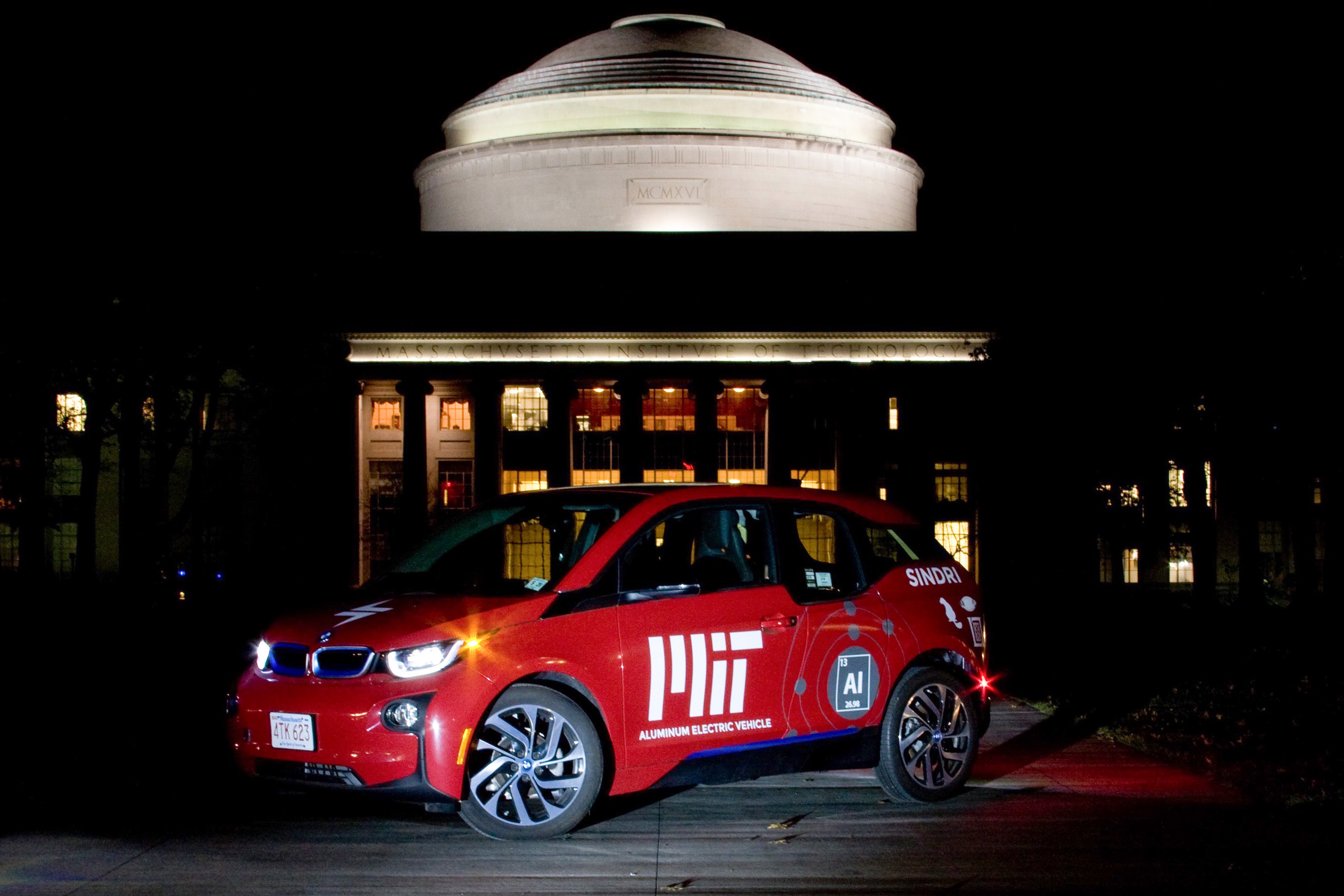
The group is continuing to develop the process. They recently designed a small reactor, about the size of a water bottle, that takes in aluminum pellets and seawater to generate hydrogen, enough to power an electric bike for several hours. They previously demonstrated that the process can produce enough hydrogen to fuel a small car. The team is also exploring underwater applications, and are designing a hydrogen reactor that would take in surrounding seawater to power a small boat or underwater vehicle.

This research was supported, in part, by the MIT Portugal Program.

© Credit: Courtesy of the researchers

MIT engineers have developed a new aluminum-based process to produce hydrogen gas, that they are testing on a variety of applications, including an aluminum-powered electric vehicle, pictured here.
❌