
Reading view

There are new articles available, click to refresh the page.

New propulsion system could make tiny satellites both fast and fuel-efficient

MIT engineers are testing a new propulsion system that combines the power and speed of conventional chemical thrusters with the precision and fuel-efficiency of electrical thrusters. 

The system could enable the design of nimbler, more flexible small satellites, which could perform both fast, powerful maneuvers and slower, precise adjustments, depending on the mission and moment at hand.

The key to the new system is a special propellant that can power both chemical and electrical thrusters, which traditionally have required separate, bulky fuel sources. 

“If you can have chemical and electrical propulsion in one small package, it’s the best of both worlds,” says Amelia Bruno, a former postdoc in MIT’s Department of Aeronautics and Astronautics (AeroAstro). “This opens the door for small satellites to do even more science, more observations, and more interesting missions, all on a smaller and cheaper platform.” 

Bruno is the lead author of a study appearing this week in the Journal of Propulsion and Power showing that a type of “green monopropellant” originally developed by the U.S. Air Force for use in chemical propulsion in space can also effectively power tiny “electrospray” thrusters. Electrospray thrusters are dime-sized rockets that use electric fields to charge up a liquid propellant’s particles, which are then shot into space as a thrust-generating spray.

Electrospray thrusters are extremely fuel-efficient and can perform slow and precise maneuvers, such as pushing a small spacecraft bit by bit through a long, interplanetary journey. Chemical thrusters, in contrast, require a large fuel supply to perform short and fast bursts, for instance to quickly ascend and descend, or speed up and slow down. 

Now that the MIT group has found a propellant that can fuel both chemical and electrospray thrusters, they see big potential for small spacecraft. The team is working with NASA to launch the Green Propulsion Dual Mode mission — a briefcase-sized CubeSat that will carry a chemical thruster and four electrospray thrusters, all fueled by a single propellant tank. The mission will be the first to test such a two-in-one propulsion system for small spacecraft. If it is successful, Bruno says the mission could pave the way for small satellites to explore beyond Earth’s orbit. 

“We could send CubeSats to Mars, or the asteroid belt, where they could make the journey slowly, using electrospray thrusters,” says study co-author Paulo Lozano, the Miguel Alemán Velasco Professor of Aeronautics and Astronautics at MIT. “You could then use your chemical thrusters to quickly move to look at interesting features. You could have a lot more flexibility to do a lot more things.”

The study’s co-authors also include Matthew Corrado SM ’22, PhD ’26.

A sea of ions

Lozano’s group at MIT designs, fabricates, and tests electrospray thrusters for use in satellites that range from the size of a lunchbox to a small carry-on suitcase. Compared to conventional satellites, these microsatellites are significantly smaller and cheaper to launch into space.

But smaller spacecraft require smaller everything else, including propulsion systems. In that respect, electrospray thrusters are a good fit. The thrusters Lozano develops are about the size of a thumbnail. Each thruster sits atop a small reservoir of ionic liquid propellant. When the reservoir is connected to a battery, the battery supplies some amount of voltage that electrically charges a corresponding amount of ions in the liquid. The charged particles are then channeled out of the reservoir, through the thruster’s tips and into space as a thrust-inducing spray. 

Over the past decade, Lozano has tested many thruster designs, under varying conditions, and with various types of ionic liquid propellant — a fuel that is essentially made from salts that can remain in liquid form. 

“Ionic liquids are very stable and can even remain a liquid in space, which not a lot of materials can do,” Bruno says. “And it’s basically a sea of ions, which is why we base our technology around it, so we can pull those ions out into an electrospray.”

Bruno and Lozano have collaborated with the U.S. Air Force, which synthesized a new kind of ionic liquid propellant — the Advanced SpaceCraft Energetic Non-Toxic propellant (ASCENT) — which was being tested in chemical thrusters. Chemical thrusters are high-force propulsion systems typically associated with launching rockets and performing hard and fast maneuvers once in space. ASCENT was designed as a “green,” less toxic alternative to hydrazine, which has been the traditional fuel source for chemical propulsion and is extremely hazardous to handle. 

“ASCENT happens to be an ionic liquid mixture,” Bruno says. “And we said, hey, that’s the stuff we typically use. Theoretically, this should work. Let’s go figure out how.”

Spray and spin

In their new study, Bruno, Lozano, and Corrado tested the performance of electrospray thrusters that they fueled with ASCENT. Each thruster they used was attached to a small cube-shaped reservoir about the size of a Lego brick. They filled each reservoir with 1 gram of ASCENT, a liquid that has a viscosity similar to baby oil. They then attached a thruster to opposite sides of a CubeSat, which they set on a MagLev stand — a custom testbed that is designed to magnetically levitate a sample or device. The MagLev in Lozano’s lab is installed inside a large vacuum chamber, which the researchers can tune to mimic the conditions in space.

Over multiple experiments, the team remotely applied varying levels of voltage to activate the thrusters, which in turn produced a spray that spun the CubeSat around, like a floating, spinning top. The researchers measured the amount of thrust produced with each trial, and calculated ASCENT’s fuel efficiency as they ran the thrusters continuously over periods lasting up to 100 hours. 

In the end, they found that ASCENT was able to successfully fuel each electrospray thruster. What’s more, the propellant, which was originally intended for chemical propulsion, was just as efficient as other, conventional ionic liquids at propelling electric thrusters.

“Compared to our normal electrospray propellants, ASCENT can provide similar performance in terms of thrust,” Bruno says. “Now that we know our thrusters work with ASCENT, we can start thinking of all the ways we can make them even better.” 

Now that ASCENT has been proven to work in both chemical and electrical propulsion, she and Lozano say that a single tank of the fuel can be used to power both types of thrusters, all in a compact, two-in-one system that could fit within a small CubeSat. The team will test the idea with NASA’s Green Propulsion Dual Mode mission, which is scheduled to launch in November. 

“This will be the first time that a satellite will have a shared propellant tank,” says Lozano, who notes that in addition to long, exploratory interplanetary missions, small satellites equipped with both chemical and electrical propulsion could also be useful for missions closer to Earth, such as for weather and climate observations. 

“Say there’s a storm coming, and you’d want to deploy your constellation of small satellites to observe over one location,” he says. “You could choose to send them quickly or slowly depending on the nature of the observation. And the only way to do that is if you have two propulsion systems, which is now possible.”

This research is supported, in part, by NASA.
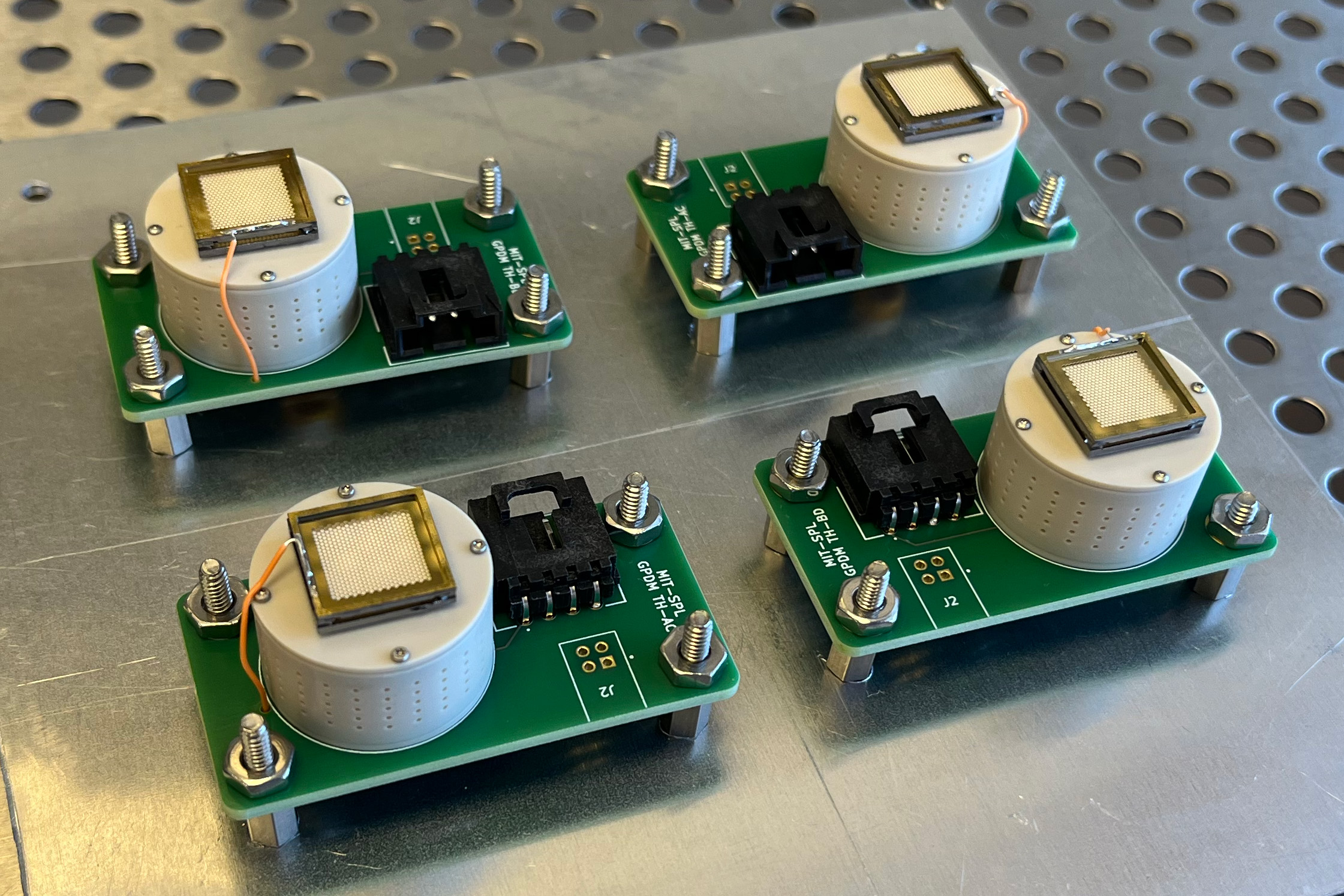
© Image: Amelia Bruno
These four flight unit electrospray thrusters were delivered by MIT Space Propulsion Laboratory to NASA for the upcoming Green Propulsion Dual Mode (GPDM) mission.

MIT students combat climate anxiety through extracurricular teams

Climate anxiety affects nearly half of young people aged 16-25. Students like second-year Rachel Mohammed find hope and inspiration through her involvement in innovative climate solutions, working alongside peers who share her determination. “I’ve met so many people at MIT who are dedicated to finding climate solutions in ways that I had never imagined, dreamed of, or heard of. That is what keeps me going, and I’m doing my part,” she says.

Hydrogen-fueled engines

Hydrogen offers the potential for zero or near-zero emissions, with the ability to reduce greenhouse gases and pollution by 29 percent. However, the hydrogen industry faces many challenges related to storage solutions and costs.

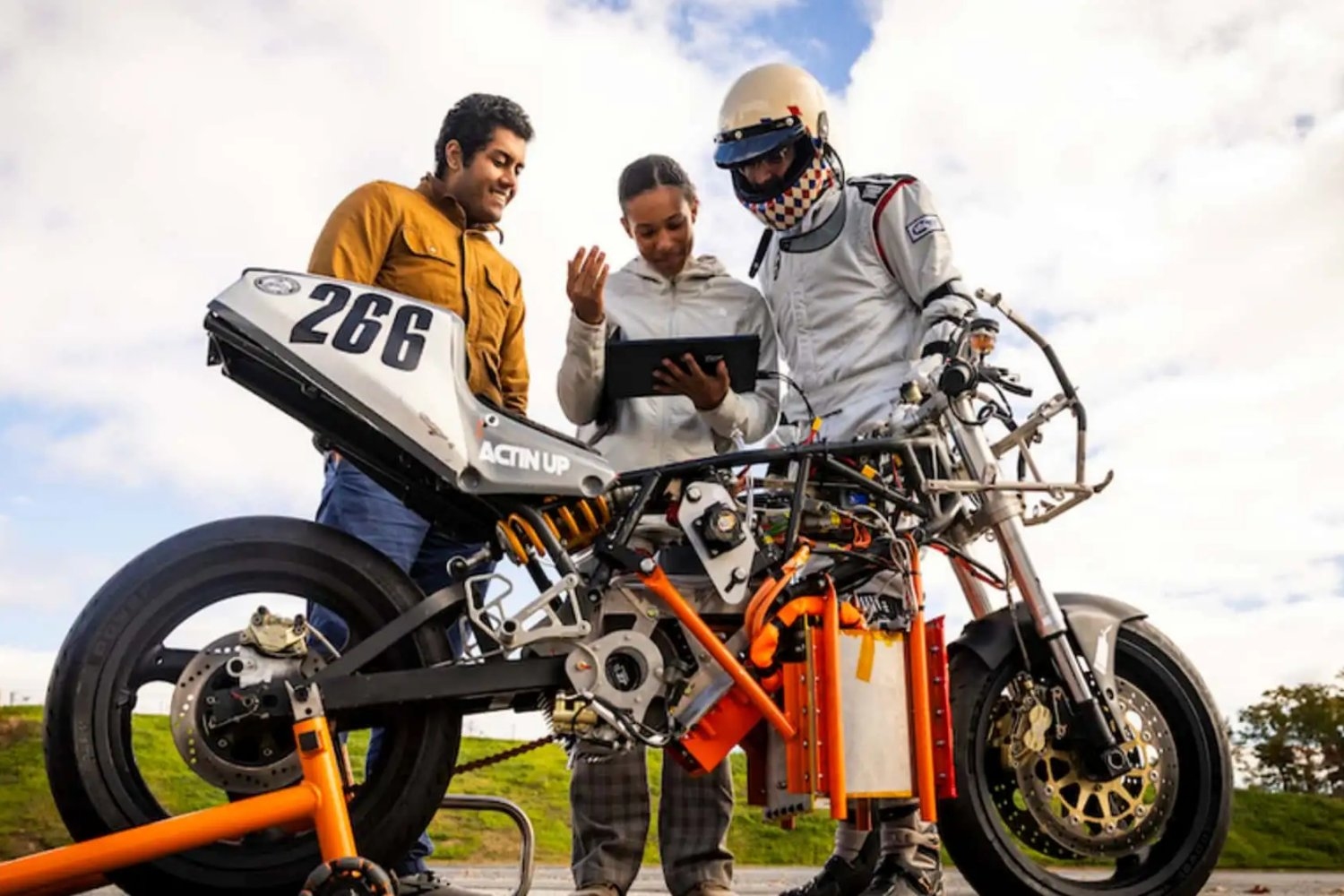
Mohammed leads the hydrogen team on MIT’s Electric Vehicle Team (EVT), which is dedicated to harnessing hydrogen power to build a cleaner, more sustainable future. EVT is one of several student-led build teams at the Edgerton Center focused on innovative climate solutions. Since its founding in 1992, the Edgerton Center has been a hub for MIT students to bring their ideas to life.

Hydrogen is mostly used in large vehicles like trucks and planes because it requires a lot of storage space. EVT is building their second iteration of a motorcycle based on what Mohammed calls a “goofy hypothesis” that you can use hydrogen to power a small vehicle. The team employs a hydrogen fuel cell system, which generates electricity by combining hydrogen with oxygen. However, the technology faces challenges, particularly in storage, which EVT is tackling with innovative designs for smaller vehicles.

Presenting at the 2024 World Hydrogen Summit reaffirmed Mohammed’s confidence in this project. “I often encounter skepticism, with people saying it’s not practical. Seeing others actively working on similar initiatives made me realize that we can do it too,” Mohammed says.

The team’s first successful track test last October allowed them to evaluate the real-world performance of their hydrogen-powered motorcycle, marking a crucial step in proving the feasibility and efficiency of their design.

MIT’s Sustainable Engine Team (SET), founded by junior Charles Yong, uses the combustion method to generate energy with hydrogen. This is a promising technology route for high-power-density applications, like aviation, but Yong believes it hasn’t received enough attention. Yong explains, “In the hydrogen power industry, startups choose fuel cell routes instead of combustion because gas turbine industry giants are 50 years ahead. However, these giants are moving very slowly toward hydrogen due to its not-yet-fully-developed infrastructure. Working under the Edgerton Center allows us to take risks and explore advanced tech directions to demonstrate that hydrogen combustion can be readily available.”

Both EVT and SET are publishing their research and providing detailed instructions for anyone interested in replicating their results.

Running on sunshine

The Solar Electric Vehicle Team powers a car built from scratch with 100 percent solar energy.

The team’s single-occupancy car Nimbus won the American Solar Challenge two years in a row. This year, the team pushed boundaries further with Gemini, a multiple-occupancy vehicle that challenges conventional perceptions of solar-powered cars.

Senior Andre Greene explains, “the challenge comes from minimizing how much energy you waste because you work with such little energy. It’s like the equivalent power of a toaster.”

Gemini looks more like a regular car and less like a “spaceship,” as NBC’s 1st Look affectionately called Nimbus. “It more resembles what a fully solar-powered car could look like versus the single-seaters. You don’t see a lot of single-seater cars on the market, so it’s opening people’s minds,” says rising junior Tessa Uviedo, team captain.

All-electric since 2013

The MIT Motorsports team switched to an all-electric powertrain in 2013. Captain Eric Zhou takes inspiration from China, the world’s largest market for electric vehicles. “In China, there is a large government push towards electric, but there are also five or six big companies almost as large as Tesla size, building out these electric vehicles. The competition drives the majority of vehicles in China to become electric.”

The team is also switching to four-wheel drive and regenerative braking next year, which reduces the amount of energy needed to run. “This is more efficient and better for power consumption because the torque from the motors is applied straight to the tires. It’s more efficient than having a rear motor that must transfer torque to both rear tires. Also, you’re taking advantage of all four tires in terms of producing grip, while you can only rely on the back tires in a rear-wheel-drive car,” Zhou says.

Zhou adds that Motorsports wants to help prepare students for the electric vehicle industry. “A large majority of upperclassmen on the team have worked, or are working, at Tesla or Rivian.”

Former Motorsports powertrain lead Levi Gershon ’23, SM ’24 recently founded CRABI Robotics — a fully autonomous marine robotic system designed to conduct in-transit cleaning of marine vessels by removing biofouling, increasing vessels’ fuel efficiency.

An Indigenous approach to sustainable rockets

First Nations Launch, the all-Indigenous student rocket team, recently won the Grand Prize in the 2024 NASA First Nations Launch High-Power Rocket Competition. Using Indigenous methodologies, this team considers the environment in the materials and methods they employ.

“The environmental impact is always something that we consider when we’re making design decisions and operational decisions. We’ve thought about things like biodegradable composites and parachutes,” says rising junior Hailey Polson, team captain. “Aerospace has been a very wasteful industry in the past. There are huge leaps and bounds being made with forward progress in regard to reusable rockets, which is definitely lowering the environmental impact.”

Collecting climate change data with autonomous boats

Arcturus, the recent first-place winner in design at the 16th Annual RoboBoat Competition, is developing autonomous surface vehicles that can greatly aid in marine research. “The ocean is one of our greatest resources to combat climate change; thus, the accessibility of data will help scientists understand climate patterns and predict future trends. This can help people learn how to prepare for potential disasters and how to reduce each of our carbon footprints,” says Arcturus captain and rising junior Amy Shi.

“We are hoping to expand our outreach efforts to incorporate more sustainability-related programs. This can include more interactions with local students to introduce them to how engineering can make a positive impact in the climate space or other similar programs,” Shi says.

Shi emphasizes that hope is a crucial force in the battle against climate change. “There are great steps being taken every day to combat this seemingly impending doom we call the climate crisis. It’s important to not give up hope, because this hope is what’s driving the leaps and bounds of innovation happening in the climate community. The mainstream media mostly reports on the negatives, but the truth is there is a lot of positive climate news every day. Being more intentional about where you seek your climate news can really help subside this feeling of doom about our planet.”

© Photo: Adam Glanzman

Electric Vehicle Team members (from left to right) Anand John, Rachel Mohammed, and Aditya Mehrotra '22, SM '24 monitor their bike’s performance, battery levels, and hydrogen tank levels to estimate the vehicle’s range.
❌