Reading view

There are new articles available, click to refresh the page.

72% Of New EV Buyers Just Traded In A Gas Car, Even After Losing The $7,500 Credit

  • EV trade-in rates rose from 67.1% to 72.1% between January and April.
  • Used EV wholesale values jumped 11% this year and beat ICE prices for weeks.
  • Analysts urge caution, citing high rates and more expensive gasoline.

Data from Edmunds suggests the shift from gas to electric is gaining momentum at the dealership level. In January of this year, 67.1% of new EV purchasers at dealerships traded in a gas car. In April of this year, that figure had jumped to 72.1%. And it’s not just a first-time fad. Repeat EV purchase data also show an increase.

Numbers for January 2026 show that 26.2% of buyers traded in an old EV for a brand-new one. That figure leaped to 35.4% in April. Worth noting: this uptick comes despite the removal of the federal $7,500 EV tax credit and several state-level incentives. So, is this a definitive trend, then?

Read: America’s Used EV Market Is Heating Up For One Simple Reason

Speaking to CNBC, Ivan Drury, Senior Director of Insights at Edmunds, says it’s too early to draw a concrete conclusion, or to say whether it’s just the effect of the Middle East War and its resulting runaway fuel prices. “Oil and gas prices started rising after the U.S. and Israel attacked Iran on Feb. 28. About three more months of high gas prices and elevated EV trade-in numbers will give a better indication of whether customers feel pinched enough at the pump to consider a switch…” says Drury.

Car Prices Are Rising, But Especially EVs

With auto prices rising across the board, whether you buy a brand-new car or a used one, the chances are you’ll be paying more for it now than you would have six months ago, and much more than in 2020.

 72% Of New EV Buyers Just Traded In A Gas Car, Even After Losing The $7,500 Credit
Cox Automotive

According to Cox Automotive, their Manheim Used Vehicle Value Index is approximately 4% higher than at the same time last year. And they’ve seen EVs leading the charge, with price increases notably higher than regular gas-powered vehicles.

“Additionally, we continue to see EV prices rising faster and holding higher than non-EVs. Three-year-old EV prices have outpaced non-EVs for six weeks in a row and are 11% higher than they were at the start of the year. The longer gas prices remain elevated, the more we expect consumers to turn to fuel-efficient vehicles.

“As EV lease maturities continue to increase throughout the summer, it will be critical to follow EV price trends—especially if the Middle East conflict remains unresolved.” says Jeremy Robb, Chief Economist at Cox Automotive. So, it seems that buyers are willing to pay more upfront if it means lower running costs, which EVs have offered for quite some time now.

Unsurprisingly, ICE SUVs Have Appreciated Least

It’s no surprise to see that out of all the categories analyzed by Cox Automotive, used gas-powered SUVs and CUVs have appreciated by just 0.3% on average since last year. Given their gas-guzzling tendency and resultant tugging at pocket strings, it’s to be expected.

 72% Of New EV Buyers Just Traded In A Gas Car, Even After Losing The $7,500 Credit
Cox Automotive

Equally unsurprising is the fact that compact cars, a relatively fuel-efficient segment in the internal combustion engine class, saw the second-highest increase, at 7.6%. As Drury would likely agree, the data points in an interesting direction — but it’s still too early to call it a structural shift rather than a gas-price reaction.

 72% Of New EV Buyers Just Traded In A Gas Car, Even After Losing The $7,500 Credit
Chevrolet

Used EVs Look Like A Steal, Until You Pay Repairs And Insurance Premiums

  • Data suggests that the average used EV costs just ~$1,000 more than a used ICE car.
  • Analysts warn that there are some hidden costs of running an EV that need to be considered.
  • Components, accident repairs, and insurance cost more on average for EVs than for ICE vehicles.

In the past, used EVs may have been considered a bit of a gamble, especially if they were packing a few years under their belt. But things are changing. A report from Cox Automotive says that used EV sales in March were up 27.7% compared with the previous year.

Even more telling was that the March figures were a whopping 53.9% higher than February’s. There are several reasons driving the change, but according to CNBC, experts warn that while cheap EVs may look attractive, there are a few hidden considerations buyers should still be wary of.

An Influx Of Used EVs

 Used EVs Look Like A Steal, Until You Pay Repairs And Insurance Premiums

One reason is the simple fact that as more people buy new EVs, more used EVs end up at dealer lots as their leases end. According to Joseph Yoon, a Consumer Insights Analyst at Edmunds, “Where we had the highest concentration of leasing happen was between the tail end of 2022 and all the way through 2023, and since most leases are three years long, all those cars… are coming back to dealer lots in droves.”

Read: America’s Used EV Market Is Heating Up For One Simple Reason

This means that much of the depreciation has already occurred, translating into some attractive deals for those looking at the used market. In fact, 44% of those EVs sold in March of this year were priced below the $25,000 mark.

More Choices & Price Parity

 Used EVs Look Like A Steal, Until You Pay Repairs And Insurance Premiums

Whereas previously electric vehicles were offered by only a handful of manufacturers, nowadays there’s a veritable smorgasbord of options coming into the used market. And with more options comes lower prices as well. The average price of a used EV in March was $34,653, according to Cox Automotive. Contrast that with the average price of a used gas car being $33,641, and price parity isn’t far off.

With used EVs no longer bearing price premiums over their gas-powered equivalents, they are now more accessible to buyers who have long aspired to jump on the EV bandwagon but were unable to in the past. But it’s not just lower purchase prices that are seen as appealing. Promises of cheap running costs are just as enticing.

Costs To Consider

 Used EVs Look Like A Steal, Until You Pay Repairs And Insurance Premiums

Charging an EV, especially if you use a home charger, can be pretty cheap, according to a Kelley Blue Book report. Taking into account a 1,015-mile monthly average, home-charging an EV worked out to an average of $59.66. But not everyone has the ability to install one of those. If you’re forced to use public fast charging exclusively, then things are a little different. That cost rises to $169, which is higher (albeit not by much) than the $147.24 gas bill that an average gas-powered vehicle with a 30mpg fuel efficiency figure would cost you.

See Also: The Average New Car Costs $50K, So Americans Are Emptying Used Car Lots

Another of the biggest benefits that EV makers regularly promote is their relative lack of maintenance. It’s true that you don’t need to spend money on engine oil changes and filters because an EV doesn’t have a gasoline engine. Also, since EVs use regenerative braking to recover energy under deceleration, their brake pads also benefit from longer lifespans. However, there is one consumable component that EVs go through faster than gas cars, and that’s tires. According to Consumer Reports, this is primarily due to the higher curb weight of EVs contributing to accelerated tread wear.

Components’ Costs

 Used EVs Look Like A Steal, Until You Pay Repairs And Insurance Premiums

EVs also have some pretty expensive components that can run you a pretty sum if they go wrong outside of warranty. Chief among these is the traction battery, where replacement costs can range from $5,000 to $15,000. That’s why the advice from experts is to seek out a used EV that still has warranty coverage remaining. Generally, EV batteries come with an eight- or ten-year warranty, and in most cases these are transferable to a subsequent owner.

Collision repairs are another area where EVs tend to cost more. In 2025, fully battery-powered cars cost an average of $6,395 to repair after a collision, compared with $5,105 for gas-powered vehicles, according to Mitchell International, which specializes in claims and collision technology.

Insurance is similarly pricier. The average annual cost of insuring an EV runs to $4,058, versus $2,732 for a comparable gas car, according to a 2025 report from insurance website Insurify. That said, the actual figure varies considerably by model, insurer, and location, and a used EV will generally cost less to insure than a new one.

 Used EVs Look Like A Steal, Until You Pay Repairs And Insurance Premiums

Edmunds Lost $47,000 On The Charger Daytona, And That Was The Good News

  • A year of ownership wiped nearly 60 percent off the Daytona’s value.
  • The electric Charger covered under 7,000 miles before its value collapsed.
  • Staff complaints ranged from fake exhaust sounds to glitchy software.

Buying a new car is almost always a terrible financial decision. But losing nearly $50,000 in a single year after just a few thousand miles takes things to an entirely different level of painful. Unfortunately for Edmunds, that’s exactly what happened with its 2024 Charger Daytona Scat Pack.

Unlike many magazines and websites, that simply borrow their long-term test cars from automakers, Edmunds buys them with real cash. True, it got a small discount from Dodge on the as-tested price of $85,965, but it still paid a hefty $82,000 to get behind the wheel of Detroit’s first electric muscle car.

Related: The Last Dodge Challengers Were Supposed To Age Into Money, Not Lose $14,000 With Delivery Mileage

But 12 months later when it came time to move the car on, Edmunds was shocked to find its Daytona was worth just $35,000. That’s almost a 60 percent hit, and not because the road test team had put a lifetime’s worth of miles on the EV. It had covered less than 7,000 miles (11,300 km), which is the kind of distance some drivers do in six months.

Even worse, the massive financial hit came after most of the Edmunds staff spent a year actively disliking the thing. Reading through their long-term test notes would be enough to send anyone wavering over which pony car to buy straight into the arms of a V8-powered Ford Mustang Dark Horse.

Digital Headaches

 Edmunds Lost $47,000 On The Charger Daytona, And That Was The Good News

Complaints ranged from glitchy infotainment and strange drivetrain clunks to awkward ergonomics and bizarre software behavior. One editor described the fake Fratzonic exhaust sound as “an insult to V8s everywhere,” while another said the car was simply “boring,” which is probably the most brutal criticism you can level at something wearing a Charger badge.

Others hated the turning circle, massive dimensions, inconsistent regen braking, and handling that apparently couldn’t back up the car’s straight-line punch. But the year didn’t pass without the Charger getting some praise. Several staffers liked the styling, roomy hatchback practicality and surprisingly good range. The 670 hp (679 PS /500 kW) Daytona managed 255 miles (410 km) in real world use, comfortably beating its pathetic official EPA estimate of 216 miles (348 km).

“The Charger was a big, expensive disappointment,” the outlet said, summing up the year-long experience. “We won’t miss having this thing in our fleet.”

\\\\\\

Dodge

Hertz Wanted $65K For Its Shelby Mach-Es, Now It Will Take Almost Anything

  • Hertz has cut prices on its Shelby Mach-Es again, and the drop is steep.
  • Mileage across the cars on offer ranges from just 3,275 to over 15,000 miles.
  • Shelby’s tuning package adds looks and sound, but no real performance.

Hertz has a long history of renting out modified cars from Shelby to its customers, and often these vehicles become prized collector’s items. That does not appear to be the case with the Shelby-tuned Ford Mustang Mach-Es that it had in its fleet.

Read: Hertz Slashes Prices On Shelby Mustang Mach-E, Some With Just 3K Miles

The rental giant started offloading a bunch of these special black-and-gold Mustang Mach-Es back in late 2024, asking around $65,000 for most of them. Fast forward just a couple of months to January 2025, and the prices were slashed to around $60,000. Hertz, clearly desperate to offload its remaining inventory, has reduced prices by a further $20,000. Could this be a deal too good to pass up?

\\\\\\\\\\\\

Photos Hertz

A scan of Hertz’s current inventory across the States turns up 31 Shelby Mach-Es, with prices spanning a narrow $40,085 to $40,999 and mileage stretching from 3,275 to just over 15,000. The cheapest examples sit in California, while a Scottsdale car claims the lowest mileage of the lot at 3,275 for $40,649. One in New Orleans splits the difference at 8,215 miles for $40,436. A new Mach-E GT, the donor car for the Shelby treatment, stickers at $53,395.

A Performance Bargain?

It shouldn’t come as much of a surprise that Hertz has slashed prices of these cars so significantly. After all, they are EVs, and current electric cars tend to depreciate very quickly. We suspect the designs of the Shelby models also turn off many prospective buyers, particularly because of the go-fast gold racing stripes and carbon fiber parts, including the hood.

 Hertz Wanted $65K For Its Shelby Mach-Es, Now It Will Take Almost Anything

Shelby is believed to have built just 100 examples of the Hertz-exclusive Ford Mustang Mach-E GT, so it does have exclusivity going for it. In addition to the gold stripes and the carbon parts, Shelby added custom black wheels and sourced an exhaust sound system from Borla, aiming to replicate the sound of an internal combustion engine. Sadly, no real performance upgrades were made that could justify the price.

There is also the usual caveat that comes with any ex-rental: someone else got the keys first, and they probably did not treat them gently.

\\\\\\\\\\\\

Porsche’s Macan Turbo Electric Lost Over $33,000 In Value After Just 1,500 Miles

  • Nearly-new Macan Turbo Electric struggled to excite auction bidders.
  • High-specification, 1,500-mile car failed to sell on the Cars&Bids site.
  • Porsche is also struggling with a fall in demand for new examples.

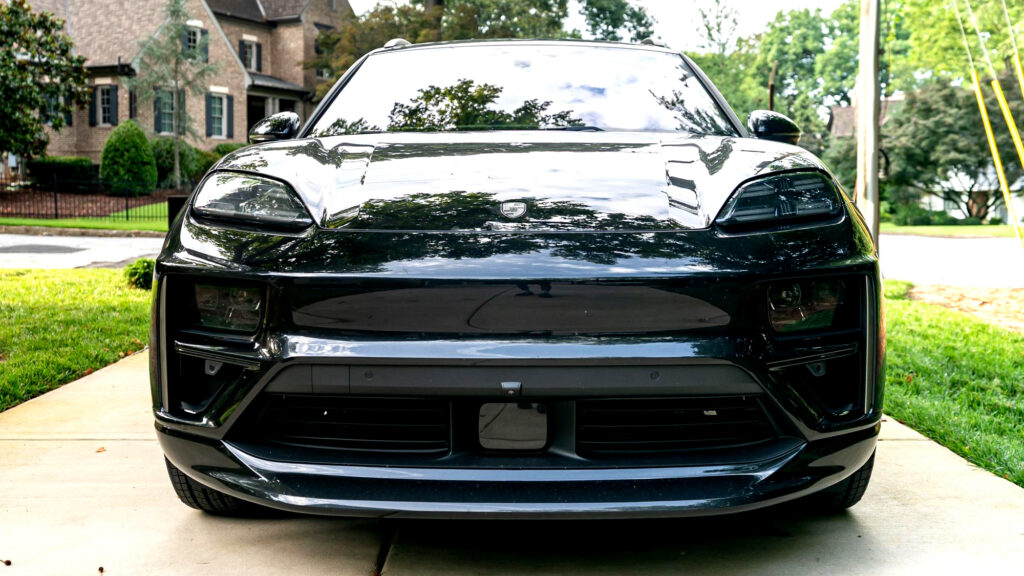
Hype and market reality are very different. Just check out the tale of this Porsche Macan Electric. A 2025 MY car in desirable Turbo trim bought for over $120,0000 when the Macan EV was still bathing in the glow of the model’s launch buzz, it stalled at just $88,500 in bids on an auction website this month.

This particular example, finished in Ice Grey Metallic and with just 1,500 miles (2,414 km) on the clock, originally stickered at $121,855 including destination when sold through Porsche Edison, NJ. That’s some serious money for a compact luxury SUV, even one wearing a Porsche badge.

More: Porsche’s Next Gas Macan Is Already Testing In An Audi Disguise

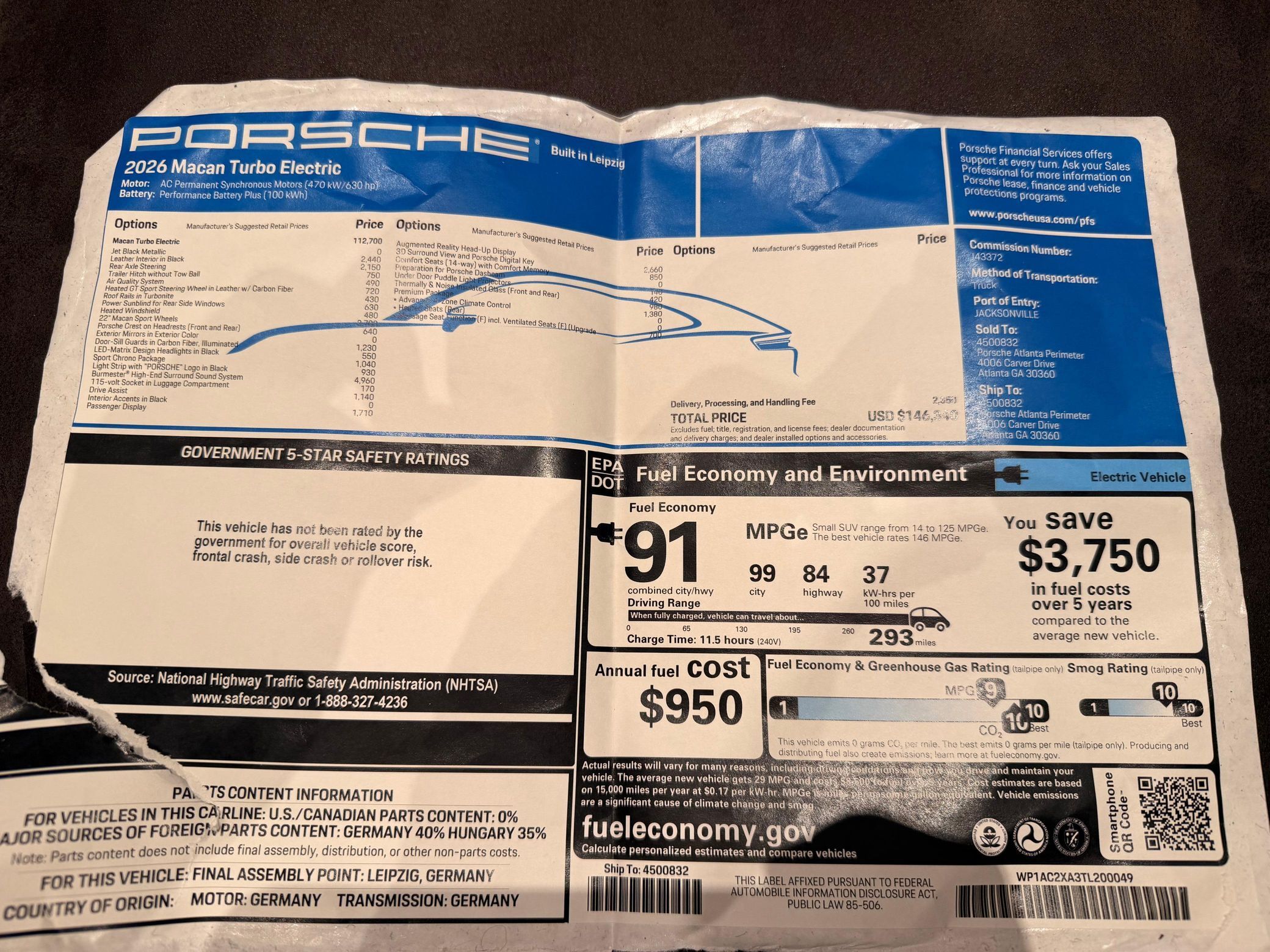
But then it also offers some serious go. The Macan Turbo Electric packs dual-motors pushing around 630 hp (639 PS / 470 kW) and a massive 833 lb ft (1,130 Nm) of torque through all four wheels. It’ll hit 60 mph (96 km/h) in just 3.1 seconds and still promises nearly 300 miles (483 km) of EPA range.

RS Wheels And Bottom Coolers

A bare-bones Turbo would have cost $105,300, but this car’s first owner splashed out another $15k on goodies like the 22-inch RS Spyder Design wheels ($3,900), head-up display ($2,630), Sport Chrono package ($980), and $600 of fake engine sounds. It also has a $1,310 Premium Package that included four-zone climate, ventilated front seats and heated rear seats.

\\\\\\\\\\\

It’s the kind of EV most of us would love to see on our driveways, but Cars&Bids visitors didn’t like it enough to put in on theirs. The C&B listing shows bidding stopped short of the unknown reserve at $88,500, which would have represented a $33,355 haircut, and that was obviously too much for the seller to handle. The seller, by the way, claims he bought the car 100 miles (160 km) ago, so we don’t know how much he would have lost had the final bid secured a sale.

New Macan Sales Struggling

Macan Electric owners looking to exit aren’t the only one struggling to find buyers for the EV. So are Porsche dealers. Global Macan sales are already sliding, down 23 percent overall, and the electric version is taking an even harder hit. Deliveries dropped 43 percent year over year in Q1, while the combustion version most buyers prefer goes out of production this summer and won’t be replaced until 2028.

\\\\\\\\\\

Cars&Bids

❌