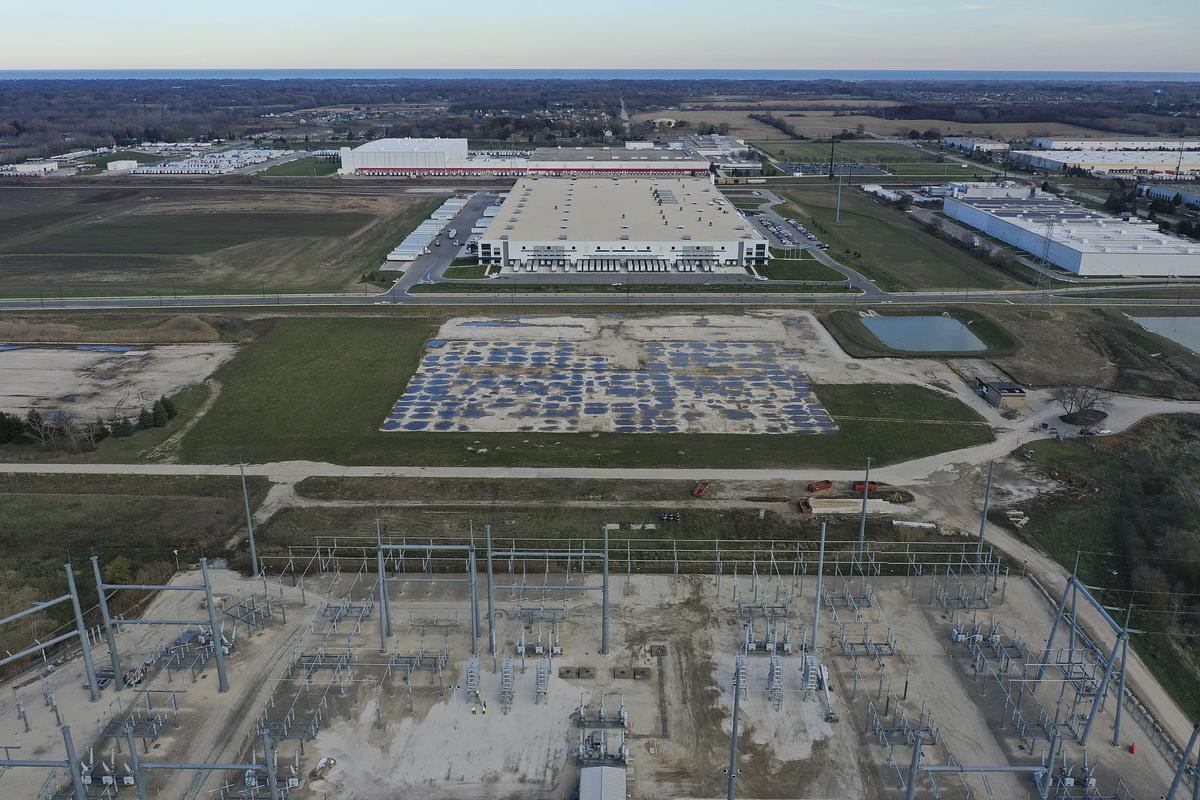
Members of the WEBB gather at Walnut Way with Lindsay Heights residents on Feb. 10 to publicly demand that the state's utility regulators not allow We Energies to charge residential customers for the explosive, unprecedented growth in electricity demand to power hyperscale data centers. (Photo courtesy Walnut Way Conservation Corps.)
Data centers, artificial intelligence and fossil fuels are dominating headlines. Across the United States, more than $350 billion was invested in AI and data-center infrastructure, with tens of billions of dollars proposed in Wisconsin. Investment and economic development are often framed as unequivocal wins, but energy infrastructure is different. If built without foresight, the consequences will reshape the future.
Growth is certain; however the balance between positive and negative growth is yet to be determined.
I have worked in Wisconsin’s energy sector since 2019, beginning in residential and commercial solar. Over the years, I’ve seen energy debates around renewable energy become increasingly politicized, even as their original purpose remains unchanged: to produce reliable electricity, reduce dependence on fragile infrastructure, and give communities more control over their energy supply. Yet, the existing industry stakeholders have blocked deployment and ownership for everyone but themselves. While homeowners, farmers, tribal nations and small businesses face mounting restrictions on deploying their own power systems, the state has moved quickly to approve massive new energy loads for data centers. These agreements are also accompanied by preferential rate structures, infrastructure guarantees and the ability to negotiate.
That contradiction should concern all of us.
Wisconsin residents have grown accustomed to electric rate increases justified by grid maintenance, system upgrades and long-term reliability. According to federal energy data, Wisconsin already ranks among the top 15 states for electricity costs, and utilities have signaled additional increases in the years ahead. At the same time, power reliability has deteriorated in both rural and urban areas.
In parts of Milwaukee, aging poles lean precariously, and low-hanging lines form tangled webs that look untouched for decades. In rural Wisconsin, the impacts are similar. Tribal nations such as the Sokaogon Chippewa and the Menominee Nation have experienced long-duration outages lasting days or even weeks, disrupting health care, food systems and economic activity. These are not isolated incidents; they are symptoms of an overstretched and unevenly maintained grid.
Against this backdrop, Wisconsin is welcoming some of the most energy-intensive facilities on the planet. A single large data center can consume as much electricity as a small city, operating around the clock, every day of the year. The rise of AI only accelerates this demand. Unlike the rest of the state, these facilities do not proceed without firm assurances of power availability, reliability, transmission access,and cost certainty.
Data centers operate under a different set of rules.
Utilities and regulators are willing to negotiate specialized rate structures, accelerate infrastructure investments, and prioritize reliability. Meanwhile, everyday ratepayers, who collectively use far less power and have far less leverage, are asked to shoulder rising costs and accept declining service quality.
This is not a free market. Wisconsin’s energy industry has become an unregulated monopoly. Large utilities control generation, transmission and distribution, and they largely determine who is allowed to produce power and under what terms. While utilities have invested heavily in renewable energy they own, they continue to restrict external ownership and community-scale generation knowing that distributed energy can reduce peak demand, improve resilience, and lower long-term system costs.
If utilities can justify new power plants, substations and transmission lines for data centers, they must also explain why a similar urgency does not apply to grid reliability, ownership opportunities for distributed energy systems and lower rates for Wisconsin residents. Why is Wisconsin able to deliver gigawatts of electricity to data centers, yet unable to address persistent grid failures in communities that have been struggling for decades?
This moment calls for accountability, not ideology. Wisconsin deserves transparency in how data center energy deals are structured, who bears the costs of new infrastructure and how reliability risks are distributed. Ratepayers deserve to know why the largest electricity users receive the greatest assurances, while households, businesses and communities are told to accept less while paying more. Economic growth should not come at the expense of affordability, resilience or fairness. If Wisconsin is going to power the future of AI and digital infrastructure, it must also protect the people and communities that power Wisconsin itself.
This energy crisis is not inevitable. It is the result of choices. And those choices will determine whether Wisconsin’s energy future delivers reliable power for all, or a system defined by higher costs, more frequent outages and growing divides between communities.
A produce cooler at Willy Street Co-op in Madison, Wisconsin. The Evers administration and a large group of advocates are calling on the Legislature to put $69 million more into the Wisconsin FoodShare program to cover new administrative expenses. (Photo by Erik Gunn/Wisconsin Examiner)
Advocates are urging state lawmakers to help Wisconsin absorb new administrative costs as a result of federal changes to the nation’s primary food assistance program.
Changes made to Supplemental Nutrition Aid Program (SNAP) benefits in the mega bill signed by President Donald Trump last year will add $69.2 million to the cost of Wisconsin’s FoodShare program in the current two-year budget, according to the Wisconsin Department of Health Services. The agency administers the FoodShare program.
The federal mega bill, which Trump signed on July 4, cut taxes along with spending on some federal programs, including SNAP.
Aletter from 165 participating groups asks legislators “to take immediate action to provide funding for these changes. Additional delays in providing this funding will put Wisconsin taxpayers at risk of paying for increased costs and will negatively impact communities, businesses, and SNAP recipients across Wisconsin.”
The coalition of social service, food industry and advocacy organizations held a press conference Wednesday to call for the added state support.
“At an average of $6 per person per day, SNAP supports nearly 700,000 Wisconsinites, and also supports local economies with each dollar in SNAP benefits, generating between $1.50 and $1.80 in economic activity,” said Jackie Anderson, executive director of Feeding Wisconsin.
The press conference coincided with a lobbying day for the Wisconsin Cheesemakers Association, one of the coalition members
“FoodShare brings more than a billion dollars of spending power into our state every year, and a large share of that is returned to Wisconsin producers, and in particular, dairy producers, that flows not only through grocery stores, but back through cheese plants and into dairy farms like the one my family owns,” said Andy Hatch, the owner of Uplands Cheese in Dodgeville and the cheesemakers’ association’s policy chair.
“This is a bipartisan issue” — one that the association’s members, Republicans and Democrats alike, “have all agreed on,” Hatch added. “Our core mission is to feed people and to support our communities, rural and urban, and is why we’ve come together with people across the state to ask our lawmakers to fund the requested $69 million and make sure that there is not a disruption to FoodShare.”
The request includes funding to add administrative staff to avoid errors in the state’s operation of the program. Among the changes to SNAP is a penalty that would require states to pick up some of the benefit costs if their errors exceed 6%. State officials have said that could cost Wisconsin up to $205 million.
The $69 million that the state has estimated it will require to implement those changes was not included in the 2025-27 state budget. Gov. Tony Evers’s office said he had told lawmakers about the need last August, and Evers highlighted the coalition’s call in a statement Thursday.
“Because of President Trump’s so-called ‘Big Beautiful Bill,’ Wisconsin taxpayers will already be on the hook for over a quarter of a billion dollars in new costs in future budgets,” Evers said.
“And if we don’t get the resources we’ve been asking for in order to keep our FoodShare error rate low, Wisconsinites could have to pay hundreds of millions even more in penalty fees each year,” he added. “That just cannot happen—it will cripple future state budgets. This funding is critical, and the Legislature must get this done.”
The request includes $16.1 million to add staff in order to ensure that FoodShare is administered accurately. The new federal law requires states with SNAP error rates exceeding 6% to cover from 5% to 15% of the benefit costs starting in October 2027.
Wisconsin’s error rate in 2024 was 4.47%, the state health department said in anews release in August. The error rate flags instances when recipients get too much or too little SNAP aid or the state makes other mistakes in the program.
“However, rates naturally fluctuate, and even more so when the federal government changes program policies and standards with virtually no notice and is inconsistent with its definition of an error,” the health department release stated.
If the error rate rises and requires Wisconsin to start paying some of the benefit costs, that could cost the state up to $205 million a year, according to the Wisconsin DHS.
To hold down the state’s “historically low error rate while implementing the other provisions” in the federal law and to maintain quality control in administering FoodShare, the state and Wisconsin counties combined will need to add 56 employees, according to the health department.
The new federal law also increases the state’s share of administrative costs for SNAP from 50% to 75%, starting Oct. 1, 2026. That will cost the state an additional $32.4 million.
In addition, the law expanded work requirements for people who receive SNAP, which the Wisconsin DHS estimates would affect about 43,700 Wisconsin FoodShare recipients.
The new requirements affect anyone ages 18 to 64 without a child under 14 at home, including parents with children ages 14 to 17, who were previously exempt from work requirements. Previously work requirements applied to adults age 54 or younger without any children under 18 at home.
The state has estimated it would need an additional $20.7 million to increase participation in the FoodShare employment and training program for recipients who have work requirements and aren’t working already.
Reno Wright, public policy and advocacy director at the Hunger Task Force in Milwaukee, said more than 40% of FoodShare recipients are children, with about one in four Wisconsin children living in a household that uses FoodShare sometime during the year.
“Research shows that SNAP reduces child poverty by nearly 30% and is linked to long-term health and educational outcomes, but those outcomes depend on a system that functions efficiently,” Wright said. The funding sought for the program “ensures that the department has the staffing and the infrastructure needed to prevent delays and disruptions as new federal requirements take effect.”
There is not a stand-alone bill in the Legislature currently for the additional funding, but advocates hope an amendment could be added to another piece of legislation that would fund SNAP.
A child gets an MMR vaccine at a clinic in Lubbock, Texas, in March 2025. Wisconsin experts say vaccination rates here are lower than they should be to guard against a wider outbreak. (Photo by Jan Sonnenmair/Getty Images)
With three measles cases in three different Wisconsin communities since New Year’s Day, the state could be vulnerable to a larger outbreak, according to public health experts.
“We’ve gotten three cases in the state of Wisconsin so far in 2026, and there’s been many years in which we had zero,” said Dr. Joe McBride, a pediatric infectious disease physician at UW Health Kids and assistant professor of medicine at the University of Wisconsin School of Medicine and Public Health. If the cases spread, “those are incredibly, incredibly difficult for us to slow down and to prevent.”
Ajay Sethi (UW-Madison photo)
“There may be only three people with measles, but the cases are occurring in three different places,” said Ajay Sethi, director of the Master of Public Health Program at the UW medical school. “These are three separate public health responses, and that is significant given the potential for spread to others from just one person with measles.”
In January, state health officialsreported a measles infection in a Waukesha resident. This month, measles infections have been identified inDane County and in a person who traveled throughMilwaukee County’s Mitchell International Airport to Walworth County. The Wisconsin Department of Health Services has also identified possible locations when other people might have been exposed in the Dane County and Mitchell Airport cases. All three were described as connected to travel.
“It’s good, in that they don’t seem to be related, and we don’t see an outbreak,” McBride said. “But it’s also bad because that means there’s a lot of measles,” he added. “It’s kind of a tinderbox, and we have large cohorts of our population who are not immune.”
The year 2025 saw a resurgence of measles nationwide, approaching 2,000 cases,Stateline reported in December, with outbreaks in Texas, Arizona, South Carolina, Utah and New Mexico.
Sethi said an August 2025 cluster of cases inOconto County started with a case in St. Croix County in someone who was visiting from out of state. Across Wisconsin in 2025, “Ultimately 36 people got measles, and two of them needed hospitalization,” he said.
‘Incredibly infectious’ illness
Although most widely known for its trademark rash, the measles virus “is a respiratory virus, just like really any other cough and cold virus that we think about,” said McBride. “However, it’s incredibly, incredibly infectious.”
Dr. Joe McBride (UW-Madison photo)
The virus is airborne, McBride said, and can hang in the air for up to two hours. In one landmark case, at the 1991 Special Olympics at the Minneapolis Metrodome, a participant on the field had measles, McBride said, “and people who were susceptible to the infection got the infection who were sitting in the upper deck.”
Vaccination is the primary tool to stop measles, and in Wisconsin as well as in much of the U.S. vaccination rates are below the 95% that public health practitioners say allows for widespread “herd immunity.”
The measles vaccine is usually given in combination with mumps and rubella vaccines, first at the age of 1 with a booster by the time a child is 5.
Some people aren’t eligible for the vaccine, either because they’re younger than 6 months old or because they have a compromised immune system due to another illness.
“It’s a live vaccine, and live vaccines have the potential of causing infections in people who are immune-compromised, like bone marrow transplant recipients or a patient with AIDS” or people on medications that suppress the immune system, McBride said.
That makes it even more important for people who are eligible to get the vaccine, public health experts say.
Anational map produced by ABC News in collaboration with Boston Children’s Hospital, Harvard Medical School and Icahn School of Medicine at Mount Sinai in New York shows that none of the counties in Wisconsin has as many as 90% of 5-year-olds fully vaccinated for measles.
The lowest rates of measles vaccinations for that age group are in Portage and Columbia counties, with fewer than 60%. A cluster of counties around Oshkosh have vaccination rates in the low 60s; another cluster around Eau Claire in the mid-60s, and Milwaukee, Racine and Waukesha counties have vaccination rates in the high 60s. In the rest of the state, vaccination rates for children 5 or younger are in the range of 70% to more than 80%.
“The decision to get vaccinated is still very nuanced,” Sethi said — influenced by a variety of factors. Those include complacency, which may lead people to dismiss the need for a vaccine, he said. Other factors include how convenient it may be to get the shot, confidence in the vaccine’s effectiveness and a sense of community responsibility.
HHS shift, CDC silence
One source of shakier confidence has been a shift at the U.S. Department of Health and Human Services and the Center for Disease Control and Prevention (CDC), in the agencies’ stance on vaccines under HHS Secretary Robert F. Kennedy Jr., who had a history of anti-vaccine campaigning for years before his appointment.
Kennedy has made some appeals for people toget the measles vaccine, and in an appearanceon CNN Sunday, Dr. Mehmet Oz, director of the Centers for Medicare & Medicaid Services, urged viewers, “Take the vaccine, please.”
But researchers at Johns Hopkins Universityin a report published in December documented that amid the 2025 measles surge, CDC social media accounts “have gone quiet, creating a ‘void’ in online health communication. In this vacuum, measles messaging has been dominated by news media rather than expert health authorities, resulting in polarized and potentially inaccurate information.”
By the year 2000, measles vaccination had become so widespread that the U.S. was identified as having eliminated the disease. Canada, which also had that status, lost it in 2025, and the U.S. appears to be on the verge of losing it as well, Sethi said.
Yet the measles vaccine is both extraordinarily effective and essentially the only weapon against the virus.
“There isn’t any kind of other medicine that can abort it,” McBride said. “It is completely dependent on either preventing it or having natural infection and supporting the individual through it.”
The infection itself can be extremely serious, however, he said. In addition to fevers, cough and the rash, which is painful, secondary complications can do much more bodily damage. Those can include bacterial infections, pneumonia, vision and neurological damage and cardiovascular system harm as well.
In about one of every 1,000 cases, a delayed neurological condition can arise 10 years after a person is infected “that is completely fatal,” McBride added. Among the hundreds of cases across the U.S. now, “there certainly is somebody who’s walking around today who will be dead of measles in 10 years, who doesn’t know it. And that’s incredibly scary.”
People born before 1957 are more likely to have natural immunity from having been exposed to measles in childhood. “After 1957 we can’t really make that claim for people,” McBride said. “And so our immunity is dependent on vaccine status.”
People living in Wisconsin can look up their immunization status on theWisconsin Immunization Registry, McBride said. Some people’s records might be incomplete, either because they received a vaccine in another state or because they got a vaccine before 1999, when the registry was launched. Earlier vaccines were logged on paper by health providers, according to the Wisconsin Department of Health Services.
Interest in the MMR vaccine appears to be rising. News reports and public health announcements drawing attention to recent measles cases and the importance of the vaccine “certainly raises new awareness and attention to it,” he said.
More patients are asking about the shot and more doctors and nurses are asking whether there needs to be any changes to the current vaccine schedules recommended by the American Academy of Pediatrics or the state health department.
McBride said the current cases in Wisconsin don’t point to any change in those recommendations, however. For health care providers, “The most helpful interventions would be to evaluate your patients and make sure they are up to date with the measles vaccine.”
What to do if you’re exposed to measles
If you’re exposed to someone with measles and you are not immune, there’s as much as a 90% chance you’ll get infected with the virus, said Dr. Joe McBride. People with measles should quarantine for 21 days to avoid infecting others.
McBride recommends that people exposed to measles follow these steps:
Find out what your level of immunity is. If you can check your vaccine record and if it confirms you’ve had the MMR vaccine, “that’s really wonderful,” he said. “The measles vaccine is incredibly effective at preventing infections.”
If your vaccine status is uncertain, a blood test can confirm whether there are antibodies to the virus — another indicator that you’ve had the vaccine.
If you haven’t had the vaccine and don’t have antibodies, a vaccine within the first three days of exposure can still help a person develop an immune response and ward off the illness.
But that’s difficult. The incubation period for measles can range from 7 to 21 days. “Many times we don’t even know where the people are in that time frame,” McBride said. The better alternative is for people who haven’t been vaccinated and who are eligible to get it now, he said.
Robert F. Kennedy Jr. promotes "real food" at a rally in Harrisburg, Penn., last month. Over the next decade, obesity rates across the nation could surge to close to half of U.S. adults, a new study says. (Photo by Whitney Downard/Pennsylvania Capital-Star)
Over the next decade, obesity rates across the nation could surge to close to half of U.S. adults, a new study published in the medical journal JAMA estimates.
Researchers at the University of Washington conducted the analysis using body mass index data from the National Health and Nutrition Examination Survey and self-reported weight data from a national survey of adults ages 20 and older. They examined the 2022 rates and created estimates for 2035 based on current trends. The researchers also looked at race, ethnicity and state-level data, finding wide disparities across states and racial groups.
About a fifth of U.S. adults were living with obesity in 1990. By 2022, the percentage increased to nearly 43%. Obesity was more prevalent in states in the Midwest and South.
If current trends continue, about 47% of U.S. adults will be living with obesity by 2035, according to the researchers. Obesity rates are projected to increase among Americans of all ages and racial groups.
In 2022, non-Hispanic Black women had the highest age-standardized obesity rate, at about 57%, followed by Hispanic women at 49%. Hispanic males, non-Hispanic white males and females, and non-Hispanic Black males had similar rates, ranging from about 40% to nearly 43%.
The study comes amid exploding demand for weight-loss drugs, and as U.S. Health and Human Services Secretary Robert F. Kennedy, Jr. continues to push his Make America Healthy Again campaign.
HHS and the U.S. Department of Agriculture last month made changes to the federal food pyramid, placing a greater emphasis on animal protein, dairy and fats. Like the previous guidelines, the new pyramid discourages the consumption of processed foods, which can cause weight gain.
Despite disparities between men and women and between racial groups, HHS says its nutrition strategy moves away from the “health equity” focus of the Biden administration, in favor of making “the health of all Americans the primary goal.”
For Hispanic people, obesity rates were generally higher in states in the Midwest and the South in 2022, a pattern that is expected to continue through 2035.
In 2022, the obesity rate for Hispanic women was highest in Oklahoma, at about 54%. For Hispanic men, the rate was highest in Indiana, at roughly 47%. In 2035, Indiana is projected to have the highest rate of obesity among Hispanic men at about 54%, while the highest rate for Hispanic women, nearly 60%, is expected to be in South Dakota.
The Midwest and South also had high rates of obesity for non-Hispanic white men and women. In 2022, West Virginia had the highest obesity rates for white men and women — about 47% and 49%, respectively. In 2022, obesity rates for white men and women were lowest in the District of Columbia, at roughly 24% for men and 26% for women.
Among Black women, obesity rates were over 50% for all states, except Hawaii, in 2022. That pattern is expected to continue through 2035. Black men have lower obesity rates than Black women across all states. In 2022, the highest obesity rate for Black men was in Oklahoma, at about 44%. That rate projected to rise to 49% in 2035.
“While no locations were predicted to have decreases in obesity prevalence between 2022 and 2035, there were many with small increases over this time,” the authors wrote. They pointed to Mississippi, where Black women had the highest obesity rates between 1990 and 2022, but are projected to see one of the smallest changes — an increase of about 1.8% — by 2035.
“Predictions in states with historically high levels of obesity, such as Mississippi, suggest that the prevalence of obesity may be plateauing in some locations,” the researchers wrote.
This story was originally produced by Stateline, which is part of States Newsroom, a nonprofit news network which includes Wisconsin Examiner, and is supported by grants and a coalition of donors as a 501c(3) public charity.
A sign at a University of Utah health clinic warns visitors about the spread of measles. Under the Trump administration, federal health officials have cut back the number of recommended vaccines, and more states are offering exemptions for parents who don't want to vaccinate children entering public schools. (Photo by McKenzie Romero/Utah News Dispatch)
States that were leaders in childhood vaccination before the pandemic are among those losing ground as exemptions and unfounded skepticism take hold, encouraged by the Trump administration’s stance under U.S. Health and Human Services Secretary Robert F. Kennedy Jr.
Expanded exemptions for parents are likely to drop both Mississippi and West Virginia from the top national rankings they held before the pandemic, according to a Stateline analysis of federal data. Other states like Florida, Idaho, Louisiana and Montana also are pushing the envelope on vaccine choice.
At least 33 states were below herd immunity in the 2024-25 school year, compared with 28 states before the pandemic in 2018-2019, the analysis found. Herd immunity refers to the percentage of people who must be vaccinated or otherwise immune from an infectious disease to limit its spread.
Research shows that in the case of measles — a highly contagious disease — states need to maintain at least 95% vaccination rates to protect people who can’t get vaccinated. Other diseases have similar herd immunity rates. People who can’t be vaccinated might include infants too young to receive certain vaccines and those with underlying health conditions.
Misinformation and expressions of distrust from influential leaders have an effect on parents, doctors say, as do new state exemptions making it easier for families to avoid the vaccines.
Some people who never questioned vaccines before notice a national debate and get confused, said Dr. Patricia Tibbs, a pediatrician in rural Mississippi and president of the Mississippi chapter of the American Academy of Pediatrics. New religious exemptions may already be fueling an increase in pertussis, also known as whooping cough, in Mississippi, she said.
“If they hear something about it in the news, then it must be right, they think,” Tibbs said. “We’re just following the guidelines and informing patients that this is a scientific discussion. Nothing has changed about the science. But people who don’t know science are making decisions.”
Nothing has changed about the science. But people who don’t know science are making decisions.
– Dr. Patricia Tibbs, Mississippi pediatrician
Under Kennedy’s leadership, federal support for vaccination has continued to slide, and many states have joined a movement to set their own course by following more science-based recommendations from doctors. On Jan. 26 the Governors Public Health Alliance, a group of 15 Democratic governors, endorsed child and adolescent vaccination standards from the American Academy of Pediatrics rather than the federal government.
Federal health officials in Trump’s administration have cut back the number of recommended vaccines. The chair of a vaccine advisory committee, pediatric cardiologist Kirk Milhoan, suggested in a Jan. 22 podcast that individual freedom was more important than protecting community health with vaccines, even for measles and polio.
New leading states
Before the pandemic, Mississippi and West Virginia had the highest kindergarten vaccination rates in the nation, according to the Stateline analysis. About 99% of kindergartners in each state had their required vaccinations before entering public schools in the 2018-2019 school year.
In the latest statistics for the 2024-25 year, Connecticut gained the No. 1 spot, followed by New York and Maine. Those states have reined in exemptions to school vaccine requirements, while Mississippi and West Virginia have begun to allow more exemptions.
West Virginia didn’t report vaccinations to the federal Centers for Disease Control and Prevention for the 2024-25 school year. The state department of health told Stateline the data wouldn’t be available until later this year.
But the state is likely to be pushed out of the top 10. Republican Gov. Patrick Morrisey issued an executive order a year ago giving parents the right to ask for religious exemptions. To date, the state has approved 693 such requests for the current school year, spokesperson Gailyn Markham wrote in an email. That alone is enough to shift the state’s ranking significantly.
Stateline computed an average of required kindergarten vaccination rates to compare states. The analysis uses 2018-19 as a pre-pandemic baseline because a large number of states did not report the information in 2019-20 in the chaos that followed the early COVID-19 spikes and school closings.
A January study published by JAMA Pediatrics found increased vaccination rates among kindergartners in states that had repealed nonmedical exemptions, suggesting the repeals “played a role in maintaining vaccination coverage in repeal states during a period of heightened vaccine hesitancy.”
Requirements and exemptions
All 50 states and the District of Columbia require students to have certain vaccines before attending public school. They also all allow exemptions for children who cannot receive vaccinations for medical reasons, and most states allow nonmedical exemptions, often for religious or sometimes personal reasons. But Florida Republican Gov. Ron DeSantis’ administration has proposed dropping all requirements, and Idaho enacted a 2025 law allowing vaccination exemptions for any reason. Idaho had the lowest rate of kindergarten vaccination, about 80% in the 2024-25 school year before the law took effect in July last year.
Louisiana in 2024 enacted a law dropping COVID-19 vaccine requirements for public schools, and the state has opted to halt publicity about flu vaccination and end public vaccine clinics.
A Florida bill that progressed out of committee in January would maintain school vaccine requirements but expand exemptions to include “conscience” as well as medical and religious reasons.
Dr. Jennifer Takagishi, a Tampa pediatrician and vice president of the Florida chapter of the American Academy of Pediatrics, said the organization opposes both the DeSantis administration proposal to revoke vaccine requirements and the bill that would expand exemptions. Florida’s kindergarten vaccination rate fell from 94% before the pandemic to about 90% in 2024-25, according to the Stateline analysis.
“They’re ignoring the 90% of their constituents who want vaccines and want to stay safe,” said Takagishi. “The legislators are listening to the louder voice of those who want to oppose vaccines instead of the majority. We also know that there are teachers in the school system and school nurses who are fighting this because it puts them at risk.”
All states except Montana report kindergarten vaccine statistics to the federal government. Montana enacted a 2021 law making vaccine status private and unavailable for statistical reports, over the objections of medical experts. The law also made medical exemptions easier for families who think their children have been injured by vaccines.
Dr. Lauren Wilson, a pediatrician and then-vice president of the Montana chapter of the American Association of Pediatrics, said in a hearing that the law would make “vaccination information unavailable for responding to and mitigating public health emergencies.”
“Vaccines have saved millions of lives. I personally have seen cases of tetanus, pertussis, measles and meningitis and the tragedies that these mean for families,” Wilson said in her testimony.
A 2023 court order forced Mississippi to accept religious exemptions. West Virginia allows religious exemptions following the governor’s order last year.
Dr. Patricia Tibbs, right, poses for a photo with then-state Sen. Robin Robinson, a Republican, on a visit to the Mississippi Capitol last March. (Photo courtesy of Robin Robinson)
Tibbs, who practices pediatrics in rural Jones County, Mississippi, said she has been seeing more pertussis than usual, and thinks vaccine exemptions could be a factor.
In Mississippi, which reported 394 religious exemptions for the 2024-25 school year, overall rates remained high enough that year, at about 97.8%, to ensure “herd immunity” in most cases.
Mississippi has granted 617 religious vaccination exemptions for kindergartners this school year, about 1.8% of the class, according to Amanda Netadj, immunizations director for the state health department. About 96.3% of kindergartners have all required vaccinations this year.
But the state’s whooping cough cases last year were the highest they’d been in at least decade, and in September health officials announced an infant had died of the disease — the state’s first whooping cough death in 13 years.
“We do have a lot of people getting the religious exemption,” Tibbs said. ”But still, on any given day, the majority of my patients will still get their vaccines. We are keeping our fingers crossed that the numbers stay high enough.”
This story was originally produced by Stateline, which is part of States Newsroom, a nonprofit news network which includes Wisconsin Examiner, and is supported by grants and a coalition of donors as a 501c(3) public charity.
Bystanders watch as Washington, D.C., police and agents from the federal Drug Enforcement Administration make an arrest in August. Crime in major U.S. cities continued to decline in 2025, with homicides down 21% from 2024 and 44% from a peak in 2021, according to a new analysis by the Council on Criminal Justice. (Photo by Noelle Straub/Stateline)
Crime continued to decline in 2025, with homicides down 21% from 2024 and 44% from a peak in 2021, according to a new analysis of crime trends in 40 large U.S. cities released by the nonpartisan think tank Council on Criminal Justice.
If federal nationwide data, which is set to be released later this year, reflects similar trends, the national homicide rate could fall to its lowest level in more than a century.
The Council on Criminal Justice study analyzed 13 types of offenses — from homicides to drug crimes to shoplifting — in cities that have consistently published monthly data over the past eight years. Researchers found that 11 of the 13 offenses were lower in 2025 than in 2024, with nine dropping by 10% or more.
Drug offenses were the only category to rise, while sexual assaults remained unchanged.
Carjackings and shoplifting also declined sharply. Reported carjackings fell 61% from 2023, while reported shoplifting dropped 10% from 2024.
Among the 35 cities reporting homicides, nearly all recorded declines. Denver; Omaha, Nebraska; and Washington, D.C., saw homicide rates drop roughly 40%.
There were some modest increases, including in Little Rock, Arkansas; Fort Worth, Texas; and Milwaukee, Wisconsin. The homicide rate in El Paso, Texas, remained flat. Overall, 922 fewer homicides were reported across the cities in the sample.
The downward trends extend beyond homicides. In 2025, reported incidents of aggravated assaults fell 9%, gun assaults 22%, robberies 23%, residential burglaries 17%, nonresidential burglaries 18%, larcenies 11%, and domestic violence 2%.
Looking at longer-term trends, violent crime levels in most cities are at or below pre-pandemic levels, the analysis found. Homicides were 25% lower than in 2019, with Baltimore seeing the largest drop at 60%. Milwaukee had the largest increase in homicides, at 42%.
Robberies, carjackings, domestic violence incidents, gun assaults, aggravated assaults and sexual assaults also remained below 2019 levels. Only motor vehicle thefts and nonresidential burglaries remained slightly elevated.
Nonviolent crimes have shown varied trends over the past seven years. Burglaries fell 45%, larcenies 20%, drug offenses 19%, and shoplifting 4% compared with 2019 levels.
The Council on Criminal Justice also examined trends from recent peaks, finding substantial declines in all major offense categories. Homicides fell 44% from their 2021 peak, gun assaults fell 44%, aggravated assaults 19%, domestic violence 23%, robbery 39%, carjackings 61%, residential burglaries 51%, and motor vehicle thefts 43%.
Despite the downward trajectory, researchers caution that the reasons for the decline are uncertain. Changes in criminal justice policies, law enforcement practices, crime-fighting technology, social and economic conditions, and local violence prevention efforts could all be contributing factors, according to the analysis.
This story was originally produced by Stateline, which is part of States Newsroom, a nonprofit news network which includes Wisconsin Examiner, and is supported by grants and a coalition of donors as a 501c(3) public charity.
Federal Reserve Governor Lisa Cook leaves the U.S. Supreme Court on Jan. 21, 2026 in Washington, D.C, after the court heard oral arguments in Trump v. Cook. (Photo by Kevin Dietsch/Getty Images)
WASHINGTON — U.S. Supreme Court justices across the political spectrum appeared skeptical of President Donald Trump’s swift, informal dismissal of Federal Reserve Board Governor Lisa Cook, and his effort to influence the independent central bank that governs monetary policy in the United States.
The oral arguments Wednesday drew a high-profile appearance in the courtroom of Federal Reserve Chair Jerome Powell — now a target of a Department of Justice investigation. For months prior to the federal probe, Trump has threatened to fire Powell if the chair did not quickly lower interest rates.
For two hours, the justices heard arguments over whether Cook could remain on the board, as a lower court ruled, while litigation continues examining if Trump violated a “for cause” removal statute when he fired her over social media in late August.
Trump alleged in an Aug. 25 letter posted to his Truth Social platform that Cook committed financial fraud by lying on mortgage loan documents. Trump declared he had “sufficient cause” to remove Cook based on alleged “deceitful and potentially criminal conduct in a financial matter.”
Under the Federal Reserve Act, the president can only remove board governors “for cause” — as designed by Congress in an effort to preserve the central bank’s independence.
Trump claims his removals of members of independent government agencies are not reviewable by the courts.
Cook has denied any wrongdoing and challenged the president, the board and Powell, essentially arguing in court that an “unsubstantiated allegation about private mortgage applications,” submitted prior to her Senate confirmation, does not amount to cause for removal. Cook also argued that Trump denied her due process in not giving her notice or a chance to respond to his allegations.
Cook, an appointee of former President Joe Biden, has continued to perform her board duties, without interference from Powell.
Alito questions ‘hurried manner’ of firing
During lengthy questioning of U.S. Solicitor General John Sauer, Justices Amy Coney Barrett and Ketanji Brown Jackson asked what the risk would be in allowing Cook to remain in her job while the administration made its case to the lower courts.
“The question is: What is the harm of allowing that injunction to remain, because she’s in office now and would just continue?” Brown asked.
Sauer, Trump’s former personal defense lawyer, said the administration asserts “grievous, irreparable injury to the public perception, to the Federal Reserve, of allowing her to stay in office.”
“Do you have evidence related to the public perception, or is this just the president’s view?” Jackson, a Biden appointee, pressed back.
Sauer said the evidence regarding Cook’s two separate mortgage applications was contained in Trump’s “dismissal order,” referring to the letter posted on social media.
Moments later, Brown asked if Cook was “given the opportunity in some sort of formal proceeding to contest that evidence or explain it?”
“Not a formal proceeding. She was given an opportunity in public,” Sauer said.
“In the world? Like she was supposed to post about it, and that was the opportunity to be heard that you’re saying was afforded to her?” Brown asked.
“Yes,” Sauer replied.
Justice Samuel Alito, one of the high court’s most conservative members, asked Sauer why the removal had to be handled “in such a hurried manner.”
“You began by laying out what you claim to be the factual basis for the for-cause removal, but no court has ever explored those facts. Are the mortgage applications even in the record in this case?” asked Alito, who was appointed to the court under President George W. Bush.
“I know that the text of the social media post that screenshots the mortgage applications is in the record. I don’t recall if the paperwork itself was in the record,” Sauer said.
Federal Reserve independence
Over several minutes of back-and-forth, Justice Brett Kavanaugh pressed Sauer on the importance of the Federal Reserve’s independence.
“Let’s talk about the real world downstream effects of this. Because if this were set as a precedent, it seems to me — just thinking big picture, what goes around, comes around — all the current president’s appointees would likely be removed for cause on Jan. 20, 2029, if there’s a Democratic president, or Jan. 20, 2033,” argued Kavanaugh, who was appointed during Trump’s first term.
“We’re really at, at will removal. So what are we doing here?” he asked.
“I can’t predict what future presidents may or may not do,” Sauer replied.
“Well, history is a pretty good guide. Once these tools are unleashed, they are used by both sides, and usually more the second time around,” Kavanaugh said.
Kavanaugh later challenged Cook’s lawyer, Paul Clement, over whether his argument was “tilting the balance too far the other direction from where the solicitor general is.”
Clement responded, “This is a situation where Congress, political animals, one and all, knew better than anyone that the short-term temptations to lower interest rates and have easy money was a disaster in the long term, but was going to be irresistible.
“And so they tied their own hands by taking the Fed out of the appropriations process, and they tied the president’s hands,” the Alexandria, Virginia-based attorney said.
In a statement following arguments, Cook said the case is “about whether the Federal Reserve will set key interest rates guided by evidence and independent judgment or will succumb to political pressure.”
“Research and experience show that Federal Reserve independence is essential to fulfilling the congressional mandate of price stability and maximum employment. That is why Congress chose to insulate the Federal Reserve from political threats, while holding it accountable for delivering on that mandate. For as long as I serve at the Federal Reserve, I will uphold the principle of political independence in service to the American people,” Cook continued in the statement.
Regulating interest rates — to cool inflation or stimulate the economy — is one tool the central bank uses to accomplish its dual mandate on employment and price stability.
Subpoena issued
The arguments occurred just a dozen days after Powell received a federal grand jury subpoena as part of a Department of Justice probe into allegations that he lied to Congress about multi-year renovation costs to the central bank’s District of Columbia headquarters.
The revelation of a federal investigation of Powell ignited sharp criticism, even from some Republicans.
Powell alleged in a rare video statement that the administration’s “unprecedented action should be seen in the broader context of the administration’s threats and ongoing pressure.”
He continued, “The threat of criminal charges is a consequence of the Federal Reserve setting interest rates based on our best assessment of what will serve the public, rather than following the preferences of the president.”
Trump first nominated Powell in 2017 to head the Federal Reserve, for a four-year term that began in February 2018. Biden reappointed him in 2021, and Powell received overwhelming support in an 80-19 Senate confirmation vote.
Wednesday’s arguments also came less than two months after the Supreme Court heard arguments in Trump’s firing of another member of an independent federal agency, Federal Trade Commissioner Rebecca Slaughter.
Federal Reserve Chair Jerome Powell speaks during a press conference following the Federal Open Markets Committee meeting at the Federal Reserve on Dec. 10, 2025 in Washington, D.C. (Photo by Chip Somodevilla/Getty Images)
WASHINGTON — President Donald Trump’s feud with Federal Reserve Chairman Jerome Powell has escalated into a Department of Justice investigation, raising alarm bells among some Republicans in the Senate, where Trump will need broad backing from GOP lawmakers to get his choice for the next Fed chairman approved after Powell’s term ends in May.
Retiring North Carolina Sen. Thom Tillis, who sits on the narrowly divided Banking Committee that will hold hearings on the next nominee, wrote in a statement he won’t approve anyone to fill Powell’s seat if Trump or administration officials try to further erode its independence.
“If there were any remaining doubt whether advisers within the Trump Administration are actively pushing to end the independence of the Federal Reserve, there should now be none,” Tillis wrote. “It is now the independence and credibility of the Department of Justice that are in question.”
Tillis added he plans to “oppose the confirmation of any nominee for the Fed—including the upcoming Fed Chair vacancy—until this legal matter is fully resolved.”
Powell fights back in a video
Trump has criticized Powell repeatedly since retaking the Oval Office in January, pressing him to reduce interest rates faster and signaling he wanted to fire him.
Powell said in a video released this weekend that Justice Department officials on Friday “served the Federal Reserve with grand jury subpoenas, threatening a criminal indictment related to my testimony before the Senate Banking Committee last June.”
Powell alleged the DOJ investigation is not purely about oversight of the multi-year renovation project at the Fed’s offices in Washington, D.C., but “a consequence of the Federal Reserve setting interest rates based on our best assessment of what will serve the public, rather than following the preferences of the president.”
“This is about whether the Fed will be able to continue to set interest rates based on evidence and economic conditions—or whether instead monetary policy will be directed by political pressure or intimidation,” Powell said.
Trump first nominated Powell to be chairman of the Federal Reserve in November 2017 for a four-year term that began in February 2018, writing in a statement that Powell had “demonstrated steady leadership, sound judgment, and policy expertise.”
“Mr. Powell will bring to the Federal Reserve a unique background of Government service and business experience,” Trump wrote. “He previously served as Under Secretary at the Department of Treasury in the administration of President George H.W. Bush. Mr. Powell also has nearly three decades of business experience.”
The Senate voted 84-13 in January 2018 to confirm Powell to the role.
President Joe Biden re-nominated Powell in November 2021 for another four-year term that began in May 2022 after the Senate voted 80-19 to confirm him for a second time.
Tillis leverage on committee
Trump hasn’t said publicly whom he will nominate to succeed Powell as Fed chairman, but whoever he picks will need to move past the Senate Banking Committee in order to receive a confirmation vote on the floor and actually take on the role.
The Banking Committee holds 13 Republicans and 11 Democrats, giving Tillis considerable leverage to block any Trump nominee from advancing if all of the Democrats on the panel also vote against reporting that person to the floor.
Massachusetts Democratic Sen. Elizabeth Warren, ranking member on the committee, wrote in a statement that “Trump is abusing the authorities of the Department of Justice like a wannabe dictator so the Fed serves his interests, along with his billionaire friends.”
“As Donald Trump prepares to nominate a new Fed Chair, he wants to push Jerome Powell off the Fed Board for good and install another sock puppet to complete his corrupt takeover of America’s central bank,” Warren wrote. “This Committee and the Senate should not move forward with any Trump nominee for the Fed, including Fed Chair.”
Chairman Tim Scott, R-S.C., had not released any public statements about the Department of Justice investigation into Powell as of Monday morning.
Murkowski sees ‘attempt at coercion’
Alaska Republican Sen. Lisa Murkowski, who isn’t on the committee, released a written statement after speaking with Powell on Monday morning, saying “it’s clear the administration’s investigation is nothing more than an attempt at coercion.”
“If the Department of Justice believes an investigation into Chair Powell is warranted based on project cost overruns—which are not unusual—then Congress needs to investigate the Department of Justice,” Murkowski wrote. “The stakes are too high to look the other way: if the Federal Reserve loses its independence, the stability of our markets and the broader economy will suffer. My colleague, Senator Tillis, is right in blocking any Federal Reserve nominees until this is resolved.”
Senate Minority Leader Chuck Schumer, D-N.Y., wrote in a statement the Justice Department’s actions represent “the kind of bullying that we’ve all come to expect from Donald Trump and his cronies.”
“Anyone who is independent and doesn’t just fall in line behind Trump gets investigated,” Schumer wrote. “Jay Powell and the Fed aren’t the reason Trump’s economy and his poll numbers are in the toilet. If he’s looking for the person who caused that he should look in the mirror.”
Former Federal Reserve chairmen, Treasury secretaries and White House economic advisers released a written statement that the Fed’s “independence and the public’s perception of that independence are critical for economic performance, including achieving the goals Congress has set for the Federal Reserve of stable prices, maximum employment, and moderate long-term interest rates.”
“The reported criminal inquiry into Federal Reserve Chair Jay Powell is an unprecedented attempt to use prosecutorial attacks to undermine that independence,” they wrote. “This is how monetary policy is made in emerging markets with weak institutions, with highly negative consequences for inflation and the functioning of their economies more broadly. It has no place in the United States whose greatest strength is the rule of law, which is at the foundation of our economic success.”
White House press secretary Karoline Leavitt told reporters in the afternoon she didn’t know if Trump had seen Powell’s video but defended the president’s right to denounce the Fed’s actions under his leadership.
“Look, the president has every right to criticize the Fed chair. He has a First Amendment right, just like all of you do,” Leavitt said. “And one thing for sure, the president has made it quite clear that Jerome Powell is bad at his job. As for whether or not Jerome Powell is a criminal, that’s an answer the Department of Justice is going to have to find out and it looks like they intend to find that out.”
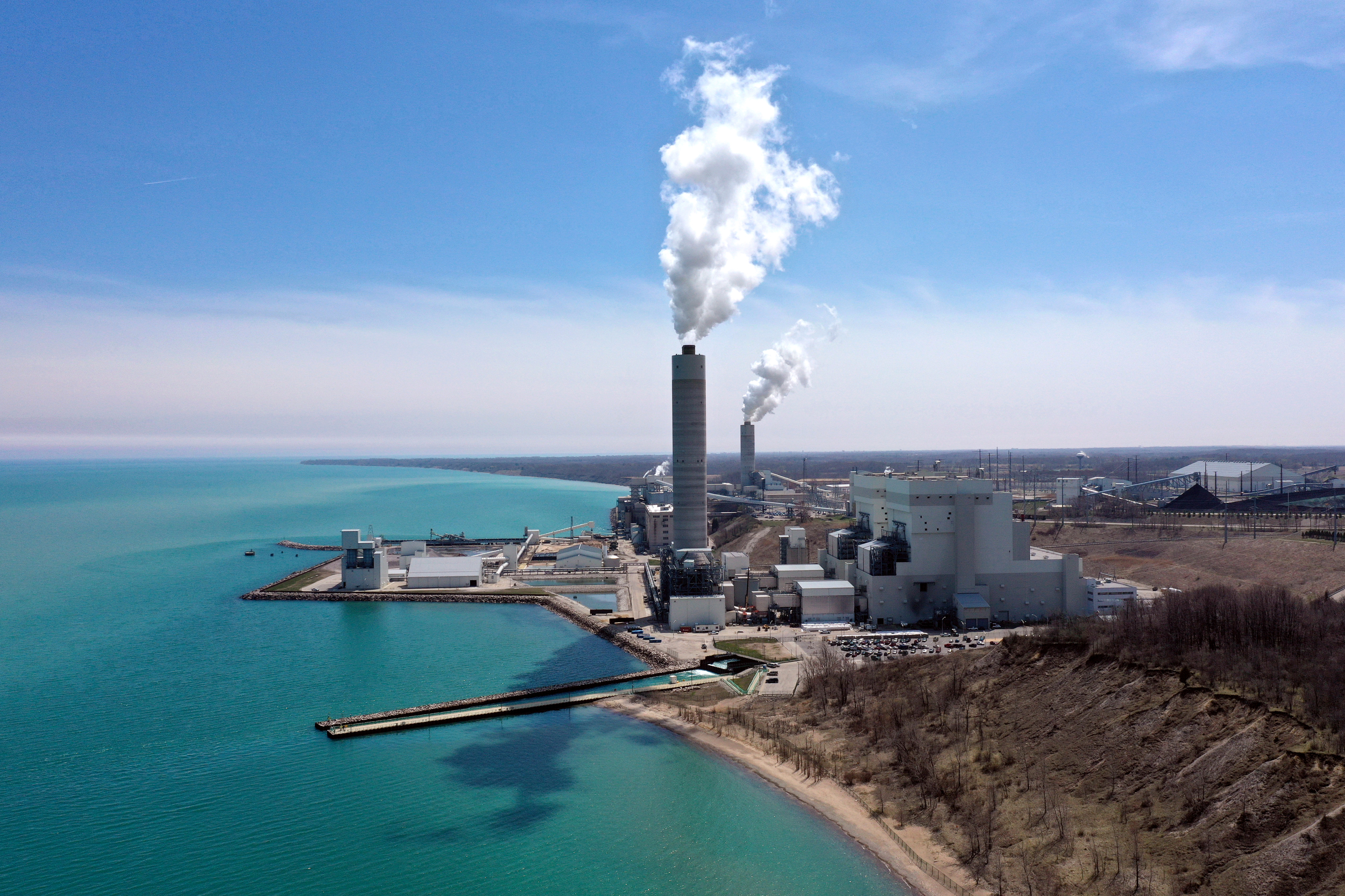
The former site of the We Energies Power Plant on Nov. 13, 2025, in Pleasant Prairie, Wis. (Photo by Joe Timmerman/Wisconsin Watch)
By some measures, the Pleasant Prairie Power Plant, once regarded locally as an “iconic industrial landmark,” had a good run.
Opened in 1980 near Lake Michigan in Kenosha County, it became Wisconsin’s largest generating plant, burning enough Wyoming coal, some 13,000 tons a day, to provide electricity for up to 1 million homes.
But over time, the plant became too expensive to operate. The owner, We Energies, shut it down after 38 years, in 2018.
We Energies customers, however, are still on the hook.
A portion of their monthly bills will continue to pay for Pleasant Prairie until 2039 — 21 years after the plant stopped producing electricity.
In fact, residential and business utility customers throughout Wisconsin owe nearly $1 billion on “stranded assets” — power plants like Pleasant Prairie that have been or will soon be shut down, a Wisconsin Watch investigation found.
That total will likely grow over the next five years with additional coal plants scheduled to cease operations.
Customers must pay not only for the debt taken on to build and upgrade the plants themselves, but also an essentially guaranteed rate of return for their utility company owners, long after the plants stop generating revenue themselves.
“We really have a hard time with utilities profiting off of dead power plants for decades,” said Todd Stuart, executive director of the Wisconsin Industrial Energy Group.
The $1 billion tab looms as Wisconsin utility companies aim to generate unprecedented amounts of electricity for at least seven major high-tech data centers that are proposed, approved or under construction. By one estimate, just two of the data centers, which are being built to support the growth of artificial intelligence, would use more electricity than all Wisconsin homes combined.
All of which raises an important question in Wisconsin, where electricity rates have exceeded the Midwest average for 20 years.
What happens to residents and other ratepayers if AI and data centers don’t pan out as planned, creating a new generation of stranded assets?
How much do Wisconsin ratepayers owe on stranded assets?
Of the five major investor-owned utilities operating in Wisconsin, two — We Energies and Wisconsin Public Service Corp. — have stranded assets on the books. Both companies are subsidiaries of Milwaukee-based WEC Energy Group.
As of December 2024, when the company released its most recent annual report, We Energies estimated a remaining value of more than $700 million across three power plants with recently retired units: Pleasant Prairie, Oak Creek and Presque Isle, a plant on Michigan’s Upper Peninsula.
Wisconsin Public Service Corp.’s December 2024 report listed roughly $30 million in remaining value on recently retired units at two power plants.
In total, utilities owned by WEC Energy Group will likely have over $1 billion in recently retired assets by the end of 2026.
The company also noted a remaining value of just under $250 million for its share of units at Columbia Generating Station slated to retire in 2029, alongside a remaining value of roughly $650 million for units at Oak Creek scheduled to retire next year.
Its customers will pay off that total, plus a rate of return, for years to come.
The company estimates that closing the Pleasant Prairie plant alone saved $2.5 billion, largely by avoiding future operating and maintenance costs and additional capital investments.
Both Wisconsin Power and Light and Madison Gas and Electric also own portions of the Columbia Energy Center, and Wisconsin Power and Light also operates a unit at the Edgewater Generating Station scheduled for retirement before the end of the decade. Neither company provided estimates of the values of those facilities at time of retirement. Andrew Stoddard, a spokesman for Alliant Energy, Wisconsin Power and Light’s parent company, argued against treating plants scheduled for retirement with value on the books as future stranded assets.
How stranded assets occurred: overcommitting to coal
In 1907, Wisconsin became one of the first states to regulate public utilities. The idea was that having competing companies installing separate gas or electric lines was inefficient, but giving companies regional monopolies would require regulation.
Utility companies get permission to build or expand power plants and to raise rates from the three-member state Public Service Commission. The commissioners, appointed by the governor, are charged with protecting ratepayers as well as utility company investors.
A demolition sign is posted at the former site of the We Energies Power Plant on Nov. 13, 2025, in Pleasant Prairie, Wis. (Photo by Joe Timmerman/Wisconsin Watch)
Stranded assets have occurred across the nation, partly because of the cost of complying with pollution control regulations. But another factor is that, while other utilities around the country moved to alternative sources of energy, Wisconsin utilities and, in turn, the PSC overbet on how long coal-fired plants would operate efficiently:
In the years before We Energies pulled the plug on Pleasant Prairie, the plant had mostly gone dark in spring and fall. Not only had coal become more expensive than natural gas and renewables, but energy consumption stayed flat. By 2016, two years before Pleasant Prairie’s closure, natural gas eclipsed coal for electricity generation nationally.
In 2011, We Energies invested nearly $1 billion into its coal-fired Oak Creek plant south of Milwaukee to keep it running for 30 more years. The plant, which began operating in 1965 and later became one of the largest in the country, is now scheduled to completely retire in 2026 — with $650 million on the books still owed. That will cost individual ratepayers nearly $30 per year for the next 17 years, according to RMI, a think tank specializing in clean energy policy. The majority of the debt tied to those units stems from “environmental controls we were required to install to meet federal and state rules,” WEC Energy Group spokesperson Brendan Conway said.
In 2013, to settle pollution violations, Alliant Energy announced an investment of more than $800 million in the Columbia Energy Center plant in Portage, north of Madison. But by 2021, Alliant announced plans to begin closing the plant, though now it is expected to operate until at least 2029.
Various factors encourage construction and upgrades of power plants.
Building a plant can create upwards of 1,000 construction jobs, popular with politicians. Moreover, the Public Service Commission, being a quasi-judicial body, is governed by precedent. For example, if the PSC determined it was prudent to allow construction of a utility plant, that finding would argue in favor of approving a later expansion of that plant.
The PSC allowed utility companies “to overbuild the system,” said Tom Content, executive director of the Wisconsin Citizens Utility Board, a nonprofit advocate for utility customers. “I think the mistake was that we allowed so much investment, and continuing to double down on coal when it was becoming less economic.”
Utilities “profit off of everything they build or acquire,” Stuart said, “and so there is a strong motivation to put steel in the ground and perhaps to even overbuild.”
Conway, the WEC Energy Group spokesperson, argued that the utilities’ plans to retire plants amount to a net positive for customers.
“We began our power generation reshaping plan about a decade ago,” he wrote in an email. “That includes closing older, less-efficient power plants and building new renewable energy facilities and clean, efficient natural gas plants. This plan reduces emissions and is expected to provide customers significant savings — hundreds of millions of dollars — over the life of the plan.”
Guaranteed profits add to ratepayer burden
The built-in profits that utility companies enjoy, typically 9.8%, add to the stranded assets tab.
When the Public Service Commission approves construction of a new power plant, it allows the utility company to levy electricity rates high enough to recover its investment plus the specified rate of return — even after a plant becomes a stranded asset.
The former site of the We Energies Power Plant on Nov. 13, 2025, in Pleasant Prairie, Wis. (Photo by Joe Timmerman/Wisconsin Watch)
“We give them this license to have a monopoly, but the challenge is there’s no incentive for them to do the least-cost option,” Content said. “So, in terms of building new plants, there’s an incentive to build more … and there’s incentive to build too much.”
When the Pleasant Prairie plant was shut down in 2018, the PSC ruled that ratepayers would continue to pay We Energies to cover the cost of the plant itself, plus the nearly 10% profit. The plant’s remaining value, initially pegged at nearly $1 billion, remained at roughly $500 million as of December 2024.
Eliminating profits on closed plants would save ratepayers $300 million on debt payments due to be made into the early 2040s, according to Content’s group.
New ‘stranded assets’ threat: data centers
As artificial intelligence pervades society, it’s hard to fathom how much more electricity will have to be generated to power all of the data centers under construction or being proposed in Wisconsin.
We Energies alone wants to add enough energy to power more than 2 million homes. That effort is largely to serve one Microsoft data center under construction in Mount Pleasant, between Milwaukee and Racine, and a data center approved north of Milwaukee in Port Washington to serve OpenAI and Oracle AI programs. Microsoft calls the Mount Pleasant facility “the world’s most powerful data center.”
Data centers are also proposed for Beaver Dam, Dane County, Janesville, Kenosha and Menomonie.
The energy demand raises the risk of more stranded assets, should the data centers turn out to be a bubble rather than boom.
“The great fear is, you build all these power plants and transmission lines and then one of these data centers only is there for a couple years, or isn’t as big as promised, and then everybody’s left holding the bag,” Stuart said.
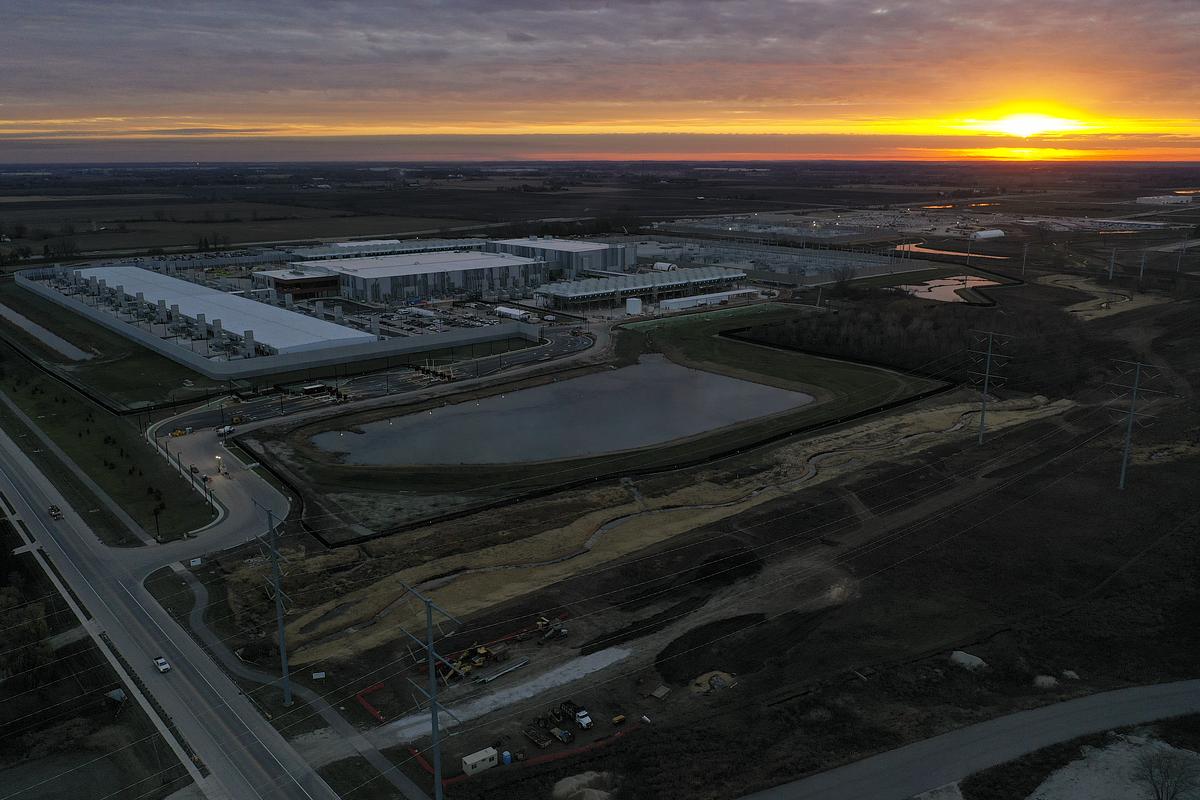
The sun sets as construction continues at Microsoft’s data center project on Nov. 13, 2025, in Mount Pleasant, Wis. (Photo by Joe Timmerman/Wisconsin Watch)
In an October Marquette Law School poll, 55% of those surveyed said the costs of data centers outweigh the benefits. Environmental groups have called for a pause on all data center approvals. Democratic and Republican leaders are calling for data centers to pay their own way and not rely on utility ratepayers or taxpayers to pay for their electricity needs.
Opposition in one community led nearly 10,000 people to become members of the Stop the Menomonie Data Center group on Facebook. In Janesville, voters are trying to require referendums for data centers. In Port Washington, opposition to the data center there led to three arrests during a city council meeting.
Utilities are scheduled in early 2026 to request permission from the Public Service Commission to build new power plants or expand existing plants to accommodate data centers.
Some states, such as Minnesota, have adopted laws prohibiting the costs of stranded assets from data centers being passed onto ratepayers.
Wisconsin has no such laws.
Shifting cost burden to utility companies
Currently, ratepayers are on the hook for paying off the full debt of stranded assets — unless a financial tool called securitization reduces the burden on ratepayers.
Securitization is similar to refinancing a mortgage. With the state’s permission, utilities can convert a stranded asset — which isn’t typically a tradeable financial product — into a specialized bond.
Utility customers must still pay back the bond. But the interest rate on the bond is lower than the utility’s standard profit margin, meaning customers save money.
A 2024 National Association of Regulatory Utility Commissioners report noted that utilities’ shareholders may prefer a “status quo” scenario in which customers pay stranded asset debts and the standard rate of return. Persuading utilities to agree to securitization can require incentives from regulators or lawmakers, the report added.
In some states, utilities can securitize the remaining value of an entire power plant. Michigan utility Consumers Energy, for instance, securitized two coal generating units retired in 2023, saving its customers more than $120 million.
In Wisconsin, however, utilities can securitize only the cost of pollution control equipment on power plants — added to older coal plants during the Obama administration, when utilities opted to retrofit existing plants rather than switching to new power sources.
The Oak Creek Power Plant and Elm Road Generating Station, seen here on April 25, 2019, in Oak Creek, Wis., near Milwaukee, are coal-fired electrical power stations. (Photo by Coburn Dukehart/Wisconsin Watch)
In 2023, two Republican state senators, Robert Cowles of Green Bay and Duey Stroebel of Saukville, introduced legislation to allow the Public Service Commission to order securitization and allow securitization to be used to refinance all debt on stranded assets. The bill attracted some Democratic cosponsors, but was opposed by the Wisconsin Utilities Association and did not get a hearing.
Democratic Gov. Tony Evers proposed additional securitization in his 2025-27 budget, but the Legislature’s Republican-controlled Joint Finance Committee later scrapped the provision.
Even Wisconsin’s narrow approach to securitization is optional, however, and most utilities have chosen not to use it.
We Energies was the first Wisconsin utility to do so, opting in 2020 to securitize the costs of pollution control equipment at the Pleasant Prairie plant. Wisconsin’s Public Service Commission approved the request, saving an estimated $40 million. “We will continue to explore that option in the future,” Conway said.
But the PSC expressed “disappointment” in 2024 when We Energies “was not willing to pursue securitization” to save customers $117.5 million on its soon-to-retire Oak Creek coal plant. The utility noted state law doesn’t require securitization.
Stuart said that if utilities won’t agree to more securitization, they should accept a lower profit rate once an asset becomes stranded.
“It would be nice to ease that burden,” he said. “Just to say, hey, consumers got to suck it up and deal with it, that doesn’t sound right. The issue of stranded assets, like cost overruns, is certainly ripe for investigation.”
Comprehensive planning required elsewhere — but not Wisconsin
Avoiding future stranded assets could require a level of planning impossible under Wisconsin’s current regulatory structure.
When the state’s utilities propose new power plants, PSC rules require the commission to consider each new plant alone, rather than in the context of other proposed new plants and the state’s future energy needs. Operating without what is known as an integrated resource plan, or IRP, opened the PSC to overbuilding and creating more stranded assets. IRPs are touted as an orderly way to plan for future energy needs.
“There’s no real comprehensive look in Wisconsin,” Stuart said. “We’re one of the few regulated states that really doesn’t have a comprehensive plan for our utilities.
”We’ve been doing some of these projects kind of piecemeal, without looking at the bigger picture.”
Protesters speak against a proposed natural gas power plant in Oak Creek, Wis., on March 25, 2025. (Photo by Julius Shieh/Milwaukee Neighborhood News Service)
Structured planning tools like IRPs date back to the 1980s, when concerns about cost overruns, fuel price volatility and overbuilding prompted regulators to step in. Minnesota and Michigan require utilities to file IRPs, as do a majority of states nationwide.
Evers proposed IRPs in his 2025-27 state budget, but Republican lawmakers removed that provision because it was a nonfiscal policy issue.
Northern States Power Company, which operates in Wisconsin and four other Midwestern states, is required by both Michigan and Minnesota to develop IRPs. “Because of these rules, we create a multi-state IRP every few years,” said Chris Ouellette, a spokesperson for Xcel Energy, the utility’s parent company.
Madison Gas and Electric, which only operates in Wisconsin, argued that its current planning process is superior to the IRP requirements in neighboring states. “A formal IRP mandate would add process without improving outcomes,” spokesperson Steve Schultz said. “Wisconsin’s current framework allows us to move quickly, maintain industry-leading reliability and protect customer costs during a period of rapid change.”
How to influence decisions relating to stranded assets
The devil will be in the details on whether the Public Service Commission adopts strong policies to prevent the expected wave of new power plant capacity from becoming stranded assets, consumer advocates say.
The current members, all appointed by Evers, are: chairperson Summer Strand, Kristy Nieto and Marcus Hawkins.
The public can comment on pending cases before the PSC via its website, by mail or at a public hearing. The commission posts notices of its public hearings, which can be streamed via YouTube.
Barbed wire fence surrounds the former site of the We Energies Power Plant on Nov. 13, 2025, in Pleasant Prairie, Wis. (Photo by Joe Timmerman/Wisconsin Watch)
Among the upcoming hearings on requests by utilities to generate more electricity for data centers:
Feb. 12: We Energies’ request to service data centers in Mount Pleasant and Port Washington. We Energies says the fees it proposes, known as tariffs, will prevent costs from being shifted from the data centers to other customers. The “party” hearing is not for public comment, but for interaction between PSC staff and parties in the case, such as We Energies and public interest groups.
Feb. 26: Another party hearing for a case in which Alliant Energy also said its proposed tariffs won’t benefit the data center in Beaver Dam at the expense of other customers.
To keep abreast of case developments, the PSC offers email notifications for document filings and meetings of the commission.
The PSC would not provide an official to be interviewed for this article. It issued a statement noting that utilities can opt to do securitization to ease the financial burden on ratepayers, adding:
“Beyond that, the commission has a limited set of tools provided under state law to protect customers from costs that arise from early power plant retirements. It would be up to the state Legislature to make changes to state law that would provide the commission with additional tools.”
On Nov. 6, state Sen. Jodi Habush Sinykin, D-Whitefish Bay, and Rep. Angela Stroud, D-Ashland, announced wide-ranging data center legislation. One provision of their proposal aims to ensure that data centers don’t push electricity costs onto other ratepayers.
A PFAS advisory sign along Starkweather Creek. (Henry Redman | Wisconsin Examiner)
A Wisconsin Senate committee held a public hearing Thursday on a bipartisan bill that would require the state Department of Natural Resources to notify county and tribal governments when local groundwater contamination is found to exceed state standards.
Throughout the hearing, the bill’s authors and residents of communities with water quality problems complained of incidents in which significant amounts of time passed before people learned their water was contaminated with harmful chemicals such as nitrates or PFAS.
“Time really counts, hours, days, weeks, and in our case, even years,” said Lee Donahue, a resident of the town of Campbell on French Island near La Crosse, which has been dealing with PFAS contamination for years. “It’s been heart wrenching to know that my family and my friends and my neighbors have all been impacted by these toxic chemicals. I don’t wish anyone to have contamination in their water. And the sad part is we had no clue that PFAS was pouring from our faucets and that we were drinking that water for years and years and years before any notification was made.”
Initially authored by Rep. Jill Billings (D-La Crosse) and Sen. Jesse James (R-Thorp), more than 60 legislators of both parties have signed onto the bill as co-sponsors, signaling the legislation has enough support to be signed into law during a legislative session in which efforts to find compromise on environmental issues — including efforts to extend the Knowles-Nelson stewardship grant program and to create a method to spend $125 million that has been set aside for more than two years to remediate PFAS contamination — have been stuck in the partisan muck.
Under the bill, if the DNR finds an exceedance of the state’s groundwater standards the department will have seven days to notify the local county or tribal health department as well as the county land and conservation department.
For several years, Wisconsin policymakers have been unable to establish a state standard for the acceptable amount of PFAS in the state’s groundwater, hitting roadblocks at the state Natural Resources Board and in the Republican-controlled Legislature. The state does have established standards for the amount of PFAS in the state’s surface water and the drinking water provided by municipal water utilities.
As the Legislature has tried and failed to pass a bill that would spend the $125 million in the PFAS trust fund, residents of communities affected by PFAS contamination have frequently said the policy change they’d most like to see is the establishment of a groundwater standard.
The contaminant notification bill does not establish a groundwater standard for PFAS, however it requires the DNR to notify the county government if the groundwater is found to have PFAS levels higher than the existing state standards for PFAS in surface or drinking water.
About one-third of Wisconsin residents get their water from private drinking wells. While the bill does not establish a groundwater standard and does not provide any assistance if the groundwater they use to shower, brush their teeth, make coffee or mix baby formula is contaminated, proponents said it does make sure residents have the information they need to make decisions about the source of their water.
“If people have a right to clean water, then they have a right to know when their water is not clean,” said Michael Tiboris, the agriculture and water policy director at the River Alliance of Wisconsin. “And this bill is exactly the kind of action that we appreciate having legislators take a strong position on, giving families knowledge of the threats to their drinking water makes it possible for them to protect themselves.”
None of the people or groups that testified at the hearing Thursday were in opposition to the bill, but a few industry groups expressed a handful of complaints and said they’d like to see amendments to the bill’s final version.
The concerns of business groups centered around making sure that any notifications were made after test results have been verified and making sure that the notifications don’t instigate regulatory action from the government that it doesn’t have the authority to undertake.
“It’s just not appropriate for the government to take any kind of action,” said Adam Jordahl, director of environmental and energy policy at Wisconsin Manufacturers and Commerce. “I know it’s not a direct regulatory action where we’re expecting an individual or business to do something or comply with something, but nevertheless, the issue of sort of holding people accountable to a regulatory PFAS standard that has not yet actually been promulgated into the administrative code. We find that to be very problematic and kind of a slippery slope going down in terms of holding people accountable or responsible to something that hasn’t gone through the full rulemaking process.”
Scott Suder, the president of the Wisconsin Paper Council, said he’s concerned that prematurely telling people their water is contaminated could create “reputational risks” for nearby businesses.
“It creates unnecessary legal and reputational risk for industry, potentially because the notice is subject to public inspection and copying under [Wisconsin open records law],” Suder said. “All exceedance notifications would become public records, creating significant disclosure and some reputational risks, so even minor errors or omissions could trigger liabilities, and the visibility of exceedances may lead to public misunderstanding about actual risks. So it is a bit concerning for industry as well.”
Wisconsin electricity rates – for residential, industrial and commercial users – have exceeded regional averages annually for 20 years.
From 2003 through 2022, Wisconsin rates exceeded the averages in each of the three user categories for eight Midwest states, Wisconsin Public Service Commission reports show.
For the three categories combined, Wisconsin’s rate was second-highest in 2023-24 and third-highest in 2024-25 among 12 central region states, federal Energy Information Administration figures show.
Here are the July 2025 cents-per-kilowatt hour rates in Wisconsin versus the north central region average:
Residential: $18.30/$17.84
Commercial: $13.39/$13.31
Industrial: $9.87/$9.46
Electric bills rose for residential customers of Wisconsin’s five largest utilities, according to the Wisconsin Citizens Utility Board. For example, the average monthly We Energies bill for a typical residential customer was $128.65 in 2024, twice as high as $56.18 for 2004.
Booming data center construction in Wisconsin could affect utility rates.
This fact brief is responsive to conversations such as this one.

 Login
Login