
Normal view

There are new articles available, click to refresh the page.
Before yesterdayMain stream

Uber And Lucid Robotaxi Arrives Later This Year

  • Lucid, Nuro, and Uber have shown a production-intent robotaxi at CES.
  • It’s based on the Lucid Gravity and is scheduled to launch later this year.
  • Operations will kick off in the San Francisco Bay Area, before going global.

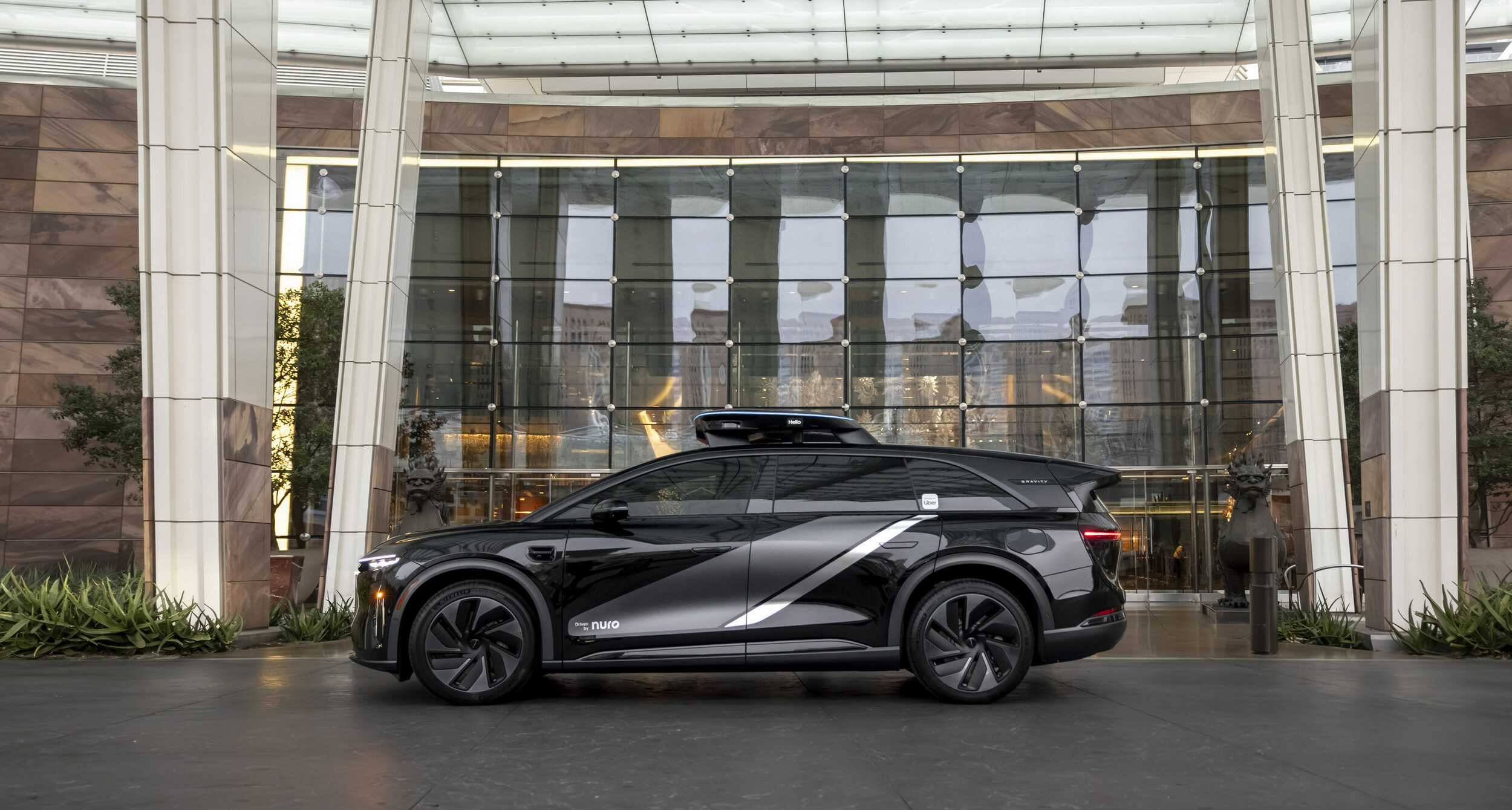
Lucid, Nuro, and Uber have used CES to unveil their production-intent robotaxi as well as the model’s in-cabin rider experience. The companies also announced on-road testing began in December, ahead of a scheduled launch in the San Francisco Bay Area later this year.

Based on the Gravity SUV, the Level 4 robotaxi features a next-generation sensor array that consists of high-resolution cameras, solid-state lidar sensors, and radar sensors. These provide a 360° view of the vehicle’s surroundings and the equipment is integrated into the Gravity’s body as well as a roof-mounted halo.

More: Uber And Lucid Partner For Thousands Of Robotaxis

Information is fed to the Nuro Driver, which is a Level 4 autonomous driving system. It’s supported by Nvidia’s Drive AGX Thor, which allows for “high-performance” computing and real-time AI processing.

Uber’s role is to own and operate the robotaxis – along with third-party fleet partners – and allow for rides using the company’s popular ride-hailing platform.

An Intuitive User Experience

While the companies are still being coy on specifics, they revealed a handful of details about the user experience. This begins as soon as the robotaxi approaches as the ‘halo’ has multiple displays that show the rider’s initials, ensuring people get into the right vehicle.

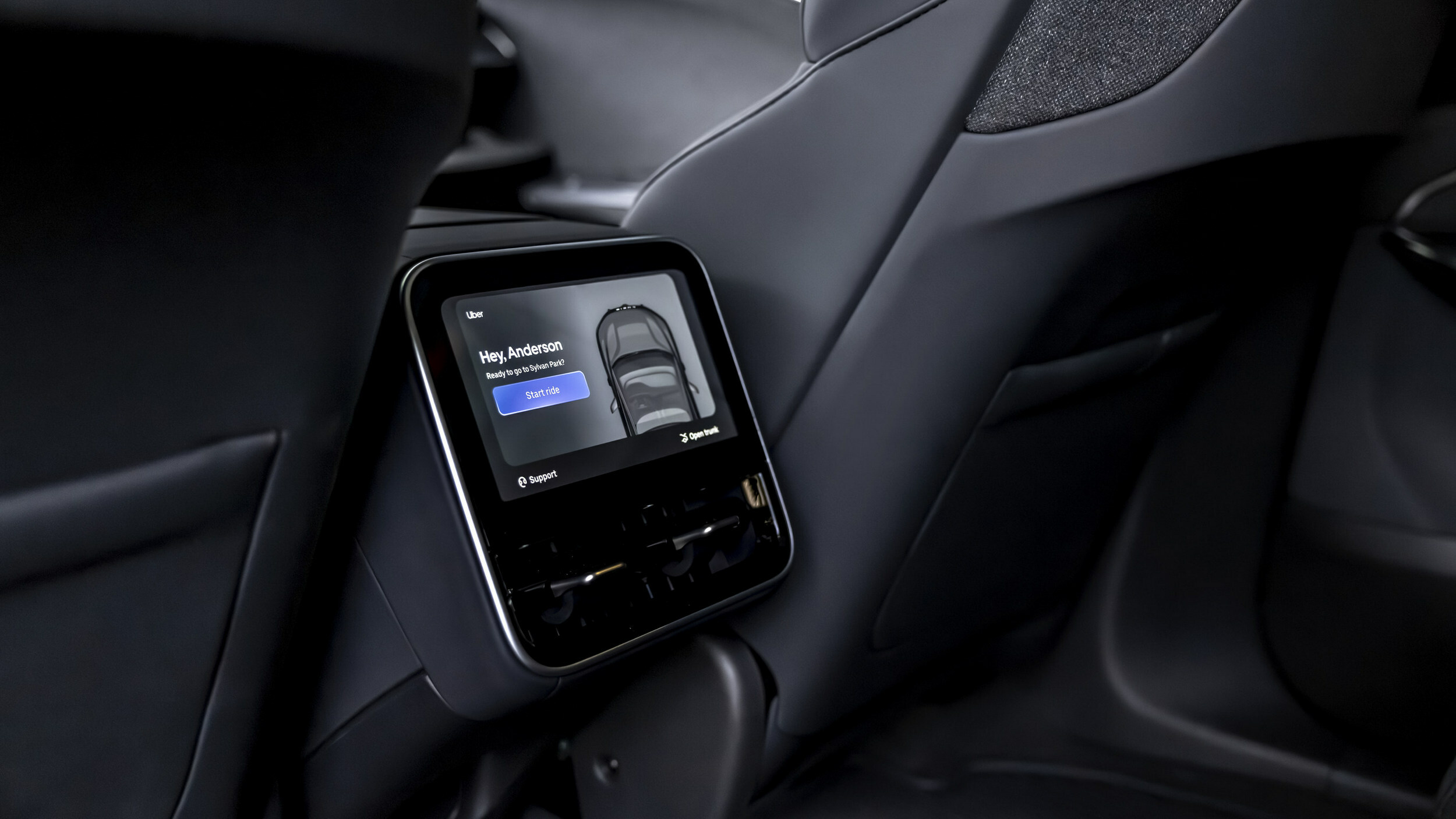
Riders are envisioned to hop in the second-row, where they’ll be greeted by a screen that says their name and where they’re going. There’s also a digital button that enables them to open the liftgate and store luggage in the back.
 Uber And Lucid Robotaxi Arrives Later This Year

Once riders are ready to go, they can tap “Start Drive.” The screen will then display their estimated drop off time and animations showing what the vehicle is doing. This includes “maneuvers such as yielding to pedestrians, slowing at traffic lights, changing lanes, and dropping off a passenger.”

Riders will be able to access a handful of vehicle controls including settings for the climate control system, heated seats, and audio system. They can also contact support and tell the vehicle to pull over to the side of the road. Users can also view a traditional Uber-style map, which isn’t much of a surprise considering the ride-hailing giant developed the experience.
 Uber And Lucid Robotaxi Arrives Later This Year

While a number of riders will likely be traveling solo, the companies said the robotaxi is also great for groups. It can accommodate up to six passengers and their luggage at a time.

We’ll likely learn more about the robotaxi in the coming months, but Lucid is expected to begin production later this year in Arizona. The vehicles will then be deployed in the Bay Area.

If everything goes according to plan, Uber will deploy at least 20,000 Lucid robotaxis over six years in dozens of markets around the world.
\\\\

Lucid Pulled Off What Most EV Brands Couldn’t After The Tax Credit Was Cut

  • Lucid’s 2025 sales rose 104 percent compared to 2024 totals.
  • Gravity SUV launch helped drive strong Q4 performance gains.
  • Q4 deliveries rose 31 percent, capping Lucid’s best quarter yet.

Despite a sharp drop in EV demand across much of the U.S. market, Lucid managed to chart its strongest quarter yet. Following the Trump administration’s decision to eliminate the $7,500 federal EV tax credit at the end of September, most automakers saw EV sales falter during the final stretch of 2025. Lucid, however, went in the opposite direction and closed the year with a notable uptick.

The company reported that it built 8,412 vehicles in Q4 2025, marking a 116 percent jump over the previous quarter. Deliveries also climbed to 5,345, up 31 percent. For Lucid, it wasn’t just an improvement, it was the best-performing quarter of the entire year.

Read: No Tax Credit? No Worries, Lucid Has A $7,500 Gravity Discount

The start of 2025 looked far less promising. In the first quarter, Lucid produced only 2,121 vehicles and delivered 3,109. The second quarter showed progress, with 3,863 vehicles built and 3,309 delivered. By Q3, production edged slightly to 3,891, and deliveries rose to 4,078.

Lucid’s full-year production and sales figures were also strong. It produced 18,378 vehicles in 2025, a 104 percent increase over the year before. Deliveries reached 15,841, representing a 55 percent year-over-year gain.

 Lucid Pulled Off What Most EV Brands Couldn’t After The Tax Credit Was Cut

Helping Lucid boost its production and sales throughout the latter part of 2025 was the arrival of the all-electric Gravity SUV .While the company has yet to disclose how many units of the Gravity were produced, sold, or delivered, its presence clearly contributed to the quarter’s growth. Just how much is still unclear.

Lucid’s Own Credit

One likely reason Lucid avoided the sales slump seen elsewhere is its Advantage Credit program. Designed to soften the blow of the lost federal incentive, Lucid introduced a $7,500 credit of its own, applicable to new Gravity orders.

It was first set to expire at the end of December but has now been extended through January 18. While not a permanent fix, it offers a near-term solution for buyers left in the lurch after the tax credit rollback.

 Lucid Pulled Off What Most EV Brands Couldn’t After The Tax Credit Was Cut

He Sold His $142K Lucid At A Huge Loss After Just 400 Miles Of EV Reality

  • The owner sold nearly new $142K Lucid Gravity after 400 miles.
  • Broken workplace chargers and no home charger caused the issue.
  • The seller still loves the car and plans to return to EVs eventually.

It’s hard to argue that owning a vehicle with 1,070 horsepower (797 kW) wouldn’t be extremely fun. However, that excitement turns on its head when you realize that there’s nowhere to refuel, or rather in this case, recharge it.

That’s exactly what just happened to a Brooklyn-based Lucid Gravity Dream Edition buyer. After snatching this unique EV up brand new in September of 2025, he ended up selling it just 400 miles later for a huge loss.

More: Lucid’s Cheaper Gravity Lost Hundreds Of Horses But Found You Thousands In Savings

The seller on Cars & Bids shared a photo of the window sticker for this luxury SUV, listing an MSRP of $141,550. When the hammer fell on his auction sale of the car, it brought just $123,000. That’s a painful $18,500 lesson for 400 miles of usage in a little over a month, amounting to $46.25 for every mile he put on the odometer.

Where Do You Plug In?

Why take such a big loss for a vehicle that the owner says is “an awesome car”? It all comes down to charging it up. For the owner, it was almost like buying a Hellcat and then realizing that the closest gas station is 220 miles away.

\\\\\\

Cars&Bids

He says that his initial plan was to charge where he works but then one option after another fell apart until he had to take the loss we’re talking about here.

“I was planning to charge at work but the chargers at my work aren’t working and there is seemingly no plan to fix them. Since I don’t have a charger at home and can’t get one installed this became an unsolvable,” he said in response to a question about the situation.

He then went on to fault his living location, New York, more than anything else.

 He Sold His $142K Lucid At A Huge Loss After Just 400 Miles Of EV Reality

“I tried to find another solution but in NYC most chargers (all the ones convenient to me) were in parking garages where you had to pay exuberant [sic] prices to park in order to use the chargers. I live a busy life so just couldn’t find a workable solution,” he added.

It’s a little ironic that in a city as vast and densely packed as New York, famous for both its wealth and its gridlock, a high-end EV can still be this impractical. For now, he’s out, but he hasn’t sworn off electric power entirely. According to him, he’ll be back behind the wheel of another EV “as soon as [a solution] presents itself.”

\\\\\\\\

Source: Cars&Bids

Lucid’s Cheaper Gravity Lost Hundreds Of Horses But Found You Thousands In Savings

  • Lucid introduced a more affordable Gravity known as the Touring.
  • It starts at $79,900 and has 560 hp as well as 337 miles of range.
  • Highlights include a glass roof, and a 34-inch curved display.

The Lucid Gravity is a finalist for 2026 North American Utility Vehicle of the Year and their case is getting stronger with the introduction of a new Touring trim. It was unveiled at the Los Angeles Auto Show and is currently available to order.

Designed to slot beneath the range-topping Gravity Grand Touring, the latest variant is instantly recognizable and features a familiar design. Few details were released, but it sports LED lighting units, a glass roof, and flush-mounted door handles. They’re joined by 20-inch wheels, acoustic front glass, and a power liftgate and frunk.

More: Meet The Finalists For North American Car, Truck and Utility Vehicle Of The Year

The five-seat interior sports PurLuxe upholstery as well as heated front chairs with 12-way power adjustment. Buyers will also find a 34-inch curved display as well as a lower 12.6-inch touchscreen.

Elsewhere, there’s a wireless smartphone charger, a ten-speaker audio system, and a four-zone climate control system. Other highlights include an ambient lighting system and an auto-dimming rearview mirror.

An assortment of options will be available including leather, a third-row, and a 22-speaker premium audio system with Dolby Atmos technology. Customers can also get a heated steering wheel as well as heated, ventilated, and massaging front seats.

Tech That Watches Your Back

\\\\\\\

The crossover comes standard with an air suspension as well as the DreamDrive 2 suite of driver assistance systems. It includes Adaptive Cruise Control, Automatic Emergency Braking, and Drive Assist (Lane Centering).

There’s also Lane Departure Protection, Front & Rear Cross Traffic Protection, and Blind Spot Monitoring with Active Intervention. Rounding out the highlights are Speed Limit Assist, Traffic Sign Recognition, Safe Exit Warning, and High Beam Assist.

While that’s a pretty comprehensive list, buyers can upgrade to DreamDrive 2 Premium or DreamDrive 2 Pro. The latter allows for hands-free driving as well as remote automatic parking.

Performance and Range

\\\\\\\\

Power is provided by an 89 kWh battery pack that feeds a dual-motor all-wheel-drive system developing up to 560 hp (418 kW / 568 PS). That’s 268 hp (200 kW / 272 PS) less than the Grand Touring, but the crossover can hit 60 mph (96 km/h) in four seconds flat.

The Touring has an EPA-estimated range of up to 337 miles (542 km), which trails the Grand Touring by 113 miles (182 km). That’s a pretty significant difference, but the 300 kW DC fast charging capability enables the crossover to get 200 miles (322 km) of range in as little as 15 minutes.

If you want to take advantage of the native NACS port and use a Tesla Supercharger, you’ll be limited to 220 kW. That’s a bit of a bummer, but it’s still relatively speedy.

What Will It Cost You?

Pricing starts at $79,900 before a $1,650 destination fee. This makes it significantly cheaper than the Gravity Grand Touring, which begins at $94,900.

In Canada, pricing starts at $113,500 and this includes a $2,300 destination fee, a $200 documentation fee, and a $100 federal air conditioning tax.

 Lucid’s Cheaper Gravity Lost Hundreds Of Horses But Found You Thousands In Savings
❌
❌