Tesla says the first Cybercab has left the Texas line.
Musk still targets a sub-$30,000 version by 2027.
Milestone revived MKBHD’s viral head-shaving bet.
Don’t look now, but Tesla might actually be on schedule, if not slightly ahead, at least for now, with its Cybercab program. The automaker says the first production example rolled off the line on Tuesday, more than a month earlier than Elon Musk previously suggested. Its CEO also confirmed pricing.
Of course, plenty of hurdles remain if Tesla plans to sell one before the end of the decade. And yes, at least one major YouTuber could end up shaving his head if Musk’s team pulls it off.
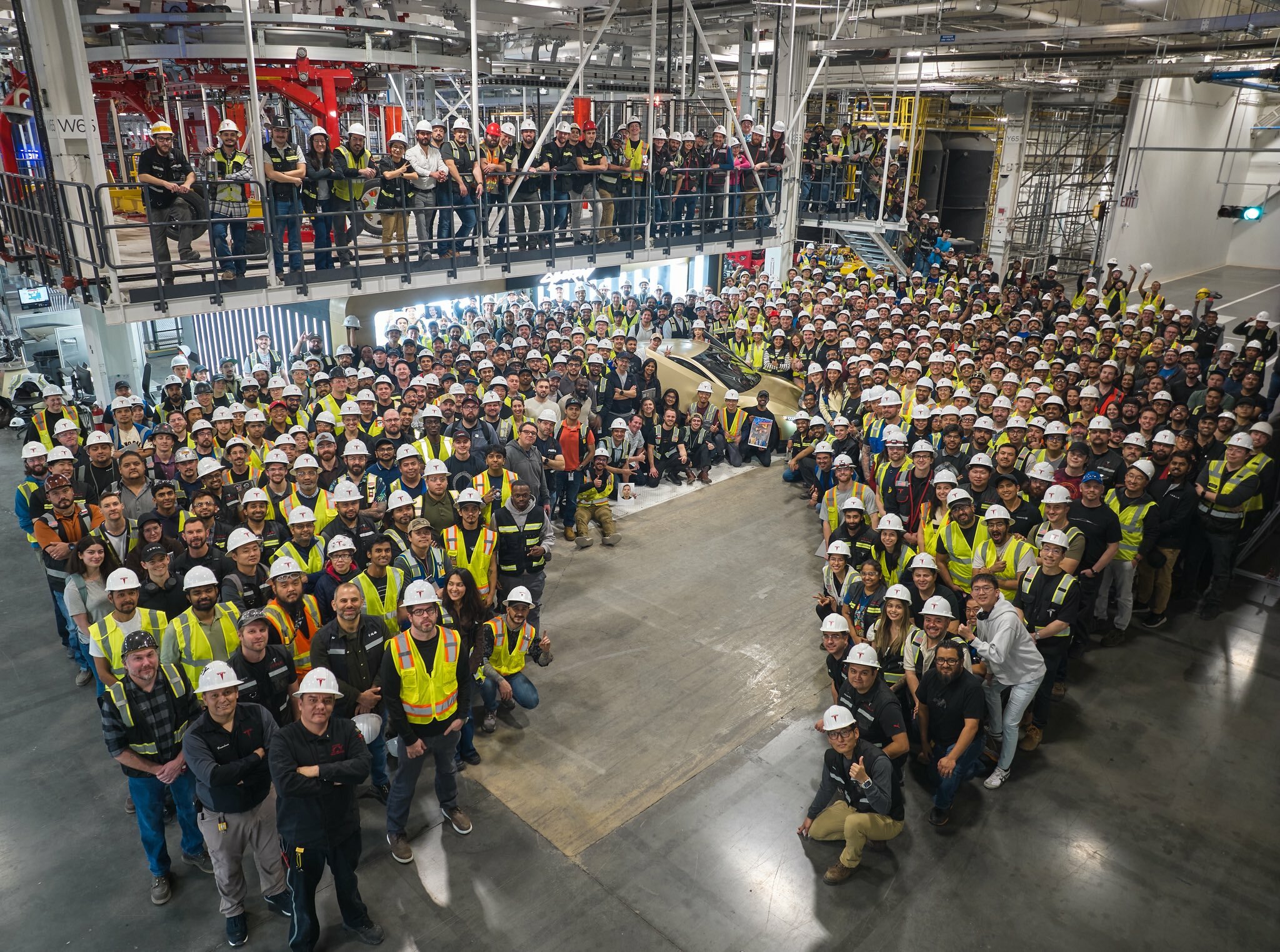
Tesla posted a photo on February 17 showing the team at Gigafactory Texas surrounding the first production Cybercab. While there’s still no clear timetable for full-scale production, Musk previously indicated that manufacturing wouldn’t even begin until April. I double-checked my calendar, and it still says February.
Importantly, this is almost certainly a pilot build and not a car destined for a customer. That said, it’s a significant step forward for a brand often associated with shifting timelines.
Public Bets And Pricing
That reputation likely played a role in Marques Brownlee (MKBHD) saying in 2024 that if Tesla launched the car before 2027 at a price below $30,000, he’d shave his head on camera.
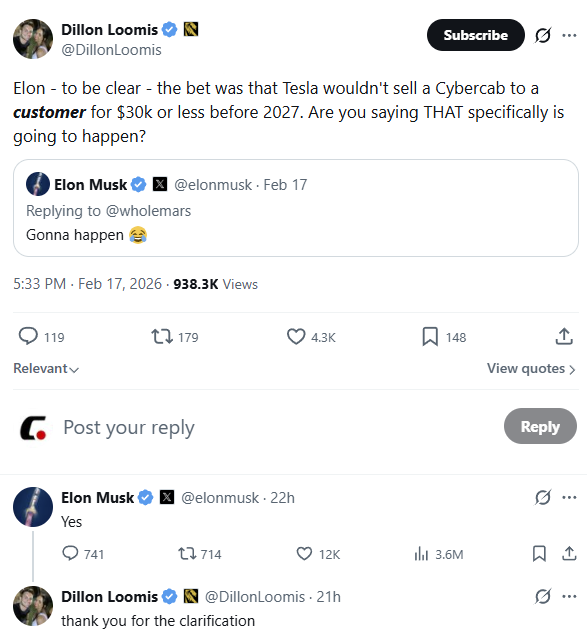
After Tesla announced the milestone, meme versions of a bald MKBHD quickly spread across X. Musk joined in, replying “Gonna happen 😂” to one such post. In a separate exchange, he also confirmed that Tesla still plans to sell a consumer version of the Cybercab before 2027 for “$30,000 or less”.
Hurdles Ahead
That all sounds promising, but Tesla has to do more than simply build the car. The Cybercab is meant to be the brand’s first true autonomous vehicle sold without a steering wheel or pedals. Since unveiling it, however, Tesla has hinted that those controls could return if regulations require them.
And that’s where the real challenge begins. Federal vehicle safety standards assume a human driver is present, and insurance frameworks do too. The NHTSA may need to grant exemptions for certain rules, while individual states could impose their own restrictions on autonomous vehicles operating on public roads.
In other words, building the Cybercab might prove easier than getting it legally approved. Whether Tesla can clear those hurdles before 2027 remains an open question.
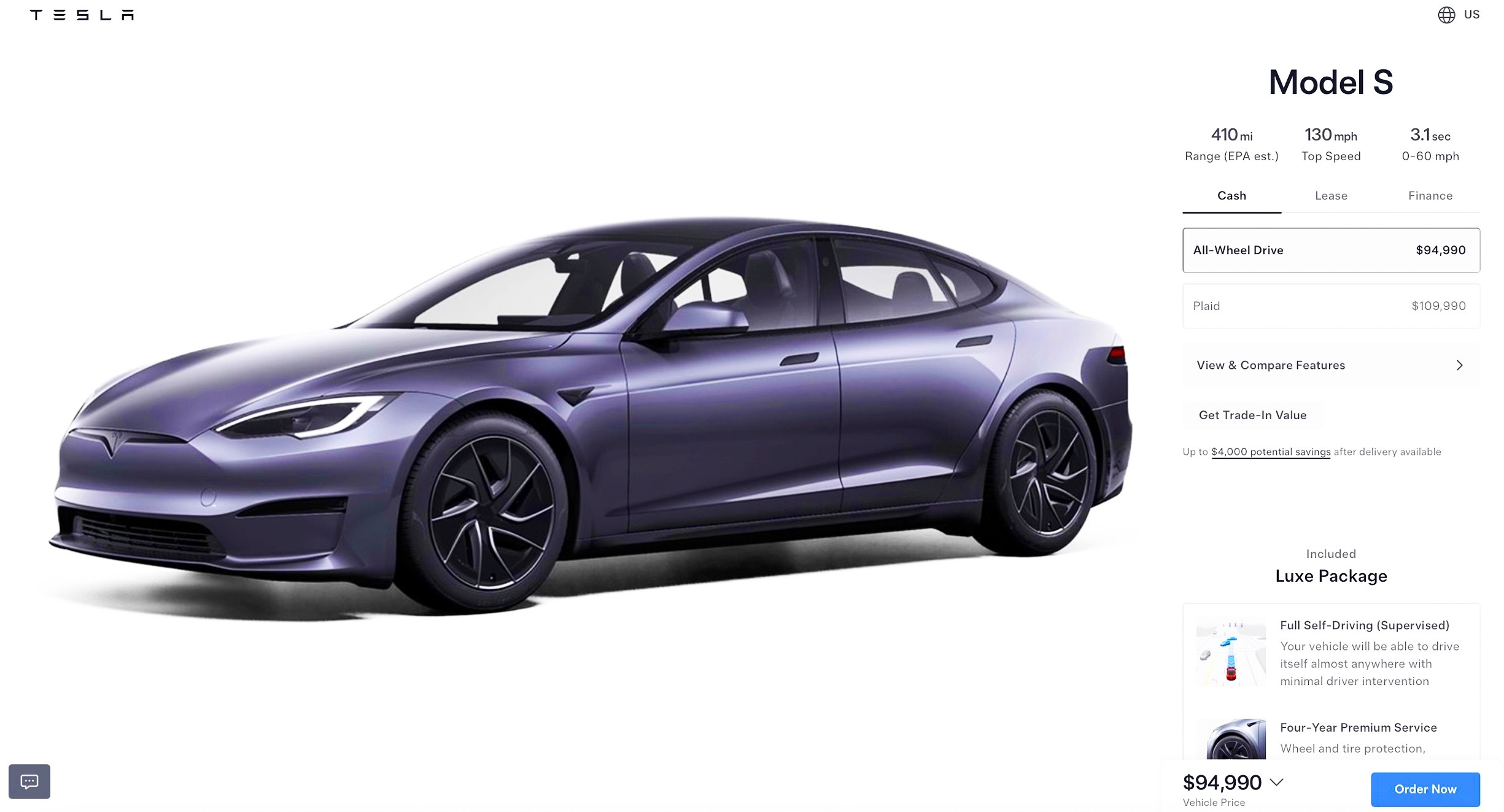
Tesla is ending Model S and X production this year, Musk says.
Model S helped prove EVs could be fast, fun, and desirable.
Fremont, CA, plant will be retooled to build humanoid robots.
Tesla is quietly switching off two of the cars that helped kickstart the modern EV revolution. The Model S sedan and Model X SUV are heading for retirement as the company steers away from cars and toward humanoid robots instead.
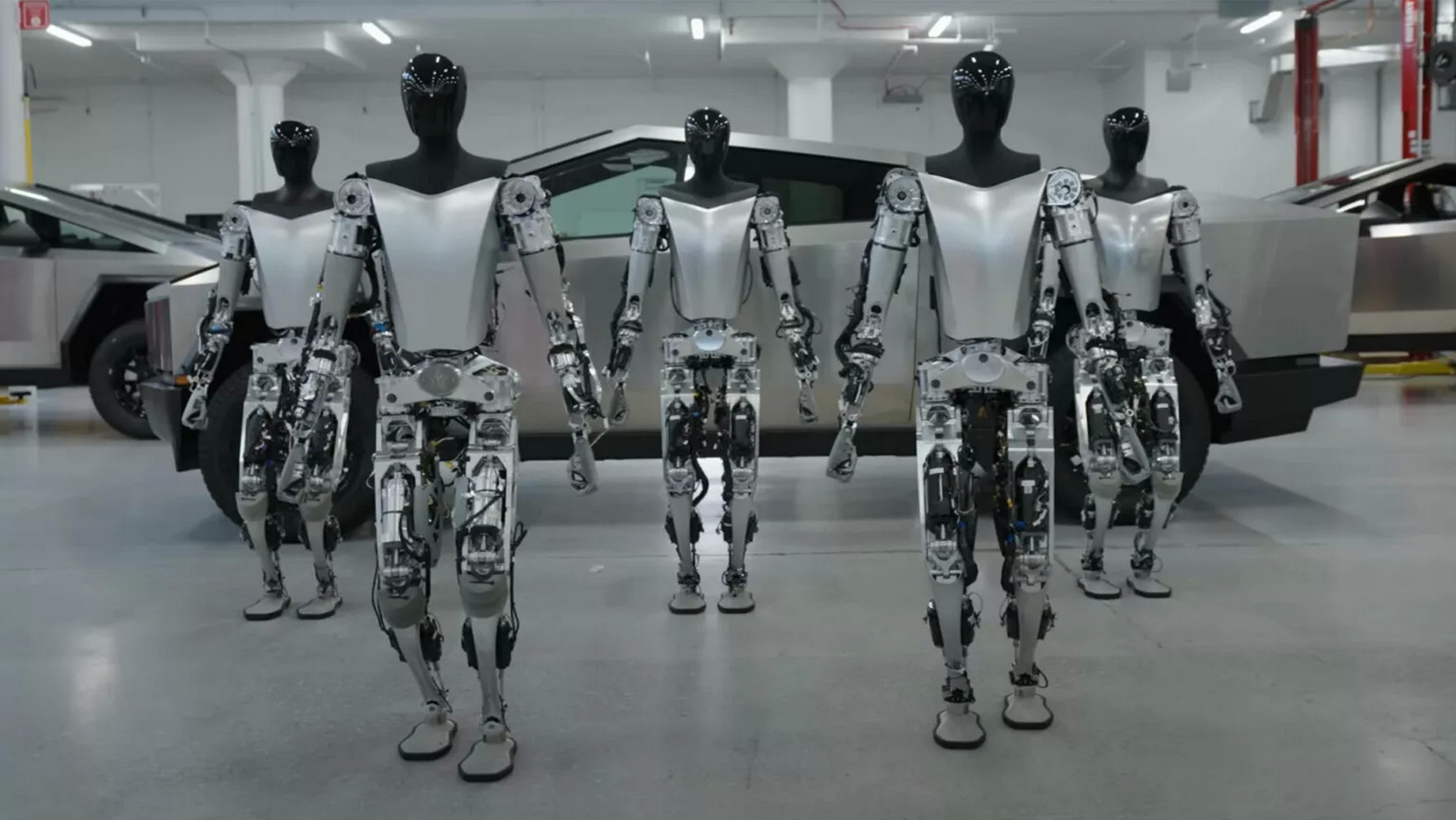
CEO Elon Musk made the announcement on an earnings call on Wednesday, explaining that S and X production would end in California next quarter, and the Fremont plant would be repurposed to build Optimus robots.
“It’s time to bring the Model S and X programs to an honorable discharge because we’re really moving into a future that is based on autonomy,” Musk told investors.
“We’ll obviously continue to support S and X programs for as long as people have the vehicles, but we’re going to take the production space in our Fremont factory and convert that into an Optimus factory with the long term goal of having 1 million units a year.”
Game changer
It feels strange to say goodbye to the Model S, and Musk himself conceded the news was “slightly sad.” When it launched back in 2012, it rewrote the rulebook. Here was an electric car that was not a compromise box on wheels but a sleek, luxury sedan with Aston Martin vibes that could outrun a BMW M5 – and later, supercars – in a straight line. Alongside the Nissan Leaf, it helped drag EVs into the mainstream.
The Model X followed with its dramatic falcon wing doors and family friendly space, though it never quite matched the S for cultural impact. Still, both became rolling symbols of Tesla’s rise from scrappy startup to industry disruptor.
Replacements Overdue
The problem is time waits for no car, especially in the EV world. Sales numbers told the story. The Model 3 and Model Y became Tesla’s volume heroes, while S and X faded into niche status. While Tesla refreshed the S and X over the years, it never gave us all-new versions even as the threat from Western and Chinese rivals grew stronger.
Now, rather then reboot them, Tesla has decided to pivot to something different altogether, something with the potential to make even more money, and have an even bigger impact than the S did a decade ago.
This week marked the fifth anniversary of the Jan. 6 insurrection, in which supporters of President Trump stormed the U.S. Capitol, demanding that then-Vice President Pence overturn the will of the people. Efforts to impose accountability for those responsible and those involved have largely ended — except in Wisconsin. This means that Wisconsin has the opportunity, and the responsibility, to re-assert the rule of law, to ensure justice, and to bolster the foundations on which American democracy has been built over the past 250 years.
As we assess the state of our democracy in light of this somber anniversary, let’s start with the bad news:
The U.S. Supreme Court derailed efforts by states to enforce the 14th Amendment’s prohibition against insurrectionists serving in federal office, and then it invented an ahistorical and jaw-droppingly broad doctrine of presidential immunity to derail criminal prosecutions of Trump in state and federal courts alike.
Federal prosecutions of the violent mob in the Capitol were upended by Trump’s Department of Justice, and Trump issued sweeping federal pardons to every individual connected with Jan. 6, effectively encouraging them to keep it up.
State prosecutions of the fraudulent electors — those who executed an unprecedented effort to overturn the 2020 election by submitting to Congress (and other officials) paperwork that falsely declared Trump to have won seven key states that he in fact lost and thereby laying the groundwork for the Jan. 6 rioters to violently demand Pence validate their efforts — have faltered, often for reasons unrelated to the merits of those actions.
But here in Wisconsin there are still grounds for hope. Hope that bad actors who deliberately took aim at our democracy will be held accountable. Hope that our institutions will stand up and protect our democracy from further meddling by those most directly responsible. And hope that those institutions will act promptly to prevent further damage. Every Wisconsinite should be watching the following accountability efforts — and urging our elected officials to use their authority to advance the rule of law and protect our democracy.
First, the Wisconsin Supreme Court will soon determine the appropriate sanction for Michael Gableman’s ethical transgressions as he spearheaded a sham “investigation” of the 2020 election. Gableman, who once served on the Wisconsin Supreme Court, accepted this job despite his own assessment that he did not understand how elections work in Wisconsin. He wasted taxpayer funds, undermined government transparency laws, dealt dishonestly with his clients and the public, lied to and insulted courts, and tried to jail the elected mayors of Green Bay and Madison. In March 2023, Law Forward filed an omnibus ethics grievance, documenting Gableman’s myriad breaches of the ethics rules that bind all Wisconsin attorneys. Last summer, Gableman stipulated that he had no viable defense of his conduct and agreed with the Office of Lawyer Regulation to jointly recommend his law license be suspended for three years. (He is now trying to wriggle out of accountability by serially pushing justice after justice to recuse.)
Wisconsin precedent is clear that, where a lawyer is charged with multiple ethical breaches, the proper sanction is determined by adding the sanctions for each breach together. The Court should apply established law, which demands revoking Gableman’s law license. Then the Office of Lawyer Regulation and the Court should act on our requests to hold Andrew Hitt (chairman of the Wisconsin fraudulent electors) and Jim Troupis (chief Wisconsin counsel to Trump’s 2020 campaign and ringleader of the fraudulent-elector scheme) accountable as well.
Second, the primary architects of the fraudulent-elector scheme, detailed in records obtained through Law Forward’s groundbreaking civil suit, are also facing criminal prosecution in Dane County. Attorney General Josh Kaul’s case is narrowly focused only on three lawyers — two who were based here in Wisconsin, and one working for the Trump campaign in DC — who conceived and designed the scheme to overturn Wisconsin’s results and then convinced six other states to follow suit. Troupis, who himself was appointed to the Wisconsin bench by former-Gov. Scott Walker as a reward for his key role in the 2011 partisan gerrymander, has gone to great lengths to slow down this prosecution, which Kaul initiated in June 2024. He filed nine separate motions to dismiss the case. He accused the judge hearing preliminary motions of misconduct and insisted that the entire Dane County bench should be recused. And now he has appealed the denial of his misconduct allegations. This case, since assigned to a different Dane County judge, will proceed, and it is the best hope anywhere in the country to achieve accountability for the fraudulent-elector scheme.
Third, on behalf of the Wisconsin Democracy Campaign and two individual voters, Law Forward is suing Elon Musk and two advocacy organizations he controls for their brazen scheme of million-dollar giveaways to influence the 2025 Wisconsin Supreme Court election. This case is about ensuring that Wisconsin elections are decided by Wisconsin voters, not by out-of-state efforts to buy the results they want for us. We’re waiting for the trial court to decide preliminary motions, but, with another Wisconsin Supreme Court election imminently approaching, there is urgency to clarify that Wisconsin law forbids the shenanigans we saw last year, which contributed to the most expensive judicial race in American history.
Beginning in 2011, Wisconsin became the country’s primary testing ground for the most radical anti-democratic ideas. From Act 10 to one of the strictest voter ID laws in the country, from subverting the separation of powers and steamrolling local control over local issues to hobbling the regulatory state and starving our public schools, Wisconsin’s gerrymandered Legislature adopted idea after idea hostile to democracy. With the end of the nation’s most extreme and durable partisan gerrymander in 2023 and a change in the makeup of the state Supreme Court, however, the tide in Wisconsin has ebbed somewhat.
Now, improbably, Wisconsin is the place that democracy can best hold the line. We can create accountability for those who have abused power, have undermined elections, and have diminished the ideals and institutions of our self-government. That, in conjunction with Law Forward’s broad docket of work to defend free elections and to strengthen our democracy, sustains my hope.
Wisconsin politicians denounce the "billionaire loophole" that makes state elections so expensive, but they're still raising tons of cash. | Getty Images
Two high-profile candidates for governor of Wisconsin, Republican U.S. Rep. Tom Tiffany and Democratic former Lt. Gov. Mandela Barnes, have denounced the unlimited flow of cash into state political campaigns. Then, practically in the same breath, both men announced their plans to raise tens of millions of dollars, signalling to their less well funded primary opponents that they might as well get out of the way.
In an interview with PBS Wisconsin on Dec. 5, Tiffany criticized “that pass-through loophole, I call it the ‘billionaire loophole,’” in Wisconsin law, adding, “there’s just so much money that comes into Wisconsin.”
“You can cry about it or you can compete,” Tiffany continued. “We choose to compete … We’re hoping to raise $40 million.”
As Baylor Spears reports, Tiffany actually voted for the “billionaire loophole” he now criticizes back when he was serving in the state Senate in 2015.
Mandela Barnes, in a recent campaign stop in Madison, told Spears and other reporters that he has raised a “strong haul,” in the first week of his campaign, and that he intends to raise a staggering $50 million by the end of the race. He added that he doesn’t like the role of money in politics. “It’s not a good sign,” he said, and his future goal is “to get big money out of politics” and enact “campaign and ethics reform.”
Back in 2015, when Republicans were ramming through the “billionaire loophole,” Barnes opposed it, saying at the time that it would allow “shady special interest money and allow for more corruption to go undetected and unprosecuted.”
Jay Heck, executive director of Common Cause Wisconsin, remembers that moment well. Under former Republican Gov. Scott Walker, Republican legislative majorities passed the law eviscerating campaign finance limits along with other measures getting rid of the nonpartisan Government Accountability Board and eliminating the John Doe procedure that was used to criminally prosecute leaders of both political parties for campaign finance crimes in the infamous caucus scandal of the early 2000’s.
The 2015 law doubled the amount individuals could give to candidates. More importantly, it eliminated all limits on state party contributions to candidates and allowed coordination between candidates and outside groups that make issue ads supporting the campaigns. Donors were able to give as much as they wanted to political parties, which then funneled that money to candidates, creating the billionaire loophole to which Tiffany belatedly objects. The 2015 law cleared the way for outsiders like Elon Musk to pour limitless cash into state races to try to affect the outcome.
“The Republicans did that in 2015 because they were convinced that they would have a great financial advantage since they generally raised more money from donors and special interests,” says Heck. “Of course, what they didn’t anticipate was [former Wisconsin Democratic Party chair] Ben Wikler and the Democratic Party’s ability to take that big hole in the law and use it to raise massive amounts of money.”
Recently, Democrats in Wisconsin have been beating Republicans in the fundraising arms race. In 2025, in the most expensive judicial election in U.S. history, Susan Crawford, the candidate for the Wisconsin Supreme Court supported by the Democratic Party, raised $28.3 million compared with Republican-supported Brad Schimel, who raised $15.1 million. Outside special interests accounted for most of the spending on the race, with Musk alone putting in nearly $20 million through his political action committees and millions more laundered through the state Republican Party for Schimel, while the Democratic Party of Wisconsin funneled $10 million to Crawford.
The lesson of the 2015 law, says Heck, is, “be careful what you wish for.”
That certainly applies to Republicans, who lost the two most expensive state Supreme Court races in history as well as the last two record-breaking gubernatorial races won by Gov. Tony Evers with $93 million in total spending in 2018 and $164 million in 2022.
But it also applies to Democrats, who cannot count on continually bringing in more money than Republicans.
More importantly, when it costs tens of millions of dollars to win state elections, regular voters’ voices are drowned out by billionaires, who are not investing in candidates just out of the goodness of their hearts.
Heck believes that change will only come when voters demand reform, most likely because a big scandal clearly illustrates that politicians are doing favors for their donors in exchange for campaign cash.
“It’s going to require a bipartisan coming-together to establish some limits,” Heck says.
Even as the U.S. Supreme Court has opened the floodgate for campaign spending with the Citizens United decision, which in 2010 struck down a federal ban on political donations from corporations, and McCutcheon v. FEC, which in 2014 found that annual caps on total political donations from one person are unconstitutional, states have the ability to impose limits.
A report by the National Conference of State Legislatures shows Wisconsin is one of only 11 states that allow unlimited candidate contributions by state parties and among the top 10 for the highest limits on PAC contributions to candidates. Minnesota, Michigan, Illinois and most other states limit how much political parties can accept, which reduces the Elon Musk effect. Plus, “We are one of few states that allows so-called coordination between political candidates and outside groups,” Heck says.
The problem is that candidates, while acknowledging that massive amounts of money fueling their campaigns is a bad look, don’t want to unilaterally disarm.
But now, as the Trump administration drags the country to new levels of overt corruption, it could be a good time for a campaign that ties together billionaires’ destructive influence on society and the fact that they are buying our democracy.
“There has to be public disgust with the amount of money being spent,” says Heck. “If a candidate put corruption front and center, it might get a lot of traction.”

 Login
Login