❌

Normal view

There are new articles available, click to refresh the page.
Before yesterdayMain stream

Citroën Already Brought Back The 2CV, Now Its Fourgonette Van Could Get the Same Treatment

  • A panel van version of the Citroën 2 CV Concept has debuted at the Paris Motor Show.
  • It reimagines the popular 2CV Fourgonette van Citroën built between 1951 and 1978.
  • Citroën describes the van as a “passion project” and won’t confirm production plans.

The Citroën 2CV’s return is arguably the biggest news at this year’s Paris’ Motor Show. But the four-door family car with the rollback roof might not be the only 2CV making a comeback. Citroën’s designers have also reimagined the classic 2CV Fourgonette van.

The stubby commercial vehicle marries the front half of the new electric 2 CV hatch concept with a with a square box that swaps back seats for extra load carrying capacity. Cargo is loaded either through the split rear doors, or via a flip-up panel on the side.

Related: Citroen’s 2CV is Back, And It’s Still A Safe Space For Eggs

Production of the original 2CV-based Fourgonette panel van ran from 1951 to 1978, but the survivors were still powering businesses across France well into the new millennium. And while Citroën has yet to confirm the concept van for production – unlike the hatch, which morphs into a production car for 2028 – it’s not hard to see it getting the corporate thumbs up.

Citroën’s conventional ë-Berlingo is already a popular van option in Europe, but it doesn’t have anywhere near the sense of fun or emotional draw that a new Fourgonette would. And that’s before you consider the price advantage. The cheapest ë-Berlingo costs over €24,000, but Citroën says the 2CV hatch will cost around €15,000, which would suggests a van variant might be even more affordable.

Urban Missions
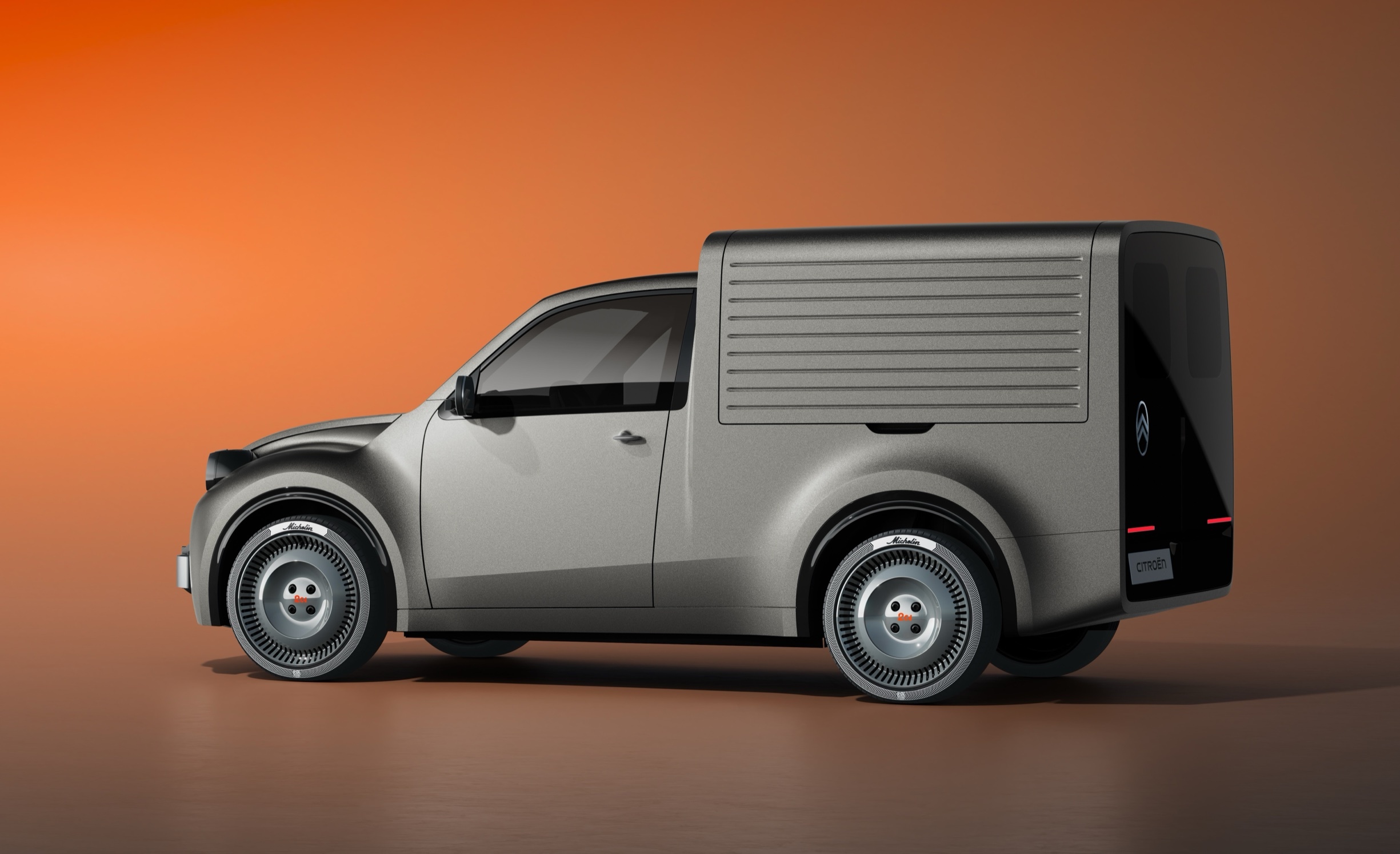
 Citroën Already Brought Back The 2CV, Now Its Fourgonette Van Could Get the Same Treatment

Hitting that price target would inevitably mean making do with a small capacity electric battery, although Citroën hasn’t revealed the size of the hatch’s power pack yet. But the Fourgonette’s brief would be to cover small urban journeys, the kind of use where a long electric driving range isn’t necessary.

Citroën hasn’t shown any pictures of the Fourgonette’s interior, though it should mirror the 2CV concept’s, maybe minus some of the more cutesy elements and colors. We’d expect to see a simple one-spoke steering wheel and basic seating, but the panel van misses out on the retractable roof.

“The 2CV Fourgonnette was more than just a workhorse. It was part of everyday life,” Xavier Chardon, CEO of Citroën and DS Automobiles said of the original van. “Simple, ingenious and accessible, it above all possessed something few commercial vehicles have: a soul. That is the spirit we are bringing back to life today, because being useful should never mean being ordinary.”
\\\\\\\\\\\\

Citroën

Citroen’s 2CV is Back, And It’s Still A Safe Space For Eggs

  • Citroen is taking on cut-price Chinese EVs with a homage to the iconic 2CV.
  • A production version of the retro 2 CV Concept hits showrooms in late 2028.
  • In-door egg storage nods to the original 2CV’s quirky egg-friendly design brief.

The Mini Cooper, Fiat 500, VW Beetle, Renault 5, Chevy Camaro, and other classics have been resurrected to push our nostalgia buttons over the last 30 years. But the Citroën 2CV was always a glaring absentee from the list, until this week’s Paris Motor Show. This is the 2 CV Concept, and it’s more than a bit fun. A production version arrives in 2028, Citroën promises.

Previous Citroën CEOs vowed they’d never resurrect the iconic 2CV, despite it remaining the brand’s most famous car. More than 3.8 million were sold between 1948 and 1990. But now Citroën, like other legacy brands, is making use of its heritage to remind us why we should stick with it as Chinese automakers take an ever larger slice of the European car market.

Review: Stellantis Gave Citroen C3 And Fiat Grande Panda The Same Bones, But Not The Same Soul

The result is a four-door electric hatch concept that doesn’t just dip its toe in retro waters. It free dives right to the bottom. All the classic design cues are present. The plunging, ribbed hood, the bug-eye headlights on fenders that stand proud of the flat bodywork, and the roll-back canvas roof. But there’s a pumped-up muscular look this time around, and the wide track and 19-inch wheels fill the fenders like no original 2CV ever did.

It’s also around 8 inches (0.2 m) smaller than the OG tin snail, at 148 inches ( 3.76 m) long. Citroën says that size makes it easy to park in cities, but it will also help keep the cost of the production version down to just €15,000 ($16.8k / £12.7k).

Removable Seats, Egg Storage

\\\\\\\\\\\\\\\\

The interior definitely doesn’t scream ‘budget car,’ even if it does channel the simplicity of the original. The bench seats can be removed for picnics, and a portable hamper on the floor serves as a console and storage cubby. The doors even have an integral egg box. Why? Because the original 1930s design brief for the 2CV called for a car that could carry a basket of eggs across a rutted field without any breakages.

Other retro details include a single-spoke steering wheel and transmission shifter that sprouts from under the dash. But that shifter is hooked up to an electric drivetrain here, not an air-cooled 2-cylinder and four-speed manual.

Citroën hasn’t revealed anything about the motor and battery. But it’s unlikely to be fast, or go far on a charge. The target price makes it impossible. Rival Renault’s base model Twingo produces 81 hp (82 PS / 60 kW) and lasts 163 miles (262 km), which might offer some kind of guide. We’ll find out more in the run up to the production 2CV making its global debut at the 2028 Paris Motor Show, exactly after the original premiered at the same event.

\\\\\\\\\\\\\\\\\\\\\\

Citroën

Cheap Thrills: Stellantis Adds Extra Plastic And Mobile Office To Base Vans

  • Citroen Berlingo and Opel Combo gain cheaper trims in Europe.
  • The vans feature unpainted bumpers and a redesigned dashboard.
  • The Opel Combo Start is priced from €22,400 ($26,000) in Germany.

Stellantis has introduced two new entry-level trims for the Citroen Berlingo and Opel Combo twins in Europe, making them more accessible and more practical. The base models benefit from a redesigned interior which transforms into a mobile office, and will be available with gasoline, diesel, mild-hybrid, and fully electric powertrains.

From the outside, the Citroen Berlingo Van First and the Opel Combo Start have slightly different faces compared to the rest of the lineup. The lower bumper appears to be carried over but the upper portion sheds the body-colored finish for unpainted plastic and gains a simplified design for the grille. The rest of the bodywork remains unchanged.

More: Opel’s Cheapest New Car Is Now A Family SUV With Three Pedals And Steelies

Note that the Berlingo Van has different headlights compared to the Berlingo which is better aligned with Citroen’s passenger car and SUV lineup.

More Practicality Inside The Cabin

More substantial changes take place inside the cabin, making us wonder why Opel and Citroen didn’t apply this treatment to the entire lineup of the Combo and Berlingo vans. The dashboard and door panels have been redesigned with the goal of improving “robustness” and “ergonomic handling” for business owners and fleet operators using the LCVs for delivery services and on construction sites.

 Cheap Thrills: Stellantis Adds Extra Plastic And Mobile Office To Base Vans

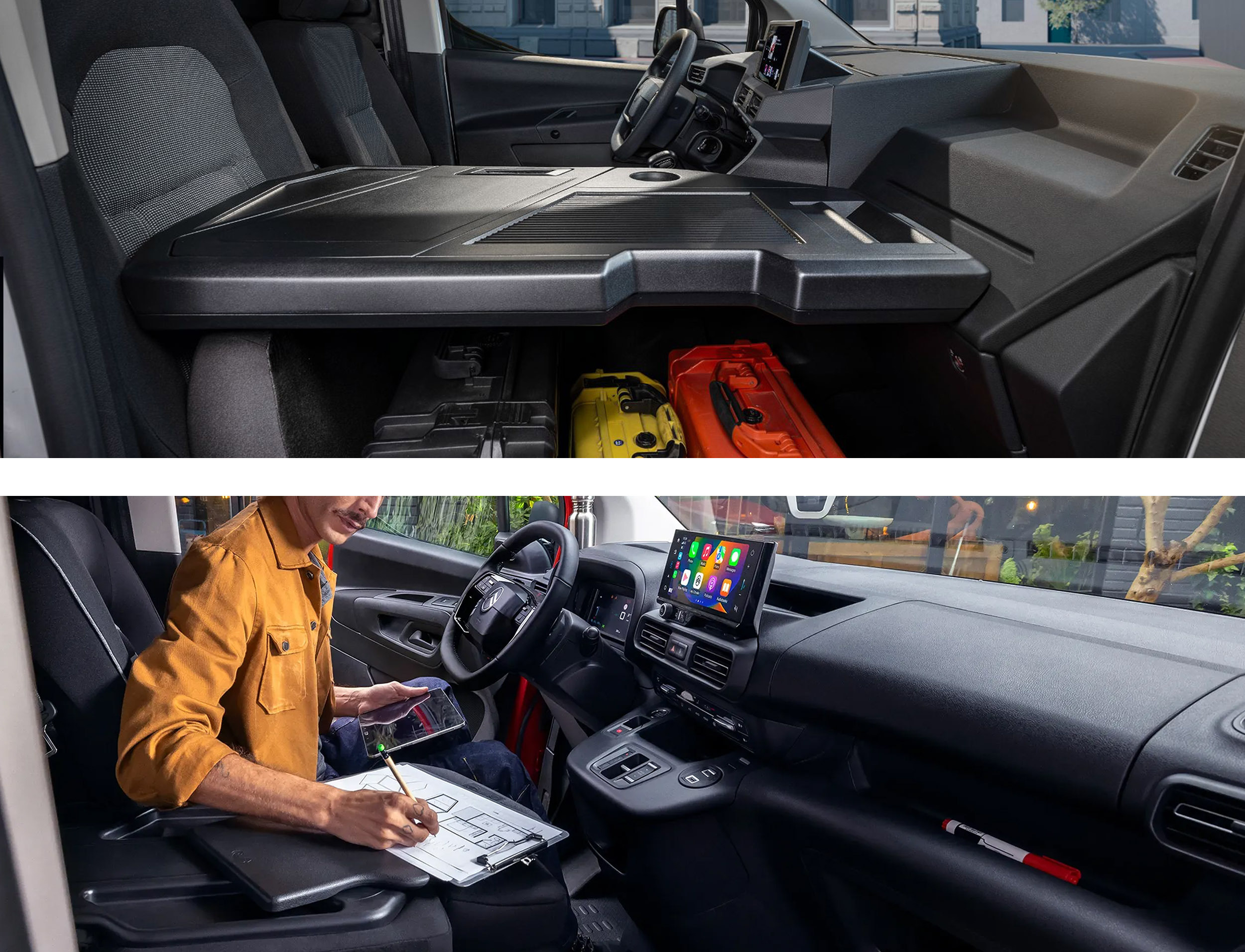
Highlights include the extra shelfs on the dash, the new drawer under the driver’s seat, and the standard FlexiSeat for the front passenger. The latter can be folded upwards, creating extra space for packages, tool boxes or other equipment and increasing the van’s total load volume by 0.5 cubic meters (17.7 cubic feet).

More: This Smart Kit Turns Your Stellantis Van Into A Camper On The Go

More importantly, the FlexiSeat can be optionally combined with the ModuTable. This costs €300 ($350) and offers a surface that can be used as an extra shelf with cupholders or as a mobile desk for your laptop. When not in use, the ModuTable can be stored behind the cabin wall in the cargo area. Still, Citroen said that professionals drive alone for about 80% of the time so it will likely be used quite often.

Finally, the FlexCargo/Moduwork configuration adds a third seat at the front which turns into a load-through when transporting longer items.

\\\\\\\\\

Citroen Berlingo Van First

The compact vans remain available in two body lengths, delivering a load volume between 3.3-4.4 cubic meters (116.5-155.4 cubic feet). The maximum payload capacity is unchanged at 1,000 kg (2,205 lbs).

Multiple Powertrain Options

As with the rest of the lineup, the entry-level vans offer the option between gasoline, diesel and fully electric powertrains, with a mild-hybrid variant set to join the lineup in 2027.

More: Stellantis Turns ICE FWD Vans Into 4x4s With Rear Electric Motor Conversion

The turbo 1.2-liter engine is good for 109 hp (81 kW / 110 PS), while the 1.5-liter turbodiesel produces 101 hp (75 kW / 102 PS) or 129 hp (96 kW / 131 PS). All ICE variants are exclusively offered with a six-speed manual gearbox, although the upcoming mild hybrid will get a dual-clutch automatic. Finally, the EV has a single electric motor generating 134 hp (100 kW / 136 PS), and a 42 kWh battery offering up to 270 km (168 miles) of WLTP range.

Pricing

\\\\

The base Opel Combo Start with the gasoline engine is priced from €22,400 ($26,000) before VAT in Germany, lowering the entry point in the compact van’s lineup by €1,000 ($1,200). The diesel starts from €23,200 ($26,900) and the electric from €28,500 ($33,100).

More: This New Fiat Might Be Stellantis’ Most Halfhearted Reboot Yet

Citroen has yet to announce pricing for the Berlingo Van First, but we expect similar figures with its Opel twin. It will be interesting to see whether the same treatment will be applied to the nearly identical Peugeot Partner, Fiat Doblo, and Toyota ProAce City.

\\\\\\\\\\\

Opel Combo Start

Citroen Makes Budget Models More Expensive With Stylish New Outdoor Edition

  • Citroen launches Outdoor variants for the C3, C3 Aircross, and Ami.
  • The flagship trims gain rugged looks and improved equipment.
  • Dutch pricing starts at €30,950 ($35,500) for the C3 Outdoor.

Citroen is one of Stellantis’ most affordable brands alongside Fiat and Opel. However, as proven by Dacia, there is plenty of demand for flagship trims of budget models in Europe. The French automaker is now introducing a new Outdoor edition for the C3, C3 Aircross, and Ami, featuring more rugged styling and a longer list of standard equipment.

Before you get excited about the off-road capability of the hatchback and SUV models, bear in mind that the Outdoor treatment is more of a styling package. Right off the bat, Citroen explains that their understanding of adventure is “not about extreme conditions or long journeys, but about the ability to make every drive more pleasant, more fun, and extra inspiring.”

Review: Stellantis Gave Citroen C3 And Fiat Grande Panda The Same Bones, But Not The Same Soul

The Outdoor editions of the C3 and C3 Aircross are positioned above the Max trim in the lineup and stand out thanks to several styling updates. The highlight is the redesigned bumpers, inspired by the earlier Citroen C3 Aircross Marine Nationale Concept.

\\\\\\\\\\\\\\\\\\\\\\\\\\\\\\\\\\\\\\\\\\\\\\\\\

Citroen C3 Aircross Outdoor

The front bumper adopts boxier intakes, Infra Red accents, and a pronounced skid plate finished in gray. The profile gains gray decals on the doors with an Outdoor logo featuring the Migoo comic book mascot. More importantly, the models ride on a new set of 17-inch alloy wheels with boxy spokes and an Infra Red Citroen logo in the middle. Specifically for the C3 Aircross, Citroen added a set of chunkier roof rails.

More: Opel’s Cheapest New Car Is Now A Family SUV With Three Pedals And Steelies

The Sequoia Green shade is new, but buyers can also order the Outdoor specials in Perla Nera Black, Mercury Gray, Polar White, or Bright Blue. At the back, changes are limited to the reshaped silver garnish on the lower section of the rear bumper.

Inside, we find an exclusive graphic pattern on the Advanced Comfort seats with the Migoo mascot laser-etched on the backrests and an Outdoor badge on the dashboard. Furthermore, Infra Red was chosen for the stitching, the seatbelts, and the Citroen emblem on the steering wheel. Naturally, the Outdoor models come standard with a generous equipment list.

\\\\\\\\\\\\\\\\\\\\\\\\\\\\\\\\\\\\\\\\\\\\\\

Citroen C3 Outdoor

As with the rest of the Citroen C3 and C3 Aircross lineup, the new variants are available with gasoline, mild-hybrid, and fully electric powertrain options and front-wheel drive. Note that the French models share their Smart Car chassis and engines with the Opel Frontera, Fiat Grande Panda, the Fiat Grizzly and an upcoming model from Chrysler.

More: Fiat’s New Grizzly SUV Is Hunting The Dacia Bigster, And It Didn’t Come Alone

The new Outdoor treatment has also been applied to Citroen’s heavy quadricycle. The highlight of the Ami Outdoor is the roll-down fabric sunroof, previously limited to the Ami Buggy. The exterior is finished in Khaki Green with special decals and Infra Red accents. Furthermore, the EV gains a rally-inspired roof spoiler and a set of white steelies.

\\\\\\\\\\\\\\\\\\\\\\\\\\\\\\\\\\\

Citroen Ami Outdoor

Inside, the two-seater cabin has a unique upholstery, the mascot on the backrests, Infra Red seatbelts, and a bunch of optional accessories fitted as standard. Interior amenities include a dashboard storage compartment, bag hook, door storage pockets, floor mats, a central storage net, and a smartphone holder.

The Outdoor special editions will be available to order in the Netherlands starting on October 1, ahead of a wider rollout across European markets. Dutch pricing starts at €30,950 ($35,500) for the C3 Outdoor and at €35,250 ($40,400) for the C3 Aircross Outdoor, positioning them at the very top of their respective lineups.

\\\\\\\\\

Citroen Outdoor Lineup

Citroen’s Letting People Roll The Dice For 2 CV Merch Ahead Of Its EV Revival

  • The French brand is giving away caps, suitcases, and Monopoly sets.
  • Citroën’s new 2 CV will premiere as a concept and then launch in 2028.
  • Original 2 CV delivered just 9 hp, but the new one will have much more.

Citroën is reviving one of its most iconic nameplates for the modern age. After lying dormant for more than 35 years, the 2 CV returns as a small EV, set to premiere at the Paris Auto Show in October. To stir up interest ahead of that debut, Citroën has kicked off an interactive social media campaign complete with prizes.

The new 2 CV campaign is inspired by a French board game, and five challenges will be launched on Instagram in the lead-up to the new car’s unveiling. The first of these games was shared a couple of weeks ago, simply asking followers how much horsepower the first 2 CV had. There were seven winners, each receiving a Citroën-branded version of Monopoly.

Read: Citroen’s Budget Fastback Looks Fast Only When Standing Still

The second game was a little more challenging than the first, though it still seemed pretty easy for 2 CV enthusiasts. This time, Citroën played the sounds of four different vehicles online, and players had to guess which sound was the 2 CV. Once again, the French brand is selecting seven winners, each of whom will receive a 2 CV cap.

Among the other prizes previewed for future games are a carry-on suitcase, a portable Bluetooth speaker, and a bright red Citroën drink bottle.

What Can We Expect From The New 2 CV?

As for the new 2 CV itself, a single teaser image has revealed it will have a small footprint just like the original, complete with a bulbous-looking roofline and pronounced front and rear fenders. It will also include LED headlights perched above the bumper and is shaping up to have quite a spacious cabin.

Technical specifications remain a mystery. It’s understood the car premiering at the Paris Auto Show will be a concept and that the production model will go on sale in 2028, priced at under €15,000 ($17,300).

Photos Stellantis / Citroen

❌
❌