Reading view

There are new articles available, click to refresh the page.

Your Childhood Supercars vs A Family SUV. You Already Know How This Ends
  • Skoda’s electric SUV beat three ’80s icons in a straight-line sprint.
  • It managed the win despite making the least power of the four.
  • On a longer road, all three classics might have driven away.

Anyone who came of age in the ’80s is living in a different world now. Back then, nobody would have guessed that the poster cars from Ferrari and Lamborghini would one day lose to a family SUV. Technology keeps chipping away at acceleration numbers, and the latest proof comes from a stunt staged by Skoda, the value brand of the VW Group.

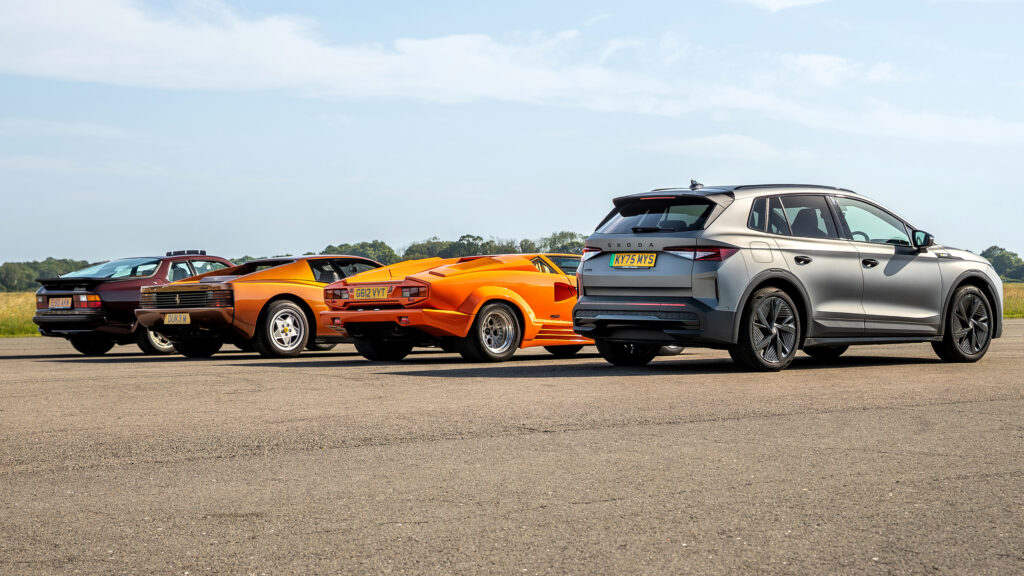
The automaker took its quickest production model, the Skoda Elroq vRS, and lined it up against some of the most recognizable sportscars and supercars of the ’80s for a straight-line shootout. The opposition consisted of a brown Ferrari Testarossa, an orange Lamborghini Countach 25th Anniversary, and a burgundy Porsche 944 Turbo.

Review: The 2026 Skoda Elroq Gets The Hard Stuff Right And The Easy Stuff Wrong

Back in their heyday, these machines were the undisputed kings of the road. However, ICE nostalgia is no match for the instantaneous torque of modern EVs, and the crossover won the drag race by a wide gap, leaving the legends behind.

Watching the footage closely gives a sense of what the four cars ran at the Dunsfold track. There’s no telling how gentle the drivers were with the clutches of these coveted classics, but the finishing order reflects their real-world launch performance well enough.

More: A 9,000-Lb Camera Truck Just Gapped A Ferrari And Ford GT Like They Were Parked

The Skoda Elroq vRS crossed the line at 19.19 seconds, followed by the Ferrari at 20.08 seconds, the Lamborghini at 21.22 seconds and the Porsche at the 22.10 mark.

While this particular drag race had a clear winner, it is worth noting that all three classics would easily beat the EV on a longer stretch of road. Skoda caps the Elroq’s top speed at 111 mph (179 km/h), well under the 162 mph (261 km/h) of the Porsche, the 180 mph (290 km/h) of the Ferrari, and the 188 mph (303 km/h) of the Lamborghini.

\\\\\\\

In any case, the flagship trim of the family EV with its dual-motor AWD setup produces 335 hp (250 kW / 340 PS), allowing a 0-100 km/h (0-62 mph) in 5.4 seconds. For comparison, the 5.2-liter V12 of the Lamborghini produced 449 hp (335 kW / 455 PS), the 4.9-liter flat-12 of the Ferrari was good for 385 hp (287 kW / 390 PS), and the turbo 2.5-liter four-cylinder engine of the Porsche made 247 hp (184 kW / 250 PS) back when they left the factory floor.

More: Skoda Peaq Debuts As Three-Row EV Flagship With 402-Mile Range

Another advantage of the Skoda Elroq vRS over the classic models is its spacious five seater cabin and the generous boot capacity of 470 lt (16.6 cubic feet), making it significantly more practical as a daily in combination with the standard Dynamic Chassis Control system. Despite its larger body, it is also significantly more aerodynamic than the wedge-shaped supercars, with a drag coefficient of 0.26 cd.

\\\\\\

Skoda UK

Performance is one thing, but the silent electric powertrain is no match for the glorious sound of the 12-cylinder engines from the past. Furthermore, looks might be subjective, but we seriously doubt anyone would pick the Skoda over the Ferrari, the Lamborghini, or the Porsche in a beauty contest.

At the end of the day, it is fun knowing that a family SUV of today can outrun the coolest supercars of the ’80s. In fact, if you drive a Tesla Model Y Performance you can probably beat supercars from the ’00s. But which one would you rather have in your garage?
\\\\\\\

Skoda UK

First Tesla Semi Fatal Crash Kills Two At A Nevada Red Light

  • A Tesla Semi rear-ended stopped cars at a Nevada red light.
  • Two people died and a third has life-threatening injuries.
  • Police suspect the driver may have fallen asleep at the wheel.

A Tesla Semi rear-ended two passenger vehicles in Nevada on Sunday, killing two people and leaving another with life-threatening injuries, in what appears to be the first known fatal crash involving the fully electric truck. Early information gathered by the sheriff’s office at the scene suggests the driver may have fallen asleep, though the official cause has yet to be determined.

More: The Driver Said Self-Driving Was On, Tesla Says He Floored It To 73 MPH In Fatal Home Crash

The incident happened Sunday morning on US 50 in Dayton, Nevada. Two vehicles, one of them a classic VW Beetle, had reportedly stopped at a red light when the Tesla plowed into them from behind.

Two Dead At The Scene

The force of the collision and the sheer mass of the semi claimed the lives of the married couple, who were pronounced dead at the scene. A third person was flown to a local hospital and remains there with life-threatening injuries.

Both directions of US 50 were shut for a few hours while crews cleared the debris. Photos of the aftermath show the heavily damaged Beetle at the roadside, right next to the white semi that appears to have a broken front bumper. The other vehicle, a red Toyota RAV4 SUV, is left with a crumpled rear end.

More: Another Tesla Crash, Another Owner Says It ‘Drove On Its Own’

The accident is currently under investigation by the Nevada State Police. Preliminary statements obtained at the scene by deputies from the Lyon County Sheriff’s Office “suggest the driver of the truck might have fallen asleep,” though that account has yet to be confirmed by investigators.

The Semi is not available with Tesla’s Full Self-Driving system, but it does come with various safety features, including autonomous emergency braking, which is meant to help in situations like this.

The Tesla Semi is being manufactured at the Gigafactory Nevada, which is about an hour away from the site of the accident. The name of the driver and the operator of the semi truck have not been made public.

 First Tesla Semi Fatal Crash Kills Two At A Nevada Red Light
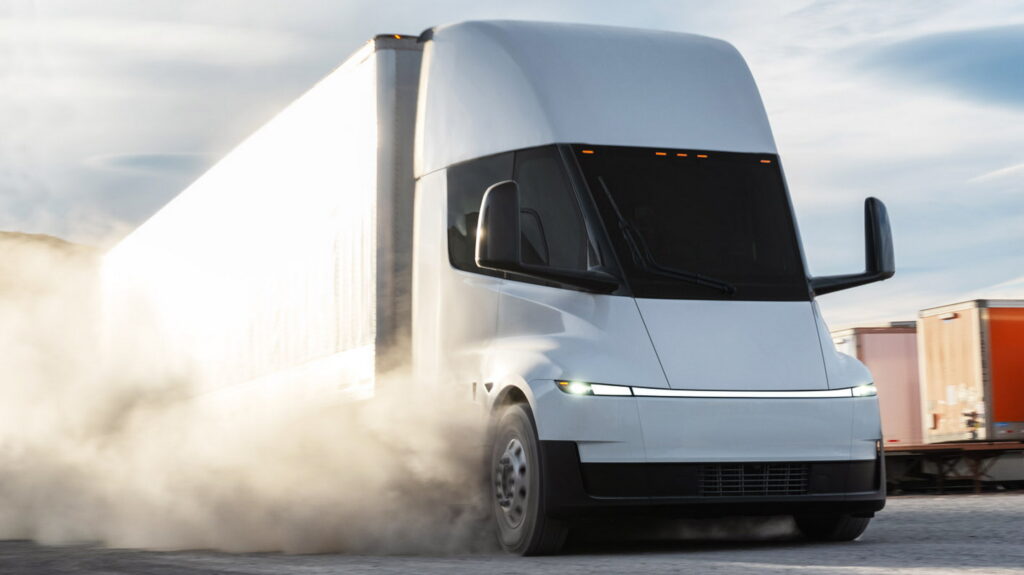
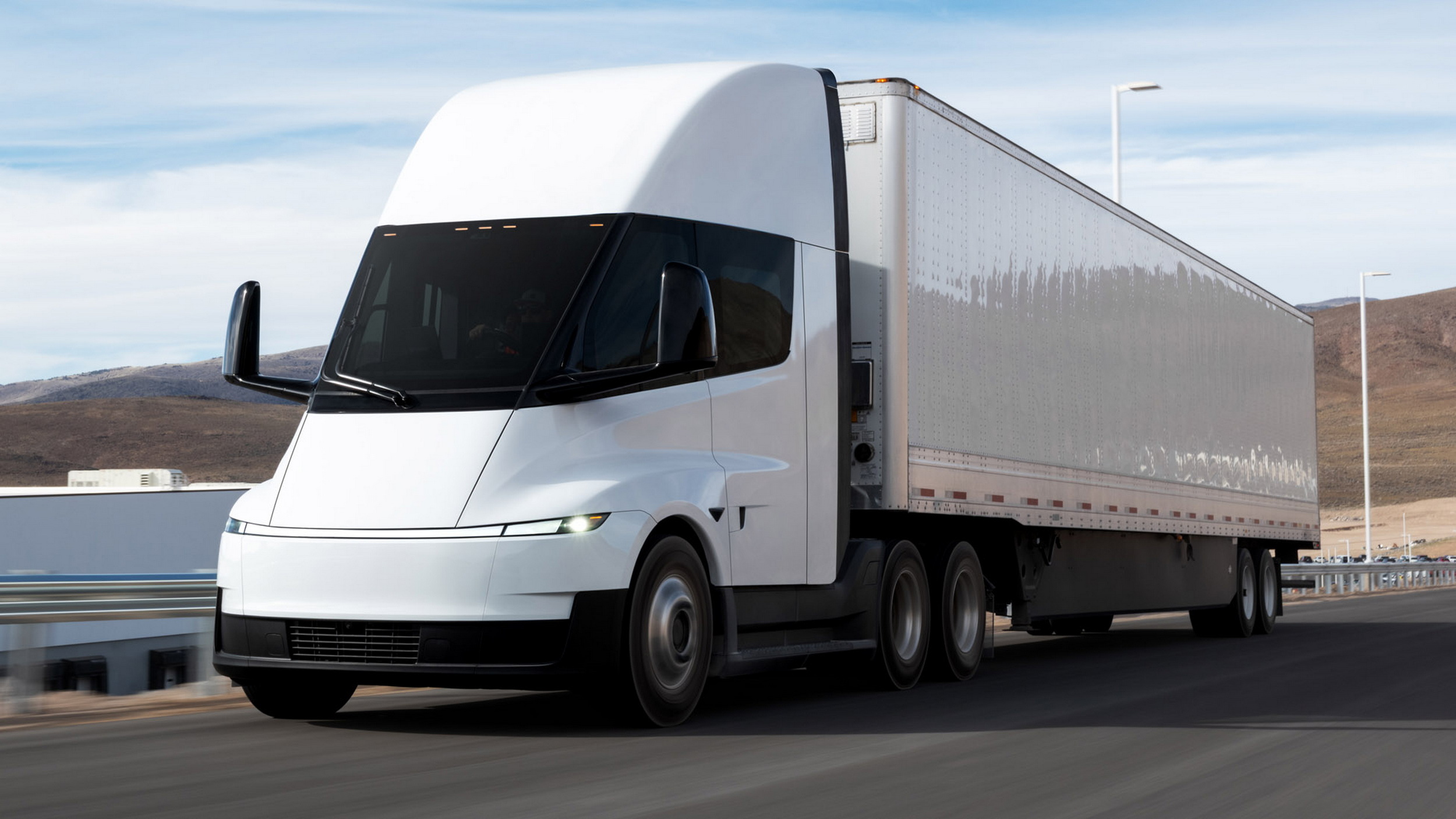
The updated Tesla Semi, introduced in late 2025 for 2026 production.

Jason Momoa Just Built Harley Davidson’s First PHEV

  • Electrogenic converted Jason Momoa’s vintage Land Rovers to electric power.
  • Two classic Harleys now combine combustion engines with electric propulsion.
  • A modern off-grid trailer packs enough battery power for month-long adventures.

Jason Momoa has developed an electromod habit that would make most petrol-loving classic car purists break out in hives. First came an electric 1929 Rolls-Royce Phantom II. Then a one-off miniature Bentley Blower EV. Now Hollywood’s Aquaman has handed a pair of rare Land Rovers and a trio of century-old Harley-Davidsons to an EV conversion company.

The latest chapter in Momoa’s increasingly eclectic garage comes courtesy of British EV specialist Electrogenic, which features prominently in the second season of his HBO Max documentary series On The Roam. This time, the company tackled five classic conversions, while also creating a battery-packed adventure trailer for extended off-grid expeditions.

Related: Jason Momoa Put A 666 Badge On His Tiny Bentley, But It’s Not What It Looks Like

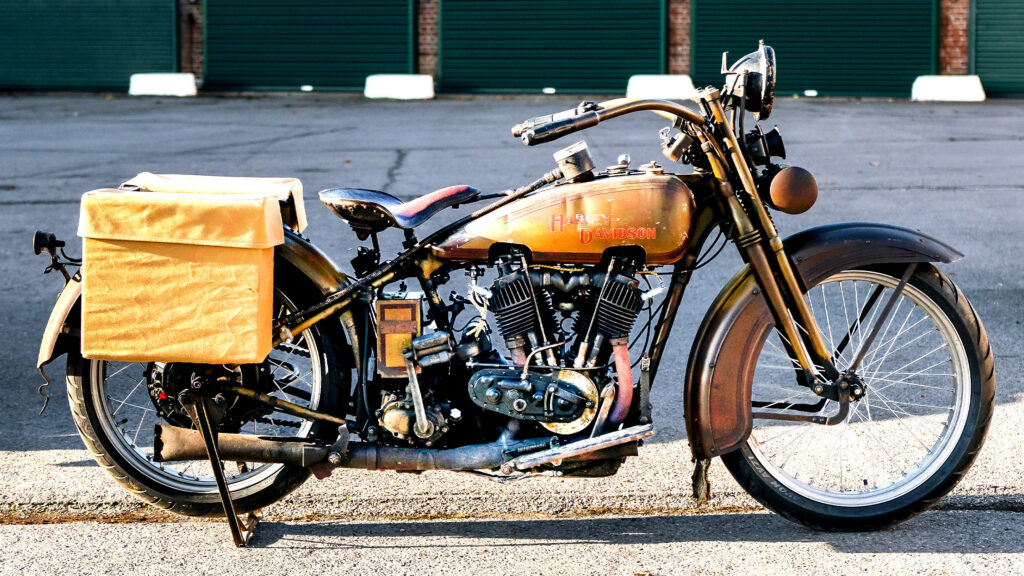
Let’s start with the motorcycles, because they put a really different spin on the whole idea of converting old ICE machines to electricity. Rather than removing the original engines, Electrogenic transformed a pair of Harley-Davidson Model JDs from the 1920s into plug-in hybrids.

Choose Your Power

\\\\\\\\\\

Momoa can choose the bikes to be propelled by 15 hp (15 PS / 11 kW) of electric power, the original 20 hp (20 PS / 15 kW) gasoline power, or both at once on his 1924 and 1927 model JD plug-ins. There’s even enough electric assistance from the 190 lb-ft (260 Nm) electric motor to eliminate the traditional kick starter.

A third bike, a 1921 Harley-Davidson Model FD, went fully electric after its original engine was deemed beyond repair. All three use discreet 2.7 kWh battery packs hidden inside period-style panniers good for more than 50 miles (80 km) of electric riding, and feature modern braking upgrades.

\\\\\\\\\\\\

Photos Electrogenic

The Land Rover conversions are definitely more conventional. A 1949 Series I and a highly collectible 1961 Series IIA 109 Dormobile camper have both been converted to full electric power. Electrogenic retained the Landies’ original four-wheel-drive systems and transfer cases, meaning they should still be every bit as capable off-road, only much faster and quieter on it.

The Series I gets a 48 kWh battery and a 201 hp (204 PS / 150 kW) motor, while the Dormobile uses a larger 62 kWh pack paired with a 161 hp (163 PS / 120 kW) motor. Both offer around 150 miles (240 km) of real-world range and CCS fast charging. The Dormobile even swaps its original gas cooking setup for an induction hob, creating what is effectively a fully electric classic camper.

And finally, Electrogenic also kitted out Momoa’s Schutt Industries XVENTURE XV-2 camping trailer with a massive 93 kWh battery pack for those long, wilderness getaways. It can reportedly power camping equipment for up to a month while also serving as a mobile charging station. What do you think Momoa’s next EV commission should be?

\\\\\\\\\\\\\\\\\\\\\\

Photos Electrogenic

❌