
Normal view

There are new articles available, click to refresh the page.
Before yesterdayMain stream

VW’s First Electric GTI Costs $8K Less Than A Gas Golf GTI, But America Can’t Have It

  • First electric GTI brings hot hatch spirit to Volkswagen’s new EV era.
  • Single front motor delivers 223 hp for a 6.8-second 0-62 mph time.
  • LSD, adaptive dampers, 19-inch wheels and retro screens are standard.

The GTI badge has spent 50 years making small Volkswagens feel more exciting than they probably had any right to be. Now it’s going electric for the first time, but the Wolfsburg team reckons the new ID. Polo GTI still has the right hot hatch character, even if the recipe is very different.

Unveiled at the Nürburgring 24 Hours where VW is racing a widebody Golf R, the ID. Polo GTI gets a single electric motor that sends 223 hp (226 PS / 166 kW) and 214 lb-ft (290 Nm) to the front wheels. That’s enough for 0-62 mph (100 km/h) in 6.8 seconds and a far less exciting 109 mph (175 km/h) top speed. The larger gas-powered Golf GTI handles the same sprint in 5.9 seconds and keeps pulling to 155 mph (250 km/h).

Related: VW’s New ID. Polo Starts Under $30K And Comes With Massage Seats

It’s punchier than the top version of the regular electric Polo, which only recently launched and tops out at 208 hp (211 PS 155 kW). But there’s a tradeoff. The standard car claims 283 miles (455 km) of range, while the GTI’s 52 kWh net NMC battery is rated at up to 263 miles (424 km) on the WLTP cycle. That’s still good for the segment though, and we’ll come back to it later.

Charging should be painless enough. The GTI can take up to 105 kW at a DC charger, and VW says its flat charging curve means a 10 to 80 percent top-up takes around 24 minutes. AC charging is rated at 11 kW.

Electric LSD And Adaptive Dampers

VW hasn’t simply turned up the motor and thrown some red stitching at it. Every ID. Polo GTI gets an electronically controlled front differential lock, adaptive DCC sports suspension, progressive steering, 19-inch alloy wheels, premium sports seats, IQ.LIGHT LED matrix headlights, and a dedicated GTI driving mode.

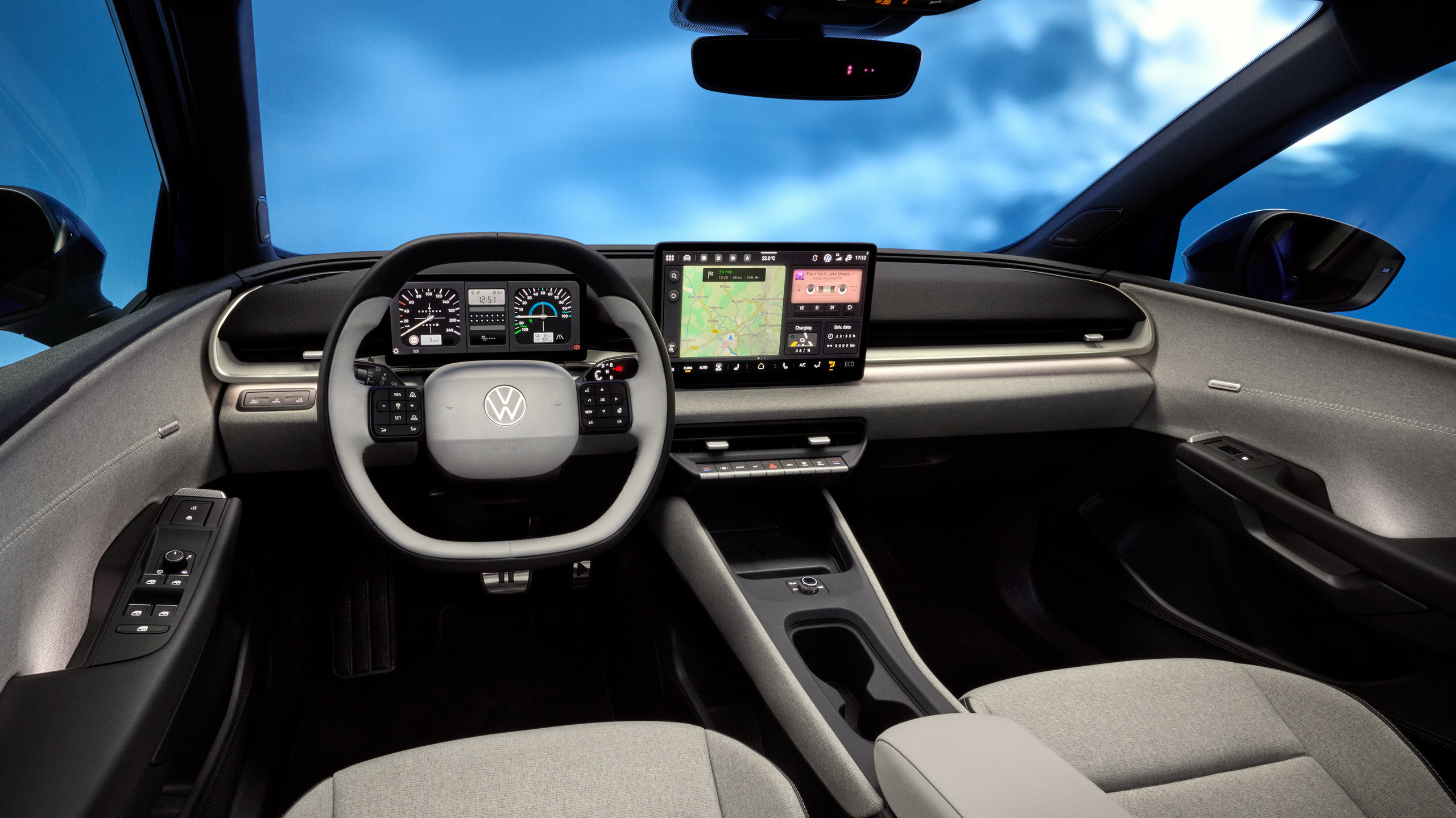
Hit the GTI button on the odd, two-spoke squircle steering wheel and the motor response, steering, dampers and chassis systems all switch into their angriest settings. The ambient lighting turns red, the graphics change, launch control becomes available, and Volkswagen even pipes in a combustion-style soundtrack.

ID. Polo Clubsport In The Works

Fake gearshifts, which featured on the almost identical-looking ID. Concept GTI back in 2023, don’t appear on the production GTI, sadly. But they will make it to the more hardcore ID. Polo Clubsport currently in development, a recent report claimed. Hopefully the Clubsport will also get the concept’s black plastic arch trims, a nod to the original Golf GTI’s, but which are missing from this one.

Other than the arch spats and fatter mirrors though, this 2027 car looks damn near identical to the concept. There’s a full-width red stripe across the nose, a 3D GTI badge, honeycomb lower intake, a split rear spoiler, illuminated rear graphics, and a chunky black diffuser. Six colors will be offered, including Tornado Red, Candy White, Oyster Silver, Celestial Blue, Magnetic Grey, and Grenadilla Black.

Tartan Seats, Real Buttons

\\\\\\\\\\\\\\\

Inside, the GTI gets red stitching, a 12 o’clock steering wheel marker, illuminated GTI logos, sports seats with traditional GTI tartan trim, and brake regen paddles. A 10.25-inch digital cluster is paired with a 12.9-inch touchscreen, and best of all, there’s a retro display mode that replicates an old Golf dashboard and plenty of real buttons on the wheel and dashboard to press.

More: VW’s ID. Polo Interior Brings Back Something You Thought Was Gone For Good

It’s practical, too. The electric platform’s 2,599 mm (102.3 inches) wheelbase is only 37 mm (1.46 inches) shorter than a Golf’s, and the Polo’s 441 liters (15.6 cu-ft) of trunk space actually shames the supposedly much bigger car’s 381-liter cargo bay (13.5 cu-ft), despite not having a frunk.

Options include a 425-watt Harman Kardon sound system with 10 speakers, a panoramic glass roof, 12-way electrically adjustable front seats with pneumatic massage, and Bridgestone Potenza Sport performance tires for drivers who want to give the 1,540 kg (3,395 lbs) GTI a real workout.

Alpine A290 And Mini JCW In The Crosshairs

\\\\\\\\\\\\\\\\\\\

Stick to the base spec and VW says you could take a GTI home for less than €39,000, or around £35,000 in the UK after government EV incentives. That’s a big step up from the regular ID. Polo’s €25,000 starting price, but it’s on a par with the 255 hp (258 PS / 190 kW) Mini John Cooper Works E and 215 hp (218 PS / 160 kW) Alpine A290 GTS.

Both are at least 0.4 seconds faster to 62 mph than the Polo, and the Opel Corsa GSE and its Peugeot 208 GTI cousin both punch out a massive 276 hp (280 PS / 206 kW) and hit 62 mph in as little as 5.5 seconds. But none of these cars can do more than 230 miles (370 km) on a charge. The Polo, remember, does 263 miles (424 km).

This Or A Combustion GTI?

What’s also interesting is that the performance Polo comes in around €7,000 / £6,000 / $8,150 cheaper than a Euro-spec 262 hp (265 PS / 195 kW) petrol Golf GTI. True, it’s 0.9 seconds slower to 62 mph, but with the EV being closer in size to the Golf than to the old combustion Polo, we wouldn’t be surprised if a few would-be Golf GTI buyers find themselves in an ID. Polo GTI instead. Except in North America, of course, which isn’t taking the ID. Polo in any form.

The ID. Polo GTI might not be the quickest electric hot hatch on sale, but VW GTIs have rarely been the fastest in their class. What they are is great all-rounders, and with a strong electric range, loads of standard hardware, proper retro charm, and a famous badge finally dragged into the EV age, it might be the one electric hat hatch ICE fans actually care about.
\\\\\\\\\\\\\

VW

VW Said No Fake Shifts On A GTI, The Clubsport Could Borrow Hyundai N’s Trick Anyway

  • VW’s ID. Polo GTI Clubsport could fake shifts for extra fun.
  • The hotter EV hatch may jump from 223 hp to nearly 282 hp.
  • Mini and Stellantis rivals already push as much as 276 hp..

Volkswagen hasn’t even officially launched the electric ID. Polo GTI yet, and already there’s talk of an even hotter Clubsport version lurking in development. Better still, it might come with fake gearshifts and simulated combustion-style power delivery and sounds designed to make EV hot hatch feel less, well, EV-ish.

According to Autocar, VW engineers are exploring a more extreme ID. Polo GTI Clubsport packing roughly 282 hp (286 PS / 210 kW), up substantially from the regular car’s expected 223 hp (226 PS / 166 kW) output. That would immediately put it closer to the upper end of the growing electric hot hatch class.

Related: VW’s New ID. Polo Starts Under $30K And Comes With Massage Seats

While the standard ID. Polo GTI should comfortably match the 215 hp (218 hp / 160 kW) Alpine A290 GTS and its mechanically related 223 hp Cupra Raval sibling, several rivals already bring considerably more firepower. The electric Mini JCW produces 255 hp (259 PS / 190 kW), while Stellantis has gone properly aggressive with the 276 hp (280 PS / 206 kW) Peugeot e-208 GTI and Opel Corsa GSE.

The Opel, unveiled this week, sets a serious benchmark, sprinting to 62 mph in just 5.5 seconds. Current expectations suggest the regular VW GTI might need around a second longer than that, though the Clubsport should give the Opel a real fight.

Performance upgrades reportedly won’t stop at extra power. Autocar says VW’s also considering replacing the current electronically controlled BorgWarner limited-slip differential with a fully mechanical setup for sharper front axle behavior.

Hyundai N-Style Shifts

\\\\\\\\

But arguably the most interesting part is the fake shifting system, something that appeared on the GTI concept back in 2023, but which VW then said would not appear on a production GTI. Of course nobody asked about a GTI Clubsport.

VW dynamics boss Florian Umbach said the company is working on “a similar kind of paddleshift power delivery that the [electric] Hyundai N cars have.” Like the Ioniq 5 N, the setup would use software-controlled power delivery to imitate a combustion engine and transmission.

“It’s all about motor control and an audio soundtrack to match,” Umbach told the magazine, suggesting fake sounds – also featured on the 2023 VW GTI concept – will also be part of the Clubsport package.

Purists will absolutely argue about whether fake shifts belong in a GTI, but the reality is many drivers miss the interaction traditional hot hatches delivered and VW clearly knows engagement matters just as much as raw acceleration numbers.

Images shown below are of the 2023 GTI concept.

\\\\\\\\\\\\

VW

VW’s New ID. Polo Starts Under $30K And Comes With Massage Seats

  • Pre-sales of the VW ID. Polo EV kick off this week starting at €24,995.
  • Three power outputs and two batteries offer up to 283 miles of range.
  • Interior features retro-style digital display and pneumatic seat massagers.

Over 20 million Polos have found homes since the nameplate launched more than 50 years ago. Now Volkswagen’s rebooting the whole thing as the ID. Polo, a fully electric seventh-generation hatch built on the new MEB+ EV platform with front-wheel drive, up to 283 miles (455 km) of range and a starting price that keeps it firmly in affordable territory.

More: VW’s 2026 ID. Buzz Adds 335 HP And Real Buttons, America Gets Neither

Pre-sales are already live in Germany, where the entry-level Trend trim kicks off at €24,995 ($29,300). That’s the headline number Volkswagen‘s been keen to shout about, though if you want one right now, the only available order is the mid-spec Life trim, which starts at €33,795 ($39,600). More variants follow in the summer.

\\\\\\\

There are three power outputs at launch. The 114 hp (116 PS / 85 kW) and 133 hp (135 PS / 99 kW) versions come with a 37 kWh lithium iron phosphate battery offering up to 204 miles (329 km) of range and DC fast charging at up to 90 kW, with a 10-to-80 charge taking around 27 minutes.

The 208 hp (211 PS / 155 kW) variant steps up to a 52 kWh nickel-manganese-cobalt pack, pushing range to a provisional 283 miles (455 km) and accepting up to 105 kW DC charging, shaving that charge window down to roughly 24 minutes. A GTI variant with 223 hp (226 PS / 166 kW) is coming in 2027.

New Front-Wheel Drive Platform

The switch to the front-wheel drive MEB+ platform pays dividends in terms of space because unlike the bigger ID.3 Neo, there’s no motor stashed under the cargo bay floor. Luggage volume jumps 25 percent over the combustion Polo, from 351 to 441 liters, and with the rear seats folded you’re looking at 1,243 liters. The interior also gains 19 mm of extra space that passengers will actually notice, particularly those in the back.

VW’s tape measure says the Polo comes in at 4,053 mm (159.6 inches) long, 1,816 mm (71.5 inches) wide and 1,530 mm tall on a 2,600 mm (102.4 inches) wheelbase. That makes 131 mm (5.2 inches) shorter and 42 mm (1.7 inches) narrower than its most obvious rival, the Renault 5 E-Tech, but as good as identical in size to the Cupra Raval, which like the Skoda Epiq, shares the Polo’s platform and running gear.

On the outside the handsomely chiselled ID. Polo looks almost identical to the 2023 ID.2all concept, right down to its fat five-spoke wheels and blue paint. The rear door handles are hidden near the C-pillar to clean up the lines, and a wide transverse light bar at the tail is crowned with an illuminated red VW roundel to finish what the white lit logo at the front started.

Retro-Digital Interior

\\\\\\\\\\\\\\\\\

Inside, Volkswagen’s “Pure Positive” design language makes its production debut. Chief Designer Andreas Mindt says he wanted the cabin to feel like a familiar friend, and the approach blends a 10-inch digital cockpit with a 13-inch infotainment center touchscreen.

Physical buttons handle climate control, there’s a rotary audio dial between the front seats, and a “retro display” mode transforms the instruments into something that looks straight out of a post-facelift Mk1 Golf, complete with a classic speedo and a power gauge standing in for the rev counter. Nice touch.

Three trim levels cover the range. The Trend gets LED headlights, Side Assist, Lane Assist and a standard 90 kW DC charging capability. Life adds Adaptive Cruise Control, a rear camera, CarPlay, Android Auto and wireless phone charging. Style goes further with IQ.LIGHT LED matrix headlights, 3D tail lights, an illuminated VW logo front and rear, sport comfort seats, two-zone climate and the upgraded ID. Light strip that now runs into the door panels.

Massage Seats

\\\\\\\\\\\

Optional tech potentially worth splashing for includes a 425-watt Harman Kardon sound system, a panoramic glass roof and something genuinely unusual for this class: a pneumatic massage function for the electrically adjustable 12-way front seats, with three programs to choose from. That’s a premium-saloon feature in a sub-€25,000 hatchback.

Also: VW Spent Years Removing Knobs From Its Cars, The ID.3 Neo Puts Them Back

The ID. Polo also supports Vehicle-to-Load as standard, meaning it’ll push up to 3.6 kW out through a Schuko adapter to charge e-bikes or run outdoor kit. Depending on spec, it can tow up to 1,200 kg too.

Cut-Price Charging

\\\\\\\\\\\\\\\\\\

On the charging side, Volkswagen’s subsidiary Elli is launching a new city tariff at €0.39 per kWh for public AC charging across more than a million European charge points, aiming to make street charging as predictable and affordable as a home wallbox. A dynamic home tariff called Naturstrom Flex can cut home charging costs by up to 30 percent by automatically charging when electricity prices are lowest.

Aside from next year’s GTI, shown below in disguised form, the ID. Polo lineup feels pretty complete for a launch. It’s practical, it’s priced right, and that retro display alone might sell a few cars.

\\\\\\\\

VW

The ID. Polo Is VW Back To Its Best

  • Pre-sales of the VW ID. Polo EV kick off this week starting at €24,995.
  • Three power outputs and two batteries offer up to 283 miles of range.
  • Interior features retro-style digital display and pneumatic seat massagers.

Over 20 million Polos have found homes since the nameplate launched more than 50 years ago. Now Volkswagen’s rebooting the whole thing as the ID. Polo, a fully electric seventh-generation hatch built on the new MEB+ EV platform with front-wheel drive, up to 283 miles (455 km) of range and a starting price that keeps it firmly in affordable territory.

Pre-sales are already live in Germany, where the entry-level Trend trim kicks off at €24,995. That’s the headline number Volkswagen‘s been keen to shout about, though if you want one right now, the only available order is the mid-spec Life trim, which starts at €33,795. More variants follow in the summer.

Related: VW’s 2026 ID. Buzz Adds 335 HP And Real Buttons, America Gets Neither

There are three power outputs at launch. The 114 hp (116 PS / 85 kW) and 133 hp (135 PS / 99 kW) versions come with a 37 kWh lithium iron phosphate battery offering up to 204 miles (329 km) of range and DC fast charging at up to 90 kW, with a 10-to-80 charge taking around 27 minutes.

The 208 hp (211 PS / 155 kW) variant steps up to a 52 kWh nickel-manganese-cobalt pack, pushing range to a provisional 283 miles (455 km) and accepting up to 105 kW DC charging, shaving that charge window down to roughly 24 minutes. A GTI variant with 223 hp (226 PS / 166 kW) is coming in 2027.

New Front-Wheel Drive Platform

The switch to the front-wheel drive MEB+ platform pays dividends in terms of space because unlike the bigger ID.3 Neo, there’s no motor stashed under the cargo bay floor. Luggage volume jumps 25 percent over the combustion Polo, from 351 to 441 liters, and with the rear seats folded you’re looking at 1,243 liters. The interior also gains 19 mm of extra space that passengers will actually notice, particularly those in the back.

VW’s tape measure says the Polo comes in at 4,053 mm (159.6 inches) long, 1,816 mm (71.5 inches) wide and 1,530 mm tall on a 2,600 mm (102.4 inches) wheelbase. That makes 131 mm (5.2 inches) shorter and 42 mm (1.7 inches) narrower than its most obvious rival, the Renault 5 E-Tech, but as good as identical in size to the Cupra Raval, which like the Skoda Epiq, shares the Polo’s platform and running gear.

On the outside the handsomely chiselled ID. Polo looks almost identical to the 2023 ID.2all concept, right down to its fat five-spoke wheels and blue paint. The rear door handles are hidden near the C-pillar to clean up the lines, and a wide transverse light bar at the tail is crowned with an illuminated red VW roundel to finish what the white lit logo at the front started.

Retro-Digital Interior

\\\\\\\\\\\\\\\\\

Inside, Volkswagen’s “Pure Positive” design language makes its production debut. Chief Designer Andreas Mindt says he wanted the cabin to feel like a familiar friend, and the approach blends a 10-inch digital cockpit with a 13-inch infotainment center touchscreen.

Physical buttons handle climate control, there’s a rotary audio dial between the front seats, and a “retro display” mode transforms the instruments into something that looks straight out of a post-facelift Mk1 Golf, complete with a classic speedo and a power gauge standing in for the rev counter. Nice touch.

Three trim levels cover the range. The Trend gets LED headlights, Side Assist, Lane Assist and a standard 90 kW DC charging capability. Life adds Adaptive Cruise Control, a rear camera, CarPlay, Android Auto and wireless phone charging. Style goes further with IQ.LIGHT LED matrix headlights, 3D tail lights, an illuminated VW logo front and rear, sport comfort seats, two-zone climate and the upgraded ID. Light strip that now runs into the door panels.

Massage Seats

\\\\\\\\\\\\\\\\\\

Related: VW Spent Years Removing Knobs From Its Cars, The ID.3 Neo Puts Them Back

Optional tech potentially worth splashing for includes a 425-watt Harman Kardon sound system, a panoramic glass roof and something genuinely unusual for this class: a pneumatic massage function for the electrically adjustable 12-way front seats, with three programs to choose from. That’s a premium-saloon feature in a sub-€25,000 hatchback.

The ID. Polo also supports Vehicle-to-Load as standard, meaning it’ll push up to 3.6 kW out through a Schuko adapter to charge e-bikes or run outdoor kit. Depending on spec, it can tow up to 1,200 kg too.

Cut-Price Charging

\\\\\\\\\\\\\\\\\\

On the charging side, Volkswagen’s subsidiary Elli is launching a new city tariff at €0.39 per kWh for public AC charging across more than a million European charge points, aiming to make street charging as predictable and affordable as a home wallbox. A dynamic home tariff called Naturstrom Flex can cut home charging costs by up to 30 percent by automatically charging when electricity prices are lowest.

Aside from next year’s GTI, shown below in disguised form, the ID. Polo lineup feels pretty complete for a launch. It’s practical, it’s priced right, and that retro display alone might sell a few cars.

\\\\\\\\

VW

VW’s ID. Lineup Looked Like The Future, Turns Out People Wanted The Past

  • VW admits ID. models missed mark on design, usability and emotional appeal.
  • New leadership focuses on customers not egos to reshape future EV lineup.
  • Return of buttons, names and identity aims to reconnect brand with buyers

VW rebounded from the dieselgate scandal determined to do better, but the German brand’s boss has admitted that some of those early efforts landed wide of the mark. Now he’s on a mission to right some ID. wrongs and win back the crowd it drifted away from.

“It was clear to me that we were actually losing our core,” CEO Thomas Schäfer told journalists at the presentation of the heavily facelifted ID.3 Neo. The former Skoda chief, who bagged the top Wolfsburg job in 2022, says the brand had drifted from the VW people knew and loved.

Related: VW ID.4’s Death Could Lead To Birth Of An American Pickup

The problems were everywhere once you started looking. Styling that didn’t quite feel right, confusing touch controls, and a naming strategy that ditched familiar badges in favor of cold tech-speak. Turns out customers didn’t love slider controls for basic functions, and they definitely missed the clarity of names like Golf and Tiguan.

 VW’s ID. Lineup Looked Like The Future, Turns Out People Wanted The Past
The new ID. Polo’s interior.

Schäfer didn’t just tweak things around the edges. He gathered hundreds of managers, threw every issue on the table, and asked for brutal honesty. “We had to change ourselves, we had to create a new mindset,” Auto Express reports the CEO saying. He recalled how his wider team reacted with relief rather than resistance when he laid out the new plan.

Ask The Customer

Engineering boss Kai Grünitz says the reset goes deeper than pretty design. “We are doing customer clinics a lot,” he explained, signalling a shift away from gut feeling toward actual feedback. That means features get tested by real people before making production, not just approved in boardrooms because the CEO has decided he likes something and engineers don’t feel able to push back.

\\\\\\

Exterior styling is getting a rethink, too, following the Schäfer-assisted exodus of Klaus Bischoff, architect of the mostly bland first-generation ID. cars. New creative boss Andy Mindt, who came from Bentley, has pushed for simpler, more timeless shapes, plus interiors that don’t require a tutorial. Physical buttons are coming back, and even door handles are being reconsidered so they actually work when your hands are full.

“We sell emotions, we sell memories,” Grünitz said, summing up the new direction, which is really just about getting back to the old direction. If VW can pull that off again with the help of cars like the new ID. Polo (below), maybe the people’s car maker really can find its groove.

\\\\\\\\
❌
❌