Reading view

There are new articles available, click to refresh the page.

VW’s Killing The ID.4 To Bring Back A Familiar Name

  • VW plans to rename ID.4 as ID. Tiguan with facelift, report says.
  • Familiar name aims to make VW electric SUVs easier to sell.
  • Facelift brings new look, better interior and new FLP battery tech.

Volkswagen’s ID.4 electric SUV is getting a new suit and a new name to go with it. A report out this week suggests the ID.4 will soon be rebadged as the ID. Tiguan, confirming what we suspected in a recent spy shot story.

Also: VW’s ID. Polo Interior Brings Back Something You Thought Was Gone For Good

The name change will arrive alongside a comprehensive facelift later this year, according to Auto News. Their nformation reportedly came from the IG Metall labor union during a press conference in Germany, which is about as official as things get without VW actually saying anything. Unsurprisingly, Volkswagen declined to comment.

\\\\\\\\

Baldauf

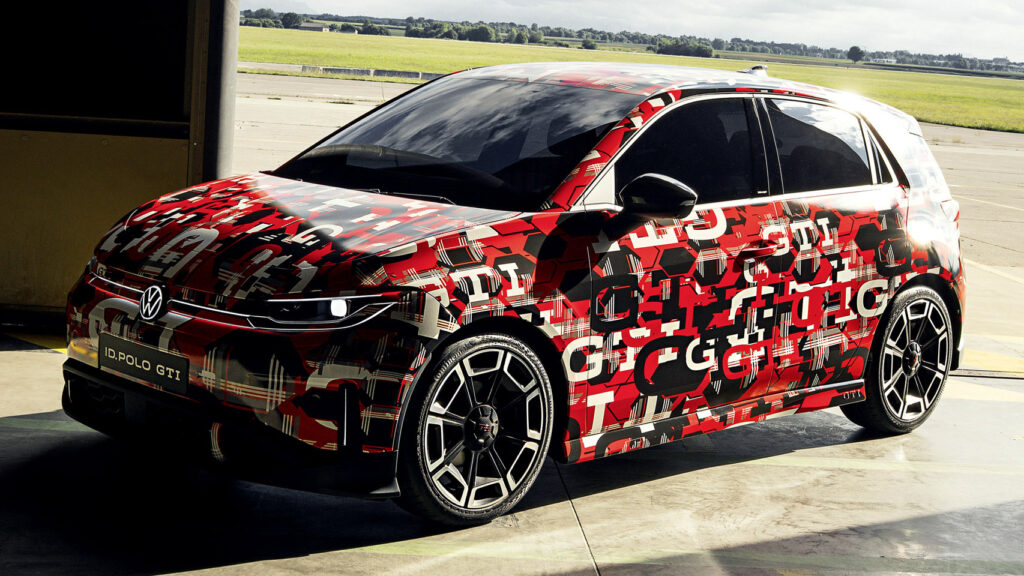
This move fits perfectly with VW’s recent decision to abandon cold numeric names in favor of familiar badges. It was recently confirmed that the production version of the ID.2all hatch concept will be called ID. Polo when it arrives in European dealerships this year, and don’t be surprised if the ID.Every1 concept turns into an ID. Up.

We’ve already seen what the ID. Tiguan looks like in prototype form. Our spy shots revealed a heavily revised exterior with new doors, redesigned lights, fresh bumpers, and a reworked rear hatch. The shape remains familiar, but the surfacing is sharper and more upright, bringing it closer to the combustion Tiguan and the upcoming ID Cross.

Rediscovering Buttons

 VW’s Killing The ID.4 To Bring Back A Familiar Name

The changes are more than skin deep. Inside, Volkswagen appears ready to undo some of its recent interior mistakes. Physical buttons are expected to return, including a proper volume knob, along with better materials and a cleaner dashboard layout.

The touchscreen and digital cluster should grow in size, while updated software promises a smarter voice assistant that hopefully listens this time. The result should look something like the interior of the new ID. Polo, shown below.

Battery Upgrade

 VW’s Killing The ID.4 To Bring Back A Familiar Name
The current 2026 VW ID.4.

Underneath, the facelifted ID. Tiguan is expected to ride on a revised MEB plus platform. That likely means newer battery cells, including LFP chemistry in some versions, improving efficiency and potentially boosting real-world range. Don’t expect a voltage upgrade though, as it will stick with 400-volt architecture and modest charging speeds.

Performance updates should be mild, since VW already boosted the base single-motor version in 2024 to 282 hp (286 PS/ 210 kW), though dual-motor versions could get a lift to help them regain their advantage over rear-drive models. The focus overall though, will be on usability, refinement, and making the electric Tiguan feel like a natural alternative to the combustion SUV carrying the same name.

Production of the new ID. Tiguan will continue in Emden, Germany, through 2031, Auto News reports, suggesting VW sees plenty of life left in this model. And that makes sense, since the ID.4 was one of only two models that grew, rather than lost, sales in the US last year.

\\\\\\\\\\

Baldauf

VW’s Facelifted ID.4 Is Starting To Look A Lot Like A Tiguan

  • Facelifted VW ID.4 spotted testing ahead of debut later this year.
  • Visual changes include new doors, lights, bumpers, rear hatch.
  • Updated MEB+ platform may add LFP batteries and extra range.

Volkswagen isn’t sitting still when it comes to electric cars, even if most of its lineup in the US has struggled to gain traction this year. The ID.4, one of only two VW models whose American sales actually increased in 2025, is getting more than a light polish.

Instead, it’s heading into a major refresh that reshapes it into what some within the company are already calling the “electric Tiguan.”

Related: Every VW Model Dropped In Sales, Except The Two You’d Never Expect

Our first spy shots show a crossover that’s recognizably an ID.4, but one that’s been carefully sharpened. The front end is squarer, clearly aligned with the upcoming ID Cross look.

\\\\\\\\\\\\\

SB-Medien

As you can see in our spy shots, the doors are new with proper pull handles, and the rear end has been subtly reworked with a concave rather than convex tailgate panel, plus a re-profiled D pillar.

It’s not a ground-up redesign, because there’s only so much you can change with a facelift. The underlying structure appears mostly identical, which makes sense for a mid cycle update.

However, the surfacing and proportions have been tweaked just enough to bring the ID.4 visually into sync with the new Tiguan and VW’s upcoming electric ID.Cross, which was unveiled in concept form last September, and goes on sale in Europe later in 2026.

Buttons Are Back

 VW’s Facelifted ID.4 Is Starting To Look A Lot Like A Tiguan
The upcoming ID. Polo seen here will be the first of many new VWs to feature physical controls.

Inside is where the biggest changes may be felt day to day. Physical buttons and switches will feature prominently, including a real volume knob, alongside a new dashboard, better materials, and a revised user interface. We got our first glimpse of this direction in the official photos of the new ID. Polo’s interior (pictured above) earlier this month.

The software gets an upgrade too, with an improved AI-powered voice assistant, and the currently undersized digital gauge cluster will grow in size.

Powertrains and Batteries

 VW’s Facelifted ID.4 Is Starting To Look A Lot Like A Tiguan
SH Proshots

Under the skin sits a revised MEB plus platform that should feature LFP battery chemistry for better efficiency and potentially more range, though it’ll still be stuck with 400-volt electrics.

Powertrains are expected to receive light updates rather than dramatic changes. But VW did, after all, only relatively recently dramatically improve the output of the base single-motor ID.4, which since 2024 produces 282 hp (210 kW / 286 PS). That represents an increase of 80 hp (60 kW / 82 PS) over the previous version.

This facelifted ID.4 is expected to arrive near the end of 2026, helping carry the model through to 2028. That’s when a fully new version is due, this time based on a true 800-volt platform. That is nearly sure to be badged ID.Tiguan, if VW hasn’t decided that this year’s facelift is extensive enough to justify that name change for the 2027 model year.

\\\\\\\\\\\\\\\\\\\

SH Proshots

VW’s Compact EV Is Getting A Bigger Makeover Than It Wants You To Think

  • Camouflaged VW ID.3 tester previews a deeper second facelift.
  • Sharper styling, physical buttons, and better batteries coming.
  • Facelifted electric hatchback expected to debut later this year.

The Volkswagen ID.3 was launched in 2019 as the opening act in VW’s dedicated electric lineup, the ID family. Positioned as a compact hatchback, it received a mid-cycle refresh in 2023. Now, Volkswagen is preparing a more involved update, bringing tweaks to its styling, tech, and battery options.

More: VW’s Entry EV Packs More Power And Space Than You’d Think

According to recent reports, the next-generation electric Golf has been delayed until 2030. That leaves the ID.3 with an extended tour of duty, longer than originally anticipated. Meanwhile, rising pressure from aggressively priced Chinese EVs has set the bar higher for European automakers.

What Is VW Hiding?

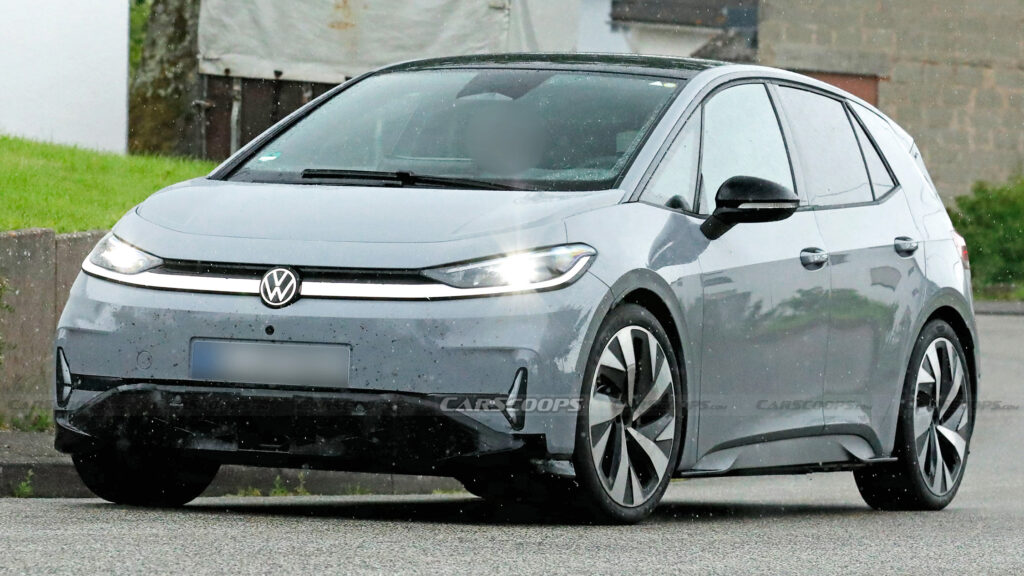
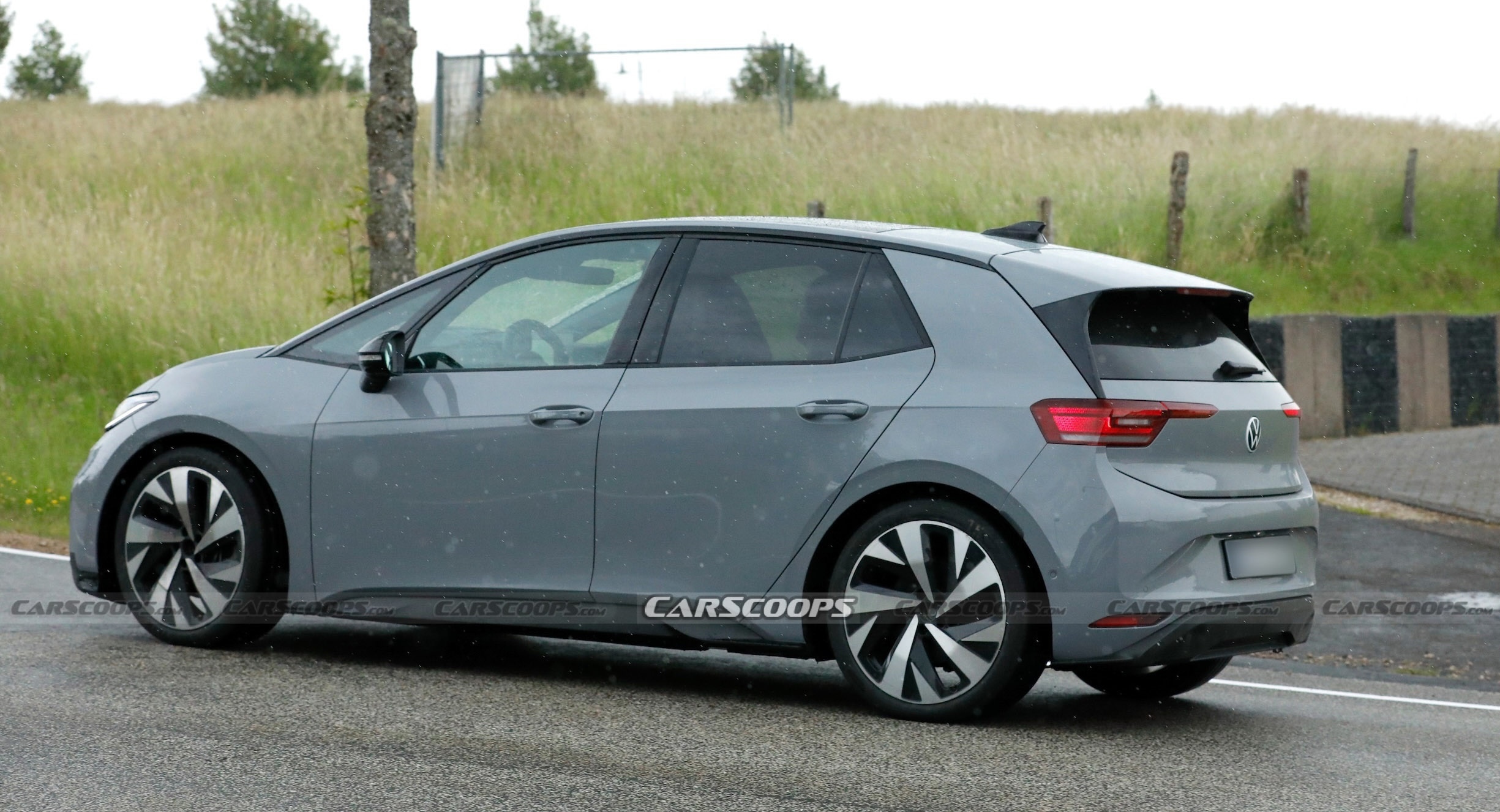
Our spy photographers spotted the revised ID.3 undergoing cold-weather testing, ahead of its expected debut in the second quarter of the year. As is often the case with Volkswagen prototypes, the tester wears cleverly applied camouflage to imitate the current model.

Look closely, though, and you’ll notice stickers concealing updated design elements on the grille and headlights. These new front-end components are likely to align with the visual identity of the forthcoming ID. Polo, a model shaped under the guidance of VW’s head of design, Andreas Mindt.

\\\\\\\\\\\\\\\\\\\\\\\\\

SH Proshots

The side profile and rear of the prototype appear nearly identical to today’s ID.3. That’s not expected to last. As development continues and newer prototypes surface, more visible changes should emerge leading up to launch.

More: VW’s ID. Polo Interior Brings Back Something You Thought Was Gone For Good

Last year, VW’s development boss Kai Grunitz revealed that the updated ID.3 and ID.4 will have a “completely new design language, going back to where we originally came from”. This suggests the revisions will go much deeper than updated LED lighting.

What’s Changing Inside?

Inside, the hatchback will follow the wider VW trend of reintroducing physical buttons and tactile controls, addressing long-standing feedback, echoing the approach taken with the new ID. Polo. Interior quality is also set to improve, with upgraded materials and design elements.

 VW’s Compact EV Is Getting A Bigger Makeover Than It Wants You To Think
The interior of the ID. Polo is a good indication of what to expect from future VWs.

Beyond styling and tech, the MEB-based model will also benefit from technical enhancements, improving its performance, range, and charging times. It’s also likely that the sporty GTX variant will transition to wearing a GTI badge, in line with VW’s evolving branding.

Battery Variety Incoming

The new battery cells won’t be the only option. Volkswagen is reportedly preparing an entry-level variant using a more affordable lithium-iron phosphate (LFP) battery. That move could help lower the starting price, an important strategy as VW faces off against a flood of budget-friendly Chinese EVs.

More: VW’s Cheapest Electric SUV Steps Out Almost Undisguised

What remains uncertain is whether the updated model will keep the ID.3 moniker. VW’s revamped naming strategy includes the use of traditional nameplates for EVs, as seen with the upcoming ID. Polo hatchback and the closely-related ID. Cross SUV.

Could this signal a switch from ID.3 to ID. Golf, and from ID.4 to ID. Tiguan? It’s possible, though nothing has been confirmed. In any case, the facelifted ID.3 is expected to reach customers in the second quarter of the year, with the larger SUV arriving later. The year 2026 is shaping up to be a pivotal one for VW’s electric range, with the rollout of both ID. Polo and ID. Cross models on the horizon.

 VW’s Compact EV Is Getting A Bigger Makeover Than It Wants You To Think
The VW ID.3 has already received its first facelift in 2023.

VW’s Cheapest Electric SUV Steps Out Almost Undisguised

  • New ID. Cross prototype loses heavy disguise and mirrors concept.
  • VW uses clever tape tricks to fake gas cues but EV details obvious.
  • Likely to get 208 hp motor and 52 kWh battery from ID. Polo.

Spy photographers just caught VW’s smallest electric SUV running around almost completely undisguised – it was even wearing a VW badge. And the only thing more obvious than the ID. Cross‘s shape is the fact that Wolfsburg really wants us to think it’s not electric at all.

Related: VW’s Entry EV Packs More Power And Space Than You’d Think

Gone is the heavy swirly wrap. In its place is VW’s favorite optical illusion job where silver and black tape is slapped across the grille, lights and bumpers to impersonate an older gas powered model. It doesn’t work. Under the tape we can clearly see the exact contours of the ID.Cross concept shown a few months ago at the Munich auto show.

C pillars still hiding

 VW’s Cheapest Electric SUV Steps Out Almost Undisguised
Baldauf

The production doors are now almost fully exposed without their earlier cladding, although VW has even tried to hide the black lower plastic trim by covering it with body color tape. The C pillar treatment is also disguised, though only enough to hide the fun ID. Buzz style inserts that we know sit underneath.

Shape-wise nothing has changed. The bluff little nose, the tight overhangs and the tucked tail all match the concept almost panel for panel. Even the light graphics are visible through the tape and they look identical to the Munich show car’s with VW’s latest family face emerging loud and clear.

\\\\\\\\\\\\\\

Tablet touchscreen with AI

Though we can’t see inside on these latest images, we can be sure it will also closely echo what was on display at Munich. That means an 11-inch freestanding rectangular digital gauge cluster ahead of the steering wheel, and a much bigger, 13-inch tablet touchscreen mounted above the console and featuring ChatGPT-powered AI assistance.

Read: VW Has A Plan To Save EVs And It Involves Gas Engines

Under the skin the ID. Cross shares its MEB platform and hardware with the new ID. Polo. The Cross concept had a 208 hp (211 PS / 155 kW) front mounted motor, which is the punchiest of the three launch powertrains VW confirmed for the Polo EV this week.

 VW’s Cheapest Electric SUV Steps Out Almost Undisguised

ID.Cross GTI?

The other two Polo options make 114 hp (85 kW / 116 PS) and 133 hp (99 kW / 135 PS), and you can be sure that the second of those, if not both, will also make it to the ID. Cross.

How about an ID. Cross GTI? It’s theoretically possible, since VW plans to add a 223 hp (166 kW / 226 PS) motor to the Polo down the line to create its first electric hot hatch.

 VW’s Cheapest Electric SUV Steps Out Almost Undisguised
Baldauf

VW never confirmed battery dimensions for the concept, but did reveal a 261-mile (420 km) range. That ties in with the 280 miles (450 km) VW claims for the lighter, more slippery ID. Polo with a 52 kWh battery. Polos will also be available with a 37 kWh pack, though VW might not offer that on the SUV when it debuts in production form in 2026.

\\\\\\\\

Photos Baldauf / Carscoops

VW’s Make-Or-Break Small Electric SUV Steps Out For The First Time

  • VW’s 2025 ID.Cross concept is being developed into a production EV.
  • Electric counterpart to subcompact T-Cross ushers in new VW design.
  • Concept had a front-mounted 208 hp motor and a 261-mile range.

Volkswagen’s smallest electric SUV has crawled out of the concept studio and onto public roads. Our spy photographers just snagged the very first shots of the ID.Cross prototype, giving us an early look at the subcompact EV that VW previewed with the ID.Cross concept at last September’s Munich Auto Show.

It’s still wrapped in camouflage, but even through the swirls, the production version looks remarkably close to the original concept.

Related: VW Revives Classic Nameplates With A New Mission To Fight Off China’s EV Surge

The proportions look almost copy-and-paste. The ID.Cross sits has short overhangs, a rounded nose and a slightly pinched tail that mirrors the concept’s “urban-friendly” footprint.

Expect the real thing to land close to the concept’s numbers, which were designed to squeeze maximum cabin space from a small footprint: roughly 4,160 mm (163.8 inches) in length, making it shorter than America’s Taos and right in the heart of the subcompact EV class.

\\\\\\\\\\

Even under wrap, the headlight and taillight outlines look familiar from the Munich show, hinting at VW’s newest light-bar family face. And though we can’t see them, we’re sure the three illuminated rectangles embedded in the concept’s black C-pillar have also made the cut.

The concept’s whimsical yoga-studio-on-wheels interior probably won’t survive 100 percent unchanged, though, so don’t expect pastel mood lighting or Zen-garden textures in the base model.

But VW’s latest compact cabin architecture, with a bigger infotainment screen and improved physical switchgear, should appear here.

What Powers It?

\\\\\

SH Proshots

Under the skin, the ID.Cross rides on the latest evolution of the MEB platform, tweaked for a new front-wheel-drive generation of small EVs including the ID.Polo.

The concept was pitched with a single-motor setup producing around 208 hp (211 PS / 155 kW), and that’s a believable target for the production version, though we expect to also see less powerful versions join the lineup to improve accessibility.

VW didn’t give a battery size for the concept but claimed it could deliver a 261-mile (420 km) WLTP electric range, and again, that’s a solid indicator about the kind of touring ability we’ll get from the real thing when it makes its global debut next year.

Will The US Get It?

US sales are yet to be confirmed, but in Europe the ID.Cross will cost from around £25k/€28k ($32k) when it goes head to head with other electric crossovers like the Kia EV2, Toyota Urban Cruiser, and its VW Group cousins, the Skoda Epiq and Cupra Raval.

\\\\\\\\\\\\\\\\\

Stefan Baldauf, Guido ten Brink, VW

VW’s Next Electric Sedan Looks Nothing Like You’d Expect

  • Xpeng and VW are collaborating on a new ID electric sedan.
  • Based on the Xpeng P7, it features a unique exterior design,
  • VW plans 30 new models for China, including 20 electrified ones.

If anyone needed a reminder of just how central China has become to the global car industry, look no further than to Volkswagen’s partnership with Xpeng.

Announced last year, the collaboration centers on a next-generation electrical architecture set to support a wide range of future models, from pure EVs to traditional combustion and plug-in hybrid vehicles.

Read: VW’s Concepts Mark The Start Of 30 New Models For China’s EV Future

This joint effort is already bearing fruit. Among the first of these shared creations is an as-yet-unnamed sedan from Volkswagen that’s expected to join the ID family.

What Does It Look Like?

Recently seen testing under camouflage on Chinese roads, the upcoming electric sedan is believed to be based on the Xpeng P7, whose second generation debuted only a few months ago, while also reflecting design elements from Volkswagen’s ID. Aura and ID. Evo concepts showcased earlier this year.

\\\\\

Sugar Design

Digital artist Sugar Design produced a series of renderings based on those camouflaged prototypes, and there’s no denying that, compared with several Volkswagen models currently sold in Western markets, it has a distinctly sleeker and sportier presence.

At the front, it features split LED headlights and a small illuminated badge in the center, as well as a large open black grille and smooth lines. It’s nowhere near as radical as the sharp-looking second-gen P7, but for the German brand, it’s still quite a bold shift in style.

The side profile is particularly eye-catching, highlighted by its pronounced rear haunches and a smooth, flowing roofline. At the back, intricate LED taillights frame a softly illuminated VW badge, with a discreet black diffuser completing the look.

What Could Power It

Whether Volkswagen’s upcoming sedan will mirror the Xpeng P7’s specifications is still uncertain, but the P7 itself measures 197.5 inches (5,017 mm) in length and offers two battery options: a 74.9 kWh pack and a larger 92.9 kWh version.

 VW’s Next Electric Sedan Looks Nothing Like You’d Expect
The new Xpeng P7 | Photo Stefan Baldauf & Guido ten Brink

The standard rear-wheel-drive layout produces 362 hp (270 kW) from a single motor, while the all-wheel-drive setup adds a front unit for a combined 586 hp (437 kW). The AWD variant is expected to hit 62 mph in 3.7 seconds and reach a top speed of 142 mph.

Range depends on configuration, from roughly 436 miles (702 km) in base form to 509 miles (820 km) for the long-range RWD model.

VW’s Chinese Plans

VW is taking the Chinese market extremely seriously. Beyond confirming that its jointly developed electrical and electronic architecture with Xpeng will underpin future EVs, the company has made clear that the same foundation will serve combustion and plug-in hybrid models.

\\\\

Sugar Design

The new system won’t simply enable over-the-air updates; it’s also designed to streamline vehicle development, cutting production timelines and allowing faster adaptation to market trends.

The German brand has committed to launching more than 30 new models in China, including 20 new-energy vehicles. In addition to working with Xpeng to make these a reality, it is collaborating with partners through the FAW-Volkswagen and Volkswagen Anhui joint ventures.

\\\\

Sugar Design

❌