Democratic U.S. Rep. Mark Pocan is calling for further oversight of Immigration and Customs Enforcement after an agent shot and killed a woman driving her vehicle in Minneapolis.
A community in rural Brown County is raising the alarm on a possible data center development after several people received offers to purchase their property from a local realtor on behalf of a Delaware-based limited liability company.
Job centers help people who are looking for work, including people who must conduct work searches each week to receive unemployment benefits. A bill to change the unemployment insurance rules has divided lawmakers despite being offered by the joint labor-management Unemployment Insurance Advisory Council. (Wisconsin Examiner photo)
This report has been updated
A bill that would boost Wisconsin’s top weekly jobless pay while penalizing people who receive federal disability pay is heading to the Assembly floor — so far with only GOP support.
On Wednesday, Gov. Tony Evers’ communications director said the governor will veto the measure if it reaches his desk.
The legislation, AB 652, would also impose several previously vetoed changes to the state’s unemployment insurance (UI) law. It passed the Assembly’s labor committee Tuesday on a 6-3 vote, with all committee Democrats voting no.
The bill came from the Unemployment Insurance Advisory Council. With equal participation of labor and management, the council negotiates changes to the state’s unemployment insurance law every two years.
The council historically has been credited with giving neither side a lopsided advantage in revisions to the unemployment insurance system. The bill that the body offered for the current legislative session, however, has become problematic for some of the council’s staunchest advocates.
Rep. Christine Sinicki (D-Milwaukee) is the ranking Democrat on the Assembly’s labor committee. (Wisconsin Examiner photo)
“I simply cannot vote for this particular bill as written,” said Rep. Christine Sinicki (D-Milwaukee) at Tuesday’s vote by the Assembly Committee on Workforce Development, Labor and Integrated Employment.
The measure would increase the maximum jobless pay for the first time in 12 years — to $395 a week from $370.
It would also formally repeal a 12-year-old ban on unemployment benefits for people who receive federal Social Security Disability Income. At the same time, however, it would cut an SSDI recipient’s jobless payments by the equivalent of half their weekly disability income.
A federal judge ruled in July 2024 that Wisconsin’s ban violated federal laws protecting people with disabilities.
In 2025 the judge ordered the Wisconsin Department of Workforce Development to stop denying jobless pay for SSDI recipients. The department was also ordered to review the cases going back to 2015 of people denied unemployment insurance due to the ban and make payments to those who were otherwise eligible.
Sinicki has long championed the role of the UI advisory council in revising the state’s UI laws, criticizing changes Republicans have proposed that didn’t go through the joint labor-management body.
Despite that, she’s been an outspoken critic of the UI advisory council’s current bill since it was introduced in November, and reiterated her opposition Tuesday because of the SSDI penalty.
Sinicki described an autistic constituent who works “a few hours a day” at a library. “She counts on that money. If she loses that job, she’s out that money,” Sinicki said. “We’re talking about a very small amount of money. It’s not saving the state millions and millions of dollars” to claw it back.
She predicted the bill would run afoul of the court order blocking the SSDI ban.
Sinicki also criticized “the paltry $25 increase” in the maximum weekly benefit.
“When you look around at the states around us, most of them are paying out twice as much as we do here,” she said. “And I just think it’s a slap in the face.”
Rep. Paul Melotik (R-Grafton) chairs the Assembly Committee on Workforce Development, Labor and Integrated Employment. (Wisconsin Examiner photo)
State Rep. Paul Melotik (R-Grafton), the committee chair, defended the legislation.
“This is increasing what people are getting when they claim [unemployment],” Melotik said. “And it also is legal based on what the agreed-upon deal has been.”
In addition to its SSDI penalty, AB 652 would write into the state’s UI law changes that were in previous bills Evers has vetoed — two of them in the current legislative session.
Those provisions would penalize unemployment insurance recipients accused of “ghosting” job interviews or failing to show up for an offered job; increase the scrutiny of recipients’ work searches; impose new requirements for applicants to prove their identities; and require DWD to follow specific steps, including checking databases that track death records, employment records, citizenship and immigration records, to confirm the identity of a UI applicant.
In vetoing previous UI-related bills, Evers has cited in part the failure to put them through the advisory council process. Asked via email Tuesday whether Evers would veto the bill if it passes both houses, Evers’ communications director, Britt Cudaback, replied Wednesday morning: “Yes.”
DWD “has a number of concerns with the UIAC agreed upon bill package,” according to written testimony the department filed with the committee at a November public hearing on the bill.
Rachel Harvey, DWD’s legislative director, wrote that the bill’s $25 increase in the top weekly benefit from the maximum set in 2013 amounts to less than 7%. The increase “remains far below the maximum weekly benefit rate in neighboring states,” she wrote.
Harvey wrote that the testimony was provided “for information only,” but showed no enthusiasm for the legislation.
“The bill package includes reductions of Ul benefits for recipients of SSDI, multiple provisions previously vetoed by Gov. Evers, costly work search audit requirements, redundant measures already in effect at DWD to ensure program integrity, and new barriers for individuals receiving benefits,” she wrote
It makes those changes, she added, “all while failing to provide adequate resources for the department to implement these provisions in their entirety.”
Worker’s compensation changes get unanimous support
By contrast Tuesday, the Assembly committee unanimously endorsed legislation that would update Wisconsin’s worker’s compensation laws. That bill was also the product of a separate joint labor-management body, the The Worker’s Compensation Advisory Council.
AB 651 increases the maximum weekly compensation for a permanent, partial disability, currently $446, to $454 for workplace injuries before Jan. 1, 2027 and to $462 for injuries on or after that date.
It also increases supplemental benefits for permanent total disability. Those benefits had applied to people injured at work before Jan. 1, 2003, but the new bill extends them to cover workplace injuries before Jan. 1, 2020.
The legislation gives volunteer firefighters, emergency medical responders and emergency medical practitioners coverage for post-traumatic stress disorders that is in line with the coverage already available to law enforcement officers and non-volunteer firefighters.
The bill also makes numerous other procedural and administrative changes.
This report has been updated at 1/7/2026, 9:38 a.m.
The Wisconsin Technical College System is growing at a time when four-year universities are largely struggling with enrollment. Dual enrollment programs are one reason.
Enrique Casiano addresses a rally at the Wisconsin State Capitol on Sept. 4, 2025, during a strike by UAW-represented employees against Mercyhealth East Clinic in Janesville. (Photo courtesy of Enrique Casiano)
Among the Democrats running for the chance to challenge the Republican incumbent in Wisconsin’s 1st Congressional District are a nurse, a union leader, a working class activist and a Hispanic professional.
Enrique Casiano (Courtesy photo)
A fifth candidate, Enrique Casiano of Janesville, happens to check all four of those boxes. A 47-year-old registered nurse, Casiano said his decision to join the Democratic field of hopefuls for the 1st District seat arose during a four-month strike at the Mercyhealth East Clinic in Janesville, where he is a leader in United Auto Workers Local 95.
The walkout of UAW-represented nurses, physical therapists, medical assistants and maintenance employees at the clinicstarted July 2, centered on health care costs, wages and security for employees.
“When September came around we were still on strike,” Casiano recalled. “I was thinking to myself, What in the world is going on? Why would a company do this to their employees? Why would this even be allowed?”
He and fellow union members blamed federal labor laws. Casiano said they have “no teeth” and don’t hold employers accountable.
“That has to be changed at a national level,” Casiano said. “That’s what motivated me to get out there and run for Congress.”
The strikeended Nov. 3, when the clinic management and the union ratified a new contract. The agreement led to raises that were higher than nonunion employees received elsewhere in the Mercyhealth system, Casiano said, although still less than what the union had originally sought. Health care costs for employees will be “basically three times” what they were previously, he added.
“This was a big concession,” Casiano said. “Something I told the membership, this should be a wake-up call for everybody to vote for someone who’s going to do something about the health care crisis in our nation.”
Casiano argues that health care is a human right and government should do more to prevent health care costs from leaving people in debt or sending them into bankruptcy.
“If you have the money, you’ll get care,” he said. “If you don’t have the money, I’ve seen how many people end up being homeless or go into great debt because of their health.”
He supports Medicare for All, but also favors giving states greater freedom to regulate the health care systems. He opposes consolidation among health care groups and favors breaking up large hospital and health care systems, as well as keeping for-profit businesses, including private equity and venture capital firms, out of health care.
“The current system rewards profiting from people’s health care crisis,” Casiano said. “It is not a system of prevention and rewarding the best health care outcomes and practices.”
Casiano said that updating the 1930s-era National Labor Relations Act with laws that would strengthen the rights of workers to union representation is a top priority of his. If elected he would also seek to enact stronger federal laws against wage theft and against misclassifying workers as independent contractors with fewer protections. He said that he also wants “real tax relief to the working class” instead of the wealthy.
Casiano is one of five Democrats vying for the chance to challenge U.S. Rep. Bryan Steil, the Republican incumbent in the 1st District now in his fourth term.
“I’m part of the working class. I’m not a lawyer. I’m not a politician,” Casiano said — although he readily acknowledged that every other Democrat competing for the nomination could make the same claim.
“Pretty much everybody running this time around, we’re all just working class people who want to see a change in the 1st District,” he said.
As he shapes his campaign, Casiano is leaning into his background as a health care professional, a union activist and also a member of the Hispanic community.
He said the Trump administration’s round-ups of immigrants — which has caught up U.S. citizens in addition to people without legal immigration status — has a personal dimension.
“It’s sad that I, when I go to Milwaukee, can be stopped [by police] just because of the way I look and the way I talk,” he said. “At the national level, we’re attacking specific [ethnic groups of] people, which we’ve never done before.”
The 1st Congressional District has been solidly Republican since the mid-1990s. Steil succeeded Paul Ryan in the office when Ryan stepped aside in 2018 after a 20-year tenure. A corporate lawyer and former Ryan aide, Steil won with margins of 9 to 10 points in 2022 and 2024.
The Cook Political Report has rated the district as likely Republican in 2026, and gives the GOP a 2-point advantage based on past presidential elections.
Casiano contends political apathy accounts for Steil’s success. “In the last election, many of my coworkers, they just did not go out to vote,” he said. “It’s not winnable, somebody told me [because] it’s all about the money.”
He contends that 2026 can be different.
“What’s changed now is the Trump administration and how messed up everything is going,” Casiano said. “Only people that have blinders on will say everything is OK, because it’s not.”
Casiano said he knows he’s a long-shot candidate, but he believes Steil is vulnerable and that people can be motivated to vote if candidates reach out to them.
“I know he has let down a lot of his constituents,” Casiano said. “We know he’s not out there for the farmers, or some of the small businesses” in the district, he added. “That’s the big message we’ve got to bring forward.”
He believes enough people have stayed away from the polls in the past to make a difference in the outcome for 2026.
“We have to go and start talking to Black and brown people in our community and get them out to vote,” Casiano said. “This is what I’m going to be fighting for.”
American agriculture relies on foreign workers, and that workforce is already stretched thin. With Trump’s immigration crackdown set to expand next year, some farmers fear that workers will be even harder to find.
From the docks of the Port of Santos, a 58-terminal complex covering an area the size of 1,500 American football fields, ships loaded with soybeans prepare to set sail for China.
Less than 45 miles from São Paulo, the port services nearly a quarter of Brazil’s soybean exports. For decades, U.S. agribusiness giants like Archer Daniels Midland, Bunge and Cargill have operated facilities at the port.
Today, they share space with COFCO International, China’s state-owned food conglomerate, which has invested around $285 million in recent years. The expansion will make it the port’s largest dry bulk terminal.
And Santos isn’t alone. In the west, the Port of Chancay is rising on Peru’s central coast.
COSCO Shipping, a state-owned Chinese company, is investing at least $3.5 billion to construct 15 berths, logistics facilities and a 1.1-mile tunnel, enabling cargo to be channeled directly from the port to nearby highways.
Once fully operational, Chancay will function as a regional redistribution hub for exports from Peru, Argentina, Brazil, Chile, Ecuador and Colombia: from copper and lithium to soybeans and other agricultural products. Upon completion around 2035, it is expected to become the region’s third-largest port.
These and other recent investments across the region have positioned China to source more agricultural products from Latin America as it pivots away from U.S. farmers in response to President Trump’s higher tariffs.
China first began that pivot in 2018, when Trump’s first-term tariff hikes ignited a global trade war. But since returning to office, the president has renewed that strategy, and China’s investments signal a generational shift that may not reverse if and when the trade war subsides.
“What are the signs that China’s here to stay (in Latin America)? Really, the infrastructure,” said Henry Ziemer, an associate fellow with the Americas program at the Center for Strategic and International Studies (CSIS), a U.S. nonprofit policy research organization that reports 23 ports across Latin America have some degree of Chinese investment.
“Ports, railways, roads, bridges, metro lines, energy, power plants are probably the best signs that China has a long-term commitment … These are long-term projects.”
The Port of Santos alternates with Paranaguá as Brazil’s leading soy export hub, handling about 25% of the country’s shipments. (Santos Port Authority)
Daniel Munch, an economist with the American Farm Bureau Federation, said that when a country gains control over ports that make trade faster, cheaper and more reliable, such as the Port of Chancay, trade flows tend to “lock in.” Reversing that trend, he warned, would require the United States to narrow its efficiency gap, noting that none of its container ports rank among the world’s top 50.
“It could entrench patterns,” Munch said.
This is bad news for American farmers, particularly soybean growers.
Soybeans are a cornerstone of American agriculture, particularly in the Midwest. Nationwide, more than 270,000 farms grow the crop, according to the latest Census of Agriculture. In Illinois, nearly half of all farms depend on soybean production, and in Iowa and Minnesota, about four in 10 do.
In 2024, more than 40% of U.S. soybean production was exported, with about half going to China.
But tensions between the United States and China have risen this year – Trump has increased tariffs and recently threatened a 157% tax on all Chinese imports, while China responded by reducing U.S. soybean imports to near zero for six months.
A trade deal announced in November ends the suspension and includes commitments for China to buy 12 million metric tons of U.S. soybeans in the final two months of 2025 and at least 25 million metric tons annually through 2028, according to Purdue University and farmdoc Daily.
Brazil has stepped in as China’s biggest supplier of soybeans, which are used to feed livestock to support protein demand.
China has become one of the two main export markets for at least 10 nations, most of them in South America, according to the International Trade Outlook for Latin America and the Caribbean 2023 report by the U.N. Economic Commission for Latin America and the Caribbean (ECLAC).
From 2010 to 2022, the region accounted for nearly one-third of China’s food imports. Brazil alone supplied about 21% of those imports over the same period.
“In recent years, there has been significant growth in telecommunications projects and across all areas of transportation – including airports, ports, roads, railways, and subways – as well as in sanitation and urban mobility. These sectors account for nearly 60% of the total number of projects,” said José Manuel Salazar-Xirinachs, executive secretary of ECLAC, who highlighted the scale of China’s involvement during the 2024 International Seminar on Contemporary China Studies in Costa Rica.
China has viewed Brazil as a strategic partner for several years, primarily because of its soybean supply, and has responded with infrastructure investments, according to Fernando Bastiani, a researcher with ESALQ-LOG, the Group of Research and Extension in Agroindustrial Logistics at the University of São Paulo.
“Today, COFCO has direct access to farmers, purchases soybeans and oversees the entire commercialization chain, including storage and transport to China,” Bastiani said. “In recent years, (COFCO) has also realized it needs to control logistics systems and infrastructure, because that’s a key part.”
In Brazil, Bastiani explained, logistics costs account for 20% to 25% of the final soybean price, mainly due to the long distances between farms and ports and the high cost of trucking. “China understood that by investing in infrastructure, it could help make Brazil more competitive,” he said.
In May, the two countries signed new agreements to deepen their agricultural trade ties, granting Brazil authorization to export meat and ethanol byproducts.
“Amid the changing and turbulent international landscape, China and Brazil should remain committed to the original aspiration of contributing to human progress and global development,” said Chinese President Xi Jinping.
China’s pullback squeezes US port volumes
While Latin America has seen growth, many U.S. ports have experienced a significant decline in business.
At the New Orleans District — a dominant grain corridor — soybean exports grew by less than 3% between September 2024 and September 2025, according to the most recent data from the Bureau of Transportation Statistics at the U.S. Department of Transportation. Shipments through the Los Angeles District fell almost 15%, while the steepest drop came in the Seattle District, where exports plunged 81%.
Nearly half of all U.S. corn, soybean and wheat exports move through the Mississippi River system, according to the American Farm Bureau Federation’s Market Intel report.
This major inland trade artery connects the Midwest’s farming regions to the Gulf of Mexico, carrying an average of 65 million metric tons annually of bulk agricultural products by barge over the past five years to export terminals near New Orleans, where shipments depart for international markets.
“The facilities that purchase soybeans from farmers extend to our freight railroads, where they don’t have as much volume that they’ve been moving, at least for soybeans,” said Mike Steenhoek, executive director of the Soy Transportation Coalition.
Steenhoek noted that corn exports have remained strong, which has helped sustain some port activity — but it hasn’t solved the underlying problem: “China imports more U.S. soybeans than all of our other international customers combined,” he said.
At the Port of Los Angeles, the largest container port in the Western Hemisphere, agricultural exports have also weakened as trade with China cools.
“Exports in general have been very soft, and we attributed it to the retaliatory tariffs that have been put in place by China,” said Gene Seroka, executive director of the Port of Los Angeles. “Our single biggest export sector is agriculture … of that, soybeans are the number one export commodity.”
Before the first tariffs were introduced in 2018, China accounted for about 60% of the port’s business. Today, it’s closer to 40% and falling, as trade flows and sourcing shift toward countries such as Vietnam, Indonesia and Thailand.
“We’ve been very aggressive in finding cargo out of other countries,” Seroka said. “But there is no doubt in my mind that we are concerned every day that these policies could impact the amount of cargo that comes to Los Angeles.”
The decrease in exports is not just a hit to farmers, but also to port workers; each four containers handled at the port generates one job, according to Seroka.
“In Southern California, one in nine people has a job related to this port,” said Seroka, referring to dockworkers, truck drivers, brokers and warehouse employees. “It truly is a conversation of national significance.”
U.S. port traffic isn’t poised for a quick rebound despite a recent trade agreement that ends China’s suspension of U.S. soybean imports. After six months of near-zero shipments due to retaliatory trade measures, Beijing in November agreed to purchase 12 million metric tons of U.S. soybeans in the final two months of 2025 and to commit to annual purchases of at least 25 million tons through 2028.
A recent analysis from Purdue University’s Center for Commercial Agriculture and farmdoc Daily said the announcement offered some relief to U.S. farmers at the tail end of harvest, but overall exports to China this year are still on track to be the weakest since 2018, when trade tensions during the first Trump administration slashed volumes to 8 million tons.
“It is very difficult to take a market (China) of over a billion people and replace that,” said John Bartman, a soybean farmer from Marengo, Illinois.
By October, Brazil had exported a record 79 million metric tons of soybeans to China, nearly 80% of its total soybean shipments during the period, according to a farmdoc Daily analysis of data from Brazil’s Foreign Trade Secretariat. Brazil’s total soybean exports reached about 100 million tons between January and October, already surpassing the country’s full-year total for 2024, which was just under 99 million tons.
“U.S. soybean farmers are standing at a trade and financial precipice,” Caleb Ragland, president of the American Soybean Association, wrote in a statement.
US trade strategy remains unsettled as China moves ahead
While China builds long-term infrastructure to secure its supply chains, Washington is still struggling to define its trade strategy and to contain the political fallout of renewed tariffs.
In mid-September, the Republican-controlled House of Representatives moved to block Congress from influencing Trump’s tariff policy, even as Senate Democrats prepared to force votes challenging his trade war, The New York Times reported. The maneuver effectively stripped lawmakers of the ability to advance measures to lift tariffs until March 31, 2026, extending a prohibition first imposed in the spring to spare members from taking a politically difficult vote.
“Tariffs not only cause farmers to pay more for their inputs, but they have also seen tariffs reduce markets for U.S. farm products,” said U.S. Sen. Chuck Grassley, a Republican from Iowa, during an October session.
If the November soybean agreement between Trump and the Chinese president holds, Beijing’s purchases would still fall short of recent norms. Even if China buys at least 25 million metric tons of U.S. soybeans annually over the next three years, that volume would remain about 14% below the five-year average shipped to China from 2020 to 2024, according to an analysis from Purdue University’s Center for Commercial Agriculture and farmdoc Daily.
April Hemmes grows soybeans and corn on Iowa farmland that her family has owned since 1901. Hemmes is shown here on the farm on April 30, 2025. (Joseph Murphy / Iowa Soybean Association)
Some purchases have started rolling in. But April Hemmes, an Iowa soybean farmer who has promoted increased trade with China, said the agreement would be difficult to fulfill, noting that delivering 12 million metric tons of soybeans by early next year is “not very realistic.”
As China establishes new trade routes across Latin America, every new port or shipping lane makes a future recovery for U.S. farmers more challenging.
Despite the tensions, Hemmes still views China as an essential market.
“I don’t think our relationship with China has been damaged,” the Iowa soybean farmer said. “China is a low-cost buyer and will need soybeans from the U.S. for a long time. But we will never be their number one source.”
For her, the changing politics and policies have made the United States an “unreliable trading partner.”
“The only way that we become their top choice would be if our soybeans were far cheaper than South America’s.”
The announcement that Tyson would shutter a massive beef processing plant in Nebraska was the first such closure in more than a decade. Beef processors are running at lower capacity, as the U.S. cattle herd size is the smallest it's been since the 1950s.
Tyler Stafslien is a fourth-generation farmer who’s worked his family’s land in central North Dakota for about 20 years. Roughly half of his 2,500 acres is typically dedicated to soybeans, a major crop in the state and in the Mississippi River Basin. But growing soybeans has become less profitable over the last decade as input costs rose and the Trump administration’s tariff negotiations in 2018 and 2025 destabilized trade and strained farmers’ incomes.
This year, wary of the precarious export market, Stafslien decreased his soybean acres by half.
“We’ve been experiencing in ag, the last couple of years, a downturn in commodity prices, a lot of that related to just a large supply across the globe of major commodities, but then you add this trade war on top of it, and it’s like the icing on the cake,” Stafslien said.
The administration this month announced a $12 billion fund for one-time payments to row crop farmers to offset a portion of their inflation- and trade-related losses in the 2025 crop year.
Farmers were asking for the federal relief funds and are happy the administration is finally answering, said Stafslien. But he’s still facing uncertainty. The administration has yet to announce how much money per acre eligible growers will be receiving, and the funds will not be distributed until February, further stressing farmers like him with large debt and growing interest.
“Payments announced this week must be followed by additional and expedient efforts to keep farmers on the land and to improve the farm safety net, leaving annual bailouts as cautionary historical context rather than ongoing policy,” David Howard, policy development director of the National Young Farmers Coalition, wrote in a statement earlier in December.
Farmers and farming associations are looking for longer-term solutions: to diversify trade partners and increase domestic uses for soybeans as export revenues become less certain. Some, like Stafslien, are shifting to other crops, like corn and wheat.
Soybeans are the largest agricultural export in the U.S. The legume covers more than 81 million acres — or 10% — of all U.S. farmland, the U.S. Department of Agriculture reported in September, and more than 40% of the nation’s soybeans are exported to other countries.
U.S. farmers received $24.5 billion from soybean exports in 2024, with Chinese purchases accounting for $12.6 billion – roughly twice the amount purchased by the next five largest export partners combined, according to USDA data.
But this year, China stopped purchasing U.S. soybeans during tariff negotiations with the Trump administration, instead falling back on its relationships with Brazil and other South American countries to meet its soybean needs. For U.S. soybean farmers, this growing season ends with low prices, unsold harvests, big financial losses and uncertainty going into the next season despite a tentative new deal with China.
“We learned firsthand that being heavily reliant on China for export sales is only good when things are good,” said Andrew Muhammad, University of Tennessee professor of agricultural and resource economics.
How did we get here?
Soybeans brought by traders and missionaries from Asia first took root in North America in small quantities in the 1700s, but the USDA did not begin tracking soybeans as a crop until the early 1920s.
Around that time, the USDA, land grant university extension agents and farm groups started to promote the soybean to farmers as a soil-fertilizing crop that yielded high-protein meal for animal feed, oil and even meat replacements for human consumption. The Mississippi River Basin’s flat plains and intermittent rain proved to be ideal conditions for the crop.
Soybeans gained a foothold on U.S. farms in “fits and starts” over several decades, author Matthew Roth writes in his book, “Magic Bean: The Rise of Soy in America,” but really took off as a cash crop after World War I. Its success was later buoyed by the Agricultural Adjustment Act that allowed soy plantings while restricting other commodities as a way to stabilize crop prices during the Great Depression, policies limiting foreign oils, and the growing need for animal feed and oil during World War II, according to Roth.
The crop helped diversify farming in the South and Midwest. By the 1960s, Roth writes, “the soybean had insinuated itself thoroughly into the American diet,” but indirectly – as feed for the country’s livestock, oils for salads and derivatives in processed foods.
At the same time, soybeans proved to be a desirable product for international trade partners. In 1989, U.S. soybean exports totaled around $4 billion, about a fifth of which went to Japan. The Freedom to Farm Act in 1996 allowed farmers to plant single-crop fields, and with rising export demand from China starting in the early 1990s, many farmers chose to plant soybeans, Roth wrote.
In 2001, China joined the World Trade Organization and gained better access to globalized trade with the organization’s members, including the U.S., according to Muhammad and the Council on Foreign Relations. From there, growth in China’s tourism economy and middle class spurred increased demand for meat protein, Muhammad said, heightening the country’s need for animal feed in the form of U.S. soybeans.
By 2000, the crop was planted on more than 74 million U.S. acres, according to the National Agricultural Statistics Service.
“Over time, China has grown, and it seems to be the case that our total export sales have grown with our exports to China,” Muhammad explained. “They’ve sort of driven that rise over the last two decades.”
Brazil’s soybean industry has competed with American exports since the 1970s, but since 2017 has consistently exported more than the U.S.
When Trump first upped tariffs on Chinese goods in 2018, China retaliated, Muhammad said, and began investing more heavily in purchases and transportation infrastructure in Brazil. The turn toward Brazil as a primary provider during trade negotiations in 2025 “represents a return on that investment (for China),” he said.
Farmers in the U.S. are reckoning with the fallout.
Farming pains and changing plans
Justin Sherlock farms 2,400 acres of corn and soybeans in eastern North Dakota. His dad started farming in the early 2000s and he took over the farm in 2012.
“The last, you know, 13 years that I’ve been going, the last decade, has been pretty tough to really try and get established,” he said.
For Sherlock, China coming to market very late in the 2025 harvest season was a blow to profits. Nearly one-quarter of the state’s agricultural exports hinge on soybeans, with China serving as the largest market for U.S. grain.
Sherlock was able to sell most of his soybean crop early to North Dakota soybean elevators — facilities that store the beans — which then found domestic processors in Nebraska and Kansas to sell to. But those domestic markets were also absorbing the supply that would typically be exported to China, so prices — around $8.65 per bushel — dropped significantly below Sherlock’s cost of production. He said he will lose “several hundred thousands of dollars” this year, on top of similar losses last year.
“We just have to find a way to hopefully make it to next year,” he said. “That’s the struggle right now for a lot of producers.”
Farmer Tyler Stafslien shows off his soybeans Nov. 14, 2025, in Ryder, North Dakota. A bushel of these beans was selling for $8.65 when he sold them to grain elevators this fall, much below his profit margin. (Gabrielle Nelson / Buffalo’s Fire)
Especially for young or beginning producers, said Sherlock, farmers will likely be having “tough financial discussions with their bankers and lenders.” Or, worst case scenario, these losses could mean losing their farms.
“You cannot have a successful agriculture industry in North Dakota without trade,” he said. “It’s so important that we fix these trade relationships and get back to doing business with other countries.”
Trade uncertainty was keenly felt by soybean farmers in several Mississippi River Basin states, many of which lead the nation in soybean production and exports.
Illinois accounts for 16% of the country’s total soybean exports, followed by Iowa with 13%, according to the most recent data from the U.S. Department of Agriculture’s Economic Research Service. North Dakota comprises 5% of national exports.
Even in states that aren’t among the country’s top producers, soybeans can make up a significant portion of the state farm economy. Tennessee ranks 16th in the nation for soybean exports, for example, but soybeans were the highest-ranked agricultural commodity produced in the state in 2023, bringing in more than $990 million in cash receipts. In 2025, soybeans covered nearly 1.5 million acres of Tennessee farmland – the most of any crop in the state – according to the University of Tennessee Institute of Agriculture.
New crush facilities that separate the beans into oil and meal are under construction in North Dakota, Nebraska, Wisconsin, Iowa, Kansas and Ohio — states that previously shipped soybeans to other countries to be processed.
The USDA’s Economic Research Service reported in July that more soybeans are being processed domestically. Most of the soybeans that stay in the U.S. are crushed into oil and meal, and a majority of that meal goes toward feeding livestock. The oil is used in biofuels, for industrial uses, and in food. New crush facilities that separate the beans into oil and meal are under construction in North Dakota, Nebraska, Wisconsin, Iowa, Kansas and Ohio — states that previously shipped soybeans to other countries to be processed. Biofuel has increased domestic demand for soybeans — and crush facilities — since around 2010, providing an alternative for farmers facing lower demand from traditional export partners.
April Hemmes, a fourth-generation farmer in north-central Iowa, said in September that she is fortunate to have nearby options for her beans: There is an ethanol plant and a crush facility that makes soybean meal, biodiesel and food-grade oil, about 10 miles away from her farm. Farmers who don’t have those options will have a harder time adapting to changing export markets, she wrote in an email.
The lack of money in farmers’ pockets is trickling down to other sectors in farming communities, too, said John Bartman, a regenerative farmer working about 850 acres in northern Illinois. He pointed to farm equipment dealers and factories in Illinois and Iowa that are shuttering well-paying jobs because business has been so slow.
“So it’s more than just farmers who have been affected by this,” Bartman said.
What comes next?
In October, China and the U.S. hammered out a trade agreement. China agreed to purchase at least 12 million metric tons of U.S. soybeans by the end of the year, according to the White House, and will purchase at least 25 million metric tons each year through 2028. USDA export sales data from Oct. 2 through Dec. 8 shows China made soybean purchases from the U.S. totaling about 2.8 million metric tons.
For comparison, China purchased an annual average of 29 million metric tons of soybeans from the United States between 2020 and 2024, according to The Center for Strategic and International Studies, an international public policy think tank.
The deal “really isn’t much of a trade deal at all,” Bartman said.
“We’ve just gone through this tariff war, which we’re still going through right now, and what did we get out of it? China agreed to buy less soybeans than what we had last year, and we as farmers have suffered the collateral damage from this,” Bartman said.
With low trade prices and higher input costs, he warned, “we have not improved our economic situation for next year.”
Bartman is among farmers who are promoting investment in domestic uses for soybeans, including biofuels and plastics, though he acknowledges that a market the size of China’s will be “very difficult” to replace.
Muhammad said the turbulence in the soybean exports market shows that disruption of stable trade policy has consequences, which can hurt some sectors more than others.
The U.S. agriculture sector is often a political target in trade disputes, he said, because other countries understand the agricultural community’s significance in U.S. politics.
“It’s not a major export in the context of all exports, but it’s a politically viable community, and it carries a lot of heft in the context of trade agreements and trade policy because of the national security nature of food,” Muhammad said.
Farmers who are eligible for the Trump administration’s $12 billion Farmer Bridge Assistance program should expect the USDA to announce payment rates for crops the week of Dec. 22, according to the department. Payments are limited to up to $155,000 per person or legal entity.
The program appears similar to a $10 billion aid package offered to farmers impacted by trade retaliation in 2018. Those subsidies did not cover all of farmers’ losses.
For many farmers like Sherlock, these subsidies are a necessity for short-term survival. He said any farming subsidies he receives go straight to paying his bills and paying off loans.
“There will be a lot of producers, especially young, beginning producers, who won’t be able to make it and farm next year if we don’t do something to help them pay their bills from this year,” he said.
Tyler Stafslien holds a picture of his farm Nov. 14, 2025, in Ryder, North Dakota. His family has grown crops on the land since 1912, starting with his great-grandfather. Stafslien hopes to pass down the farm to one of his children. (Gabrielle Nelson / Buffalo’s Fire)
Even established producers are worried. Stafslien works land that’s been in his family since 1912, but the tough years are piling up.
“This is my future. This is my retirement. I don’t have a 401k plan. I have a farm,” said Stafslien, who lives on the farm with his wife, Shannon, and their two kids. “If I have to keep burning through this equity, that’s very, very scary for my future and my family’s future.”
A broad majority of Wisconsin banking executives believe the state economy is strong, but enthusiasm is down compared to past surveys. That’s according to a new end-of-the-year survey from the […]
Obsolete power plants continue to cost ratepayers. Now, the push to generate
unprecedented amounts of electricity for data centers risks creating another $1 billion in "stranded assets."
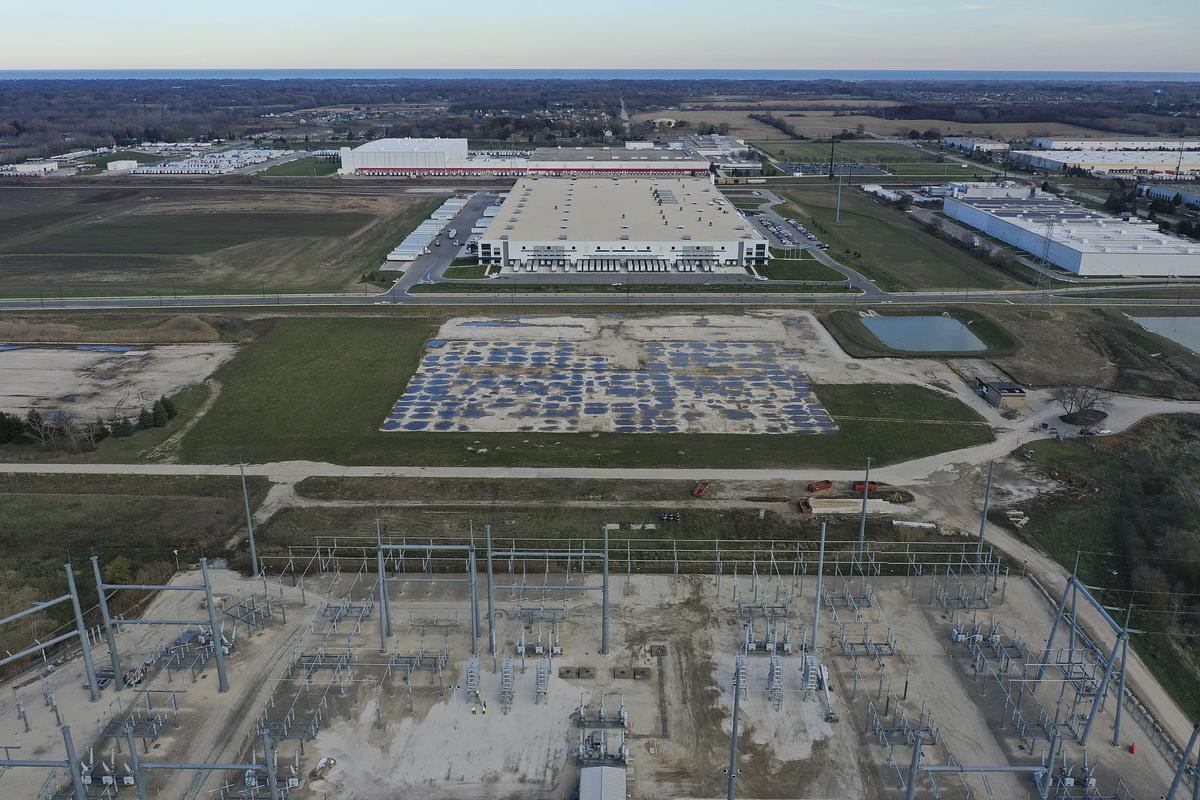
The former site of the We Energies Power Plant on Nov. 13, 2025, in Pleasant Prairie, Wis. (Photo by Joe Timmerman/Wisconsin Watch)
By some measures, the Pleasant Prairie Power Plant, once regarded locally as an “iconic industrial landmark,” had a good run.
Opened in 1980 near Lake Michigan in Kenosha County, it became Wisconsin’s largest generating plant, burning enough Wyoming coal, some 13,000 tons a day, to provide electricity for up to 1 million homes.
But over time, the plant became too expensive to operate. The owner, We Energies, shut it down after 38 years, in 2018.
We Energies customers, however, are still on the hook.
A portion of their monthly bills will continue to pay for Pleasant Prairie until 2039 — 21 years after the plant stopped producing electricity.
In fact, residential and business utility customers throughout Wisconsin owe nearly $1 billion on “stranded assets” — power plants like Pleasant Prairie that have been or will soon be shut down, a Wisconsin Watch investigation found.
That total will likely grow over the next five years with additional coal plants scheduled to cease operations.
Customers must pay not only for the debt taken on to build and upgrade the plants themselves, but also an essentially guaranteed rate of return for their utility company owners, long after the plants stop generating revenue themselves.
“We really have a hard time with utilities profiting off of dead power plants for decades,” said Todd Stuart, executive director of the Wisconsin Industrial Energy Group.
The $1 billion tab looms as Wisconsin utility companies aim to generate unprecedented amounts of electricity for at least seven major high-tech data centers that are proposed, approved or under construction. By one estimate, just two of the data centers, which are being built to support the growth of artificial intelligence, would use more electricity than all Wisconsin homes combined.
All of which raises an important question in Wisconsin, where electricity rates have exceeded the Midwest average for 20 years.
What happens to residents and other ratepayers if AI and data centers don’t pan out as planned, creating a new generation of stranded assets?
How much do Wisconsin ratepayers owe on stranded assets?
Of the five major investor-owned utilities operating in Wisconsin, two — We Energies and Wisconsin Public Service Corp. — have stranded assets on the books. Both companies are subsidiaries of Milwaukee-based WEC Energy Group.
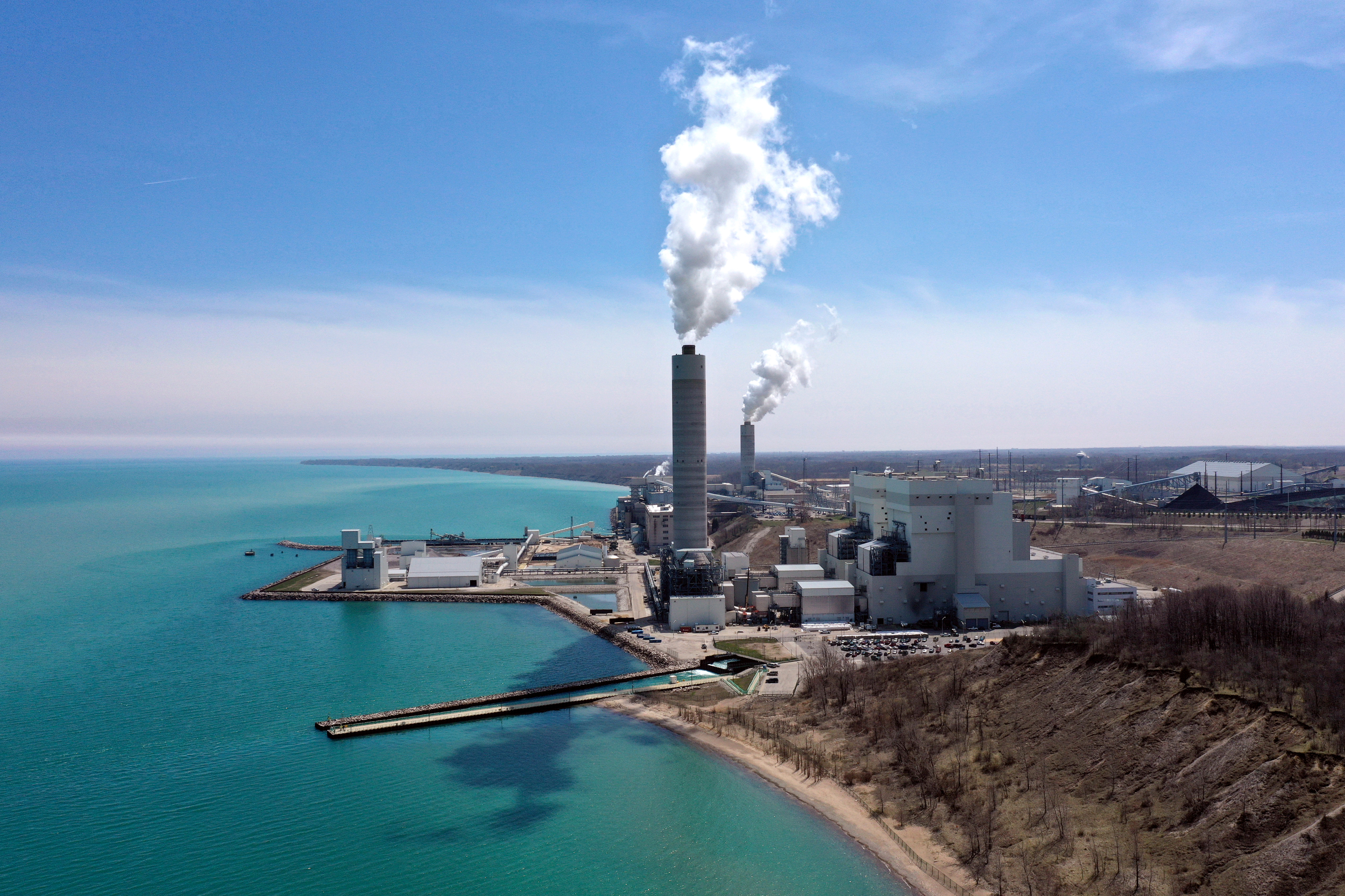
As of December 2024, when the company released its most recent annual report, We Energies estimated a remaining value of more than $700 million across three power plants with recently retired units: Pleasant Prairie, Oak Creek and Presque Isle, a plant on Michigan’s Upper Peninsula.
Wisconsin Public Service Corp.’s December 2024 report listed roughly $30 million in remaining value on recently retired units at two power plants.
In total, utilities owned by WEC Energy Group will likely have over $1 billion in recently retired assets by the end of 2026.
The company also noted a remaining value of just under $250 million for its share of units at Columbia Generating Station slated to retire in 2029, alongside a remaining value of roughly $650 million for units at Oak Creek scheduled to retire next year.
Its customers will pay off that total, plus a rate of return, for years to come.
The company estimates that closing the Pleasant Prairie plant alone saved $2.5 billion, largely by avoiding future operating and maintenance costs and additional capital investments.
Both Wisconsin Power and Light and Madison Gas and Electric also own portions of the Columbia Energy Center, and Wisconsin Power and Light also operates a unit at the Edgewater Generating Station scheduled for retirement before the end of the decade. Neither company provided estimates of the values of those facilities at time of retirement. Andrew Stoddard, a spokesman for Alliant Energy, Wisconsin Power and Light’s parent company, argued against treating plants scheduled for retirement with value on the books as future stranded assets.
How stranded assets occurred: overcommitting to coal
In 1907, Wisconsin became one of the first states to regulate public utilities. The idea was that having competing companies installing separate gas or electric lines was inefficient, but giving companies regional monopolies would require regulation.
Utility companies get permission to build or expand power plants and to raise rates from the three-member state Public Service Commission. The commissioners, appointed by the governor, are charged with protecting ratepayers as well as utility company investors.
A demolition sign is posted at the former site of the We Energies Power Plant on Nov. 13, 2025, in Pleasant Prairie, Wis. (Photo by Joe Timmerman/Wisconsin Watch)
Stranded assets have occurred across the nation, partly because of the cost of complying with pollution control regulations. But another factor is that, while other utilities around the country moved to alternative sources of energy, Wisconsin utilities and, in turn, the PSC overbet on how long coal-fired plants would operate efficiently:
In the years before We Energies pulled the plug on Pleasant Prairie, the plant had mostly gone dark in spring and fall. Not only had coal become more expensive than natural gas and renewables, but energy consumption stayed flat. By 2016, two years before Pleasant Prairie’s closure, natural gas eclipsed coal for electricity generation nationally.
In 2011, We Energies invested nearly $1 billion into its coal-fired Oak Creek plant south of Milwaukee to keep it running for 30 more years. The plant, which began operating in 1965 and later became one of the largest in the country, is now scheduled to completely retire in 2026 — with $650 million on the books still owed. That will cost individual ratepayers nearly $30 per year for the next 17 years, according to RMI, a think tank specializing in clean energy policy. The majority of the debt tied to those units stems from “environmental controls we were required to install to meet federal and state rules,” WEC Energy Group spokesperson Brendan Conway said.
In 2013, to settle pollution violations, Alliant Energy announced an investment of more than $800 million in the Columbia Energy Center plant in Portage, north of Madison. But by 2021, Alliant announced plans to begin closing the plant, though now it is expected to operate until at least 2029.
Various factors encourage construction and upgrades of power plants.
Building a plant can create upwards of 1,000 construction jobs, popular with politicians. Moreover, the Public Service Commission, being a quasi-judicial body, is governed by precedent. For example, if the PSC determined it was prudent to allow construction of a utility plant, that finding would argue in favor of approving a later expansion of that plant.
The PSC allowed utility companies “to overbuild the system,” said Tom Content, executive director of the Wisconsin Citizens Utility Board, a nonprofit advocate for utility customers. “I think the mistake was that we allowed so much investment, and continuing to double down on coal when it was becoming less economic.”
Utilities “profit off of everything they build or acquire,” Stuart said, “and so there is a strong motivation to put steel in the ground and perhaps to even overbuild.”
Conway, the WEC Energy Group spokesperson, argued that the utilities’ plans to retire plants amount to a net positive for customers.
“We began our power generation reshaping plan about a decade ago,” he wrote in an email. “That includes closing older, less-efficient power plants and building new renewable energy facilities and clean, efficient natural gas plants. This plan reduces emissions and is expected to provide customers significant savings — hundreds of millions of dollars — over the life of the plan.”
Guaranteed profits add to ratepayer burden
The built-in profits that utility companies enjoy, typically 9.8%, add to the stranded assets tab.
When the Public Service Commission approves construction of a new power plant, it allows the utility company to levy electricity rates high enough to recover its investment plus the specified rate of return — even after a plant becomes a stranded asset.
The former site of the We Energies Power Plant on Nov. 13, 2025, in Pleasant Prairie, Wis. (Photo by Joe Timmerman/Wisconsin Watch)
“We give them this license to have a monopoly, but the challenge is there’s no incentive for them to do the least-cost option,” Content said. “So, in terms of building new plants, there’s an incentive to build more … and there’s incentive to build too much.”
When the Pleasant Prairie plant was shut down in 2018, the PSC ruled that ratepayers would continue to pay We Energies to cover the cost of the plant itself, plus the nearly 10% profit. The plant’s remaining value, initially pegged at nearly $1 billion, remained at roughly $500 million as of December 2024.
Eliminating profits on closed plants would save ratepayers $300 million on debt payments due to be made into the early 2040s, according to Content’s group.
New ‘stranded assets’ threat: data centers
As artificial intelligence pervades society, it’s hard to fathom how much more electricity will have to be generated to power all of the data centers under construction or being proposed in Wisconsin.
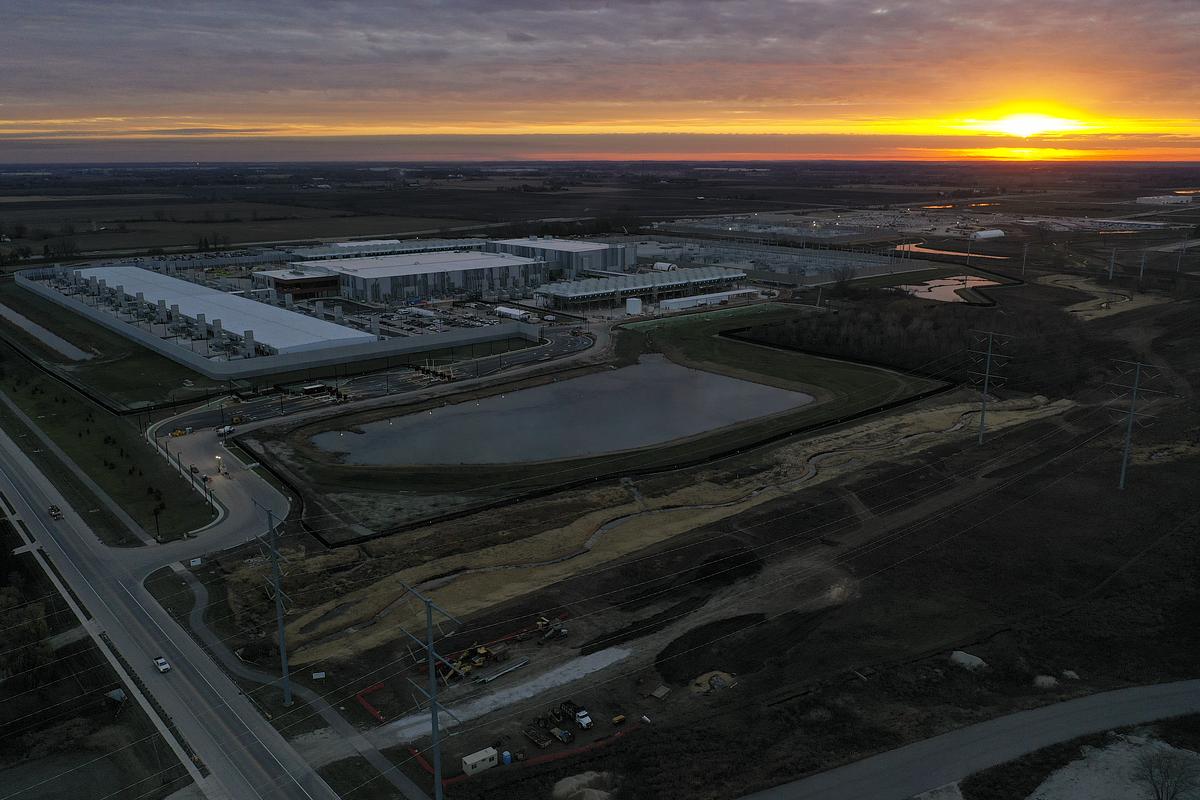
We Energies alone wants to add enough energy to power more than 2 million homes. That effort is largely to serve one Microsoft data center under construction in Mount Pleasant, between Milwaukee and Racine, and a data center approved north of Milwaukee in Port Washington to serve OpenAI and Oracle AI programs. Microsoft calls the Mount Pleasant facility “the world’s most powerful data center.”
Data centers are also proposed for Beaver Dam, Dane County, Janesville, Kenosha and Menomonie.
The energy demand raises the risk of more stranded assets, should the data centers turn out to be a bubble rather than boom.
“The great fear is, you build all these power plants and transmission lines and then one of these data centers only is there for a couple years, or isn’t as big as promised, and then everybody’s left holding the bag,” Stuart said.
The sun sets as construction continues at Microsoft’s data center project on Nov. 13, 2025, in Mount Pleasant, Wis. (Photo by Joe Timmerman/Wisconsin Watch)
In an October Marquette Law School poll, 55% of those surveyed said the costs of data centers outweigh the benefits. Environmental groups have called for a pause on all data center approvals. Democratic and Republican leaders are calling for data centers to pay their own way and not rely on utility ratepayers or taxpayers to pay for their electricity needs.
Opposition in one community led nearly 10,000 people to become members of the Stop the Menomonie Data Center group on Facebook. In Janesville, voters are trying to require referendums for data centers. In Port Washington, opposition to the data center there led to three arrests during a city council meeting.
Utilities are scheduled in early 2026 to request permission from the Public Service Commission to build new power plants or expand existing plants to accommodate data centers.
Some states, such as Minnesota, have adopted laws prohibiting the costs of stranded assets from data centers being passed onto ratepayers.
Wisconsin has no such laws.
Shifting cost burden to utility companies
Currently, ratepayers are on the hook for paying off the full debt of stranded assets — unless a financial tool called securitization reduces the burden on ratepayers.
Securitization is similar to refinancing a mortgage. With the state’s permission, utilities can convert a stranded asset — which isn’t typically a tradeable financial product — into a specialized bond.
Utility customers must still pay back the bond. But the interest rate on the bond is lower than the utility’s standard profit margin, meaning customers save money.
A 2024 National Association of Regulatory Utility Commissioners report noted that utilities’ shareholders may prefer a “status quo” scenario in which customers pay stranded asset debts and the standard rate of return. Persuading utilities to agree to securitization can require incentives from regulators or lawmakers, the report added.
In some states, utilities can securitize the remaining value of an entire power plant. Michigan utility Consumers Energy, for instance, securitized two coal generating units retired in 2023, saving its customers more than $120 million.
In Wisconsin, however, utilities can securitize only the cost of pollution control equipment on power plants — added to older coal plants during the Obama administration, when utilities opted to retrofit existing plants rather than switching to new power sources.
The Oak Creek Power Plant and Elm Road Generating Station, seen here on April 25, 2019, in Oak Creek, Wis., near Milwaukee, are coal-fired electrical power stations. (Photo by Coburn Dukehart/Wisconsin Watch)
In 2023, two Republican state senators, Robert Cowles of Green Bay and Duey Stroebel of Saukville, introduced legislation to allow the Public Service Commission to order securitization and allow securitization to be used to refinance all debt on stranded assets. The bill attracted some Democratic cosponsors, but was opposed by the Wisconsin Utilities Association and did not get a hearing.
Democratic Gov. Tony Evers proposed additional securitization in his 2025-27 budget, but the Legislature’s Republican-controlled Joint Finance Committee later scrapped the provision.
Even Wisconsin’s narrow approach to securitization is optional, however, and most utilities have chosen not to use it.
We Energies was the first Wisconsin utility to do so, opting in 2020 to securitize the costs of pollution control equipment at the Pleasant Prairie plant. Wisconsin’s Public Service Commission approved the request, saving an estimated $40 million. “We will continue to explore that option in the future,” Conway said.
But the PSC expressed “disappointment” in 2024 when We Energies “was not willing to pursue securitization” to save customers $117.5 million on its soon-to-retire Oak Creek coal plant. The utility noted state law doesn’t require securitization.
Stuart said that if utilities won’t agree to more securitization, they should accept a lower profit rate once an asset becomes stranded.
“It would be nice to ease that burden,” he said. “Just to say, hey, consumers got to suck it up and deal with it, that doesn’t sound right. The issue of stranded assets, like cost overruns, is certainly ripe for investigation.”
Comprehensive planning required elsewhere — but not Wisconsin
Avoiding future stranded assets could require a level of planning impossible under Wisconsin’s current regulatory structure.
When the state’s utilities propose new power plants, PSC rules require the commission to consider each new plant alone, rather than in the context of other proposed new plants and the state’s future energy needs. Operating without what is known as an integrated resource plan, or IRP, opened the PSC to overbuilding and creating more stranded assets. IRPs are touted as an orderly way to plan for future energy needs.
“There’s no real comprehensive look in Wisconsin,” Stuart said. “We’re one of the few regulated states that really doesn’t have a comprehensive plan for our utilities.
”We’ve been doing some of these projects kind of piecemeal, without looking at the bigger picture.”
Protesters speak against a proposed natural gas power plant in Oak Creek, Wis., on March 25, 2025. (Photo by Julius Shieh/Milwaukee Neighborhood News Service)
Structured planning tools like IRPs date back to the 1980s, when concerns about cost overruns, fuel price volatility and overbuilding prompted regulators to step in. Minnesota and Michigan require utilities to file IRPs, as do a majority of states nationwide.
Evers proposed IRPs in his 2025-27 state budget, but Republican lawmakers removed that provision because it was a nonfiscal policy issue.
Northern States Power Company, which operates in Wisconsin and four other Midwestern states, is required by both Michigan and Minnesota to develop IRPs. “Because of these rules, we create a multi-state IRP every few years,” said Chris Ouellette, a spokesperson for Xcel Energy, the utility’s parent company.
Madison Gas and Electric, which only operates in Wisconsin, argued that its current planning process is superior to the IRP requirements in neighboring states. “A formal IRP mandate would add process without improving outcomes,” spokesperson Steve Schultz said. “Wisconsin’s current framework allows us to move quickly, maintain industry-leading reliability and protect customer costs during a period of rapid change.”
How to influence decisions relating to stranded assets
The devil will be in the details on whether the Public Service Commission adopts strong policies to prevent the expected wave of new power plant capacity from becoming stranded assets, consumer advocates say.
The current members, all appointed by Evers, are: chairperson Summer Strand, Kristy Nieto and Marcus Hawkins.
The public can comment on pending cases before the PSC via its website, by mail or at a public hearing. The commission posts notices of its public hearings, which can be streamed via YouTube.
Barbed wire fence surrounds the former site of the We Energies Power Plant on Nov. 13, 2025, in Pleasant Prairie, Wis. (Photo by Joe Timmerman/Wisconsin Watch)
Among the upcoming hearings on requests by utilities to generate more electricity for data centers:
Feb. 12: We Energies’ request to service data centers in Mount Pleasant and Port Washington. We Energies says the fees it proposes, known as tariffs, will prevent costs from being shifted from the data centers to other customers. The “party” hearing is not for public comment, but for interaction between PSC staff and parties in the case, such as We Energies and public interest groups.
Feb. 26: Another party hearing for a case in which Alliant Energy also said its proposed tariffs won’t benefit the data center in Beaver Dam at the expense of other customers.
To keep abreast of case developments, the PSC offers email notifications for document filings and meetings of the commission.
The PSC would not provide an official to be interviewed for this article. It issued a statement noting that utilities can opt to do securitization to ease the financial burden on ratepayers, adding:
“Beyond that, the commission has a limited set of tools provided under state law to protect customers from costs that arise from early power plant retirements. It would be up to the state Legislature to make changes to state law that would provide the commission with additional tools.”
On Nov. 6, state Sen. Jodi Habush Sinykin, D-Whitefish Bay, and Rep. Angela Stroud, D-Ashland, announced wide-ranging data center legislation. One provision of their proposal aims to ensure that data centers don’t push electricity costs onto other ratepayers.
Wisconsin’s aging population and large agriculture sector complicate the picture of how the labor market is doing, says UW-La Crosse economist Marissa Eckrote-Nordland.
President Donald Trump addresses the nation in an address from the Diplomatic Room of the White House on Dec. 17, 2025. (Photo by Doug Mills - Pool/Getty Images)
WASHINGTON — As Americans continue to face rising prices ahead of year-end holidays, President Donald Trump blamed inflation and health care costs on his predecessor during a prime-time speech Wednesday in which he also claimed to have fixed the issues.
Trump “inherited a mess” and has turned the United States into the “envy of the entire globe” by imposing an immigration crackdown, tariffs and tax breaks, he said.
“Over the past 11 months, we have brought more positive change to Washington than any administration in American history. There’s never been anything like it, and I think most would agree I was elected in a landslide,” Trump said.
Standing before a backdrop of Christmas decorations, Trump also promised $1,776 checks would arrive for members of the United States military by Christmas.
And he continued to blame Democrats for health care costs that are projected to skyrocket next month when tax credits for Affordable Care Act marketplace plans expire.
Nearly a year into his second term, Trump remains fixated on blaming former President Joe Biden even as his own approval ratings sink, according to numerous recent polls.
A plaque below Biden’s photo in Trump’s newly installed “Presidential Walk of Fame” display reads “Sleepy Joe Biden,” according to reports from journalists present at the White House Wednesday.
“When I took office, inflation was the worst in 48 years, and some would say in the history of our country, which caused prices to be higher than ever before, making life unaffordable for millions and millions of Americans. This happened during a Democrat administration, and it’s when we first began hearing the word ‘affordability,’” Trump said.
Consumer price index data released Thursday for September through November show the overall cost of goods rose 2.7% over the past 12 months, after rising 3% for the 12 months recorded at the end of September, according to the Bureau of Labor Statistics. When Trump took office in January 2025, it was 3% over the previous 12 months. The bureau did not analyze data for October 2025 because of the government shutdown.
In recent weeks, Trump has said “affordability” is a “hoax.”
Yet the bulk of Trump’s somewhat hastily scheduled address — the White House announced it Tuesday — focused on lowering costs for housing, electricity and health care.
Trump announced he will send a $1,776 “warrior dividend” to every U.S. servicemember. The amount is in honor of the year of the country’s founding, Trump said. Checks are “already on the way,” he said.
That could add up to as much as $2.6 billion, according to a White House estimate Wednesday night that 1.45 million service members would receive the payment.
Health care costs
He also touted trumprx.gov, where he said Americans can find “unprecedented price reductions” on prescription drugs starting in January.
“These big price cuts will greatly reduce the cost of health care,” Trump said.
He boosted a Republican plan on Capitol Hill to fund individual health savings accounts, or HSAs, in annual amounts of $1,000 to $1,500 depending on age and poverty level. An HSA is not health insurance.
“I want the money to go directly to the people so you can buy your own health care. You’ll get much better health care at a much lower price,” Trump said.
Four House Republicans defected Wednesday to sign a Democrat-led petition to bypass Speaker Mike Johnson, R-La., and force a floor vote in January on extending health insurance premium subsidies for people who buy insurance on the Affordable Care Act marketplace.
‘My favorite word’
Trump spent several minutes addressing the economy, stating that prices on groceries and fuel are coming down. Both claims are false, according to government data.
“I am bringing those high prices down and bringing them down fast,” Trump said.
The latest consumer price index for September showed gasoline prices rose 4.1% over the past 12 months, and “was the largest factor in the all items monthly increase,” increasing 1.5% over the previous month.
Food prices rose faster than overall inflation in recent months, according to the government’s latest data. Food prices in August were 3.2% higher than a year ago, according to the data.
Still, Trump claimed an economic turnaround that he credited to his international trade policy.
“Much of this success has been accomplished by tariffs — my favorite word ‘tariffs’ — which for many decades have been used successfully by other countries against us, but not anymore,” he said.
The U.S. ended fiscal year 2025 with a deficit reaching nearly $1.8 trillion, or roughly 6% of the domestic economy’s gross domestic product.
Trump unilaterally imposed a global 10% tariff on all foreign goods in April, plus higher tariffs on many major trading partners, including the European Union, Japan, South Korea and Vietnam. The Supreme Court is expected to rule soon on whether Trump’s emergency tariffs are legal.
The U.S. collected nearly $195 billion in customs duties in fiscal year 2025, up from $77 billion in fiscal 2024, according to the U.S. Treasury’s monthly statement.”
Americans have lost faith in Trump’s ability to handle the economy, according to an NPR/PBS News/Marist poll published Wednesday.
Trump received a 36% approval rating on his economic strategy, the lowest rating over the past six years that the survey has asked voters the question.
A Fox News poll released Nov. 19 found 76% of respondents saw the economy negatively. Of all voters polled, 41% approved and 58% disapproved of Trump’s performance. That’s down from the conservative news network’s poll of Biden’s approval ratings during the same point in his presidency, which the network says was 44%.
Mum on Venezuela
The president did not spend much time addressing his military campaign off the coast of Venezuela, despite declaring just 24 hours beforehand that the U.S. had formed a “blockade” in the Caribbean Sea.
Trump posted on his own social media platform Truth Social Tuesday night that Venezuela is “completely surrounded by the largest Armada ever assembled in the History of South America.”
The campaign, which has become top of mind for many lawmakers on Capitol Hill, is about preventing drug smuggling to the U.S., Trump and Republican lawmakers have repeatedly said.
Democratic lawmakers are pressing the Trump administration to release unedited footage of a Sept. 2 strike that killed two shipwrecked individuals who were clinging to what was left of a boat after an initial strike.
December 18, 20259:30 amThis report was updated to reflect new Consumer Price Index data on inflation released Thursday.

 Login
Login