The cheapest Model 3 lease now works out to $418 per month in the US.
The Performance version comes to $731 monthly over 36 months.
Lease prices across the lineup have climbed by as much as 12 percent.
Leasing a Tesla Model 3 in the US has just gotten more expensive, so anyone hoping to get behind the wheel of a new one may find that paying cash makes more sense than signing a lease, at least in some cases.
Lease prices have crept up quietly across the entire Model 3 family, and the increases start with the base Rear-Wheel Drive model, which now runs $379 per month over 36 months with an annual mileage cap of 10,000 miles. That figure looks reasonable enough on its own, but it leaves out the $4,075 due at delivery, a sum made up of a $3,000 down payment, the first monthly payment, and an acquisition fee.
After factoring this in, you get an effective rate of $481 per month, which is roughly 12 percent higher than earlier this year. As recently as last week, the EV was offered at $329 per month with a lower $4,024 fee due at signing.
Lease prices have also increased for other Model 3 variants. For example, the Premium Rear-Wheel Drive commands $399 per month over 36 months, excluding the $4,094 fee that’s due up front. Add that into the equation, and you’re looking at an effective rate of $501. The Premium All-Wheel Drive is more expensive at $479 per month with a higher fee of $4,174, meaning it works out to $581 per month over the life of the lease.
Then there’s the Model 3 Performance. It has a monthly lease of $629 plus the $4,324, which is due at delivery. Do the math, and it works out to $731 per month for 36 months.
While this is roughly 4.3 percent higher than previously, it’s not necessarily a bad deal. Earlier this year, Hyundai was offering the Ioniq 5 N for $699 per month over 36 months with $3,999 due at signing, working out to $810 per month.
Used EV prices rose sharply in the US while overall used market softened.
Tesla models dominated price increases but 911 values dropped by 10 %.
Higher fuel costs due to Iran war may have pushed shoppers back to EVs.
For the past few years, buying a used EV has been a waiting game, with would-be buyers often waiting for prices to fall a little further. That strategy may no longer be paying off. Used electric vehicle prices are climbing rapidly while the rest of the used car market continues to drift in the opposite direction, making dream cars like the Porsche 911 more affordable.
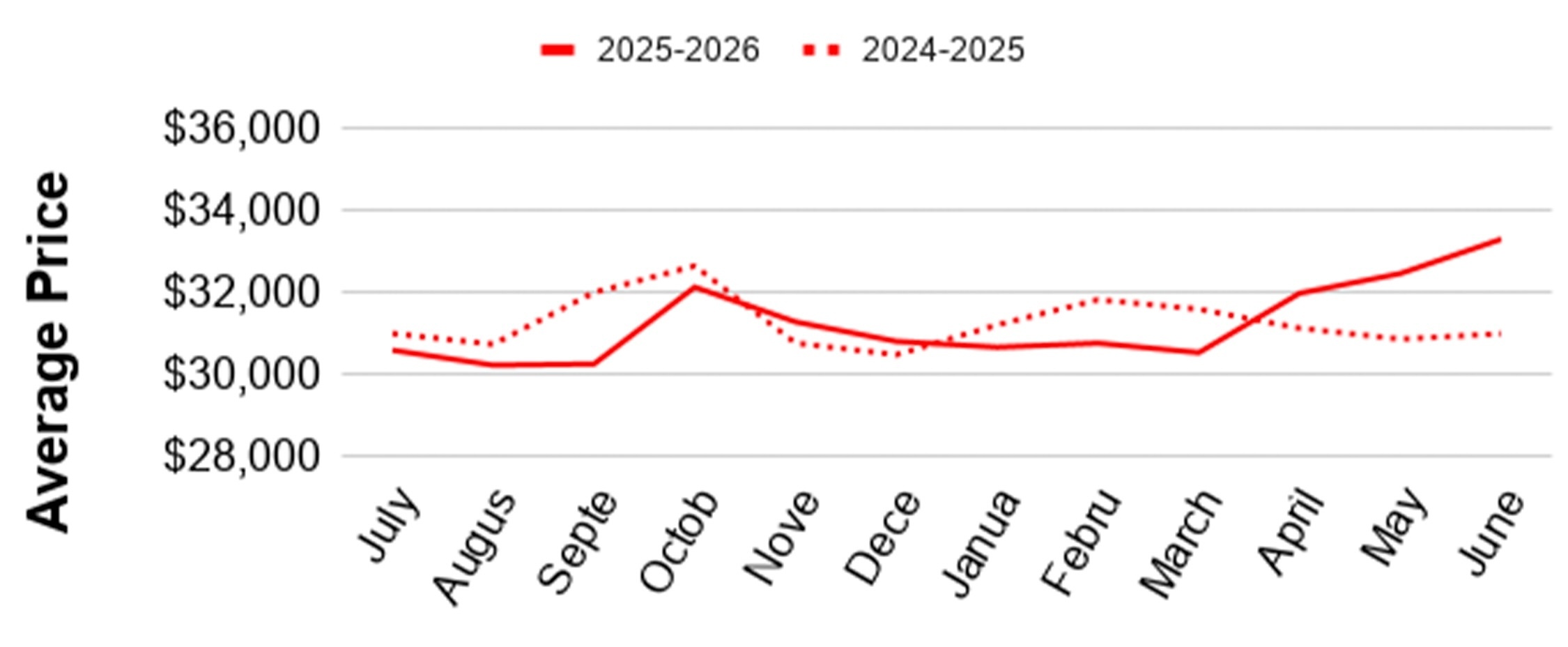
New data from iSeeCars suggests the turnaround isn’t a one-month anomaly, either. Used EV prices have now posted three straight months of year-over-year gains, moving from a 2.7 percent increase in April to 5.2 percent in May before reaching 7.4 percent in June.
That pushed the average price of a one- to five-year-old used EV to $33,305 in June. Compared with the same month last year, that’s an increase of $2,308. Meanwhile, the average used vehicle price fell by 1.3 percent year over year, highlighting just how differently the EV segment is behaving.
Rising fuel costs may have helped trigger the shift, iSeeCars Executive Analyst Karl Brauer logically suggests. Gasoline prices rose sharply during the Iran conflict earlier this year, but it took several weeks before buyers adjusted their shopping habits and begin gravitating back toward EVs.
Average 1-5 YO EV Prices
Tesla was the biggest beneficiary of the trend. All four of the brand’s core models landed among the 10 used vehicles with the largest year-over-year price increases. The Model X led the entire market, jumping 17.5 percent to an average price of $60,950.
The Model 3 wasn’t far behind with a 13.5 percent increase, while the Model S climbed 13.1 percent and the Model Y gained 12.0 percent. “Tesla makes up nearly half of the top 10 used models with the highest price increase,” Brauer noted.
Perhaps just as telling is what didn’t appear in the rankings. Not a single EV showed up among the 20 used vehicles with the steepest price declines. Instead, that list was populated by a mix of luxury vehicles, pickups, SUVs, hybrids, and conventional gasoline-powered models. The Lincoln Corsair posted the biggest percentage value drop (-14.7 %), but the Porsche 911 was right behind it (-10.6 %), and reminds us that there’s a silver lining to every cloud.

 Login
Login