Reading view

There are new articles available, click to refresh the page.

The Fun 2026 Renault 5 EV America Will Never Get To Buy | Review

PROS ›› Design, exceptional ride, handling, equipment CONS ›› Rear legroom, limited range on the highway

Plenty of carmakers reach into their own past and come back with clumsy pastiche. Renault is one of the few that gets it right. The R5 E-Tech is among the more desirable electric subcompacts in Europe right now, so we took the keys for a week to find out whether it holds up as something you actually live with.

The production version landed in 2024, three years after the concept, carrying retro-futuristic styling that reaches back to the original R5 of 1972. The French subcompact serves as a zero-emission alternative to the closely sized Clio and a successor to the aging Zoe, while sitting just above the Twingo E-Tech that has only recently joined the range.

None of this is coming to America. Renault left the US decades ago, and the R5 was built around European prices, European streets, and European tastes, with no plan to cross the Atlantic. So consider this a look at the charming little electric hatch America would probably love but can’t have.

More: Renault Finally Has A Proper Premium SUV, But Europe Doesn’t Get It

Our press car is the flagship Iconic trim painted in the striking but optional Pop Yellow shade with a sparkle effect, arguably the best fit for the new R5. The vivid color comes paired with a Diamond Black roof, a red accent strip along the flank, and 18-inch Chrono alloys, though I would take the Techno wheels given the choice. Iconic trim is also the only way to get the stronger 148 hp electric motor and the larger 52 kWh battery pack.

QUICK FACTS
› Model2026 Renault 5 E-Tech Iconic
› PowertrainSingle Electric Motor (FWD)
› Output148 hp (110 kW / 150 PS)
› Torque245 Nm (180 lb-ft)
› 0-100 km/h (0-62 mph)8.0 seconds*
› Top Speed150 km/h (93 mph)*
› Battery52 kWh Lithium-ion
› Range (WLTP)410 km (255 miles)
› Dimensions154.4 in L x 69.8 in W x 59 in H (3,922 x 1,774 x 1,498 mm)
› Wheelbase100 in (2,540 mm)
› Boot Capacity326 lt (11.5 cubic feet)
› Curb Weight1,524 kg (3,360 lbs)*
› Price (Greece)from €33,200 ($39,100)
SWIPE

*Manufacturer

\\\\\\\\\\\\\\

Photos Thanos Pappas for Carscoops

Looks are subjective, but everyone I interacted with had good things to say about the design of the R5, which turned more heads than most press cars I have reviewed. Besides the exotic color, my favorite details are the vertical LED taillights with a three-dimensional finish, the sculpted fenders, and the rally-style DRLs on the front bumper.

More: Renault’s New Electric Van Probably Looks Better Than Your Car

The result is a car with a sporty, playful character that is genuinely hard to ignore in a market drowning in interchangeable SUVs.

I am also taken with the small bump on the hood, a clear callback to the cooling vents of the classic 5 that earns its keep functionally too. Walk up to the car and the 5 emblem lights up in segments, reading out the battery charge level before you have even opened the door.

Premium Tech In A Small Package

\\\\\\\\\\\\\\\\\\\\\\

Photos Thanos Pappas for Carscoops

The interior is filled with tech, especially in the flagship Iconic trim. The rather bulky digital cockpit sits high, comprising a 10.3-inch digital instrument cluster that changes colors depending on the driving mode and a crisp 10.1-inch touchscreen that’s slightly angled towards the driver.

Review: The 2026 Renault Austral Facelift Is Polished, But It Has A BMW-Sized Problem

Renault’s Google-powered OpenR infotainment has intuitive menus and connects seamlessly to a smartphone. More importantly, it is joined by a row of physical climate controls on the center console. The only ergonomic foul is the volume buttons which are awkwardly positioned on top of the screen, although there is a dedicated stalk behind the steering wheel for easier operation.

Another slightly irritating thing is that the ChatGPT-powered “Reno” AI assistant kept popping up at irrelevant times during my conversation with the front passenger, reminding me of the animated paperclip from the old Windows Office.

The buttons on the steering wheel control most functions, including a Multi Sense button for switching drive modes (Eco, Comfort, Sport, Perso). The gear stalk only has drive and reverse, leaving park out of the equation. Equipment is quite generous with heated seats and steering wheel, wireless charging, and a full suite of ADAS including an auto parking function that works great.

\\\\\\\\\\\\\\

Photos Thanos Pappas for Carscoops

In terms of materials, Renault’s color a trim department did a great job in creating a youthful environment. The yellow recycled textile on the seats and front doors is a nice touch, paired with synthetic leather and yellow stitch, also found on the passenger side of the dashboard.

More: Radical Espace Reboot Leads Renault’s 36-Car Plan To Fight China’s Threat

As for practicality, the rear seats of the 3,922 mm (154.4 inches) long hatchback might feel cramped for tall passengers if they sit behind a tall driver. Legroom and headroom are tighter than a Fiat Grande Panda, although adequate for an urban-focused offering. The boot has a capacity of 326 lt (11.5 cubic feet) which is slightly above average for the segment. Don’t look for a frunk as the electric motor takes up all of the space under the hood.

Sharp Reflexes and Highway Manners

On the road, the Renault 5 E-Tech clearly punches above its weight. The real surprise is the balanced chassis setup with the sophisticated multi-link rear axle giving it the ride refinement of a much larger vehicle.

\\\\\\\\\\

Photos Thanos Pappas for Carscoops

The suspension soaks up potholes in the city and make it a comfortable cruiser on the highway where you’ll appreciate the exceptional noise insulation. At the same time, it is firm enough to stay flat and composed on a twisty road. The planted stance and low center of gravity are combined with a direct and communicative steering which is a rarity among modern EVs.

More: Ford Turns To French Carmaker To Revive Fiesta

The front mounted electric motor produces up to 148 hp (110 kW / 150 PS) which feels like the right number for the size and positioning of the EV, making me wonder if the Alpine A290 is really necessary. While the R5 is far from Tesla-fast with a 0-100 km/h (0-62 mph) acceleration in a modest 8 seconds, the power delivery is more usable and natural, especially to those coming from a combustion vehicle.

\\\\\\\\\\\\\\\\\\\\

Photos Thanos Pappas for Carscoops

In the city, it is helpful to use the B function with regenerative braking every time you lift off the throttle. I was going to complain about the lack of a one-pedal drive function although this was recently added to the Techno and Iconic trims with the more potent engine. Still, this won’t be offered as an update to existing owners.

Range And Charging

The 52 kWh battery pack offers a claimed WLTP range of up to 410 km (255 miles), which sounds far better than the 300 km (186 miles) of the smaller 40 kWh unit. In real life, you can easily match and surpass the 400 km (249-mile) barrier within an urban environment, where the EV is surprisingly efficient.

On the highway you’re probably looking at something closer to 250 km (155 miles) depending on the conditions and the speed.

\\\\\\\

Photos Thanos Pappas for Carscoops

During my time with the EV, I completed a 240 km (150-mile) highway trip without a charging stop. I had the A/C on and kept a stable 120 km/h (75 miles) speed for the most part, arriving to my destination with 10% battery charge and 40 km (25 miles) of remaining range.

More: The World’s Favorite Renault Got Longer, Wider And Weirder

However, the returning trip was different. While I traveled at similar speeds and even used the Eco mode that limits power and drops the top speed to 115 km/h (72 mph), I was forced to stop on the way as the range estimate was not enough to complete the trip. Thankfully, I found a fast charger so I only needed to stop for about 15 minutes to get back to a safe range estimate.

The R5 is capable of 100 kW fast charging, taking the battery from 15-80% in 30 minutes. Using a standard 11 kW wall box, a full charge takes around 4.5 hours. Furthermore, the model has V2L capability with a special adapter.

Pricing And Rivals

\\\\\\\\\

Photos Thanos Pappas for Carscoops

In Greece, where we tested it, the R5 E-Tech range opens with the Evolution trim at €26,900 ($31,700), or €22,400 ($26,400) once the local EV subsidies are applied. Keep in mind, prices include VAT (sales tax), which in the case of EVs is at the reduced rate of 13% rather than the standard 24%, as well as delivery fees.

Base kit is generous, but the entry car comes only with the smaller 40 kWh battery and the 118 hp (88 kW / 120 PS) motor. Step up to the mid-spec Tecno and you can have the 52 kWh battery paired with the 148 hp (110 kW / 150 PS) motor, priced at €33,200 ($39,100). The flagship Iconic, with the full features list, lands at €35,200 ($41,500) before subsidies.

More: VW’s New ID. Polo Starts Under $30K And Comes With Massage Seats

Overall, the cheapest R5 E-Tech closely matches the more budget-oriented and family-friendly Fiat Grande Panda Electric, while high-spec trims are priced on par with the base Mini Cooper E. Other contestants in the subcompact segment include the Peugeot e-208, Opel Corsa-e, Lancia Ypsilon Elettrica, and Citroen e-C3.

Still, the biggest rivals of the French EV are the upcoming VW ID.Polo and Hyundai Ioniq 3, both expected to hit European roads in the coming months. The R5 also faces strong internal competition from the new Renault Clio Full Hybrid E-Tech, especially for buyers who don’t have access to a home charger.

Notably absent from that list is the United States. In Greece the R5’s high trims line up on price against the base Mini Cooper E, a car Americans can actually buy. The Renault sitting next to it at the same money, the more characterful of the two, is the one they cannot.

Verdict

 The Fun 2026 Renault 5 EV America Will Never Get To Buy | Review

After spending a week with the Renault 5 E-Tech, I found myself just as excited as the day I first picked up the keys. This small hatchback successfully balances a sporty, playful character with genuine everyday usability.

Besides its stunning looks, the R5 makes a compelling case for the ideal second vehicle, one that excels as a refined urban dweller while remaining equally capable of handling weekend getaways, comfortable highway stints, and spirited runs on twisty B-roads.

While it may not offer segment-leading interior space, and the desirable high-spec flagship trim carries a premium price tag, the R5 is a car that never fails to put a smile on your face, making you feel several years younger.

Photos and Videos: Thanos Pappas for Carscoops

We Drove The 2026 Lexus ES Hybrid And EV, And One Version Stands Out | Review

PROS ›› Classy cabin, great fuel economy, spacious second row CONS ›› A bit boring to drive, some questionable materials, no RWD

For decades, the Lexus ES has existed in a comfortable little bubble. Buyers loved it because it was quiet, reliable, spacious, and almost aggressively committed to not upsetting anyone. It wasn’t sporty, it wasn’t especially daring, and if you asked enthusiasts about it, many would respond with a shrug and a comment about retirement communities.

That wasn’t really criticism either. Lexus knew exactly what the ES was and, more importantly, who it was for. The formula worked so well that the brand had little reason to mess with it. Why reinvent a luxury sedan that’s spent years quietly printing money? Now Lexus says it’s broadened the ES formula.

Read: The First Electric Lexus ES Actually Costs Less Than The Hybrid

After driving the all-new 2026 ES lineup around San Diego, including the ES 350h AWD hybrid, ES 350e, and range-topping ES 500e AWD, there’s evidence the company wasn’t just tossing around marketing jargon. The eighth-generation ES is a big change. It’s literally larger in every direction, rides on a new multi-pathway architecture supporting both hybrid and EV variants, and, for the first time ever, gets fully electric versions.

That also created an unusual challenge for this review. The new ES is really two different cars wearing nearly identical sheet metal. One relies on Lexus’ latest hybrid system while the other embraces full electrification, and they deliver very different experiences from behind the wheel. So rather than force them into one giant blended driving section, we’re splitting that section of this review into two. One set of impressions for the hybrid and another for the EVs.
QUICK FACTS
› Model:2026 Lexus ES
› Starting Price:$48,895–$60,295 + $1,395 destination (depending on trim/powertrain)
› Dimensions:202.4 in L x 75.6 in W x 61.2 in H (5,141 x 1,920 x 1,554 mm)
› Curb Weight:Hybrid: 4,001–4,134 lbs (1,815–1,875 kg)

EV: 4,608–4,928 lbs (2,090–2,235 kg)
› Powertrain:ES 350h – 2.5-liter four-cylinder hybrid + rear electric motor, eCVT AWD
ES 350e – Single Motor FWD electric
ES 500e – Dual-motor AWD electric
› Output:ES 350h – 244 hp (182 kW)
ES 350e – 221 hp (167 kW) / 198 lb-ft (268 Nm)
ES 500e – 338 hp (252 kW)
› MPG / Range:Hybrid – 47 city / 42 highway / 44 combined MPG (AWD)
Electric – 272–307 miles EPA-estimated
› On Sale:Hybrid – June 2026
Electric – Now
SWIPE

Because after spending a day hopping between all three variants, one thing became clear: they may look nearly identical, and sitting in them produces the same vibe… but they absolutely don’t feel identical once you’re moving. So did Lexus finally build an ES with some personality? Or is this just a modernized appliance for those who don’t really love driving to begin with? Read on to find out.

Styling

\\\\\\\\\

Aside from actual ES owners and sincere fans, most folks probably couldn’t provide many details about what the ES generations look like from one to the next. Most blended into traffic so effectively that you could probably lose one in a Costco parking lot within minutes. Not this one.

The new ES genuinely looks striking. During our drive, it repeatedly turned heads and, at one point, one distracted Mazda driver seemed more interested in staring at the Lexus than the road ahead. That’s anecdotal, sure, but the point stands. People noticed it.

The side profile is dominated by an enormous character strake that feels very Lexus. It very much reminds me of the Maxwell tape ad “Blown Away Guy.” Some people are going to hate it. Others will love it. That’s okay. Lexus has spent years pushing design further than Toyota, and it continues doing exactly that here.

 We Drove The 2026 Lexus ES Hybrid And EV, And One Version Stands Out | Review

The hood itself is wild too. There are creases and surfacing details piled on top of more creases and surfacing details. Exhibit should pop out any moment, asking if we wanted creases on our creases. Depending on your taste, it’ll either feel bold or overworked. It’s probably one of the many touches Lexus is using to make this look as far afield from a Toyota product as it can.

The rear, meanwhile, is where things come together best. The Blade-style taillight treatment works, the proportions are cleaner than before, and the trunk opens surprisingly wide. Useful details still matter in a sedan like this. Dimensionally, this thing has grown significantly too. Wheelbase stretches to 116.1 inches, while total length swells to 202.4 inches.

Cabin Appointments

\\\\\\\\\\

The cabin immediately creates a strong first impression. The seats are excellent. Bolstering is good, thigh support is good, visibility is good, and the seating position doesn’t leave you perched awkwardly high like some modern luxury vehicles (especially electrified ones). Add in the massage functionality, and long highway drives should be easy work.

Fit and finish are generally impressive, too. This isn’t a flagship, but that doesn’t mean that Lexus suddenly abandoned quality. Panel fit felt mature and well-sorted. The available bamboo trim also deserves praise. It looks genuinely interesting and, importantly, it’s real material rather than some totally fake printed substitute. Luxury trims get illuminated bamboo layering integrated into the cabin design as well.

Of course, then you start touching things, and a few cracks begin to appear.

 We Drove The 2026 Lexus ES Hybrid And EV, And One Version Stands Out | Review

For example, the look of the HVAC controls is nice. It’s uniform, simple, and most importantly, we’re talking about physical buttons. But Lexus hid them all under a long rubberized panel. It feels a lot like (and I realize very few ES buyers will get this reference) the texture of gaming controller stalks. That’s all well and good, but only to a point.

Since everything lives on one strip and relies almost entirely on symbols, you still glance down to make sure you’re pressing the right thing. Worse, if one switch fails, replacing it means replacing or, at very least, removing a much larger assembly. Plenty of buyers won’t care because they’ll sell before the warranty runs out, but it’s worth considering for second or third buyers and especially beyond.

The steering wheel buttons don’t help. Some feel oddly cheap for a Lexus, and the infotainment volume knob looks expensive while somehow feeling… not expensive.

Thankfully, the infotainment system itself provides no real reason for anything but praise. Every ES gets a 14-inch touchscreen and a 12.3-inch digital driver display. The screen is bright, responsive, and fairly intuitive once you learn your way around it. The Mark Levinson 17-speaker system absolutely rips, too.

\\\\\\\\\\\\\\\\\

Rear seat buyers get interesting options too. The Executive Package adds heated, ventilated, and massaging rear seats plus a deployable ottoman on the passenger side. That’s delightfully weird and surprisingly cool. Lexus says buyers get 13.3 cubic feet of cargo space, which is fine for the class. The extra length of this car really goes toward rear-seat comfort over all else. From that standpoint, it’s a clear winner, as at 6’6”, my head only grazed the roof and my legs had space for days.

Driving Impressions

 We Drove The 2026 Lexus ES Hybrid And EV, And One Version Stands Out | Review

ES 350h

First and foremost, let’s focus on the ES 350h. The hybrids will no doubt be the volume sellers here. Lexus imagines that 80 percent of buyers will pick the hybrid, and it’s easy to see why. It’s the tech that most are familiar with, and the two versions couldn’t be much more different when it comes to range and performance.

The ES 350h uses a 2.5-liter four-cylinder hybrid setup producing 244 hp (182 kW), a CVT, and offers up to 46 mpg combined in FWD form. Lexus also says the range exceeds 600 miles. Our test car started the day with 629 miles of predicted range. That’s outstanding and makes this a genuine highway mile crusher for those who regularly take longer drives.

Those who opt for the AWD version won’t give up much in fuel economy either. It gets up to 44 mpg, but keep in mind that performance doesn’t really change. The FWD version does 0-60 mph in 7.3 seconds, while the AWD gets an electric motor for the rear axle and does the same sprint in 7.1 seconds. Those figures are acceptable, but far from what the average enthusiast will consider reasonable.

First Look: Lexus’ New TZ Trades Fake Ruggedness For Quiet Luxury

Around town, the ES is dialed in. It’s comfortable, quiet, composed, and just a pleasant place to spend time. I’d stop short of saying that it feels particularly nimble or playful, but it doesn’t feel clumsy, dopey, or disappointing. While the steering verges on overly light, the pedal feedback deserves real praise. It’s easy to get hybrid braking systems wrong, but Lexus absolutely nailed it here. Modulating the brakes on what starts out as a harder braking event is easy enough that you can finish that same event with a deft and subtle touch easily.

There’s only one problem that really stands out, but it only pops up under one circumstance, and to solve it, there’s a simple fix. Never ever drive the EV.

ES 350e / ES 500e

 We Drove The 2026 Lexus ES Hybrid And EV, And One Version Stands Out | Review

Back when we tested the BMW i5 and its gas-powered counterparts, we noted something unique. The gas-burners felt decidedly more fun to drive because, while they weren’t as quick, they were so much lighter that chucking them around was more engaging. Somehow, Lexus has done the exact opposite here. If anything, the EVs feel more playful, but that’s not why hybrid buyers need to stay away.

The problem is that the EVs are so quiet that the hybrid feels abnoxiously loud after driving them back to back. Don’t get us wrong. The hybrids aren’t actually loud in the grand scheme of things. But adding a relatively unrefined efficiency-focused four-cylinder to a CVT and lengthy acceleration times for things like getting on the highway, and these two are in different leagues when it comes to interior noise.

Recentering on the driving experience itself, the ES 350e starts with 221 hp (167 kW), front-wheel drive, and up to 307 miles of range. It reaches 60 mph in 7.4 seconds. That’s right, a modern automaker just built an EV that’s slower than its hybrid equivalent. Leave it to Lexus, I guess. From behind the wheel, though, it’s surprisingly good. Obviously, the throttle response is far more direct.

The steering and braking are similar to the hybrid, but it’s worth noting that there’s no simple one-pedal driving setting. Instead, Lexus allows drivers to increase or decrease regenerative braking via pedals. That’s nice, but one-pedal driving is even nicer for those who prefer it.

The ES 500e is the real winner here. Its dual-motor setup pumps out 338 hp (252 kW) and launches to 60 mph in 5.1 seconds. This is the one for drivers. Acceleration hits hard down low. It feels punchy, nimble in traffic, and more premium because it actually feels like Lexus wanted to compete dynamically.

Even then, this still feels slightly conservative. Like Lexus got halfway toward building a true German sports sedan rival and then eased off. Still, if I had to choose? Easy. I’d charge at home and buy the ES 500e. NACS charging capability only sweetens the deal.

Competition

 We Drove The 2026 Lexus ES Hybrid And EV, And One Version Stands Out | Review

Pricing is where the new ES starts making a strong argument. The hybrid lineup begins at just over $51,000, while the EV range spans from roughly $49,000 for the ES 350e to just over $60,000 for a loaded ES 500e AWD Luxury. That’s notable because key rivals often start much higher. A BMW i5 begins around $68,500, while the Mercedes E-Class starts in the mid-$60,000 range before options begin their inevitable attack on your wallet.

Then there are the numbers. The ES 350h offers up to 46 mpg combined and over 600 miles of estimated range, while the EVs deliver between 272 and 307 miles depending on trim and wheel choice. The ES 500e also puts down 338 hp (252 kW) and reaches 60 mph in 5.1 seconds, making it quick enough to stay in the conversation even if it won’t embarrass German rivals at a stoplight.

The difference is philosophy. BMW and Mercedes still prioritize performance and prestige. Lexus seems content offering a quieter, less complicated luxury experience that also happens to cost thousands less. Whether that’s enough depends entirely on what you want out of a luxury sedan.

The Verdict

 We Drove The 2026 Lexus ES Hybrid And EV, And One Version Stands Out | Review

The old ES formula worked because Lexus understood exactly what its buyers wanted. It wasn’t a big flagship sedan, and it wasn’t a tight compact sports sedan either. This new one adds a little more spice without completely abandoning the script. The hybrid remains the rational choice.

But the EVs, especially the ES 500e, finally inject some personality into a sedan that spent years avoiding it. Lexus broadened the ES. I just wish it had gone a little further. Thankfully, this is just the start of the generation. There’s plenty of time left for an ES 500e F. Note that we didn’t say “F-Sport.” Hope Lexus is listening.

\\\\\\\

Credit: Stephen Rivers for Carscoops / Lexus

The 2026 Skoda Elroq Gets The Hard Stuff Right And The Easy Stuff Wrong | Review

PROS ›› Stylish, efficient, rear-wheel drive, well-priced CONS ›› No one-pedal driving, manual seats, lacks tech

European brands have spent the past few years watching the affordable electric SUV segment fill up around them. Most of the continent’s biggest names arrived late to the fight, scrambling to put together competitively priced models that could hold their own against fresh entries from China and the established Asian players.

The VW Group’s new Skoda Elroq is one answer to that problem. It won’t be sold in the US, but it is available across Europe and several other markets including Australia, where we recently tested it in entry-level Elroq 60 guise. The rivals list reads like a roll call of the segment: Kia EV3, Nissan Ariya, Tesla Model Y, Geely EX5, and plenty more. To hold its own against that lineup, it needs to be more than competent.

Read: Skoda’s Smallest EV Has One Big-Car Surprise

Slotted between the large Enyaq and the smaller Epiq, the Skoda Elroq doesn’t initially announce itself as a standout in this crowded segment. Spend a little time behind the wheel, though, and it actually reveals itself to be quite a compelling proposition.

QUICK FACTS
› Model:2026 Skoda Elroq 60
› Starting Price:AU$49,990 ($36,300) including on-road costs
› Dimensions:176.6 L x 74.1 W x 63.9 in H (4,488 x 1,884 x 1,625 mm)
› Wheelbase:108.8 in (2,765 mm)
› Curb Weight:1,934 kg (4,263 lbs)
› Powertrain:Single electric motor / 59 kWh battery
› Output:201 hp (150 kW) / 229 lb-ft (310 Nm)
› 0-62 mph~8 seconds (0-100 km/h) as tested
› Transmission:Single speed
› Efficiency:16 kWh/100 km as tested
› On Sale:Now
SWIPE
\\\\\\\\\\

Photos Brad Anderson/Carscoops

In Australia, three versions of the Elroq are available. Sitting at the base of the range is the Select 60, priced from AU$49,990 ($36,300), including all fees. Sitting above it in the range is the Select 85 available from AU$59,990 ($43,500), while the range is topped out by the AU$69,990 ($50,800) 130 Years Edition.

Positioned beneath the bodywork is a 59 kWh nickel-manganese-cobalt battery pack, while power comes from a single electric motor delivering 150 kW (201 hp) and 310 Nm (229 lb-ft). Crucially, the Elroq is rear-wheel drive, unlike rivals including the Kia EV3 and Geely EX5, which are front-wheel drive. In theory, this should eliminate any torque steer concerns and help deliver more engaging and enjoyable driving dynamics.

The price of the Elroq 60 is competitive, although certainly not class-leading. A more well-equipped Geely EX5 Inspire is available for AU$50,061 ($36,300), while the base Kia EV3 Air – Standard Range is available from AU$46,990 ($34,100), and the Air – Long Range is $52,990 ($38,500). Nevertheless, it’s nice to see something from Europe that largely matches the competition from Asia.

A Fresh, Modern Cabin

\\\\\\\\\\\\\\\\\\\\\\

Photos Brad Anderson/Carscoops

Stepping inside the Elroq for the first time, I was pleasantly surprised by just how spacious it is and by the overall fit and finish.

Modern EV interiors are growing increasingly homogeneous, and while the cabin of the Elroq is far from industry-shifting, it does have some intriguing elements that make it feel somewhat special.

The highlight of this base model is the fabric upholstery adorning the dashboard, armrests, seats, and center console. It’s a welcome point of difference from much of the competition that relies exclusively on hard black plastic or soft-touch leather. While it may not come through in photos, the fabric looks a little like dark grey denim, although it’s much softer than any pair of jeans you may own. Alongside the upholstery, the two-spoke black steering wheel is quite interesting.

\\\\\\\\\\

Photos Brad Anderson/Carscoops

In terms of tech, the Skoda includes a 13-inch infotainment screen with wireless Apple CarPlay and Android Auto, as well as a small 5.0-inch instrument cluster display. The cluster screen isn’t anything special, but it’s better than some rivals that don’t have one at all.

The central touchscreen houses all of the important car controls, and yes, that includes the climate control. There are some controls, like temperature and media shortcuts, pinned to the bottom of the menu, but it’d be nice to have shortcuts for fan speed as well. Below the central air vents are physical buttons for several driving settings and the front and rear demisting functions.

 The 2026 Skoda Elroq Gets The Hard Stuff Right And The Easy Stuff Wrong | Review

The overall build quality in the cabin is top-notch, but it’s a real shame that this base model has only manually adjustable seats, with no configurable lumbar support. This alone will likely some turn off some prospective buyers, particularly given that some rivals from China do have these features. Like with other Skoda models, an umbrella has been neatly fitted into the driver’s door, just like a Rolls-Royce.

As Skoda’s designers have avoided falling into the trap of trying to make the Elroq look too sporty with a teardrop-style roof, there’s more than enough head and legroom for adult passengers in the second row.

\\\\\\\\\\\

Photos Brad Anderson/Carscoops

Most vehicles in this segment aren’t designed to tug at the heartstrings of enthusiasts like ourselves. Taking a step back and viewing the Elroq 60 as a vehicle to appeal to everyday buyers looking for something that feels premium, the Skoda ticks a lot of boxes.

First is efficiency. Skoda claims the Elroq 60 can average 15.9 kWh/100 km over the combined cycle, which should give it a theoretical range of 395 km (245 miles). During my week with the car, I averaged exactly 16.0 kWh/100 km, just shy of the claim, and driving across a mix of urban and rural settings.

In a world where more expensive EVs are now promising driving ranges exceeding 800 km (497 miles), a sub-400 km range of the Elroq 60 may not seem that impressive, and it’s not. However, it’s important to note that this is more than enough for the daily driving duties of the vast majority of people looking for an SUV like this, especially one that’s large enough to ferry kids around in.

 The 2026 Skoda Elroq Gets The Hard Stuff Right And The Easy Stuff Wrong | Review

As for charging, the Elroq 60 supports DC speeds of up to 165 kW. Again, that’s far from class-leading and means that topping up from 10-80 percent takes 24 minutes. This is better than the popular Kia EV3, however, which takes around 29 minutes to charge its 58.3 kWh battery from 10-80 percent. Plugged into an 11 kW AC house charger, and the battery can be fully charged in about 6.5 hours, so an overnight charge is all most owners will ever need.

Performance is also solid. Owing to the rear-wheel drive layout, there’s none of the torque steer found in some of the competition. All owners will experience smooth, unfettered power. Admittedly, the Elroq 60 isn’t particularly brisk, needing around 8 seconds to hit 62 mph (100 km/h).

Dynamically, the Skoda feels excellent. Body roll has been kept to a minimum thanks to the excellent suspension setup, yet it remains compliant enough for daily use on even the roughest roads. Shod in Hankook tires, there’s more than enough grip on offer to hustle the Elroq through corners at an impressive clip, and when it does reach the limits of adhesion, it remains easy to control.

Very few electric cars on the market have particularly engaging or communicative steering, but for most drivers, that’s not a concern. What is nice is how light and direct the steering is, working just as well on the highway as it does in a cramped shopping mall car park.

\\\\\\\\\\\\\\\\\

Photos Brad Anderson/Carscoops

Braking is an area where the Elroq 60 could be improved. Left in Drive, there’s no regenerative braking on offer at all, meaning the SUV will simply coast – seemingly endlessly. If you do want some regen, you’ll have to drive in B mode, which offers plenty of stopping power but crucially does not include a one-pedal driving mode, which is unfortunate. It’s also a shame there aren’t more ways to tweak the regen level on offer. Things could be worse, however, as some of the competition require you to dive through multiple menus on the central display to adjust the regen level.

Read: New Elroq vRS Is Skoda’s Quickest Production Car Ever

Among the key safety features fitted as standard to the Elroq 60 are autonomous emergency braking, adaptive cruise control, blind-spot alert, lane-keep assist, and lane-centering assist, as well as front and rear parking sensors and an optional 360-degree camera.

I found the adaptive cruise control and lane-centering to function flawlessly on well-marked highways, and it’s quick and easy to turn the lane-centering on and off using the steering wheel controls if you’d prefer to remain in charge.

 The 2026 Skoda Elroq Gets The Hard Stuff Right And The Easy Stuff Wrong | Review

Verdict

The Skoda Elroq 60 helps prove that established European brands are up to the task of competing with the Chinese, Japanese, and South Korean rivals in the world of cut-price EVs.

This isn’t the type of vehicle that’ll ignite a burning passion among owners to go for a midnight cruise just for the fun of it, but it does exactly what it should and at a good price. Skoda has never been a massive volume seller in Australia, only delivering around 5,000 units last year. If locals can look beyond some of the glitz and glamor and tech gizmos found in some of the competition, they’ll find a very adequate EV with the Elroq 60.

\\\\\\\\\\\\\\\\\\\\\\\\\\\\\\\\\\\\\\\\\\\\\\\\\\\\\\\\\\\\\\\\\\\\\\\\\\\\\\\\\\\\\

Photos Brad Anderson/Carscoops

Cadillac’s 2026 Escalade IQ Nails The Entrance, Then Spends A Week Undoing It | Review

PROS ›› Stylish design, excellent tech, wild range CONS ›› Really heavy, some cheap materials, clunky usability

There is a very specific moment that defines first contact with the Escalade IQ. It happens right after you walk up to it, take in the size, the lighting, the presence… and then open the door and see that massive screen stretching across the entire dashboard. In that moment, it feels like Cadillac figured it out.

This thing has a 205 kWh battery, up to 750 hp (559 kW), and around 460 miles of range. Those are the kinds of numbers that make you stop comparing it to other Escalades and start comparing it to, well, basically, everything else on sale. Because on paper, it’s not just competitive. It’s dominant.

And honestly, for a little while, it lives up to that promise. It feels expensive. It feels thought-out. It feels like something you worked toward. Then you spend real time with it.

Quick Facts
› Model:2026 Cadillac Escalade IQ
› Starting Price:$127,405 + $2,895 destination (not including options)
› Dimensions:224.3 in L x 82.4 in W x 76.1 in H (5,697 x 2,093 x 1,934 mm)

Ground Clearance: 6.9 inches (175 mm)
› Curb Weight:9,134 lbs (4,143 kg)
› Powertrain:Dual-motor AWD electric drivetrain
› Output:750 hp (559 kW) / 785 lb-ft (1,064 Nm) in Velocity Max mode
› Range:Up to 460 Miles (740 km) EPA
› On Sale:Now
SWIPE

And instead of one big “wow” moment, you start getting a series of smaller realizations. Some are impressive. Some are confusing. Some make you wonder what ownership is actually going to look like a few years down the road. That’s where the Escalade IQ really starts to reveal itself.

Modern Styling Without Losing The Plot

\\\\\\\\\

Photos Stephen Rivers / Carscoops

Cadillac got the design right. This thing is massive at 224.3 inches long (5,698 mm), but it doesn’t feel clumsy or awkward. It looks deliberate. Clean. Expensive in a way that doesn’t feel like it’s trying too hard. Even the 24-inch wheels sort of blend into the entire picture while still looking impressive and special. 

It still has that Escalade presence. You sit it next to almost anything else, and it just owns the space. But instead of leaning into the old-school boxiness, it smooths things out just enough to feel modern without losing the identity.

More: 2026 Cadillac Vistiq Is The Escalade IQ’s Smaller 3-Row Brother

It honestly feels like a preview of what the gas Escalade should become. And then there are the details. Forget using a common button to open the rear hatch. It opens when you touch the Cadillac crest itself. Amazingly, that’s not the most special ‘opening’ feature either. 

 Cadillac’s 2026 Escalade IQ Nails The Entrance, Then Spends A Week Undoing It | Review

The available power doors both open and close with a simple touch. In fact, drivers get to enjoy something usually reserved for super-luxury brands. Slip into the seat, press the brake, and the door will close automatically. Little moments like that matter more than they should. They make the whole experience feel elevated in a way that spec sheets can’t really explain. It’s the kind of thing where you catch yourself thinking, “yeah, this is special.”

Then you start thinking a step ahead.

All of those features? They’re great right now. But what happens when they’re not? What does it cost to fix a power door mechanism on something like this five years from now? What happens when that touch-sensitive hatch stops responding? That question hangs around, at least for a plebeian like me, more than you’d expect. Imagine maintaining the IQ five years from now. Ten? Forget about it.

Drama Stretched Across The Dash

 Cadillac’s 2026 Escalade IQ Nails The Entrance, Then Spends A Week Undoing It | Review

The interior hits you immediately. That 55-inch curved display is one of those features that feels almost unnecessary until you see it in person. It stretches across the entire dash and completely changes how the cabin feels. It’s dramatic, a little over the top, and exactly what this kind of vehicle needs. Pair that with the seating position, and you start to understand the appeal.

The front seats are genuinely excellent. Heated, ventilated, massaging – and not just as a gimmick. They’re actually comfortable over long drives. You sit high, you see everything that’s ahead of you, and there’s this constant sense that you’re in control of something important.

There are also details that show real thought. For example, Cadillac built in two separate wireless charging pads, one for the driver, one for the passenger, placed in a way that feels intentional instead of an afterthought. A cooler quietly sits in the center console and can hold a couple of drinks. Rear screens that actually feel usable, not like an afterthought.

\\\\\\\\

Photos Stephen Rivers / Carscoops

Then there’s the 36-speaker AKG sound system. It’s one of those systems where you start playing songs you’ve already heard a hundred times just to hear them again in this environment. It’s that good. Maybe the Jeep Wagoneer’s McIntosh system is better, but I’d need to hear them back to back to say for sure. 

Second-row passengers get treated well, too. Even in standard form, it’s comfortable and spacious and comes with heating and ventilation. Step up to the higher trims, and it turns into something closer to a first-class airline experience, with available massaging seats and tray tables. For a moment, everything lines up. Then you start noticing the details.

Some of the materials don’t quite match the vibe. There’s trim that looks like wood but feels like plastic, and it’s not hidden. It’s the places you touch all the time. Some of the switches, like the center console knob, look high-end but feel like they came from a Power Wheels. It’s not enough to ruin the experience, but it’s enough to interrupt it. 

 Cadillac’s 2026 Escalade IQ Nails The Entrance, Then Spends A Week Undoing It | Review

Then there’s the usability. Everything lives in the screen. Climate controls, seat settings, the glove box, most of it. It looks clean, and at first, it feels futuristic. But after a few days, you start wishing for a couple of actual buttons. None of us enjoys swiping to change the temperature. The piano black surfaces don’t help either. They look great for about five minutes. After that, they’re just fingerprints and dust.

The third row is where the illusion fades a bit more. It’s fine. It’s usable. But it doesn’t feel special. It doesn’t match the rest of the cabin. And the fact that passengers back there can’t control their own climate settings feels like an oversight in something this expensive. Cargo functionality also feels unfinished.

\\\\\\\\\\\\\\\\\

Photos Stephen Rivers / Carscoops

The power-folding seats require you to hold buttons the entire time instead of just pressing once and walking away. Sometimes they don’t behave exactly how you expect, and you end up stepping in to fix it manually. None of this is catastrophic. But in a vehicle that’s trying this hard to feel perfect, those things stand out because some vehicles that cost half this much nail it. 

Calm Until You Ask It To Corner

 Cadillac’s 2026 Escalade IQ Nails The Entrance, Then Spends A Week Undoing It | Review

The first thing you notice is how calm it feels. At normal speeds, the Escalade IQ does a really good job of isolating you from the outside world. The air suspension and magnetic dampers smooth things out, and on the highway, it’s quiet in a way that feels intentional. This is where it makes the most sense. Long drives are easy. You settle in, turn on Super Cruise, and just let it do its thing. It feels less like driving and more like being carried somewhere. Then you hit a corner, and it might as well be a brick wall because it shifts your thinking just that fast. 

This thing weighs over 9,000 pounds (over 4,000 kg), and it never really lets you forget it. There’s body roll. There’s a sense of mass shifting around you. And if you push it even a little, it quickly tells you to back off. It’s not scary. It’s just clear. This is not a vehicle that wants to be driven hard. Even in a straight line, it doesn’t quite deliver what the numbers suggest.

With 750 hp (559 kW), you expect something dramatic. Instead, it feels… fine. It gets up to speed without issue, but it doesn’t pin you back in your seat the way you might expect. A 0–60 time of around five seconds is respectable. It just doesn’t feel like 750 horsepower. And then there’s the ride.

For something this advanced, on wheels this large, it’s good, but not perfect. You still feel some of the road. Cracks and bumps come through more than you might expect. Steering and braking are solid, predictable, and easy to live with. But again, everything is filtered through that weight. I’ll be honest. The Escalade IQ was genuinely engaging to use for a week, but when something that weighed a third as much showed up, I was excited to drive it even though it had a similar trim in terms of power. 

Super Cruise And A 460-Mile Cushion

 Cadillac’s 2026 Escalade IQ Nails The Entrance, Then Spends A Week Undoing It | Review

There’s a lot of genuinely impressive tech here. Rear-wheel steering is one of the highlights. It makes this massive SUV feel smaller in tight spaces. U-turns are easier than they should be. Parking is less stressful than you’d expect. That alone makes daily life with this thing better.

Super Cruise is another win. On the highway, it transforms the experience. Long drives become quieter, calmer, and easier. It fits the Escalade’s personality perfectly. Then there’s the range.

At around 460 miles, this is one of the longest-range EVs you can buy right now. And in real-world use, that matters. Plenty have proven that it can go beyond 500 miles without hypermiling. You can go days, sometimes longer, without even thinking about charging. It removes a lot of the mental load that comes with owning an EV.

Read: The Escalade IQ Gets Louder Without Making A Sound

Until you plug it in somewhere public, that is, because charging something this big isn’t cheap. Seeing a triple-digit charging session bill hits differently. It changes how you think about the whole “EVs are cheaper to run” conversation. At this scale, it’s just not that simple. Yes, it charges quickly when you find a fast charger.  Yes, the range is excellent. 

But there’s no getting around the fact that feeding a battery this size costs real money. Generally speaking, it’s good advice to say that if you can’t charge at home, don’t own an EV. Escalade IQ owners can afford to charge wherever, but charging at home will save them thousands every year. 

Competition

Let’s be real. Nothing truly compares apples to apples to the Escalade IQ. No other SUV weighs this much (save for its cousin, the Hummer EV SUV). No electric three-row SUV is this big or has this kind of range. Very few SUVs have the type of luxury features you’ll find here, and that’s across all powertrain types. This SUV is sincerely unique. Want better driving dynamics? Pretty much everything beats this. Want this kind of range, size, and luxury in an EV? You won’t find it. 

 Cadillac’s 2026 Escalade IQ Nails The Entrance, Then Spends A Week Undoing It | Review

Final Thoughts

Let’s just be honest about it. The Escalade IQ is heavy.  It doesn’t handle particularly well.
It doesn’t feel as fast as the numbers suggest.  Some of the materials aren’t quite where they should be.  The tech can be more complicated than it needs to be.  And charging it in the real world can get expensive quickly.

You feel all of that. You live with all of that. And yet…

You also get one of the most comfortable, quiet, and genuinely impressive luxury experiences on the road right now. You get range that removes most of the stress of EV ownership.  You get a cabin that feels like an event every time you step into it. You get presence, real presence, in a way that very few vehicles can deliver.

And more than anything else, you get something that feels like the top of the market. Because right now, this is the most luxurious three-row electric SUV you can buy, full stop. The Escalade IQ isn’t trying to be balanced. It’s trying to make an impression. And it does. You just have to decide if you’re okay with everything that comes along with that.

\\\\\\\

Photos Stephen Rivers / Carscoops

First Look: Lexus’ New TZ Trades Fake Ruggedness For Quiet Luxury

  • Lexus’ TZ sits unusually low for a three-row, chasing efficiency and composure.
  • The ultra-quiet cabin feels genuinely luxurious despite a few odd material choices.
  • Pricing will decide whether the TZ becomes a real contender or a niche luxury EV.

A week ago, Lexus pulled the wraps off of its new TZ, the brand’s first three-row electric SUV. Now, we’ve just had a chance to see it up close, and there’s a lot to drink in. Available with up to 402 horsepower, this new all-electric SUV that’s based on the Toyota Highlander EV appears ready for prime time. Whether it flies off dealer lots won’t likely be down to interior quality, but rather pricing.

Read: The 2027 Lexus TZ Borrows The Highlander’s Bones And The LFA’s V10 Voice

Unlike most modern three-row SUVs desperately trying to cosplay as off-roaders, the TZ sits low. Really low. That stance completely changes the vibe of the vehicle. Instead of chasing fake ruggedness with oversized cladding, massive ride heights, and chunky styling gimmicks that hurt both efficiency and on-road dynamics, the TZ feels intentionally road-focused. It’s sleek, stretched, and surprisingly elegant for something this large.

Aerodynamic Lexus Styling

Speaking of efficiency, the TZ has a drag coefficient of just 0.27. To put that into perspective, the Prius scores 0.25. That’s right, this three-row SUV is almost as slippery in the wind as a Prius.

\\\\\\\\\\

Photos Stephen Rivers / Carscoops

From some angles, especially up front, the design does feel a little derivative. There’s only so much you can do when aerodynamic efficiency becomes the priority, and EVs no longer need giant grilles or aggressive cooling ducts. But the rear? That’s where the TZ becomes genuinely interesting. The tail has a far more artistic and sculptural look than the front, giving the SUV a stronger visual identity than Lexus’ press photos initially suggested.

Interestingly, the version shown here is technically the European model. U.S.-spec examples will reportedly offer an illuminated front badge. Powertrain details remain somewhat limited for now, but Lexus has confirmed dual-motor all-wheel drive and roughly 300 miles (483 km) of range or (not and) up to 402 horsepower (299 kW) depending on trim.

Inside The Driver’s Lounge

 First Look: Lexus’ New TZ Trades Fake Ruggedness For Quiet Luxury

Inside, the TZ leans heavily into what Lexus calls a “Driver’s Lounge” philosophy. Slightly strange wording considering drivers probably shouldn’t be lounging behind the wheel of a massive electric SUV, but the execution itself works. The cabin is exceptionally quiet, arguably quieter than anything else in Lexus’ lineup, including the LX. And unlike many EVs that simply feel sterile, the TZ genuinely comes across as upscale.

First Look: New Toyota Highlander Drops Its Biggest Tradition, And I Got A Front-Row Look

Designers did a great job of making the dash different enough from the Toyota Highlander that they’re not a direct one-to-one comparison despite having a similar vibe overall. Things like the gauge cluster, wireless chargers, and some controls are in similar spaces but positioned a bit differently.

Some materials are more successful than others. Lexus’ “forged bamboo” trim sounds incredibly cool on paper, and the fact that it incorporates real bamboo is admirable. In reality, though, the finish initially looked more like faux stone-effect plastic before anyone explained what it actually was.

 First Look: Lexus’ New TZ Trades Fake Ruggedness For Quiet Luxury

Still, there’s a lot to like here. The packaging appears excellent, the third row seems genuinely usable, and certain details make more expensive products like the Cadillac Escalade IQ feel undercooked. For instance, the TZ features one-touch power buttons along with heating and seatback adjustment for the third row. The Escalade, which costs substantially more, has none of that.

Also: New Toyota Highlander Goes All-Electric, But Its Door Handles Don’t Fully Trust Electricity

There are plenty of tech items to sort out whenever we get the chance to drive it for the first time. For example, it’ll feature rear-wheel steering, a high-end Mark Levison audio system, and a “rear-comfort” mode for dampening inputs in order to make the ride more comfortable for rear-seat occupants.

 First Look: Lexus’ New TZ Trades Fake Ruggedness For Quiet Luxury

Where The TZ Lives Or Dies

The biggest question is price. The engineering philosophy makes perfect sense for Lexus. EVs naturally amplify serenity, smoothness, and isolation. But enthusiasm for large luxury EVs in America remains questionable.

Given the TZ shares its underpinnings with the Toyota Highlander EV but sits a full segment above it in finish and intent, the gap between the two stickers will be the real test. If Lexus prices the TZ aggressively enough, it could become a compelling alternative to vehicles like the Volvo EX90. If not, this may simply become an exceptionally refined niche product for buyers who want maximum comfort and minimal noise.

\\\\\\\\\\\\\\\\

Photos Stephen Rivers / Carscoops

More Porsche Than Hyundai, The Ioniq 6 N Is A Masterstroke | Review

PROS ›› Exceptional performance, great sounds, fake DCT CONS ›› Design will divide opinions, expensive, poor range

Hyundai lit a fire under the performance EV world when it dropped the Ioniq 5 N a couple of years back. Not only was it the South Korean brand’s first crack at a high-performance electric car, it was arguably the first EV built with the driver, not the spec sheet, at the forefront.

Now comes the follow-up. The Korean brand has launched its second high-performance EV, the Ioniq 6 N. Created around the same philosophy as the Ioniq 5 N, and sharing many of its parts, the 6 N promises even greater performance with far more adjustability, a slightly higher price tag, and quicker lap times, aided in no small part by the lower center of gravity.

Review: The Hyundai Ioniq 5 N Is A Ballistic Missile That Redefines EVs

The question is, can Hyundai have possibly made the already great Ioniq 5 N even better? We headed to Sydney Motorsport Park to find out, putting the Ioniq 6 N through its paces. It revealed itself to be a car so enjoyable to drive that it’s hardly even recognizable as an EV.

QUICK FACTS
› Model:2027 Hyundai Ioniq 6 N
› Starting Price:AU$115,000 ($82,800) plus on-road costs
› Dimensions:194.3 L x 76.4 W x 58.9 H inches (4,935 x 1,940 x 1,495 mm)
› Wheelbase:116.7 in (2,965 mm)
› Curb Weight:2,166 kg (4,775 lbs)
› Powertrain:Two electric motors / 84 kWh battery
› Output:650 hp (478 kW) / 546 lb-ft (740 Nm) w/ N Grin Boost
› 0-62 mph3.2 seconds (0-100 km/h) as tested
› Transmission:Single speed
› Efficiency:24 kWh/100 km as tested
› On Sale:Now
SWIPE

What Makes It Special?

Significant improvements have been made to the Ioniq 6 to ensure it’s fitting of the N badge. It uses an 84 kWh battery pack and a pair of electric motors delivering 448 kW (601 hp) and 740 Nm (546 lb-ft) of torque as standard, and 478 kW (650 hp) with the N Grin Boost function enabled and launch control engaged. The battery packs support charging from 350-kW DC fast chargers, with peak charging rates of around 250 kW, enough to charge the pack from 10-80 percent in 18 minutes.

\\\\\\\\\\\\\

Photos Hyundai Australia

Like any N product, this one is about much more than improved power. Hyundai has tweaked the suspension geometry, lowering the roll center and installing new dual-layer bushings. It also uses an advanced, new stroke-sensing electronically controlled suspension system that adjusts damping based on driving conditions and travel stroke. There’s also an electronically limited-slip differential at the rear, a steering mounting void bushing to improve response, and Hyundai’s Integrated Drive Axle.

Hyundai has also added 44 additional weld points and an extra 340 mm (13.4 inches) of structural adhesive to the body-in-white, and installed new brakes with 400 mm (15.7-inch) discs with four-piston calipers up front. There are also two brake-feel modes, a slew of regenerative-braking settings, and several aerodynamic improvements, including a rear wing that delivers 100 kg (220 lbs) of downforce.

 More Porsche Than Hyundai, The Ioniq 6 N Is A Masterstroke | Review

Like the Ioniq 5 N, the number of functions to enhance the driving experience is dizzying. There’s the N Drift Optimizer, N Launch Control, and an N Torque Distribution that allows for 11 different adjustments to how power is sent to the wheels, ranging from 95:5 front-to-rear to 5:95 front-to-rear. Hyundai has also included its N Pedal system to boost regenerative braking on the track and improve tuck-in response, N Grin Boost to increase power in 10-second bursts, and N Battery to optimize battery temperatures for drag, sprint, and endurance settings.

In Australia, prices start at AU$115,000 (US$82,800). In the US, it’s expected to start at around US$70,000. The matte grey model you’ll see in some photos includes several carbon fiber accessories, including a towering AU$7,289 (US$5,245) rear wing, a AU$2,484 (US$1,787) carbon splitter, AU$4,810 (US$3,461) side skirts, and a AU$4,090 (US$2,943) rear diffuser.

Sporty Cabin Tweaks

\\\\\\\\\\\\\\\\\\\\\\\\\\\\

Photos Hyundai Australia

The interior has also been tweaked, although it’s not dramatically removed from the regular Ioniq 6. Key touches include a new N steering wheel, new head-up display graphics, bucket seats, and new leather and Alcantara surfaces.

As the N is based on the facelifted Ioniq 6, it has all of the same features. These include a configurable 12.3-inch digital instrument cluster, a 12.3-inch infotainment display, and, importantly, loads of tactile, physical buttons throughout, an increasing rarity in the EV space. It’s a lovely space to spend time, and the upgrades made to the N ensure it feels special.

Just like the Ioniq 5 N, the Ioniq 6 N is very much a niche product. This is not the type of vehicle that Hyundai expects to sell in high numbers. In Australia, roughly 500 expressions of interest have been received, although order books have yet to open, so it’s unclear how many of those will actually translate into buyers.

Driving

\\\\\\\\\\\

Photos Hyundai Australia

All it takes is a quick look at the Ioniq 6 N’s specs to understand that this is a car that means serious business. However, unlike some of the straight-line heroes that dominate the so-called ‘performance’ class of EVs, Hyundai’s latest creation is about much more than simply pulling away from an intersection quickly.

Of course, that’s not to say that this thing isn’t ferocious off the line. It is. According to Hyundai, the Ioniq 6 N can sprint to 100 km/h (62 mph) in just 3.2 seconds with the N Grin Boost function enabled, which bumps up peak power to 478 kW (650 hp) and 740 Nm (546 lb-ft) of torque for 10-second bursts. In our testing, we recorded repeated runs to 100 km/h in 3.2 seconds, while running from 60-120 km/h takes as little as 2.45 seconds.

\\\\\\\\\\\

Photos Hyundai Australia

While it’d be easy to shrug off these figures given how many quick EVs are on the market right now, it’s worth remembering that numbers like these were once the exclusive territory of high-end supercars costing half a million dollars, not a practical four-door sedan that stickers for a fraction of that and costs about a third of what a Porsche Taycan Turbo does.

Fitted as standard with Pirelli P Zero Elect tires, but equipped with P Zero Corsa rubber for our track sessions, the car simply bites into the pavement, delivering unrelenting, unforgiving acceleration.

No Electric Sedan Should Drive Like This

However, it’s the handling and overall driving dynamics of the Ioniq 6 N that stand out more than the acceleration.

Like the Ioniq 5 N, the 6 N uses a pair of powerful electric motors at the front and rear axles. It includes the N Torque Distribution function, allowing drivers to move from as much as 95 percent front-power bias to 95 percent rear-power bias. However, to extract peak power from the two motors, it’s best to keep the power split in its 50-50 mode.

 More Porsche Than Hyundai, The Ioniq 6 N Is A Masterstroke | Review

Even in this mode, with a 60-40 front-to-rear power split, the Ioniq 6 N feels inherently rear-biased and is even more playful than its SUV sibling. For several laps, I had the car’s power split in 50-50 mode with the ESC in Sport mode, and was left giddy by how the rear end gracefully starts to kick under power. When it does step out, the stability control system allows for a surprising amount of slide angle before reining things in, making the EV exceptionally easy to control at and beyond the limit.

Read: New Elantra N TCR Undercuts The Civic Type R By $7,000 With A Bigger Wing

Outright grip is exceptional and has been perfectly coupled with superb steering feel, despite it being an electrically assisted system. What’s particularly impressive is that the steering provides just as much feedback as Hyundai’s combustion-powered N models. There are no dramas in determining where the extremities of the grip are, either through the front or the rear axle.

Admittedly, the overall size of the Ioniq 6 N and its weight mean that both the road-focused P Zero Elect and P Zero Corsa tires start to overheat after three or four flying laps. This wasn’t helped by the fact that the tires of the cars we tested were dated back to 2023, so they were a little old.

\\\\\\\\\\\\\\\\\\\\\\\\\\\\\\\\\\\\\\\\\\\

Photos Brad Anderson/Carscoops

Improvements have been made to the car’s N e-Shift function. This is the system that aims to replicate the feel of Hyundai N’s eight-speed dual-clutch, providing a satisfying thump in the back and a change in torque just like an ICE car. Whereas the Ioniq 5 N had seven of these fake gears, the Ioniq 6 N has eight. With shorter ratios, even though they’re not real, it’s possible to enjoy even more shifts.

Those who haven’t experienced this system may be quick to dismiss it. After all, how can an EV’s software possibly mimic actually shifting gears? However, the team of Hyundai engineers who developed the N’s eight-speed dual-clutch also developed this system, and it’s almost indistinguishable from a normal transmission. It’s bewildering at first, but quickly becomes second nature.

Alterations have also been made to the car’s N Active Sound+ system. As in the Ioniq 5 N, the Ioniq 6 N’s system includes three modes, Ignition, Evolution, and Supersonic, although changes have been made to all three. Whereas the Ioniq 5 N’s system uses two channels, the Ioniq 6’s uses six, providing a richer, louder, and more authentic soundtrack, particularly in Ignition, which sounds just like the exhaust of the i30 N. However, the Active Sound+ system doesn’t faithfully recreate the sound of a turbocharged four-cylinder quite as well as the e-Shift does act like a genuine dual-clutch.

On-Road Performance

\\\\\\\\\\\\\\\\\\

Photos Hyundai Australia

On the road, the Ioniq 6 N revealed itself to be a shockingly good cruiser, yet one that can transform into an animal at the press of the N button.

Given the performance on offer, it should come as no surprise that the Ioniq 6 N isn’t as efficient as the regular model. Sitting on the highway, it’ll average about 19 kWh/100 km, which is respectable. However, start driving it in a slightly sportier manner, and that figure will quickly rise deep into the 20s. On the track, when driven at its limits without regenerative braking, it’ll deplete the battery pack by about 8 percent over a 105-second lap. Using regen, it’s possible to lower this to around 5 percent.

 More Porsche Than Hyundai, The Ioniq 6 N Is A Masterstroke | Review

A key masterstroke for the Ioniq 6 N’s on-road performance is how well it rides. The new and improved suspension works wonders, soaking up bumps beautifully in its softest setting while still delivering a sporty feel. Amp things up into one of the more aggressive modes, and it’s far less jarring than an i30 N, remaining perfectly suitable for everyday driving.
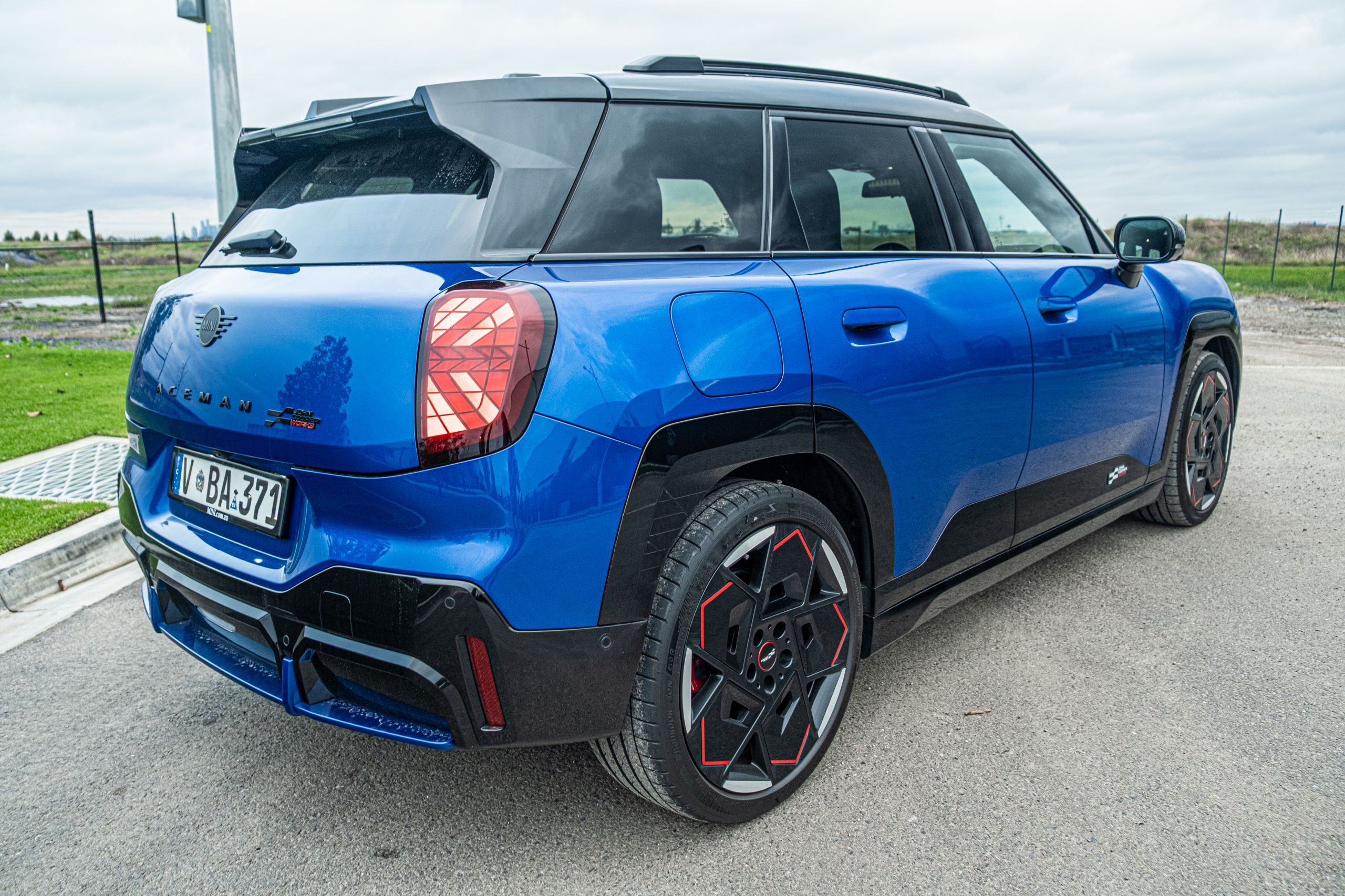
While the street tires can overheat on the track, you’d have to find a very long ribbon of tarmac to get them to do so on the road. They provide loads of grip and excellent feedback about the limits of grip. Just like we found while on the circuit, there’s no other EV that feels like this on the road. Dynamically, the car’s hard to fault, and it’s absolutely more capable than the Ioniq 5 N.

Perhaps the feel of the brakes isn’t as nice as some other performance cars out there, but that’s clutching at straws. One thing’s for sure: there’s no noticeable shift from regenerative to friction braking, a trademark of other Hyundai Group EVs.

Verdict

\\\\\\\\\\\\\\\\\\\\\\\\

Photos Brad Anderson/Carscoops

Car manufacturers have struggled to develop and build EVs that tug at the heartstrings of driving enthusiasts. In general, these cars lack soul and passion, often devoid of any personality at all. That’s not the case with Hyundai, and there’s a good reason why Ferrari, Lamborghini, Porsche, and others have all benchmarked the Ioniq 5 N.
The Ioniq 6 N is the culmination of everything Hyundai’s N division has been developing since its establishment more than a decade ago. It’s expensive for a Hyundai, but it’s cheap compared to a Porsche Taycan or an Audi RS e-tron GT, and delivers thrills that neither of those two can. As we enter a world where performance-focused EVs will become increasingly common, it’s nice to know Hyundai is keeping the preferences of car enthusiasts at the top of its agenda.

\\\\\\\\\\\\\\\\\\\\\\\\\\\\\\\\\\\\\\\\\\\\\\\\\\\\\\\\\\\\\\\\\\\\\\\\\\\\\\\\\\\\\\\\\\\\\\\\\\\\\\

Photos Hyundai Australia

Kia’s 2026 EV4 GT-Line Rides Like An Audi e-tron GT For A Third Of The Price | Review

PROS ›› Exceptional ride, feels premium, expansive cabin CONS ›› Looks weird, not very exciting, only FWD

A year ago, electric sedans looked like a settled bet. Not anymore. As recently as October last year, Kia was planning to build and sell the all-electric EV4 in the United States, aimed directly at the ever-popular Tesla Model 3.

However, the American market for EVs is markedly different now than it was in early 2025, due in no small part to the Trump administration’s pro-ICE policies and abandonment of the federal EV tax credit. This has forced Kia to indefinitely postpone the EV4 in America. While the US won’t get it, at least not yet, the EV4 has landed in several markets, including Australia.

Read: Kia Finally Brings An Affordable EV To America, Fake Gears And All

To see if the States are missing out on an exceptional electric sedan, or if it is perhaps better off without it, we recently lived with one for a week. Sadly for our American readers, they don’t get to experience a very competitive EV.

QUICK FACTS
› Model:2026 Kia EV4 GT-Line
› Starting Price:AU$64,690 ($46,500) plus on-road costs
› Dimensions:186.2 L x 73.2 W x 58.3 in H (4,730 x 1,863 x 1,480 mm)
› Wheelbase:111 in (2,820 mm)
› Curb Weight:1,910 kg (4,210 lbs)
› Powertrain:81.4 kWh battery / single electric motor
› Output:201 hp (150 kW) / 209 lb-ft (283 Nm)
› 0-62 mph~7.7 seconds (0-100 km/h)
› Transmission:Single speed
› Efficiency:14.3 kWh/100 km as tested
› On Sale:Now
SWIPE
\\\\\\\\

Photos Brad Anderson/Carscoops

While much of the EV4 is similar to other current Kia EVs, much of it is also unique. For starters, it’s been developed in both sedan and Hatch guises, and in some markets, is sold in both configurations. Australia only gets the sedan, which is the version that the US was also going to receive.

Underpinning the EV4 is the familiar Electric Group Modular Platform (E-GMP) from Hyundai, but in this application, it’s a 400-volt system rather than the 800-volt architecture of models like the Hyundai Ioniq 5, Kia EV6, and others.

The downside of this platform is slower charging speeds. According to Kia, the max DC charge rate is a disappointing 128 kW. On the flip side, this cheaper platform has allowed Kia to make the EV4 more affordable. It starts at AU$49,990 ($35,800) for the EV4 Air Standard Range, and goes up to AU$59,190 ($42,400) for the EV4 Earth Long Range, and AU$64,690 ($46,300) for the EV4 GT-Line Long Range that we tested.

 Kia’s 2026 EV4 GT-Line Rides Like An Audi e-tron GT For A Third Of The Price | Review

To put these prices into perspective, the Tesla Model 3 starts at AU$54,900 ($39,300) and tops out at AU$80,900 ($58,000), while the BYD Seal is available from as little as AU$46,990 ($33,700), has a mid-range AU$52,990 ($38,000) version, and tops out at AU$61,990 ($44,400).

What do you get for your money? The Standard Range model utilizes a 58.3 kWh battery pack and a front-mounted electric motor with 150 kW (201 hp) and 283 Nm (209 lb-ft) of torque. Long Range versions have the same motor, but are fitted with an 81.4 kWh pack, boosting the claimed driving range from 456 km (283 miles) to 612 km (380 miles).

As we’ve seen from many other Kia EVs in recent years, the EV4 doesn’t want to blend in. It looks more like a concept car than one you can actually walk into a showroom and buy, with the sedan being even more striking than the hatch.

Likely eager to maximize cargo space, Kia has extended the roofline and stretched the rear window, so it almost looks like a cross between a sedan and an estate. Or, more aptly, it looks a bit like the hunchback of Notre Dame, because pretty, it is not.

Well-Equipped And Tech-Forward

\\\\\\\\\\\\\\\\\\\\

Photos Brad Anderson/Carscoops

The cabin of Kia’s latest electric sedan is similar to that of some of the brand’s other EVs, but it has unique elements that make it stand out.

Key features include a pair of 12.3-inch screens and a smaller 5.0-inch display sandwiched between them, used for climate control. As in the much larger EV9, this central screen is mostly blocked by the steering wheel, but there are also physical HVAC toggles positioned further down on the dashboard.

With wireless Apple CarPlay and Android Auto, the infotainment display feels modern enough, even if the software is a little simple to what’s found in some of the EV4’s rivals.

\\\\\\\\\\\\\\

Photos Brad Anderson/Carscoops

The surfaces feel slightly more premium than those of the EV5, and there are nice metallic switches for the seat heater and ventilation functions near the door handles. There’s also an abundance of storage between the seats, as well as a wireless smartphone charger.

In addition, the Earth and GT-Line models get a pair of premium front seats with pillowy headrests that feel great. These seats also include a one-touch reclining mode. It’s also nice that the seats can be adjusted very low, ensuring that even taller drivers have heaps of headroom.

Review: 2023 Hyundai Ioniq 6 Epiq Shakes Up The EV Hierarchy

The downsides of the EV4 sedan’s shape can be mostly felt in the second row. If you’re over 6 feet, there’s a good chance your hair will brush on the headliner. In addition, toe room is almost non-existent if one of the front seats is adjusted into a low position. While there are a couple of air vents in the rear, there unfortunately aren’t any temperature or fan speed controls.

Cargo volume is good, with Kia quoting 490 liters (17.3 cubic feet) of space in the trunk. Crucially, both rear seats can be folded flat, creating a large pass-through area that greatly enhances the car’s practicality.

Drives Like A Premium Sedan

\\\\\\\\\\\\

Photos Brad Anderson/Carscoops

Given the specifications of the EV4, one can’t expect it to feel like a performance car, even in flagship GT-Line guise. However, it feels just as poised and polished to drive as the competition, as well as some more expensive electric offerings from Hyundai’s own stable, including the Ioniq 6.

The highlight of driving the EV4 isn’t the powertrain, its efficiency, or noise isolation, but rather how exceptional the ride quality is.

Like all other Kia models sold in Australia, the EV4 has undergone comprehensive local testing to fine-tune its ride, ensuring it perfectly irons out bumps and imperfections on the country’s often poorly surfaced roads.

 Kia’s 2026 EV4 GT-Line Rides Like An Audi e-tron GT For A Third Of The Price | Review

It’s not an adjustable system, meaning there’s no way to stiffen or relax the ride as in some more expensive sedans. But it doesn’t need any adjustments, as it’s just about perfect and one of the most comfortable cars I’ve driven in quite some time.

Potholes and speed bumps are often a nuisance, but in the EV4, they completely fade into insignificance. It’s really quite extraordinary how well it rides, and it’s almost at the same standard as the Audi e-tron GT, which can cost over three times as much and has one of the more complex air suspension systems on the market. The Earth and GT-Line models have 19-inch wheels, while the Air sits on smaller 17-inch shoes, and may even be more supple.

The EV4’s sophisticated feel extends beyond its ride quality. Given that it’s down just 10 kW (13 hp) and 27 Nm (20 lb-ft) of torque from the EV5 SUV, I had expected the EV4 to suffer from the same torque steer qualms as its bigger brother. However, there’s not even a hint of torque steer under full throttle, perhaps in part due to the suspension setup.

\\\\\\\\\\\\\\\

Photos Brad Anderson/Carscoops

In addition, the EV4 doesn’t have quite the same propensity to spin up its inside front wheel as we found in the EV5. Admittedly, it’s not particularly quick and needs about 8 seconds to reach 100 km/h (62 mph). That said, it never feels like it’s lacking power.

It’s a shame that the GT-Line doesn’t have a dual-motor, all-wheel drive setup as found in some of Kia’s other GT-Line-badged EVs, particularly since the cheaper BYD Seal Performance has twin motors and an impressive 390 kW (523 hp) and 670 Nm (494 lb-ft) of torque.

Kia presented a GT version of the EV4 earlier this year, complete with twin motors producing 215 kW (282 hp), but I’d have liked to see this powertrain offered in the GT-Line, given the price point. This would have allowed Kia to develop a full-blown performance version to rival the BYD and the Tesla Model 3 Performance.

 Kia’s 2026 EV4 GT-Line Rides Like An Audi e-tron GT For A Third Of The Price | Review

One good thing about the EV4’s single-motor setup is efficiency. Over my week with the car, I averaged just 14.3 kWh/100 km, beating Kia’s claimed 14.9 kWh/100 km and giving it a very achievable range of around 550 km (342 miles). It’s worth noting, however, that I spent most of my time with the EV4 driving in Eco mode and the regenerative braking in one-pedal mode.

The EV4’s steering has been well-calibrated and offers varying levels of feel depending on the driving mode. It’s also hard to fault how the EV4 feels under braking, with a consistent, smooth pedal feel and no noticeable shift from regenerative braking to mechanical braking.

While the EV4 does not prioritize performance, it handles shockingly well, thanks in part to the Goodyear tires. Front-end bite is great, and there’s plenty of grip.

Verdict

 Kia’s 2026 EV4 GT-Line Rides Like An Audi e-tron GT For A Third Of The Price | Review

While the Kia EV4 looks a little odd, that doesn’t detract from the fact that it delivers exactly what an electric sedan like this should, at this price point.

It’s exceptionally efficient and undercuts many of its nearest rivals on price, all with the assurance of buying from a well-established brand with an expansive dealership and service network. The EV4’s ride is the standout, the cabin is well-equipped, and it offers plenty of range. If it were based on an 800-volt architecture that supported faster charging speeds, it would be difficult to fault. It’s a shame it won’t be sold in the US.

\\\\\\\\\\\\\\\\\\\\\\\\\\\\\\\\\\\\\\\\\\\\\\\\\\\\\\\\\\\\\\\\\\\\\\\\\\\\\\\\\\\\\\\\\\\\\\

Photos Brad Anderson/Carscoops

❌