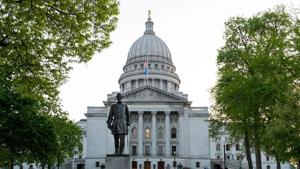
(The Center Square) - The Wisconsin Senate is scheduled to vote on both a sports wagering bill and a University of Wisconsin name, image and likeness bill Tuesday in its final meeting of the session, set to begin at 11…
(The Center Square) - Wisconsin lawmakers have touted the economic impact of University of Wisconsin football and athletics as a reason to support a name, image and likeness bill that includes $15 million in taxpayer funds given annually toward athletics…
(The Center Square) – The Institute for Reforming Government is calling for Wisconsin lawmakers to create a special committee to investigate the Department of Public Instructions decision to spend nearly $370,000 of taxpayer money on a 2024 Forward Exam standard-setting…
Reading Time: 6minutesClick here to read highlights from the story
At least five Wisconsin communities have signed nondisclosure agreements with data center developers, including the town of Beloit.
Even in communities without an NDA, there has been pushback against transparency. For example, Port Washington was sued because it released emails referencing a project, but not the attached files.
It’s unclear if the state Senate will take up a bill that would ban data center NDAs, but the Assembly has already adjourned without passing the bill.
At a Jan. 28 public forum on Wisconsin data centers, Port Washington Mayor Ted Neitzke boasted that his city did not sign a nondisclosure agreement that would have concealed plans for a $15 billion facility that is now under construction.
“If you’ve got the courage and you push back and say, ‘Listen, we’re just not going to do it,’ (the data center developers) will find a way to operate without having to sign an NDA,” Neitzke said. “So, we did not and we will not.”
On the same day Neitzke was touting his community’s openness, Port Washington was in court over its refusal to provide communications about its data center. The city had turned over emails, but not documents attached to the emails.
It’s one example, beyond NDAs, of local governments hiding details of proposed large-scale AI data centers, which are projected to span hundreds of acres, cost billions of dollars and transform communities.
Wisconsin Watch reported in January that NDAs were signed in at least four Wisconsin communities where artificial intelligence data centers are proposed or being built — Beaver Dam, Kenosha, Janesville and Menomonie. Since then, Wisconsin Watch has learned about a fifth project with an NDA, this one in the town of Beloit — showing that discussions there occurred more than a year before any public announcement was made.
Port Washington stymies public records requests
Construction began in December on Lighthouse, the 672-acre Vantage-OpenAI-Oracle data center campus in Port Washington, north of Milwaukee.
Four months earlier, philanthropist Lynde Uihlein, a town of Port Washington resident, environmentalist and major Democratic donor, made a public records request of the city. She asked for any communications between the city and the data center developer dating back to Jan. 1, 2025.
The Wisconsin public records law declares that “all persons are entitled to the greatest possible information regarding the affairs of government” and that governmental bodies must respond to requests “as soon as practicable and without delay.”
After nearly three months, the city did not reply to Uihlein’s request, so she sued.
The city responded by turning over emails, but not the documents attached to those emails, such as a draft development agreement. The city’s attorney explained that Uihlein didn’t specifically ask for the attachments.
“When cities want to court large, community-changing development, they also should be prepared to act with maximum transparency,” said Madison lawyer Christa Westerberg, one of the lawyers representing Uihlein.
“The city of Port Washington has been too slow to respond to requests about the data center and even when it has, there are gaps, like providing emails without attachments. This was foreseeable and avoidable.”
Wisconsin Watch is one of Westerberg’s clients, but is not a party to this case. Westerberg did not participate in the writing or editing of this report.
City Attorney Matthew Nugent told Wisconsin Watch: “The assertion that the city refused to produce email attachments is inaccurate. The city reasonably interpreted the original request to seek the email communications themselves, that is, the body of the email message, not the separate documents attached to those communications.”
At a court hearing Jan. 28, Ozaukee County Circuit Court Judge Adam Gerol rejected the idea that documents attached to emails aren’t part of the emails themselves. “There has not been a complete response to the open records request,” he said.
In February, the city turned over emails along with attachments to Uihlein, and Gerol ruled that city officials must submit to depositions to answer questions from Uihlein’s lawyers.
Gerol will be asked to determine whether the city has fully complied with the public records law, whether its delay in replying violated the law and whether it should have to pay Uihlein’s legal fees.
Another denial
The city used the same rationale to partially deny another public records request.
Port Washington resident Michael Beaster, an opponent of the data center, asked the city Nov. 20 for emails and other communications between city officials and the data center developer.
The city replied six weeks later, sending some emails but no attachments to the emails. An attorney for the city told Beaster he would need to submit another request if he wanted attachments because Beaster did not specifically request those.
“It feels like they’re being overly cautious in trying to protect the city,” Beaster said, “which certainly isn’t serving the public.”
Beaster is running unopposed April 7 for an open seat on the Port Washington city council. He helped lead a failed effort to recall Neitzke over the data center.
Neitzke said he could not comment on why the city has not turned over email attachments, other than to say he is not part of the process of releasing records.
NDA for possible Beloit data center
News surfaced this month of a possible data center an hour southeast of Madison in the town of Beloit. The town, saying it was responding to information “being disseminated” about a possible data center, announced it had begun “very preliminary discussions” and signed a predevelopment agreement with Delaware-based Cambrin LLC.
Wisconsin Watch has since learned that the town signed an NDA with Cambrin in February 2025 — more than a year before making its announcement.
The NDA and other documents provided to Wisconsin Watch in response to a public records request do not directly refer to a data center.
The documents indicate that “Project Corn Maze” would initially include 700,000 square feet of buildings, employ 50 people and require tax incremental financing from the town.
The records also show that the town has exchanged emails about the project since April 2025. They indicate that Cambrin LLC was formed to make the development proposal and don’t identify what company would operate the data center.
Signs of openness
Access to records also was at issue for the first phase of a data center complex south of Milwaukee in Mount Pleasant. The first center in that Microsoft complex is expected to open later this year.
This month the Wisconsin Freedom of Information Council announced it is giving its annual citizen openness advocate award to Midwest Environmental Advocates. The public interest law firm successfully sued the city of Racine for records disclosing how much water it is projecting to provide for the Mount Pleasant data center.
Amid reports of a possible data center in Grant County and as Meta seeks to add a data center to one it is building in Beaver Dam, there is movement toward more openness on several fronts.
Beaver Dam residents weigh in as second data center proposal looms. (Video by Trisha Young / Wisconsin Watch)
The state Public Service Commission, which approves requests for new utility plants and utility rates, initially accepted a confidentiality request from Alliant Energy in its application to serve the Beaver Dam data center despite numerous redactions — including how much energy the center would use.
On Feb. 26, however, state administrative law judge Michael Newmark, who is overseeing the PSC hearings on the request, told Alliant to resubmit its request with fewer redactions. Alliant did the next day with less information blacked out.
“It seemed like the redactions were not going to allow us to do sort of the basic functions of open government,” Newmark said at the hearing. Fewer redactions would enable the commission to rule on the application in a way that is “defensible in court and in the court of public opinion,” he said.
Last week the University of Wisconsin-Milwaukee Center for Water Policy released a model for state legislation to “promote transparency and environmental protections” for data centers.
The model, which recommends temporary statewide moratoriums on data centers, makes several recommendations to increase transparency, including a ban on local governments signing NDAs and requiring public disclosures on water and electricity use before any approvals are given.
The “continued absence of comprehensive and timely disclosure requirements,” the report said, “undermines public understanding and limits informed decision-making around siting, permitting and environmental impacts.”
And on Friday, a state Senate committee on a 4-1 vote approved Senate Bill 969, which would prohibit local governments from signing NDAs with data center developers. No further action has yet been scheduled.
The committee also advanced, 3-2, Assembly Bill 840, which would require the Public Service Commission to protect ratepayers from the costs of providing electricity to data centers. The bill contains a controversial requirement that renewable energy used for a data center be located on the site. The Assembly passed the bill 53-44 in January.
Legislation banning NDAs is pending in several states, including two that took action last week.
A Minnesota House of Representatives committee approved a bill banning data center NDAs and sent it to the House floor.
In Florida, a provision banning NDAs that industry groups lobbied against was removed from a data center bill.
A report released last week by the Alliance of Great Lakes urged governmental bodies to limit the use of NDAs so that the public can know how much water and energy a data center will use.
“When critical information is withheld, decision-making shifts risk from private developers to communities and public utilities,” the report said.
Wisconsin Watch is a nonprofit, nonpartisan newsroom. Subscribe to our newsletters for original stories and our Friday news roundup.
With the $1.8 billion replacement project in limbo, regional leaders say delays could raise costs and complicate years of planning for a five-year construction closure.
In 2025 alone, nearly 200 school groups visited, bringing about 8,500 students to learn about agriculture and the many careers connected to food production.
Eau Claire author B.J. Hollars is currently co-leading a fundraising effort to keep putting books like Katie Venit's “Forts” in the hands of kids in the Eau Claire area for years to come.
The Wisconsin Senate will hold what could be its last floor session of the year Tuesday. Included within the sprawling agenda are bills legalizing online sports betting and subsidizing "name, image, likeness," or NIL, deals that have split Republicans' slim 17-vote majority and could require Democratic votes to pass.
Bacteria can cause illness and death, UW-Madison professor Timothy Paustian said on "The Larry Meiller Show," but they could also help us to sleep better or find the motivation to exercise.
PBS Wisconsin's "Here & Now" sat down with the candidates for Wisconsin Supreme Court to ask them about an important Supreme Court decision from the 2020 election and see how they would have ruled.
Federal immigration agents allow an arrested man to talk to his wife on the phone in Robbinsdale, Minn., in February. Recent immigration operations have resulted in some households losing a provider and renters facing eviction. (Photo by Nicole Neri/Minnesota Reformer)
As federal immigration officers made more “at-large” arrests in communities across the country in the first year of the current Trump administration — including at homes, places of worship and workplaces — more than 1,100 Nebraska families developed family safety plans in the event a parent or breadwinner faced detention or deportation.
These plans help families decide who will take care of the children, handle school and medical decisions, and manage finances if a parent suddenly cannot be there.
Families are encouraged to choose a trusted adult — such as a relative or family friend — who could temporarily care for the children. They’re making sure children have passports, updating school emergency contacts, and letting family members know how to locate a parent if they are detained.
“This is not unique to immigrant families, but it’s of course more nuanced for immigrant families in the sense that their family can be separated at any time,” said Lina Traslaviña Stover, a sociologist who also is executive director of the Heartland Workers Center, a Nebraska nonprofit that advocates on behalf of workers in the meatpacking, restaurant, construction and cleaning industries.
“There are a lot of ripple effects when families prepare for the possibility of separation. In some cases, older siblings are being asked to step into the role of head of household if a parent is detained or deported. Imagine a high school senior suddenly carrying the responsibility for the family’s finances and stability. Even if it’s just a ‘what if’ scenario, that kind of pressure can change a young person’s plans for the future.”
The effort in Nebraska, and similar ones around the country, points to the social and economic fallout from the immigration crackdown. The deportation of a breadwinner, the potential exposure of tenants’ personal data and stricter federal housing policies can all stress families, advocates say, even as some policymakers are trying to help.
Demand for rental housing is driven primarily by U.S. citizens, but immigrants have long been a key subset of renters: They headed 9.6 million renter households (21%) in 2024, according to the recently published America’s Rental Housing report by the Harvard University Joint Center for Housing Studies. Researchers also note that immigrants contribute to the economy and pay taxes, supporting the communities they live and work in.
“For households living paycheck to paycheck, losing just a few days of wages can mean losing housing,” said Meesha Moulton, a Las Vegas-based immigration attorney. “Housing insecurity in these communities doesn’t start with an eviction notice, it starts with the empty chair at a job site.”
Fear can also affect how or whether immigrant families — with or without legal status — apply for food, housing or health programs they qualify for because they worry it could put them on the government’s radar. Both Americans and immigrants with legal status have been arrested during the past year’s enforcement crackdown. And nearly three-fourths of the people in immigration detention in late January had no criminal record.
Jacob Rugh, a sociologist and associate professor at Brigham Young University who studies immigration enforcement and housing, said high-profile incidents of aggressive and fatal encounters between federal agents and U.S. citizens and noncitizens have shifted public opinion in ways that could help affected immigrants.
In a Quinnipiac University poll conducted shortly after a federal immigration officer fatally shot 37-year-old Renee Good, roughly 80% of respondents said they had seen video of the shooting.
“People are seeing videos everywhere and there’s more visibility in the non-immigrant community,” Rugh said. “It makes the issue much more salient in ways that didn’t exist before. People donate, help on the ground and become part of the solution.”
‘We cannot GoFundMe our way out of a crisis’
Policymakers in many affected places are looking for ways to help.
In Los Angeles County, officials declared a state of emergency in 2025 after federal immigration raids, allowing the county to provide rent relief, legal aid and other services to residents affected by immigration enforcement in Southern California last year.
In Clark County, Washington, a $50,000 rental assistance program was launched to help families who have a family or household member — and are missing a primary wage-earner — detained or deported by immigration officers. Officials say the demand for assistance is already exceeding available funds.
In Santa Ana, California, a $100,000 emergency assistance program is aimed at helping renters affected by federal immigration raids. It offers up to one month of rent or utility assistance for a household that lost income as a result of a member’s detention or deportation.
Few places better illustrate the direct relationship between immigration enforcement and housing insecurity than Minnesota, where the Trump administration in December sent thousands of federal agents. Operation Metro Surge closed streets and businesses amid protests and shelter-in-place orders, and agents detained more than 4,000 people, according to the White House.
The Minneapolis City Council approved extending the time frame for eviction notices, but Mayor Jacob Frey vetoed the measure and instead proposed $1 million in city funding in rental assistance.
Landlords across Minneapolis and St. Paul have filed 2,585 eviction notices so far this year, 25% above the same time period in 2023 and 2024, according to the Eviction Lab at Princeton University.
Many residents have reported losing jobs, said Tara Raghuveer, director of the Tenant Union Federation, a national union of tenant unions involved in a new tenant campaign in the Twin Cities. Some fell behind on rent, and with income-earners detained, some families have attempted to fill the void by raising money on GoFundMe.
“We cannot GoFundMe our way out of a crisis of this scale,” Raghuveer said in an interview. “Many people have not been able to work, and as a result many people have not been able to pay rent, and the economic pain created by this invasion will still be with everyday people long after ICE (Immigration and Customs Enforcement) agents are gone.”
Minneapolis and St. Paul have each allocated about $1 million in emergency rental assistance.
Last week, Minnesota’s Democratic-led Senate approved $40 million in rental assistance, but the legislation isn’t expected to pass the evenly split House. Republicans argued that residents living in the country illegally shouldn’t receive aid, the Minnesota Reformer reported.
Trust between landlords and immigrant tenants
Immigration enforcement has also caused a ripple in the relationship between landlords and their tenants who lack legal status. In Tennessee, a law enacted in 2025 criminalizes harboring such immigrants for financial gain, which some critics argue could pressure landlords to evict tenants or refuse rentals out of fear of legal consequences.
In Oregon, lawmakers passed legislation that would restrict landlords from disclosing a tenant’s immigration status and sensitive personal information without clear legal requirements. The measure would protect information such as immigration status, Social Security numbers and financial records. It’s awaiting action by the governor.
A New Jersey bill that would bar landlords from using a tenant’s immigration status is advancing in the legislature.
California, Colorado and Illinois have enacted so-called immigrant tenant protection acts, with provisions to prevent landlords from harassing, intimidating or evicting tenants based on their citizenship or immigration status.
Democratic Oregon state Rep. Pam Marsh, who sponsored the Oregon legislation, told Stateline that the idea emerged after reviewing tenant records from her own experience as a small landlord.
“I realized I had file drawers full of very sensitive data,” she said. “It made me start asking what the law actually requires about confidentiality.”
The measure ultimately passed with bipartisan support after negotiations with landlord groups.
Immigration authorities have taken a new legal position that civil administrative warrants may allow agents to enter residences without a judge-signed warrant, according to guidance compiled by the National Apartment Association’s legal team. Many legal experts dispute the directive, and at least one court has found it unconstitutional.
A proposed U.S. Housing and Urban Development rule would prohibit “mixed-status” families — households with both U.S. citizens and people without legal immigration status — from living in public or other subsidized housing.
HUD estimates that about 25,000 mixed-status households currently receive agency-assisted housing, less than 1% of all federally aided renters. The Center for Budget and Policy Priorities estimates about 80,000 people could lose housing assistance, including roughly 37,000 children, nearly all U.S. citizens.
They’d rather live in a crowded basement with no paperwork than sign a legal contract that has their name on it.
– Meesha Moulton, a Las Vegas-based immigration attorney
Some landlords are concerned their tenants may end a lease early or not renew based on rumors or threats of immigration agent sightings, according to Alexandra Alvarado, director of marketing and education for the trade group American Apartment Owners Association.
María Monclova, a Mexican-born immigration lawyer, says that landlord compliance with requests from federal agents is in part due to ignorance of obligations to cooperate with federal matters.
“There have been credible reports of immigration authorities requesting leases, rental applications and identification documents from landlords or property managers,” she said.
“Many landlords don’t fully understand the difference between an administrative request and a court-issued subpoena or warrant,” she said. “When that distinction isn’t clear, some property owners may overcomply out of fear of liability.”
Given the current administration’s attempt to determine immigration status through public housing data, Moulton, the immigration attorney, thinks some immigrant and mixed-status families may be avoiding formal leases altogether.
“They’d rather live in a crowded basement with no paperwork than sign a legal contract that has their name on it. This is all bad for everyone,” Moulton said. “It leads to ‘shadow housing’ where buildings aren’t inspected, safety rules are ignored and slumlords can take advantage of people. When we push people into the shadows, we lose the data we need to keep our neighborhoods safe.”
Some neighborhoods — and the groups of people who live and call them home — have been reshaped by immigration preceding the current Trump administration and dating through the George W. Bush, Obama, first Trump and Biden administrations.
A 2025 study from Rugh and other researchers in the journal Demography found that when local police helped enforce immigration laws, Latino and white residents were less likely to live in the same neighborhoods over time. Researchers say tougher enforcement can make immigrant families feel less secure financially and more likely to move.
“When large numbers of men are detained or deported — and most deportees are men — they’re suddenly no longer contributing to household income,” Rugh said in an interview.
“When you detain and deport large numbers of people, it affects entire communities,” he said. “Landlords lose renters, property values can fall, local businesses suffer, and people who aren’t immigrants feel the economic effects.”
This story was originally produced by Stateline, which is part of States Newsroom, a nonprofit news network which includes Wisconsin Examiner, and is supported by grants and a coalition of donors as a 501c(3) public charity.
Members of a key CDC advisory committee, known as the Advisory Committee on Immunization Practices, met in Atlanta on Dec. 4. Maya Homan/Georgia Recorder
A federal judge in Massachusetts has halted enforcement of several key vaccine policies imposed by Health Secretary Robert F. Kennedy Jr., ruling that the Trump administration illegally overhauled a Centers for Disease Control and Prevention committee dedicated to issuing immunization recommendations.
The decision, which comes in response to a lawsuit filed by the American Academy of Pediatrics last July, temporarily blocks the enforcement of all recommendations voted on by the panel. That includes the overhaul of a decades-old recommendation that all newborn babies receive a vaccine against hepatitis B, a push to emphasize the risks of COVID-19 vaccines and a ban on vaccine preservatives like thimerosal.
The ruling also temporarily halts participation from 13 of the panel’s 15 members, complicating a meeting that was scheduled to begin later this week.
The CDC’s committee, known as the Advisory Committee on Immunization Practices, is charged with setting national guidelines around which people should be vaccinated against a wide range of preventable diseases and when those vaccines should be administered. The recommendations play a key role in determining which vaccines insurance companies are willing to cover and how accessible those immunizations are to the public.
Last June, Kennedy abruptly dismissed all 17 members of the committee and replaced them with a slate of hand-picked appointees, many of whom are seen as vaccine skeptics. In his Monday decision, District Court Judge Brian E. Murphy ruled that the Trump administration likely violated the Administrative Procedure Act by failing to appoint qualified, nonpartisan experts, as the panel’s charter requires.
By ignoring those requirements, “the Government has disregarded those methods and thereby undermined the integrity of its actions,” Murphy’s ruling reads.
Dr. Andrew Racine, the president of the American Academy of Pediatrics, celebrated the ruling, calling it “a historic and welcome outcome for children, communities, and pediatricians everywhere.”
“For decades, the AAP partnered closely with the federal government to advance our mission of attaining the optimal health and well-being of children and youth,” Racine added. “We would much prefer to return to that partnership and collaborate with federal healthcare agencies instead of litigating against them.”
A spokesperson for the U.S. Department of Health and Human Services did not immediately reply to a request for comment.
This story was originally produced by Georgia Recorder, which is part of States Newsroom, a nonprofit news network which includes Wisconsin Examiner, and is supported by grants and a coalition of donors as a 501c(3) public charity.
A lawsuit by 16 states and the District of Columbia says the U.S. Department of Housing and Urban Development has new guidance that could weaken state discrimination protections. (Photo courtesy of HUD Office of Public Affairs)
Sixteen states and the District of Columbia are challenging guidance from the U.S. Department of Housing and Urban Development that plaintiffs allege imposes new rules and funding conditions they say could weaken state protections against housing discrimination — and their ability to investigate them.
The lawsuit focuses two HUD memos in September detailing how it will prioritize resources for cases with clear evidence of intentional discrimination.
HUD withdrew several fair housing documents including guidance policies on disparate impact — a theory of discrimination where neutral-seeming policies disproportionately exclude or harm certain groups — along with procedures for referring discrimination cases to the Department of Justice, and credit programs aimed at expanding access to housing.
On April 11, it will be 58 years since President Lyndon B. Johnson signed the Fair Housing Act into law in an effort to combat housing discrimination and partner HUD with state and local agencies to enforce those laws. Through the Fair Housing Assistance Program, HUD refers complaints to state agencies, which use HUD funding to investigate cases, train staff and conduct outreach.
The September memos stipulated that state agencies receiving HUD dollars to enforce fair housing laws won’t be reimbursed for cases regarding discrimination based on sexual orientation, gender identity, criminal record, source of income or English-language proficiency.
Attorneys general filing the lawsuit say HUD has significantly reduced staffing and the number of discrimination cases it pursues, while dismissing whistleblowers who raised concerns about the agency’s ability to enforce fair housing laws or look into acts of housing discrimination.
If the HUD changes go through, many state laws could be in conflict with this guidance.
Several states, including some represented in the lawsuit, have fair housing laws that extend protections beyond those covered by federal law and could be impacted by HUD’s guidance.
Included in the lawsuit alongside are attorneys general from Arizona, California, Colorado, Connecticut, Delaware, Hawaii, Illinois, Maine, Maryland, Massachusetts, Michigan, New Jersey, Rhode Island, Vermont, Washington and the District of Columbia. It was filed in the U.S. District Court for the Northern District of California.
Among state laws that offer protections cited in the HUD memos, California state law protects tenants based on sexual orientation, gender identity and lawful source of income, including housing vouchers.
Other states such as Illinois and Washington extend protections based on immigration status. Colorado, Massachusetts and Rhode Island also provide protection against discrimination on the basis of identities such as gender identity, sexual orientation and source of income.
This story was originally produced by Stateline, which is part of States Newsroom, a nonprofit news network which includes Wisconsin Examiner, and is supported by grants and a coalition of donors as a 501c(3) public charity.
The U.S. Supreme Court on Oct. 29, 2024. (Photo by Jane Norman/States Newsroom)
WASHINGTON — The U.S. Supreme Court Monday said it will hear oral arguments in April in two cases brought by immigrants hailing from Syria and Haiti after the Trump administration tried to end their temporary protections, initially granted because their countries had been deemed too dangerous for return.
Monday’s order consolidates two cases, one brought on behalf of 6,000 Syrians with Temporary Protected Status and another from 350,000 Haitians.
The justices also declined to grant the Trump administration’s request to stay a lower court order that prevented the end of TPS for those two countries, meaning that protections from deportation will remain for now for those immigrants.
The justices will hear arguments for the cases in the last week of April, with final briefs due by April 20. A specific date has not yet been set.
Congress created TPS to allow immigrants from countries dealing with war, natural disasters, political violence or other instabilities to remain and work in the United States on a temporary basis, ranging from six months to 18 months.
The TPS holders who sued the Trump administration have argued that their countries’ conditions were not considered when the Department of Homeland Security determined their protections should end.
The Trump administration has sought to cancel legal protections for immigrants, so far revoking TPS status for 13 of the 17 countries that were designated at the start of President Donald Trump’s second term.
Those 13 countries are Afghanistan, Cameroon, Ethiopia, Haiti, Honduras, Myanmar, Nepal, Nicaragua, Somalia, South Sudan, Syria, Venezuela and Yemen.
The four remaining countries with TPS expiring this year without an extension are El Salvador, Lebanon, Sudan and Ukraine.
Gov. Tony Evers meets with children at a Fitchburg child care center in September 2023. Evers vetoed a bill on Friday, March 13, that would have expanded a business tax credit for child care expenses, saying the measure had a vague "catch-all" provision that could open the door to fraud. (Photo by Erik Gunn/Wisconsin Examiner)
Gov. Tony Evers has vetoed legislation that would have broadened a tax credit for businesses that invested in child care services.
A “catch-all” provision in the bill would have awarded the tax credit for “any other cost or expense incurred due to a benefit provided by an employer to facilitate the provision or utilization by employees of child care services.”
The provision “invites the possibility of a business claiming various expenses only tangentially related to child care services,” Evers wrote in his veto message, signed Friday. He added that it “significantly increases the risk of fraud” and didn’t including funding to cover the increased costs for the Wisconsin Economic Development Corp. to ensure against employers scamming the system.
Republican lawmakersintroduced the legislation,SB 291 /AB 283, in 2025 as the Evers administration and child care advocates were seeking up to $480 million in the Wisconsin 2025-27 state budget to support child care workers’ wages and avert increased child care tuition for families. The final budget included about $110 million for direct payments that expire this summer.
The GOP measure proposed expanding the state’s Business Development Tax Credit, which since 2023 has allowed employers to get a tax credit for 15% of the capital expenditures they make for child care facilities for their employees. The original tax credit had no takers.
Child care providers were critical of the expansion proposal and argued that that it wasn’t adequate to address increased costs and reduced capacity for child care in Wisconsin.
The measure passed the Senate in November 2025 on a 19-14 vote with all but one Democrat voting against it. The Assembly concurred with the Senate bill on a 63-31 vote in February, with nine Democrats joining the GOP in favor of the bill.
In his veto message, Evers noted that he signed a bill in December, permitting employers to take the tax credit if they invest in a third party that establishes a child care program or in a revolving loan fund for that purpose. That measure, 2025 Act 78, was an example of “making smart and strategic modifications” Evers wrote.
“Unfortunately , this bill fails to do the same,” he wrote. “I am vetoing this bill in its entirety because I object to the Legislature making drastic and vague expansions to tax incentive programs without providing the necessary funding for proper implementation and the clarity necessary to prevent fraud, waste, and abuse.”

 Login
Login