Reading view

There are new articles available, click to refresh the page.

The 2026 Ioniq 9 Calligraphy’s Biggest Threat Is Hyundai Itself | Review

PROS ›› Superb interior, excellent performance, bold design CONS ›› Expensive, heavy, hard-sell over Palisade

Electric SUVs have come a long way in a short time, but in the three-row space, progress has been surprisingly slow. Hyundai made a big impression on the EV market when it unveiled the striking Ioniq 5 in early 2021. A month later, Kia unveiled its related EV6.

However, following the debut of the Ioniq 5 and the later arrival of the Ioniq 6, Hyundai’s rollout of next-generation EVs has slowed, especially compared to Kia. In the same span, Kia has steadily grown its lineup, recently adding the EV3, EV4, EV5, and EV9 to its expanding electric stable.

Review: The New Nissan Qashqai e-Power Drives Like An EV But Doesn’t Need Charging

This makes the launch of the new Hyundai Ioniq 9 all the more important. You see, it’s related to the three-row Kia EV9, but that model was launched more than 18 months before it, meaning Hyundai has to catch up ground.

QUICK FACTS
› Model:2026 Hyundai Ioniq 9 Calligraphy
› Starting Price:AU$128,413 (US$84,000)
› Dimensions:5,060 mm (199.2 in.) Length

1,980 mm (77.9 in.) Width

1,790 mm (70.4 in.) Height

3,130 mm (123.2 in) Wheelbase
› Curb Weight:2,721 kg (5,998 lbs)
› Powertrain:Dual electric motors | 110.3 kWh battery
› Output:421 hp (314 kW) / 516 lb-ft (700 Nm)
› 0-62 mph5.2 seconds (0-100 km/h)
› Transmission:Single-speed
› Efficiency:22 kWh/100 km as tested
› On Sale:Now
SWIPE

Working in Hyundai’s favor is the fact that not much has changed in the three-row electric SUV segment since the EV9 launched. Few contenders have emerged in this particular bracket, especially at the price point where both the EV9 and Ioniq 9 are playing.

We recently had the opportunity to spend a full week living with the Hyundai Ioniq 9 in Calligraphy trim, putting it through its paces not just to see how it stacks up against the EV9, but also to ask a tougher question: can it justify its position as the most expensive Hyundai ever sold?

What Does it Cost?

\\\\\\\\\\\\\

Photos Brad Anderson/Carscoops

While Kia offers several versions of the EV9 in Australia, Hyundai has only launched a single trim variant of the Ioniq 9, known as the Calligraphy. Buyers can choose between six or seven seats, and pricing starts at AU$128,413 (equal to US$84,000 at current exchange rates) including on-road costs.

There’s no denying that’s a lot of cash for a Hyundai. However, it’s surprisingly good value compared to the Kia EV9 GT-Line, the nearest equivalent to the Calligraphy, which is priced from AU$138,915 ($90,700).

Read: Americans Just Sent Hyundai EV Sales Through The Roof But Trouble’s Brewing

Shoppers in the US looking to pick up the keys to the new Ioniq 9 can purchase it for as little as US$58,955. The flagship Performance Calligraphy Design tops out at the range, starting at US$76,490. Although Australia’s Calligraphy model lacks the word ‘Performance’ in its name, it has the same powertrain as the American model.

Beneath the concept-car-like looks of the Ioniq 9 is a huge 110.3 kWh battery, larger than the flagship 99.8 kWh pack in the EV9. This battery feeds a pair of electric motors, each rated at 157 kW (210 hp), or a combined 314 kW (421 hp) and 700 Nm (516 lb-ft) of torque. That gives it a healthy edge over the EV9 GT-Line’s 283 kW (380 hp), although torque remains identical.

A High-Class Cabin

\\\\\\\\\\\\\\\\

Photo Credits: Brad Anderson/Carscoops

As you’d expect for a vehicle at this price point, the Ioniq 9 Calligraphy’s cabin is exceptionally plush and feels more premium than the EV9, which has too much plastic for our liking.

Like other Hyundai models, there are two 12.3-inch screens in front of the driver, housed within a single curved display that supports wireless Apple CarPlay and Android Auto. Whereas Kia insists on continuing to employ an inconveniently located third screen on the dash for the climate controls, the Ioniq 9 uses a dedicated display under the dash with a touch panel and physical temperature dials.

Review: New Fiat Grande Panda Hybrid Makes Budget Look Cool Again

Our Ioniq 9 was equipped with the eye-catching Dark Wine and Dove Grey two-tone Nappa leather, one of three available two-tone options for those not interested in the standard Obsidian Black trim. The Ioniq 9 is available with digital wing mirrors, but fortunately, our car didn’t have them. By comparison, the EV9 GT-Line is sold exclusively with cameras instead of mirrors.

There are plenty of luxuries found within the cabin, making the Ioniq 9 perfectly suited to any kind of journey. This includes a heated steering wheel, heated, ventilated, and massaging front seats and a wireless phone charger.

\\\\\\\\\\\\\\\\\\\\\\\\\\\\\\\\\\\\

Photos Brad Anderson/Carscoops

There’s also a panoramic sunroof, tri-zone climate control, configurable ambient lighting, and a head-up display. Tech enthusiasts will be pleased to know that in addition to having two high-powered 100-watt USB-C ports in the dash, there are also 100-watt USB-C ports on the backs of the front seats for rear passengers.

Those seeking the ultimate in comfort would be wise to opt for the six-seat version, as it replaces the second-row bench seat with a pair of captain’s chairs, which are very similar to the front seats.

Review: BYD Sealion 6 Makes Plug-In Hybrids Feel Seamless But Fun Is Optional 

However, even in 7-seat guise, the Ioniq 9’s second row is more than large enough to carry three adults in comfort. Even the third row is surprisingly practical. I’m 6’2” (189 cm) and my hair only brushed the headliner, but I did have to slide the second-row seats forward to get any leg room.

There’s no question this ranks among the most premium interiors Hyundai has ever put together. Even so, it doesn’t feel dramatically more upscale than the far more affordable Santa Fe. It shares quite a few components too, including the dual screens, steering wheel, and HVAC controls. Cabin space is only slightly more generous as well. The latest Palisade, for that matter, feels every bit as polished as the Ioniq 9.

Performance and Comfort
 The 2026 Ioniq 9 Calligraphy’s Biggest Threat Is Hyundai Itself | Review

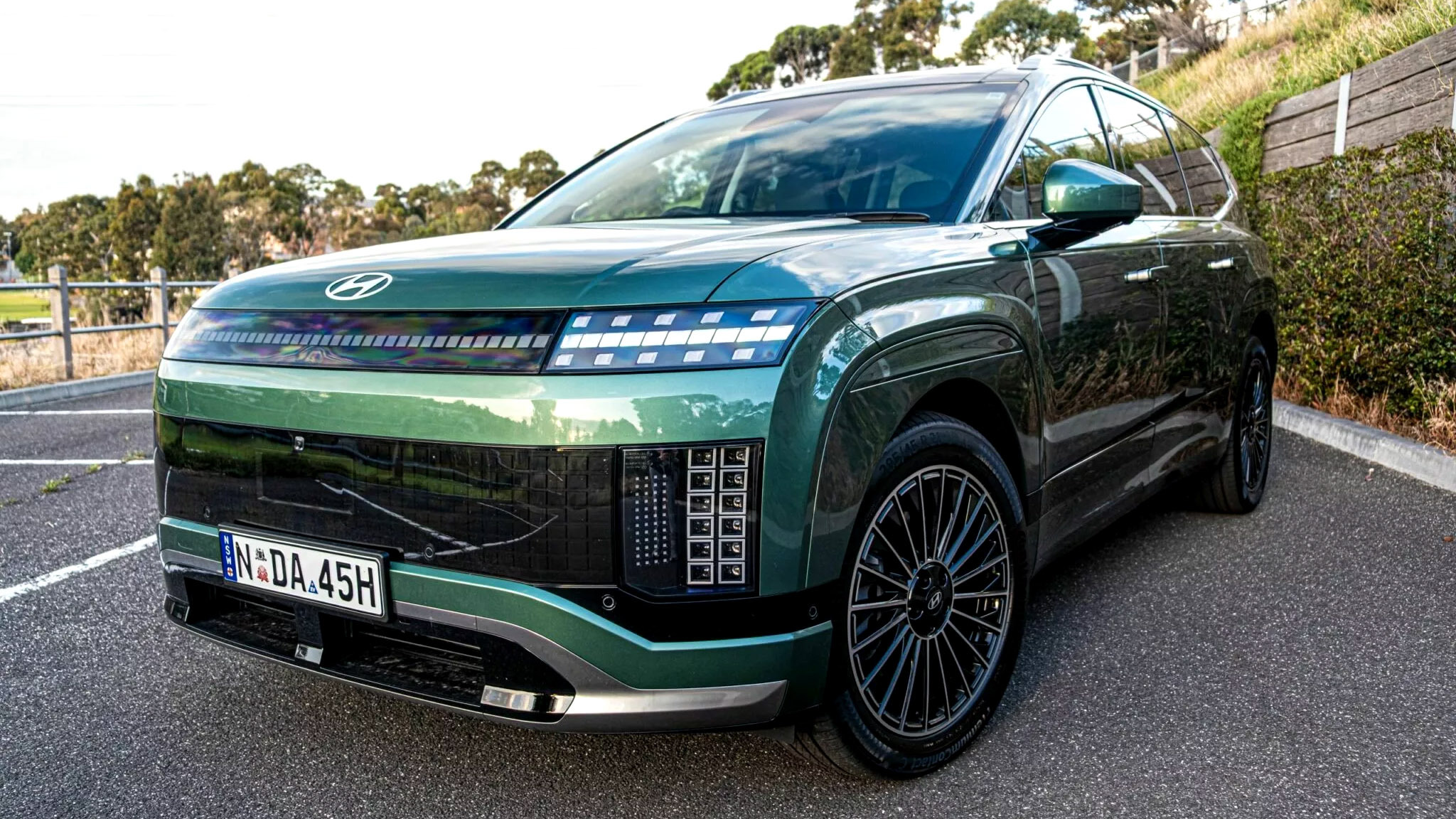
Despite not being marketed as a performance vehicle in Australia, that’s exactly what the Ioniq 9 feels like, at least in a straight line. It can hit 100 km/h (62 mph) in 5.2 seconds, an impressive figure considering the seven-seater weighs a portly 2,721 kg (5,998 lbs). Pin the throttle and it lurches forward, squatting at the rear and leaving hot hatches for dead.

However, show the Ioniq 9 a set of corners, and it doesn’t match the surprising agility of the EV9 GT-Line. That isn’t to say it can’t be hustled through corners at impressive speeds, as it can, thanks in part to the Continental PremiumContact tires. But the Ioniq 9 clearly prefers a calmer approach, and with the massaging seats doing their thing, it feels most at ease settling into a smooth cruise.

Hyundai has done a good job of calibrating the steering of its new flagship SUV and it is beautifully light, perfect for a vehicle of this size, ensuring it’s easy to park. While driving the Ioniq 9, I quickly forgot about its weight, although it was a little harder to forget about the sheer size of the thing.

Measuring it at 5,060 mm (199.2 inches) long, it’s 50 mm (1.9 inches) longer than the EV9, and matches the Kia’s 1,980 mm (77.9-inch) width. It’s even 8mm (0.3 inches) longer than a full-size Range Rover.

Range to Match The Speed

\\\\\\\\\\\\\\\\

Photos Brad Anderson/Carscoops

Thanks to the big battery pack and respectable efficiency, the Ioniq 9 has good, real-world driving range. Hyundai claims it can travel up to 600 km (373 miles) between stops and quotes average efficiency of 20.6 kWh/100 km. During my week with the Ioniq 9, I averaged 22 kWh/100 km, traveled 210 km (130 miles), and had 298 km of remaining range (185 miles).

As with other EVs from Hyundai, Kia, and Genesis, charging is a strong suit of the Ioniq 9. It supports charging speeds of up to 233 kW, meaning the battery can be topped up from 10-80 percent in 24 minutes through a 350 kW charger. AC charging is capped at 10.5 kWh, which is enough for an overnight charge at home.

Also: Hyundai Just Got A Big Gift From Trump, But It’s GM That’s Smiling

Given the Ioniq 9’s considerable weight, I expected the ride to be on the firmer side, as is often the case with electric vehicles. Instead, it turned out to be surprisingly comfortable and noticeably softer than the EV9 GT-Line. That said, the lighter and more compact Santa Fe still manages to deliver an even smoother ride.

Brake regeneration is handled by paddle shifters behind the steering wheel, allowing you to cycle between four different levels, including a one-pedal driving mode which works superbly.
 The 2026 Ioniq 9 Calligraphy’s Biggest Threat Is Hyundai Itself | Review

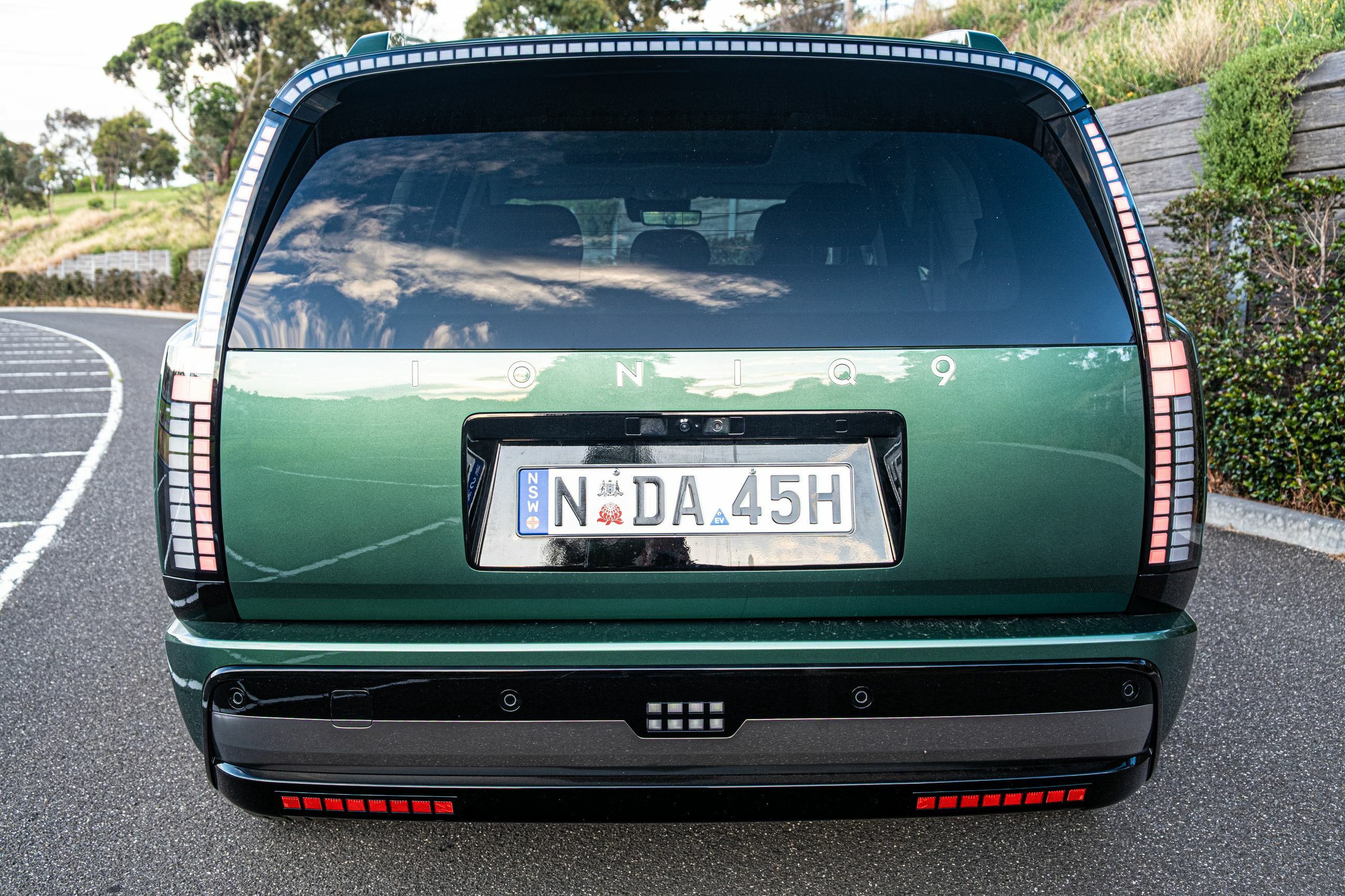
Hyundai has also equipped the Ioniq 9 Calligraphy with its Highway Driving Assist 2 system, which includes radar cruise control and an automatic lane-change function. It can even shift the EV to the edge of the lane when passing a truck for added safety. As we’ve come to expect from the South Koreans, the HDA2 system works flawlessly on the highway.

Verdict

As a standalone EV, especially when stacked against pricier rivals like the troubled Volvo EX90, the Hyundai Ioniq 9 makes a compelling case for itself. Yes, it carries a price more commonly tied to Hyundai’s luxury arm, Genesis, but large electric SUVs come at a premium, particularly those that blend comfort, refinement, and capability as well as this one.

However, as we saw with the Kia EV9, it is the competition from within Hyundai’s own lineup that will likely limit the Ioniq 9’s appeal.

For roughly AU$50,000 (US$32,600) less, you can get a seven-seat Santa Fe Hybrid Calligraphy. And if you’re looking for something larger, the all-new Palisade is available as a seven-seater or even an eight-seater, and costs around AU$30,000 (US$19,500) less. Still, if you’re dead set on an electric SUV for the family, the Ioniq 9 is an easy one to recommend.

\\\\\\\\\\\\\\\\\\\\\\\\\\\\\\\\\\\\\\\\\\\\\\\\\\\\\\\\\\\\\\\\\\\\\\\\\\\\\\\\\\\\\\\\\\\\\\\

Photos Brad Anderson/Carscoops

The 2026 Kia EV6 GT-Line Still Feels Great Yet Something’s Missing | Review

PROS ›› Great to drive, tech-heavy cabin, practical sizeCONS ›› Quite pricey, less range than rivals, tiny frunk

Electric cars have come a long way in a short time, and few have made as much noise, or driven as well, as the Kia EV6. When it first arrived, it wasn’t just another entry into the EV race; it felt like a genuine shift in direction for Kia. When we first drove it, we called the EV6 the new EV benchmark.

Fast-forward a few years, and this not-quite-hatchback, not-quite-crossover remains one of the brand’s best creations. It’s a car that still makes a strong first impression, though the road ahead now looks tougher than ever.

Despite that unusual profile, the EV6 found steady momentum early on. Sales rose from its first year (18,249 units) to its second (18,879), and again into its third (21,715). Yet 2025 tells a different story, with numbers slipping fast to 11,077 through September.

The shape hasn’t changed, the fundamentals haven’t faltered, and on paper, it remains a strong contender. So what’s behind the slowdown?

QUICK FACTS
› Model:2026 Kia EV6 GT-Line AWD
› Starting Price:$58,900 (excluding $1,475 delivery)
› Dimensions:Length 180.9 in (4,595 mm)

Width 73.0 in (1,854 mm)

Height 67.0 in (1,702 mm)

Wheelbase 105.9 in (2,690 mm)
› Curb Weight:4,906 lbs (2,226 kg)*
› Powertrain:Dual motor electric
› Output:320 hp (238 kW)
>0-60 MPH4.8 seconds (GPS verified) 
› Range270 Miles
› Efficiency:3m/kWh
› On Sale:Now
SWIPE

*Manufacturer

To find out what might be causing low sales this year, we picked a 2026 EV6 GT-Line AWD up for a week to treat it as our everyday driver. We tested it on the highway, in urban cityscapes, and even on some gravel roads. This is still a good car, and better than it was back in 2022, but is now harder to recommend than ever before. Read on to find out why. 

Shape and Presence

\\\\\\\\\

Photos Stephen Rivers for Carscoops

The general shape of the EV6 is unchanged since 2022. We’ve reviewed it in different years and in different markets, and one consistent charm has been its dapper styling. For 2025, the car received new front and rear-end lighting elements. 

They are genuine standouts in a market full of somewhat boring-looking light housings. There are updated wheels, lower bodyside moldings, and bumpers that continue in 2026 unchanged. 

One standout is the spoiler that splits in the middle and flares out at each end. It sort of looks like a backward driver’s cap and adds just a bit more personality to an already effervescent automobile.

Overall, this is a mostly cohesive design that turns heads without being too shout-y. The Wolf Gray paint on our test car certainly imbued that ethos. 

Interior

 The 2026 Kia EV6 GT-Line Still Feels Great Yet Something’s Missing | Review

The cabin got an update in 2025 as well, so there’s a new steering wheel that the EV6 shares with other Kias. Our GT-Line trim also benefits from a heated steering wheel, dual 12.3-inch panoramic screen displays, a heads-up display, heated and ventilated front seats, heated outboard rear seats, Meridian speakers, a wireless device charger, and a huge power sunroof. 

Let’s break that list down a bit and discuss real-world experiences. The tech package in this car is great. The infotainment screens are responsive, provide excellent graphics, and have easy-to-navigate menus.

Some of the steering wheel controls can take a bit to learn, but once familiar, they feel like second nature. The heads-up display is bright, configurable, and can even incorporate navigation directions. 

 The 2026 Kia EV6 GT-Line Still Feels Great Yet Something’s Missing | Review

Kia has also updated the seat heating and ventilation buttons on the center console. No longer are they haptic ones that can end up activated accidentally. Instead, they’re genuine hard buttons, which is a step in the right direction. 

Unfortunately, Kia continues to try and push its dual-mode HVAC/Media control system with a haptic button that changes the controls from one to the other.

 The 2026 Kia EV6 GT-Line Still Feels Great Yet Something’s Missing | Review

I’ve griped about it plenty, so I won’t do it again here, but it’s annoying – especially when there’s clearly space to just put a second row of the same controls right under the current one and end the need to switch from one profile to the other and back. 

The seats are some of my favorites in this segment. They combine good lateral bolstering with solid adjustability and support. I especially like the headrest design that has multiple settings both horizontally and vertically.

Forget the type that just pivots on the bottom; these move as one unit forward or back to your desired position. If there’s anything I’d complain about, it’s that as a guy who stands 6’6’’, I could use about one more inch of headroom. 

\\\\\\\

Photos Stephen Rivers for Carscoops

That goes double for the rear seats, where I have okay legroom but again lack space for my noggin. Of course, the majority of back-seat passengers in the EV6 will likely fit just fine, and they’ll have access to bun warmers in the process. 

The cargo space provides 24.4 cu-ft of space. Sadly, the front trunk is only big enough for a few small accessories like charging adapters or a few tools.

Drive Impressions

 The 2026 Kia EV6 GT-Line Still Feels Great Yet Something’s Missing | Review

As an automotive journalist, you sometimes have lots of access to cars. You’ll get one, sometimes two, every week. So far this year, very few have implored me to drive them as much as the EV6 GT-Line. Despite the fact that I don’t fit perfectly in it, I made up random excuses to go drive this thing. 

Since the first time I tested one, it’s been clear to me that the folks behind the Stinger GT may have had a hand in its creation. It’s no Tesla Model 3 Performance, but it ain’t far off.

Granted, this is the 320-horsepower (238 kW) dual-motor-equipped version of the EV6 that also makes 446 lb-ft (605 Nm) of torque. It’s no slouch, but even the base models aren’t what we’d call slow. 

That said, this is the best of the bunch for 2026 – unless, that is, Kia brings the GT back soon. It feels like it, too, with instantaneous acceleration, tight body control, and verbose steering feedback that makes hitting apexes a breeze. 

 The 2026 Kia EV6 GT-Line Still Feels Great Yet Something’s Missing | Review

The one big complaint I have behind the wheel of the EV6 GT-Line AWD is that the ABS is still a bit too eager to kick in under hard pedal engagement. This was an issue with the more powerful GT, and remains to this day. With that in mind, it’s something drivers should almost never encounter regularly this side of a track day. 

How does such a sharp driver’s car handle everyday fair? The answer is, with aplomb. The EV6 has an Eco setting that dials things down to a comfortable six or so out of ten. The throttle softens up, the steering relaxes, and the whole car feels a touch more willing to float over bumps rather than pound them back into the pavement. 

Speaking of poor road conditions, they rarely upset the EV6. It’s composed and calm over everything aside from an actual dirt or gravel road. Even there, the weight balance and excellent motor tuning make it playful, predictable, and fun. The cabin is well insulated, too. Wind noise just isn’t an issue here. All in all, it’s a great car to drive. 

Charging And Efficiency

 The 2026 Kia EV6 GT-Line Still Feels Great Yet Something’s Missing | Review

Including the week that we piloted the EV6, it had been over 900 miles since the last trip odometer reset. In that time, it managed exactly 3 miles per kWh.

That will no doubt change based on how one drives, but it’s a solid score. In our one testing foray with the car, it went from 19 percent to 97 percent on a 125 kW charger in 49 minutes.

Seeing as we charged at a public station, it cost us $28.55 to do so. Kia now uses the North American Charging Standard plug type, which makes it compatible with Tesla Superchargers.

In Eco mode, the EV6 predicted we had 283 miles of available range when full. We never found out because I couldn’t bear to keep it in Eco for that long. Sorry, not sorry. 

Competition

 The 2026 Kia EV6 GT-Line Still Feels Great Yet Something’s Missing | Review

When the EV6 first arrived on the scene, it undercut the competition by tens of thousands of dollars. That’s not an exaggeration. The base price for a Model Y at the time was $58,990. The Ford Mustang Mach-E was $42,895. The EV6 was $40,900.

Several years on, it’s only increased its MSRP by $2,000 if we don’t count destination and delivery. That’s impressive, but the competition is far stiffer. 

The Model Y now starts at just $39,990, and even the next trim up costs only $44,990. A top-of-the-range Performance starts at $57,490. Our Kia EV6 GT-Line AWD has an MSRP of $60,740 with delivery.

That would make perfect sense if it were beat-for-beat on par with the Tesla, but sadly for the Korean automaker, that just isn’t the case. Tesla offers more range, similar performance, a simpler buying experience, more towing capacity, and more cargo space. 

Add to that competition the also excellent, and similarly equipped, Hyundai Ioniq 5. It’s a tough market, and it’s possible that the EV6 hasn’t improved enough, or dropped its price enough, to remain seriously competitive.

On top of that, we have the problem of the used market, which sees similarly equipped low-mileage EV6s go for roughly 60 percent of their original MSRP with regularity. 

Final Thoughts

 The 2026 Kia EV6 GT-Line Still Feels Great Yet Something’s Missing | Review

At the end of the day, this is still a good car. One could even call it great. It’s certainly a blast to drive. I think it’s more attractive than most in its segment, too. It’s practical in that it’s a hatch with decent boot space and reasonable seating for five.

While it doesn’t have as much range as some of its competition, it’s more than enough for most drivers. What really makes it hard to recommend it, then, is its price. Drop that by somewhere between five and ten percent, and it would feel far easier to justify. 

 The 2026 Kia EV6 GT-Line Still Feels Great Yet Something’s Missing | Review

New Zeekr X Got Me Questioning My Feelings For Volvo | Review

PROS ›› Premium interior, comfortable ride, solid safety record CONS ›› Unknown brand, small boot, limited charging speed

Chinese automakers have been bombarding us with new and updated models faster than our browsers can keep up, but every once in a while, one stands out for more than just novelty. The Zeekr X is one of those. A sibling to the Volvo EX30, it carries sharper styling, a dash of swagger, and a promise of premium polish that suggests it’s aiming a little higher than your typical Chinese EV.

Review: Subaru’s Ascent Is Good At Everything Except Winning You Over

The Geely-owned brand has recently landed in my home country, Greece, giving me the chance to see what the compact-sized Zeekr X is all about and, more importantly, take it for a drive.

QUICK FACTS
ModelZeekr X RWDZeekr X AWD
PowertrainSingle Electric MotorDual Electric Motors
Output268 hp (200 kW / 272 PS) and 343 Nm (253 lb-ft)422 hp (315 kW / 428 PS) and 543 Nm (401 lb-ft)
Battery49 kW / 69 kWh69 kWh
Range (WLTP)446 km (277 miles)425 km (264 miles)
0-100 km/h (0-62 mph)5.6 seconds*3.8 seconds*
Top Speed190 km/h (118 mph)*
Length4,432 mm (174.5 inches)
Width1,836 mm (72.3 inches)
Height1,566 mm (61.6 inches)
Wheelbase2,750 mm (108.3 inches)
Weight1,885 kg (4,156 lbs)*1960 kg (4,321 lbs)*
Price €34,990 ($40,700)**
€39,990 ($46,500)**
€44,990 ($52,300)**
SWIPE

* Manufacturer | **Prices in Greece including a €3,000 local incentive for EVs

The X was introduced in late 2023 as the entry-level EV in Zeekr’s growing lineup. It has already been updated in China with more powerful motors and new color and trim options, but those have yet to reach export markets.

Like its Volvo EX30 and Smart #1 relatives, it rides on Geely’s SEA platform, which also underpins the Lynk & Co 02. It even made headlines as Euro NCAP’s safest EV, outperforming some far pricier rivals, including the Porsche Macan. Still, there’s more to this compact SUV than a glowing safety score.

Aggressive Looks, Familiar DNA

 New Zeekr X Got Me Questioning My Feelings For Volvo | Review

Zeekr is still a young brand, having been born in 2021. In terms of styling language, there’s a clear family resemblance with Geely stablemate Lynk & Co, yet Zeekr sits higher in the group’s hierarchy, positioned above Volvo and Polestar in terms of its premium aspirations.

More: Volvo EX30 Cross Country Adds A Touch Of Ruggedness To Baby EV

The Zeekr X has a sharp and modern exterior that will make you look twice when it passes by. Its “double-edged” headlights, greenhouse, door handles, mirrors, and taillights are reminiscent of the Lynk & Co 02, though without the coupe-SUV stance.

Other highlights include the glossy black cladding around the wheel arches and a sharp character line on the profile that extends to the side windows.

\\\\\\\\\\\\\

Photos Thanos Pappas for CarScoops

At 4,432 mm long, it’s 199 mm longer than the Volvo EX30 and 28 mm shorter than the Lynk & Co 02. That puts it right among Europe’s compact premium EV-SUVs, including the BMW iX1, Audi Q4 e-tron, and Mercedes EQA.

Our press tester was the Long Range RWD variant, which sounds like a sweet spot in the lineup. It pairs a single 268 hp (200 kW) motor with the larger 69 kWh battery for up to 446 km (277 miles) of WLTP range. Visually, it rides on 19-inch alloy wheels rather than the 20-inch option which is reserved for the 422 hp AWD flagship.

Premium Aspirations

 New Zeekr X Got Me Questioning My Feelings For Volvo | Review

Open the frameless doors and you immediately sense that this brand aims for BMW territory in terms of perceived quality. Soft-touch materials cover most surfaces, complemented by futuristic ambient lighting and ASMR-friendly switchgear finished in copper.

The configurable switches on the steering wheel are a nice touch, as they can also serve as physical controls for the A/C so you don’t have to fiddle with the screen all the time.

More: Zeekr’s 007 GT Is One Sexy Looking Wagon Heading To Europe

The seats are upholstered in soft vegan leather and feature hard outer shells adding a futuristic note. Geely designers played safe in terms of the dashboard layout, combining a 14.6-inch central touchscreen with an 8.8-inch instrument cluster.

There is also a 24.3-inch augmented reality head-up display helping keep your eyes on the road. Equipment is generous, including a panoramic sunroof, a 13-speaker Yamaha sound system, and a full suite of ADAS.

\\\\\\\\\\\\\\\\\\\\\\\\\\\\\\\\\\\\

Photos Thanos Pappas for CarScoops

Rear passengers are also treated well. Thanks to the longer wheelbase, the X offers noticeably better rear legroom and headroom than the Volvo EX30, making it a far more comfortable choice for adults or small families.

There is also plenty of in-car storage including a multi-functional central armrest. However, the boot is equivalent of a subcompact hatchback with a capacity of 362 lt (12.8 cubic feet), and the tiny 21 lt (0.4 cubic feet) frunk is mostly for storing charging cables.

Comfort Is the Key

 New Zeekr X Got Me Questioning My Feelings For Volvo | Review

My drive was brief, just a few hours during the local media presentation, so this is not a full review, but it was enough to get a good feel for the Zeekr X’s personality.

As with the Volvo EX30, the excellent SEA platform has the robustness of larger segments. Here, it is combined with a softer suspension setup for even higher levels of comfort and slightly better soundproofing.

More: Zeekr Follows BYD With Free Self-Driving Systems In New And Existing Models

The steering has a nice feel, although I didn’t notice enough differentiation between the available modes (Comfort, Standard, and Sport). Still, the Zeekr X is more engaging than your average Chinese EV while keeping a neutral and predictable character in line with its Swedish R&D genes. The ADAS worked well overall, but a few over-eager alerts popped up on roads with faint lane markings.

\\\\\\\\\\\\

Photos Thanos Pappas for CarScoops

Performance-wise, the 268 hp RWD version feels plenty quick for daily use, making the 422 hp AWD variant seem somewhat indulgent. Interestingly, China’s updated models have bumped outputs to 335 hp and 489 hp respectively, hinting that future exports could get an extra jolt of power.

Overall, the extra range that should be around 400 km (250 miles) in real-life conditions and the extra playfulness of the RWD make it the preferred choice from my point of view – especially considering it offers a nearly identical equipment at a lower price.

The 69 kWh battery pack doesn’t have the ultra-fast charging capabilities of the Zeekr 001 flagship, but can go from 10-80% in under 30 minutes when connected to an 150 kW DC charger.

How Much Does It Cost?

 New Zeekr X Got Me Questioning My Feelings For Volvo | Review

In Greece, where we tested it, the base Core RWD starts at €34,990 ($40,700), while the Long Range RWD sits at €39,990 ($46,500), and the top Privilege AWD costs €44,990 ($52,300). Each trim comes fully loaded.

The closely related Volvo EX30, by comparison, ranges from €36,175 to €48,448, while the larger Tesla Model Y starts from €36,175. All prices include Greece’s €3,000 EV incentive.

Another indirect competitor at a similar price point is the larger and more practical Tesla Model Y that currently starts from €36,175 ($42,100) in the same market. Keep in mind that all of the aforementioned prices include a €3,000 incentive for EVs.

More: Zeekr’s Flagship 9X Costs Lincoln Money But Crushes Hypercar Power

Zeekr representatives told us that the company plans on keeping prices consistent across all European markets. This means that the X will start from around €38,000 ($44,200) before incentives in Germany, undercutting its Volvo sibling and the Tesla Model Y by a couple of grand, while being almost €10,000 ($11,600) cheaper than the entry-level BMW iX1.

Eyes on Europe

\\\\\\\\\\\\\\\

Photos Thanos Pappas for CarScoops

Zeekr has sold a total of 550,000 vehicles since its inception in 2021. The European rollout of the brand started in 2023, with new countries being added every year. The next step is to enter major European markets including Germany, France, Spain, Italy, and the UK by the end of 2026.

The brand’s R&D and design hub in Gothenburg, Sweden and regional offices in Amsterdam, the Netherlands, complement its Chinese operations, signaling long-term European ambitions.

Beyond the X compact SUV, Zeekr is currently offering the 7X midsize SUV and the 001 flagship shooting brake in the Old Continent. Still, the company’s Chinese lineup is much broader, including the 007 sedan, the Mix and 009 minivans, and the new 9X flagship SUV.

Verdict

 New Zeekr X Got Me Questioning My Feelings For Volvo | Review

After a short but telling encounter, the Zeekr X left a lasting impression. It feels more spacious, more comfortable, and more polished than the Volvo EX30 it shares bones with, while coming in cheaper. The ride quality, cabin refinement, and safety credentials suggest it’s one of the most convincing Chinese EVs yet to reach Europe.

If you can get past the unfamiliar badge, the Zeekr X makes a compelling case as a smart, well-rounded alternative in the compact electric SUV space.

❌