Normal view

There are new articles available, click to refresh the page.
Before yesterdayMain stream

EV Speed Comes At A Price, So Where’s The Sweet Spot?

  • A Tesla owner performed a series of real range tests in his single-motor Model Y.
  • He drove the same route 30-mile route at 50 mph, 60mph, 70 mph and 80 mph.
  • Going 80 mph vs 50 mph cut time by 38% but dropped range by same amount.

Speed or efficiency? For as long as there have been cars, drivers have had to weigh up that decision. Going faster means getting from A to B sooner, but is going to burn through more fuel, costing you more money.

And now, in the EV age, there are added pressures. Some electric cars are only good for 250 real-world miles (402 km), and BYD’s new 1,500 kW chargers aren’t here yet, meaning that if you need to stop mid-journey you can easily add 15-30 minutes to your trip, more than wiping out the time you saved by flexing your right ankle.

Related: Tesla’s Budget Model Y Gets Grip And Grit For $2K More, But Don’t Call It Standard

So what’s the sweet spot? That’s what one Tesla-owning YouTuber behind the Carwire channel decided to find out by conducting a series of test runs in his single-motor, rear-wheel drive Model Y.

He ran the same 30-mile (50 km) looping route along local multi-lane freeways (dual-carriageways in UK-speak) at 50 mph (81 km/h), 60 mph (96 km/h), 70 mph (113 km/h) and 80 mph (129 km/h), noting the Wh/mile efficiency for each trip.

Taking those numbers and assuming a 75 kWh usable battery capacity, he was able to extrapolate realistic freeway-type range figures, plus a hypothetical time for a 200-mile (302 km) journey based on the time taken to complete each loop at the different speeds. While this isn’t exactly super-scientific, it still delivers a useful comparison that highlights the huge effects different speeds have on efficiency and journey time.

The first loop, taken at a steady 50 mph, would result in 200-mile trip in the Model Y taking four hours. But the excellent 224.7 Wh/mi efficiency gives a calculated 333-mile (536 km) range, meaning you’d get to your destination with stacks of charge to spare.

80 MPH Decimates Range

At the other end of the scale, the 80 mph run crashed efficiency to 366.2 Wh/mi, and the range to just 204 miles (328 km). So while technically you could handle the 200-mile journey in one go, and in only 2 hours and 30 minutes, few people would risk not filling up before they hit the finish line.

The sweet spot, as Carwire concludes, seems to be somewhere between 60 and 70 mph. Bumping the speed up to 60 mph cuts a handy 40 minutes off the 50 mph journey time, yet the 300-mile (483 km) range is only 33 miles (53 km) lower.

Pushing the needle up to 70 mph cuts another half hour from the trip, and though the efficiency starts to tumble the 248-mile calculated range would still let you comfortably complete your 200-mile run without charging, or stressing that you probably ought to.

Speed Versus Time And Efficiency
50 mph60 mph70 mph80 mph
Journey time4 hours3 hours 20 mins2 hours 51 mins2 hours 30 mins
Efficiency224.7 Wh/mi249.9 Wh/mi302.2 Wh/mi366 Wh/mi
Calculated range333 miles300 miles248 miles204 miles
SWIPE

Carwire

EV Buyers Didn’t Disappear, They Just Moved Somewhere Automakers Don’t Love

  • New EV sales dropped sharply year over year in Feb, but rose slightly versus Jan.
  • Used EV demand surged as prices fell and inventory tightened across the market.
  • Tesla still dominates, though rivals gained ground with strong February showing.

The war in Iran and resulting gas price spike might be making American drivers suddenly more interested in new EVs, but that’s obviously not reflected in February’s sales figures.

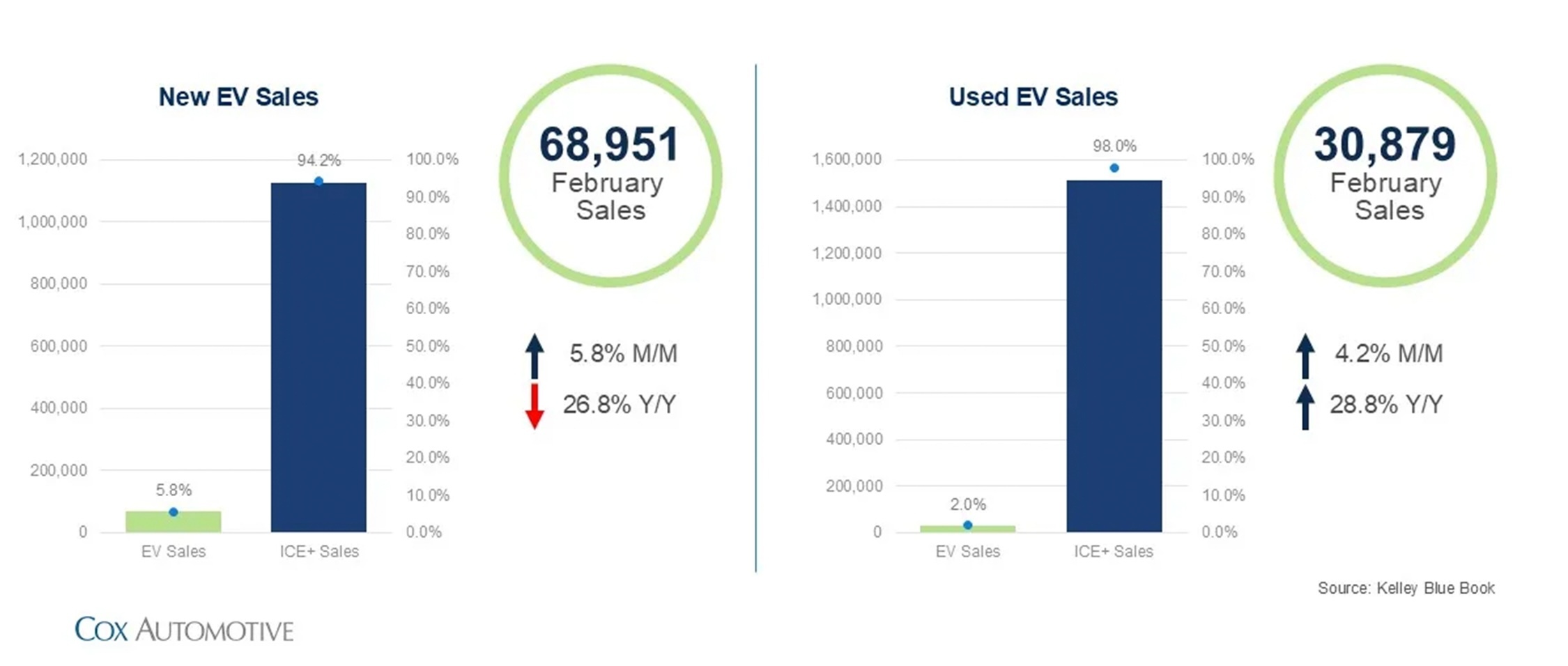
Data shows new EV sales came in just under 69,000 units last month, which sounds healthy until you notice that’s down a hefty 27 percent compared to last year. That total still marked a 5.8 percent increase compared to January and represented about 5.8 percent of all new vehicle sales.

There is a silver lining though, and it’s that those people who did buy an EV paid less for it as prices were pushed down across the board, Cox Automotive says.

More: Global EV Sales Just Fell 11%, But Carmakers Found A Surprising Backup Plan

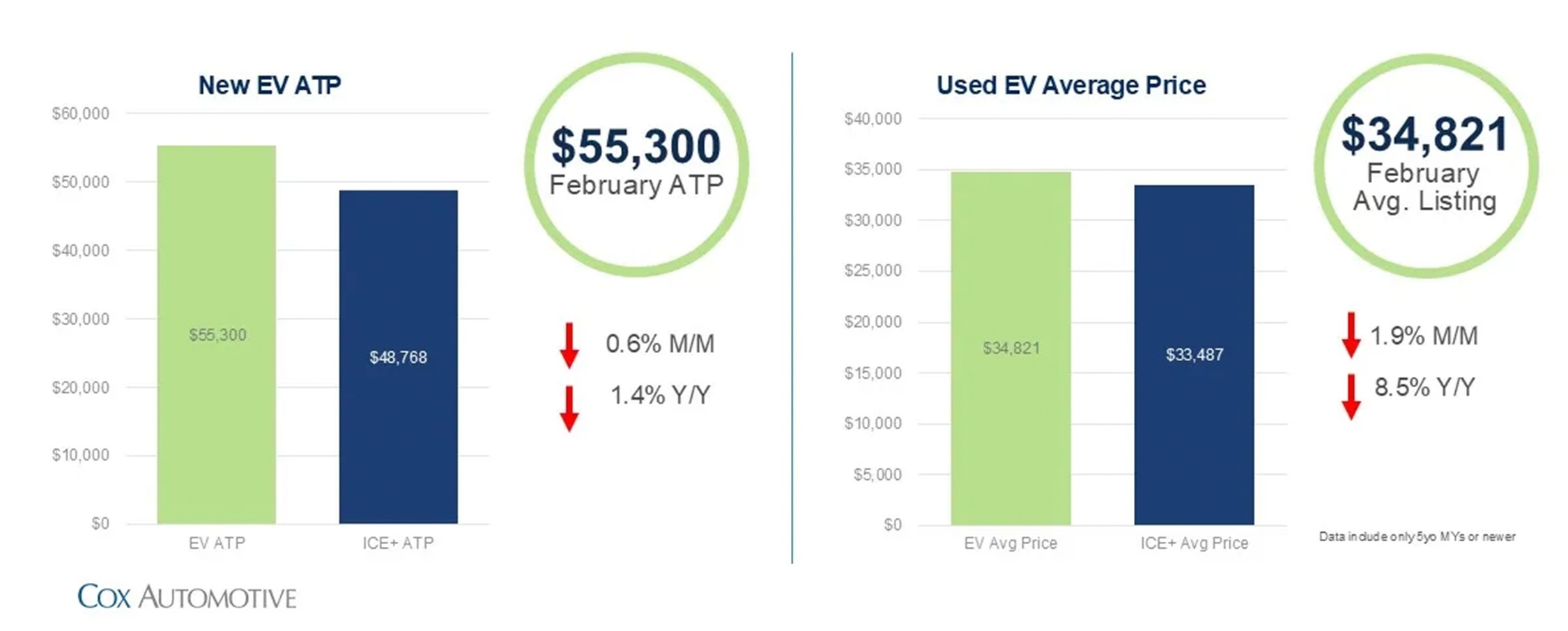
New EVs averaged around $55,300, dipping slightly from last year and narrowing the price gap with gas cars to its lowest ever. Incentives are doing a lot of work here, now making up more than 14 percent of the average transaction price.

 EV Buyers Didn’t Disappear, They Just Moved Somewhere Automakers Don’t Love

On average, incentives climbed to about $7,870 per vehicle, a clear sign automakers are relying heavily on discounts to keep buyers interested.

Tesla still leads the pack by a mile, shifting around 38,500 units, but even the world’s most famous EV company isn’t immune to gravity. Its share slipped 4 percent month over month as rivals started clawing back some ground.

Chevrolet had a particularly strong month, demand jumping 70 percent versus January, and Hyundai and Toyota also nudged forward, while Ford and Nissan’s performances suffered, as did EV sales overall.

Used Sales Head In The Opposite Direction

Meanwhile, the used EV market is quietly having a moment. Sales jumped nearly 29 percent year over year, with almost 31,000 units finding new homes. That’s not explosive growth, but it does show buyers are warming to second-hand electric cars, especially as prices keep sliding.

That figure also reflects a modest 4.2 percent increase from January, pointing to steady month-over-month momentum.

 EV Buyers Didn’t Disappear, They Just Moved Somewhere Automakers Don’t Love

We’ve already touched on the falling prices of new EVs, but prices for used ones are dropping even faster, and now average just under $35,000. That’s down more than 8 percent year over year, making them far more tempting for budget-minded buyers. In fact, many used EVs now cost less than their gas powered equivalents, which would’ve sounded wild not long ago.

The report also explains that inventory is tightening, especially for used EVs, suggesting demand is finally starting to match supply as the market  shifts from the oversupply headaches of recent months. But while Cox Automotive experts didn’t explicitly say that could lead to prices rising, simple supply and demand laws suggest to us they might.

In fact, used EV supply dropped to about 42 days, now slightly exceeding comparable gas vehicle levels for the first time in nearly a year.

 EV Buyers Didn’t Disappear, They Just Moved Somewhere Automakers Don’t Love

Cox Automotive

Global EV Sales Just Fell 11%, But Carmakers Found A Surprising Backup Plan

  • Global EV sales fell by 11% in Feb, and are down 8% year-to-date.
  • Europe surged 21%, but the biggest region, China, suffered a 26% drop.
  • Carmakers and suppliers are now moving into energy storage systems.

Electric cars were supposed to take over the world in a neat upward line. Instead the global EV market and new-vehicle buyers threw in a curveball and carmakers are scrambling to adapt.

Approximately 1.1 million electric vehicles were sold worldwide in February, according to new data from Benchmark Mineral Intelligence, which sounds impressive until you look closer. Sales were down 11 percent compared with the same month last year and also down 11 percent compared with January.

Related: These Used EVs Are Selling Faster Than Gas Cars In Today’s Market

So yes, EV demand is still big. But it’s not as big as it was, and it differs wildly from region to region. Europe, for instance, is still booming. EV sales there are up 21 percent so far this year, helped heavily by subsidies and government incentives. Germany (up 26 percent) and France (+30 percent) are leading the charge, and Italy’s market has nearly doubled thanks to generous EU backed incentives.

Ford’s Tough Time

 Global EV Sales Just Fell 11%, But Carmakers Found A Surprising Backup Plan

Meanwhile, North America is heading the opposite direction. True, February sales climbed 8 percent, but year-to-date they’re down a staggering 36 percent as demand weakens. Some automakers are feeling the pain more than others. Ford’s EV sales have reportedly dropped 70 percent so far this year.

China, still the biggest EV market, is somewhere in between. Domestic EV sales are down 26 percent since the start of the year after the country reintroduced purchase taxes and tweaked its trade in incentives. But Chinese brands are making up for that by exporting more EVs than ever. In the first two months of 2026 alone, Chinese EV exports more than doubled and topped half a million units.

EV Sales Jan-Feb 2026
YTD ’26Change vs ’25
Global2.2 million-8%
China1.1 million-26%
Europe0.6 million21%
North America0.17 million-36%
Rest of World0.37 million84%
SWIPE

Benchmark Minerals

For automakers the slowdown creates a practical problem. Billions have been invested in battery factories designed to feed a huge wave of EV demand. And when that demand softens, those batteries still need a job.

That’s why more automaker and suppliers are turning toward energy storage. Large grid scale battery systems are suddenly becoming a convenient way to soak up spare production while also helping stabilize electricity networks.

VW Hooks Up

Volkswagen, for example, recently switched on its first large scale battery storage facility in Germany. In Salzgitter, the VW Group’s energy subsidiary Elli has connected a storage system to the grid with an output of approximately 20 megawatts (MW) and a storage capacity of 40 megawatt-hours (MWh).

Instead of powering cars, the batteries help store renewable electricity and release it when the grid needs extra juice. Other automakers including Tesla, BYD, GM, Ford, Renault, Mercedes and Hyundai are also either already selling energy storage systems or working on them.

\\\

VW

America’s Used EV Market Is Heating Up For One Simple Reason

  • Used EV sales rose 21 percent year over year in January.
  • Resale values fell sharply as lease returns expanded supply.
  • Battery durability data helps ease buyer reliability fears.

While the world continues to grapple with virtually universal rises in pump prices, could we be in for an EV renaissance? As automakers wrestle with long-term electrification strategies, another trend is gaining attention, the growing acceptance of used electric vehicles in the USA.

Yes, EVs are no longer just for first adopters. In the States, the falling resale value and a rising number of used cars in inventory are introducing normal consumers to the used EV marketplace much faster than expected. What may previously have felt like an experiment now looks like a practical solution to stubbornly high new car prices.

Read: These Used EVs Are Selling Faster Than Gas Cars In Today’s Market

Used EV demand is climbing at a noticeable pace. In January alone, sales were 21 percent higher than a year earlier. Figures cited by Reuters show the trend stretching across the entire year, with used EV sales in 2025 ending up 35 percent higher than in 2024.

EV Depreciation Is Real

 America’s Used EV Market Is Heating Up For One Simple Reason

Price movement is a major reason. Data from Cox Automotive, gathered across major automotive marketplaces, indicates that the decline in prices for used EVs has been much sharper in the past year, narrowing the gap between them and comparable gas-powered vehicles.

The premium for used EVs over comparable gasoline vehicles narrowed to $1,376 in January from $2,591 in December. Analysts attribute that change to a glut of lease returns, deep discounts on new electric models, and federal tax credits that are evolving how shoppers crunch the numbers.

Best-Selling Used EVs In The U.S. In 2025
VehicleUnits Sold
Tesla Model 372,673
Tesla Model Y53,847
Tesla Model S18,257
Ford Mach-E16,355
Chevy Bolt14,103
SWIPE

Source: Cox Automotive (Tesla totals exclude vehicles the company sold directly)

It was not only Tesla showrooms that were impacted when Tesla reduced the prices of three new models in 2023 and 2024. These reductions lowered resale in the entire electric market. When the new cars had gone cheaper, used cars were forced to be drop their prices too.

Add to that ‌car rental firm Hertz’s large-scale sale of Teslas, and you suddenly have many more second-hand options in the used EV market.

Confidence in EV Ownership Is Improving

Affordability helps, but confidence is just as important. Data on battery performance still continues to show that modern packs are built to last well past 100,000 miles. Most manufacturers offer long battery warranties, which gives peace of mind to shoppers who fear costly repairs.

Charging access has also improved. Public fast charging stations are being added along highways and in urban areas with the help of both private companies and federal funding. With increased visibility and reliability of infrastructure, the fear of being stranded with a low battery for many drivers is a thing of the past.

 America’s Used EV Market Is Heating Up For One Simple Reason

These Used EVs Are Selling Faster Than Gas Cars In Today’s Market

  • New study shows used EVs are selling quicker than used ICE models.
  • In February, the average used car took 53 days to sell in the US.
  • The Tesla Model X was the quickest-selling used car last month.

We all know that new car prices have surged over the past six years, but they’re not alone. The used market has followed the same trajectory. Prices have risen sharply, and vehicles are now lingering on dealer lots longer than before, partly because many owners are not shopping for cars and are holding on to their current ones. Even so, one automaker seems largely unaffected by the slowdown

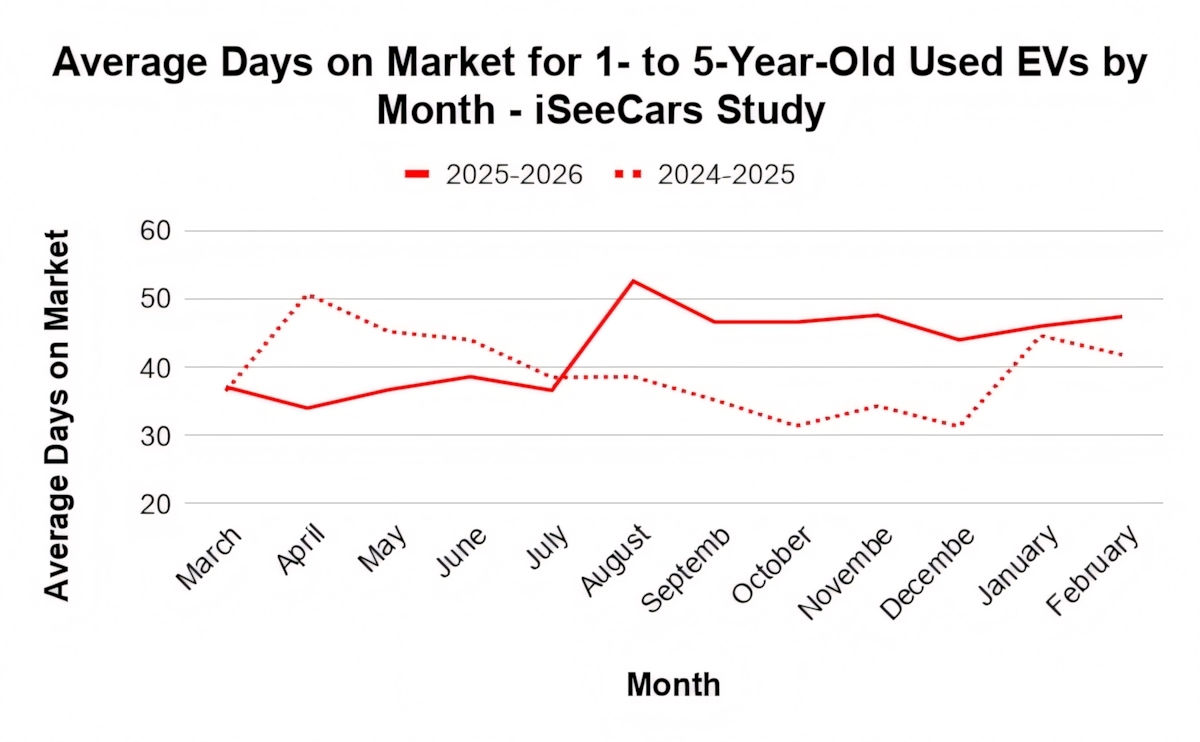
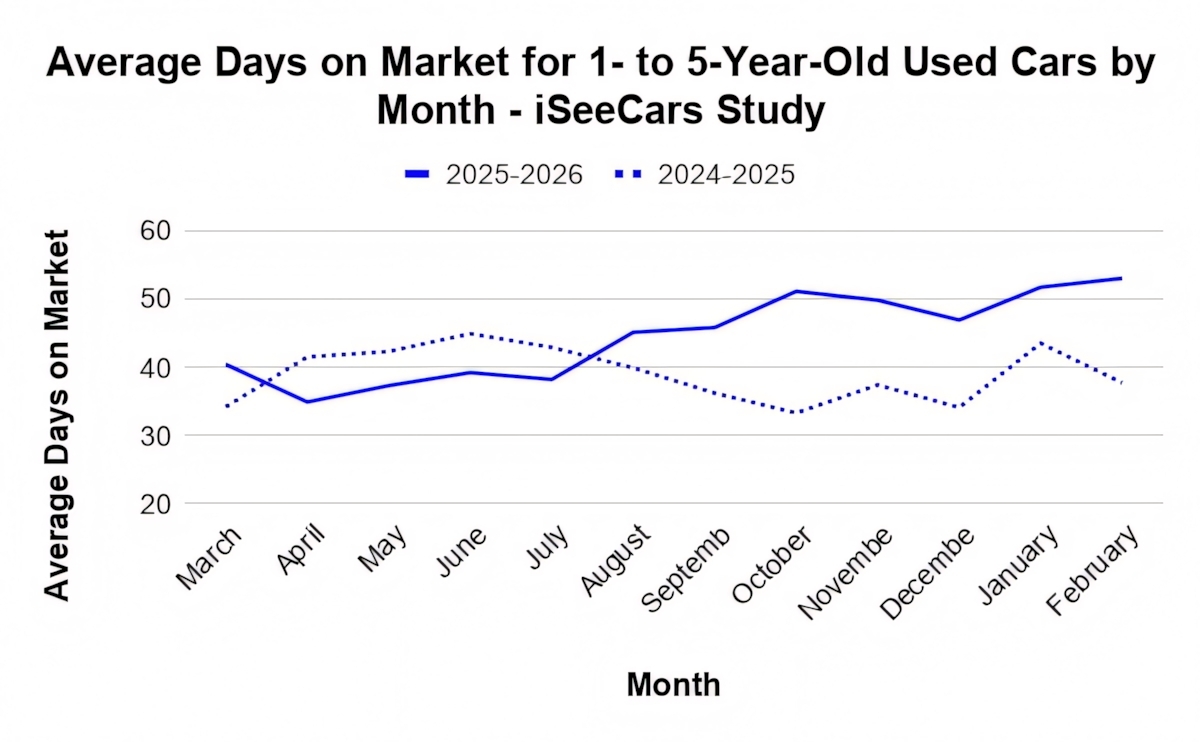
Fresh data from iSeeCars sheds some light on the trend. It examined more than 960,000 transactions involving used vehicles between one and five years old during February. Across that sample, the typical used car sat on the market for 53 days before finding a buyer. A year earlier the average was just 37.7 days in the US, which means selling times have stretched by roughly 40 percent in only twelve months.

Read: Tesla’s Sales Collapsed By Nearly 90% In The Land Of EVs

Used electric models, interestingly, are moving a bit faster than their gasoline counterparts. In February, the typical used EV took 47.4 days to sell. That figure has increased from last year’s 41.8-day average, but the 13.4 percent rise is modest compared with the broader used market.

 These Used EVs Are Selling Faster Than Gas Cars In Today’s Market
iSeeCars
 These Used EVs Are Selling Faster Than Gas Cars In Today’s Market

Tesla Bucks The Trend

However, there’s a little more to these figures than may first meet the eye. Because Teslas still account for the vast majority of EV sales, their typically quick resale times drag down the overall market average. Remove Tesla from the equation and the picture changes. Without those models included, the typical used EV took 57.3 days to sell in February, a 15.1 percent increase from the 49.8-day average recorded at the same time last year.

So which models disappear from listings the fastest? Comfortably leading the pack is the Tesla Model X, needing an average of just 22.6 days to sell. Surprisingly, it was followed by the Mercedes-Benz EQS SUV, at an average of 26.9 days, and then the Tesla Cybertruck, at 27.4 days.

Fastest-Selling Used Cars In February 2026
RankModelDays on MarketCompared to Average
1Tesla Model X22.60.43x
2Mercedes-Benz EQS (SUV)26.90.51x
3Tesla Cybertruck27.40.52x
4Mazda MX-5 Miata RF29.30.55x
5Toyota GR Supra30.00.57x
6Genesis G9030.40.57x
7Rivian R1S30.80.58x
8Toyota GR Corolla31.10.59x
9Hyundai Kona Electric31.40.59x
10Volkswagen Golf R31.80.60x
11Lexus GX 55032.40.61x
12Lexus RX 500h33.00.62x
13Tesla Model 333.10.62x
14Nissan LEAF33.80.64x
15Honda Civic Hybrid34.80.66x
16Tesla Model Y34.90.66x
17Toyota GR8635.10.66x
18BMW M235.40.67x
19BMW X5 M35.50.67x
20Cadillac Escalade-V35.60.67x
Overall Average53.0
SWIPE

Other strong performers uncovered by the iSeeCars study included the Mazda MX-5 Miata RF at 29.3 days, the Toyota GR Supra at 30 days, the Genesis G90 at 30.4 days, the Rivian R1S at 30.8 days, and the Toyota GR Corolla at 31.1 days. Several of these cars lean toward the enthusiast end of the spectrum, which likely helps keep demand strong.

Tesla’s higher-volume models appear a little further down the rankings. The Model 3 lands in 13th place with an average of 33.1 days on the market, while the Model Y sits in 16th at 34.9 days. However, it’s worth noting that far more Model 3s and Model Ys are sold monthly than the likes of the GR Supra, G90, R1S, and MX-5 Miata, so they help to sway the overall market.

The opposite end of the list looks very different. Some vehicles sit for months before finding a buyer. The Volvo XC60 is the slowest mover in the study, lingering for an average of 170.2 days. The BMW i5 is not far behind at 153 days, followed by the Dodge Hornet at 123.7 days and the Lincoln Nautilus Hybrid at 118 days.

Slowest-Selling Used Cars In February 2026
RankModelDays on MarketCompared to Average
1Volvo XC60 (hybrid)170.23.21x
2BMW i5 (electric)153.02.89x
3Dodge Hornet (hybrid)123.72.33x
4Lincoln Nautilus Hybrid118.02.23x
5GMC Sierra EV116.12.19x
6Ford Escape Plug-In Hybrid112.32.12x
7Volvo XC90 (hybrid)108.72.05x
8Nissan Z107.92.04x
9Genesis GV60101.61.92x
10Land Rover Discovery101.51.92x
11Dodge Charger (electric)96.71.82x
12Chevrolet Blazer EV96.31.82x
13Cadillac Escalade IQ93.81.77x
14Cadillac XT691.61.73x
15BMW 8 Series91.41.72x
16Lincoln Corsair (hybrid)90.61.71x
17Chevrolet Silverado EV87.71.65x
18Cadillac LYRIQ87.41.65x
19GMC HUMMER EV (SUV)87.21.65x
20Dodge Hornet87.21.65x
Overall Average53.0
SWIPE

Nearly 1 In 3 EV Chargers Are Mischarging UK Drivers

  • About 31.5 percent of tested chargers fell outside limits.
  • Some units delivered far less energy than shown.
  • Public charging costs and taxes add to driver concerns.

Refueling is something most drivers don’t think about too much. They plug in or insert a fuel nozzle, press go, and wait to see how bad the bank account damage is in the end. Now, EV drivers in the UK might be thinking twice before they plug in at a public charging station. A new study found that almost one in three mis-calculated the energy provided during a session.

According to independent inspection provider EVCI Global, 31.5 percent of the chargers it reviewed either overestimated or underestimated the energy transferred to vehicles. In roughly 15 percent of cases, errors exceeded five percent, with a small number showing what the company described as “materially larger deviations.”

EVCI says this effectively leaves EV drivers carrying more financial risk than petrol car owners, who enjoy far tighter oversight every time they pull up to a pump.

More: BYD’s New EV Chargers Are So Fast They’re Arranged Like Gas Station Pumps

The study, first reported by The Telegraph, highlights how different standards are for EV chargers when compared to gas or diesel fuel pumps. Fuel dispensers are subject to strict statutory verification and typically must operate within a tolerance of -0.5 to +1 percent.

 Nearly 1 In 3 EV Chargers Are Mischarging UK Drivers

By contrast, most public EV charge point meters are allowed a margin of error of up to +2 percent. Even so, EVCI says nearly a third of the units it tested fell outside that permitted window.

The company argues that public chargers should be brought under a formal verification regime similar to fuel pumps. It has also raised the issue with relevant government departments, pushing for clearer oversight and enforcement.

Extreme Cases And Industry Response

In one extreme case cited by CEO Craig Marsden, a charger was found to be delivering 37 percent less electricity than the figure displayed on-screen. Importantly, there were also cases where the chargers actually under-valued the amount of juice they provided, so drivers paid less. The findings have been presented to the Transport Select Committee.

“People with EVs need to know that they’re getting what they’re paying for, the same way that they do at petrol pumps,” Marsden said.

 Nearly 1 In 3 EV Chargers Are Mischarging UK Drivers

EVCI argues that this situation creates a two-tiered situation where EV owners are at greater risk of losing money. That’s especially true for those who don’t have access to off-street parking and home charging networks. Such individuals rely heavily on public charging infrastructure and could end up paying more than their fair share. A long charging session can exceed £70, and annual costs may approach £2,000. That’s without the errors included.

Industry Response To Accuracy Claims

Industry body ChargeUK has pushed back on the report, saying that the inaccuracies are isolated cases. It also pointed out that measuring electricity transfer is more complex than measuring liquid fuel.

Also: PHEVs Promised Efficiency, Drivers Are Burning Three Times More Fuel

A spokesperson for the Department for Transport told the newspaper that public EV charge points are expected to measure and supply exactly the electricity they claim to deliver. They added that meters at most public chargers are regulated to ensure accuracy within 2 percent.

That said, EV drivers will no doubt want to see a dramatic improvement in the next EVCI report. Otherwise, adoption rates could take a hit.

 Nearly 1 In 3 EV Chargers Are Mischarging UK Drivers

America’s Gen Z Is Ready For Chinese Cars, Their Parents Are Not

  • U.S. consumers are sharply divided on Chinese vehicle brands.
  • Dealers show strong resistance despite notable shopper curiosity.
  • Price incentives could sway buyers, but trust remains critical.

If you spend any time in automotive comment sections, you’ve seen it. Someone inevitably points to a cutting-edge EV from China and declares it superior to whatever U.S.-market model is under discussion. There’s a huge catch, though: that vehicle doesn’t actually exist in the American marketplace.

More: BYD Got In America Through The Back Door, Now It Wants The Front One Too

It’s not federally certified, not sold through U.S. dealers, not supported by a domestic service network, and not priced with tariffs factored in. It’s a theoretical alternative, not a real one, and new research helps explain why this dynamic exists. Americans are forming opinions about Chinese automakers before most have ever seen one in person.

 America’s Gen Z Is Ready For Chinese Cars, Their Parents Are Not

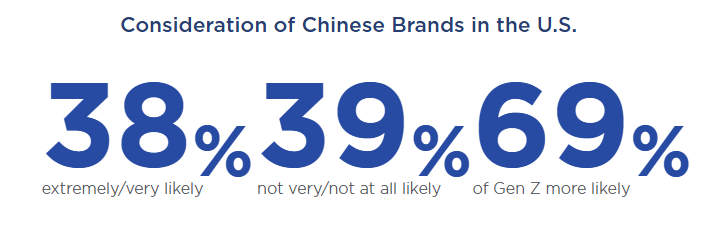
According to a study from Cox Automotive, consumers are heavily divided. Around 38 percent of shoppers say that they’re extremely or very likely to consider a Chinese brand. Another 39 percent says the opposite, that they’re extremely unlikely to do so. Among Gen Z buyers, the openness jumps to a whopping 69 percent, so if this ever does happen, expect the marketing to skew toward younger folks.

That split implies any early traction would likely be concentrated within specific demographics rather than spread across the broader market, creating both opportunity and risk for established players.

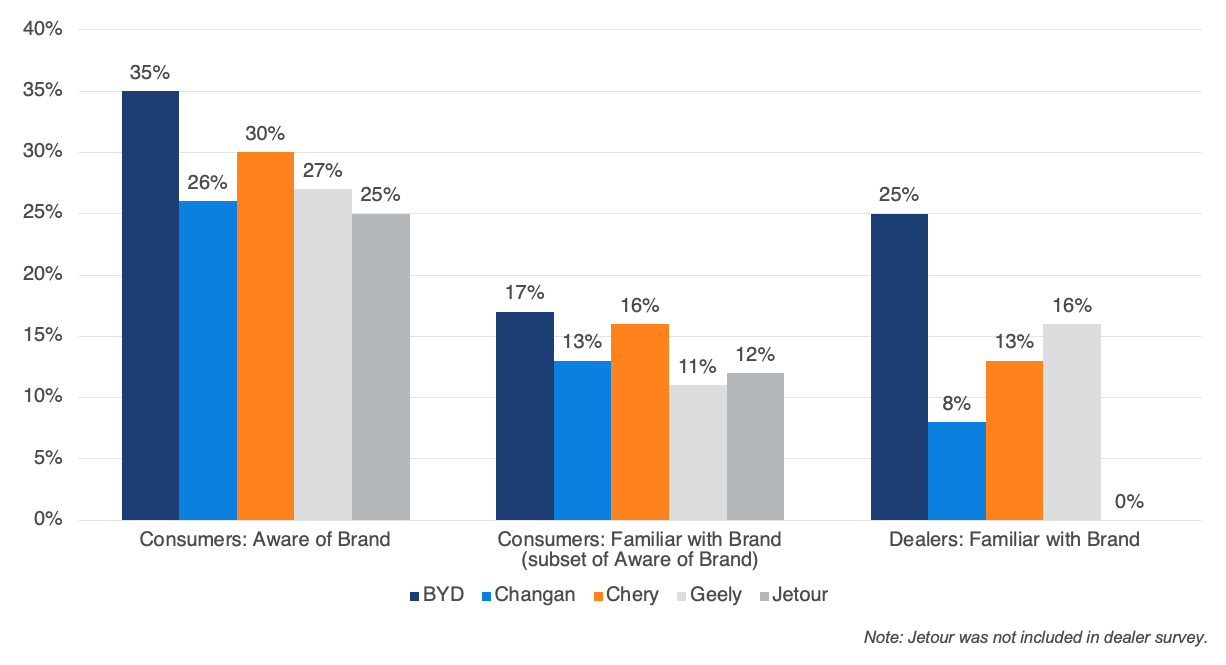
That said, actual awareness is thin. Nearly half of those surveyed said they were familiar with Chinese brands, but actual brand knowledge falls off a cliff quickly. BYD is the brand most are familiar with and that made up just over one-third of respondents. In total, only 17 percent said they had a deeper awareness of it. That’s a pretty big insight gap.

Dealer familiarity lags even further behind, with only about a quarter reporting any awareness of BYD, a reminder of how preliminary this conversation still is at the retail level.

Chinese Brand Awareness and Familiarity
 America’s Gen Z Is Ready For Chinese Cars, Their Parents Are Not
Cox Automotive

Shoppers Vs Sellers

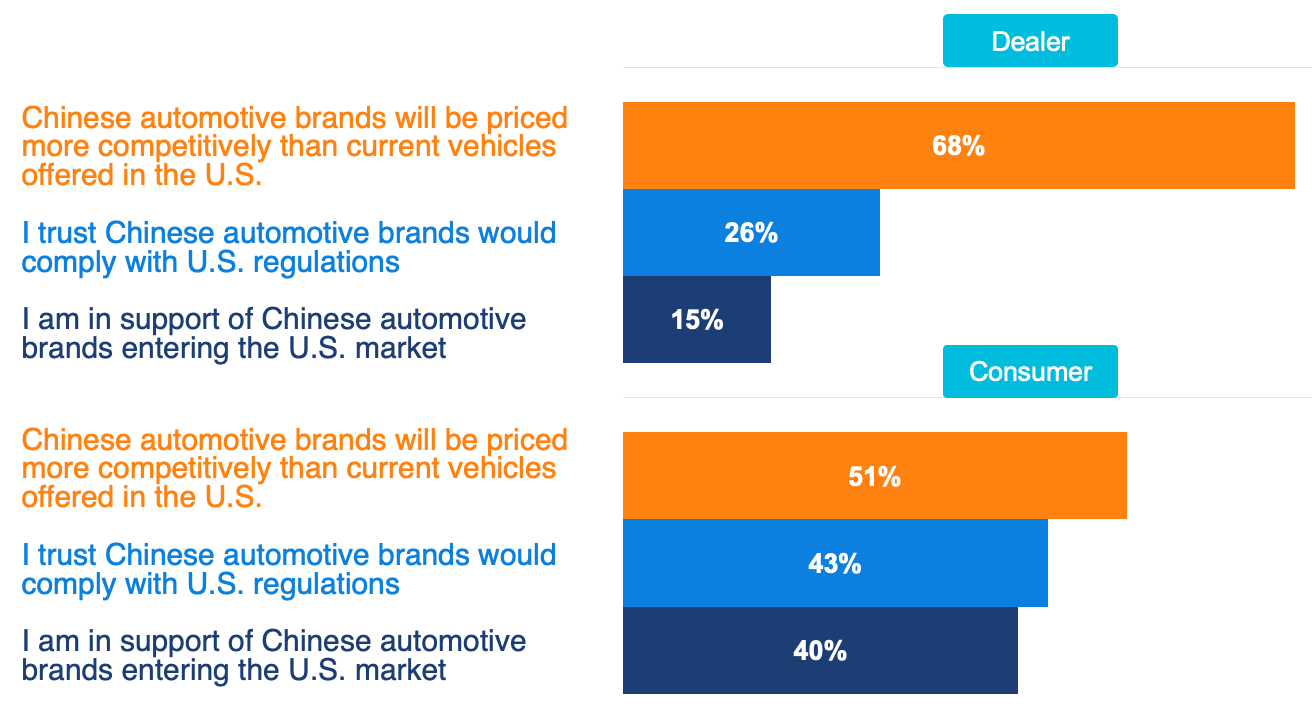
While around 40 percent of consumers say that they’re interested in Chinese brands coming to America, dealers, the ones with the real power, aren’t so hot on it. Only 15 percent said they’d like these brands in the USA. In fact, 92 percent of dealers reported concerns about selling Chinese vehicles. They cited everything from reliability to safety to long-term viability. That hesitation matters even more than the fact that some 60 percent of buyers aren’t interested.

The research also found that roughly 70 percent of dealers would adjust their business strategies if Chinese brands entered the market, suggesting preparation may follow skepticism.

Partnerships could shift the equation, though. When consumers were asked to consider a Chinese automaker aligned with an established U.S. brand, purchase consideration rose sharply to 76 percent, indicating that brand pairing may influence acceptance as much as pricing or product.

The Attraction

 America’s Gen Z Is Ready For Chinese Cars, Their Parents Are Not

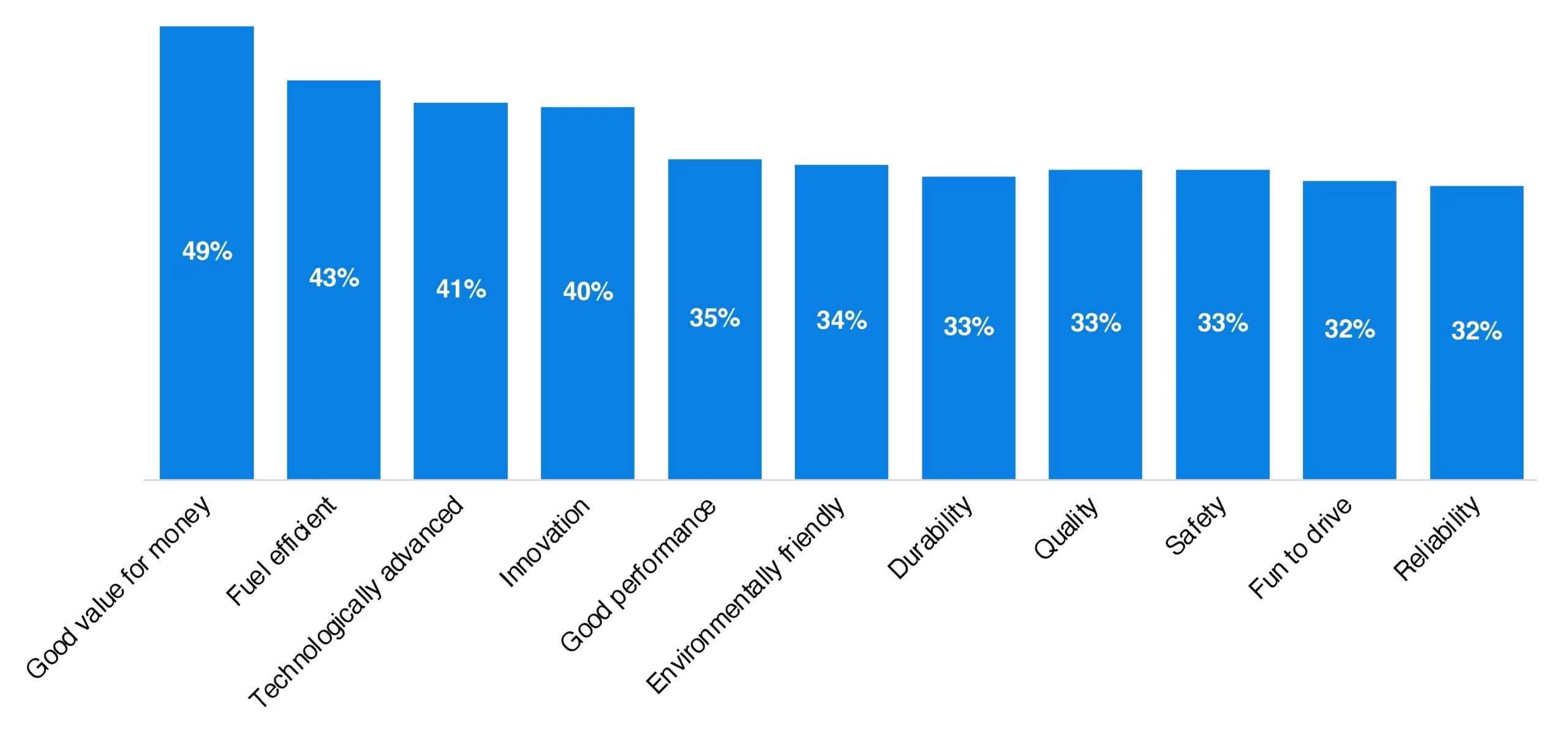
Interest does not appear to hinge on technology, styling, or practicality. It comes down to price. Nearly half of consumers rate them positively for affordability, and 35 percent give strong marks for performance. No doubt, we’ve seen pricing for Chinese automobiles undercut just about every other brand. But durability, safety, quality, and reliability fall short, and those are precisely the fundamentals that drive mainstream purchase decisions.

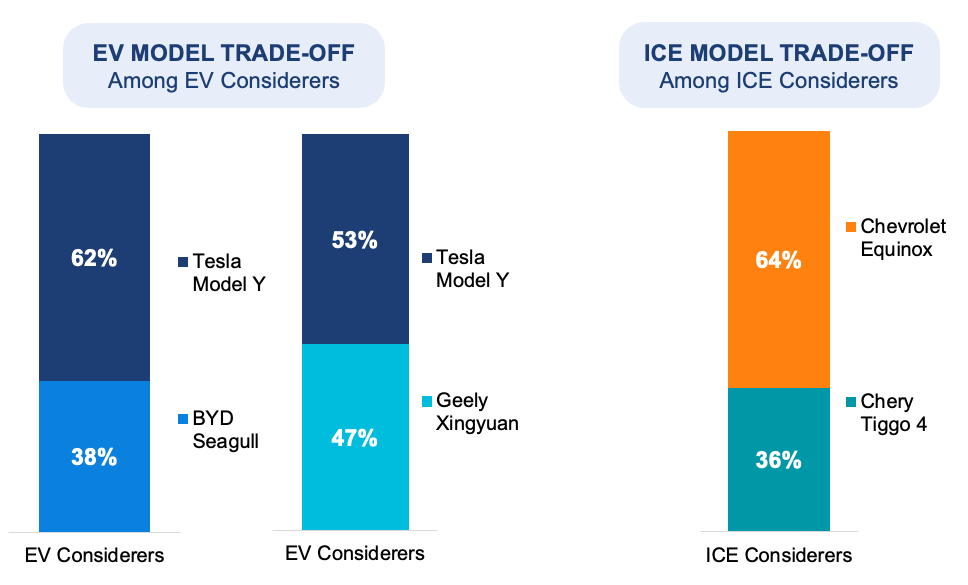
When consumers directly compared specific models, Tesla’s Model Y maintained a clear edge among EV shoppers, and the Chevrolet Equinox led among ICE vehicles, reinforcing the staying power of established nameplates.

However, when steep price discounts were introduced into side-by-side comparisons, a meaningful share of buyers indicated they would switch, particularly among lower-income and more price-sensitive groups.

Dealer and Consumer Comparisons (Strongly or Somewhat Agree)
 America’s Gen Z Is Ready For Chinese Cars, Their Parents Are Not
Cox Automotive

Established U.S. brands still hold the advantage, buoyed by trust and familiarity. Price can narrow that gap, especially among more cost-sensitive buyers, but it doesn’t erase it. And it’s why those folks in the comment section suggesting that readers get a BYD Dolphin instead of whatever is actually available might have to wait a while longer before that comment makes any sense.

Consumers Rate Chinese Brands Lower on Buying Criteria (Durability, Quality, Safety and Reliability)
 America’s Gen Z Is Ready For Chinese Cars, Their Parents Are Not
Cox Automotive
Choosing Between Brands: U.S. vs. China
 America’s Gen Z Is Ready For Chinese Cars, Their Parents Are Not
Cox Automotive

In the next decade, states will see a surge in obesity

8 February 2026 at 22:30
Robert F. Kennedy Jr. promotes "real food" at a rally in Harrisburg, Penn., last month. Over the next decade, obesity rates across the nation could surge to close to half of U.S. adults, a new study says. (Photo by Whitney Downard/Pennsylvania Capital-Star)

Robert F. Kennedy Jr. promotes "real food" at a rally in Harrisburg, Penn., last month. Over the next decade, obesity rates across the nation could surge to close to half of U.S. adults, a new study says. (Photo by Whitney Downard/Pennsylvania Capital-Star)

Over the next decade, obesity rates across the nation could surge to close to half of U.S. adults, a new study published in the medical journal JAMA estimates.

Researchers at the University of Washington conducted the analysis using body mass index data from the National Health and Nutrition Examination Survey and self-reported weight data from a national survey of adults ages 20 and older. They examined the 2022 rates and created estimates for 2035 based on current trends. The researchers also looked at race, ethnicity and state-level data, finding wide disparities across states and racial groups.

About a fifth of U.S. adults were living with obesity in 1990. By 2022, the percentage increased to nearly 43%. Obesity was more prevalent in states in the Midwest and South.

If current trends continue, about 47% of U.S. adults will be living with obesity by 2035, according to the researchers. Obesity rates are projected to increase among Americans of all ages and racial groups.

In 2022, non-Hispanic Black women had the highest age-standardized obesity rate, at about 57%, followed by Hispanic women at 49%. Hispanic males, non-Hispanic white males and females, and non-Hispanic Black males had similar rates, ranging from about 40% to nearly 43%.

The study comes amid exploding demand for weight-loss drugs, and as U.S. Health and Human Services Secretary Robert F. Kennedy, Jr. continues to push his Make America Healthy Again campaign.

HHS and the U.S. Department of Agriculture last month made changes to the federal food pyramid, placing a greater emphasis on animal protein, dairy and fats. Like the previous guidelines, the new pyramid discourages the consumption of processed foods, which can cause weight gain.

Despite disparities between men and women and between racial groups, HHS says its nutrition strategy moves away from the “health equity” focus of the Biden administration, in favor of making “the health of all Americans the primary goal.”

For Hispanic people, obesity rates were generally higher in states in the Midwest and the South in 2022, a pattern that is expected to continue through 2035.

In 2022, the obesity rate for Hispanic women was highest in Oklahoma, at about 54%. For Hispanic men, the rate was highest in Indiana, at roughly 47%. In 2035, Indiana is projected to have the highest rate of obesity among Hispanic men at about 54%, while the highest rate for Hispanic women, nearly 60%, is expected to be in South Dakota.

The Midwest and South also had high rates of obesity for non-Hispanic white men and women. In 2022, West Virginia had the highest obesity rates for white men and women — about 47% and 49%, respectively. In 2022, obesity rates for white men and women were lowest in the District of Columbia, at roughly 24% for men and 26% for women.

Among Black women, obesity rates were over 50% for all states, except Hawaii, in 2022. That pattern is expected to continue through 2035. Black men have lower obesity rates than Black women across all states. In 2022, the highest obesity rate for Black men was in Oklahoma, at about 44%. That rate projected to rise to 49% in 2035.

“While no locations were predicted to have decreases in obesity prevalence between 2022 and 2035, there were many with small increases over this time,” the authors wrote. They pointed to Mississippi, where Black women had the highest obesity rates between 1990 and 2022, but are projected to see one of the smallest changes — an increase of about 1.8% — by 2035.

“Predictions in states with historically high levels of obesity, such as Mississippi, suggest that the prevalence of obesity may be plateauing in some locations,” the researchers wrote.

Stateline reporter Nada Hassanein can be reached at nhassanein@stateline.org.

This story was originally produced by Stateline, which is part of States Newsroom, a nonprofit news network which includes Wisconsin Examiner, and is supported by grants and a coalition of donors as a 501c(3) public charity.

❌
❌