Reading view

There are new articles available, click to refresh the page.

Trump left contraceptives to rot — and women paid the price 

Drawing of female reproductive system with judge's gavel and stethoscope

Getty Images

As a practicing OB-GYN in Wisconsin, I see firsthand how many of my patients rely on contraception to protect their health, manage painful conditions, and plan their futures. When a woman sits across from me in the exam room, she’s not thinking about politics. She’s thinking about how to survive her work day without severe cramps, how to manage her bleeding so she can attend class without mishap, or how to avoid threatening her life with another high-risk pregnancy. 

These situations are only a few of the reasons why the news about abandoned U.S.–funded contraceptives overseas is so alarming. This action blatantly reflects the same disregard for women’s health that now shapes national policy. And that disregard lands directly on women’s bodies. 

Under the Trump administration, the U.S. government ordered the destruction of nearly $10 million worth of U.S.–funded contraceptives, based on the false claim that birth control is an “abortifacient.” This claim is absolutely nonsensical. Contraception doesn’t end a pregnancy — it prevents one. Unfortunately, ideology, and not medicine, guided that decision, leaving lifesaving, taxpayerfunded medicine stalled in warehouses instead of reaching women who need it. 

The full picture is even more disturbing. Several days ago, a new report found that the Trump administration left 20 of 24 U.S.–funded contraceptive shipments to waste away in Belgian warehouses. These were fully paid-for, taxpayer-funded supplies — IUDs, implants, pills, and other reproductive health essentials — intended for women in 13 countries. This is simply appalling. 

And if you think that kind of extremism stops at the water’s edge, think again. 

Back home, I see the fallout of the same ideology driving national attacks on contraception and women. 

Already, there are over 300,000 women of reproductive age in Wisconsin in need of contraception, and attacks are making this gap even worse. 

And these gaps carry real health risks, because contraception does more than prevent pregnancy — it treats endometriosis, PCOS, severe bleeding and anemia, and it reduces the risk of reproductive cancers

Rural clinics that once offered contraception and family-planning visits have declined in number, a trend worsened by federal policy shifts that weaken the reproductive-health safety net and leave too many women without reliable nearby options for care.

And now, with health-insurance costs already skyrocketing for many families — and monthly bills set to jump even higher if those tax credits expire — the ACA’s no-cost contraception guarantee slips further out of reach. Road block after road block after road block. 

Fortunately, Wisconsin has leaders who understand the stakes. 

Sen. Tammy Baldwin’s leadership on the “Right to Contraception Act” reflects a truth every OBGYN knows: contraception saves lives. Contraception reduces maternal deaths, prevents unintended pregnancies, treats reproductive-health conditions, and empowers women to build stable lives. Baldwin fights to protect contraception — what Wisconsin women rely on every day — not because it’s politically convenient, but because she understands it’s a medical necessity. 

U.S. Rep. Mark Pocan co-sponsored the “Saving Lives and Taxpayer Dollars Act” — legislation designed to stop exactly what we’re seeing in Belgium. The bill requires that U.S.–funded food and medical supplies – like the contraception sitting in Brussels at this moment – reach the people they were purchased for, instead of being left to rot or destroyed for ideological reasons. In Washington, where too many have decided contraception is a cultural wedge rather than essential health care, Pocan’s voice matters. 

The women I see in my exam room aren’t looking for a political fight. They’re looking for care that lets them stay healthy, stay safe, and stay in control of their lives — something contraception makes possible every day. 

Jeopardizing contraception — whether through wasteful negligence abroad or political interference here at home — is harmful, cruel and simply unjust. 

We in Wisconsin cannot afford to look the other way. We need leaders who will defend the right to contraception, not undermine it. 

The stakes are simple: either we protect access to basic health care, or we allow ideology to decide who gets care — and who doesn’t. 

For the women in my clinic — and for women everywhere — contraception is essential care that strengthens their health and safeguards their freedom.

GET THE MORNING HEADLINES.

Arizona’s Congresswoman Grijalva says she was pepper sprayed during Tucson ICE raid

Adelita Grijalva speaks to the media during a primary election-night party at El Casino Ballroom in South Tucson, Arizona, on July 15, 2025. Grijalva, the Pima County supervisor, won a special election for the state's 7th District seat vacated by the death of her father, longtime U.S. Rep. Raúl Grijalva. (Photo by Rebecca Noble/Getty Images)

U.S. Rep. Adelita Grijalva, D-Arizona, speaks to the media during a primary election-night party at El Casino Ballroom in South Tucson on July 15, 2025. Grijalva claims she was pepper-sprayed during an ICE raid in Tucson on Dec. 5, 2025, but the Department of Homeland Security denies it. (Photo by Rebecca Noble/Getty Images)

Arizona’s U.S. Rep. Adelita Grijalva was involved in a clash with federal agents during a protest of immigration raids in west Tucson Friday, during which she claims she was hit with pepper spray. 

According to a spokesman for U.S. Immigration and Customs Enforcement, the agency partnered with the Internal Revenue Service to carry out as many as 16 warrants in southern Arizona in a “years-long investigation into immigration and tax violations.” In videos posted to social media by community advocates, several masked federal agents in tactical gear can be seen near the westside location of popular Mexican seafood and grill restaurant Taco Giro. 

The raids prompted a protest and federal agents deployed tear gas and pepper spray against the crowd. The Arizona Daily Star reported that multiple employees who live near the west Tucson restaurant were detained. At least one protester was among those taken into custody by federal agents. AZ Family reported that Taco Giro locations in north Tucson, Casa Grande and Vail were also targeted. ICE spokesman Fernando Burgos-Ortiz confirmed to the Arizona Mirror that multiple people were arrested, but didn’t clarify how many or confirm claims that agents had pepper-sprayed a sitting U.S. Congresswoman.

Tricia McLaughlin, the spokeswoman for the Department of Homeland Security, dismissed Grijalva’s account. McLaughlin accused Grijalva of hindering the work of federal agents and appeared to question Grijalva’s claim that she was pepper-sprayed by highlighting her lack of visible physical reaction in the video. 

“If her claims were true, this would be a medical marvel,” McLaughlin wrote. “But they’re not true. She wasn’t pepper sprayed. She was in the vicinity of someone who *was* pepper sprayed as they were obstructing and assaulting law enforcement. In fact, 2 law enforcement officers were seriously injured by this mob that (Grijalva) joined. Presenting one’s self as a ‘Member of Congress’ doesn’t give you the right to obstruct law enforcement.”

Tucson Sentinel reporter Paul Ingram, who was on-the-ground covering the ICE raid and protest, reported that federal agents shot pepper spray into his face and eye, even though he was clearly identified as a member of the press.

A video from Univision reporter Óscar Gómez shows federal agents shooting pepper spray directly into the faces of protesters, with Grijalva in close proximity. An agent is then seen coming after Gómez directly, covering his camera with pepper spray, even as Gómez appeared to be backing away.

The large-scale raid of several Taco Giros in Southern Arizona is the second time this year a restaurant chain was the subject of an investigation by Homeland Security Investigations, a division within ICE, that ensnared multiple employees who lack legal immigration status. 

In July, federal agents raided Colt Grill BBQ and Spirits locations in Northern Arizona. The operation was the culmination of a multi-year investigation into a money laundering and labor exploitation scheme. Along with the husband-and-wife owners of the Northern Arizona restaurants, and two undocumented immigrants who were involved in recruiting and exploiting other immigrant workers, several more undocumented employees were also arrested

In a video posted to her X account, Grijalva described as many as 40 agents gathered at the westside location she visited with her staff for lunch, and said that she was treated with hostility even after identifying herself as a member of Congress. 

“I was here, this is like the restaurant I come to literally once a week, and was sprayed in the face by a very aggressive agent, pushed around by others when I literally was not being aggressive,” she said. “I was asking for clarification which is my right as a member of Congress.” 

A video of the incident posted to Grijalva’s social media accounts shows a federal agent spraying several bursts of pepper spray directly at demonstrators in the street, close to where Grijalva is standing. Grijalva’s staffer jumps in front of her. Coughing can be heard offscreen. Later in the video, a pepper ball appears to explode inches from Grijalva’s feet as she walks away.

Grijalva, Arizona’s first Latina congresswoman, has been a fierce critic of immigration enforcement activity in her district. Earlier this week, she publicly condemned a Border Patrol raid of a humanitarian group’s migrant aid station in the desert on the floor of the U.S. House of Representatives, criticizing it as an example of President Donald Trump’s “cruel (and) unconstitutional” mass deportation agenda. 

 In a statement issued shortly after she said she was pepper-sprayed, Grijalva said her office was working to get more information on Friday’s immigration arrests.

“Our residents deserve to know whether these raids are targeting genuine public safety threats – or law-abiding neighbors who have called our communities home for decades,” she wrote. “ICE has become a lawless agency under this Administration – operating with no transparency, no accountability, and open disregard for basic due process.”

While Trump administration officials have time and again emphasized their intent to detain the “worst of the worst”, many of the immigrants that ICE has arrested during Trump’s second term have no criminal record. A June survey of people in immigration detainment facilities at the time found that nearly half, 47%, lacked any criminal history and fewer than 30% of them had been convicted of crimes.

Arizona Attorney General Kris Mayes, the state’s top legal officer, denounced the incident on social media. In a post on X, the Democrat, who has long criticized Trump’s immigration enforcement tactics, called the incident “unacceptable and outrageous.”

“Enforcing the rule of law does not mean pepper spraying a member of Congress for simply asking questions,” Mayes wrote. “Effective law enforcement requires restraint and accountability, not unchecked aggression.”

Grijalva voiced concern for how federal officials interact with people who don’t have her authority, in light of how she was mistreated on Friday.

“While I am fine, if that is the way they treat me, how are they treating other community members who do not have the same privileges and protections that I do?” she questioned, in her written statement. 

***UPDATE: This story has been updated with eyewitness reporting from the Tucson Sentinel and Univision. 

This story was originally produced by Arizona Mirror, which is part of States Newsroom, a nonprofit news network which includes Wisconsin Examiner, and is supported by grants and a coalition of donors as a 501c(3) public charity.

Goodbye Grocery Store?

Meet the Wisconsin native who is foraging 100% of his food.

What was the last thing you foraged? Maybe some ramps, or morels? But what about your salt, oil, even toothpaste? On this episode, meet the Wisconsin native who is setting out to prove that he can not only survive for an entire year eating only food he has foraged, but he can also help show the true connection to nature most of us have been missing.

Host: Amy Barrilleaux

Guest: Robin Greenfield, Sustainability Advocate, Ashland Wis. native

Resources for You:

robingreenfield.org

Food Freedom: A Year of Growing and Foraging 100% of My Food

Robin Greenfield YouTube Channel

Defender Episode 57: Wisconsin's Forbidden Fruit

💾

New Mercedes GLB Ditches Gas For Now, Adds AI And A Very Strange Rear End

  • Mercedes GLB replaces EQB and launches with electric-only options.
  • 85 kWh battery enables 392 miles in single-motor, 382 in dual-motor.
  • Next year, an entry-level EV will be introduced, as will several hybrids.

A new generation of the Mercedes-Benz GLB has arrived, and while the silhouette remains true to the blocky, upright form of the original, there’s quite a bit going on beneath the surface.

Offered in both 5- and 7-seat configurations, the 2026 GLB debuts as an all-electric model and, for now, serves as a replacement for the EQB in everything but name. Hybrid versions will follow later, but the first wave is electric-only.

Read: New Mercedes GLB Goes Big On Screens And Stars

Two versions of the new generation GLB are launching out of the gate. The first, labeled GLB 250+ with EQ Technology, features an 85 kWh lithium-ion battery and adopts an 800-volt electric architecture.

It powers a single rear-mounted motor rated at 268 hp and 247 lb-ft of continuous torque, with a short-term boost up to 335 lb-ft. Acceleration from 0–62 mph (100 km/h) takes 7.4 seconds, and range is quoted at 392 miles (630 km) on a full charge, olid figures for a compact SUV in this category.

\\\\\\\\\\\\\\\\\\\\\\\\\\\\\\\\\\\\\\\\\

Sitting above the 250+ is the 350 4Matic with EQ Technology. The name might not stick in your memory, but the numbers probably will. This dual-motor variant adds a front axle motor for all-wheel drive, producing a combined 349 hp and 380 lb-ft of torque.

Range takes a slight dip to 382 miles (615 km), but the extra grunt cuts the 0–62 mph time down to 5.5 seconds.

Mercedes has also confirmed a more affordable electric entry-level version will join the lineup next year, followed by a hybrid variant using 48-volt architecture. Three power levels will be available across front- and all-wheel drive formats.

Starry Eyed

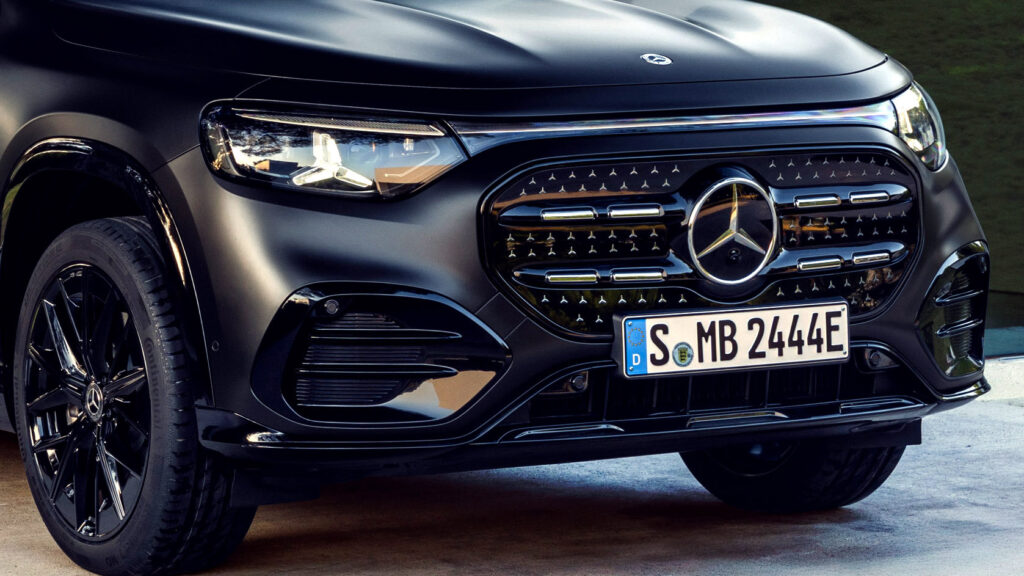
Like other new-generation Mercedes models (think CLA and GLC EQ), the GLB adopts a more expressive front end. A large grille dominates the nose, flanked by redesigned headlights with intricate star-shaped DRLs and a full-width light bar. It’s not a particularly handsome looking SUV, but neither is the outgoing model.

\\\\\\\\\\\\\\\\\\\\\\\\\\\\

The rear-end is perhaps the most controversial angle of the 2026 GLB. The taillight treatment leans into the styling language seen on the brand’s EQXX Concept from a few years back, with vertically oriented clusters connected by a slim light bar. The signature star pattern makes another appearance here.

An All-New Cabin

A big step into the future has also been made with the GLB’s interior. Like the CLA, it can be optioned with the Mercedes Superscreen, consisting of a 10.25-inch driver display, a 14-inch infotainment screen, and a 14-inch display for the passenger.

As with other new Mercedes-Benz interiors, the dash of the GLB is almost completely flat, largely free of any interesting design details.

\\\\\\\\\\\\\\\\\\\\\\\\\\\\\\

It runs on the fourth-generation MBUX system that includes Microsoft and Google artificial intelligence. The screen runs on the Unity Game Engine and includes the MBUX Virtual Assistant, based on ChatGPT4o. Clearly, Mercedes was eager to make the GLB as tech-focused as possible.

At this point, pricing is confirmed only for Germany. The GLB 250+ with EQ Technology starts at €59,048 ($68,700), while the 350 4Matic comes in at €62,178 ($72,400). US pricing hasn’t been announced yet, but expect a similar spread when it arrives in other markets next year.

\\\\\\\\\\\\\\\\\\\\\\\\

Photos Mercedes

Six Figure Rolls-Royce Spectre Discounts Raise The Question Why Are Rich Buyers Avoiding EVs

  • EV platforms seem ideal for ultra luxury brands like Rolls Royce today.
  • Wealthy buyers appear hesitant about fully embracing these EVs.
  • Two certified Spectres show steep six figure discounts at a dealer.

Electric power should be the ultimate match for ultra-luxury motoring. On paper, nothing suits a Rolls-Royce, Bentley, or Maybach better than smooth, silent propulsion and torque-rich acceleration.

These are brands built on quietness, presence, and seamless power delivery, the very same traits electric vehicles seem born to provide better than any V12 ever has. In theory, this should be a golden era for the top of the market.

Review: The Rolls-Royce Spectre Is The Ultimate EV Right Now

Wealthy owners don’t worry about range, rarely road-trip their cars across states, and often have multiple vehicles (and dedicated home charging) to rotate through. So why is it that the first wave of ultra-luxury EVs is landing with a thud on the used market?

The clearest example of this is the Rolls-Royce Spectre. It’s elegant, impeccably built, and quieter than basically everything else in their lineup. Despite that, resale values are cratering faster than it can rocket from 0 to 60.

Are Rich Buyers Backing Off?

Take, for instance, the Spectre listed on Bring a Trailer early last year. With only 99 miles on the odometer and the added appeal of being a “Launch Package” edition, it failed to meet reserve with a high bid of just $451,000. That might sound like a lot, but its MSRP was $521,650.

This week, we also spotted two low-mileage, certified pre-owned examples at a Rolls-Royce Boston dealership, each listed with six-figure discounts off their original MSRP! Don’t get us wrong, no luxury car (outside of hypercars) is going to maintain perfect value.

\\\\\

Rolls-Royce Motorcars Boston

But together, these two Spectres from Herb Chambers originally carried a combined sticker price of $1,064,725. The lower-mileage example, showing just over 2,100 miles, is listed at $385,575, or $136,000 below its original MSRP of $521,575.

The other Spectre, with only 3,822 miles on the odometer, is priced at $385,150, reflecting a massive $158,000 drop from its $543,150 MSRP from about a year ago. That’s enough to buy a brand-new Porsche 911 Carrera T ($143,700) and still have money left over for something else.

More: Someone Drove This Maserati 255 Miles And Lost Almost $100,000

Which circles us back to the broader question. Why is it that wealthy buyers are steering clear of super-luxury EVs like the Spectre? Does it come down to tradition and the desire for a classic internal combustion powertrain like a V12 powerhouse?

Is infrastructure anxiety still a factor, even at the top end of the market? Or maybe some buyers simply haven’t driven them enough (or at all) to realize just how rewarding they really are. We’re curious what you think. Let us know in the comments below.

\\\\\

Rolls-Royce Motorcars Boston

❌