Illinois tracks cannabis sales by in-state versus out-of-state purchasers. A 2023 analysis from Wisconsin’s nonpartisan Legislative Fiscal Bureau found Illinois collected $36.1 million in tax revenue in 2022 from out-of-state residents who purchased cannabis in counties bordering Wisconsin.
About half of cannabis sales in 2022 at dispensaries in Illinois counties that border Wisconsin were to out-of-state residents, the analysis found.
This story was originally published by ProPublica, a nonprofit newsroom that investigates abuses of power. Sign up to receive its biggest stories as soon as they’re published.
The $16 billion Hudson Tunnel Project, under construction between Manhattan and New Jersey, will improve passenger rail service, an important issue for New York City commuters. It would seem to have nothing to do with what’s happening in northern Wisconsin.
But after the White House froze federal grant funding for the project in the fall, citing concerns about diversity and equity measures, lobbyists with an interest in the tunnel donated $2,500 to a political novice running in the Republican primary in Wisconsin’s 7th Congressional District.
The young candidate, Michael Alfonso, has no sway over the matter. However, his father-in-law does: Sean Duffy is secretary of the U.S. Department of Transportation.
The contributions are among dozens to Alfonso’s campaign from lobbyists, business executives and political action committees tied to industries — from rails and highways to shipping and air travel — that Duffy’s department funds and regulates. His department also oversees the Federal Aviation Administration.
Duffy held the 7th Congressional District seat for nearly a decade before resigning in 2019. He was succeeded by Tom Tiffany, who is now running for Wisconsin governor, leaving the seat open again. Alfonso, 26, who has worked in construction and podcasting, has been endorsed by President Donald Trump.
A ProPublica analysis found that many of the Alfonso donors with transportation interests had never given to Duffy or Tiffany. While legal, such donations set up the appearance that helping Alfonso might assist the donors with issues influenced by Duffy. (Politico has reported on some of these contributions.)
“The law, as it stands, provides very little constraint,” said Daniel Weiner, director of the Elections and Government Program at the Brennan Center for Justice, a law and policy institute based in New York. “There’s a very large gulf between what is legal and what is ethical. Obviously, this raises numerous ethical questions.”
This is not the first time a Cabinet secretary’s relative has created thorny ethical issues. During the first Trump administration, Transportation Secretary Elaine Chao made headlines for appearing to give preferential treatment to Kentucky officials for millions of dollars in infrastructure grants. Kentucky is the home state of her husband, Mitch McConnell, then Senate majority leader. At the time, Chao’s office denied showing any favoritism, saying that Kentucky’s share was not out of the ordinary.
And in 2012, under President Barack Obama, Agriculture Secretary Tom Vilsack, an Iowa Democrat, fielded questions about the separation between U.S. Department of Agriculture business and the campaign of his wife, Christie, who was running for Congress. Christie Vilsack told ProPublica in an interview that the couple was careful about making sure her husband was not involved in the campaign, other than to support her at some debates and on election night. He “never did any fundraising at all,” she said.
An influential member of Trump’s Cabinet, Duffy has been openly assisting his son-in-law’s campaign. The notice for a November “meet and greet” with Alfonso in Wausau, Wisconsin, mentioned that Duffy would be a special guest, as did an invitation for another December fundraiser.
Among the sponsors for the December event was the political action committee for Delta Air Lines. The invitation included a caveat: “Sean Duffy is not soliciting funds in connection with this event.”
Alfonso’s campaign did not respond to requests from ProPublica for an interview or for comment. A spokesperson for Duffy, Nathaniel Sizemore, provided a written statement saying: “The Secretary attends fundraising events in his personal capacity. Regulatory decisions are guided by career safety professionals, the law, and the facts.”
Nothing in law bars Duffy from campaigning for his son-in-law, so long as he goes about it on his personal time, does not use government resources and does not promise to take some official action in exchange for a contribution.
Alfonso is using the same fundraising consultant, Kirstin Hopkins, that Duffy employed, Federal Election Commission records show. In addition, Alfonso has received help with ads and mailers from a super PAC, the Northwoods Future PAC, that is funded with $1 million from Duffy’s former campaign committee. Alfonso’s familial advantage has irked some Wisconsin Republicans who don’t want the newcomer to glide into such an important position.
Through his own campaign committee, Alfonso had raised a little over $305,000 as of the end of 2025, the latest filing available. By law, contributions for each election are limited to $3,500 from individuals and $5,000 from political action committees. Donors can contribute to more than one election at the same time, such as a primary race and a general.
Alfonso’s donors include lobbyist Jeffrey Miller, a finance chair of Trump’s most recent inaugural committee. In December, Miller and his company’s chief operating officer donated separately to Alfonso, for a combined $8,500. No one listing their firm, Miller Strategies, as an employer had donated to either Duffy or Tiffany in the past, according to FEC records.
Lobbyist disclosure reports show that Miller lobbied the Transportation Department in 2025 on behalf of at least nine companies, one New York county and one Native American tribe. The issues included airport signage regulation, aviation permitting for the developer of a supersonic airliner and advancements in GPS technology. Miller reported advocating for Archer Aviation regarding electric vertical takeoff and landing aircraft technology, known as eVTOL — the basis for future flying cars.
Earlier this month, Duffy announced a first-of-its-kind FAA pilot program to test eVTOL technology in eight demonstration projects across 26 states. Archer was among the companies selected to participate, according to the Transportation Department. In a video accompanying the announcement, Duffy spoke enthusiastically about the technology, envisioning “Ubers in the air” taking people from one airport to the next and beyond. He said, “eVTOLs are going to make the airspace far more interesting and far more fun, and we have to be prepared for that.”
Miller did not return calls or emails seeking comment.
Alfonso graduated in 2022 from the University of Wisconsin with a math degree. He moved to Florida for a time to help produce a popular podcast hosted by Dan Bongino, a Trump supporter who later served a brief stint as deputy director of the FBI. (Bongino is back podcasting again.)
By Alfonso’s account, he and Trump first met in 2022 at Alfonso’s wedding to Duffy’s daughter, Evita. The reception took place at one of Trump’s New Jersey golf courses.
In a post on X, Alfonso thanked his father-in-law for joining him on the campaign trail in Wisconsin last November.
Alfonso has said that in an Oval Office meeting after he decided to run for Congress, he pledged loyalty to the president. “I promised him that I would always be America first, I would always fight for his agenda and that nobody would ever outwork me,” Alfonso told Mark Halperin, another podcaster.
On social media in November, Alfonso thanked Duffy for coming to his first campaign event in Wausau, the city where the candidate met his future wife while they were in middle school.
The following month, the transportation secretary appeared at a campaign fundraiser for Alfonso at a hotel in Green Bay, near the storied Lambeau Field. The donors in attendance included Sharad Tak of Bethesda, Maryland, the CEO of ST LNG, a company seeking a DOT-issued license to construct and operate a deep-water port offshore of Matagorda, Texas, to load liquefied natural gas onto carriers.
Tak gave $500 to the campaign, and his wife, Mahinder, who did not attend the function, gave $7,000. Neither had donated to Duffy or Tiffany.
Tak did not reply to ProPublica’s request for an interview but asked a longtime friend of his, Ann Murphy of Green Bay, who works as a consultant for him, to respond. Tak owns a paper mill in Oconto Falls, north of Green Bay. It is not in the 7th Congressional District. But Murphy said Tak was visiting the state and agreed, at her request, to attend the fundraiser for Alfonso.
She said in an interview that the Texas liquefied natural gas project had no bearing on Tak’s campaign contribution. “Absolutely not.”
It’s typical, she said, for Tak and his wife to support causes, both political and philanthropic, that Murphy and her husband find worthwhile — and vice versa.
“We were very excited about Michael,” Murphy said of Alfonso, likening him to Charlie Kirk, the founder of Turning Point USA who inspired many young people before being killed last year. “And he does have the endorsement of President Trump.”
Others donating to Alfonso’s candidacy include political action committees for employees of the military jetmaker Lockheed Martin, which is subject to FAA safety regulations and has lucrative government contracts, and for T-Mobile, which is working on a DOT project to enhance the resilience of critical 5G infrastructure. PACs for unions and trade associations for heavy equipment operators, engineers, aeronautical services and the travel industry have also pitched in.
The PAC for Brightline, a high-speed train service in Florida, also donated, giving $2,500 in December. Brightline trains have struck and killed more than 180 pedestrians or drivers at crossings since 2017, according to an investigation by the Miami Herald and WLRN. Duffy promised at a congressional committee hearing in July to work to “drive down the number of deaths.” In September, he announced that his department would distribute $42 million to improve safety along the line. In a statement to the Florida news organizations, Brightline officials blamed the deaths on suicides and the “reckless” behavior of people who put themselves in harm’s way.
Brightline, T-Mobile and Lockheed Martin did not respond to ProPublica’s requests for comment. On its website, Lockheed notes that it complies with all applicable laws and regulations with regard to its political and public policy activities.
Alfonso’s campaign has drawn donations from others in the heavily regulated railroad sector. They include Peter Bartek, founder of FTS Rail, which manufactures battery-powered railroad repair tools and sensors that detect rail breaks caused by extreme heat or cold. He gave $3,644 in November. Duffy appointed Bartek last July to serve on a DOT advisory committee.
Bartek had never given to a candidate in the district before. In an interview, he said he read a news article about Alfonso’s campaign and decided to donate. “I like Secretary Duffy very much,” he said, “and I thought very simply, boy, if he’s anything like his father-in-law, it would be nice to support him as well.”
He said in a text that he didn’t know Duffy personally and was not involved in Alfonso’s campaign or fundraising.
In New York, construction on the Hudson Tunnel Project to improve commuter rail service came to a screeching halt in early February after the federal government cut off funds. A court intervened, ordering the money released, and work resumed. A bistate commission overseeing the project warned this month that it could face disruptions again in upcoming months if federal disbursements do not continue.
In response to outreach from ProPublica, an executive at Venture Government Strategies, whose lobbyists for the tunnel project gave a combined $2,500 to Alfonso, said in an email the company had no comment.
On his campaign website, Alfonso lists a dozen issues “that matter to us” — ranging from education and health care to immigration. He wants to “make farms and families strong,” “give Gen Z a voice” and work against access to abortion.
Transportation issues are not among those priorities, but he still is getting support from General Motors, which regularly lobbies DOT on various issues, including fuel economy, vehicle safety and emissions standards, and other mandates. The giant car manufacturer also gave to Duffy when he was running for the congressional seat, and the transportation secretary has become a booster. (GM did not respond to ProPublica’s request for comment.)
In mid-December, viewers of social media saw Duffy slide behind the wheel of a sleek, black, limited-edition Corvette, imbued with patriotic insignia to celebrate the nation’s upcoming 250th birthday.
“Over 1,000 horsepower,” Duffy said in a promotional video, emphasizing the dynamic features of the $200,000 supercar. “We’re going to take this bad boy on a little test drive to the Army-Navy game.” Off he went.
The video, uploaded to the social media platform X, highlighted a travel app the carmaker made in partnership with the Department of Transportation, while also showcasing Chevrolet’s automotive series dubbed Stars and Steel.
The post received over 130,000 views: valuable advertisement for the storied carmaker, General Motors. A couple of weeks later, GM’s political action committee donated $1,000 to Alfonso.
Conservation groups say Wisconsin will lose out on opportunities to set aside public lands and struggle to find funds to pursue that work as the state’s land purchase program is likely to expire in June.
Wisconsin Supreme Court candidate Chris Taylor was a lobbyist for Planned Parenthood and a Democratic legislator before she became a judge. Her path reflects the changing nature of judicial races in Wisconsin.
Spending by the New York-based 1776 Project PAC is up 240 percent on Wisconsin races this year compared to 2025, according to records from the Wisconsin Ethics Commission.
Conservative Wisconsin Supreme Court candidate Maria Lazar has described herself as an underdog in an era that's seen liberals run the tables in elections for the state's highest court, but says she's beaten the odds before. Supreme Court races have become highly partisan, but she says what people really need is someone "geeky and law nerdy enough" like her to "live and breathe the law" during their 10 year term on the state's highest bench.
Romania’s history offers a rare natural experiment on what happens when abortion laws change rapidly. What can the rest of the world learn from this?<br><br><a href="https://ourworldindata.org/the-human-cost-of-unsafe-abortions"><img src="https://ourworldindata.org/cdn-cgi/imagedelivery/qLq-8BTgXU8yG0N6HnOy8g/f022345d-6fae-4d0e-f408-54a324b62200/w=1024"/></a>
Although the incident has been accompanied by much disinformation and confusion, it is evident that on or before March 20, Iran's IRGC attempted to f...
With ocean carriers drawing up contingency plans for cargo destined to the Gulf region, some ports on the East African coast have gained a strategic...
President Donald Trump has given the Iranian government until Monday evening to reopen the Strait of Hormuz, which he has previously said that the U....
On March 18, 2026, the Trump administration announced the approval of a 60-day Jones Act waiver to allow foreign-flagged ship to move cargoes between...
Champagne Energy and Environmental Solutions (CEES) has joined Edison Chouest Offshore. The acquisition, announced on March 19, will give Chouest Gro...
The largest cruise ships are floating towns, with thousands aboard - and they have waste handling requirements to match. Waste disposal is a major co...
The U.S. Department of Education on Feb. 20, 2026. (Photo by Shauneen Miranda/States Newsroom)
WASHINGTON — The U.S. Treasury Department will take over the Department of Education’s responsibility for collecting on defaulted federal student loan debt, President Donald Trump’s administration announced Thursday.
It’s the first step in a multi-phase process that will end with Treasury taking on the entire federal student loan portfolio. It’s also the latest interagency agreement announced by the Education Department.
A senior Department of Education official cited the agency’s “longstanding partnership” with Treasury in administering federal student aid programs and expressed confidence that the department was in a good position to increase its role.
The administration continues to take sweeping steps to do away with the 46-year-old Education Department, as Trump seeks to return education “back to the states.” That effort comes despite much of the oversight and funding of schools already occurring at the state and local levels.
In the first phase, Treasury will also “provide operational support” to the Education Department’s efforts to return borrowers to repayment, per the announcement.
The Education Department’s student loan portfolio stands at roughly $1.7 trillion. The agency says fewer than 40% of borrowers are in repayment and nearly a quarter are in default.
In later phases, Treasury is set to “work to provide operational support over non-defaulted Federal student loan debt, to the extent practicable and permitted by law, while also seeking opportunities to provide operational support to FSA’s other functions.”
The senior Education Department official said that borrowers currently making payments “should see no change” and can expect to see “better customer service.”
Department forges multiple agreements
U.S. Education Secretary Linda McMahon said that “by leveraging Treasury’s world-renowned expertise in finance and economic policy, we are confident that American students, borrowers, and taxpayers will finally have functioning programs after decades of mismanagement,” in a statement Thursday.
The Education Department has announced nine other agreements with the departments of Labor, Health and Human Services, Interior and State that transfer several of its responsibilities to those agencies.
Meanwhile, the U.S. Supreme Court in July 2025 temporarily greenlit mass layoffs and a plan to dramatically downsize the Education Department ordered earlier that year. Those layoffs inflicted a heavy hit on Federal Student Aid, among other units at the agency.
That plan was outlined in a March 2025 executive order that called on McMahon to “take all necessary steps to facilitate the closure” of her own department.
‘Irresponsible, reckless’
Sen. Patty Murray of Washington state, the top Democrat on the Senate Appropriations Committee, said that “instead of helping student borrowers get the support they need, Secretary McMahon is focused on illegally hollowing out the department she leads and creating new, harmful bureaucracy while she’s at it,” in a statement Thursday.
“Despite all this administration’s talk about creating efficiency, the fact is these agreements simply create pointless new red tape — while threatening basic services and support that students depend on every day,” Murray added.
Rachel Gittleman, president of American Federation of Government Employees Local 252, which represents Education Department workers, lambasted the announcement Thursday.
Gittleman described it as “an insult to the nearly 43 million Americans with federal student loan debt and to the taxpayers who depend on federal oversight to prevent waste, fraud and abuse.”
Gittleman noted that since McMahon took over, “the agency has fired or pushed out nearly half of Federal Student Aid’s workforce, leading to the Government Accountability Office warning that the majority of federal student loan servicers running the government’s $1.7 trillion student loan portfolio have been repeatedly breaking the law without staff oversight.”
The GAO report found that the staffing reductions affected the government’s ability to determine how well student loan servicers are doing their jobs.
Aissa Canchola Bañez, policy director for the advocacy group Protect Borrowers, blasted the administration’s move as “irresponsible, reckless, and bad news for our most vulnerable student loan borrowers.”
She added that “in the midst of a growing affordability crisis where American families are already struggling to make ends meet, this risks driving millions of borrowers further into financial hardship.”
U.S. Sen. Markwayne Mullin speaks to reporters after a vote at the on March 12, 2026. The Senate advanced Mullin's nomination to lead the Department of Homeland Security in a vote Sunday. (Photo by Anna Moneymaker/Getty Images)
WASHINGTON — The U.S. Senate voted Sunday to advance Oklahoma GOP Sen. Markwayne Mullin’s nomination to lead the Department of Homeland Security.
The 54-37 procedural vote sets up a final vote on Mullin’s confirmation as early as Monday. Democratic Sen. John Fetterman of Pennsylvania voted to advance Mullin, after backing him in committee as well. Also voting with Republicans was Democratic Sen. Martin Heinrich of New Mexico.
If confirmed, Mullin will take over a department that has been shut down since Feb. 14 amid a stalemate over changes to immigration enforcement policy.
Senate Democrats have declined to approve a funding bill for the department following the deaths of two U.S. citizens in Minneapolis during a months-long immigrant enforcement operation.
The Senate Committee on Homeland Security and Governmental Affairs voted, 8-7, to move Mullin’s nomination forward Thursday. Mullin did not gain the support of the fellow Republican who chairs the committee, Rand Paul of Kentucky, but still received a favorable vote from the committee because Fetterman joined all other Republicans in voting in Mullin’s favor.
Paul did not vote on Sunday.
During Mullin’s confirmation hearing, Paul questioned whether Mullin could lead the DHS given his “anger issues.” He also confronted Mullin about his comments calling Paul a “freaking snake” and expressing sympathy for a neighbor who assaulted Paul in a 2017 attack that broke six of his ribs and damaged a lung.
Homeland Security Secretary Kristi Noem testifies during a U.S, House Judiciary Committee hearing on March 4, 2026. Photo by Heather Diehl/Getty Images)
Outgoing DHS Secretary Kristi Noem leaves the department, which has the primary responsibility of enforcing President Donald Trump’s aggressive immigration policy, with myriad problems, including a bottleneck in approving Federal Emergency Management Agency grants.
Noem, the former governor of South Dakota, also came under bipartisan criticism for describing the victims of the fatal Minneapolis shootings, Renee Good and Alex Pretti, as domestic terrorists without any evidence.
Mullin made a similar comment the day of Pretti’s shooting, but said during his confirmation hearing that he regretted the statement, though he stopped short of apologizing to Pretti’s family.
Sarah Beckman, left, stands with other staff members of Ohio's Hamilton County Quick Response Team in an undated photo. The team helps people who use fentanyl get treatment. Ohio had the largest drop in opioid overdose deaths of any state as of October 2025 since the national peak in June 2023. (Photo courtesy of Hamilton County Quick Response Team)
Since their peak less than three years ago, opioid overdose deaths dropped nearly by half as of October, according to a Stateline analysis. The drop comes as a shrinking fentanyl supply has made the drug weaker and less deadly and volunteer efforts get more people into treatment.
The weaker fentanyl tracks to a crackdown on materials used to make fentanyl in China around the time U.S. deaths started dropping in 2023. Some experts see it as a welcome, but possibly temporary, break for states in a scourge that boosted crime as people who are using the drugs sometimes fall into homelessness and steal to support fentanyl habits.
The numbers and rates of opioid overdose deaths fell for all races between 2023 and 2026, according to more detailed data from the federal Centers for Disease Control and Prevention analyzed by Stateline. That’s in contrast to an earlier trend from 2019 to 2023, when rates dropped only among white people and rose sharply among Black and Indigenous Americans.
Ohio had the nation’s largest decrease since mid-2023, when the nation’s opioid overdose deaths peaked. Ohio has seen fewer deaths but more risky behavior lately as fentanyl supplies dry up and people turn to substitutes tainted by animal tranquilizers.
Ohio is seeing a difference in the bottom line, said Erin Reed, director of RecoveryOhio, the state agency charged with reducing overdose deaths.
“We’re seeing things you would expect — like reductions in emergency department visits and reductions in Medicaid costs,” Reed said. “But we’re also seeing a positive impact on violent crime and recidivism, and I think this is really, really encouraging. At the end of the day, people want to be safe.”
Sarah Beckman, 36, stopped using illicit drugs 11 years ago when she learned she was pregnant with her first child. Now she works through Hamilton County’s Quick Response Team to help Ohio residents who use fentanyl.
When overdoses peaked a few years ago, the team started spending more time talking to people after overdoses.
“We saw overdoses were going up and up, and going out two days a week was not enough. We expanded it to full time,” Beckman said. “That window is so small. It has to be kind of a perfect storm for an individual to be, like, ‘OK, I’m ready.’”
Even if people aren’t ready for treatment, kindness can help build trust and prevent some of the thefts and arrests that lead to police involvement, as it did for her when she stole to get money for drugs and was charged with resisting arrest, she said.
“When you’re in the midst of addiction you need help with everything. For us it’s just meeting people where they are and saying, ‘Hey, are you hungry? Do you have enough clothes?’” Beckman said. “You’re showing consistency and empathy, and by doing that you can slowly move someone closer toward accepting overdose prevention materials or hopefully, eventually, treatment.”
Nationally there were 46,066 opioid overdose deaths in the year ending with October, barely more than half the peak of 86,075 in June 2023 and the lowest since April 2017. The numbers, often delayed because of the process of determining overdose deaths, were released this month based on information available March 1 by the federal National Vital Statistics System.
Deaths fell the most in Ohio, West Virginia, Virginia and Florida since June 2023, but increased in Alaska, Arizona and Nevada.
In Ohio, annual deaths fell 63% from about 4,300 in June 2023 to about 1,600 as of October 2025.
As in many other states, deaths in Ohio started falling before 2023, but then dropped more sharply — 34% in that year alone, said Reed.
Arizona and Nevada, however, saw deaths increase since the national peak in 2023. Arizona’s border crossings with Mexico are among the largest fentanyl smuggling points in the country, with fentanyl traffic dominated by the Sinaloa Cartel in Mexico. One Arizona crossing, the Port of Lukeville, was the site of the largest fentanyl seizure in U.S. Customs and Border Protection history: 4 million fentanyl pills hidden in a trailer brought to the border by a 20-year-old U.S. citizen in July 2024.
The state’s notorious summer heat exacerbates overdose deaths, according to recent research.
An Arizona Army National Guard member inspects a vehicle within a railcar entering the U.S. in Nogales, Ariz., in April 2025 as part of Task Force Stopping Arizona’s Fentanyl Epidemic. Arizona is one of three states with more opioid overdose deaths as of October 2025 than at their national peak in 2023, according to a Stateline analysis. (Photo by Staff Sgt. Amber Peck/U.S. Army National Guard)
Plentiful supply from the border may help explain continued increases in Arizona, said Will Humble, executive director of the Arizona Public Health Association, a public health workers organization.
Political infighting over how to spend the state government’s share of $1.2 billion in opioid settlement money hasn’t helped, he said. The state attorney general, governor and legislature have gone to court over plans to use some of the money to balance the state budget.
“Many other states are way ahead of Arizona when it comes to distributing the state portion of the opioid settlement dollars,” Humble said. “It could be there are fewer interventions because the state dollars are locked up. There’s this dispute in Arizona over who gets to decide. Many other states are not having this jurisdictional issue.”
On the national stage, opioid overdose deaths fell across demographic groups. Even older Americans, whose overdose death numbers had surged earlier even as they fell for other groups, saw a 25% decline from 2023 to 2025, about half the national decrease, according to the Stateline analysis.
In a sign of a weaker fentanyl supply, the Drug Enforcement Administration said in December that 29% of the pills it seized in fiscal 2025 contained a lethal dose of fentanyl, down from 76% in fiscal 2023.
“These reductions in potency and purity correlate with a decline in synthetic opioid deaths,” the DEA said.
Keith Humphreys, a health policy professor at Stanford University who testified to the U.S. Senate in 2023 about increases in accidental overdose deaths among older adults, told Stateline that a “fentanyl supply shock” originating in China made fentanyl supplies weaker. That would include fentanyl-tainted cocaine, which had caused many deaths among older Black men, Humphreys said.
“This likely includes some long-term cocaine users who had the bad luck to get cocaine that had fentanyl in it,” Humphreys said in an interview. White women are more likely to overdose on prescription drugs in order to commit suicide, a trend that would be less likely to be affected by fentanyl supply, he added.
Humphreys and a team of other researchers, in a Science magazine report published in January, found a “drought” of fentanyl that could be traced on the social media platform Reddit.
Elevated mentions of a “drought” started in May 2023, nearly the same time as overdoses began to drop, their research found. Also, the Drug Enforcement Administration reported decreasing potency in seized fentanyl and fewer seizures, both indicating a shortage of supply.
“Drug dealers often adapt to supply shortages by lowering purity more than raising prices,” the report stated. The likely reason: China cracked down on source chemicals for making illicit fentanyl. Such “precursor” chemicals typically arrive from China and are processed in Mexico before being smuggled into the U.S. as illicit fentanyl.
“Actions by the government of China that resulted in greater scrutiny of production and export of precursor chemicals, including the removal of online advertisements and several marketplaces,” may have been what caused the drought in fentanyl and thus saved lives, the report concluded.
The DEA concluded that Mexican fentanyl producers were cutting potency because they were having a hard time finding source chemicals from China, the report noted. That makes it likely supply is the biggest reason for the drop in deaths, not enhanced U.S. border searches or other actions such as the Trump administration’s attacks on drug boats off the South American coast. Those boats are typically used to transport cocaine rather than fentanyl.
Data shows a similar drop in overdose deaths in Canada, where fentanyl supplies are usually produced from Chinese chemicals inside the country rather than smuggled in. That’s another reason to suspect that China’s crackdown affected both countries, despite differing policies and law enforcement strategies.
In their Science article, Humphreys and the other researchers noted that the recent decline in deaths offers the chance to prepare for future opioid-related problems.
“The incentive to restore the fentanyl trade will persist as long as there is demand for the drug,” the authors wrote. “It may be wise to use the current drought as an opportunity to ramp up the prevention and treatment programs that have evidence of decreasing demand.”
There have been some more recent upticks in death numbers.
Colorado saw an increase in synthetic opioid overdose deaths starting in late 2024, according to a Common Sense Institute report released this month. The institute is nonpartisan but has ties to the Republican Party, and concluded the state needs stiffer penalties for fentanyl possession and distribution, similar to Texas law. Opioid overdose deaths in Colorado are down 9% since the national peak in 2023, according to the Stateline analysis.
In Ohio, the recent trend among people who use fentanyl is to find pills spiked with an animal tranquilizer that causes severe addiction, said Beckman, of the Hamilton County Quick Response Team. Three recent clients survived overdoses but required emergency treatment, she said.
“We can educate people in the community: ‘Hey, your drugs are not what you thought they were, that’s why you’re experiencing all these weird side effects,’” Beckman said. “These substances are so severe that a traditional detox hasn’t been able to handle them.”
This story was originally produced by Stateline, which is part of States Newsroom, a nonprofit news network which includes Wisconsin Examiner, and is supported by grants and a coalition of donors as a 501c(3) public charity.
Right now there are three AI data centers under construction in Wisconsin. So how do you minimize the toll they will take on our environment and our energy bills?
On this episode, a deep dive into data center tariffs at the PSC and what they means for you.
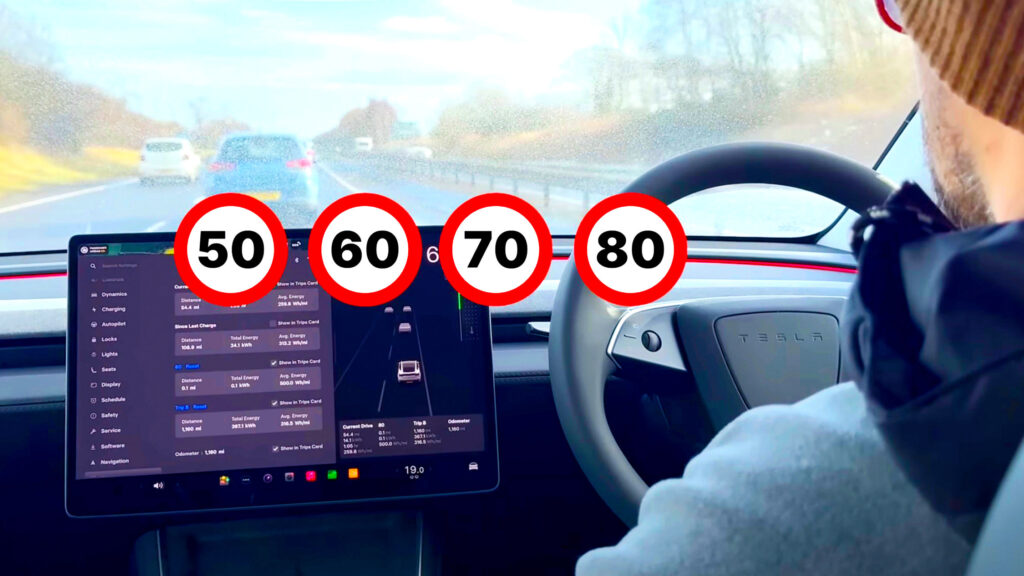
A Tesla owner performed a series of real range tests in his single-motor Model Y.
He drove the same route 30-mile route at 50 mph, 60mph, 70 mph and 80 mph.
Going 80 mph vs 50 mph cut time by 38% but dropped range by same amount.
Speed or efficiency? For as long as there have been cars, drivers have had to weigh up that decision. Going faster means getting from A to B sooner, but is going to burn through more fuel, costing you more money.
And now, in the EV age, there are added pressures. Some electric cars are only good for 250 real-world miles (402 km), and BYD’s new 1,500 kW chargers aren’t here yet, meaning that if you need to stop mid-journey you can easily add 15-30 minutes to your trip, more than wiping out the time you saved by flexing your right ankle.
So what’s the sweet spot? That’s what one Tesla-owning YouTuber behind the Carwire channel decided to find out by conducting a series of test runs in his single-motor, rear-wheel drive Model Y.
He ran the same 30-mile (50 km) looping route along local multi-lane freeways (dual-carriageways in UK-speak) at 50 mph (81 km/h), 60 mph (96 km/h), 70 mph (113 km/h) and 80 mph (129 km/h), noting the Wh/mile efficiency for each trip.
Taking those numbers and assuming a 75 kWh usable battery capacity, he was able to extrapolate realistic freeway-type range figures, plus a hypothetical time for a 200-mile (302 km) journey based on the time taken to complete each loop at the different speeds. While this isn’t exactly super-scientific, it still delivers a useful comparison that highlights the huge effects different speeds have on efficiency and journey time.
The first loop, taken at a steady 50 mph, would result in 200-mile trip in the Model Y taking four hours. But the excellent 224.7 Wh/mi efficiency gives a calculated 333-mile (536 km) range, meaning you’d get to your destination with stacks of charge to spare.
80 MPH Decimates Range
At the other end of the scale, the 80 mph run crashed efficiency to 366.2 Wh/mi, and the range to just 204 miles (328 km). So while technically you could handle the 200-mile journey in one go, and in only 2 hours and 30 minutes, few people would risk not filling up before they hit the finish line.
The sweet spot, as Carwire concludes, seems to be somewhere between 60 and 70 mph. Bumping the speed up to 60 mph cuts a handy 40 minutes off the 50 mph journey time, yet the 300-mile (483 km) range is only 33 miles (53 km) lower.
Pushing the needle up to 70 mph cuts another half hour from the trip, and though the efficiency starts to tumble the 248-mile calculated range would still let you comfortably complete your 200-mile run without charging, or stressing that you probably ought to.
PROS ›› Sleek looks, cheap, efficient, comfortable ride CONS ›› Annoying safety tech, smallish trunk, not fun to drive
The all-electric SUV space has transformed at a remarkable pace in recent years, shifting from niche curiosity to mainstream battleground. Over the past five years in particular, growth has been rapid, driven in no small part by a surge of ambitious entrants from China.
If you’re a Carscoops regular, you’ll no doubt be familiar with all of the new and compelling EVs coming out of the People’s Republic. It’s bad news for those living in the US, as none of them are available, but across Europe, Asia Pacific, and elsewhere, these EVs have forced legacy carmakers to up their game and cut prices, which is great news for consumers.
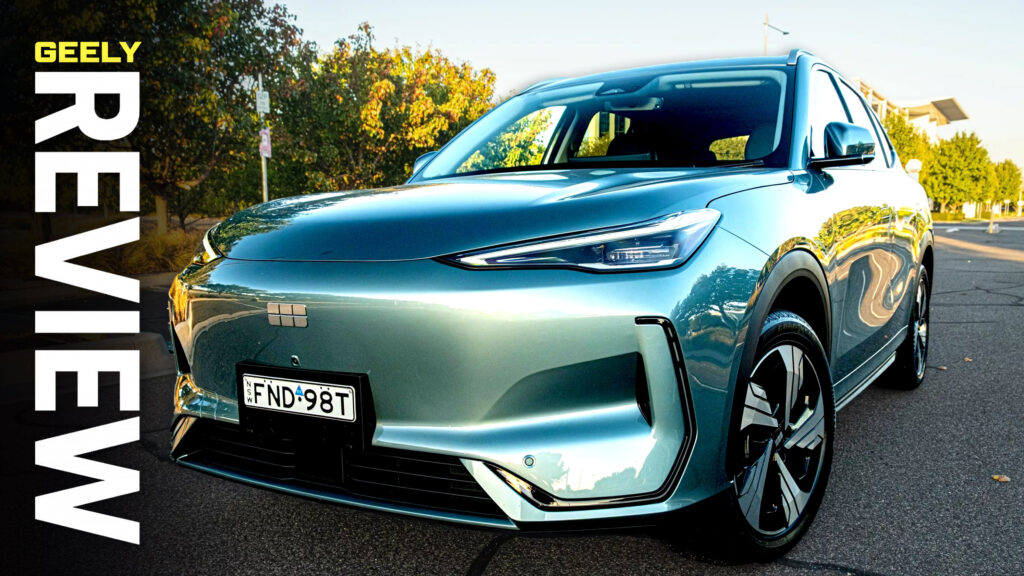
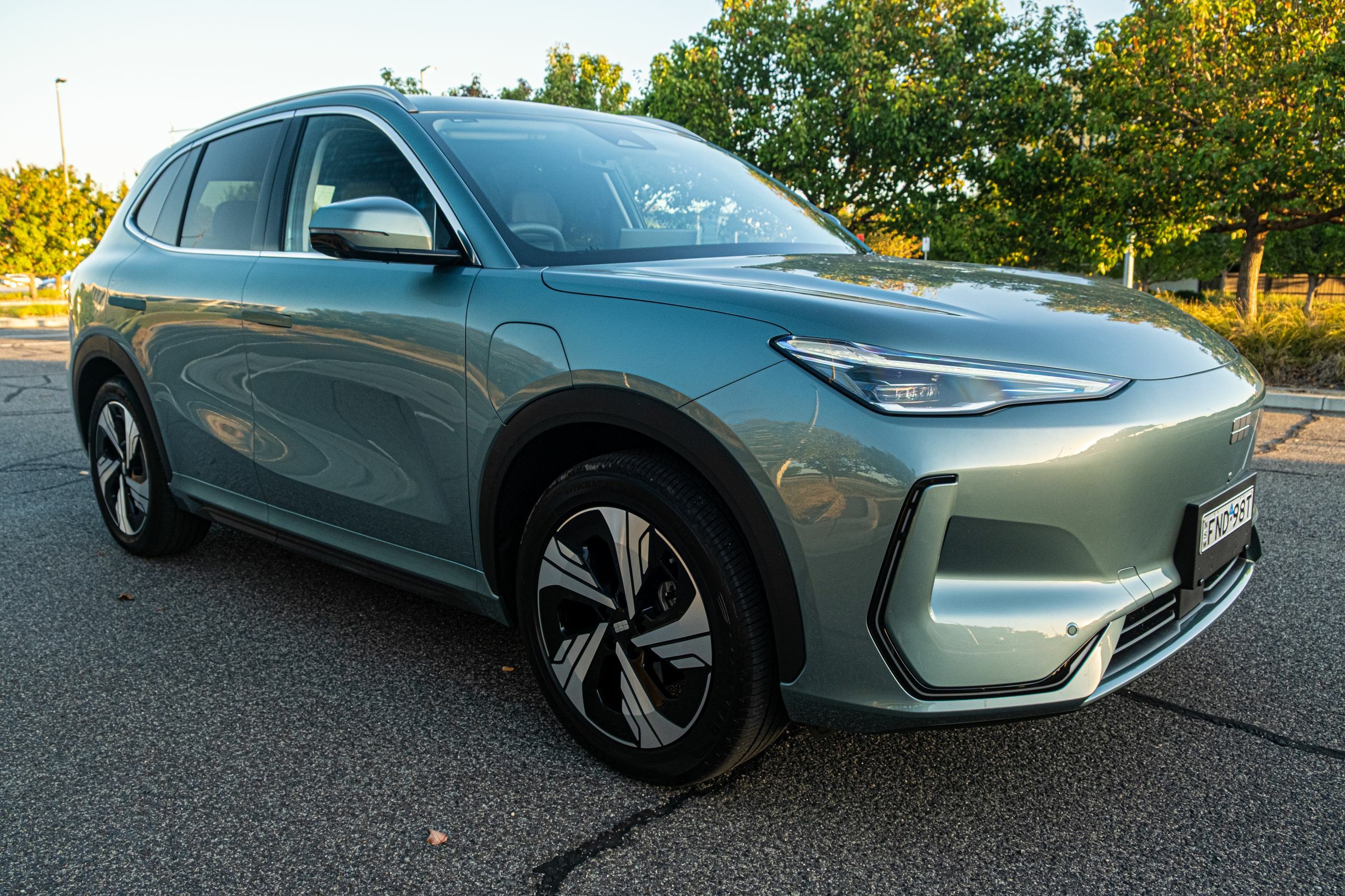
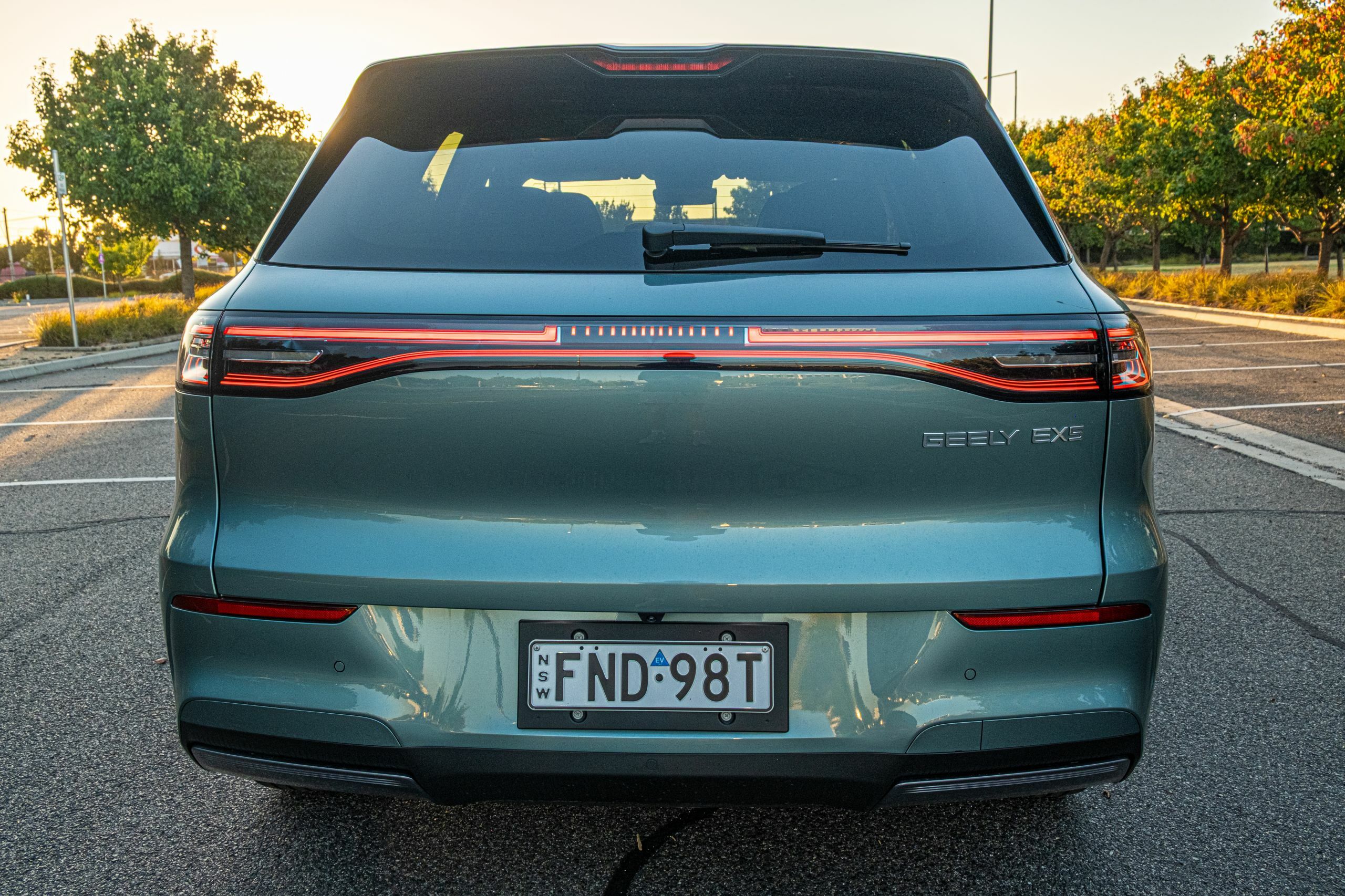
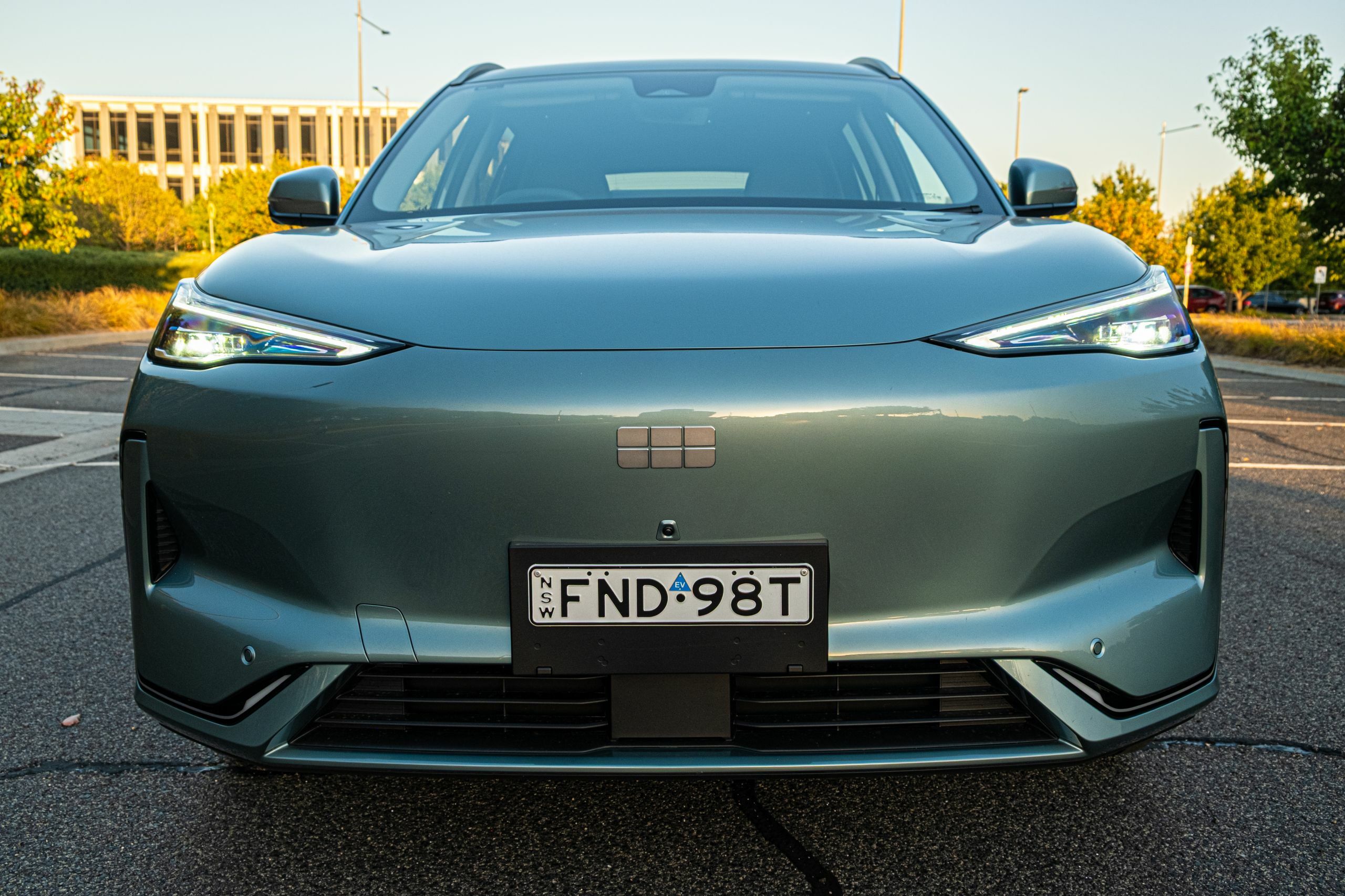
One of the country’s key players is the Geely Group, which continues to expand the reach of its core brand alongside a portfolio that includes Lotus, Volvo, Polestar, and Zeekr. In markets such as Australia, its most significant new EV is the Geely EX5, aimed squarely at the Tesla Model Y and competing Chinese models like the Xpeng G6 and BYD Sealion 7. It may not turn many heads or deliver an especially engaging drive, but it does tick loads of boxes.
QUICK FACTS
› Model:
2026 Geely EX5 Inspire
› Starting Price:
AU$45,990 ($32,500)
› Dimensions:
181.7 L x 74.8 W x 65.7 in H (4,615 x 1,901 x 1,670 mm)
› Wheelbase:
108.3 in (2,750 mm)
› Curb Weight:
1,765 kg (3,212 lbs)*
› Powertrain:
60.2 kWh battery / single electric motor
› Output:
215 hp (160 kW) / 236 lb-ft (320 Nm)
› 0-62 mph
6.9 seconds*
› Transmission:
Single-speed
› Efficiency:
16.2 kWh/100 km*
› On Sale:
Now
SWIPE
*Manufacturer
Photos Brad Anderson/Carscoops
What Do You Get For Your Money?
Two versions of the Geely EX5 are currently available in Australia – the Complete and the Inspire. Last month, we lived with the flagship Inspire for a week. Prices start at AU$41,990 ($29,600) for the Complete and rise to AU$45,990 ($32,500) for the Inspire, which translates to AU$50,061 ($35,300) when factoring in on-road costs.
Neither the Complete nor the Inspire offers any optional extras. All customers must choose from one of six available paint finishes and two available interior colors.
The EX5 is slightly smaller than a Tesla Model Y and BYD Sealion 7, but it’s also considerably cheaper. The new Model Y Premium Rear-Wheel Drive starts at AU$58,900 ($41,600), a difference of AU$16,910 ($12,000), while the larger Sealion 7 kicks off from AU$54,990 ($38,800). The EX5 also undercuts the Xpeng G6, starting at AU$54,800 ($38,700), and the Leapmotor C10, priced from AU$47,990 ($33,900).
The EX5 is based on Geely’s GEA architecture and features a compact 60.2 kWh lithium-iron phosphate battery pack with a single electric motor driving the front wheels. Both versions deliver the same 160 kW (215 hp) and 320 Nm (236 lb-ft) of torque.
Due to the small battery pack, the 430 km (267 miles) quoted range of the Complete and the 410 km (255 miles) driving range of the Inspire aren’t all that impressive, but the EX5 does promise to be pretty efficient, averaging as low as 15.8 kWh/100 km.
A Sleek Cabin
Photos Brad Anderson/Carscoops
I stepped into my week with the EX5 just after handing back the keys to Geely’s new Starray EM-i plug-in hybrid. From behind the wheel, the two look and almost feel the same, which is certainly no bad thing.
The EX5’s basic dashboard, steering wheel, door panels, and floating center console are all virtually identical to the Starray. While it’d be nice to have a little more differentiation between the two models, I can’t imagine there’ll be any EX5 buyers not completely satisfied with the fit and finish of the cabin.
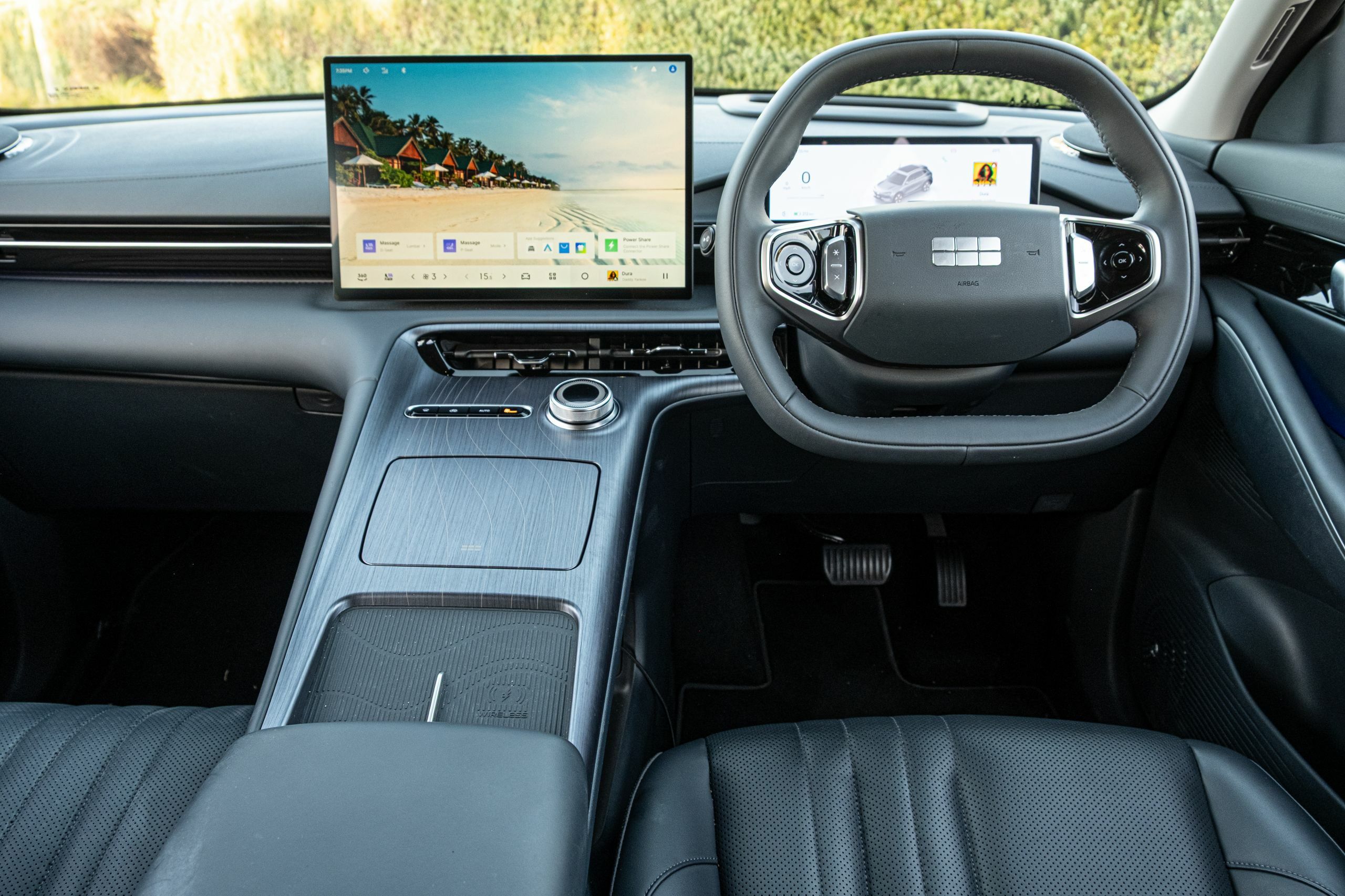
Perched in the center of the dashboard is a 15.4-inch infotainment display using Geely’s Flyme OS. It’s an excellent system, using a snappy processor and having logical and easy-to-understand menus. I especially liked the ability to customize which functions remained fixed to the taskbar at the base of the screen, such as temperature controls, fan speed, and seat adjustments.
A large 10.2-inch digital cluster is also used. Just like in the Starray EM-i, only the right side of it can be configured to display things like your media and trip functions. The rest of the screen remains unconfigurable.
Our tester had the available black interior finish, and it felt more premium than the price tag would suggest. There are some areas with piano black plastic, including the steering wheel and parts of the door panels, but Geely hasn’t gone overboard with them. Found on the floating center console are climate-control shortcuts and a configurable scroll wheel.
The Good And The Bad
Photos Brad Anderson/Carscoops
Sliding into the driver’s seat for the first time, I was relieved that the faux leather felt very real and was beautifully soft to the touch. However, I was disappointed that, like in the Starray, there is no ability to adjust the lumbar support. This is an odd exclusion, particularly given that Geely has gone to the trouble of fitting ventilated, heated, and massaging front seats.
Speaking of the massage seats, they are superb and remarkably forceful, unlike most other cars in this price range with massage seats.
When launched, the EX5 only included wireless Apple CarPlay, but no Android Auto connectivity. Thankfully, our test car benefited from a software update just before we collected it, adding wireless Android Auto, which worked seamlessly. The Inspire also comes standard with a panoramic sunroof and a solid 16-speaker audio system.
Externally, the EX5 looks quite small, but much to my surprise, there’s plenty of room for adults in the second-row, including plenty of legroom and headroom. However, it seems Geely has robbed some cargo volume to make the rear seats as spacious as they are.
As such, there’s just 302 liters (10.6 cubic feet) of space in the rear, although this does increase to 410 liters (14.5 cubic feet) if you include the generous under-floor storage area. Fold the seats down, and you’re looking at 1,877 liters (66.2 cubic feet), or about 200 liters (7 cubic feet) less than the Starray.
Smooth And Sharp
Photos Brad Anderson/Carscoops
Spend any amount of time behind the wheel of the EX5, and it’s obvious that it feels just as polished as some of the more expensive competition.
As an EV like this should, it’s quiet on the open road, but it does have an especially loud pedestrian warning hum when driving at lower speeds. Figures of 160 kW (215 hp) and 320 Nm (236 lb-ft) are largely par for the course for a vehicle like this, and just so happen to be identical to the recently-launched Hyundai Elexio.
Power feels absolutely adequate. Were this a combustion-powered SUV, it may feel a little underpowered, but as all of the grunt is available the moment you stab the throttle, the EX5 gets going surprisingly well. Indeed, it can hit 100 km/h (62 mph) in 6.9 seconds, which is very respectable. Geely has also done a good job of ironing out any hints of torque steer under hard acceleration.
Efficiency is also good. I averaged 16.2 kWh/100 km during my time with it, a lot better than I recently averaged in the larger and admittedly heavier Hyundai Elexio.
The ride also feels polished and plush, and that’s not something that can be said about many EVs. Given these vehicles have heavy battery packs in the floor, carmakers often give them quite harsh suspension setups. That’s not the case here as the EX5 eases over bumps smoothly and comfortably. Similarly, the steering is light and direct with several different settings to tweak the weighting.
What Could Be Improved?
Photos Brad Anderson/Carscoops
Just like we found in the Starray, most of the frustrations with driving the EX5 can be traced back to overzealous safety systems, like the speed limit warning and the driver monitoring system. In the more expensive Zeekr 7X, also from the Geely Group, these systems can be easily and quickly disengaged by swiping down from the top of the central screen and pressing on the large shortcut settings. Additionally, they stay off, even after you’ve left the car.
Things aren’t so easy in the EX5, as you have to dive into the menu in a process that can take 10-15 seconds. Whenever I would get ready to drive off, I’d have to disable them. It’d be nice to see Geely tap some of Zeekr’s UX engineers on the shoulder for some advice on how to incorporate similar shortcut toggles.
Is the EX5 particularly fun or engaging to drive? No, as it simply doesn’t have the performance or suspension setup to thrill, but it handles well, thanks in large part to the fact that it’s relatively light.
Shortly after we returned the keys to our 2025 model, Geely presented the 2026 EX5 in Australia, complete with a slightly larger 68.39 kWh battery, but retaining the same 160 kW (215 hp) front-mounted motor. In the future, we’d like to see Geely broaden the EX5’s appeal further, perhaps by launching a more powerful all-wheel drive version.
Verdict
As it stands, the Geely EX5 is a very solid choice for those in the market for an all-electric, mid-sized SUV. While it’d be nice for some of the safety systems to be calibrated more accurately, the minor niggles they have aren’t a deal-breaker.
For growing families, the EX5 could prove to be a little too small, so it would be best suited to couples and those with young children. It’s well-priced, reasonably efficient, and comfortable to drive daily. However, even though the model we drove is known as the EX5 Inspired, it felt a little uninspired and isn’t the type of vehicle that tugs at the heartstrings, as is the case with a number of alternatives.

 Login
Login