Reading view

There are new articles available, click to refresh the page.

Tesla’s FSD Was Branded Controversial, But Dutch Safety Regulators Called It The Safest System In The Test
  • Owners in the Netherlands will soon be able to use Tesla’s FSD system.
  • The Dutch safety agency will now submit FSD for EU-wide approval.
  • Tesla’s FSD system was found to outperform other driver assistance systems.

Tesla’s controversial Full Self-Driving system has received the green light for use in the Netherlands, and this could just be the start of its expansion across Europe. The decision comes after more than 18 months of tests and analysis by the RDW, the Dutch vehicle authority.

The most recent version of Tesla’s supervised FSD system “makes a positive contribution to road safety,” the RDW said. Now that it has the agency’s approval, Tesla says it will soon start rolling out the technology across the Netherlands, allowing owners to experience hands-free driving in both urban and highway settings.

Read: Feds Expand Tesla FSD Investigation After Visibility Failures

Even more important than the system’s approval for use in the Netherlands is that the RDW’s approval means it can be introduced across all European Union member states at a later date.

Before this happens, however, RDW must submit the application for authentication across the entire region, and all member states must vote on it. A majority vote is needed for the system to be approved EU-wide, and even if a majority is not achieved, individual countries can still decide to approve the system, Reuters notes.

Tackling The Country’s Most Difficult Roads

Smooth https://t.co/zJdymUNkcm

— Elon Musk (@elonmusk) April 12, 2026

Since the approval, Tesla has flooded its X account with videos of the FSD Supervised system being tested in the Netherlands. Importantly, the RDW noted that “a vehicle with FSD Supervised is not self-driving,” pointing out that “the driver remains responsible and must always maintain control.”

“The Tesla driver assistance system supports the driver more than other systems because it takes over multiple driving tasks when it is switched on,” the agency said in a statement. It added that “due to the continuous strict monitoring of the driver in the vehicle, the system is safer than other driver assistance systems,” noting it was tested both on test tracks and on public roads.

If a driver is consistently found to be not fully alert while behind the wheel, the system will trigger various signals to catch their attention. In extreme cases, the system can shut down and temporarily be prevented from switching back on.

Passed the 🇳🇱 wife test @aelluswamy ! pic.twitter.com/zpZqTR1DkD

— Sander Smit (@Sandersmit83) April 12, 2026
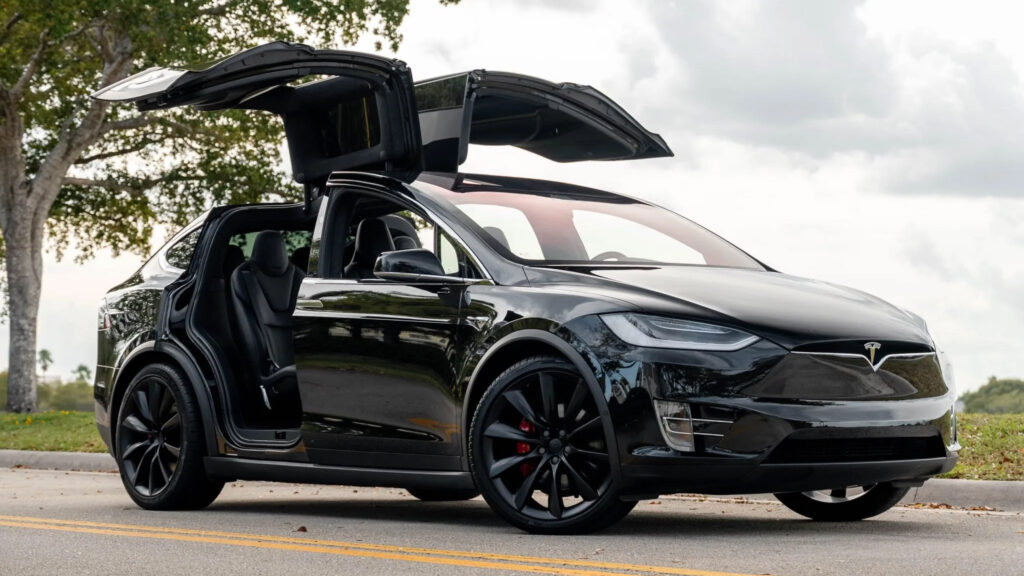
This $36,000 Used Tesla SUV Still Hits 0-60 in 2.9 Seconds

  • Used Model X offers more performance per dollar than a new Tesla.
  • A 2018 Model X P100D just sold for $36,000 with only 26,000 miles.
  • At that price, 680 hp and a 2.9-second 0-60 is an extraordinary deal.

Tesla has been chasing a $35,000 EV for the U.S. market since roughly 2015, when the Model 3’s unveiling promised to democratize electric motoring. It came close with the $36,990 Model 3 Rear-Wheel Drive launched last year, and the entry-level Model Y RWD at $39,990. But for buyers who want a genuinely affordable Tesla without the feel of a stripped-out special, the used market is where things get interesting.

Read: Tesla Quietly Kills Its Flagship EVs In Europe Just After Updating Them

Once-flagship versions of Tesla’s three-row Model X are now available for around $35,000 or so, and after eight years of depreciation, they represent a rather compelling proposition.

\\\\\\\\\\\\\\\\

Bring a Trailer

A 2018 Model X P100D recently sold for $36,000 on Bring a Trailer. Yes, it’s eight years old, which explains the price, but it has only covered 26,000 miles (41,800 km), which is remarkably low for its age. Barring anything catastrophic, the SUV should deliver tens of thousands of additional trouble-free miles, provided it has been routinely maintained and kept up to date with software updates.

Supercar Performance With SUV Practicality

Before Tesla’s Plaid models were a thing, the P100D-branded models represented the pinnacle of performance. In the Model X, a pair of electric motors produces a combined 680 hp, enough to send it to 60 mph (96 km/h) in just 2.9 seconds. Find an SUV buyer who claims they need something faster than that, and we’ll tell you they’re lying.

Tesla only recently announced it would stop building the Model X, hardly a surprise given how few have been sold in recent years. But when it was first launched, it was incredibly innovative.

\\\\\\\\\\\\\

Bring a Trailer

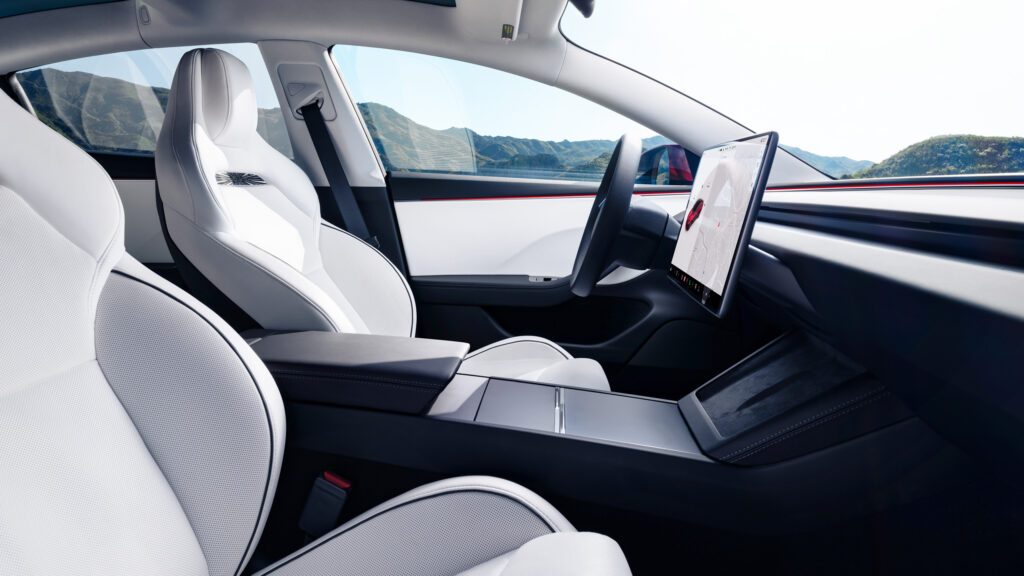
We’d argue the cabin of this original model is more appealing than newer models, which adopted Tesla’s landscape-oriented touchscreen, rather than a vertical one. There are also loads of carbon fiber throughout and plenty of plush black leather.

Three-row electric SUVs still have relatively limited appeal, but at this price point, with this mileage, and with this level of performance, there’s no denying that something like this offers good value for the money.

Every Tesla Is Missing The Door Handle The Cybercab Just Introduced

  • Tesla has designed a new door handle similar to what Audi and Lexus use.
  • The new interior handle houses both the electric and mechanical releases.
  • Other Tesla models will be updated with these safer door releases.

Following a spate of fatal incidents involving Tesla models with door handles that allegedly couldn’t be opened after a crash, and several lawsuits, we now have our first chance to see the new inner door handles that Tesla has developed. Perhaps surprisingly, these new handles have premiered on the self-driving Cybercab.

Development of Tesla’s mass-market robotaxi is continuing, and the carmaker continues to make changes to the car. Recently, a pair of YouTubers had the chance to take an in-depth look at a new Cybercab prototype, revealing the new handles and a slew of other features.

Read: Cybercab Spotted Up Close, Steering Wheel, Panel Gaps And All

In the current Tesla Model 3, Model Y, and Cybertruck, there are individual interior buttons to open the doors, and then physical pulls incorporated into the handles. At the rear, the emergency releases are generally located in the door pockets, beneath a plastic panel, possibly making them hard to find in an emergency, particularly for someone unfamiliar with the car.

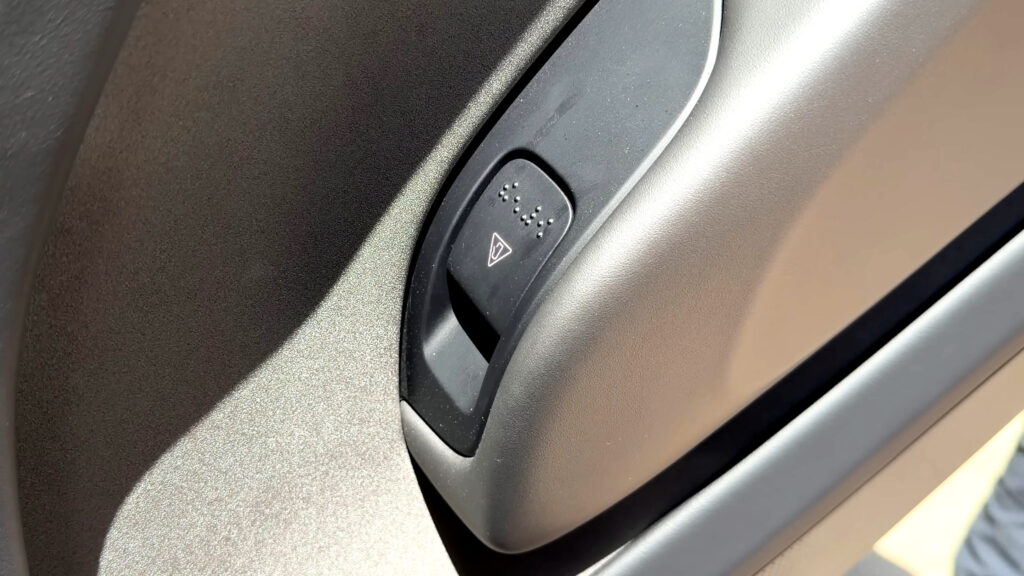
Tesla’s solution has been to switch to a small latch that can be lifted lightly to trigger the electronic release, opening the door. If you then pull the same latch harder, it will serve as the manual release. It’s a much better system than the one currently used and is similar to the door latches used by companies like Audi and Lexus, where the electronic and manual releases share the same switch or handle.

Tesla has also gone to the trouble of adding braille to the release, helping those with visual impairments to find it. That’ll be particularly useful in the Cybercab, where people will be driven around by the car’s advanced self-driving suite without anyone else on board. This new door pull is presumably the same one that will be added across all other existing Tesla models.

What Else Is New?

 Every Tesla Is Missing The Door Handle The Cybercab Just Introduced

Several other changes have been made to the Cybercab. For example, it now includes a charging port at the rear, despite initially being presented without one because Tesla only wanted them to be charged wirelessly. However, the more significant change made on a prototype Carscoops recently spied was the presence of a steering wheel, which given the autonomous nature of the Cybercab was a surprise.

\\\\\\

Photos Robert G. | Lead screenshot Kim Java / YouTube

EV Speed Comes At A Price, So Where’s The Sweet Spot?

  • A Tesla owner performed a series of real range tests in his single-motor Model Y.
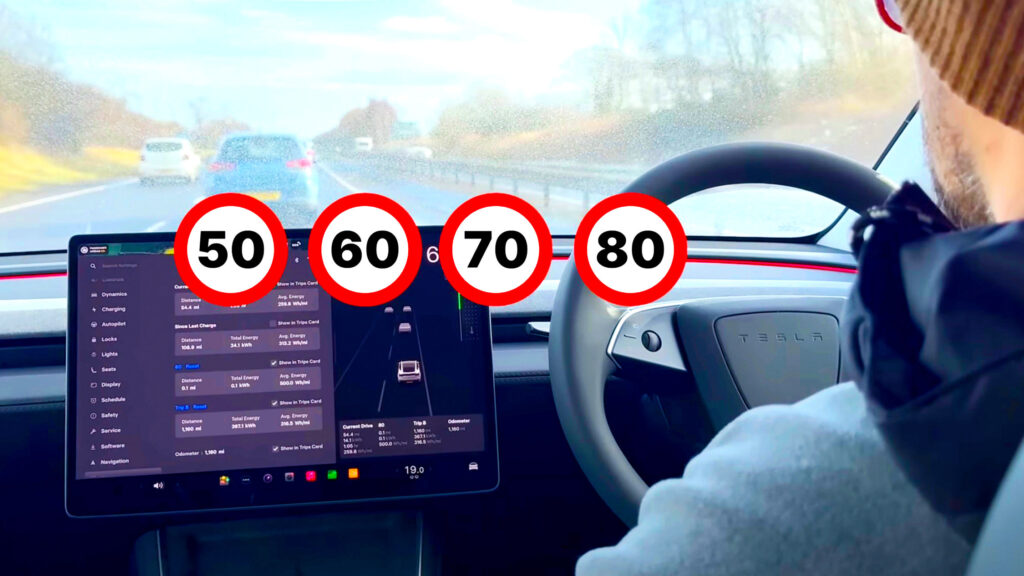
  • He drove the same route 30-mile route at 50 mph, 60mph, 70 mph and 80 mph.
  • Going 80 mph vs 50 mph cut time by 38% but dropped range by same amount.

Speed or efficiency? For as long as there have been cars, drivers have had to weigh up that decision. Going faster means getting from A to B sooner, but is going to burn through more fuel, costing you more money.

And now, in the EV age, there are added pressures. Some electric cars are only good for 250 real-world miles (402 km), and BYD’s new 1,500 kW chargers aren’t here yet, meaning that if you need to stop mid-journey you can easily add 15-30 minutes to your trip, more than wiping out the time you saved by flexing your right ankle.

Related: Tesla’s Budget Model Y Gets Grip And Grit For $2K More, But Don’t Call It Standard

So what’s the sweet spot? That’s what one Tesla-owning YouTuber behind the Carwire channel decided to find out by conducting a series of test runs in his single-motor, rear-wheel drive Model Y.

He ran the same 30-mile (50 km) looping route along local multi-lane freeways (dual-carriageways in UK-speak) at 50 mph (81 km/h), 60 mph (96 km/h), 70 mph (113 km/h) and 80 mph (129 km/h), noting the Wh/mile efficiency for each trip.

Taking those numbers and assuming a 75 kWh usable battery capacity, he was able to extrapolate realistic freeway-type range figures, plus a hypothetical time for a 200-mile (302 km) journey based on the time taken to complete each loop at the different speeds. While this isn’t exactly super-scientific, it still delivers a useful comparison that highlights the huge effects different speeds have on efficiency and journey time.

The first loop, taken at a steady 50 mph, would result in 200-mile trip in the Model Y taking four hours. But the excellent 224.7 Wh/mi efficiency gives a calculated 333-mile (536 km) range, meaning you’d get to your destination with stacks of charge to spare.

80 MPH Decimates Range

At the other end of the scale, the 80 mph run crashed efficiency to 366.2 Wh/mi, and the range to just 204 miles (328 km). So while technically you could handle the 200-mile journey in one go, and in only 2 hours and 30 minutes, few people would risk not filling up before they hit the finish line.

The sweet spot, as Carwire concludes, seems to be somewhere between 60 and 70 mph. Bumping the speed up to 60 mph cuts a handy 40 minutes off the 50 mph journey time, yet the 300-mile (483 km) range is only 33 miles (53 km) lower.

Pushing the needle up to 70 mph cuts another half hour from the trip, and though the efficiency starts to tumble the 248-mile calculated range would still let you comfortably complete your 200-mile run without charging, or stressing that you probably ought to.

Speed Versus Time And Efficiency
50 mph60 mph70 mph80 mph
Journey time4 hours3 hours 20 mins2 hours 51 mins2 hours 30 mins
Efficiency224.7 Wh/mi249.9 Wh/mi302.2 Wh/mi366 Wh/mi
Calculated range333 miles300 miles248 miles204 miles
SWIPE

Carwire

Texas PD Tests Model Y To See If Gas SUVs Really Cost Up To $12,000 More A Year

  • Murphy PD in Texas now runs the 2026 Model Y Juniper.
  • Each unit saves $4,100 to $12,000 a year in fuel and upkeep.
  • Its electric drivetrain could double the car’s service life.

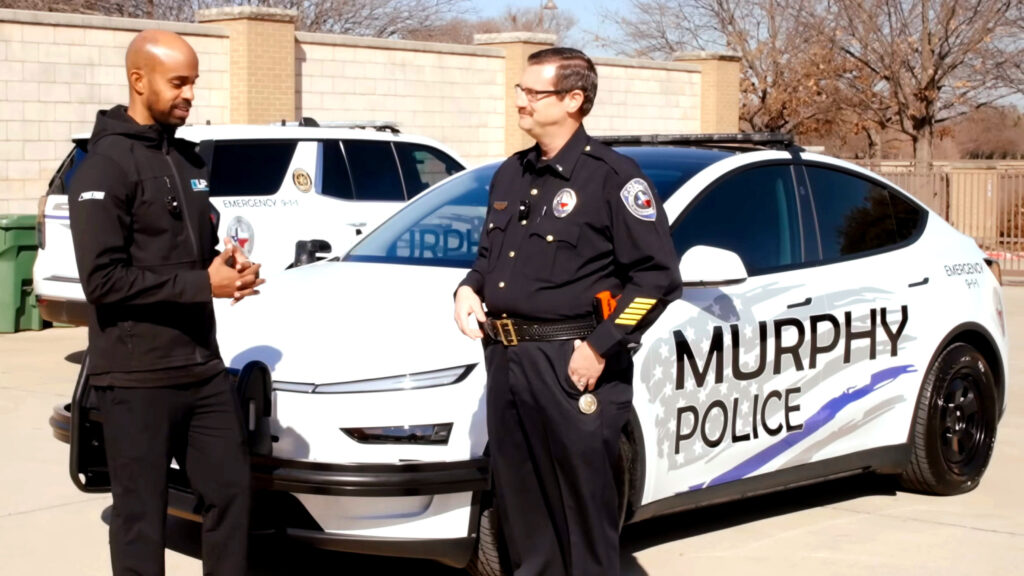
The Murphy Police Department in North Texas has become the first agency to roll out the refreshed 2026 Tesla Model Y Patrol, upgraded by Unplugged Performance. Instead of committing to a full fleet replacement, the department is running the EV in real-world conditions to see how it holds up to daily patrol duty.

Officials say the more persuasive case is financial. Each cruiser is projected to deliver measurable savings compared to a traditional ICE-powered patrol vehicle.

More: There’s A New Contender For The World’s Coolest Police Car

According to data from the City of Murphy, projected annual savings per vehicle range from $4,100 for single-officer units to as much as $12,000 for shared-shift cars clocking more than 140 hours per week. The bulk of that comes from eliminating fuel purchases, though the department will still incur electricity costs, along with a 75% reduction in maintenance compared to gasoline vehicles such as the Chevrolet Tahoe and Ford Explorer.

\\\\\\\\

No Idling Wear

The savings story does not stop at fuel and oil changes. EVs do not suffer engine wear from constant idling, which accounts for roughly 60% of a patrol car’s working life. As a result, they are expected to remain in service for up to twice as long as an ICE-powered equivalent.

More: Tesla Cybertruck Joins The Police, May Pull You Over This Year (If It Doesn’t Break Down)

Given that every hour spent idling is effectively equal to 33-35 miles (53-56 km) of driving wear, that difference adds up quickly. Without a combustion engine ticking away under the hood, the Model Y can sit on scene running lights, laptops, and climate control off its battery, without quietly shortening its lifespan.

Juniper Patrol Cars

\\\\\\\\\\\\\\\\\\\\

On the hardware front, the facelifted Tesla Model Y Juniper has been converted into a patrol unit by UP.FIT, the specialized fleet division of Unplugged Performance. Compared to the road-going version, it gains a front push bar, additional LEDs at the front and sides, a roof-mounted siren, and 18-inch forged aluminum wheels wrapped in pursuit-rated tires.

The police car is offered in RWD and AWD configurations, using the standard electric powertrains and delivering between 321-357 miles (517-574 km) of range per charge. That is more than enough for routine duty. And because police work occasionally involves pursuits, braking performance has been upgraded with six-piston calipers, stainless steel brake lines, specialized fluids, thermally upgraded components, and uprated rotors.

More: A Traffic Cop Just Got A 1,001 HP Company Car

Inside, officers get ventilated seats and improved sound insulation. Each vehicle is retrofitted with a customizable center console, a laptop mount, two weapon mounts, upgraded interior lighting, and a single rear prisoner partition.

Optional extras include ballistic protection for the front doors and custom reflective graphics.

UP.FIT has not disclosed the final MSRP for the Murphy units, though it insists the total cost of ownership undercuts everything else in the segment. Beyond the Model Y crossover, the company also offers police-ready conversions for the Cybertruck, Model S/X, and Model 3, in case your local department prefers its patrol cars in a different shape.

\\\\\

UP.FIT / Unplugged Performance

❌