
Normal view

There are new articles available, click to refresh the page.
Before yesterdayMain stream

Stellantis Gave Citroen C3 And Fiat Grande Panda The Same Bones, But Not The Same Soul | Review

SUVs may have flooded European streets, but compact, affordable hatchbacks haven’t packed up and left just yet. Stellantis seems to have taken note, quietly repositioning the Citroen C3 into a value-focused crossover-style hatchback and offering Fiat the same platform to build the new Grande Panda. We recently drove both, back to back, curious to see whether the distinctions ran deeper than design.

More: We Imagined Stellantis’ Tiny EV As Jeep, Dodge, And Chrysler Oddballs

Citroen and Fiat play a specific role within the Stellantis portfolio. They’re the budget-conscious brands, tasked with delivering the most affordable cars in each segment. That’s why the new C3 and Grande Panda are built on the cost-effective Smart Car platform, rather than the more sophisticated CMP architecture underpinning their Opel Corsa, Peugeot 208, and Lancia Ypsilon cousins.

Despite the lower-cost foundations, Stellantis didn’t skimp on drivetrains. Buyers get the same menu of internal combustion, mild hybrid, and full electric powertrains.

Quick Facts
ModelFiat Grande PandaCitroen C3
Powertrain OptionsICE / Mild Hybrid / ElectricICE / Mild Hybrid / Electric
Length3,999 mm (157.4 inches)4,015 mm (158.1 inches)
Width1,763 mm (69.4 inches)1,755 mm (69.1 inches)
Height1,585 mm (62.4 inches)1,577 mm (62.1 inches)
Wheelbase2,540 mm (100 inches)2,540 mm (100 inches)
Weight1,240-1,554 kg (2,734-3,427 lbs)1,226-1,491 kg (2,703-3,286 lbs)
Boot361-412 lt (12.8-14.6 cubic feet)310 lt (11 cubic feet)
Price (Greece)from €16,990 ($19,900)from €17,300 ($20,300)
SWIPE

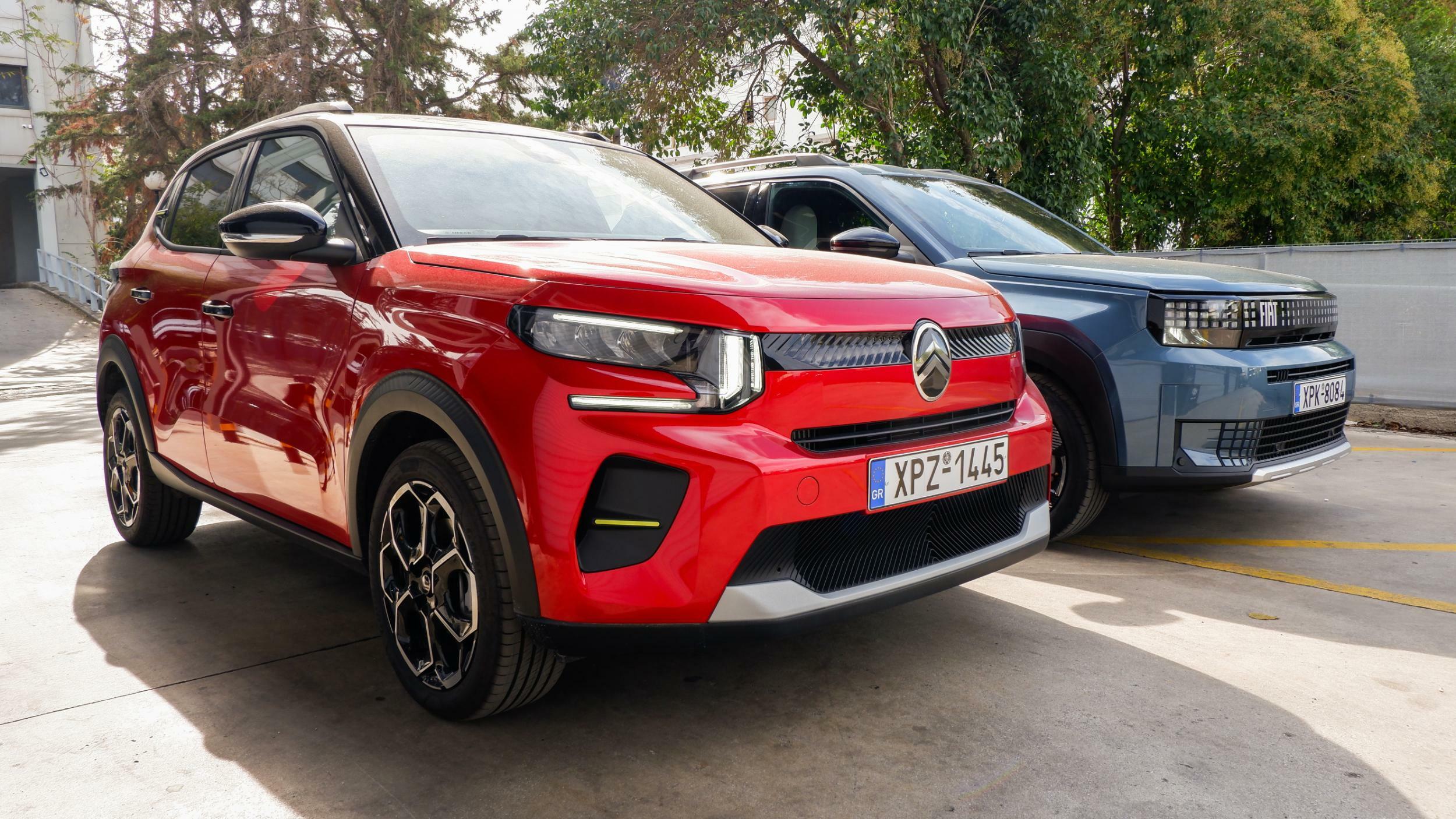
Predictably, the two hatchbacks share a wheelbase and sit within millimetres of each other in length and width. The Citroen measures 16 mm (0.6 inches) longer, while the Fiat is 5 mm (0.2 inches) wider. On paper, these are rounding errors, but the styling does help differentiate them more than the tape measure might suggest.

Different Shells

\\\\\\\\\\\\\

Photos Thanos Pappas for CarScoops

Most would agree that Citroen and Fiat’s designers did well to set their cars apart. Although the two models inevitably share core proportions, roof structure, and key hardpoints, every body panel is unique. That gave each brand the freedom to apply its own design language across the entire exterior.

More: You’re Not Wrong, The New Mercedes GLB Looks Suspiciously Like A Smart

The Citroen looks chunky and aggressive with sculpted details, while the Fiat is boxier and retro-futuristic with many Easter Eggs doubling as references to its Italian origins. Both hatchbacks sit higher than usual and carry crossover styling cues, but the slightly thicker plastic cladding and taller roof rails of the Grande Panda make it look a bit more adventurous than the C3.

Examples that highlight the fine line between cost-cutting and design statement include the combinations of the identical mirror caps with different indicators (from the Stellantis parts bin), the shared door handles with bespoke door stampings, and the common greenhouse with slightly different window lines.

Two Interiors, Two Moods

\\\\\\\\\\\\\\\\\\

Photos Thanos Pappas for CarScoops

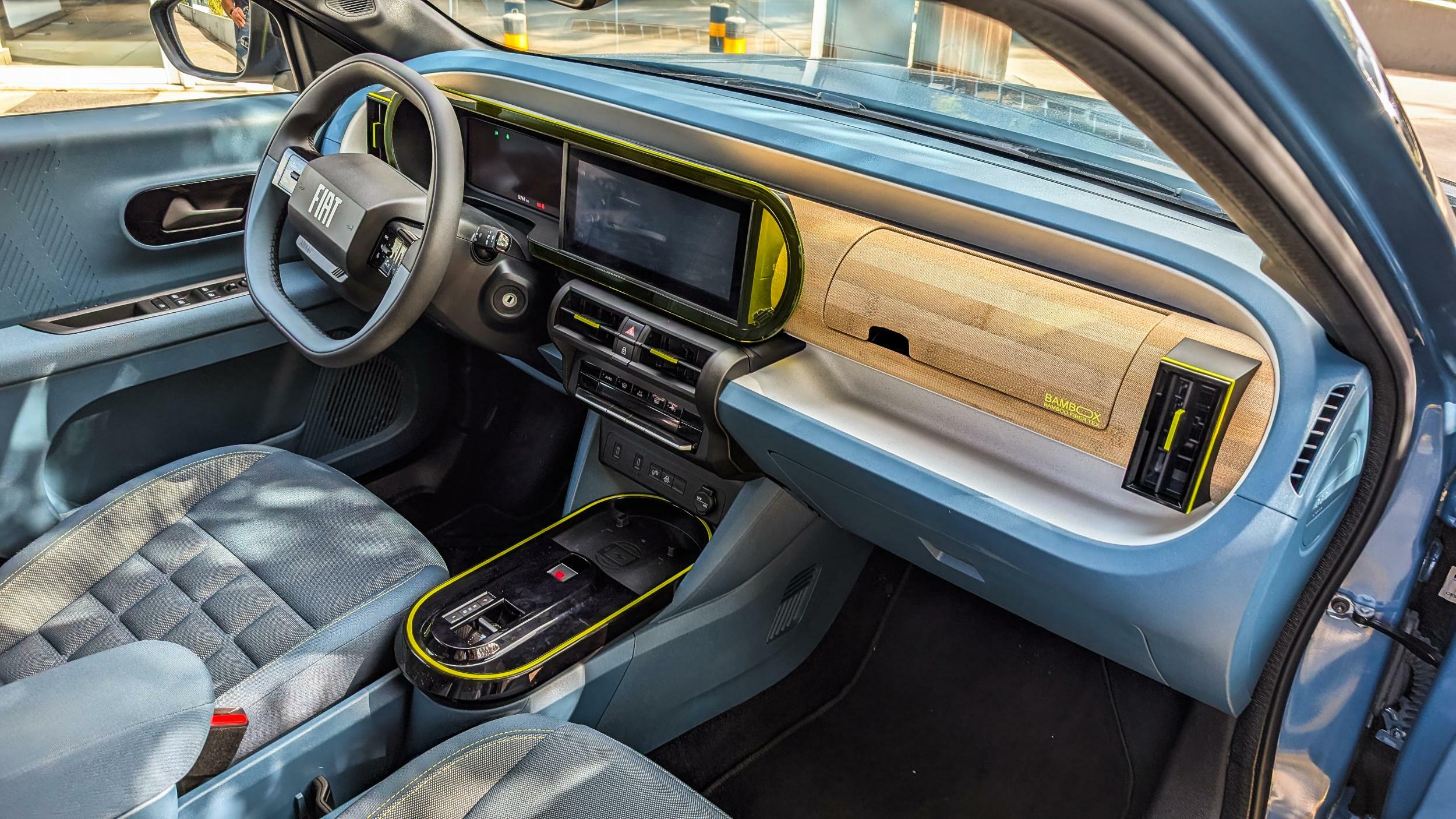
The unique character of each model is even more pronounced inside the cabin. The Citroen has a modern and minimalist approach, with horizontal lines on the dashboard. Highlights include the small two-spoke steering wheel, the tiny digital instrument cluster that resembles a head-up display, and the fabric trim that disguises the hard plastics.

Review: We Drove The New C5 Aircross And Lost Our Jeep’s Compass To Citroen’s Comfort

The Fiat is far more playful and colorful. It has an oval shaped digital cockpit with a miniature Panda trapped in the transparent perimeter, a Bamboo-like cover for the glovebox, vintage emblems and glossy black surfaces.

Of course, many of the core components are shared. The climate controls remain mercifully physical, the infotainment screen is a 10.25-inch unit across the board, and most of the switchgear and door handles are the same. It’s what you’d expect from two cars built from the same parts bin.

Comfort and Practicality
 Stellantis Gave Citroen C3 And Fiat Grande Panda The Same Bones, But Not The Same Soul | Review

Cabin space feels identical, with both cars offering enough legroom and headroom for four adults to travel comfortably. The seats are plush and equally stylish in their own regard, leaving Citroen’s “Advanced Comfort” marketing claim mostly symbolic. The boot also looks the same to the naked eye, despite the notable difference on paper in favor of the Fiat.

Overall, the Fiat has the most unique interior ambiance that will make passengers smile. On the other hand, the Citroen might age better and has a narrow lead in perceived quality – most likely due to the darker trim.

Trim levels mirror each other from the base models to the range-toppers we tested. In Greece, the Fiat is the more affordable choice across the range. But in other markets like Germany and the UK, the Citroen often comes in cheaper, at least for the electric versions.

Driving Impressions
 Stellantis Gave Citroen C3 And Fiat Grande Panda The Same Bones, But Not The Same Soul | Review

Behind the wheel, the similarities are immediately obvious. Contrary to what some reviews suggest, both models share identical suspension geometry and a soft overall tune. The Citroen does have a slight advantage over rough surfaces, thanks to its “Progressive Hydraulic Cushions” that take the edge off full damper extension.

Both small hatchbacks are very easy to drive and proved to be agile in Athens’ narrow streets. Of course, performance is identical across the range, which includes electric and turbocharged 1.2-liter engines in regular and mild-hybrid forms. The Grande Panda may eventually offer an all-wheel-drive version, potentially reviving the spirit of the Panda 4×4.

The steering feel is also very similar, but at least it gave me something to write about. In the Grande Panda I got the sense of the ultra-light City mode of older Fiats – but only when stationary. The Citroen’s steering adds a barely perceptible touch of extra weight, likely a result of the smaller steering wheel diameter.

Verdict

\\\\

Photos Thanos Pappas for CarScoops

In the end, the Citroen C3 and Fiat Grande Panda are two interpretations of the same idea, delivered in French and Italian dialects. Both target the value end of the subcompact market and use a shared platform to keep costs down, while still managing to carve out distinct personalities through design.

They don’t face much direct competition beyond the Dacia Sandero Stepway, though small SUVs and traditional hatchbacks are always hovering nearby. Beneath the styling, they’re mechanically identical, with only slight differences in ride and agility. The C3 feels a bit more composed when the suspension hits its limits, while the Grande Panda comes across as slightly more nimble. These nuances only really emerge if you drive them one after the other.

For car enthusiasts and romantics, a little more character in the driving dynamics wouldn’t have gone amiss, but for most buyers, design is what matters. On that front, the fraternal twins deliver more than enough distinction to stand on their own.

The final verdict ends in a clear draw, with each car bringing its own strengths to the table and appealing to slightly different sensibilities. The Grande Panda leans into playful energy and quirky charm, while the C3 carries itself with a more restrained, minimalist poise. If it came down to styling alone, which one would you take home?

Photos and Video: Thanos Pappas for CarScoops

Fiat’s Most Polarizing Minivan Deserves A Comeback, And This Is The Perfect Starting Point

  • Our render uses the Citroen ELO to imagine a Fiat Multipla EV.
  • Two-story headlights return with subtle vintage Fiat design cues.
  • Sliding doors reveal a modular six-seat cabin with center driving.

The unveiling of Citroen’s ELO concept, with its stacked LED lights, minivan-like shape, and six-seat layout, immediately stirred speculation. Not just about the prospect of a Citroen-badged people carrier, but also about what it might mean for other brands within the Stellantis umbrella. It landed with a visual impact that invited questions beyond the concept itself.

More: We Imagined Stellantis’ Tiny EV As Jeep, Dodge, And Chrysler Oddballs

Could this be the design foundation for a new Fiat Multipla? At first glance, it may seem like a stretch, but the idea isn’t as far-fetched as it sounds. Fiat is rumored to be bringing back the Multipla name for a family-focused SUV.

Still, the ELO’s shape and proportions prompted a different line of thinking; what if the next Multipla leaned more closely into its original spirit?

The Return of One-Box Thinking

The single-box layout of the Citroen concept feels oddly well-suited to a spiritual successor to the original 1955 Fiat 600 Multipla. The notion doesn’t feel far off, especially since both marques fall under the Stellantis umbrella.

 Fiat’s Most Polarizing Minivan Deserves A Comeback, And This Is The Perfect Starting Point
Illustrations Thanos Pappas / Carscoops

With minimal styling revisions, Fiat could spin off a distinctive variant while still sharing development costs with Citroen, if such a minivan duo were ever to hit the streets.

There’s a clear visual callback in the lighting setup. The concept features round LEDs paired with slim DRLs positioned at the base of the windshield, subtly hinting to the stacked, two-tier headlights that made the 1998 Multipla infamous. A slightly reworked front end, with smoother surfacing and Fiat’s latest badge, completes the update.

Most of the 4.10-meter (161.4-inch) bodywork is carried over from the Citroen ELO, with the exception of the rear. There, the UFO-like split taillights jutting from the corners could be swapped for pill-shaped units that recall the cheerful styling of the Fiat Topolino.

More: You’ll Grow A Beard Before Fiat’s New Manual Hybrid Hits 60

As a finishing touch, we added a set of vintage alloy wheels from the Fiat 500 anniversary specials, along with a more expressive palette of exterior colors. Finally, discreet plastic cladding around the wheel arches with a matching finish for the bumpers and door inserts make the fictional model look ready to hit the road.

 Fiat’s Most Polarizing Minivan Deserves A Comeback, And This Is The Perfect Starting Point
Illustrations Thanos Pappas / Carscoops

The wide-opening sliding doors and experimental cabin layout of the Citroen concept also make sense here. Six individual seats, a central driving position, and the option to remove chairs or add accessories like inflatable mattresses and modular storage could make this an ideal companion for family adventures.

Packaging like that requires a dedicated EV platform. That means no room for combustion engines. But a compact rear-mounted motor and a modest battery would be more than sufficient for city use and the occasional weekend escape.

The Story of the Multipla

The original Fiat 600 Multipla, designed by Dante Giacosa, was introduced in 1955. It was based on the underpinnings of the Fiat 600 featuring cab-over styling. Despite measuring just 3,531 mm (139 inches) long, it had a spacious interior that could accommodate up to six passengers and their luggage.

More: Remember The Fiat Multipla? Reimagining The ’90s Icon For The EV Age

Fiat revived the Multipla name in 1997 for a new compact MPV, and while it may be better remembered for its polarizing design, it delivered genuine functionality. Roberto Giolito’s design, with its two-level headlights and expansive glasshouse, stood out in every possible way.

\\\\\\\\\\\\\\\\\\\

Despite being shorter than a modern supermini at 3,994 mm (157.2 inches) long, the Multipla offered uncompromising practicality. Rather than stretching it lengthwise, Fiat’s designers cleverly pushed the dimensions outward, giving it a width of 1,871 mm (73.7 inches).

That allowed for two full rows of three seats, making it a genuine six-seater, with a minimum of 430 litres of boot space, plenty of room for luggage, shopping, or a four-legged passenger or two.

And because Fiat made it wide rather than long, the Multipla not only packed in the space but also handled better than most people movers, with a squat stance that gave it a more planted feel on the road.

The second-generation model received a more conventional facelift in 2004 and was discontinued in 2010. However, production continued under license in China by Zotye until 2013.

Is There Room for a Quirky Comeback?

 Fiat’s Most Polarizing Minivan Deserves A Comeback, And This Is The Perfect Starting Point
The 1998 Fiat Multipla (left) and the 1955 Fiat 600 Multipla (right).

Fiat hasn’t confirmed a new Multipla, but the name keeps resurfacing in product speculation. n. Most likely, it will be assigned to a crossover in the expanding Panda lineup.

That model is expected to use Stellantis’ Smart Car platform, shared with the Citroen C3 Aircross and Opel Frontera, and would likely compete with budget-friendly models like the Dacia Duster and Bigster.

Review: New Fiat Grande Panda Hybrid Makes Budget Look Cool Again

 Fiat’s Most Polarizing Minivan Deserves A Comeback, And This Is The Perfect Starting Point
Illustrations: Thanos Pappas for CarScoops

The forthcoming SUV will reportedly be offered with gasoline, mild-hybrid, and fully electric powertrain options, following the example of the Grande Panda subcompact hatchback and a mechanically-related fastback crossover that has been spied testing.

Still, for all the SUV planning, there remains a quiet corner of the internet hoping that Fiat remembers what made the original Multipla special: not just practicality, but a certain willingness to stand apart.

\\\\\

Stellantis Heritage Hub

We Imagined Stellantis’ Tiny EV As Jeep, Dodge, And Chrysler Oddballs

  • Fiat will bring its smallest EV to America, and it’s not even a car.
  • We visualize Jeep, Dodge, and Chrysler versions of the tiny EV.
  • Each brand gets its own styling twist on the same platform.

Americans aren’t exactly spoiled for choice when it comes to pint-sized urban runabouts. Those Kei cars from Japan that caught Donald Trump’s attention recently are off-limits, and Europe’s laughably compact quadricycles are considered too tiny to share the road with trucks and SUVs.

Still, Stellantis seems ready to test the limits of what American drivers will accept, choosing to bring over the Fiat Topolino, a vehicle so small, it makes the already diminutive 500 look like a family hauler.

Read: Fiat’s Bringing An EV To America So Small It Makes Kei Cars Look Like Cadillacs

To give you a sense of scale, the Topolino measures just 2.53 meters long (99.6 inches), making it seven inches shorter than the already tiny Smart Fortwo. That car, if you remember, looked like a Little Tikes Cozy Coupe next to your average truck.

 We Imagined Stellantis’ Tiny EV As Jeep, Dodge, And Chrysler Oddballs

Stellantis has been dabbling in the heavy quadricycle category since 2020, starting with the Citroen Ami, followed by the Opel Rocks Electric in 2021, and most recently the Fiat Topolino in 2023. All three share the same platform, and all three are designed with urban mobility in mind rather than highway cruising.

That got us wondering: what if this squat little EV were rebadged as a Dodge, Chrysler, or Jeep? Would American buyers warm up to it with a familiar name on the front?

Officially, Stellantis has no plans to expand the model lineup in North America. But given how freely these micro-EVs swap badges in Europe, it’s not much of a leap to imagine a domestic version. Maybe if it wore the right logo, this pocket-sized commuter could stand a better chance on American streets.

So we sketched out a few ideas: what would it look like if Dodge, Jeep, and Chrysler each took a swing at the format?

Jeep TrailBug: Like A Golf Cart For The Apocalypse

 We Imagined Stellantis’ Tiny EV As Jeep, Dodge, And Chrysler Oddballs
Illustrations Thanos Pappas / CarScoops

Based on the rugged Citroen Ami Buggy – more specifically, the Rip Curl concept with grippy tires, an LED roof bar, frame doors, and other accessories – the Jeep version was an easy win.

Using the Citroen Ami Buggy as a starting point, and specifically, the Rip Curl edition with its chunky tires, roof-mounted LEDs, and open-air doors, we imagined a Jeep-branded version that leans fully into rugged charm.

More: 2025 Citroen Ami Gets Funkier With Bulging Eyes And 2CV-Style Gills

The reworked front fascia includes a five-slot grille (sorry folks, room constraints nixed the full seven), with circular Wrangler-style LED headlights and Jeep-branded alloys. Matte plastic panels and a spartan cabin keep it functional, while the aesthetic reads more off-road pit crew than farmer’s market errand runner.

No, it wouldn’t come with Trail Rated credentials, but the TrailBug could still inject some Jeep attitude into cul-de-sac crawls and campground loops.

Dodge Lil’ Demon: Tiny Muscle Car Attitude

 We Imagined Stellantis’ Tiny EV As Jeep, Dodge, And Chrysler Oddballs
Illustrations Thanos Pappas / CarScoops

Our Dodge concept starts from the Opel Rocks Electric but pushes it in a more aggressive direction. The front gains a retro-style Cross Hair grille and a sharper lower bumper design.

More: Updated Opel Rocks Is A Mild Refresh Of The Citroen Ami Twin

Other touches pull directly from the brand’s muscle playbook, including Challenger-inspired quad headlights, Charger Daytona wheels, and a red paint scheme with full-length black stripes.

Chrysler AeroMini: A Retro Armchair On Wheels

The Chrysler version stays closest to the Fiat Topolino, as the retro aesthetic works great regardless of badge. We added a Chrysler wing emblem up front, U.S.-spec yellow indicators, chrome disc wheels, whitewall tires, and vintage mirrors.

The result is part mid-century cruiser, part bubble car. Its glossy navy finish paired with satin silver accents looks more like something from an airport lounge in 1958 than a modern EV.

 We Imagined Stellantis’ Tiny EV As Jeep, Dodge, And Chrysler Oddballs
Illustrations Thanos Pappas / CarScoops

As with their European siblings, all three of our fictional variants would share the same EV drivetrain and hardware underneath.

More: Tiny Jeep Dune Digital Concept Wants To Conquer Your Sidewalks

A single electric motor puts out 8 hp (6 kW / 8 PS), drawing power from a 5.4 kWh battery that offers up to 46 miles (75 km) of range. Hardly numbers that will worry Tesla, but then again, this thing looks more like a powered shopping cart than a proper car , and it performs accordingly.

In the US, these would likely fall into the “Neighborhood Electric Vehicle” category. They’re legal on certain public roads, but only at low speeds. European regulations follow a similar pattern, as under the L6e quadricycle class, models like this are capped at 28 mph and must weigh under 425 kg (without the battery).

So, from our imaginary garage, which of the three would you bring home? Would you take the Jeep TrailBug with its post-apocalyptic vibe, the sporty Dodge Lil’ Demon, or the Chrysler AeroMini channeling the Eisenhower era? Let us know which one you’d most like to wheel down the block.

Who knows, maybe someone from Stellantis is listening.

\\\\\\\

Photos Stellantis, Illustrations Thanos Pappas for CarScoops

SUVs Killed The Minivan, But Citroen Didn’t Get The Memo

  • ELO concept revives quirky minivan style with fresh intent.
  • Cabin seats six with flexible layouts and a bold orange theme.
  • Designers call it a lab for clever, fun, and practical ideas.

There was a time when Europe’s roads were dotted with compact and subcompact minivans, purpose-built to juggle space, versatility, and daily practicality. That era faded fast once SUVs rolled in and pushed the category toward near extinction. But Citroen isn’t quite ready to let the minivan disappear quietly into the past.

The French automaker has unveiled the Citroen ELO, a concept it calls a “laboratory of ideas,” blending a boxy, unmistakably van-like silhouette with a modular six-seat cabin that is, by all accounts, very orange.

Review: We Drove The New C5 Aircross And Lost Our Jeep’s Compass To Citroen’s Comfort

While not a direct preview of an upcoming production vehicle, the ELO hints at where Citroen’s design language may be heading, and perhaps at how the brand still sees a future for vehicles shaped around utility rather than what sells fashion.

The name of the concept originates from the words rEst, pLay, and wOrk, communicating some of its use case scenarios. Measuring 4.10 m (161.4 inches) long, it is about the same size with the discontinued C3 Picasso and the previous generation C3 Aircross. However, it looks nothing like these models, adopting single-box proportions.

Reinventing the Urban MPV

\\\\\\\\\\\\\\

Its name is an acronym of sorts, built from the words rEst, pLay, and wOrk, each pointing to one of the concept’s imagined roles. Measuring 4.10 meters (161.4 inches) in length, it roughly matches the size of the now-discontinued C3 Picasso and the previous C3 Aircross.

In shape, though, it’s a clean break, leaning into a single-box form that has little in common with those models.

More: Citroen Oli Concept Could Inspire Next-Gen C4

Up front, the ELO wears squared-off LED lights and a large, illuminated Citroen badge, bookended by a utilitarian front bumper that’s mirrored around the back. The windshield has a weird curve and is joined by a small glass roof. The profile is dominated by the large greenhouse and the sliding doors that create a 1.92 m (75.6-inch) wide opening.

The concept rides on 21-inch wheels with futuristic covers. There are horizontal cutouts above the fender on the beltline, while the roofline drops towards the rear section. The rear has an asymmetrical door and glass, with split LED taillights mirroring the shape of the headlights.

Four Or Six Seats

\\\\\\\\\\\\\\\\\

Inside, the ELO is configured as a “modular living space,” designed to hold either four or six people. The layout is unorthodox: the driver’s seat is mounted in the center, with two removable passenger seats positioned slightly behind it, and a three-person bench completing the rear row.

The front seat can swivel, creating a living room or a work space for meetings. The rear section of the cabin can transform into a sleeping area thanks to a pair of inflatable mattresses.

These are made of a durable material called Dropstitch and can be stored in the trunk. Furthermore, a drop-down screen turns the EV into a home theater.

 SUVs Killed The Minivan, But Citroen Didn’t Get The Memo

The ELO doesn’t have a dashboard in the conventional sense. In its place, the ELO features an open section ahead of the driver and a slim display mounted beneath the front windshield.

The steering wheel juts out from the front wall in a futuristic shape, equipped with two joystick-style inputs and traditional stalks, replacing the need for a touchscreen. Door cards and side panels incorporate clever storage solutions, as expected in a van shaped around practicality.

More: Citroen’s Budget Fastback Looks Fast Only When Standing Still

The concept rides on a fully electric architecture, which is beneficial for packaging. Citroen hasn’t shared the specifications of the electric motors or the battery pack, but said that the “natural habitat” of the concept is urban areas.

It Could Spawn a Subcompact Offering

 SUVs Killed The Minivan, But Citroen Didn’t Get The Memo

The concept will make its first public appearance at the Brussels Motor Show in January 2026. While it’s not destined for production in this form, French outlet L’Argus reports that it could influence a future subcompact model expected in 2028. That vehicle would slot somewhere between the C3 hatchback and the C3 Aircross SUV.

Citroen’s Design Director, Pierre Leclercq, referred to the ELO as “a burst of energy,” describing it as a design experiment built around practicality, efficiency, and a touch of whimsy. CEO Xavier Chardon echoed that, calling the concept both “a laboratory of ideas” and “a powerful message that carries our vision of what Citroen should be

❌
❌