Researchers have discovered a rare new type of diabetes that affects babies early in life. The condition is caused by changes in a single gene that prevent insulin-producing cells from working properly. When these cells fail, blood sugar rises and diabetes develops, often alongside neurological problems. The findings help explain a long-standing medical mystery and deepen understanding of diabetes overall.
For thousands of years, wildfires on Alaska’s North Slope were rare. That changed sharply in the 20th century, when warming temperatures dried soils and fueled the spread of shrubs, setting the stage for intense fires. Peat cores and satellite data reveal that fire activity since the 1950s has reached record levels. The findings suggest the Arctic is entering a new, more dangerous fire era.
Dark matter, one of the Universe’s greatest mysteries, may have been born blazing hot instead of cold and sluggish as scientists long believed. New research shows that dark matter particles could have been moving near the speed of light shortly after the Big Bang, only to cool down later and still help form galaxies. By focusing on a chaotic early era known as post-inflationary reheating, researchers reveal that “red-hot” dark matter could survive long enough to become the calm, structure-building force we see today.
Foams were once thought to behave like glass, with bubbles frozen in place at the microscopic level. But new simulations reveal that foam bubbles are always shifting, even while the foam keeps its overall shape. Remarkably, this restless motion follows the same math used to train artificial intelligence. The finding hints that learning-like behavior may be a fundamental principle shared by materials, machines, and living cells.
I’In this episode, I chat with Swedish tech entrepreneur Jonas Birgersson about his radical plan to apply the architecture of the internet—packet switching, buffering, and decentralized routing—to the electricity grid. We explore how his “EnergyNet” concept uses power electronics to create galvanically separated microgrids that stop cascading failures and allow neighbors to share power directly. It is a mind-bending look at how treating electrons like data could lead to unlimited energy for a low fixed fee.
Okay. Hello, everyone. This is Volts for January 14, 2026, “Making the electricity grid work like the Internet.” I am your host, David Roberts.
In the late 1990s, as people found their way online and more telephone capacity was consumed by long modem sessions, there was a debate among technologists. To handle all this new traffic, should they build even bigger, smarter central switches? Or should they decentralize and create a “network of networks,” nodes that communicate laterally, via an open protocol?
In Lund, Sweden, in 1998, a tech entrepreneur named Jonas Birgersson built a proof-of-concept of that decentralized system, directly connecting a group of homes with Ethernet cable and routing information with a router, effectively creating a local area network (LAN) of the sort that is very familiar with home-internet users today. He became an evangelist for the innovation, it got taken up by the private sector, and soon Swedish households went from paying by the minute for slow modem connections to unlimited broadband for a low fixed fee of roughly $20 a month. Sweden became among the most digitally connected countries in the world and Birgersson earned the nickname “Broadband Jesus.”
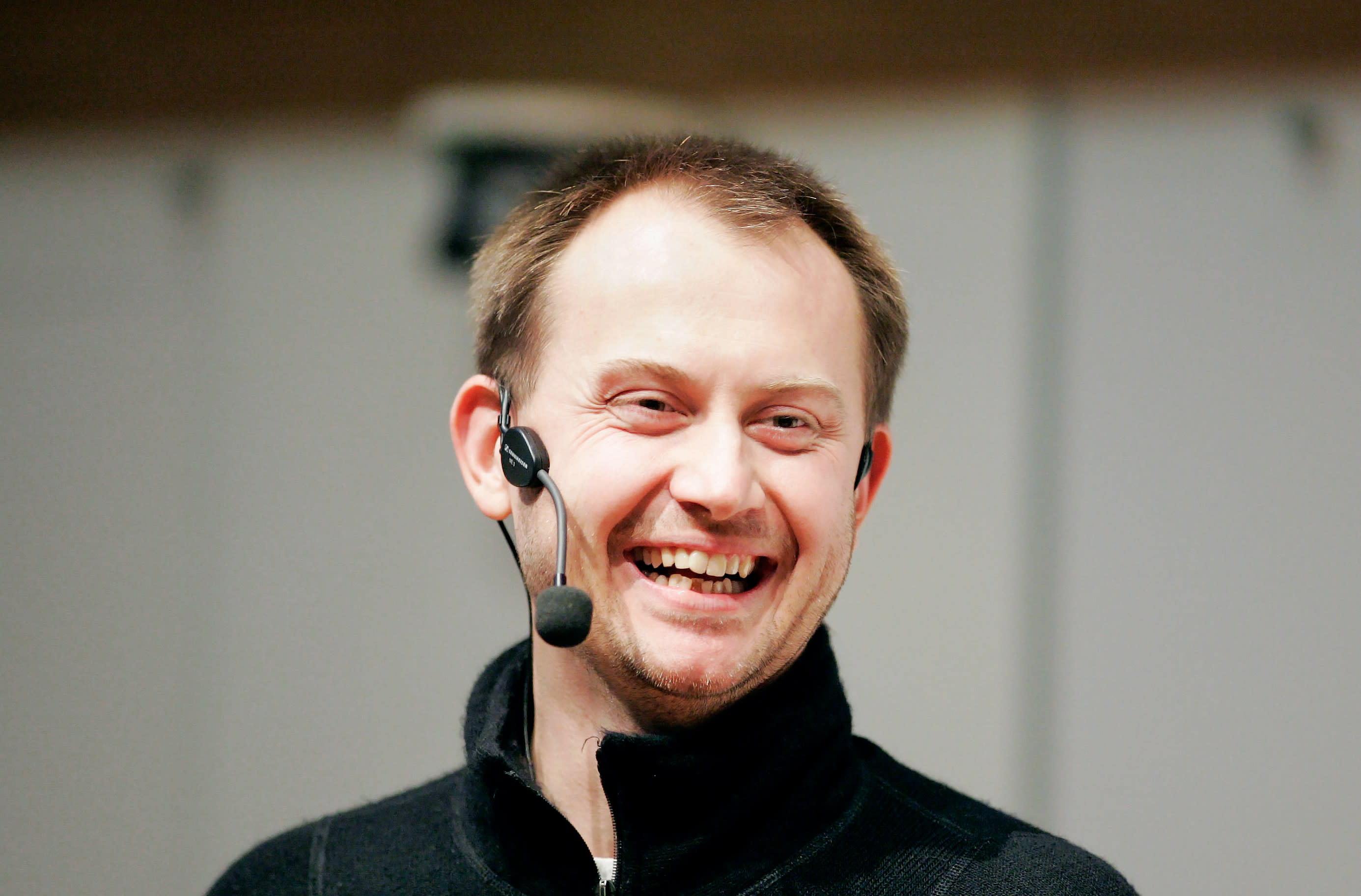
Jonas Birgersson
Now he wants to do it again, to usher in the same kind of revolution in the electricity system that he did in telephony. His premise is simple: electricity should be treated the way we treat data. And yes, instead of paying volumetrically, based on the amount you use, you should get as much as you want for a low fixed fee.
With his company ViaEuropa, he has launched Project Energy Society, which aims to create a new electricity grid where local sharing is the norm. His technical project is called EnergyNet and, once again, he has built a proof-of-concept in Lund — a group of buildings directly sharing electricity, governed by a router.
Will he someday be referred as “Electricity Jesus”? He did once say “sharing electricity is an act of love,” so if that’s the gospel, consider me a disciple. Anyway I’m excited to talk to him about how the energynet works, how it will interact with existing grids and institutions, how fast it might grow, and the energy abundance it promises.
With no further ado, Jonas Birgersson. Welcome to Volts. Thank you for coming.
Jonas Birgersson
I’m excited to be here. Thank you very much for that lovely intro.
David Roberts
Yes, and I apologize to you and to the entire country of Sweden for my pronunciation of your last name. Before we get into details — there are lots of details here — this is a real rabbit hole I have fallen into with all this stuff. Before we get into the details, maybe I would like to have you describe the conceptual revolution involved here, because this will be, I think, your third conceptual revolution in tech — that you have lived through the same conceptual revolution over and over again. Maybe just describe what that conceptual revolution is and how you envision bringing it to electricity.
Jonas Birgersson
Thank you. This is both incredibly simple and a little tricky. The simplistic part is that once you start looking at this, it is obvious that a lot of these conditions are exactly the same as they were at the end of the 90s. There is just a lot of new tech. There is an incredible price-performance increase with these electro-tech devices. The revolution of the electrical vehicles has given us one key component — power electronics — which is getting faster and cheaper in the same way as office equipment for communication was getting faster and cheaper in the 90s.
The big difference, which makes it much easier, is that the Internet already exists. The only thing we need to do is to do an internetification of energy distribution.
David Roberts
When you say “internetification,” just talk about what that means.
Jonas Birgersson
It’s three things. One of the differences between what we had in the 90s when we started then — we already had the great American innovation of the Internet protocol. We had an open language to say, “I want to communicate.” I build a network; if you were on the same standard as me, we can have different hardware, we can have different cables, but as long as we have a common language, I can carry your traffic, you can carry my traffic. We created something we call the energy protocol instead of the Internet protocol. Instead of IP, we now have EP. We created this protocol and on the 21st of April this year, we donated that to the world. It’s zero license; anybody can use it, modify it, etc.
The beautiful thing with the Internet is that it’s completely decentralized. That was the key requirement when the Internet was created — that it wouldn’t have a central point so that it couldn’t be easily knocked out. It’s completely decentralized. I can build a network, I can have different routers in the network, and the routers can make decisions on how to send my information over my network or over your network with a common language. Completely decentralized. All of the networks that can be built and owned by different people can still collaborate over an open standard.
David Roberts
I think there are two reasons there. One is so you don’t have a single point of failure, a single point of attack, as you say. But also, it’s fair to say that the Internet has become so large that there just is no — it’s just not — you could not have a central processor, a central router doing all this. It would have to be the size of a continent.
Jonas Birgersson
Absolutely.
David Roberts
It’s not only unsafe or unsecure, it’s also just impractical. You can scale much larger when you decentralize. That’s what the Internet discovered.
Jonas Birgersson
Yes. There’s a difference in tech between decentralization, which is exactly what you said about how to not have a single point of failure, which is very critical. The other one is where you create what’s called parallelization, which means that you can have much, much, much greater throughput when you don’t create bottlenecks. Even if you have the biggest machine in the world, if every traffic packet in the world tries to get through that, it still becomes a bottleneck.
David Roberts
Decentralization in the Internet and then also in telephony. It’s funny, as I was reading your paper on this, it’s funny that each time this happens — it happened in telephony, it happened in the Internet — people have the same argument.
Jonas Birgersson
Yes.
David Roberts
All over again. There’s the same dispute. There are always people saying, “We just need bigger, more powerful centralized equipment.” And there are always people saying, “No, decentralization is the way to go.” Over and over again, the decentralization people have won that argument.
Jonas Birgersson
Exactly. One of the key things is this: when you create something in very, very large volumes, even something incredibly complex, and in the start, when you make the first few of them, it’s incredibly expensive, but it can become — and this is the example with everybody today having a supercomputer in their pocket in their smartphone. Just 75 years ago, the most common phone in Sweden, the iPhone 12, has the power that is 68,000 times more powerful than the world’s first mainframe computer. Nobody thinks about it.
David Roberts
This is the power of learning curves, which we have talked about many times on this pod. You make the same small modular thing over and over and over again. It gets cheaper. It is a law of nature. This is the revolution you are trying to bring to electricity now — getting away from central bottlenecks into massively parallel architecture, roughly along the same lines the Internet did.
Jonas Birgersson
Absolutely. Just think about it — it’s exactly the paradox that you see repeating over and over again. Few large, expensive versus many small, cheap in parallel, coordinated with software, an open language. Just understand how frustrated we were. In 1998, you could go into computer stores all around the world. On one shelf you had telecommunication devices. On the other side of that shelf you had office equipment for data communication. It could be in the same store, but you could see the price-performance difference. If you bought an ISDN modem — the old phone stuff —
David Roberts
Yeah.
Jonas Birgersson
Then you got 0.064 megabits. But if you took the other shelf, you got 10 megabits symmetric and it cost very little. The performance difference was 300 times. The only thing we did in 98 was say, “We believe that we can use the datacom stuff in communications. We can put those in buildings where people live instead of just having...” This is exactly the same thing that we’re seeing with the power electronics sitting in the chargers and in the electrical vehicles. Why don’t we use those things to build a new electrical distribution network?
David Roberts
That’s the broad conceptual piece — decentralization, massive parallelization of the style that has already swept through the Internet and telephony. How do we do this in electricity? I’ve been debating how to walk through this, but I found this paragraph in your paper that I think gets almost at all. We’re just going to milk this paragraph for most of the pod.
Let me read this and then we’ll walk through it step by step. It says: “Starting from a clean slate — in other words, if we didn’t already have an electricity system, if we were starting fresh — a modern system would be local first and digitally coordinated: microgrids with power electronics frontiers, software-defined energy flows, open protocols, local buffering and storage, and policy-based interconnection between domains.”
Now, I’m guessing for most listeners, a lot of that sounded like gobbledygook, but there is an immense amount of information packed into that paragraph. I want to take these one by one. First, I think people understand what microgrids are. When you say “power electronics frontiers,” the term that keeps coming up here is “galvanic separation.” Can you just explain — two microgrids that are galvanically separated — what does galvanic separation mean?
Jonas Birgersson
Yes. For those people that like nerd jokes — all three of them — the key thing we’re doing here is that typically the classical microgrid is separated from the traditional grid, like an island.
David Roberts
Islanding — that’s a familiar term I think a lot of people listening will understand. When you have a microgrid, when you can island, that means you just flick a switch and you become physically separated —
Jonas Birgersson
Yes.
David Roberts
— from the larger grid and you’re operating autonomously. Is that what you’re referring to here?
Jonas Birgersson
Yes. The galvanic separation is the electrical description of that. You just became an island.
David Roberts
Right.
Jonas Birgersson
The key thing here is that now it’s clever software. We can decide — this is the nerd joke — it is Schrödinger’s microgrid. It’s both on and off the traditional grid. The key thing is that by using this as a firewall, you can now decide when you want to be part of the traditional grid and when you want to be an island.
David Roberts
The contrast here is the traditional grid — the conventional grid — is all hooked together, which makes it one big loop, which means if you get a fault or an accident somewhere, it can trip and go through the entire system, take the entire system down. Whereas if your grid is composed of these microgrids that are all separated, then any fault doesn’t get farther than the border of the microgrid where it happened.
Jonas Birgersson
Exactly.
David Roberts
Confine the fault.
Jonas Birgersson
Exactly. It’s even better. The technical term for people in the network world is “cascading.” It’s an avalanche. It breaks through one dam, but then it has the content of one dam plus one dam. When that gets going, suddenly you have 60 million people in Spain saying, “Why don’t I have electricity?” The thing we’re doing is even more clever because in the Internet world, which is the big guide for how we can do this in super max scale and decentralized and super safe and cheap, each port in the router is galvanically separated until the open standard software says, “Now it’s time to do a nice little energy transfer.”
Everything — if you have photovoltaics, that’s on one port, and if there’s a fault, it can’t get past that port. If you have storage, it can’t get past that port. It’s in the building, it’s in your microgrid, it’s between microgrids. Of course, all of the ports going up to the traditional grid, because we have to be careful with the traditional grid because of the cascading. But this means, because we can never create a cascade, suddenly we can have an unlimited amount of electro tech invested locally without any technical negative effect on the traditional grid.
David Roberts
The vision here in the long term is a grid that is composed of microgrids — like Legos. Except, as I was thinking about, the Lego analogy breaks down a little bit, because you can have a microgrid that is embedded in a larger microgrid,
Jonas Birgersson
Yes.
David Roberts
Which is itself embedded in a larger microgrid. As you say, even within — if you take the microgrid that’s just my house, if my photovoltaic circuit port is galvanically separated from my water heater port, in a sense, those are both even tinier microgrids. It’s microgrids all the way down — it’s nested microgrids.
Jonas Birgersson
Yes. If you think about it, this is exactly how your Internet at home works today. You have a box from your provider, and on one side of that you have the whole Internet, and on the other side you have local addresses. Even if the Internet goes down, you can still print on your printer. You can reach another computer in your home. You have your own little — this is called the local area network — and then you have a wide area network. This way of building it in these modular components is one of the things that makes Internet super robust and at the same time, incredibly scalable.
David Roberts
Scalable and secure. This is the part that makes it so secure — you are confining any fault or any problem. There are gateways that can be shut to confine anything. Everything is separated from everything else. That is the first piece. Microgrids with power electronics frontiers just means they are not physically connected to the other microgrids. There is a connection that can go on and off.
Jonas Birgersson
Exactly. One key thing that creates — this is us being network nerds — is that instead of having only the old grid, where everything is cascading or islanded, we can now have what we call a smart microgrid because it can be both on and off, and it can work inside your grid, but it can also work with other smart grids. If you need electricity, you can get it from your resources or from neighboring resources or from a neighboring smart grid. In the last instance, you bother the old traditional grid for it.
David Roberts
You go up levels. If you can be self-sufficient at the household level, you do it. If you need more than that, you get it from neighbors. If you need more than that, you get it from the next village over. It is only after you have exhausted that local self-sufficiency that you turn to the traditional transmission grid for bulk power. You start at the bottom — rather than starting at the top.
The second piece is software-defined energy flows. My question is, as opposed to what? How does it work today and how would this be different?
Jonas Birgersson
This is the true shocker. If you think about how an airplane looked when the grid architecture that everybody’s using today was designed, you would see the Wright brothers’ plane and you wouldn’t want to fly in that. It’s weird for us as network folks to look at the old grid, because the old grid — you have to remember it’s not only that it’s this cascading thing, everybody’s connected to everything. It is also, in its core architecture, analog.
David Roberts
Yes. I am constantly making this point, Jonas. I swear I say it every pod I make. People are so accustomed to digital technology. In their imaginations, they think the grid is like that. They think the grid is digital too, but it is very old-fashioned. It is physical and analog in a way that I think surprises people.
Jonas Birgersson
Yes. Another thing, if you think about it, you have all of these rooms where you see control rooms of a big grid company. The only thing they can do in the traditional electrical grid, which is 99% of the components they have out there, is turn things on or off. That’s it.
David Roberts
Yeah.
Jonas Birgersson
If you then back it up, comparing that to digital control, it means that — the old grid, if you have power at your home, you either have it or you don’t have it. That could be for all of California or for all of New York. Here we can say, “We only have 12% power, so we want that power to be transported to that critical function and that critical function.” No jacuzzis, but we’re going to run this light or open this door.
David Roberts
The refrigerator.
Jonas Birgersson
Exactly. We could say the refrigerator — you only need to get a power boost every 30 minutes or depending on climate. In Sweden, we can just open the door because we live in a refrigerator.
David Roberts
You’re talking about software that is embedded at the household level, at the building level. Each individual domain has their software, so when energy comes in, you can send it one place or another based on software rules, which, again, I bet 99 out of 100 people, if you just pulled them off the streets of America, would think that you could already do that. But that is new.
Jonas Birgersson
You get excited about this because there are many different things that you can do the moment you get it to be digital. There are a couple of things that make the digital even better. One of the things is that you have a common language so that you have your port inside the home, but your neighbor has bought different boxes, completely different vendors. As long as they still have the same language — Wi-Fi — it means that we can now help each other out. But I’m not locked into a vendor or an ecosystem.
David Roberts
Not only is the software coordinating the energy within my house, it can coordinate with my neighbors so that collectively we have the best distribution of energy. That again gets to this third piece — the open protocol. The reason this works is that there is an open protocol that all these different vendors, different boxes, different equipment, they’re all going to communicate with the same protocol so they can all do this with one another. The open protocol is a huge piece, which, as you say, you’ve been working on. There’s a body, an organization.
Jonas Birgersson
Yes. There is a nonprofit organization called the EnergyNet Task Force. It is simplistic, but that is what you have to do when you work with infrastructure and open standards. It is simple, but simple is sometimes hard to do. You get the best nerdy folks from different industries, different backgrounds. You do all of this concentrated work and you give it away for free, and nobody will ever know who you are.
David Roberts
But your work will live forever and will be in literally everyone s home.
Jonas Birgersson
Exactly. One key aspect with the language — when we say the energy protocol, so far, you and I have only talked about electricity, but for us, it is really thought out that it is really an energy protocol, because you can also do exactly the same language saying, “I need energy of electrical kind, but I could also be needing heat, or maybe I want to get rid of heat.” The same language can control also if I request or I want to get rid of energy in the form of electricity or thermal energy.
David Roberts
You could do a heat network on similar principles, working roughly the same way.
Jonas Birgersson
Yes. In Sweden, energy — electricity and heat — is very interchangeable because we have a cold country. In the rest of the world, the peak utilization is when it is very hot.
David Roberts
What’s required for that protocol to gain the ubiquity that the Internet protocol gained? Is it just — you just need big private companies to sign on? What’s required for that to become the standard? Is that underway?
Jonas Birgersson
We think so. The key thing — a fourth part that we didn’t put in that paragraph. You have the router, you have the language. The other thing is that there is a prerequisite that we now have in Europe that people don’t know about. Because of the terrible Russian attack on Ukraine, Brussels got its act together and shifted up a couple of gears. They did a radical, incredible policy, allowing for the first time in more than 100 years that in all of the EU countries, we can now build parallel electrical grids.
David Roberts
This is something we’re going to return to, Jonas, because this is the piece — one of the questions that is going to be on everybody’s mind as we go through this is, “How can we bring this to the US?” That right there is the big barrier. We’re going to come back to that. You are allowed legally now to hook households directly up with one another so that this can work.
The fourth piece in this paragraph, which I was really intrigued by, is local buffering/storage. As you think about it, conceptually, this net, this energy net that you’re creating, the energy routers — we should just say, when you say an energy router, you’re talking about a glorified smart meter, an even smarter smart meter. But it’s going to be located on the side of the house. It’s a big computer.
Jonas Birgersson
Yeah. Think about it as your communication gateway. You’re going to have a couple of ports. This is where I want to use all of my electricity. Of course, it can output normal electricity, but when it’s communicating with generation — photovoltaics — it can use DC natively. You have these ports. You can control energy where it comes in and where you want it to come out. The magic happens inside your home, but the real magic happens when one of the ports is connected to another building and you get to the real Internet when it’s connected to two buildings, because now I can make a choice —
David Roberts
Then you have a network —
Jonas Birgersson
Then you have a redundant network.
David Roberts
Local buffering and storage. As I think about this net you’re creating, these energy routers and batteries become grid infrastructure. They replace transformers and substations. They become the new infrastructure of EnergyNet. One of the things you note several times is that this enables near real-time versus real-time operations.
I think people listening understand that today’s grid, absent batteries, absent the ability to store energy, which has been most of the grid’s history, demand and supply have to sync up in real time. You produce the power, it has to be consumed instantly, more or less, which is an enormous and truly mind-boggling coordination problem. It’s amazing it works at all.
Jonas Birgersson
Exactly. It’s a terrible architecture.
David Roberts
Yeah, it is. I’ve often thought that. I always have two thoughts. One, it’s amazing that that works. Two, I can’t believe we’re still doing that.
Jonas Birgersson
Exactly.
David Roberts
Now we have batteries, which enable you to buffer. Buffering — anyone who is familiar with the Internet is very familiar with the role of buffering on the Internet. Batteries are playing the same role in the energy net. Say a little bit about what are the advantages you can get from moving from this real-time coordination to “near real-time,” meaning you have a lot of batteries out there that give you a little bit of wiggle room.
Jonas Birgersson
Exactly. A little wiggle room takes you an incredible distance. I knew nothing about electricity when I started with this a couple of years ago, but I’m a nerd. I read up quick and we have really good technical people around us. The key thing is that I know a little bit about computer networks. Once you can have buffers, it’s not a marginal change. It’s the whole ball game. It’s a completely different world.
David Roberts
This is why I’m always preaching about batteries. Batteries, batteries, batteries.
Jonas Birgersson
Exactly. Here’s the key thing — everybody that listens to this will have seen firsthand today the effect of buffering. This is what happens anytime you get on a stream of anything. If you go to Netflix or something, you click on it. What happens is that the computer immediately downloads a 10-second buffer.
David Roberts
Right.
Jonas Birgersson
If the network is having some issues or is unstable or you go through a tunnel, if you’re mobile or whatever, you have this little wiggle room and it makes all the difference.
David Roberts
It would be crazy to try to build a system where Netflix was literally supplying you as you’re watching it, and there was no buffer. People can just imagine how incredibly difficult and how much more equipment you would need to pull that off. A little bit of buffering, as you say, frees up an enormous amount of wiggle room.
Jonas Birgersson
Absolutely. There are some really interesting calculations done by some of our friends in the academic world where you can just say that — typically a Swedish household today would have a 16-amp connection. If you just have 1 kilowatt-hour of storage accessible, you can take that down to 1 amp.
Wild.
Exactly. This is just one very simple, very easy metric. It shows that it has an incredible impact on the network. If you start thinking about it, it is much easier if you give yourself a little time to think, because this is exactly what we are doing.
Instead of having to coordinate everything at once — if somebody throws you two balls at the same time, it becomes hard. If somebody throws you 30 balls at a time, it is impossible and you cannot deal with it. This creates the bottleneck.
In the old world, they say, “No, you can’t also be allowed to put energy into the network. You can only use energy from the network because we can’t handle that. Sometimes balls are coming from you or to us.” Here it’s, “No, because they’re put in a pile. I don’t need to address all of these flying balls at the same time because I have a little net.” They get caught in the net and I pick them up one at a time and have a look at them. Of course, that is much more simplistic, but also much more robust.
David Roberts
That is the magic of batteries. This is playing out in the US. There is a lot of concern about upgrading electrical appliances. You have to upgrade the electrical service too, which is often very expensive. Of course, you can get around that if you have batteries. Batteries get you around that just by doing this buffer thing, as you say. That is a key piece of this.
The fifth piece in this paragraph: policy-based interconnection between domains. I think when you say “domain” here, you’re talking about these microgrids. My photovoltaic port is one domain that’s embedded in my house microgrid, which is another domain, which is embedded in my neighborhood microgrid, which is another domain. Each domain has this single point of connection, this energy router that solves all the complexity beneath it and then serves upwards.
When you say when these domains connect to one another — say my little town has a microgrid and we are going to connect our little microgrid to the next town over, their microgrid — what does policy-based interconnection mean?
Jonas Birgersson
Yes. For the people that are into network things, what it means is — I’ll take the advanced person and then I’ll come back and explain it very easily. The advanced thing: it means that the routing, if your house is connected to neighbor A and neighbor B, it means that I need electricity, but I can now choose if I want to get everything from neighbor A or from neighbor B. This is routing where you choose where I should get my electricity from. In the old grid you don’t have that choice. You have one connection. If it doesn’t work, it’s your problem.
But this means that I can now start making these intelligent decisions. I can say, “I want to get it from neighbor A,” or “I can get it from neighbor B,” or “I can get 50/50, I can get from both, because if it’s disconnected, at least I’ll have half.” You can start making these decisions. The policy is about what you want that is above the technical level. For example, maybe I’m very good friends with neighbor A, so I’ll decide higher up that I’d love to share energy with those folks and we are good friends, so we don’t charge each other for that.
But neighbor B — I don’t like that person. We can have collaboration, but whatever they use from my side, they will pay for it and vice versa. Suddenly these are different policies, but you also have different policies saying, “I’m going to take care of my things,” etc. The city can say, because we helped establish the microgrid, “If there’s an emergency, then we can have a priority saying that we would like to be able to use your car battery to run the hospital,” or these kinds of things.
The multi-domain policy makes these things — it sounds very complex, but it makes them incredibly easy to do once you have human wishes that could be very simply coded.
David Roberts
Once you have the computer and the language.
Jonas Birgersson
Exactly.
David Roberts
And the protocol, then you can start coming up with these rules. A rule would be, “Take power from neighbor A, unless neighbor A is below X battery level, in which case take power from neighbor B.” Anyone who has done any programming is familiar — these are just programming rules. If the village microgrid is connecting to my household microgrid, as you say, one of the rules could be, “If there is a crisis on the larger grid, we can shut off your Jacuzzi.”
Jonas Birgersson
Exactly.
David Roberts
That’s another policy. The energy is being shared not based on physics alone, but based on people’s goals and desires and values, etc. That’s true between every domain — the domains in my house, the domain of my house connecting to my neighborhood domain, connecting to the next neighborhood domain, etc. All of these connections are rule based.
Jonas Birgersson
Yes. It’s important, because as you said, many people might think, “That’s how it works today.” It’s not, because you don’t have any way of controlling today where the electricity goes. For example, let’s say your town is connected with this microgrid. You have your own little microgrid in all the buildings, but then you have a microgrid in the town.
Let’s say you’re connected now with two points — it could be only two points — to the traditional overlying electrical network. For the first time in 125 years, we can now give them a simple software language or API where they say, “Dear network provider, where do you want the electricity to be collected from? Do you want us to take 50/50 from power station A or power station B? Or do you want 90/10? Or you’re going to do a service on that one?”
They can do whatever they want. We can also communicate to them because of our storage level. We can come up with an agreement saying, “You can turn us off for eight hours because we will not suffer because that is our buffer.”
David Roberts
The implication of this — all these embedded domains all the way up — is that every connection is a piece of security. Every connection is a piece where cascading can stop. At the limit, if you build this from the ground up, if you build a grid like this, this is the sort of glorious future where literally everything that uses electricity becomes a resource that can be used by the grid in which it is contained for safety and security purposes. This whole notion of distributed energy resources becomes almost a tautology. Everything electric is a resource in a grid like this. Almost by definition.
Jonas Birgersson
Yes. Even if you think about — it becomes a little nerdy again — it also supports multiple topologies that can shift over time. What does that mean? Today most people are connected to a transformer station. There’s one line going from that to your building and maybe it passes a few buildings. That’s called a star topology. You could have a ring topology so that I’m connected not only to the transformer, but I’m connected to my neighbor A and neighbor B. In the end that becomes a ring. In an old network that’s a really bad idea because that’s a short circuit.
David Roberts
Right.
Jonas Birgersson
But here it isn’t. As we said, with software negotiations — because EnergyNet is a very polite language — there’s no electrical distribution until first I ask permission: “I would like to send some electricity.”
David Roberts
It’s consent-based.
Jonas Birgersson
Exactly. The first message that was sent over Energy Protocol, by the way, was “Hello, dear,” because it is polite.
David Roberts
Hilarious. One of the advantages of this, as you’re saying, is that it is composed of these small modular pieces, these Legos that can be disassembled and reassembled in a million different ways — it’s very adaptable over time. You can flow and adapt to circumstances over time.
This is one of the advantages that I really wanted to pull out. Something that you hit several times is, number one, you can grow incrementally. You can “pay as you grow,” is that what you call it? You’re not making big risky bets on big risky power plants and big risky transmission lines. You’re building in very small increments and you’re building in parallel. All these grids are building at once in massively parallel.
The key thing that I wanted to highlight is all of this can be done by the private sector. All of this is profitable and useful and does not require — the main thing about the policy-based interconnection that I meant to mention when we were talking about it is everybody listening to this pod is very familiar at this point with the interconnection problem in the US — meaning everybody who wants to connect to the grid has to get in a line and wait for the utility’s permission, which is slowing everything down fatally here in the US. But if you have these software policy-based interconnection rules, if you build something, you just hook it up and the software handles the routing, etc. for you. You don’t have to get anyone’s permission.
Jonas Birgersson
Exactly.
David Roberts
You can just hook up. People can just build stuff and hook it up without waiting on the utility. I think that is such a huge thing. It is private sector, you do not need any giant infusions of cash, of public money. People are just going to build the Legos on their own. You are just getting away from the need for waiting on large institutions. All this can just happen on its own via the private sector.
Jonas Birgersson
Yes, that’s correct. The key thing here is that it has happened before. It sounds way too good to be true. The rolling out of the digital mobile phone grids — the GSM, the 3G, the 5G, whatever G — and the fiber networks, they were by and large, even in Europe where the state likes to do things, 80% of the fiber optical networks in Europe were paid for by the market.
This is also getting away from this notion that, “No, this is so complex, it has to be one socialized structure, one rate payer.” Theyre correct, that is how the old architecture forces the old grid to behave. But it was the same thing with the phone system. The wild fact is that next year — 2026, or maybe this year, 2026, when you listen to this — the Swedish fixed-line phone system will have been completely dismantled.
David Roberts
This brings me — we have described this system now pretty well and I have a couple of questions about it. This gets exactly to my first one, which is: in the long-term vision, do you imagine this ground-up, bottom-up, networked, highly distributed system eventually replacing the traditional grid? In other words, in the long term, what is the role of long-distance transmission and large-scale power plants in the grid of the future? Is that going to be similar to the Swedish fixed phone system in that it eventually just withers and disappears, or do you think those big pieces are going to have a persistent role forever?
Jonas Birgersson
There are a couple of things here and this is going to be very hard for people to imagine, but believe me, because I was there, it was very hard for people to imagine that the Swedish phone system would be replaced in its entirety less than 30 years after we started building the parallel fiber optical grid. What will happen, I believe, is that you will have these ground-up — what you build locally and you connect network to network — but then it will be met by another revolution. This is also so weird that this also comes from Sweden because the last time somebody did something meaningful to the old grid was in 1950 at the Royal Institute of Technology in Stockholm where they invented high-voltage DC.
This is one of the key reasons why China — why hasn’t their grid collapsed when they put all of the solar and storage out there? Because they are building their highest level of distribution with new technology. I think that you will see high voltage DC lines meet these local solutions over time because, to be drastic about it, I have nothing against alternating current, it is just with power electronics, you have no real advantage anymore for it, not in distribution at least.
David Roberts
You think the big grid will persist, it will continue on? These debates in some sense about centralization versus distribution and energy are very old. I saw you had a picture with Amory Lovins. This goes way back. I think a lot of people are skeptical. I think a lot of people can imagine a village full of houses doing this, but when they start to think about cities — big dense cities or big industrial uses like making steel, etc. — it is very difficult for people to imagine all these tiny little bits adding up to something big enough for that.
Do you think big power plants and big transmission lines are going to stay around to do that bulk work? Or do you think eventually the bottom-up grid can do everything?
Jonas Birgersson
For sure, I think it can do everything. But there will be a transition phase because what you can do — this is a really wild — there are a couple of things I want to unpack there. One is that we can talk a little bit about — people underestimate power electronics. They think that it’s a toy. But this is saying, “The personal computer or having your own supercomputer in your watch or your phone, that’s never going to happen.”
David Roberts
People did say that.
Jonas Birgersson
They did say that, and not long ago. The other key thing here is that you can repurpose the same copper lines. You can use the same copper lines with power electronics so you don’t have to rebuild all of the lines. You can run the lines with this much smarter new technology to get energy security and abundance and these things.
David Roberts
Grid-enhancing technologies.
Jonas Birgersson
Yes. The important thing is that what you do, you’re shifting completely the architecture, but you can reuse the physical lines and cables. In Europe, this is very interesting for us because Europe believes in something that sounds American, but it’s called competition. We have in Europe something called infrastructure-based competition. It’s called infrastructure overbuild — which means that you could have multiple people build fiber optical cables in the same street.
David Roberts
Interesting. So that’s not a monopoly.
Jonas Birgersson
Exactly. That has shown that our prices for broadband connection in Sweden are about a third compared to the US.
David Roberts
Wild.
Jonas Birgersson
We believe that you could see the same thing here. When you get into that thing, if you are the incumbent, you were building your network when you had monopoly protection and then you got deregulated. We now have a little electricity. What happens is that the European Union then put rules so that if you own those cables, you have to lease them out to any competitor at a fixed cost that the regulator sets every year.
Maybe the line that’s providing today AC with the cascade problem to your home, maybe that same line can be used by an entrepreneurial company creating a new network with microgrids so you don’t need to re-dig everything. You could lease those copper cables.
David Roberts
Yeah. I guess one of the things I’m getting at — this whole model is based on local generation, local storage, local sharing. If you build a steel plant, you’re going to use up the local generation of a very wide swath of geography. At the very least, it seems as you’re building this thing, if you take homes off that conventional electric grid, if they’re handling themselves, if nothing else, you freed up that traditional grid to more exclusively serve large loads, large industrial loads and stuff like that. At the very least you’re taking pressure off.
Jonas Birgersson
Exactly. Here’s the interesting thing. The growth in need for electricity from the traditional sources, for traditional needs, is pretty flat. That’s not expanding a lot, which is interesting. As you said, what happens now if you take a big load off the traditional grid, which is where we start, of course, is housing. But housing in Sweden is the biggest consumer of electricity from the grid today. It’s not a marginal sector. In Europe, in the best countries from the grid perspective, it’s still at least the third largest user. It’s significant amounts of electricity that we can take off the traditional grid and then the traditional grid can be enhanced and they can do their things.
In the end it’s going to come down to the cost because it’s not about where I can get the energy from, it’s at what cost and energy security can I provide my business. This is the thing with the Internet. The difference between the first ISDN modem and the office equipment, it was 300 times better performance. But then when the ISDN, they were so proud, they upgraded to 1028 and then the problem was that the other guys upgraded 10 times, so the gap was increasing.
David Roberts
At the very least, if you take housing off the traditional grid, and the traditional grid can just be used for other things, that is going to relieve your need to build more traditional grid — more big, expensive power lines and stuff. You’ll be freeing up a lot of capacity. Another question about safety, security.
You mentioned Spain. I did a pod on this a while back about how the current grid has these spinning masses — these giant spinning masses that are providing a little of that buffering and security on the traditional grid, keeping frequency and voltage within certain limits, providing safety. The grid you’re describing obviously has no large spinning masses. What about security? What about holding voltage and frequency within those ranges? Is that all going to be done by the power electronics? Are you concerned about that at all?
Jonas Birgersson
This is the thing. People try to take these technical solutions from the end of the 1800s, and they want to take the folly of them and turn that into, “Wow, it is very big, mechanical, manly things that rotate at a consistent rate. Look at the tonnage of that thing. It has to be safe.”
David Roberts
I know. Look how big it is.
Jonas Birgersson
Exactly. It’s so big. Look at the Titanic. It has to be very good. This is why we talk much about the galvanic separation. For people that don’t follow the nerd stuff, the frequency is set by the amount of energy that goes in and the amount of energy that goes out at the same time interval in the old analog grid. That’s a terrible, incredibly ineffective way. It was beautiful. It was genius before we had electronics and computers, but guess what? We have a lot of those. When we set up this port, the port delivers exactly the frequency that we ask it to deliver. Nothing else, nothing more.
We can now say that all of your — let’s go back to your village. Your village is having this grid. It’s a smart retrograde. It is now connected by two points — the traditional grid. You can give them — not only can you say, “We can stand on our own two feet, let’s say, for eight hours,” they can turn you off. It doesn’t matter. They can do other things. Let’s say they have a problem with the frequency in the old analog grid, they can now ask you guys for the port to deliver over frequency or under frequency to help them, to balance —
David Roberts
And stabilize it —
Jonas Birgersson
And nothing is rotating. How is it possible? This is technology. It’s magic, but it works.
David Roberts
Speaking of analog, trying to describe to people — the entire grid rests on these giant machines that are literally spinning, and if they stop spinning we’re all screwed — people don’t believe you.
Jonas Birgersson
No, people don’t understand how the grid works, of course. The other thing is that the old analog grid, it was an incredible masterpiece by the geniuses of their generation, exactly like the phone grid. They were architected about the same time, the 1800s. The key thing was it is already breaking down. Not because of solar panels — I’m very tired of that notion — but because the industry does not want to be part of a beautiful analog shared frequency.
What happened is when you start doing something in a big industry in southern Sweden, in the old world, every machine in southern Sweden started rotating a little bit slower. Big surprise when Volvo wants to build precision machinery, they don’t want their machines to digitally — they put digital converters between so that they are not on the consumption side, they’re not analog anymore. This increases the problem with keeping the frequencies because the frequency is not analog, is smoothed out by the difference in rotational things. If you’re not a nerd, forget about that. The electronics make frequency a non-problem. If you use DC, you don’t have frequency problems to begin with. It’s very easy.
Here’s the other cool thing. Everybody that listens to this pod will have used not only DC, they will have used open standards and they will have used variable power output on the same port because they will have used USB today. That is what USB does. If you connect the USB-C port — the stuff that doesn’t have a wrong side — you connect that and you can get either 5 watts or you can get up to 240 watts.
If you start thinking about that, that’s wild. I connected this thing and I have the weakest type of device. How does this not burn up? How do I make sure that it doesn’t get too much energy? Because it first asks and says, “Hey, what type of device are you? What’s your need today? You want 10 watts? Here is 10 watts. Have a good time.” Everybody uses it and it’s wild. It’s an infrastructure where you have both communication and electrical distribution and you have open standards. You could say we’re doing that — but on a city scale and then multi-city scale.
David Roberts
Right.
Jonas Birgersson
It’s so obvious.
David Roberts
Yes, I think so too. This question comes up a lot, but I agree with you. Computers, open protocols, software are a better, not just an adequate, safety substitution for spinning masses. I think they are going to be better over the long term.
Jonas Birgersson
Of course they’re going to be better. It’s so obvious. The reason why the American military paid ARPANET was that they wanted to get rid of the problem with security. The Internet is not only cheaper and faster, it’s also super resilient. This is the thing with energy security and energy independence. Of course it’s good if you can make sure that energy goes to where it’s needed. You could say that my packets are labeled, “I only want to consume green packets, but if there’s a crisis I’ll take any energy packets I want,” because of the open language.
David Roberts
You built in Lund a little tiny grid like this. You built a little proof of concept. How many buildings are involved in your little microgrid?
Jonas Birgersson
The first technical proof of concept that we built was two buildings, two different real estate owners. We call them, of course, completely value-neutral freedom cables. When we built this parallel grid, they’re connected, they have the routers and they’re exchanging electricity. Here’s the key thing — we don’t need to have a cost for electrical distribution, which is just obvious but so that people don’t miss that. When you build the freedom cables you get three major freedoms. You can set whatever technology you want to use. We can use DC.
You can set whatever cost, including zero. If you’ve co-owned it with a few neighbors, you don’t have to charge for this region. If you would use the traditional grid in Sweden, saying, “I want to connect to my neighbor and it’s only 150 meters,” that’s great, we’re going to give you 150 meters, but then we include 3,000 kilometers because you can’t use a little of the grid, you have to pay for the whole thing. The last freedom, which is also important, is that you can now set whatever price you want, including zero. Depending on if you like neighbor A, but you don’t like neighbor B, you can set different prices on the packets depending on who consumes them.
David Roberts
This will be different in Sweden and the US, obviously. As this grows, as your energy net grows, it is growing alongside the existing grid. I’m curious, do you think that can just go on and they are not going to conflict at all? What is going to be the interaction of this growing energy net with the existing grid and existing grid institutions? It’s baffling to me — one of the craziest things about reading your report is that the utility in Sweden seems fine with this. They are supportive. When I think about anyone trying to do this in the US, all I can imagine is the utility lawyers coming down on their head. What is the interaction? Is the utility not threatened in any way by this? How did you talk them into this?
Jonas Birgersson
There are a couple of things there. Let’s come back also to how we can get this going in the US because we have some interesting ideas on that, but just on the Swedish side, first of all, they can’t block it, which always helps cooperation.
David Roberts
Because of this Brussels law, you are now allowed to connect two residences directly with the cable outside the utility’s purview.
Jonas Birgersson
Exactly. Remember, the only upper limit they have set is that they don’t want the freedom cables to cover what they call nothing more than an electrical area. But an electrical area is Germany, so they don’t want us to cross national borders yet.
David Roberts
That would blow a lot of minds — trying to share this communist sharing of energy across national borders. You are going to freak a lot of people out if you try to go there. One question is, as this is growing, are you having to install cables between all these buildings, or will you eventually be able to use the existing distribution grid for this purpose?
Jonas Birgersson
Exactly.
David Roberts
The latter?
Jonas Birgersson
Exactly. On the fiber side, where this is more mature, what happened was that when you started building parallel fiber cables that were competing with somebody that built their cables under monopoly, you got this regulation saying that if you built your infrastructure under monopoly protection, you then have to lease them out at a fixed price set by the regulator. In fiber, it is called dark fiber. It means that it is unlit. It means that you can put whatever equipment you want at the end of it.
Think of it as a pipe. I can run whatever pumps I want, and if somebody else leases those lines, they can put their pumps — being the electronics. We believe that Sweden can become the world’s first country where we have dark copper, so that you would lease out the copper lines depending on what the people being connected want to use it for, so that you could reconnect the copper at the central station between two different racks. With that, you could choose two different technology models.
David Roberts
You don’t envision needing to build a giant parallel physical infrastructure of wires. You think you’ll be able to use the existing distribution grid to build the EnergyNet grid.
Jonas Birgersson
The thing is — and this is the wild stuff. Let’s continue on the Lund before I answer that. The first thing we did was a technical pilot. Now we’re building what we call the commercial pilot. We’re building 10 buildings, 270 homes. Here’s the weird thing. Remember that this is Sweden, so we don’t have that much sun.
David Roberts
Yeah, I was going to — what is local generation? I was wondering, what is that exactly?
Jonas Birgersson
The thing is, in this area, they wanted to put up a lot of solar panels. Just standard installation, but more than the traditional grid would allow. Of course, we don’t have any constraints — now they can fill the roof with their panels. What we’re going to do in these 10 buildings is install solar, put 100 kilowatt-hours in each building, 1 megawatt of batteries, and build a ring of freedom cables between.
Remember that, in Sweden, we have not very much sun. We have the cheapest electrical prices in Europe and we have some of the highest cost of labor in Europe to dig and install things. Here’s the wild thing. This area has been there for 40 years and it’s profitable for us to build all of these new things, even when we’re at this scale, when we’re still hand-building the routers, because we’re nerds and it’s fun. It shouldn’t be profitable to put a parallel infrastructure when there’s something that’s been there for 40 years, that should be depreciated, that should be very cheap. But as we know —
David Roberts
You would think.
Jonas Birgersson
Exactly, you would think. But the cost of grid connections, of course, is going up in the world, and they are going up quite dramatically. Here is the thing where I think that we are going to see this model coming together, because the last thing I want to say on the Swedish thing is when we started this, because being entrepreneurs, what we do as nerds nobody cares about.
What we had on the broadband side when we got this going was that we had one of the large national real estate companies saying that we want what you are saying — low fixed cost for communication for our tenants. We started by asking some friends of ours. We now have a contract with the Swedish public housing organization, which is a million homes. It is more than 20% of all homes in Sweden saying, “We want you to do this for us.”
David Roberts
No kidding.
Jonas Birgersson
Yes. This is part of the national scale-up project. It’s important that — once you have these serious players involved and you can see that it’s profitable so that you could get all of these things installed if we need to. Then we can say to the power company, “Dear power company, the value of your assets connecting these buildings, if there’s a parallel grid, will of course be much less. What do you say if we lease them from you instead?”
The only thing that really needs to come — but this, I think, will be the breakthrough for EnergyNet — is either that energy security becomes even more a topic as it is in Ukraine, or for obvious reasons and so forth. The other thing is that as soon as people get fed up with having higher and higher charges for getting the same service, the moment the power utility companies start getting policy that forces them to be effective, they are going to be the biggest users of EnergyNet the world has ever seen.
David Roberts
You have not yet leased infrastructure from the utility thus far. You are building your own.
Jonas Birgersson
Exactly.
David Roberts
I’m curious about this neighborhood. You’ve done this with 10 buildings in Lund. You have one of these going. What percentage of that neighborhood’s consumption are they producing on their own? What percentage of their energy consumption is produced locally?
Jonas Birgersson
60% less grid capacity will be bought over the year.
David Roberts
Interesting. They’re producing 60% of their ongoing energy needs.
Jonas Birgersson
Yep.
David Roberts
You think that will be average? It’ll be roughly — I guess it’ll depend from place to place, obviously.
Jonas Birgersson
Yeah, it will, but also it’s interesting because — 60% less on a year-to-year basis, but also six months of the year we won’t need any grid capacity at all. Even when it’s dark in Sweden, we don’t produce solar, if we have wind connected to this, the number of days when we need the grid goes down from six months to 14 days.
David Roberts
Then the large-scale grid truly is just backup. It is buffer.
Jonas Birgersson
Yes. If you’re down to 14 days, there is lots of very interesting technology that you can run locally to create that redundancy if you want to.
David Roberts
You can get into thermal storage and there are ways to fill that gap probably. If you have a reliable national grid, it is very useful to have that backup.
Jonas Birgersson
What we’re looking at is the next scale of that. That would be more like $100 million investment. To take all of the 13,000 public housing units in Lund to show it on a city scale. Of course, it means that there’s a lot of capacity that they could, with a digital polite signal, ask not to use the grid.
Even under these 14 days, when it is the most difficult conditions here, which mean that it is cold and it is dark and there is no wind, even in those days, on one of these 14 days, it is only two hours in the morning and two hours in the evening. That is the peak use. We can guarantee that we will never use electricity from the grid under these four critical hours because of the buffer.
David Roberts
Yes. Which again makes you an incredible asset to the operators of the large-scale grid. You go from a consumer to a supporter, a participant.
Jonas Birgersson
Exactly. Because of the language, and also because we work a lot with universities and different stuff, one other key thing is that we have to remember that the electrification of the vehicles also adds — this is fixed storage.
David Roberts
The addition of these rolling batteries, just to your neighborhood of 10 buildings —
Jonas Birgersson
Yep.
David Roberts
— Even if all the people living in those 10 buildings have EVs, that’s an enormous amount of flexibility right there. The whole system becomes much higher performing just because it has tons more resources to work with.
Jonas Birgersson
Exactly. Just make the quick math here. What we’re putting now is 1 megawatt distributed over the 10 batteries with 100 kilowatt-hours, but it’s 270 apartments. Let’s say that we only have 100 cars being associated with this. That’s 100 times 100 kilowatt-hours. Just the cars associated with these buildings, even when we have fixed storage built in, that would be 10 × the amount of storage that we could have potentially available to us.
David Roberts
That’s a big buffer.
Jonas Birgersson
It’s an incredible buffer. One of the researchers, Mats Alaküla at the University of Lund, calculated this because he loved these things. If all of the Swedish vehicles were transformed to today’s electric vehicles, you could run the whole of Sweden — everything with the industries and the trains and everything — for 10 hours on that buffer.
David Roberts
People underestimate the quantity that EVs add up to. Let’s just wrap up by looking briefly at the U.S. One of the things that struck me over and over again as I’m reading about this is if you could take even just residential off the US grid, you’re freeing up tons of power for these data centers that everybody is sweating bullets about.
Everybody’s freaking out about data centers. Everybody in the US is freaking out. We badly need grid capacity to do the industrialization to support AI, to support the electrification of industry, etc. We badly need more grid capacity. If you could take all of residential off the central grid, boom, there is your extra capacity, there is the capacity you need to do your data centers.
Jonas Birgersson
Absolutely. There’s another thing with that, because for some unfortunate events in the US — when you look at the wildfires in California, you look at what happened with high water outside of New York, leading to significant outages — the energy security is really one thing. As you said, electrification is another thing. If you run a big plant, if it’s a data center or it’s a traditional industrial plant, people are coming to us more and more with questions about, “We can’t afford to put all of our eggs in the traditional grid basket.”
David Roberts
Yes, this is a very active discussion over here too.
Jonas Birgersson
Exactly. It’s super important. If these local extra resources can be smartly coordinated — this is, I think, the only thing that’s missing from the electro tech — if we can become the missing link and the missing open standard language so that these resources could be prioritized and agreed on and then digitally coordinated, because they don’t need to be physically connected to be coordinated inside the same grid.
Let’s look at the US practically, because with our great friends at Berkeley and Stanford foremost, there are a couple of really interesting areas where you can do this in the US already today, because there are a couple of exceptions.
David Roberts
I just want to say up front on the US discussion, the key thing here is Brussels legalized for the entire EU direct electrical connections between households outside of the utility’s purview. That is, as far as I know, illegal everywhere in the US — to run your own wire across property lines is illegal everywhere in the US as far as I know. How do you get around that?
Jonas Birgersson
Exactly. First of all, we just have to take a couple of seconds to enjoy the paradox here. Brussels is doing radical market liberalization.
David Roberts
Famously bureaucratic, slow, etc. Brussels.
Jonas Birgersson
Exactly that. Now, they create the ability for people to just build and prove new technology stacks. That opens up for a Silicon Valley — disruptive new technology happening in Europe — who would have known? But don’t build it in the US. The important thing is — yes, that’s correct — but there are a couple of places where we can do this. The biggest traditional exceptions are university campuses —
David Roberts
Yes.
Jonas Birgersson
— ports, and also local utilities that could be interested because of their different business mechanisms.
David Roberts
Municipal utilities —
Jonas Birgersson
Exactly.
David Roberts
you mean —
Jonas Birgersson
Yes. If they wanted to try this, maybe because they want to have more resilience or they are tired of getting local calls from people that want to connect photovoltaics or storage things, if you organize in this way and within their area, they can allow for people to do that. Of course, then you need their permission.
Here’s the great thing — we are now working with Stanford. Stanford has done a lot of interesting microgrid projects in the past and we are actively working with them at the Doerr School to see how we can bring this new technology and start proving these things. There is much business value here. You can get the energy security. If there is a fire, we can control this better. We have this thing — it is for competition because it is cheaper.
Then, as you said, the data centers and the people investing in industrial processes — you want to reindustrialize the US, then you need to have a grid that you can really trust or you need alternatives so that, “Okay, we have 99% from these guys. Here’s the solution for the 1%.”
David Roberts
You say there are places in the U.S. — as you say, municipal utilities could theoretically allow this. A campus is owned, I guess, by a single entity, so they could allow this within the campus. Do you have a foothold anywhere in the U.S.? Is there any prospect of one of these energy nets being built in the U.S. anytime soon?
Jonas Birgersson
Yes. We believe that during 2026 we will have a launch of one or two energy nets physically in the US. The interesting thing is, of course, that here is where we would like to see a little bit of this famous American dynamism, or what it is called. If the DC folks are serious that this is something that is important — if we just remember one thing, we haven’t talked so much about the power electronics. It is not only that it is incredibly powerful and they are very cheap.
Another key thing with it is that if you have the biggest suppliers in the world of transformers, the best one is the biggest and they are very proud, saying that they have got the delivery time down to the incredibly short amount of three and a half years. They are the leader, they are the quickest. If we pay extra, we can have power electronics doing the same amount of conversion as that transforming station in three and a half hours if you pay extra for air freight.
If you’re serious about doing electrification or data centers right now, quickly, and as you said in the beginning — maybe not people that didn’t catch it — because you can build these things, hundreds of thousands of projects in parallel because of the galvanic separation, there isn’t any angst for the old grid to connect resources as long as there is an energy net, smart microgrid firewall effect between them and the local resources.
David Roberts
Legos, you can just come attach your Lego.
Jonas Birgersson
Yes. Nothing can happen. This is what’s so important — to build these physical footholds in the US so that we can engage with grid owners and prove physically on the ground that nothing, that whatever happens on this side, it cannot physically transfer and create a cascade in your site.
David Roberts
I keep coming back to the logic — these entities who want to connect these data centers to the grid, they will tell you that speed to power is their number one criteria right now. More than water, more than location, more than anything else. How fast can they get on the grid? I keep preaching — exploiting the existing capacity that exists all around us in households is almost definitionally faster than any large-scale infrastructure you can build. If speed is your number one metric, you can’t get faster than resources that already exist. You’re just rounding them up. You’re just rounding them up and coordinating them. They’re already out there. You don’t have to build them.
I think that logic is eventually going to penetrate the heads of the people running these companies and these utilities. They keep imagining that they are going to build a bunch of nuclear plants and high-speed transmission lines and then they are talking about losing millions of dollars a day not hooking up data centers. What are you talking about? The infrastructure you are talking about building — fast version is four, five, six years out — and you are losing millions of dollars a day. That can not go on.
Jonas Birgersson
No, I fully agree. Let’s drill down just a little bit on that because here is another thing. If you want to install whatever it is locally — data center, wind farm, solar farm, whatever it is — the key thing here is that you could come to an area where you want to deploy such a thing and you could say, “We are going as part of our charm offensive to be able to build these things. We are going to give your village EnergyNet.”
David Roberts
Yes.
Jonas Birgersson
“We’re going to give you low fixed cost for green energy with super reliability, if you approve our plan.” That’s a good thing for them. It creates, as you said, a big chunk of capacity just freed up on this transforming station. You could do it in six months easily.
David Roberts
Yes. For the money involved in building the data centers they’re building now, paying for an energy net for a small village is a rounding error. It would create much goodwill. It would be such a PR — this is what I keep saying over and over again — the data centers are in a PR hole right now. Everybody hates them. If they could say, “When we come to your area, we’re going to make your electricity system work better and cheaper,” that would transform the whole dynamic around data centers. I don’t know how long it’s going to take them to internalize that.
Jonas Birgersson
That’s true. If you add a little of these concepts, because these things can be a bit everywhere, you can pick a good place. For example, if you look at photovoltaics in agriculture, you can build massive scales of solar, but you can do it in such a way that it is better for the crop so that you use the same kilometer of land twice. You share whatever you are growing, and now you have these things on top — on stilts and stuff.
In Sweden, for example, the Swedish government runs these tests that all of our apple trees in southern Sweden are stressed. By putting solar panels, giving them a little relief, it will be more produce for them and you will have kilometer after kilometer of solar panels. The problem was, the grid can’t connect it. As we have solved that, I think that electrotech can just explode.
David Roberts
I have to believe that, especially for farmers, the idea that your farm can become energy self-sufficient and that you are creating and managing, storing your own energy, your electric tractor is reliably charged, etc., you don’t have to depend on the whims of large institutions to get power on your farm. I have to believe that’s appealing to a lot of people, just separate from the climate thing entirely. Just the autonomy of it.
Jonas Birgersson
Yes. Also that you would create a second harvest on the same land because you will produce so much electricity. You are independent, which is great, but you can also sell to a data center or a village or you can make these — all of these e-fuels and everything. This is very real here. It all comes back to this terrible land war by Putin, because resilience and energy security really went from something nice to have to, “No, this needs to be implemented really, really quick.”
David Roberts
One of the interesting things in the slides you sent me, which I have been thinking about a lot lately, is that the military is undergoing a similar conceptual revolution as all these other areas. They, too, are decentralizing. Instead of one big F20 plane that costs $3 trillion, you can create an army of 100,000 little dumb drones. They are just so much more effective. Conversely, if you want to defend against that, you need a grid that is decentralized and resilient.
Jonas Birgersson
No, it’s true. The military, they have their own language, of course they don’t — paradigm shift — they have “revolution in military affairs.” Completely different, but very much the same. They talk about it plainly because of the experiences in Ukraine about how they go from few large, expensive, to many small, cheap. This is the great thing that came out of Bell Labs, which we’re grateful for in the 80s. You have all of these local nodes, that’s what I call cellular telephony, that each cell is built locally and it’s coordinated on a software layer, not a physical layer.
This is like a swarm of drones or a swarm of storage. You have these electrical vehicles. This is also why you need the open standard, because, “Yes, we have a solution for this brand of car, as long as everything is from us.”
David Roberts
Yes. I don’t think I emphasized that enough when we were talking — the open standard part of this is crucial because the last thing you want is a proprietary company that comes, sells you their energy net that only works with their communication protocols and their standards, and then the next village over has a different proprietary standard, etc. We should say also about the drones — one of the things that is maddening about drone warfare is that you can take out a drone, you can take out two drones, you can take out 10 drones, and it doesn’t matter — all the other drones remain coordinated and remain effective, and you could bring that same resilience to your electricity grid.
We need to wrap up, Jonas. I knew this would go long. This is all so fascinating. This is all of Volts in service of this vision. I’m glad to have found it laid out with such clarity. My final question is — one of the themes of your work, your life really, is that this conceptual revolution that goes from a few big, strong central whatever to lots of distributed, coordinated — it’s funny, I meant to mention this, this is really off course, but way back in the mists of time, I used to be a philosophy grad student and one of the things I was studying and thinking about then was human consciousness and human cognition and how does human thinking work?
In that area, they were having the same debate. Is it a single smart processor or is the human mind also composed of massively parallel, relatively dumb, relatively small coordinated units? This is the same conceptual revolution over and over and over again in different domains. I find that in each case, people resist it. People are very resistant, people are very — their intuitions, I think, run counter to this. People have trouble imagining how a bunch of small dumb things could add up to something big and strong. It’s a conceptual leap for people every time, even though we’ve seen the same thing prove out in domain after domain.
All of this is a long-winded way of saying: this is going to be resisted in the US. There are going to be a lot of people in the US who don’t feel this is big enough or strong enough or that it’s going to handle industrial society, etc.
Jonas Birgersson
Yeah.
David Roberts
I think what’s going to happen is it’s going to get a foothold on the ground, it’s going to start growing, it’s going to prove itself, it’s going to show that it’s cheaper, and then it will start spreading quickly. As my final question: when do you, Jonas Birgersson, think that the average U.S. electricity ratepayer will be paying a small fixed fee for all the electricity they can consume? When is that beautiful day going to arrive in the US if you had to predict?
Jonas Birgersson
The technology is here. If it was up to technology, we could do it in five to 10 years for sure, for the majority of people in the U.S. The problem is that it goes into a domain which is today a little bit messy, which is the political landscape and decision making in the US. We believe in this old story about how the laws and the legal system, they’re subjugated by politics, but in the end politics is subjugated to technology. Once this is proven in scale — what China is doing is one thing, but let’s say that even the old world in Europe is starting to get cheaper energy, better resilience, and the data centers maybe start popping up in Europe.
David Roberts
That would be interesting.
Jonas Birgersson
Yep. I think that it’s about the dynamics, but I think that there’s a little bit of extra confusion the five plus five years coming. Let’s say that in 10 years, in my mind it will be very clear that fossil is no longer a viable project to invest in if you’re a serious investor. At that time, this thing will grow. Typically on a growth curve, let’s say that it takes 10 years for us to have 5% penetration in the US, but the next 10 years could be 75% on a typical growth curve. That would coincide very beautifully with the fossil fuel phase-out.
Nuclear — maybe it works, maybe it doesn’t. Either way, it will definitely take too long and it’s too centralized. Once it’s time to scale for what happens after fossil on all of the sectors of society, then this is the obvious type of solution.
David Roberts
Your lips to God’s ears, as they say. I certainly hope it’s true. I certainly hope I live to see it. Thank you for coming on. Thank you for all your work over the years doing this. This is truly God’s work. Thank you for your work and thank you for walking us through EnergyNet.
Jonas Birgersson
Thank you for having me.
David Roberts
Thank you for listening to Volts. It takes a village to make this podcast work. Shout out, especially, to my super producer, Kyle McDonald, who makes me and my guests sound smart every week. And it is all supported entirely by listeners like you. So, if you value conversations like this, please consider joining our community of paid subscribers at volts.wtf. Or, leaving a nice review, or telling a friend about Volts. Or all three. Thanks so much, and I’ll see you next time.
Australians bought 35,058 electrified cars last month, edging gas.
New low-cost EVs from China may push sales even higher in 2026.
Demand for diesel vehicles has stayed steady across five years..
Australia may be late to the EV party, but the guest list is growing fast. Despite trailing behind many nations in electric vehicle adoption, recent sales data shows an accelerating shift among local buyers. For the first time, electrified cars have outsold (gasoline) petrol-powered vehicles in a single month.
This could very well mark a turning point, positioning 2026 to potentially become the first full year where battery-assisted cars surpass traditional combustion sales.
In December, a total of 35,058 hybrids, plug-in hybrids, and battery-electric vehicles found new homes across the country. This was slightly above the 34,559 petrol cars sold over the same four-week period.
China’s Growing Influence on the Numbers
Zooming out to the full year, total electrified sales reached 355,887 vehicles, securing a 28.6 percent share of the overall market. Pure battery-electric vehicles made up 103,270 of that figure, accounting for an 8.3 percent slice.
Much of this momentum can be traced to the growing presence of Chinese manufacturers, whose expanding lineups have proved popular with Australian buyers. Brands such as BYD, Geely, MG, Xpeng, and Zeekr have led the charge.
Demand for EVs from China will likely grow even more this year. A slew of small and affordable electric offerings will soon hit the market, including Nio’s Firefly, the Geely EX2, and the BYD Atto 1, Australia’s Drive reports.
Petrol Still Leads the Pack
Although demand for electrified cars is increasing, petrol cars still represent the largest slice of the market. Indeed, a total of 475,279 were sold in 2025, which was 38.3 percent of the total market. Diesel models also remain popular, accounting for 29.4 percent, a figure which has remained relatively steady for the past five years.
It’s a long way from the market of a decade ago. Back in 2015, petrol cars accounted for a dominant 67 percent share, a clear sign of how much the market and consumer habits have changed in just ten years.
Traditional hybrids also had a strong showing last year. Australians bought 199,133 of them, giving the segment a 16 percent share. Plug-in hybrids, while still a smaller category, made notable progress as well. With 53,484 units sold, they secured 4.3 percent of the market, suggesting growing interest in flexible, transitional technologies
Honda and Sony will sell Afeela EVs directly to buyers only.
Dealers say Afeela pulls funding from core Honda models.
Lawsuit claims Afeela’s sales model breaks California law.
As Honda doubles down on its electric dreams, tensions are rising inside its own retail network. Honda dealerships are pushing back against the company’s joint EV venture with Sony, arguing that it’s siphoning attention and resources away from the core Honda and Acura lines, especially at a time when EV demand has begun to cool. The company, however, appears unmoved.
Sony Honda Mobility unveiled its near production-ready Afeela 1 electric sedan at this year’s Consumer Electronics Show, preparing it for a limited launch in California in late 2026. Alongside the sedan, the company also teased a second model, a crossover still in development.
Honda will manage all direct sales, vehicle deliveries, and servicing for the Afeela lineup, and will also collaborate with independent repair providers to support ownership beyond the showroom.
Dealers Push Back on Direct Sales
This has rubbed many dealers the wrong way. In August last year, the California New Car Dealers Association filed a lawsuit against Honda and Sony, claiming the direct-sales strategy is illegal under the California Vehicle Code.
Sony Honda Mobility has countered, maintaining that it operates as a separate business entity, and therefore isn’t bound to use Honda’s existing dealership infrastructure.
“While we understand the intent may be to target a different, tech-savvy customer segment, we see no compelling reason to bypass the established dealer network that has supported the brand for decades,” Bill Feinstein, the chairman of the Honda Dealer Advisory Board, told Auto News.
Honda says it has been “clear and transparent” with dealers that they will not be involved in the sale or distribution of the Afeela models.
A Hard Sell?
Feinstein didn’t stop there. “It’s really hard to understand how a premium electric vehicle priced at $90,000-plus makes sense with EV demand softening, high interest rates and intense price competition,” he said.
He also voiced concerns about the broader impact on the business. “We’re deeply worried about the ongoing drain on financial and engineering resources. Every dollar spent in Afeela’s R&D, manufacturing and marketing is a dollar not spent on core Honda and Acura products, where we see greater potential for volume growth and profitability.”
Despite the resistance, Sony Honda Mobility isn’t phased. At last week’s CES in Las Vegas, the joint venture unveiled a prototype of its next model, an all-electric SUV that shares much of its design language with the sedan. The company says this new model could hit the US market as early as 2028
GM will reintroduce plug-in hybrids despite its EV-first strategy.
Mary Barra says hybrids remain under evaluation for key markets.
Plug-in hybrids made up just 1.8 percent of U.S. sales last year.
General Motors is finally stepping into the plug-in hybrid game, a move that’s been a long time coming. Despite shifting political winds that have made it easier to build thirsty combustion models, GM still sees full electric vehicles as the ultimate goal.
With tariffs weighing on costs, the federal $7,500 EV tax credit now off the table, and fuel economy standards loosened, automakers are being forced to rethink their timelines and adjust accordingly.
While speaking at the Automotive Press Association, Mary Barra confirmed that GM “had to make some fairly significant changes,” including cutting billions of dollars’ worth of EV investments. But she also made clear that new hybrids are in development, Autonews reports.
Plug-In Plans Materialize
“We are evaluating plug-in hybrids,” Barra said. “We have plans to do some. In the past, plug-ins were the only hybrids that actually counted toward the regulatory perspective. So we have plans to do those, and we’ll have hybrids where we think we need to. But again, we’re mainly investing and continuing to work on EVs because we think that’s the end game.”
In mid-2024, Barra revealed there were plans to start selling plug-in hybrids in the US in 2027. In her most recent remarks, she didn’t provide an updated timeline or name any specific GM models slated to receive the new powertrains.
However, she acknowledged that hybrids present their own challenges, particularly the fact that many owners don’t bother to plug them in. Nonetheless, GM is weighing both plug-in and conventional hybrid setups as part of its evolving strategy.
“We’re trying to be very thoughtful about what we do from a hybrid and a plug-in hybrid perspective,” she said.
Staying the Course on EVs
Even though GM will invest in PHEVs, it isn’t pulling back from BEVs quite as aggressively as some of its competition. For example, Ford recently took a $19.5 billion writedown after axing several important EV programs and partnerships. GM, by contrast, expects to take a $6 billion charge related to scaled-back EV spending, alongside a separate $1.6 billion charge posted in the third quarter.
During her remarks at the same event, Reutersreports that Barra emphasized GM’s desire to remain adaptable, especially given the uncertain regulatory environment ahead.
“I’m a little surprised at some [automakers] that are really pulling away very quickly, because we don’t know what will be in ‘29, ‘30, ’32.”
Scientists calculate that last year was one of the three hottest on record, along with 2024 and 2023. The trend indicates that warming could be speeding up, climate monitoring teams reported.
We expect the U.S. benchmark natural gas spot price at the Henry Hub to decrease about 2% to just under $3.50 per million British thermal units (MMBtu) in 2026 before rising sharply in 2027 to just under $4.60/MMBtu, according to our January Short-Term Energy Outlook (STEO). We expect the annual average Henry Hub price in 2026 to decrease slightly as annual supply growth keeps pace with demand growth over the year. However, in 2027, we forecast demand growth will rise faster than supply growth, driven mainly by more feed gas demand from U.S. liquefied natural gas (LNG) export facilities, reducing the natural gas in storage. We forecast annual average spot prices will decrease by 2% in 2026 and then increase by 33% in 2027.
(The Center Square) - A group of Wisconsin Republicans are pushing a data center bill that would require utility rate increases are paid by data centers and not the general public, that the centers used closed-loop cooling systems to limit…
In two recent polls, a majority of U.S. adults said they use social media to get health information.
July 2025 by KFF, a leading health policy research nonprofit: 55% said they use social media “to find health information and advice” at least occasionally. Less than one in 10 said “most” of the information is trustworthy.
September 2024 by Healthline: 52% said they learned from social media health and wellness tools, resources, trends, or products they tried in the past year. About 77% expressed at least one negative view, such as “there is a lot of conflicting information.”
An April 2024 medical journal article said that over one-third of social media users perceived high levels of health misinformation, and two-thirds reported “high perceived discernment difficulty.”
The University of Wisconsin-Madison is conducting a long-term study to determine how social media affects the physical/mental health of adolescents.
This fact brief is responsive to conversations such as this one.
This story was originally published by ProPublica.
Craig Stingley had no legal training, no big-name lawyer or civil rights advocate by his side. Yet for 13 years, he refused to accept that the judicial system would hold no one responsible for the killing of his 16-year-old son, Corey.
The quest for justice dominated his life.
He gathered police reports, witness statements and other evidence in the Dec. 14, 2012, fatal incident inside a Milwaukee-area convenience store. The youth had tried to shoplift $12 worth of flavored malt beverages at the shop before abandoning the items and turning to leave. That’s when three men wrestled him to the ground to hold him for the police.
The medical examiner determined that he died of a brain injury from asphyxiation after a “violent struggle with multiple individuals.” The manner of death: homicide.
When prosecutors chose not to charge anyone, Stingley waged a legal campaign of his own that forced the case to be reexamined. A 2023 ProPublica investigation pieced together a detailed timeline of what happened inside the store, recounted what witnesses saw and examined the backgrounds of the three customers involved in the altercation.
Finally, this week, in an extraordinary turn of events, Stingley will see a measure of accountability. On Monday, a criminal complaint filed in Milwaukee County Circuit Court charged the surviving patrons — Robert W. Beringer and Jesse R. Cole — with felony murder. The defendants are set to appear in court on Thursday.
Beringer’s attorney, Tony Cotton, described the broad outlines of a deferred prosecution agreement that can lead to the charges being dismissed after the two men plead guilty or no contest. The men may be required by the court to make a contribution to a charity in honor of Corey Stingley and to perform community service, avoiding prison time, according to Cotton and Craig Stingley.
In Wisconsin, felony murder is a special category for incidents in which the commission of a serious crime — in this case, false imprisonment — causes the death of another person. The prosecutor’s office in Dane County, which is handling the matter, declined to comment. Cole’s attorney said his client had no comment. Previously, the three men have argued that their actions were justified, citing self-defense and their need to respond to an emergency.
Craig Stingley waged a legal campaign that forced the death of his son to be reexamined. (Taylor Glascock for ProPublica)
For Stingley, a key part of the accountability process already has taken place. Last year, as part of a restorative justice program and under the supervision of a retired judge, Stingley and the two men interacted face to face in separate meetings.
There, inside an office on a Milwaukee college campus, they confronted the traumatic events that led to Corey Stingley’s death and the still-roiling feelings of resentment, sorrow and pain.
Craig Stingley said he felt that, after years of downplaying their role, the men showed regret and a deeper understanding of what had happened. For instance, Stingley said, he and Cole aired out their different perspectives on what occurred and even reviewed store surveillance video together.
“I have never been able to breathe as clearly and as deeply and feel as free as I have after that meeting was over,” Stingley said.
Restorative justice programs bring together survivors and offenders — via meetings or letters or through community panels — to try to deepen understanding, promote healing and discuss how best to make amends for a wide range of harms. The approach has been used by schools and juvenile and criminal justice systems, as well as nations grappling with large-scale atrocities.
Situations where restorative justice and deferred prosecution are employed for such serious charges are rare, Cotton said. But, he said, the whole case is rare — from the prosecution declining to issue charges initially to holding it open for multiple reviews over a decade.
“Our hearts go out to the Stingley family, and we believe that the restorative justice process has allowed all sides to express their feelings openly,” Cotton said. “We are glad that a fair and just outcome has been achieved.”
A medical examiner determined that Corey Stingley died of a brain injury from asphyxiation after an altercation with three men at a convenience store in 2012. Prosecutors assigned to the case declined to press charges. (Taylor Glascock for ProPublica)
The legal quest
Milwaukee’s district attorney at the time of Corey Stingley’s death, John Chisholm, announced there would be no charges 13 months later, in January 2014. Cole, Beringer and a third man, Maurio Laumann, now deceased, were not culpable because they did not intend to injure or kill the teen and weren’t trained in proper restraint techniques, Chisholm determined.
Craig Stingley, who is Black, and others in the community protested the decision, claiming the three men — all white — were not good Samaritans but had acted violently to kill a Black youth with impunity. “When a person loses his life at the hands of others, it would seem that a ‘chargeable’ offense has occurred,” the Milwaukee branch of the NAACP said in a statement at the time.
Looking for a way to reopen the case, Stingley reexamined the evidence, including security video. In a painful exercise, he watched the takedown of his son, by his estimation hundreds of times, analyzing who did what, frame by frame. What he saw only reinforced his view that his son’s death was unnecessary and his right to due process denied.
Corey Stingley and his father lived only blocks from VJ’s Food Mart, in West Allis, Wisconsin. That December day, Stingley made his way to the back of the store and stuck six bottles of Smirnoff Ice into his backpack. At the front counter, the teenager provided his debit card to pay for an energy drink, but the clerk demanded the stolen items. Stingley surrendered the backpack, reached toward the cash register to recover his debit card, then turned to exit.
Cole told police he extended his hand to stop Stingley and claimed that the teen punched him in the face, though it is not evident on the video. The three men grabbed the youth. During a struggle, the men pinned Stingley to the floor.
Laumann kept Stingley in a chokehold, several witnesses told investigators. ProPublica later discovered that Laumann had been a Marine. His brother told ProPublica he likely learned how to apply chokeholds as part of his military service decades ago.
Beringer had Stingley by the hair and was pressing on the teen’s head, a witness told authorities. Cole helped to hold Stingley down. Eventually, Stingley stopped resisting. The police report states that Cole thought the teen was “playing limp” to trick them into loosening their grip.
“Get up, you punk!” Laumann told the motionless teen when an officer finally arrived, according to a police report. Stingley was foaming at the mouth and had urinated through his clothes. The officer couldn’t find a pulse. Stingley never regained consciousness, dying at a hospital two weeks later.
Craig Stingley unsuccessfully sought a meeting with Chisholm in 2015 to discuss the lack of charges. “Feel free to seek legal advice in the private sector regarding your Constitutional Rights,” an assistant to Chisholm replied to Stingley in an email. “I extend my deepest sympathy to you and your family!”
Stingley’s review of the video, however, did bring about another legal opportunity in 2017, after he notified West Allis police that there was footage showing Laumann with his arm around the teen’s throat. (Laumann had denied putting him in a headlock.) A Racine County district attorney was appointed to review the evidence again. She issued no report for three years, until pressed by the court, then concluded that no charges were warranted.
Finally, Stingley discovered an obscure Wisconsin “John Doe” statute. It allows private citizens to petition a judge to consider whether a crime had been committed if a district attorney refuses to issue a criminal complaint.
A former process engineer for an electrical transformer manufacturer, Stingley had no legal training. Still, in November 2020, he filed a 14-page petition with the then-chief judge of the Milwaukee County Circuit Court, Mary Triggiano. It cited legal authority and “material facts,” including excerpts from police reports, witness statements and stills from the surveillance video. Stingley quoted former U.S. Supreme Court Justice Louis Brandeis in the petition and the British statesman William Gladstone: “Justice delayed is justice denied.”
That led to the appointment in July 2022 of Dane County District Attorney Ismael Ozanne to review the case. But that process was slowed by procedural hurdles. Stingley took the delays in stride, saying he trusted that Ozanne and his staff were treating the matter seriously and acting appropriately.
In 2024, Stingley said, Ozanne’s office advised him that they had found sufficient evidence to issue charges against Cole and Beringer but could not guarantee that a jury would deliver a guilty verdict. Stingley, researching the family’s options, said he inquired about the restorative justice process. The DA’s office supported the idea, arranging for him and the two men to meet under the supervision of the Andrew Center for Restorative Justice, part of the law school at Milwaukee’s Marquette University. The program is run by Triggiano, who’d retired from the court.
The concept of restorative justice can be traced back to indigenous cultures, where people sat together to talk through conflict and solve problems. It emerged in the United States in criminal justice systems in the 1970s as a way to provide alternatives to prison and restitution to victims. Elsewhere, it has notably been used to address the aftermath of genocide in Rwanda, where beginning in 2002 truth-telling forums led to forgiveness and reconciliation.
Stingley, who has three remaining grown children and four grandchildren, desperately wanted “balance restored” for his family. He decided the best path forward was to meet with the men he considered responsible for his son’s death.
Craig Stingley now sees the charges as a message of accountability in his son’s case. (Taylor Glascock for ProPublica)
The quest for closure
Stingley brought photos of Corey to the restorative justice meeting with Berringer in April.
The goal: to respectfully share their perspectives on the tragedy and how it impacted each of them personally. What was said was not recorded or transcribed. It was not for use in any court proceeding.
The sessions began with the Stingley family sharing heartfelt stories about Corey as a son, brother, student and friend. They spoke of their great bond, Corey’s love of sports and their struggle to cope with his absence.
When discussion turned to what happened in the store, Stingley said, Berringer described having only faint memories of the fatal encounter. He recalled a brief struggle and grabbing the teen by his jacket, not his hair.
Before departing the meeting, a tearful Beringer told Stingley he was looking for peace, Stingley recalled.
Cotton, Beringer’s attorney, told ProPublica that the incident and the legal steps affected his client in profound ways. “He’s had anxiety really from this from day one,” Cotton said.
The result, he said: “Sleeplessness. Horrible anxiety. Fearful because he has to go to court.”
Does the resolution ease Beringer’s mind? “I don’t know,” Cotton said, adding that the hope is that the Stingley family finds solace in the resolution process.
Cole, in a meeting in May with Stingley and some of his family, brought a gift: a pair of angel wings on a gold chain with a small “C” charm and several clear reflective orbs. With it came a handwritten note, saying: “I hope this sun catcher brings a gentle reflection of the love & light of Corey’s memory and that you feel his presence shining on you each day.”
“I told him I appreciate the gesture,” Stingley said.
Cole, according to Stingley, told him that he felt something other than the altercation — perhaps some health ailment — led to Corey’s demise.
Stingley invited Cole to watch the surveillance video together at a second session. As that day neared, in July, Stingley considered backing out. “It was almost as if I had to drag myself up out of the car,” he said. But he said he realized that he’d been preparing for such an event for 13 years: to come to some honest reckoning with the men involved.
After watching the video, he and Cole reviewed the death certificate, showing the medical examiner’s conclusions. Stingley said Cole stressed that he did not choke Corey but came to realize that what happened in the store caused the teen to lose his life, not any preexisting condition. The acknowledgment eased Stingley’s burden.
“I felt like I was reaching a place where I was finally going to get the justice that I’ve been pursuing,” Stingley said, “and this is one of the steps I had to go through to get that completed.”
Triggiano commended each of the participants for their courage in meeting and the Stingley family for “seeking the humanity of their son as opposed to vengeance.” She said Beringer and Cole “keenly listened, reflected and really acknowledged their connection to the events that led to Corey’s death.”
“The conversations were emotional and difficult but deeply human,” she said.
After the loss of his son, Stingley wanted to see the three men imprisoned. But so many years later, justice now looks different. Now Laumann is dead. Beringer is changed by the experience. And Cole is a father eager to protect his own children.
Now, in Stingley’s eyes, prison is beside the point. Criminal charges will stand instead as a strong signal of accountability, of justice — and of a father’s unyielding love.
ProPublica is a nonprofit newsroom that investigates abuses of power.
Wisconsin Watch welcomes submissions of commentary pieces on issues important to Wisconsin for potential publication.
We aim to produce journalism that helps residents navigate their lives, be seen and heard, hold power to account and come together in community and civic life. We’re looking for commentary from a diversity of voices and perspectives toward those goals. Submissions could take a variety of forms, whether a response to Wisconsin Watch reporting, an idea for solving a community challenge, a perspective you feel is missing from a public debate — or even a reflection on how you’re finding hope and community.
Guidelines
Guest commentaries reflect the views of their authors and are independent of the nonpartisan, in-depth reporting produced by Wisconsin Watch’s newsroom staff.
Length
We prefer that submissions run no more than 750 words and encourage clear, concise writing.
We want to hear from:
People who live in Wisconsin or otherwise care about its future.
People who are affected by issues of public concern.
Subject matter experts who can offer context about important issues and explain how systems work.
Please include:
Concrete solutions to problems, supported by facts (such as estimated costs and proposed revenue sources), success in other places and scientific research.
An honest assessment of the challenges faced in dealing with an issue.
Links to authoritative, independent sources, including news reports on the topic at hand.
Civility, grace, decency.
We don’t want:
Misinformation, disinformation, falsehoods and logical fallacies.
Product advertising, fundraising appeals or links to fundraising pages.
Commentary from representatives of organizations that don’t disclose their donors or don’t clearly state their point of view.
Obscenity, personal attacks, name-calling.
We reserve the right to edit submissions for grammar, clarity, brevity, and legal or factual concerns. We may suggest edits to improve accessibility but will not alter the views expressed by the author. We may also request additional information for fact-checking purposes and reserve the right to decline publication.
Wisconsin Watch does not pay for guest commentary.
How to submit
Please email submissions to opinion@wisconsinwatch.org. We prefer that commentaries be included in the body of the email rather than as attachments. Include a one- or two-sentence bio with your organization, city of residence and any relevant background. Feel free to reach out with questions or to propose an idea for feedback.
Add your voice to Wisconsin Watch is a post from Wisconsin Watch, a non-profit investigative news site covering Wisconsin since 2009. Please consider making a contribution to support our journalism.
Reading Time: 6minutesClick here to read highlights from the story
As Wisconsin’s workforce ages and universities nationwide see fewer traditional college-aged students, UWGB is trying several unorthodox efforts to attract older learners.
The university offers short-term certificates that advance workers’ job skills, ungraded courses that keep older people socially engaged and classes in local nursing homes.
Leaders hope the initiatives will keep the region’s growing retirement-age population sharp and socially engaged — and potentially in the workforce for longer — while also bolstering enrollment.
Inside University of Wisconsin-Green Bay’s Christie Theatre, retired judge Mark Warpinski leads a discussion about how judges decide on the sentences they impose. Roughly 50 students nod along, take notes and eagerly wave their hands in the air to debate how they’d sentence someone for a hypothetical crime.
The unusually lively audience betrays that this isn’t a typical sleepy morning lecture — most of Warpinski’s students are over the age of 50.
“We pay attention. We ask questions. We’re not sitting on our cellphones and scrolling … like I guess most college students nowadays do,” said 76-year-old student Norman Schroeder.
Classrooms full of older adults are becoming more common at UWGB.
As Wisconsin’s workforce ages and universities nationwide see fewer traditional college-aged students, UWGB is trying several unorthodox efforts to attract older learners. That includes more short-term certificates that advance workers’ job skills,ungraded courses that keep older students socially engaged and classes in local nursing homes.
University leaders hope these moves will keep the region’s growing retirement-age population sharp and socially engaged — and potentially in the workforce for longer — while also bolstering enrollment.
“We’re not just an 18-year-old campus. We’re not just a campus where you live in the dorms and have a traditional experience,” said Jessica Lambrecht, UWGB’s continuing education and workforce training executive officer. “There’s hundreds of universities you can pick from that offer that type of experience. So how are we gonna stretch and serve more?”
From left, Anita Kirschling, Theresa Reiter, Judy Rogers and Linda Chapman work on knitting projects during a class through the Lifelong Learning Institute at UWGB. They are among more than 800 members of UWGB’s Lifelong Learning Institute. (Mike Roemer for Wisconsin Watch)
In fall 2025, UWGB joined the Age-Friendly University Global Network, an international web of universities that focus on including all ages. The college must follow the network’s 10 principles, which include supporting those pursuing second careers; expanding online education options; and promoting collaboration between older and younger students, among other tasks. Lambrecht hopes this commitment leads more community groups to help UWGB in its pursuit of older learners.
UWGB’s focus on enrolling people outside the typical 18-to-24 age group has helped the college’s enrollment climb over the past decade, at a time when many universities are seeing the opposite trend.
University leaders hope to do even more to cater to retirees and other older adults in coming years, starting with more courses in assisted living facilities and building ways for older people to mentor younger students and workers.
Addressing Wisconsin’s aging workforce
Wisconsin’s aging population has caused ongoing trouble for its workforce.
For years, there haven’t been enough working-age people to fill the jobs left by those retiring. That trend is expected to continue into 2030.
Lambrecht said UWGB leaders are thinking about how they can “encourage and invite that pre-retirement age population to stay engaged in the workforce a little bit longer.”
They think offering more short-term certificates can help.
Perhaps more commonly offered by two-year colleges, short-term certificates show someone completed a handful of courses focused on a skill or topic. An increasing number of people in the U.S. are seeking these credentials, as they’re cheaper and less time-consuming than degrees. They’re also often marketed as a way for workers to gain knowledge that will help them advance in their career and earn more money, though studies and data have indicated a mixed payoff.
UWGB offers 20 short-term certificate options, ranging from topics such as utilizing artificial intelligence to English-to-Spanish translation.
“Your job is going to continuously change, and with the exponential growth of information, how are you going to stay relevant in the workforce?” Lambrecht said. “So that’s really where continuing professional education programs come into play. It’s giving you short-term, bite-sized programming that’s going to help you refine a skill set that you now are faced with.”
University leaders also want to create more opportunities for younger students and employees to learn from people reaching retirement age. Lambrecht said she’s thinking about how they can “marry those two audiences to be of continued value in our workforce.” For example, last summer, they debuted an “intergenerational” program aiming to connect older adults and youth through several educational workshops.
‘Learning for its own sake’
The quest for more older students isn’t just about keeping them working. It also helps keep the region’s aging population mentally sharp and socially engaged.
UWGB’s Lifelong Learning Institute (LLI) is geared toward older adults who want to “enjoy learning for its own sake.” There are no tests, no grades and no prerequisites. The volunteer-led club offers between 150 and 250 courses each semester — the most popular including history, film and documentary classes, guest lectures and tours around the region.
“When I retired, I realized I’ve got to keep doing things. You can’t just sit in the chair,” said Gary Lewins, a 10-year LLI student. Last semester, he took a class that taught him how to digitize all of his old photo albums.
Anita Kirschling works on her knitting project during a Lifelong Learning Institute course at UWGB. LLI offers 150 to 250 courses each semester. (Mike Roemer for Wisconsin Watch)
Norman Schroeder began taking LLI classes in 2018. The retired family doctor said it was good for more than just learning — he quickly made several friends. Today he helms LLI’s Board of Directors and tries to get more people to join.
“LLI is not only just the cognitive stimulation, the brain stimulation of the classes and learning — it’s also the social engagement,” Schroeder said. “Those are important elements for good health. Particularly in older patients, there’s a high incidence of depression, and some of that comes from social isolation … I kind of promote LLI as good for your health.”
The institute has over 800 members, who pay $150 for a year of access to classes. University professors often volunteer to teach classes related to their expertise, happy to teach to a highly engaged audience, Schroeder said.
In early 2025, the Rennes Group, which operates assisted living facilities in northern Wisconsin, gave a $300,000 grant to the institute. UWGB has used the money to host classes at Rennes’ nursing homes, upgrade technology to livestream classes to residents living in them and take residents on outings, such as a tour of the Green Bay Correctional Institution.
“Just because you live in an environment that provides maybe some extra help, doesn’t mean … you shouldn’t have access to things like lifelong learning,” Rennes Group President Nicole Schingick said.
Enrolling ‘the bookends’
UWGB’s focus on older learners comes as the so-called traditional college student, aged 18 to 24 years old, makes up a smaller share of enrollment nationwide.
In September, Chancellor Michael Alexander sent a letter to faculty and staff outlining how the university must “reinvent” to topple trends like these. To do so, he wrote, UWGB leaders must recognize “every person is a potential student over their lifetime, not just at 18 with stellar high school academic credentials.”
In their quest to grow enrollment, college leaders have trained their focus on not just older learners, but younger ones, too.
“(We’re) trying to think about the bookends of the population, knowing that the 18- to 24-year-old is a shrinking demographic,” Lambrecht said. “If we’re going to thrive as a university, we have to think outside the box.”
In 2020, for example, the college launched a program for high schoolers to complete associate degrees through the university for free. High schoolers have comprised a growing share of the university’s student population over the years, from 16% in fall 2018 to more than a third of enrollment today.
Anita Kirschling, left, and Theresa Reiter work on knitting projects during a Lifelong Learning Institute class at UWGB. University officials want to do more to reach older adults in the coming years, particularly those who can’t come to campus. (Mike Roemer for Wisconsin Watch)
In 2024, 12% of UWGB’s students were over the age of 30, though that figure only includes students who are taking classes for credit and does not include students like those involved in the Lifelong Learning Institute.
These approaches have helped UWGB’s total enrollment grow over 3,300 students in the last decade, while nearly every other UW school has seen a net decrease over the same time frame.
It’s common to see people of all ages on the Green Bay campus. In the summer, UWGB rents out its empty dorms as “snowbird housing” to older adults. But college leaders want to do even more in coming years to reach older people — particularly those who can’t come to campus.
“The reality is, some of our members have mobility issues,” Schroeder said. “When you’re an 18- to 20-year-old college student, walking any distance is not a big deal. But if you’re on the campus at UWGB, sometimes it’s a long walk from the parking lot to get into the classrooms.”
UWGB leaders hope to offer more virtual classes for older students who are home-bound or have physical limitations. To assist those with hearing loss, they want to add “hearing loops” to classrooms, which transmit sound from a microphone directly into a hearing aid. Eventually, they want Rennes residents to have access to the full catalog of lifelong learning classes virtually, in real time, Schingick said.
“That would really be able to open the doors globally, if you will, to all of our residents and all of our communities, no matter where they are in the state,” Schingick said.
Miranda Dunlap reports on pathways to success in northeast Wisconsin, working in partnership with Open Campus.
Wisconsin Watch is a nonprofit, nonpartisan newsroom. Subscribe to our newsletters for original stories and our Friday news roundup.
When teacher Amanda Glunz started a robotics team at Audubon Technology and Communication High School four years ago, there were just five members.
Now, the program has grown to 32 students and two teams, including the newly formed all-girls team Av414nche. The newest team was designed to give girls an opportunity to break into science, technology, engineering and math, also known as STEM.
“We went with Av414nche at first, because you know how avalanches fall down? It’s like breaking down the barriers,” Audubon junior Lily Sanders said.
The team consists of builders, programmers and a marketing team.
The teams give students an outlet to build confidence and skills in STEM, receive mentorship and improve social skills, Glunz said.
Building the robot
Eighth grader Jorja (left) and sophomore Saniya Coates-Bonds control their team’s robot. (Jonathan Aguilar / Milwaukee Neighborhood News Service / CatchLight Local)
Several steps go into turning a concept from paper into a moving and functioning robot, said Jorja, an eighth grader at Audubon and member of Av414nche.
It all starts with a sketch.
“Then we started to actively use Legos,” she said. “Eventually we switched from Legos to Onshape (a computer-aided design (CAD) software program), and then once we had the Onshape model down, we just decided to go from there.”
After building the robot, the team uses trial and error to get it to function as best as possible.
For the team’s upcoming qualifier competitions, robots need to shoot balls into a goal. Audubon students compete against other schools across the state in several robotics competitions.
Sanders is part of the team that helps to build the robot. For their most recent competition, she tested out different wheels for their robot to see which ones launched the balls best.
“Really just figuring out what will work and what will not work,” Sanders said. “It’s really just a lot of trial and error.”
The robot is named Ava, which is short for Av414nche.
Ava, a robot built by Av4l4nche, Audubon Technology and Communication High School’s all-girls robotics team, throws a ball in preparation for an upcoming qualifier competition. (Jonathan Aguilar / Milwaukee Neighborhood News Service / CatchLight Local)
Jorja, a programmer on the team, works to make the robots move.
“The robot does not know anything until we tell it,” she said. “It wouldn’t just do it by itself.”
She said programmers first worked on the code that operates the wheels to make the robot move, then they code the wheel that makes the ball shoot.
Mentorship and higher education
When they aren’t working on the team’s social media, the marketing team looks for mentors who can introduce students to the fields of technology and engineering. (Jonathan Aguilar / Milwaukee Neighborhood News Service / CatchLight Local)
When they aren’t working on the team’s social media, the marketing team looks for mentors who can introduce students to the fields of technology and engineering.
Most mentors are students from local universities including Milwaukee School of Engineering and Marquette University. The marketing team also has its own mentor who works in graphic design.
Some students like Davin Dacio, an Audubon junior who takes a dual enrollment course at Milwaukee Area Technical College, get college-level programming experience that is used on Audubon’s co-ed robotics team, DreaMKEepers.
Davin Dacio, a junior, works on his team’s robot. (Jonathan Aguilar / Milwaukee Neighborhood News Service / CatchLight Local)
Starting at a young age
Jaida Campbell, a junior on the marketing team, said they are trying to recruit younger students to the team.
Middle and high school students at Audubon share a campus. Middle schoolers begin robotics at the school by participating in the FIRST LEGO League. League members work with coaches and teammates to build Lego-based robots for engineering competitions.
Though Jorja is only in eighth grade, this is her first year on the high school robotics team.
She started as a fifth grader in the FIRST LEGO League, and by the seventh grade, she and Glunz worked on a coding project in the Fiserv Future Techies program, where they made it to nationals.
“It really inspired me, the fifth grade LEGO League,” Jorja said. “I love Legos and I was good with technology so I was like, OK, why not join my favorite things?”
Alex Klaus is the education solutions reporter for the Milwaukee Neighborhood News Service and a corps member of Report for America, a national service program that places journalists in local newsrooms to report on under-covered issues and communities. Report for America plays no role in editorial decisions in the NNS newsroom.
Jonathan Aguilar is a visual journalist at Milwaukee Neighborhood News Service who is supported through a partnership between CatchLight Local and Report for America.
A railroad crossing in Superior is notorious for putting shock absorbers to the test. Drivers posting on social media say they’ve complained to various entities to no avail, and aren’t sure who exactly is responsible.

 Login
Login