Hyundai may tune its simulated gears to provide realistic engine braking.
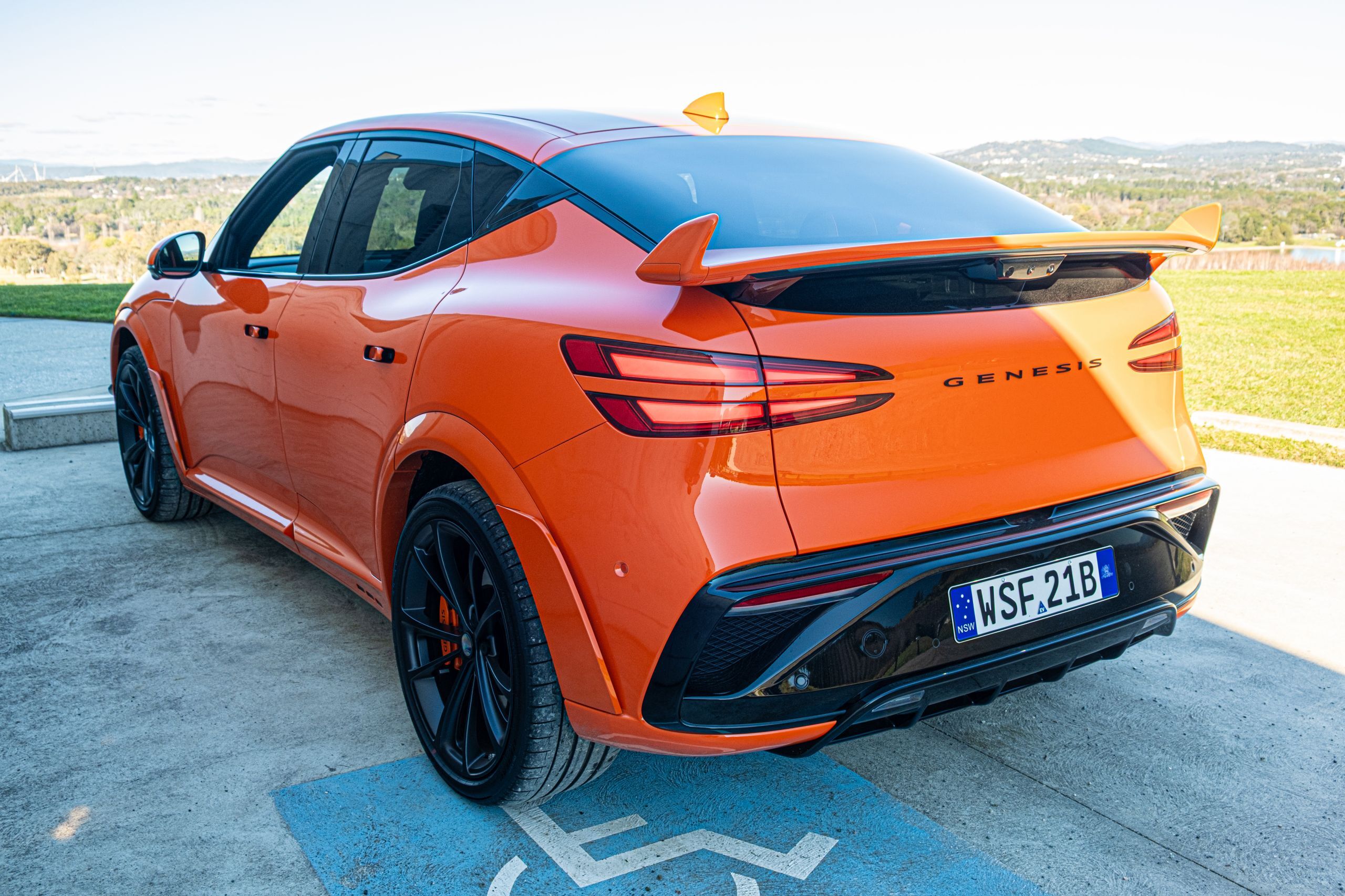
Models like the Hyundai Ioniq 5 N and Genesis GV60 Magma prove EVs can be fun.
There’s no word on which EV from Hyundai could be the first with this tech.
After Hyundai pioneered the use of a simulated transmission in its high-performance EVs, and has nearly perfected an ICE-inspired soundtrack in them, too, one may have expected engineers at the brand to kick up their feet and let the rest of the industry play catch-up. As it turns out, they’re looking to make driving an EV even more exhilarating.
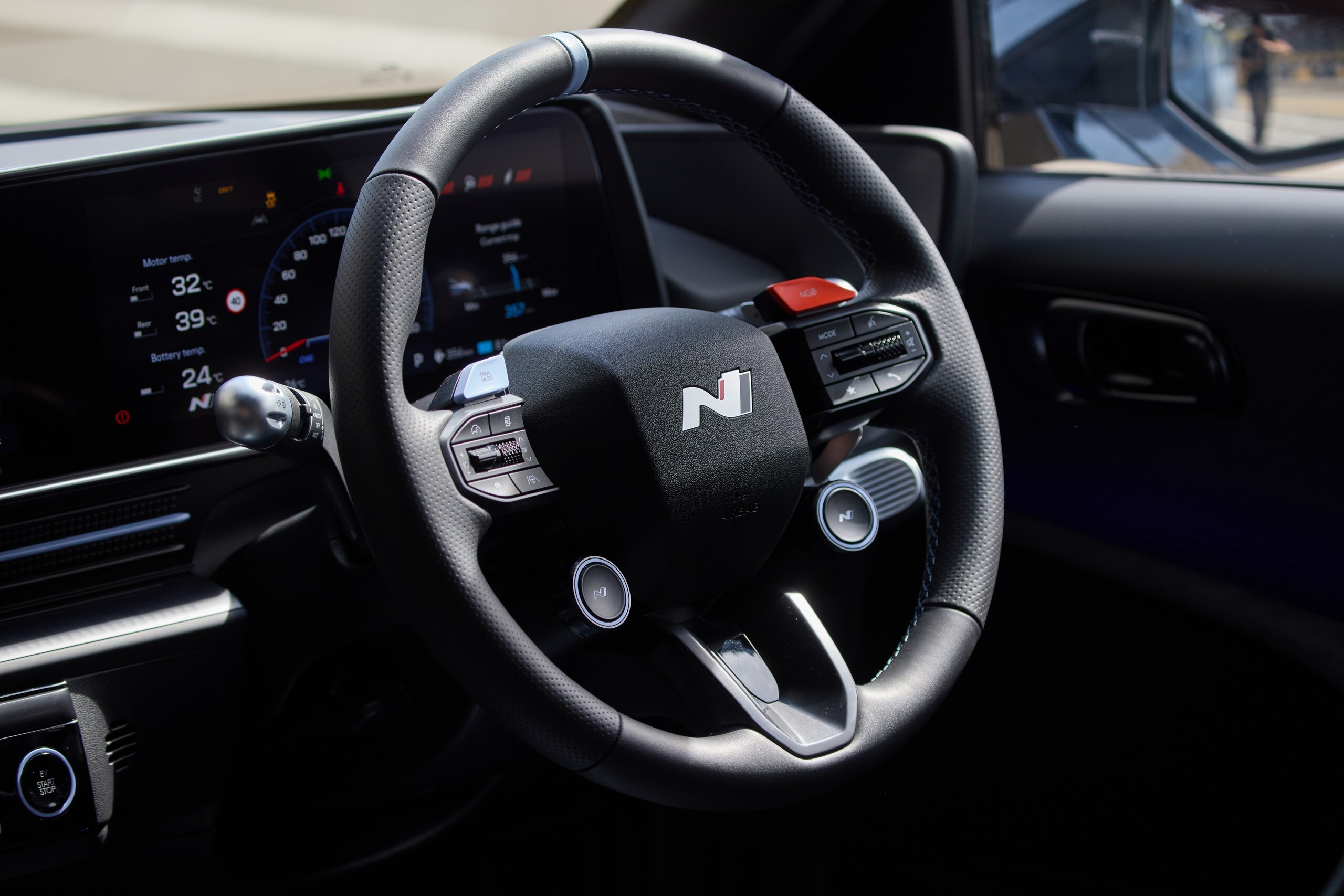
A patent recently filed in the U.S. reveals the South Korean brand is attempting to make the virtual gear shifter found in models like the Ioniq 5 N, Ioniq 6 N, Kia EV6 GT, and Genesis GV60 Magma even more engaging. To do so, Hyundai may be developing a way to replicate the engine braking found in combustion-powered cars.
Building upon the current setup, which imposes torque limitations and a rev limiter, this new system would tweak the amount of “engine” braking the driver experiences depending on what gear is selected and the revs. As in a gas car, if the revs are high and the driver is in a low gear, the amount of off-throttle engine braking would increase.
Obviously, given that Hyundai, Kia, and Genesis EVs use electric motors, rather than engines, all of this would be controlled by advanced software. It would use on-the-fly tweaks to the regenerative braking, CarBuzz reports, and certainly sounds like an intriguing way to make driving one of the brand’s electric motors that much more engaging. As it stands in current electric Hyundai N, Kia GT, and Genesis Magma models, the level of “engine” braking present is the same, regardless of what gear is selected and what the revs are.
It remains to be seen if a system like this would be introduced in updated versions of the current Ioniq 5 N and Ioniq 6 N, or if we’ll have to wait for an all-new model before this system becomes a reality. A high-performance N version of the small Ioniq 3 is in the works and could be a great candidate for such a system.
GV90’s OLED display rises 3.5 inches when parked, increasing viewing area by 70 percent.
Genesis tested the motorized mechanism for more than 100,000 cycles.
The screen retracts when the SUV moves to avoid interfering with the passenger airbag.
The Genesis GV90 already has a ton of interesting features to talk about. One version has no visible B-pillar. It’s available with front seats that rotate 180 degrees. There’s even one with full-on airplane-style tray tables for rear-seat occupants. If those things weren’t luxury enough, it also has a trick infotainment screen. Park the electric SUV, and a hidden portion of the display rises out of the dashboard, exposing more screen real estate for movies and streaming. Genesis’ latest look behind the dash shows how much engineering it took to make that work.
In its normal position, the OLED display presents a wide, 23.6-inch view for driving information, navigation, and media. Press a button on the center fascia while parked, and it climbs 90 mm (3.5 inches), revealing the full 24.6-inch screen. The diagonal measurement barely changes, but Genesis says the usable viewing area grows by approximately 70 percent.
The expanded panel measures 584.1 mm by 219 mm (23.0 by 8.6 inches) and has a resolution of 3840 by 1440. The display switches to a Media Home interface for streaming services and live channels, while an available 25-speaker Bang & Olufsen system handles the sound. Genesis also fitted a 25-inch head-up display to keep key driving information in the driver’s view when the vehicle is moving. In other words, there are several things to pay attention. What’s perhaps most interesting is how engineers worked around challenges a moving screen presents.
The assembly uses a brushless motor, a rack-and-pinion gear, and guides to move the panel. Genesis says the added weight raised concerns about vibration, so engineers mounted the display directly to the cowl crossbar. The company says the mechanism completed more than 100,000 test cycles, with operating noise below 40 decibels across a range of temperatures. Those are Genesis’ claims. How it feels after years on rough roads is something owners will find out. How a third- or fourth-owner will handle things when a component inevitably fails is another matter.
Also worth mentioning are the two reasons why the screen only works when the GV90 is in park. The obvious one is that Genesis doesn’t want to distract drivers. The less obvious one is that it could interfere with the front airbag. To that end, it’ll retract itself if the driver begins moving the car when the screen is fully deployed.
The GV90 is the first Genesis to use the group’s Pleos Connect infotainment platform. Its wide driving layout gives the driver and front passenger separate menu bars, while physical buttons still provide shortcuts to apps and commonly used vehicle settings. That mix all sounds sensible on paper. We can’t wait to see how owners find the experience. Hopefully, we’ll get a chance to test it ourselves soon.
Hyundai is launching more than 100 products by 2030.
58 launches in North America including 22 from Genesis.
Europe is getting five new EVs including a D-segment SUV.
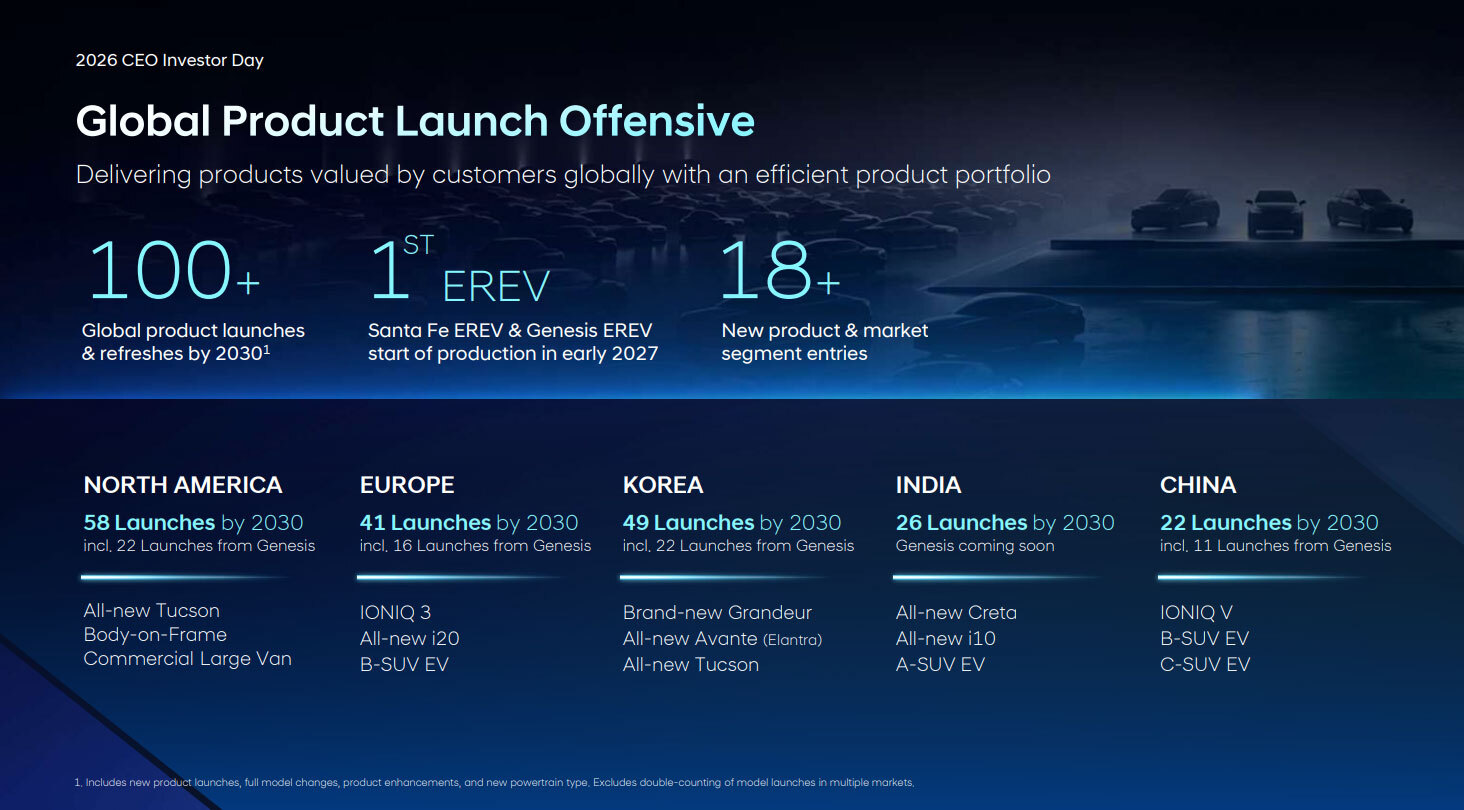
Hyundai has announced plans to introduce more than 100 new or refreshed models by 2030. Seven new vehicles are coming in the next eight months and the automaker promises there will be more than 18 different entries into “new products and market segments.”
While there’s a lot to cover, the company used their 2026 CEO Investor Day to announce a major product offensive. It’s a global effort as there will be “58 launches in North America, 49 in Korea, 41 in Europe, 26 in India, and 22 in China.” We’ve already seen a number of these as Hyundai said they include the new Elantra, Tucson, and Ioniq 3.
They’ll be joined by a range-extended Santa Fe as well as an all-new global B-segment SUV. Europe will get a second B-segment model, while India will get an even smaller A-segment electric crossover.
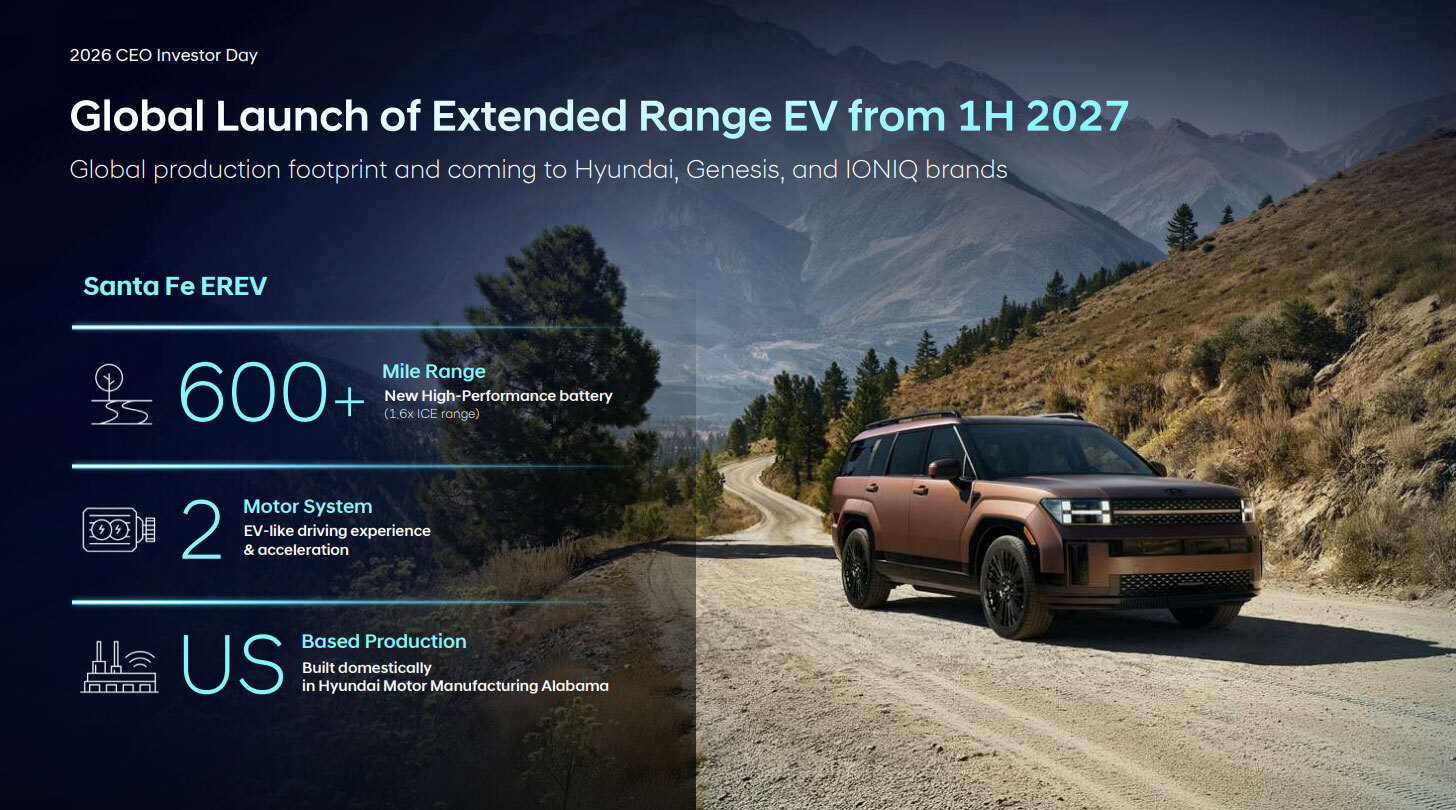
The Santa Fe EREV arrives in the first half of 2027 and it’s expected to have a combined range of more than 600 miles (966 km). It will be built at Hyundai Motor Manufacturing Alabama and deliver an EV-like driving experience, but without “range and charging anxiety.”
Europe Is Getting Five New EVs
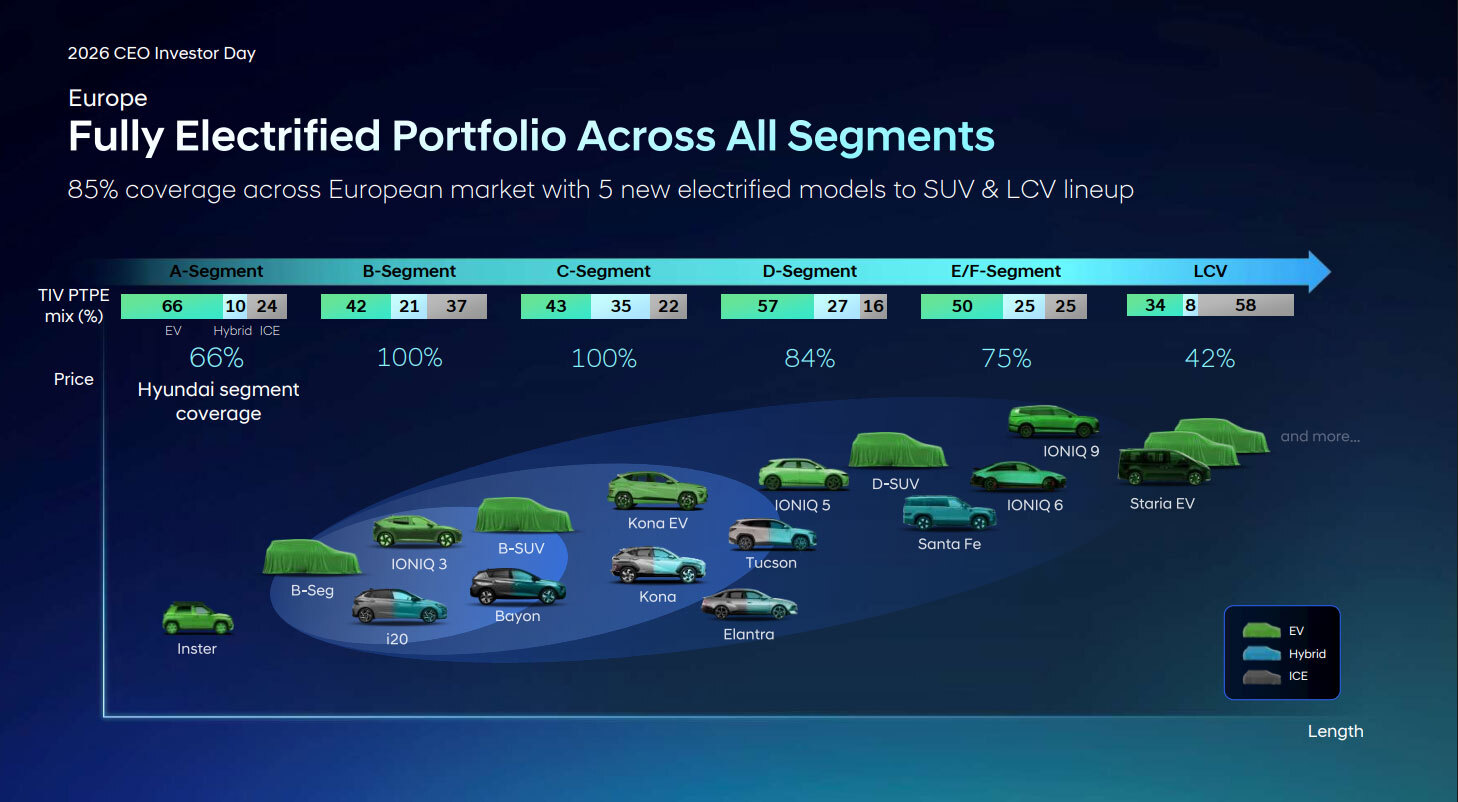
The company was largely coy on additional nameplates, but confirmed Europe will have a “fully electrified portfolio” that includes five all-new crossovers and light commercial vehicles. Hyundai hopes this will increase European EV sales from 116,000 units in 2025 to more than 420,000 units by 2030.
While Hyundai didn’t say much, they quietly revealed the two upcoming B-segment vehicles will be fully electric. They’ll be joined by a large D-segment electric crossover as well as two electric vans.
In India, a new electric crossover arrives in the fourth quarter with a next-generation infotainment system as well as a Level 2 semi-autonomous driving system. It will be followed by an ICE-powered mid-size SUV in the future.
A Chinese Turnaround With Fresh Product
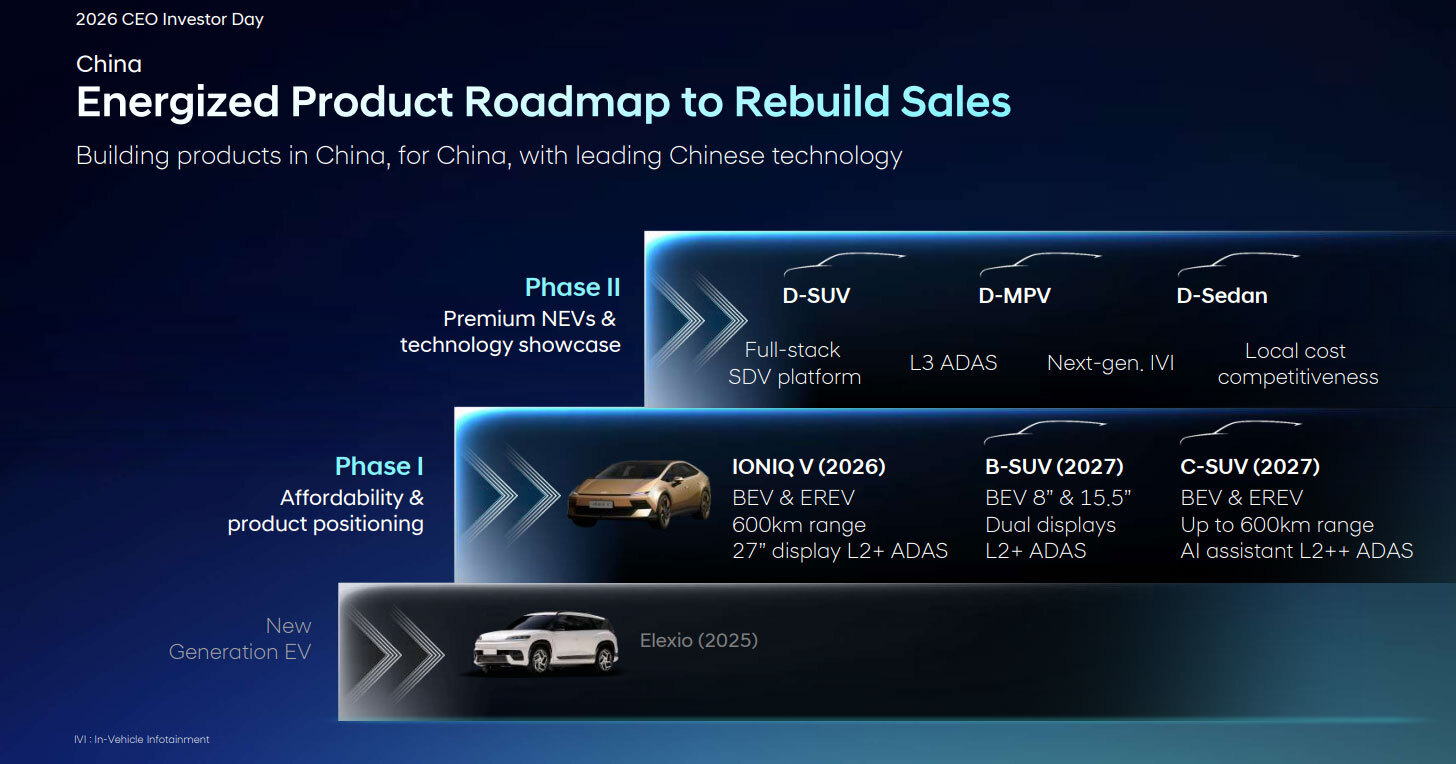
Hyundai is “pursuing a turnaround” in China, which will be spearheaded by the Ioniq V. The model will be followed by electric and range-extended vehicles in 2027.
The B-SUV will be fully electric, while the C-SUV will offer electric and range-extended powertrains. The latter will provide up to 373 miles (600 km) of range overall.
They’ll eventually be followed by three D-segment vehicles including a sedan, crossover, and MPV. These will have Level 3 autonomous driving technology as well as what sounds like a next-generation powertrain.
Genesis Looks For Growth
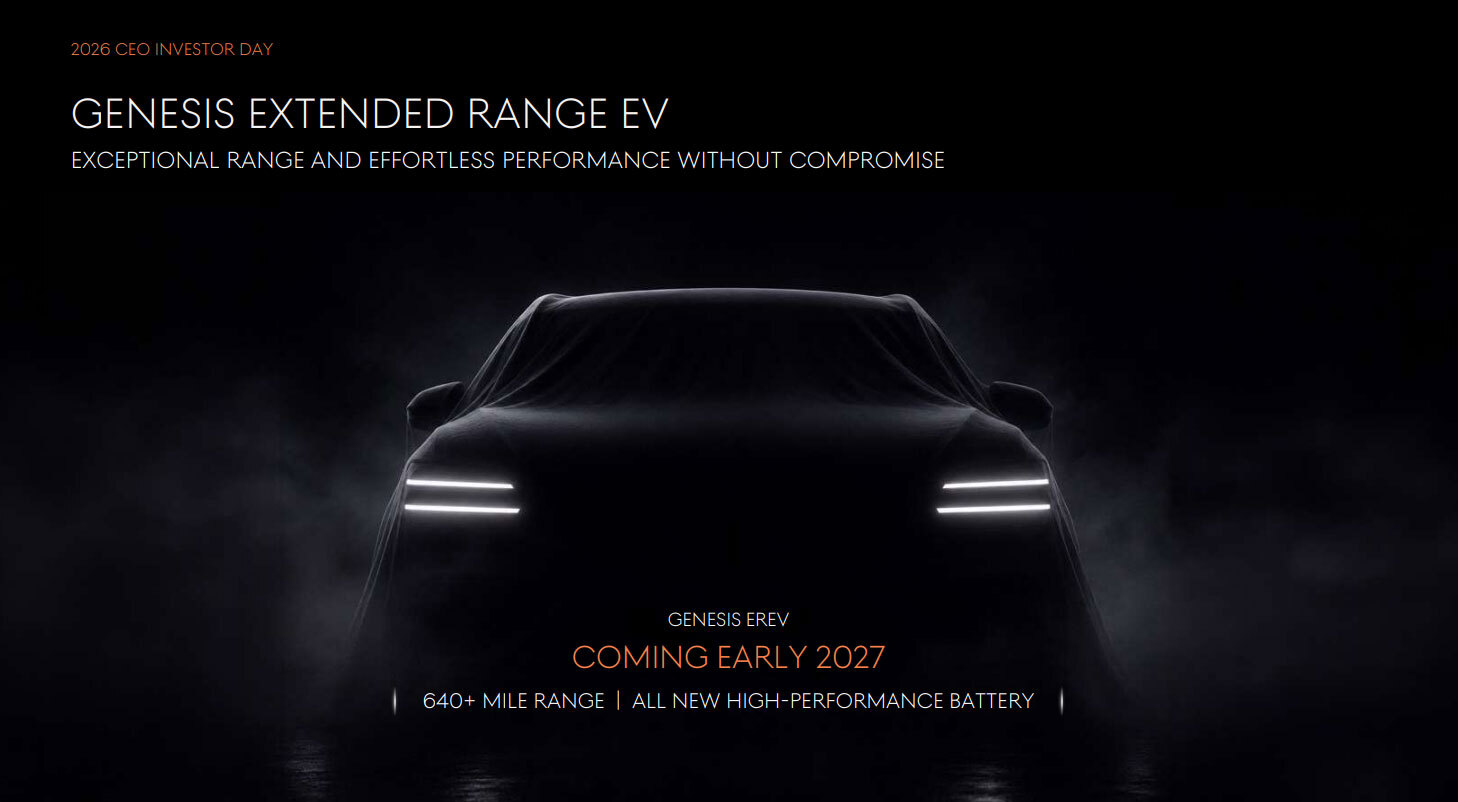
Genesis’ revamp is being led by the new GV90 as well as the GV80 Hybrid. The company also confirmed plans for a range-extended SUV in 2027, which will deliver more than 640 miles (1,030 km) of range.
While Genesis was coy on specifics, a slide mentioned 22 launches from the luxury brand in North America alone. That’s nearly a third of the models coming to the continent, but the figure undoubtedly includes variants.
The luxury brand will also enter new markets including India and the Asia Pacific region in the near future. If everything goes according to plan, they’ll be in more than 40 countries by 2030 and have annual sales of 350,000. To put that number into perspective, Lexus sold 370,260 vehicles in the United States last year.
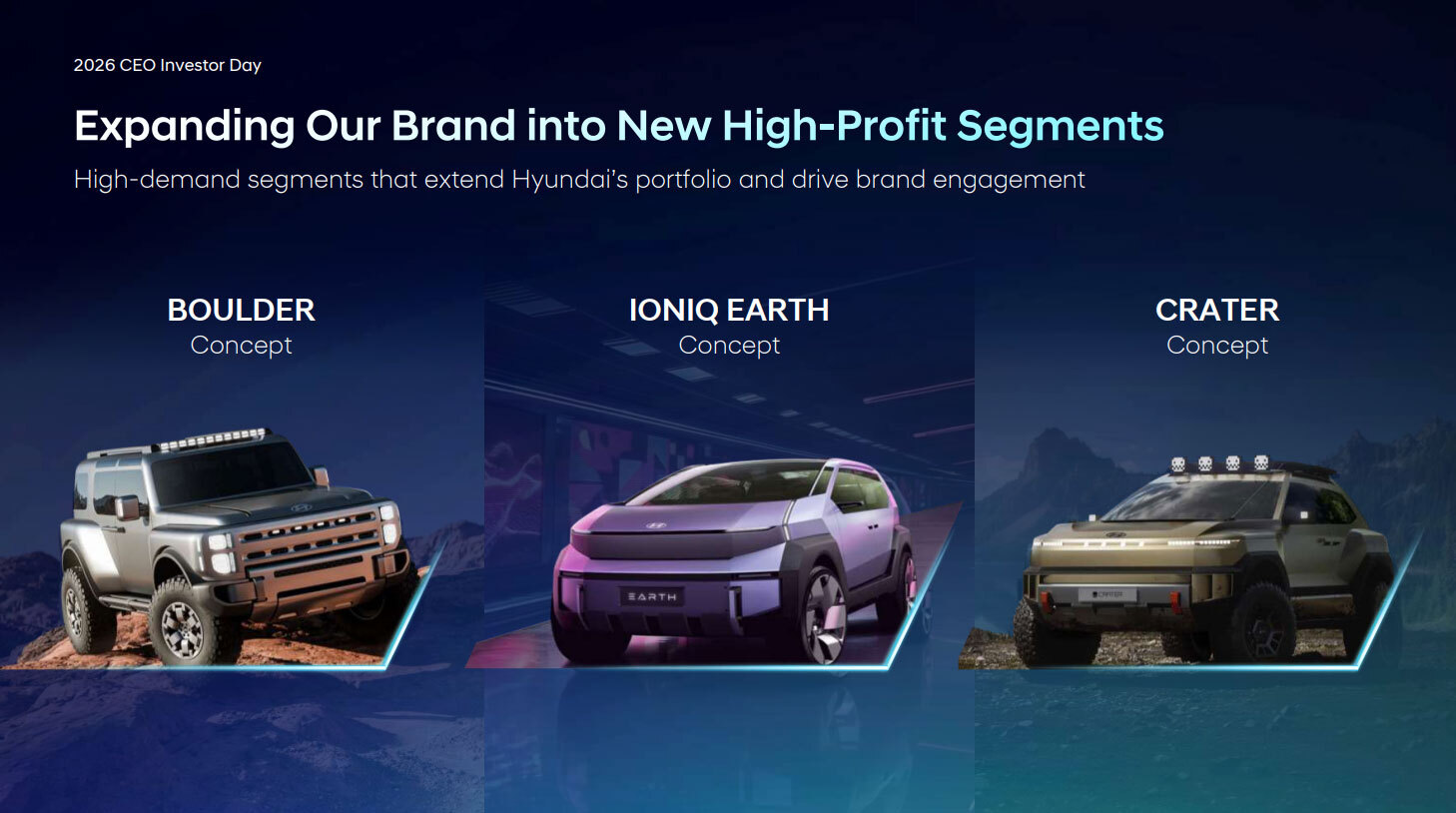
Getting back to Hyundai, the company will expand the N lineup and try to increase sales to 100,000 units annually by 2030. The automaker is also targeting so-called ‘white spaces,’ where they don’t have much of a presence and there’s “significant opportunities for growth.” To fill these voids, the company will launch body-on-frame vehicles including a midsize pickup.
Genesis says a range-extended GV90 remains technically possible.
Customer demand will decide whether the EREV actually happens.
Future Genesis models will offer hybrid, EREV, and EV choices.
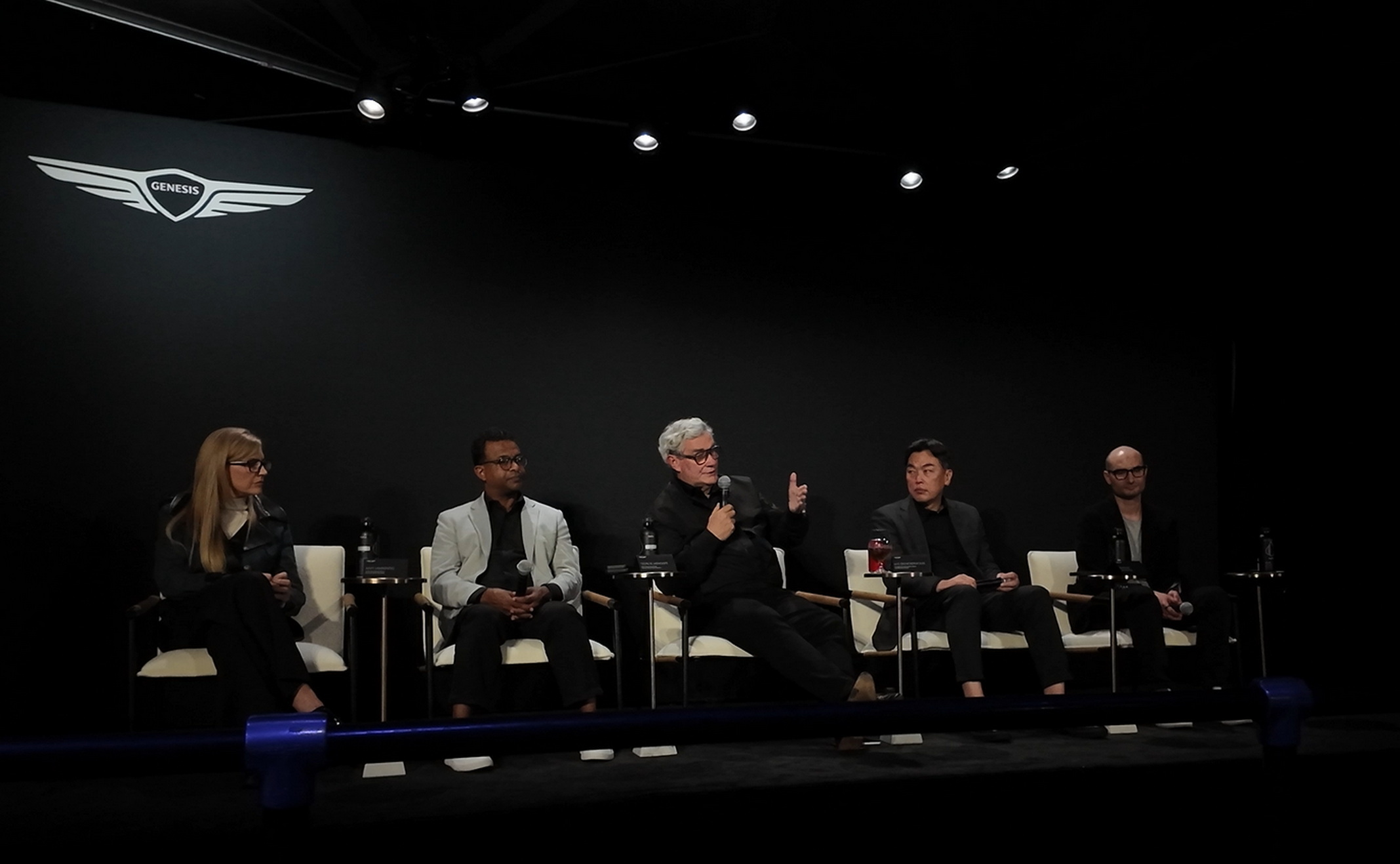
Genesis just revealed the GV90, its massive new electric flagship with 657 hp, a 123.5 kWh battery, and a cabin designed to make a chauffeured Rolls-Royce owner take notice. Every version is strictly battery-electric at launch. But that may only be true for now. At the GV90’s San Francisco debut, Genesis Chief Creative Officer Luc Donckerwolke made it clear that an extended-range electric version has not been ruled out. Asked directly about the possibility, he said: “Why not? It’s compatible. It’s another discussion.”
Donckerwolke also made the case for keeping the new flagship fully electric in the present tense. “We believe today that the electric powertrain is ideal for this type of vehicle because of the torque delivery, the silence, and luxury buyers,” he said.
Photos: Stephen Rivers for Carscoops
That makes perfect sense. The GV90 is exactly the sort of machine where instant torque, nearly silent operation, and a flat-floor cabin matter. Its 123.5 kWh pack is the largest yet used by Hyundai Motor Group. Genesis claims roughly 310 miles of range from the seven-seat version and a 10-to-80 percent fast-charge time of 22 minutes.
Still, an EREV could make a lot of sense here. Unlike a conventional hybrid, a range-extended EV uses electric motors to drive the wheels, while a gas engine works primarily as an onboard generator. In theory, it could preserve the quiet, effortless character Genesis is chasing while taking some of the pressure out of longer trips and sparse charging infrastructure. That’s something other large luxury EVs like Cadillac’s Escalade IQ don’t have.
Sean (Sihyeok) Lee later echoed Donckerwolke’s comments, saying that “In the future, the EREV door is still open. We will explore all opportunities depending on customer demand.” He went further, too. “GV90 is the only one that’s BEV only for now,” Lee said. “All the other cars in the lineup are going to be available with different options: hybrid, EREV, and also battery electric. All those options will be available for the rest of the lineup.”
That said, it’s far from a production announcement. Genesis hasn’t even confirmed when orders will open or pricing for the BEV GV90. But it’s also more than a vague corporate non-answer. The company’s top executives have said the SUV is compatible with EREV and that its future depends on whether buyers demand it loudly enough.
Donckerwolke, for his part, remains emphatic about the long game. “EVs are the future,” he said. “Combustion is going to be obsolete. It’ll disappear.”
He conceded that combustion might endure in exotic vehicles, but argued that most EV limitations and fears come from people who have never actually driven one. He may well be right. But what happens 10 or 20 years from now matters less than what luxury-SUV buyers want when the GV90 reaches dealerships next year. Genesis is betting they will embrace a BEV-only flagship. If they don’t, the company has made clear that the EREV door is there. It just might need to open sooner than planned.
The electric Genesis GV90 combines coach doors, swivel seats, and a properly plush cabin.
The 657 hp flagship claims around 311 miles of range from a 123.5-kWh battery.
Genesis hasn’t announced U.S. pricing, and that could make or break the entire proposition.
Update: Our own Stephen Rivers was on the ground for the GV90’s debut in San Francisco and has sent through a set of live photos, which we’ve added below. They show the production model from angles the official gallery skipped, including a closer look at the cabin and the detailing around the grille and lighting signature.
Genesis has spent a decade proving it can make luxury cars that belong in the same sentence as BMW, Mercedes, and Audi. The GV90 might be the vehicle that lets it start a much louder conversation. At least on first look, this thing is seriously good. It’s big, clean, properly expensive-looking, and its cabin appears to have been designed by people who understand that a flagship SUV should feel like more than a row of screens wrapped in quilted leather. There’s just one big catch, though: Genesis has yet to say how much it will cost.
Photos Stephen Rivers / Carscoops
That matters because the GV90 is not another slightly nicer electric SUV. It’s Genesis’ new flagship, a 208.1-inch-long electric luxury barge with a 127.8-inch wheelbase, 657 hp, 590 lb-ft (800 Nm) of torque, a 123.5-kWh battery, air suspension, rear-wheel steering, and dual electronic limited-slip differentials. The company says its seven-seat version can travel roughly 500 km, or 311 miles, on a charge, although that figure comes from internal testing rather than the EPA. Oh, and that’s before we get to the interesting bits.
The Coach Doors Aren’t Just A Party Trick
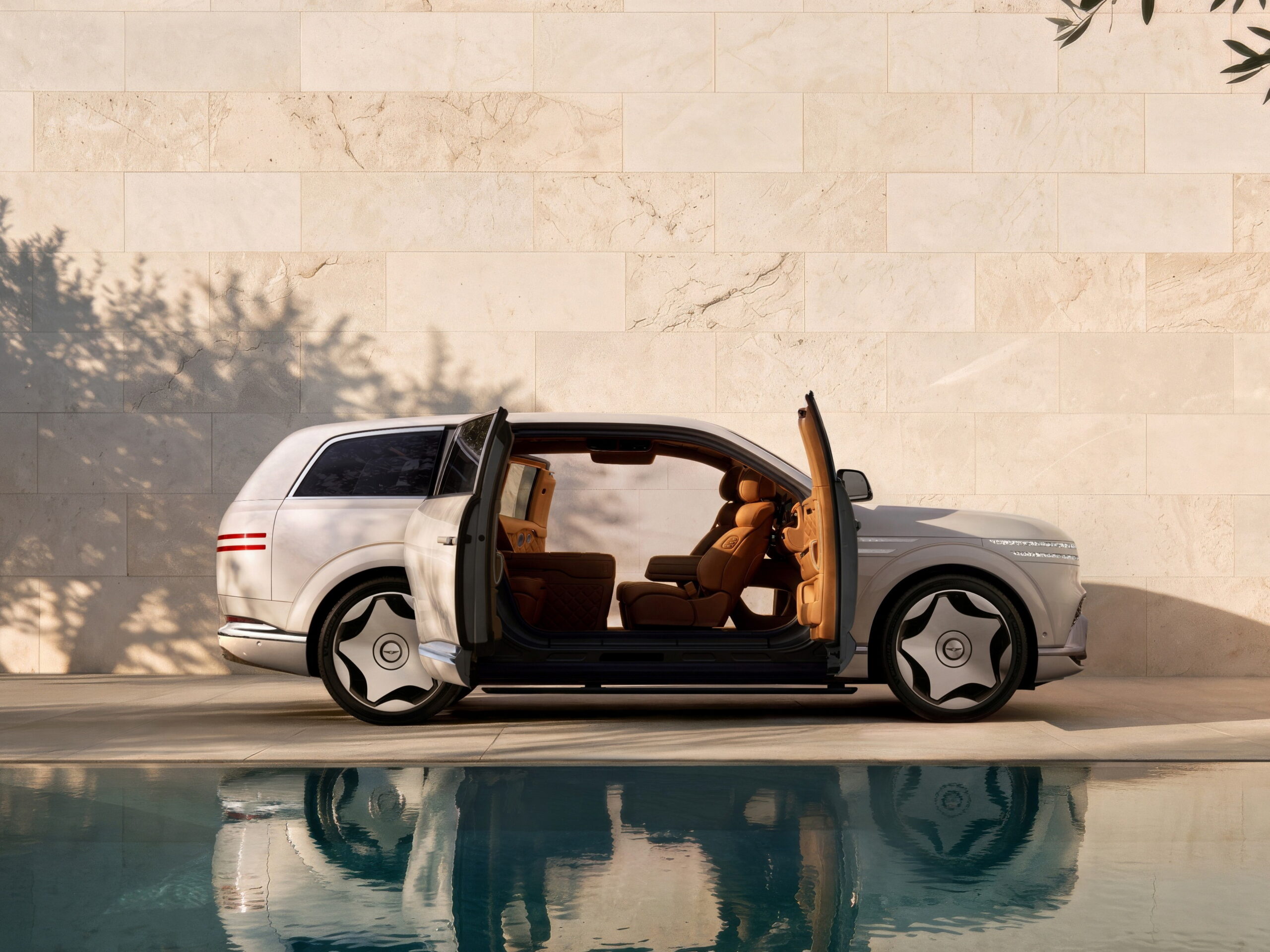
The range-topping GV90 Neolun gets what Genesis calls the Neolun Arch Gate. These are coach doors with no conventional visible B-pillar. It’s the sort of thing that looks great in a concept-car rendering and usually disappears before production because engineers, crash regulations, and reality tend to get involved. That’s not the case here.
Genesis says it has made the arrangement work by integrating high-strength steel beams into the door-and-body structure. In addition, it’s added a concealed roll-cage-like arrangement with thicker framing, steel tubes, and structural foam. The rear door also uses a dual-motion hinge that first pushes it outward before it swings open, allowing it to operate independently rather than requiring the front door to be opened first.
Photos Stephen Rivers / Carscoops
In practice, it’s more impressive than it might, at first, seem. Getting into the second row is far more classy and seamless than in pretty much any other SUV at this price point. The experience matters, and it’s pretty special here. Still, this is one of those cases where the engineering explanation matters as much as the visual effect. We still need to drive and test one of these in the real world to get a better idea of everyday pleasures and pain points.
Photos Stephen Rivers / Carscoops
The standard GV90 uses conventional swing doors, which may end up being the smarter choice for many buyers. But the Neolun gives Genesis a proper halo feature that BMW, Mercedes, and Audi don’t have. Quite simply, it adds a layer of luxury that only brands like Rolls-Royce offer, but possibly for hundreds of thousands less.
It’s A Lounge First, An SUV Second
Photos Stephen Rivers / Carscoops
The cabin may be the GV90’s real knockout punch. Genesis describes it as a “bespoke living space,” which is normally the sort of phrase that should trigger an immediate eye roll. Here, though, the experience, again, the most important part, makes a convincing case.
There’s a wide pop-up OLED display that expands from 23.6 to 24.6 inches when parked, a 25-inch head-up display in place of a conventional instrument cluster, real-glass crystal controls, motorized vents, a 25-speaker Bang & Olufsen sound system, and seats with 15 air cells and pulse-vibration massage functions.
Photos Stephen Rivers / Carscoops
Then there are the motorized swiveling front seats. While parked, they can rotate a full 180 degrees to face the second row. That turns the GV90 Neolun into an actual lounge rather than a brochure’s vague promise of one. A 1960s Imperial and a Mercedes camper van are about the only U.S.-market precedents for front seats that fully face rearward. Genesis is bringing the idea to a modern luxury SUV.
Add the available four-seat Executive Suite with real wood flooring, a refrigerator, tables, a partition, and a six-zone electronically tintable roof, and Genesis is plainly aiming at the sort of buyer who sees a long drive as an opportunity to disappear from the world for a while. That’s also where the electric powertrain makes real sense.
Nobody buying a six-figure GV90 is likely trying to figure out public charging while living paycheck to paycheck in an apartment complex. These buyers are more likely to have home charging, other vehicles, and the means to arrange their lives around the rare trip that exceeds an EV’s comfort zone. In return, they get the silence, smoothness, instant torque, flat-floor packaging, and general serenity that make an EV particularly well suited to a luxury flagship.
Photos Stephen Rivers / Carscoops
But that doesn’t mean the EV-only decision is risk-free. A buyer cross-shopping a Mercedes GLS, BMW X7, Range Rover, or gas-powered Escalade may still want the freedom to drive all day, tow without anxiety, or simply avoid planning around charging. Genesis is betting those compromises will matter less than the benefits of an electric flagship. For its target customer, it may be right. But it is still leaving some very wealthy people on the table.
The Price Has To Be Right
Photos Stephen Rivers / Carscoops
The market has already set some uncomfortable benchmarks. Lucid’s Gravity Touring starts at $79,900, while Cadillac’s Escalade IQ begins at more than $127,000. The Kia EV9 starts far lower, though it isn’t a genuine equivalent; the Genesis is roughly 11 inches longer and uses a flagship-exclusive eMP platform.
That leaves Genesis with a narrow but potentially lucrative lane. If the standard GV90 starts around $100,000, it could look like an astonishing amount of luxury SUV for the money. Push it into the $120,000 range, though, and the brand will have to justify not only the vehicle itself, but also the entire Genesis ownership experience. At that point, buyers won’t just compare leather quality, rear-seat space, and charging times.
Photos Stephen Rivers / Carscoops
They’ll compare dealer treatment, service convenience, resale confidence, and whether the Genesis badge carries enough weight beside a three-pointed star or a Range Rover grille. The Neolun, and especially the four-seat First Edition, can probably command more. Those are the versions for buyers who want something their neighbors cannot casually duplicate. But the regular GV90 has the chance to be the important one.
Genesis may have built the kind of flagship SUV that makes the established luxury players uncomfortable. It looks fantastic, the interior feels genuinely special, and the coach doors, wood flooring, and rotating seats give it a personality beyond another expensive electric SUV with a giant screen. Now we just need Genesis to put a number on it. That number will decide whether the GV90 is a masterstroke or merely a very handsome missed opportunity.

 Login