Reading view

There are new articles available, click to refresh the page.

SUVs Killed The Minivan, But Citroen Didn’t Get The Memo

  • ELO concept revives quirky minivan style with fresh intent.
  • Cabin seats six with flexible layouts and a bold orange theme.
  • Designers call it a lab for clever, fun, and practical ideas.

There was a time when Europe’s roads were dotted with compact and subcompact minivans, purpose-built to juggle space, versatility, and daily practicality. That era faded fast once SUVs rolled in and pushed the category toward near extinction. But Citroen isn’t quite ready to let the minivan disappear quietly into the past.

The French automaker has unveiled the Citroen ELO, a concept it calls a “laboratory of ideas,” blending a boxy, unmistakably van-like silhouette with a modular six-seat cabin that is, by all accounts, very orange.

Review: We Drove The New C5 Aircross And Lost Our Jeep’s Compass To Citroen’s Comfort

While not a direct preview of an upcoming production vehicle, the ELO hints at where Citroen’s design language may be heading, and perhaps at how the brand still sees a future for vehicles shaped around utility rather than what sells fashion.

The name of the concept originates from the words rEst, pLay, and wOrk, communicating some of its use case scenarios. Measuring 4.10 m (161.4 inches) long, it is about the same size with the discontinued C3 Picasso and the previous generation C3 Aircross. However, it looks nothing like these models, adopting single-box proportions.

Reinventing the Urban MPV

\\\\\\\\\\\\\\

Its name is an acronym of sorts, built from the words rEst, pLay, and wOrk, each pointing to one of the concept’s imagined roles. Measuring 4.10 meters (161.4 inches) in length, it roughly matches the size of the now-discontinued C3 Picasso and the previous C3 Aircross.

In shape, though, it’s a clean break, leaning into a single-box form that has little in common with those models.

More: Citroen Oli Concept Could Inspire Next-Gen C4

Up front, the ELO wears squared-off LED lights and a large, illuminated Citroen badge, bookended by a utilitarian front bumper that’s mirrored around the back. The windshield has a weird curve and is joined by a small glass roof. The profile is dominated by the large greenhouse and the sliding doors that create a 1.92 m (75.6-inch) wide opening.

The concept rides on 21-inch wheels with futuristic covers. There are horizontal cutouts above the fender on the beltline, while the roofline drops towards the rear section. The rear has an asymmetrical door and glass, with split LED taillights mirroring the shape of the headlights.

Four Or Six Seats

\\\\\\\\\\\\\\\\\

Inside, the ELO is configured as a “modular living space,” designed to hold either four or six people. The layout is unorthodox: the driver’s seat is mounted in the center, with two removable passenger seats positioned slightly behind it, and a three-person bench completing the rear row.

The front seat can swivel, creating a living room or a work space for meetings. The rear section of the cabin can transform into a sleeping area thanks to a pair of inflatable mattresses.

These are made of a durable material called Dropstitch and can be stored in the trunk. Furthermore, a drop-down screen turns the EV into a home theater.

 SUVs Killed The Minivan, But Citroen Didn’t Get The Memo

The ELO doesn’t have a dashboard in the conventional sense. In its place, the ELO features an open section ahead of the driver and a slim display mounted beneath the front windshield.

The steering wheel juts out from the front wall in a futuristic shape, equipped with two joystick-style inputs and traditional stalks, replacing the need for a touchscreen. Door cards and side panels incorporate clever storage solutions, as expected in a van shaped around practicality.

More: Citroen’s Budget Fastback Looks Fast Only When Standing Still

The concept rides on a fully electric architecture, which is beneficial for packaging. Citroen hasn’t shared the specifications of the electric motors or the battery pack, but said that the “natural habitat” of the concept is urban areas.

It Could Spawn a Subcompact Offering

 SUVs Killed The Minivan, But Citroen Didn’t Get The Memo

The concept will make its first public appearance at the Brussels Motor Show in January 2026. While it’s not destined for production in this form, French outlet L’Argus reports that it could influence a future subcompact model expected in 2028. That vehicle would slot somewhere between the C3 hatchback and the C3 Aircross SUV.

Citroen’s Design Director, Pierre Leclercq, referred to the ELO as “a burst of energy,” describing it as a design experiment built around practicality, efficiency, and a touch of whimsy. CEO Xavier Chardon echoed that, calling the concept both “a laboratory of ideas” and “a powerful message that carries our vision of what Citroen should be

The Lexus LFA Returns, But You’re Not Going To Like What They Did

  • LFA Concept shares its aluminum chassis with Toyota’s new GR GT.
  • The concept skips Toyota’s twin turbo V8, even though it could fit.
  • Styling evolves the earlier Sport Concept with clear refinements.

This is the Lexus LFA Concept, and it’s quite unlike the V10-powered weapon that preceded it. For years, enthusiasts assumed the next LFA would be little more than a Lexus-badged take on Toyota’s new GR GT. Instead, what’s emerged is something very different. It’s electric. Yes, really.

The concept made its debut in Japan this evening alongside the twin-turbo V8 Toyota and was first teased months ago under the name Lexus Sport Concept. That early study has now morphed into the more production-ready LFA Concept, carrying a fully electric powertrain.

Read: Toyota’s GR GT Drops With TT V8 Hybrid And At Least 641 HP

According to Lexus, the ‘LFA’ name is “not bound to vehicles powered by internal combustion engines,” but instead symbolizes a vehicle that “embodies the technologies that engineers of its time should preserve and pass on to the next generation.”

Toyota Underpinnings

\\\\\\\

While Toyota has already shared a trove of details about its new halo performance car, Lexus is staying quiet on the finer points of its electric sibling. The company has yet to release any figures for the LFA Concept’s powertrain, leaving its performance potential open to speculation.

Whatever its output, it’s safe to say no amount of kilowatts will replicate the unmistakable howl of the original LFA’s V10, or even the sound of the Toyota’s new V8.

Interestingly, the LFA Concept is based on the same all-aluminum platform as the Toyota GR GT and GR GT3. That presumably means Lexus had the option of using the same V8 as its parent company, but opted against it.

\\\\\\\\

While the choice of powertrain seems odd, particularly given poor demand for high-performance electric sports and super cars, there’s no denying the LFA Concept looks beautiful, which isn’t a word we’d use for the Toyota. The interior is also wildly different than the Toyota, although this isn’t a surprise given the LFA is still a concept.

When Will it Launch?

\\\\\\\\\

What does the future hold for the LFA Concept? We know it’s headed for production, and the renaming of the Sport Concept to the LFA Concept suggests it will indeed be sold as the second-generation Lexus LFA.

When it will reach public roads remains uncertain, but if we had to place a bet, it’s likely to arrive around the same time, or perhaps a little later, than the Toyota GR GT, which is expected in 2027.

\\\\\\\\\\\\\\\\\\\\\\

Jaguar Rolls Out Its Future In A New Color Right After Firing The Man Behind It

  • Jaguar’s Type 00 concept returns in London finished in matte red paint.
  • British brand will unveil a dramatic four-door production EV next year.
  • The production EV promises 430 miles of range and ultra-fast charging.

This time last year, Jaguar revealed the wild Type 00 concept, the first look at its all-electric future and a statement of intent to compete with Bentley and Rolls-Royce.

As development of the production version continues, a matte red example of the concept has been spotted on London’s streets, marking the marque’s 90th anniversary and coinciding with the unexpected departure of its longtime design chief, the figure behind the brand’s polarizing rebrand.

The Type 00 was originally shown in Miami Pink and London Blue during the official launch. Earlier this year, the model was dressed in a French Ultramarine livery and made a surprise appearance during the Paris Fashion Week.

Read: Jaguar’s Future GT Has No Rear Window And No Patience For Cargo

The company has now unveiled a fourth color variation, London Red with a matte finish, as the concept makes its arrival in the UK capital. The new shade draws inspiration from the redbrick Victorian architecture of Kensington, one of London’s most recognizable neighborhoods.

\\\\\

Jaguar

The freshly repainted concept was photographed alongside a classic 1935 Jaguar SS outside the Chancery Rosewood Hotel.

For those wondering, no other changes have been made to the concept’s exterior. It still rides on the same 23-inch alloy wheels, while the minimalist cabin remains finished in white and gray upholstery accented by ambient lighting.

Photos shared by Jaguar UK Director Santino Pietrosanti on LinkedIn show the Type 00 parked alongside some exotic company, including a Bugatti Chiron, Rolls-Royce Cullinan Black Badge, Ferrari F8 Tributo, and Lamborghini Aventador SVJ.

\\\\\\

Santino Pietrosanti / LinkedIn

The brand’s rebrand has been met with mixed reactions. Its ad campaign, oddly enough, featured no cars at all, leaving many scratching their heads. It was also rather odd that it initially showcased the Type 00 in a bright shade of pink, which didn’t do the car any favors.

Still, under London’s gray winter light, the matte red finish lends the concept a sense of gravitas. Out in the open, it naturally draws attention, albeit that’s not really surprising for a concept car. Much like the Tesla Cybertruck, its unconventional form challenges expectations so completely that people can’t decide whether they admire it or despise it. There seems to be little middle ground.

The Road Car

 Jaguar Rolls Out Its Future In A New Color Right After Firing The Man Behind It

Prototypes of the production version suggest Jaguar plans to stay faithful to the concept’s striking proportions. The roadgoing model will, however, take a more practical shape with four doors and a longer wheelbase, built on the company’s new Jaguar Electrical Architecture platform.

More: Jaguar’s Future GT Has No Rear Window And No Patience For Cargo

As per recent reports, the EV should have a driving range of up to 430 miles (692 km) and support fast charging, adding 200 miles (322 km) of range in just 15 minutes.

Only time will tell if those who would ordinarily shop for a Bentley or Rolls-Royce will be willing to spend their money on a vehicle that looks as controversial as this.

JLR Design Chief Axed

In separate news, it has been confirmed that Jaguar Land Rover design boss Gerry McGovern has departed from the brand. No official reason has been given for this high-profile departure, but it comes shortly after former chief financial officer at Tata, PB Balaji, was named as JLR’s new chief executive.

Citing insider sources, Autocar India reports that McGovern was “escorted out of the office” on Monday, with his contract being terminated with immediate effect. The man behind Jaguar’s relaunch has spend over two decades at JLR, being responsible for successful models including the new Land Rover Defender.

According to business economics professor at the University of Birmingham, David Bailey, McGovern’s exit marks a “symbolic end of an era.” He told The Guardian that it may also be a sign that Tata wants to exert more control over the British company.

Thanos Pappas contributed to this story.

Skoda’s Vision Sedan Keeps Its Engine Layout But Loses The Engine

  • Skoda unveiled a modern reincarnation of the 1970s 100 sedan.
  • Digital concept was designed by headlight specialist Martin Paclt.
  • It’s envisioned as fully electric with a rear-engined RWD layout.

Skoda has already served up a flurry of digital concepts nodding to its back catalogue, but this latest one marks a first, as it’s the only sedan in the mix. The design channels something like a future Superb, though under the surface it sticks with the rear-engined, rear-wheel-drive layout once common in the brand’s earlier models.

More: This Futuristic RWD Coupe Could Have Been Skoda’s Best Throwback Yet

The concept draws directly from the Skoda 100, a milestone model for the Czech brand that became its first to pass the one-million-unit production mark. Between 1969 and 1977, 1,079,708 examples of the 100 were built.

This digital reinterpretation was developed by Martin Paclt, part of Skoda’s headlight design team. He’s no stranger to shaping the company’s visual identity, having contributed to concept projects like the Vision X, 7S, and O, as well as production vehicles including the Enyaq, Karoq, Kamiq, and Kodiaq.

Paclt said he chose the Skoda 100 because of its strong recognition and what he described as its “clean, timeless lines,” which align naturally with the brand’s current Modern Solid design philosophy.

Throwback Details

\\\\\\

The new sedan’s proportions reflect those of today’s Superb, though Paclt aimed to give it a more premium, limousine-like presence compared to its modestly priced ancestor from the 1970s.

References to the original 100 appear throughout the design: character lines along the flanks, cooling intakes on the rear fenders, vents beneath the taillights, and a front graphic that encloses both grille and headlights.

The latter break from the old circular style, though Paclt experimented with that shape in early sketches before settling on a cleaner interpretation.

More: The Mazda RX-8 Spirit Lives On, But It’s Wearing A Skoda Badge

The reborn 100 sedan rides on large, futuristic alloy wheels that emphasize its balanced proportions and short overhangs. The rear deck draws attention with its roof scoop and the omission of a traditional rear window, a feature now common among experimental concepts that prioritize form over convention.

Electric Heart with a Vintage Layout

 Skoda’s Vision Sedan Keeps Its Engine Layout But Loses The Engine

Curiously, although envisioned as a fully electric vehicle, the study preserves the rear-engined, rear-drive setup that defined the original 100.

The rear intakes now cool electric components rather than a combustion engine, while the main storage area sits at the front with a smaller compartment at the back, staying faithful to the model’s unconventional architecture.

The digital 100 sedan joins Skoda’s growing catalogue of heritage-inspired concepts, following the 110R and 1000 MBX coupes, the Favorit hatchback, and the Felicia Fun pickup.

None are planned for production, yet each gives the company’s designers space to revisit its history through an electric, Modern Solid lens, where past models find new expression in digital form rather than on the assembly line.

\\\\\

Skoda

Kia’s EV5 Weekender Looks Too Good To Stay A Concept

  • Kia unveiled the EV5 Weekender concept with off-road upgrades.
  • It features lifted suspension, wide fenders, and modular accessories.
  • Concept could inspire a production model in the very near future.

Kia has unveiled a new concept at the ongoing Guangzhou Auto Show in China, one that hints at a production model on the horizon. Named the EV5 Weekender, it presents a tougher, outdoors-ready take on the compact electric SUV.

The EV5 is the fourth Kia to wear the Weekender badge, following in the tracks of the EV9, PV5, and Tasman. Each model in the series interprets an outdoor-oriented trim with its own distinct approach.

Review: Here’s Why The Kia EV5 Makes More Sense Than A Model Y

While none of the Weekender concepts have yet transitioned to production, that could change as buyers increasingly look for rugged, lifestyle-oriented versions of these models.

Outdoor Intentions

\\\\\\\\\\

The concept was developed by the Kia China Style Design Team. From the outside, the main changes are immediately clear. It sits higher on larger wheels wrapped in all-terrain tires, while the lifted suspension gives it noticeably greater ground clearance and a more confident stance.

The SUV wears a matte beige finish accented with lime green details, a color scheme that has become a signature for the Weekender range. It also features a redesigned bodykit with wider fender extensions, new skid plates, chunkier side skirts, a hood insert, and a large roof rack.

Kia even added dedicated mounts on one side of the vehicle for attaching extra equipment, in a similar vein to the Land Rover Defender.

Practical Changes Inside

\\\\\\

The interior has been reworked more extensively than expected for a concept based on an existing production SUV. The wide display now stretches in front of the passenger and is paired with a slim digital instrument cluster.

More: New Kia Telluride Drops V6 For Turbo And Hybrid Fours

Other updates include a new steering wheel, a revised center console, reshaped climate vents, and fresh upholstery with modern colors and a 3D texture.

The cabin is filled with practical touches reminiscent of Dacia’s YouClip system, including cup holders and storage compartments mounted along the sides of the cargo area, as well as extra rails on the roof liner for securing gear.

What’s Beneath It

 Kia’s EV5 Weekender Looks Too Good To Stay A Concept

Kia hasn’t disclosed the technical specifications of the concept, so it’s unclear whether it differs mechanically from the production EV5 beyond its upgraded suspension setup.

The EV5 rides on the E-GMP architecture and is available in FWD and AWD forms with different battery options depending on the region. A GT variant has been confirmed for production, promising a more potent powertrain and sportier handling.

It wouldn’t be surprising if the production EV5 lineup eventually adds a toned-down version of the Weekender concept for buyers who enjoy camping or off-road trips. Kia has a habit of turning its concepts into real models, and this one looks ready to follow the same path.

\\\\\\\\\\

GM’s Sporty EV Concept Looks Like The Future Bolt We Were Promised

  • GM’s China studio created a sporty EV concept for local market appeal.
  • Sketches show a grille-less SUV with arrow cues and wraparound glass.
  • The design may inspire future Chevrolet models for Chinese customers.

The world’s largest automotive market has become a linchpin for General Motors, a place where nearly all its brands are striving to secure a stronger presence. To that end, GM’s China Advanced Design studio has unveiled another fresh concept study, a “sporty EV” created specifically with Chinese buyers in mind.

The exploration sketches and renderings were made by GM designer Charles Huang at the company’s Shanghai facilities. They show what looks like a small crossover – some might even see shades of a future Bolt – with oversized wheels and a contrasting bi-tone paint scheme.

More: Buick’s New Concepts Look Suspiciously Ready For Production

At the front, the concept trades a traditional grille for a clean, enclosed surface with split LED headlights and a Chevrolet emblem that may light up. The bodywork is restrained, defined by crisp lines and minimal decorative detailing.

The most striking element is the wraparound glasshouse, framed by a thick C-pillar that seems to clasp the rear of the vehicle. The contrast between the deep blue and black tones amplifies this visual tension.

\\\\\

GM Design / Instagram

According to the designer, the profile is inspired by a “released arrow”, an idea most evident in the early sketches. The later, photorealistic renderings dial the drama back, edging closer to something feasible for production.

In fact, it’s easy to picture this crossover parked in a Chevrolet showroom, fitted with regular mirrors and door handles, of course, assuming those still have a place in modern EV design.

The presentation on the GM Design Instagram profile doesn’t include any sketches of the interior. We don’t have any specs, either, although a rear-mounted electric motor and a medium-sized battery pack would probably do the job.

More: GM Imagines Tomorrowland’s EVs And They’re Nothing Like Today

 GM’s Sporty EV Concept Looks Like The Future Bolt We Were Promised

The EV seems to have a similar length to the Chinese-spec Chevrolet Tracker RS and the US-spec Bolt. That puts it below the Trailblazer, Trax, Equinox EV, and Blazer currently sold in the States.

While the Chevrolet concept is just a design study with no production intent, GM is working on multiple affordable EVs for the future. It is safe to assume that at least some of them will adopt an SUV bodystyle, possibly similar to the “sporty EV” depicted in the sketches.

Though GM describes the project as a design study with no immediate production intent, it arrives at a time when the company is actively developing several affordable EVs for many markets. It’s likely that some of those models will borrow cues from this study, especially the SUV silhouete.

 GM’s Sporty EV Concept Looks Like The Future Bolt We Were Promised
2027 Chevrolet Bolt

Audi’s AUDI Bets Big On China With A 671 HP Electric SUV That Means Business

  • E SUV concept previews the second model from the AUDI sub-brand.
  • It carries the E5 Sportback’s design language on a larger SUV body.
  • Dual motors deliver 671 hp and promise a 435-mile driving range.

One year after introducing the AUDI sub-brand for China, Audi and its joint-venture partner SAIC are already gearing up for their second production model, following the market launch of the E5 Sportback in September.

The momentum continues with the reveal of the new AUDI E SUV concept at the Guangzhou Auto Show, a preview of an electric SUV expected to reach Chinese showrooms in 2026.

More: Of Course, The New AUDI E5 EV Is Ridiculously Cheap In China

The concept feels nearly production-ready, carrying over the same design cues as its low-slung stablemate. Signature styling cues include the wraparound lights on both ends and the clean surfacing with sculpted fenders.

The electric SUV also features short overhangs, flush door handles, and camera-based mirrors, with fin-shaped C-pillars adding a distinctive profile.

The AUDI emblem now sits prominently on the nose, and at 5,057 mm (199.1 inches) in length with a 3,060 mm (120.5 inches) wheelbase, the concept nearly matches the footprint of the combustion-powered Q7.

\\\\\\\\\

The company hasn’t revealed the interior, though it’s likely to mirror the E5 Sportback’s layout, centered around a vast 27-inch 4K display stretching across most of the dashboard.

The concept also includes the AUDI 360 Driving Assist System, an advanced driver-assistance suite developed specifically for Chinese traffic patterns and road conditions.

The AUDI E SUV is built on the Advanced Digitized Platform (ADP), developed jointly with SAIC. Power comes from dual electric motors delivering a combined 671 hp (500 kW / 680 PS) to a quattro all-wheel-drive system.

According to the company, it accelerates from 0 to 100 km/h (0–62 mph) in roughly five seconds.

\\\\\\\\\

The 800-volt battery pack holds 109 kWh and promises a CLTC range of over 700 km (435 miles). A rapid 10-minute charge can add about 320 km (199 miles), though the figure trails slightly behind the smaller, slipperier E5 Sportback, which stretches to 770 km (478 miles) per charge.

A Stretched A6 e-tron For China

Sharing the spotlight in Guangzhou, the A6L e-tron stretches Audi’s EV presence in the region. This version, built for Chinese buyers, gains 132 mm (5.2 inches) in wheelbase and a subtly revised front end featuring a black trim strip that links the main headlights across a covered grille.

More: Audi’s China-Only EV Deserves An RS Treatment

The cabin features a market-specific infotainment system and enhanced driver assistance features. It runs on an 800-volt electrical system with a 107 kWh battery offering a CLTC range of 770 km (479 miles).

Production takes place in Changchun under the Audi-FAW joint venture, alongside the Q6L e-tron and Q6L Sportback e-tron.

\\\\\

AUDI’s leadership describes this expansion as part of a sweeping realignment in China. CEO Gernot Döllner called it “the largest model initiative in our company’s history,” noting that five new locally built models have already launched in the latter half of 2025.

Audi China President Johannes Roscheck emphasized the brand’s dual strategy of combining two powertrains and two partners to secure long-term growth. In his words, “local innovation is now part of our foundation,” as the company aims to balance its legacy in combustion engines with a steady acceleration toward electrification.

The plan carries through 2026, with several new models already slated to join the China-specific portfolio.

 Audi’s AUDI Bets Big On China With A 671 HP Electric SUV That Means Business

Buick’s New Concepts Look Suspiciously Ready For Production

  • GM Design revealed two new Buick concept vehicles created in China.
  • One of them is a family-oriented compact SUV with modern styling.
  • The other is a sleek crossover with a sporty estate stance and suicide doors.

Buick is enjoying solid momentum in China, with consistent demand for the Envision SUV, LaCrosse sedan, and GL8 minivan keeping showrooms busy. Even so, the design team continues to push forward, developing fresh ideas and refining future models.

Two of these design studies just appeared on the General Motors Design Instagram account: one is a family compact SUV, the other a sportier crossover estate. Different takes, but both look unusually ready for production.

More: Buick’s Flagship Sedan Concept Looks Like A Citroen DS Beamed In From The Future

Both concepts were developed at the GM Advanced Design studio in Shanghai, China. One is designed by Sangmin Kim, while the other is designed by Yixuan Feng.

\\\\\\\\\

GM Design / Instagram

Starting with the more conventional concept, it’s described as “a fun, family-oriented premium Buick design study” created around the theme “driving in comfort.”

Up front, split LED headlights feature futuristic internal graphics, compensating neatly for the absence of a traditional grille. Along the sides, large bi-tone alloy wheels fill the arches, framed by glossy black cladding and muscular fenders.

The thick C-pillars flow into a rear spoiler that wraps around the back window, where the taillights are integrated beneath the glass. The rear also features a wide tailgate and a sculpted bumper with a discreet diffuser. Despite modest ground clearance, the upright front end, roof rails, and protective cladding lend it an SUV stance reminiscent of the Kia Niro.

Buick hasn’t revealed technical details, but the proportions seem to place this concept between the 171.4 inches (4,355 mm) of the Encore GX and the 182.7 inches (4,645 mm) of the Envision.

\\\\\\\

GM Design / Instagram

The next concept is described as a “small, expressive premium Buick design study” built around the idea of “driving pleasure.” It adopts an aerodynamic crossover hatchback or estate profile, complete with suicide doors and a split tailgate.

The front end features an illuminated grille, slim headlights, and ADAS sensors hidden in the bumper intakes. The forged aluminum wheels have shiny chrome accents, while the surfacing in front of the toned rear shoulders looks inspired by Lexus.

More: GM Imagines Tomorrowland’s EVs And They’re Nothing Like Today

Other highlights include the panoramic sunroof, the flying buttresses, the swooping rear glass, and the reflective taillights. Overall, the model appears to be smaller in size compared to the Electra-L Shooting Brake concept from 2024.

What’s Next For Buick?

Buick’s design language is shifting toward New Energy Vehicles (NEV), and both of these concepts seem well-suited to fully electric or range-extender setups.

While the models are labeled as design studies, they could easily pass for production vehicles, as they don’t have any wildly futuristic features. Buick is reportedly working on an electric subcompact crossover, which is set to arrive before 2029, followed by a new generation of the Encore GX.

 Buick’s New Concepts Look Suspiciously Ready For Production

GM Design / Instagram

New Toyota Land Cruiser Pickup May Break With A Long-Standing Tradition

  • Reports from Japan say Toyota is developing two new Land Cruisers.
  • One is an SUV and the other a pickup truck, both coming to US too.
  • Both models may offer electric or hybrid options when they debut.

Toyota has broadened the ever-expanding Land Cruiser family with the smaller, more accessible FJ. The catch? It’s only available in select Asian markets. But fear not, as according to a new report, this might just be the start.

A new SUV and pickup duo is said to be in the works, potentially marking a turning point for the storied Land Cruiser name.

More: Toyota’s Baby Land Cruiser FJ Looks Retro Enough To Break Your Heart

All Land Cruiser models since 1951 have been built on rugged ladder-frame foundations, defined by their focus on durability, reliability, and off-road prowess.

A Softer Side of Land Cruiser

Now, according to unnamed inside sources cited by Japan’s Best Car, an upcoming pair of Land Cruiser SUV and pickup, described by those same insiders as “the beginning of a new chapter”, are set to break from that long-held tradition.

Both are said to adopt a unibody structure, favoring on-road comfort and daily drivability over the usual body-on-frame toughness.

\\\\\\\\\

While these reports should be taken with a measure of caution, they immediately call to mind two familiar concepts: the Toyota EPU pickup truck and the larger, three-row Land Cruiser Se SUV, both shown at the 2023 Japan Mobility Show.

According to Best Car, the forthcoming pickup will share styling cues with the EPU, which measured 199.6 inches (5,070 mm) in length and featured an extendable rear bed.

That setup would clearly set it apart from the new generation Hilux, Tacoma, Tundra, and Land Cruiser 70 Series trucks, all of which continue to rely on traditional body-on-frame construction.

Electric Roots, Flexible Future

 New Toyota Land Cruiser Pickup May Break With A Long-Standing Tradition

Both of the 2023 concepts were fully electric, pairing large battery packs with all-wheel drive systems. Production versions could evolve from Toyota’s e-TNGA platform or shift to a different unibody layout that supports hybrid powertrains. That approach would align with Toyota’s broader “multi-pathway” philosophy, as demonstrated by the new Corolla concept.

More: Forget The Slate, Toyota Wants To Make A Cheap Small Truck For America

The report indicates that the new pickup could debut as early as 2027. Earlier coverage suggests the production version of the Land Cruiser Se SUV may arrive a year sooner, in 2026, to coincide with the 75th anniversary of the nameplate.

Will They Come to the US?

 New Toyota Land Cruiser Pickup May Break With A Long-Standing Tradition
The new Toyota Land Cruiser FJ will not be offered in America or Europe.

What is more interesting, but hardly surprising, is that the aforementioned pickup and SUV could be sold in North America. Current information points to the upcoming electric Land Cruiser being built in the US, which makes sense given ongoing tariff challenges and Toyota’s major push into local manufacturing, recently underscored by a $10 billion investment commitment.

Adding to this, Toyota officials have admitted they are considering an affordable pickup for the US market, a role that could be fulfilled by these new two new Land Cruiser models.

An electrified Land Cruiser pickup could go head-to-head with Ford’s forthcoming Ranger-sized EV or the eventual successor to the compact Maverick. Either way, it’s clear Toyota is positioning itself for a broader, more flexible future. We’ll be watching closely as these plans take shape.

\\\\\\\\\\

Source: Best Car

Peugeot’s Concept For Next 208 Reinvents Driving Starting With A Square Steering Wheel

  • Peugeot is giving us a sneak look at its future with the Polygon concept.
  • The exterior design and new i-Cockpit interior hint at the next 208 hatch.
  • Its square steering wheel is connected to the driving wheels virtually.

Peugeot has followed up on last week’s tease of its Polygon concept by giving us a proper look at the futuristic hatch, and now we’re even more pumped for the arrival of the next 208.

Though the French brand doesn’t specifically mention the 208 in its concept blurb, it’s clear that what we’re looking at gives us some strong pointers to both the design and technical makeup of the next-generation supermini due in 2027.

Related: Peugeot’s Next 208 Wants To Reinvent The Wheel

Sure, the extra-long gullwing doors will be swapped for four conventional ones by the time the production 208 appears. But the overall design language, the pinched waist, broad shoulders, large glass area and focus on recycled materials all hint at where the big-selling supermini – and all future Peugeots – are heading.

 Peugeot’s Concept For Next 208 Reinvents Driving Starting With A Square Steering Wheel

Details like charging port and LED charge status indicator in the C-pillar (which reference the classic 205’s design) seem like strong candidates for the production treatment, as are the horizontally oriented reimagining of the brand’s now familiar three-claw light signature.

But it’s the Polygon’s interior that Peugeot really wants us to focus on. It gets a next-generation take on the i-Cockpit interior, which for a decade has been placing the instruments above the steering wheel to make them more visible to drivers.

Here, the entire windshield becomes a gauge cluster and infotainment screen that’s equivalent to having a 31-inch display.

 Peugeot’s Concept For Next 208 Reinvents Driving Starting With A Square Steering Wheel

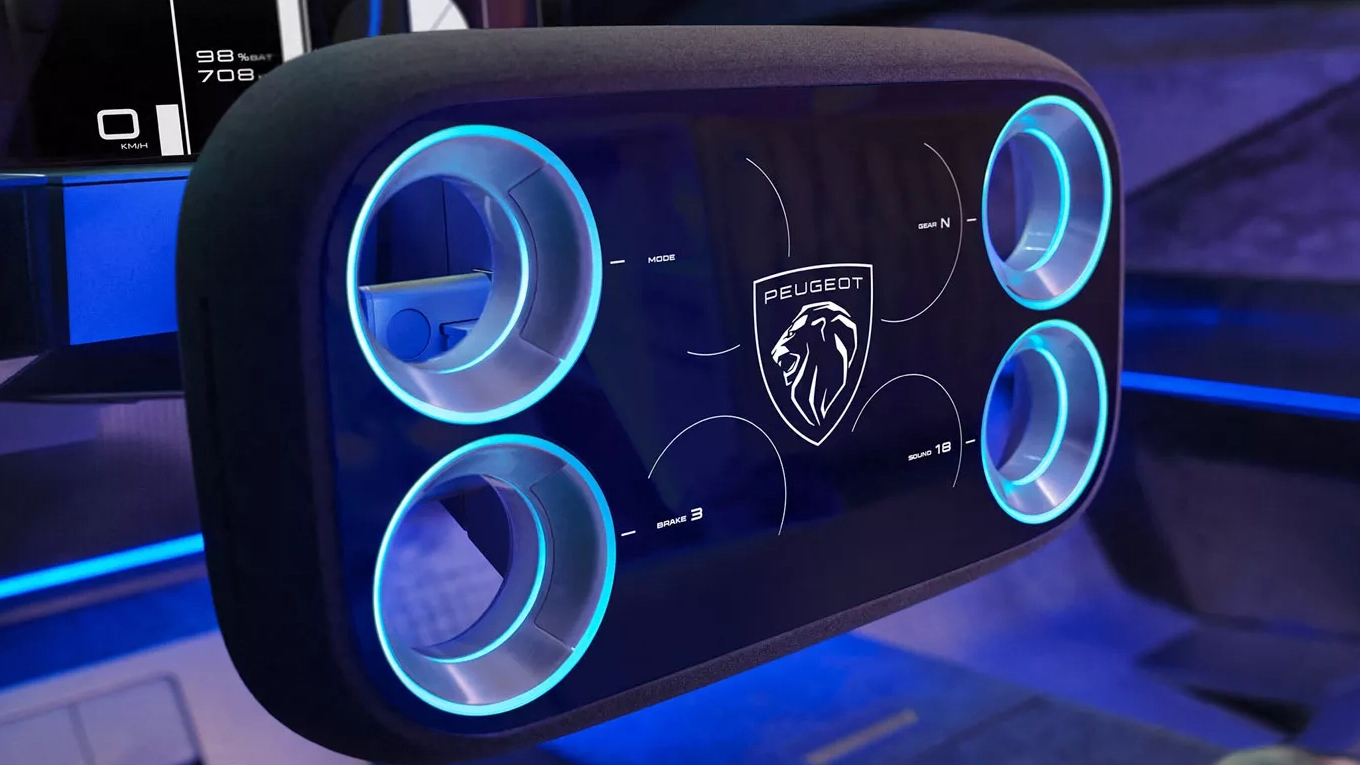
The focal point, though, is the Hypersquare rectangular steering wheel, something Peugeot began teasing on concepts a couple of years ago.

Each of the four circles within the wheel is a pod containing key controls, and steer-by-wire tech means the wheel’s gearing can be increased at parking speeds, reducing the number of turns to less than one.

Peugeot says it’s no mere show-car fantasy, either. Both the wheel and the steer-by-wire tech that “connects” it to the driving wheels will be on a production Peugeot by 2027, the company says, meaning the next 208.

\\\\\\

Peugeot

Long Before The Chevy Bolt, GM Built An Electric Egg On Wheels

  • The 1969 512 Electric Experimental shows how long GM’s pursued EVs.
  • Just 86 inches long, the fiberglass microcar used an 84-volt battery.
  • A household charge took seven hours and delivered 58 miles of range.

In 1969, the automotive world was a study in contrasts. Two concept cars, each wearing the same 512 badge yet conceived on opposite sides of the globe, were redefining what “experimental” could mean.

One was the competition-inspired V12-powered Ferrari 512 S Berlinetta Speciale, a supercar wedge that pre-dated the Lamborghini Countach concept by two years and looked like it could break the sound barrier. The other was a tiny orange ball of an EV from GM that could barely break the speed limit outside a school.

Related: GM Quietly Plots A Family Of Low-Cost EVs After New Bolt

We’ve taken a look at GM’s 512 Electric Experimental before, but the automaker has really jumped on the modern EV trend since then and has a new Chevy Bolt out for 2027, so the time feels right to throw the spotlight on it again.

How Small Is Small?

 Long Before The Chevy Bolt, GM Built An Electric Egg On Wheels
GM

Designed strictly for urban duties and part of an entire family of experimental GM microcars displayed at the Transpo ’72 trade show that used a mix of electric, petrol and hybrid engines, the 512E was every bit as tiny as it looks in these pictures.

Measuring just 86.3 inches (2,190 mm) long and 56 inches (1,420 mm) wide, it was an incredible foot (300 mm) shorter than an original Smart ForTwo and 3 inches (75 mm) narrower.

Access to its two seats was through a weird combination of a lift-up canopy that makes it look like a helmet with the visor up and side-hinged front door that reminds us of one of those grandma bathtubs for the mobility impaired.

Tiny wheels are pushed into each corner and wear fat rubber, like the kind of thing you’d see on tuned Mini in 1969.

The wraparound canopy must make for excellent visibility, though even if it had A-pillars like elephants legs you’d have plenty of time to look around them.

Slow And Steady Power

 Long Before The Chevy Bolt, GM Built An Electric Egg On Wheels

The top speed is just 30 mph and it takes 12 seconds to get there, which sounds terrible until you remember that the Citroen Ami, the modern incarnation of this very idea, is also restricted to a similar speed (28 mph / 45 kmh).

More: Secret Corvette Prototype GM Never Wanted You To See Is Going To Auction

Citroen quotes a 47-mile range, which the 512E beats by 11 miles (though certainly measured differently), but the Ami can be fully charged in four hours compared with seven hours for the GM satsuma.

Where they differ most, of course, is in the design of the batteries providing those range miles. Like all modern EVs, the Ami uses lithium ion batteries, whereas the 512E relies on old-fashioned lead-acid packs from Delco-Remy.

 Long Before The Chevy Bolt, GM Built An Electric Egg On Wheels
GM

The fiberglass-bodied GM car is still surprisingly light at 1,250 lbs (567 kg), though the Ami is lighter still at 1,065 lbs (483 kg).

The 512E project didn’t put a tiny EV in Chevy showrooms during the 1970s or 1980s, but the fact that GM unveiled the Impact EV concept, and put it into production as the EV1 six years later, proved that it hadn’t given up on the idea of small electric cars.

Half a century later, GM is still in that game, this time with the upcoming 2027 Bolt, though one can’t help but wonder how much more fun it’d be with a flip-up canopy and a hint of that 1970s optimism.

\\\\\\\

GM

Tesla’s Semi Is Getting A Facelift For Volume Production

  • 2026 Semi gains 15% efficiency, new aero, and autonomy-ready hardware.
  • 500-mile range and 1.2 MW charging target for faster long-haul turnaround.
  • Significant visual and structural changes separate it from earlier prototypes.

Tesla’s annual shareholder meeting was absolutely full of news. More than 75 percent of the company’s shareholders voted to approve Elon Musk’s one-trillion-dollar compensation plan, split into 12 tranches of shares that unlock only if Tesla meets a series of milestones over the next decade. Musk also confirmed that series production of the long-awaited CyberCab will begin in April next year.

Also: Elon Musk’s Trillion Dollar Pay Hinges On A Bet That Could Break Tesla

The Roadster 2 demo is now slated for the same month, and in classic Musk style, the timing isn’t without a joke. He says it’s happening on April Fools’ Day, partly because it “affords some deniability.” If the demo slips, he quipped, “I could say I was just kidding.”

What’s New With the Semi?

And then there’s the Semi, which is heading for a redesign and full-scale production next year, following its unveiling all the way back in 2017 The redesigned Class 8 hauler gets meaningful efficiency gains, higher payload capacity, and a package clearly engineered around Tesla’s autonomy ambitions.

While the original Semi entered limited production back in 2022, this is a full-scale update with big aspirations and changes.

 Tesla’s Semi Is Getting A Facelift For Volume Production

Efficiency is the biggest news. Tesla claims energy consumption drops to 1.7 kWh per mile, a 15 percent improvement over the current Semi. Paired with a 500-mile range rating, the update positions the new truck more competitively against rivals from Daimler and Volvo.

Drive power holds at 800 kW, but Tesla says that internal improvements under the skin, such as cooling, software, and thermal routing, provide more consistent performance under load.

Fast Charge Future

Another major upgrade is charging. The new Semi supports a peak rate of 1.2 MW (1,200 kW). That eclipses the current Megacharger output and allows for significantly shorter high-volume charging stops when paired with compatible infrastructure. Payload capacity also increases, though Tesla didn’t reveal by how much.

Visually, the Tesla truck looks a lot more like the rest of the family now. It gets a new Model Y-style front light bar, cleaner body surfacing, and a reshaped roof to improve aerodynamic flow. The black glass side panel is narrower, the bumper is reworked, and that continues to the wheel openings.

Read: Tesla’s Cybercab Might Become The Affordable Model 2 After All

Tesla frames all of this as groundwork for a future autonomous freight platform. Amazingly, the brand and its CEO avoided reaffirming any specific Level 5 self-driving timelines.

 Tesla’s Semi Is Getting A Facelift For Volume Production

How Fast Can It Build the Cybercab?

Elon Musk didn’t stop at teasing the Cybercab itself; he also boasted about how it would be built. According to him, the dedicated production line will operate on an astonishing sub-10-second cycle time, compared with the roughly one-minute rhythm it currently takes to assemble a Model Y.

If that target holds, Musk suggested, it could translate to an annual output up to five million Cybercabs, a figure that would eclipse the production pace of nearly any vehicle on the road today. Still, as with most of Musk’s projections, take everything said with a grain of salt.

Either way, it’s going to be a wild year for Tesla. From Semi production ramp-up to the launch of the Cybercab and the potential demo of the Roadster, there’s a lot to live up to and lots that could go wrong.

 Tesla’s Semi Is Getting A Facelift For Volume Production
 Tesla’s Semi Is Getting A Facelift For Volume Production

Peugeot’s Next 208 Wants To Reinvent The Wheel

  • Peugeot teases Polygon concept ahead of next week’s official reveal.
  • Two-door hatch features supercar rake and rectangular steering wheel.
  • Steer-by-wire tech from Polygon will reach future Peugeot models.

If you thought Peugeot planned to just tweak its designs for the next chapter, think again. The French brand has dropped a single teaser image of its new “Polygon” concept, a strong preview not just of the coming generation of its big-selling 208, but of an entire reinvention of its design language.

Related: Hypersquare Steering On Road Cars By 2026, Peugeot CEO Says

There’s no half-measure here. Peugeot’s current lineup of cars and SUVs is already distinctive, but the company’s designers seem to have no qualms about moving on with an even more futuristic theme.

Hints of the Past, Vision of the Future

However, you can still see echoes of the classic 205 in the triangular-shaped B-pillar and its pill-shaped badges. That’s about where the retro cues end, though.

The Polygon’s long, near-horizontal windshield looks like the kind of thing you’d expect to see on a mid-engined exotic, not a humble subcompact, and the wheels are pushed so far out you can almost feel the tension in the doorskin, which is pinched to exaggerate a lean, muscular look.

The grille-less nose tells us this is an EV and could be carried over to production mostly intact, though we doubt the partially-glazed roof will manage the same kind of transition.

 Peugeot’s Next 208 Wants To Reinvent The Wheel

Steer-by-Wire Takes Center Stage

One aspect that definitely will, though, is the steer-by-wire system, which Peugeot says is “central to the driving pleasure of future Peugeot vehicles and the Polygon concept itself.”

The high-tech steering system – Lexus uses something similar on the RZ – gets a suitably futuristic new steering wheel, that we can’t really see on this teaser image, but were introduced to on a previous Peugeot concept in 2023.

Called Hypersquare (though actually rectangular), the wheel has four holes, a design echoed in the four road wheels.

 Peugeot’s Next 208 Wants To Reinvent The Wheel

Shared DNA Across Stellantis Brands

Like its Stellantis cousin, the next Vauxhall/Opel Corsa, which was previewed in August by the 789 hp (800 PS / 588 kW) GSE Vision Gran Turismo concept, the production 208 is expected to ride on the new STLA Small platform when its unveiled late in 2026.

We’ll have to wait for the full Polygon reveal next week to get our hands on any tech spec, but don’t be surprised if it’s packing the same 82 kWh battery the GSE promised, something that would represent a big step up over the 52 kWh pack in the current e-208.

\\\\\

Peugeot’s 2023 Inception concept teased the Hypersquare steering wheel

Mazda’s RX-7 Successor Meets The One Problem It Can’t Engineer Away

  • Mazda CTO says Iconic SP production faces major financial obstacles.
  • Rotary engine work continues, but R&D costs stall bespoke sports cars.
  • RX-7 successor struggles for survival as new MX-5 arrives this decade.

Since the debut of the Iconic SP concept at the 2023 Japan Mobility Show, Mazda enthusiasts have been waiting for the day it leaves the stand and hits the street. The coupe sparked immediate speculation about a spiritual successor to the RX-7, and top Mazda execs have been eager to keep that hope alive.

Yet, the latest reports suggest that the journey from concept to reality might not be as smooth as fans would like.

More: Mazda Vision-X Compact Might Be A Little Too Friendly

In late 2024, Mazda Design Chief Masashi Nakayama said the Iconic SP was “designed with real intent to turn it into a production model,” a goal echoed by CEO Masahiro Moro: “We still persist in making it happen.” Chief Technical Officer Ryuichi Umeshita later called it “a good successor for the RX-7,” though he admitted the project still needs a sound business case.

How Close Is It to Reality Now?

Our colleagues at Autocar recently spoke with Umeshita to hear how development of the much-anticipated model is progressing. The Chief Technical Officer was candid: “Let me answer personally—that is my dream car. I want to make it real. Technology-wise, I believe it’s possible. The only outstanding issue is financial.”

 Mazda’s RX-7 Successor Meets The One Problem It Can’t Engineer Away
2023 Mazda Vision Iconic SP Concept

Earlier this year, Mazda trimmed its planned budget for electrification by half a trillion yen ($3.3B). The company is pursuing a “Multi-Solution” strategy that blends BEV, hybrid, and combustion engines rather than going all-in on electric.

More: Mazda Brings Back Turbo Rotary Engine With Vision-X Coupe

Between developing an EV-specific platform, a new hybrid setup, and the upcoming SkyActiv-Z engine, Mazda’s resources are already stretched thin. In that light, a bespoke sports car might not sit at the top of the spending list.

Rotary Revival With A Turbo

Even so, the idea hasn’t been shelved. The Vision X Coupe concept, unveiled at the 2025 Japan Mobility Show, shows Mazda hasn’t turned its back on the rotary dream.

If anything, it confirms that the company is still invested in the technology that defined some of its most celebrated cars as that study is powered by a hybrid unit with a turbocharged rotary engine.

Umeshita underlined that continuity: “We have re-established the rotary engine development team, and we know that our DNA is in sports cars, so I would never say we gave it up.”

 Mazda’s RX-7 Successor Meets The One Problem It Can’t Engineer Away
2025 Mazda Vision X Coupe Concept

The Vision X Coupe’s plug-in hybrid setup pairs a turbocharged rotary engine with an electric motor for a combined 503 hp (375 kW / 510 PS) and includes carbon-capture technology. By contrast, the Iconic SP’s range-extender system produced 365 hp (272 kW / 370 PS).

More: Over 9,500 People Wanted This Special Miata, 9,300 Missed Out

Mazda’s next step is to cut emissions from the rotary engine further, which could eventually allow it to drive the wheels directly rather than serving solely as a generator. Engineers estimate this evolution will take another “two to three years” of development.

Will the Next MX-5 Carry the Torch?

While Mazda’s design and engineering teams work toward reviving the rotary legacy, the brand’s future in sports cars looks brighter than it has in years.

Alongside the potential RX successor, Mazda has confirmed that the next-generation MX-5 roadster will arrive later this decade. The upcoming Miata will stay true to its lightweight spirit, equipped with a larger-displacement SkyActiv Z engine and, reassuringly, a manual gearbox.

 Mazda’s RX-7 Successor Meets The One Problem It Can’t Engineer Away

Source: Autocar

Would You Trust This Tiny Toyota To Drive Your Kid To School?

  • Toyota Kids Mobi is a cute self-driving EV built for young children.
  • The concept features AI, LED eyes, a canopy, and a cozy cabin.
  • It debuted at Japan Mobility Show with other robotic concepts.

Toyota’s booth at the 2025 Japan Mobility Show brimmed with futuristic ideas, from spider-like delivery bots to a six-wheeled Lexus minivan. Yet among all the tech-heavy marvels, one creation charmed visitors more than any other: the Kids Mobi, a self-driving, bubble-shaped EV made exclusively for children.

More: Honda Shogo Is A Tiny EV That Brings Joy To Hospitalized Kids

Framed as a “safe and secure AI-powered personal mobility for kids,” the concept blurs the line between toy and vehicle. It has a smooth, pod-like body with enclosed wheels and animated LED “eyes” that mimic expressions.

Even the sensors on the roof are shaped like ears, with the whole thing being reminiscent of an animated character.

The canopy, lifted straight from a sci-fi sketchbook, swings upward to reveal a snug single seat built for children up to 130 cm tall (about 4 feet 3 inches). Once inside, the canopy closes and an AI assistant called the “UX Friend” comes to life, chatting and playing with the young passenger throughout the ride.

\\\\\\\\\\\\\

While the Kids Mobi obviously relies on autonomous tech for navigation, Toyota says children can still participate in the drive, giving them a sense of control.

“It’s not just adults who want to drive and enjoy some time to themselves,” the company explains. “Kids also want freedom of mobility. And just as adults have cars, kids deserve a trusty sidekick.”

Letting a child ride solo in an autonomous pod may sound like science fiction at best and unsettling at worst, but Toyota argues it could eventually prove safer than a traditional school bus.

For now, the Kids Mobi remains a concept, though it reflects what the automaker calls the “ultimate goal” of its AI x Robotics Data Center. That means the idea will keep evolving long after the show floor closes.

Still, the project represents the “ultimate goal” of the automaker’s AI x Robotics Data Center, so development will continue.

More: Toyota Wants To Teach Your Kids To Drive With Camatte Petta Concept

Until the Kids Mobi is ready to hit the road (or, more likely, the bike lane and sidewalk), visitors of the Japan Mobility Show can check it out up close and snap a photo with it. Toyota will also give each kid an original keychain as a souvenir.

 Would You Trust This Tiny Toyota To Drive Your Kid To School?

Another Kid-Friendly Concept

Interestingly, the 2025 lineup at the show includes another Toyota concept that could serve as a helpful companion for toddlers.

The Chibibo is a quadruped robot that walks alongside people and vehicles serving as a last-mile delivery solution. A shown in the official renderings, it could help a child carry their backpack, lunchbox, or any other item that would be too heavy for them.

The spider-like design allows the robot to navigate narrow alleyways and climb stairs, taking parcels to places that vehicles can’t. When idle, it crouches down into a resting pose, much like a loyal robotic pet.

\\\\\\\\\\\\\\\\

Toyota

You’ve Never Seen A Toyota EV Quite Like This

  • Toyota has introduced the bZ Time Attack concept.
  • It features an upgraded powertrain with 402+ hp.
  • EV has an aggressive body kit and stripped interior.

The refreshed 2026 Toyota bZ offers up to 338 hp (252 kW / 343 PS), which is a massive 124 hp (92 kW / 126 PS) increase over its terribly named predecessor.

That power boost lets the top-spec model range-topping variant to rocket from 0-60 mph (0-96 km/h) in 4.9 seconds and travel 278 miles (447 km) on a single charge. To highlight that newfound performance, Toyota is bringing out the bZ Time Attack concept.

Set to debut at the SEMA Show next week, the track-focused model features an aggressive body kit with a prominent front splitter and new side skirts. They’re joined by extended fenders, a sporty rear diffuser, and a massive rear wing.

More: Toyota Slashed Thousands Off New Base bZ, But Raised It For Other Trims

Besides the body kit, the crossover has been lowered 6 inches (152 mm) while its track has been expanded by the same amount. This gives the model an aggressive stance, which is amplified by 19-inch BBS Unlimited wheels that are wrapped in Continental Extreme Contact Sport 02 tires.

Adding to the drama is a custom tri-color paint scheme that blends metallic and pearl hues.

\\\\\\\\\\\

Given the racing ambitions, the interior has been stripped of non-essential equipment. The result is a relatively bare cabin with a chromoly roll cage and OMP HTE-R racing seats. We can also see a new steering wheel and a shifter that has been relocated to the dash.`

Toyota didn’t say much about the powertrain, but confirmed the concept has a dual-motor all-wheel drive system that has been tuned to produce more than 402 hp (300 kW / 408 PS).

Aside from upgraded motors, the concept has a revised suspension that features TEIN coilovers and springs. They’re accompanied by an Alcon braking system that uses Hawk pads.

❌